The Burlington Magazine, May 2025
The long 18th century in the May issue of The Burlington:
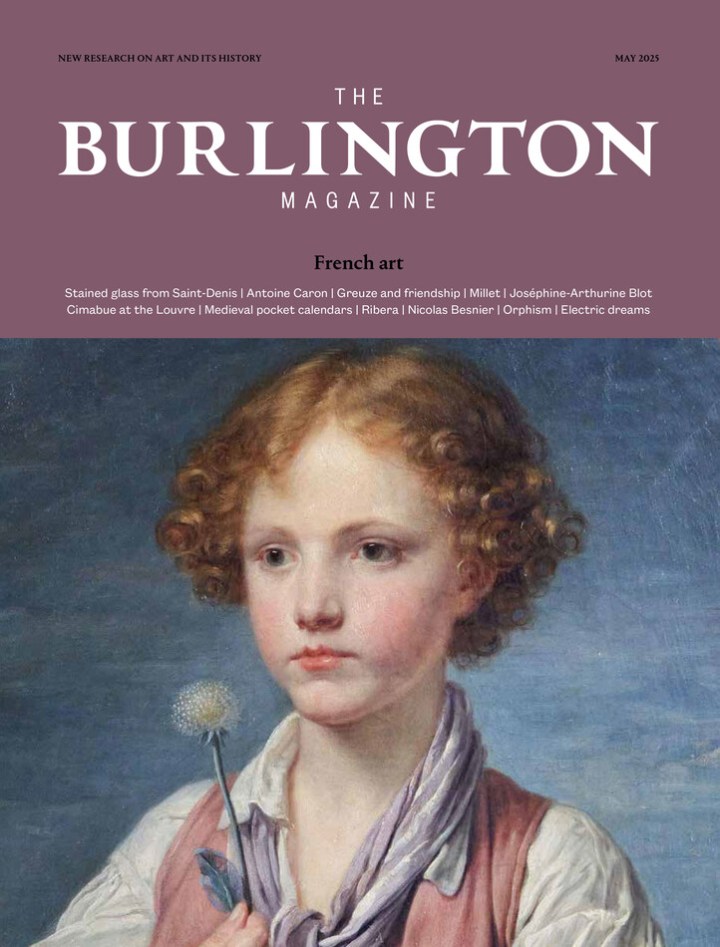
The Burlington Magazine 167 (May 2025) | French Art
 e d i t o r i a l
• “Fashionistas,” p. 427.
The costume institute and its annual gala in May at the Metropolitan Museum of Art, New York (the Met), have become fixtures on the museum world’s map and calendar. Whether you delight in them or are bemused by the spectacle they provide, or indeed try and take no notice at all, they are hard to ignore. The alignment they represent between fashion history, contemporary celebrity and the gravitas of a major museum is immensely beneficial in terms of fundraising and profile.
l e t t e r
• “A Sleeping Apostolado at Wentworth Woodhouse,” pp. 428–29.
We are launching an appeal for the conservation, reframing, and rehanging of an important set of seventeenth-century paintings. We are making this appeal in honour of the art historian Alastair Laing, who died aged seventy-nine in 2024. It was he who identified the artist of this series as the Flemish painter Gérard Seghers (1591–1651). . . . By 1870 the thirteen paintings were framed in groups and fixed against the walls, as they are now, probably to give a more church-like feel to the simple prayer-book chapel of 1736, with its panelling and gallery of craved, unstained oak.
a r t i c l e s
• Yuriko Jackall, John Delaney, and Michael Swicklik, “Friendship Tokens: Jean-Baptiste Greuze’s Paintings for Madame de Pompadour,” pp. 438–49.
Greuze’s paintings, known for their sentimentality and charm, were lauded by the artist’s contemporaries. Two early compositions, Simplicity and Young Shepherd Holding a Flower, were part of the collection of Madame de Pompadour; stylistic and technical analysis of them, in conjunction with another version of Simplicity, expands their early provenance.
• Humphrey Wine, “Napoleon Crossing the Alps: British Press Reaction to the London Exhibitions of David, Lefèvre, Wicar, and Lethière,” pp. 450–59.
Paintings by notable French artists were exhibited in Britain during the first third of the nineteenth century. Reactions to these works published in British newspapers and journals between 1814 and 1830 were often negative in tone and politically motivated. Despite this criticism, these accounts provide a valuable perspective on the art of the period that was shipped across the Channel.
• Daniëlle Kisluk-Grosheide, “Bravery, Ingenuity, and Aerial Post: An Enamelled Bowl by Joséphine-Arthurine Blot,” pp. 470–77.
During the height of the Franco-Prussian War, Gaston Tissandier made a perilous balloon journey from Paris to deliver correspondence from the besieged city. The flight is commemorated in a small bowl by Joséphine-Arthurine Blot, a technically accomplished yet little-known enamellist. Her bold design celebrates Tissandier’s bravery as well as French resistance and resourcefulness.
r e v i e w s
• Alice Minter, Review of Christophe Huchet de Quénetain, Nicolas Besnier (1686–1754): Architecte, orfèvre du roi et échevin de la Ville de Paris (Presses universitaires de Rennes, 2024), pp. 516–17.
• Céline Cachaud, Review of La Tabatière Choiseul: Un monument du XVIIIe siècle, edited by Michèle Bimbenet-Privat (Éditions Faton, 2025), pp. 519–20.
• Mark Evans, Review of Ulrike Müller, Private Collectors in Brussels, Antwerp, and Ghent, ca.1780–1914: Between Public Relevance and Personal Pleasure (Brepols, 2024), pp. 521–22.
o b i t u a r y
• Christopher Baker and Stephen Duffy, Obituary for Rosalind Joy Savill (1951–2024), pp. 526–28.
An immensely successful director of the Wallace Collection, London, and a pre-eminent scholar of eighteenth-century Sèvres porcelain, Rosalind (‘Ros’) Savill had a profound and enduring impact both on the museum and the research she cared passionately about.
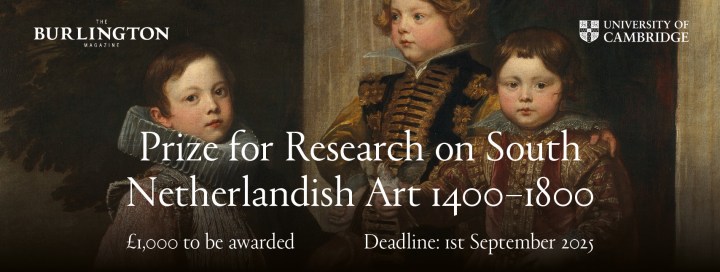
Prize for Research on South Netherlandish Art, 1400–1800
From The Burlington:
Prize for Research on South Netherlandish Art, 1400–1800
Applications due by 1 September 2025
The Burlington Magazine and the University of Cambridge are happy to announce the launch of a new annual prize established to inspire the development and publication of innovative object-based scholarship on South Netherlandish Art, 1400–1800. The winning entrant will receive a prize of £1000, with publication in The Burlington Magazine’s annual issue dedicated to Northern European Art, plus a one-year print and digital subscription.
We seek previously unpublished essays of 1000–1500 words from early career scholars worldwide. This is defined as within 15 years of their most recent post-graduate degree. Preference will be given to object-related scholarship such as is published in The Burlington Magazine. Submissions should be in English and should include candidate’s CV, all as a single PDF.
New Book | The Writer’s Lot
From Harvard UP:
Robert Darnton, The Writer’s Lot: Culture and Revolution in Eighteenth-Century France (Cambridge: Belknap Press, 2025), 240 pages, ISBN: 978-0674299887, $27.
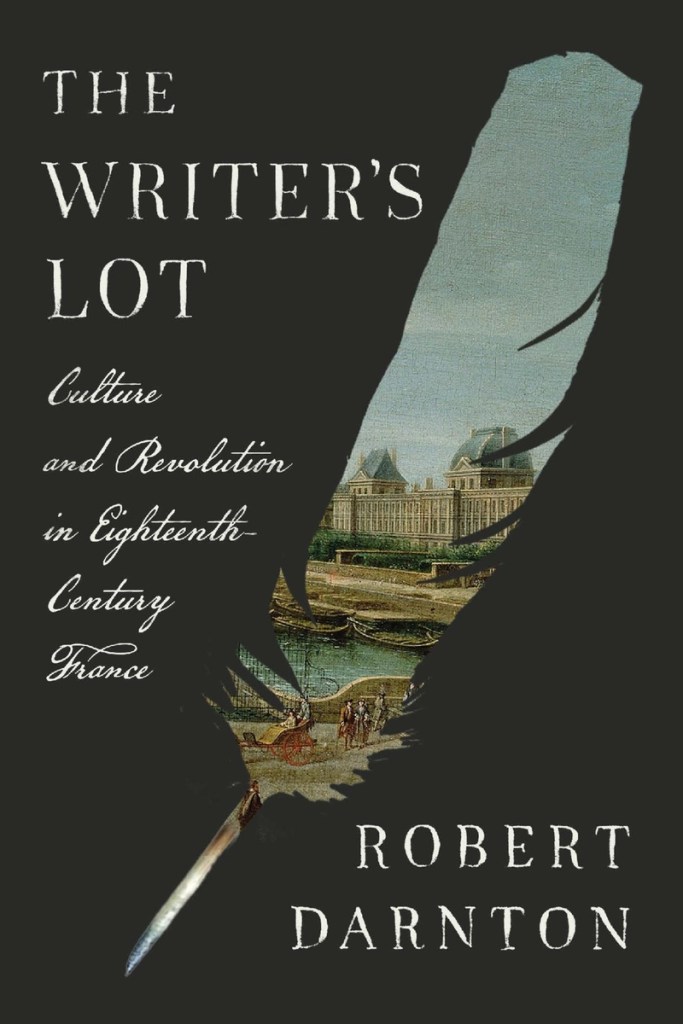 A pioneering social history of French writers during the Age of Revolution, from a world-renowned scholar and National Book Critics Circle Award winner.
In eighteenth-century France, writers emerged as a new kind of power. They stirred passions, shaped public opinion, and helped topple the Bourbon monarchy. Whether scribbling in dreary garrets or philosophizing in salons, they exerted so much influence that the state kept them under constant surveillance. A few became celebrities, but most were hacks, and none could survive without patrons or second jobs.
The Writer’s Lot is the first book to move beyond individual biography to take the measure of ‘literary France’ as a whole. Historian Robert Darnton parses forgotten letters, manuscripts, police reports, private diaries, and newspapers to show how writers made careers and how they fit into the social order—or didn’t. Reassessing long-standing narratives of the French Revolution, Darnton shows that to be a reject was not necessarily to be a Jacobin: the toilers of the Parisian Grub Street sold their words to revolutionary publishers and government ministers alike. And while literary France contributed to the downfall of the ancien régime, it did so through its example more than its ideals: the contradiction inherent in the Republic of Letters—in theory, open to all; in practice, dominated by a well-connected clique—dramatized the oppressiveness of the French social system.
Darnton brings his trademark rigor and investigative eye to the character of literary France, from the culture war that pitted the ‘decadent’ Voltaire against the ‘radical’ Rousseau to struggling scribblers, booksellers, censors, printers, and royal spies. Their lives, little understood until now, afford rare insight into the ferment of French society during the Age of Revolution.
Robert Darnton is the author of numerous award-winning books on French cultural history, including The Revolutionary Temper. A MacArthur Fellow, chevalier in the Légion d’honneur, and winner of the National Humanities Medal and the National Book Critics Circle Award, Darnton is the Carl H. Pforzheimer University Professor and Director of the University Library, Emeritus, at Harvard University.
c o n t e n t s
Introduction: Paths to Grub Street
1 Careers: The Ancien Régime
2 The Facts of Literary Life
3 Contemporary Views
4 Careers: Revolutionary Denouements
Conclusion
Notes
Acknowledgments
Index
New Book | Women Artists & Designers at the National Trust

From the National Trust:
Rachel Conroy, with an introduction by Sandi Toksvig, Women Artists & Designers at the National Trust (National Trust, 2025), 272 pages, ISBN: 978-0707804699, £15.
From the magnificent gardens created by Vita Sackville-West at Sissinghurst to a striking self-portrait by Angelica Kauffman, the elegant, mass-produced ceramics of Susie Cooper and a model of a Palmyran temple by lady’s maid Elizabeth Ratcliffe, this beautifully illustrated book explores the lives and work of women whose creativity has shaped the National Trust’s collections and, often, the experience of visitors to its places. Spanning six centuries, this book takes a closer look at some of the many women artists and designers whose lives are connected to National Trust places or whose work is represented in its vast collections. The selection features both talented amateur artists and professionals who have shaped the art-historical canon—such as Eileen Agar, Elisabeth Vigee Le Brun, Rosalba Carriera, and Barbara Hepworth—focusing on their unique contributions and achievements across a range of disciplines, including garden and interior design, photography, illustration, enamelling, fine art, studio pottery, and textiles.
Rachel Conroy is a Senior National Curator at the National Trust and loves telling stories through objects. She has worked as a curator specialising in British decorative arts since 2004, curating many exhibitions and displays. Having contributed articles to numerous specialist journals, Rachel recently co-authored a book on historic Welsh ceramics.
Sandi Toksvig OBE is a comedian, broadcaster, campaigner, and author. Her broadcasting career has included QI, The Great British Bake Off, The News Quiz, and Call My Bluff. An activist for gender equality, Sandi co-founded the Women’s Equality Party in 2015. She is a Bye-Fellow of Christ’s College, Cambridge, where she has delivered lectures on women in art.
Call for Papers | The Ancient Mediterranean and the British Museum

Charles Roberts, At the British Museum — A Peripatetic Art Lecturer, wood-engraving, from the periodical The Graphic (5 November 1881), p. 476 (London: The British Museum, EPH-ME.705). Features a group of women listening to a female guide at the south end of the main sculpture gallery of the British Museum.
◊ ◊ ◊ ◊ ◊
From ArtHist.net:
The Ancient Mediterranean and the British Museum: Pasts and Futures
Senate House, Malet Street, London, 25–27 February 2026
Proposals due by 16 June 2025
The Department of Greece and Rome at the British Museum and the Institute of Classical Studies are inviting proposals for contributions to a conference exploring the past impact and future potential of the Museum’s collections from the ancient Mediterranean world. The conference is being organised in the context of the British Museum’s ‘Masterplan’, a once-in-a-century opportunity to redisplay and re-interpret the collections from the ancient Mediterranean, Egypt, Assyria, and the Middle East for twenty-first century publics. The Department of Greece and Rome is one of the Museum’s curatorial departments leading this work.
To avoid the repetition of old narratives and to ensure that the redisplay of the galleries is based on a comprehensive reimagining of the Museum’s collections, the Department considers it vital to explore the ways in which the Museum’s collections and displays have influenced (for better or worse) modern constructions of Mediterranean antiquity. We wish to invite the widest possible range of contributions and perspectives to inform this reflection. A dialogue has already begun, in a public seminar series co-organised with our neighbour, the Institute of Classical Studies (Revisiting the Ancient Mediterranean World at the British Museum). This conference, also in partnership with the ICS, aims to extend the conversation. Whether you engage with the Museum and its ancient Mediterranean collection academically, creatively, professionally, or in other ways, we invite you to help us investigate its history and plan for the future.
We will consider proposals for single or paired papers of 20–30 minutes each in length that reflect any line of research relevant to the ways in which the Museum’s ancient Mediterranean collections have shaped and been shaped by culture, politics and society, from the Museum’s foundation in 1753 to the present day. We particularly welcome papers on topics related to the three strands described below, which we have identified as particularly promising areas for exploration. While the focus of the conference will be on the British Museum and on the ancient Mediterranean, we also welcome proposals which introduce cross-institutional, comparative, or international perspectives. Proposals for alternative formats, such as panel discussions or creative workshops, are also encouraged.
Artistic Engagement
How have artists and other makers (including for example filmmakers and craftspeople) engaged with the British Museum’s collections from the ancient Mediterranean? What was the impact of the collection and its display on artistic practice, and vice-versa? The role of the Parthenon Sculptures in inspiring artists of the early nineteenth century is well-known, as is the extensive use of the Townley and later Graeco-Roman sculpture galleries for the training of artists (Jenkins 1992). There has been vibrant engagement with the classical world, in general, by modern and contemporary artists (Holmes 2017; Squire et al 2018). But there is much more to uncover about artistic engagement with the British Museum’s collection.
Literary Engagement
From Lord Byron to HD and beyond, the British Museum is well-known as a site of poetic inspiration and provides a setting and reference-point in numerous works of literature (Ellis 1981; Stallings 2023). What do literary receptions make of the British Museum’s ancient Mediterranean collection? Has attention been concentrated on certain objects or tropes, and which figures and receptions have been overlooked to date? In what ways do the Museum’s collections from the ancient Mediterranean continue to inspire and provoke contemporary literature?
Scholarship and Intellectual History
The role of museums in the evolution of academic disciplines is an established topic of study (Marchand 1996; Dyson 2006). We welcome papers that examine how the British Museum’s collections and galleries have been instrumental in shaping approaches to the material culture of the ancient Mediterranean, or to understandings of ancient societies more widely. How has their interrelation with academic disciplines such as Archaeology, Classics, and Art History changed over time? What have been the impacts of the British Museum’s approach to chronological, regional, and thematic display to the representation of different ethnicities or the division of material into different curatorial departments? Have the particular strengths and omissions of the British Museum collection directed or limited the field of study of the ancient Mediterranean world?
Through all these themes and throughout the conference will be threaded questions of the Museum’s relationship with social, political, and historical contexts, including colonialism, imperialism, nationalism, gender, race, and class. How and why did collections from the ancient Mediterranean take on such prominence in the British Museum? To what extent has the British Museum reinforced messages of power and control? What histories have been neglected and elided? Are there also narratives of subversion and resistance to be found?
The conference will be held in-person only at Senate House (Malet St, London WC1E 7HU) from Wednesday 25th to Friday 27th February 2026. Abstracts of maximum 300 words should be submitted by Monday 16th June 2025, together with a short (100 words) speaker biography. A limited number of travel bursaries will be available to help support attendance for speakers who cannot access alternative sources of funding. Please indicate in your submission if you would need to apply for a bursary and we will be in touch with details of the separate application process. Please send paper proposals to Dr Isobel MacDonald, IMacdonald@britishmuseum.org.
This conference is co-sponsored by the British Museum and the Institute of Classical Studies, University of London School of Advanced Study.
Conference | Matters of Knowledge: Conservation through the Centuries
From the conference programme:
Matters of Knowledge:
Paradigms and Practices of Conservation through the Centuries
Université de Neuchâtel, June 5–6 June 2025
 Preservation and conservation, along with collecting and valuation, are pillars of any institution that holds a collection of cultural heritage. However, conservation is rarely the subject of analytical and reflexive discourse, researched in a historical perspective. Studies in museology, the history of collections, and even the history of science and technology, have offered their perspectives on why and how all kinds of material collections are preserved in institutions dedicated to conservation. Further, the professionals of these institutions are faced with their own questions about the state of their collections and the origins of the practices they execute in their daily work.
As part of the SNSF project Libraries and Museums in Switzerland (https://www.biblios-musees.ch/), a two-day conference will be held on June 5th and 6th, 2025, focusing on all these dimensions of the conservation of important collections since their founding. This event will bring together academic, scientific and professional circles, while providing an opportunity for theoretical reflection and case studies.
More information and abstracts of the papers can be found here»
t h u r s d a y , 5 j u n e
9.45 Welcome and Introduction
10.00 Documentation and Exhibition of Museum Work
Moderator: Séverine Cattin
• Isabelle Le Pape — Exposer les coulisses du musée: Dévoilements et mises en abyme
• Julie Hochenedel — Transforming the Museum into Heritage: Photographs of Exhibition Spaces in the Louvre Museum
11.30 Coffee Break
12.00 Keynote Lecture
Moderator: Valérie Kobi
• Lauren R. Cannady — Paper Gardens: Cataloguing Change in Early Modern Botanical Thinking
13.00 Lunch Break
15.00 Practices of Conservation in a Global Perspective
Moderator: Natania Girardin
• Marie-Charlotte Lamy — The Race for the Mounted Specimen: The Art of Taxidermy in the Museum Context of the 19th Century
• Karolyna de Paula Koppke — Two Conservator-Restorers in 19th-Century Americas: Carlos Luiz Do Nascimento (1812–1876) and Vicente Huitrado (?–1890)
17.00 Exhibition Visit
Nommer les Natures: Histoire naturelle et héritage colonial at the Muséum d’Histoire Naturelle de Neuchâtel, Rue des Terreaux 14
f r i d a y , 6 j u n e
9.15 Genius loci and Classifications
Moderator: Remo Stämpfli
• Alexandre Claude — Unchanging Materials? Preserving Stones in Early Modern European Collections
• Felicity Myrone and Ce Stevenson — Library or Print Room? New Insights into the Collecting and Care of Graphic Materials at the British Museum
• Federica Mancini — Des paradigmes et des pratiques à faire évoluer : Le cas du fonds graphique Picot-Brocard conservé au musée du Louvre
12:00 Lunch Break
13.45 Nationalism, Transculturation, and Identity Politics
Moderator: Chonja Lee
• Yuka Kadoi — From Shrine to Museum: Demonumentalising Persian Architectural Heritage
• Charlotte Rottier — The Making of a ‘Musée Belge’ Abroad? Private and State Art Collections on Display in Diplomatic Interiors, 1900–1940
15.15 Closing Remarks
Decorative Arts Trust Prize for Excellence and Innovation
From The Decorative Arts Trust:
Decorative Arts Trust Prize for Excellence and Innovation, $100,000
Application due by 30 June 2025
The nomination deadline for this year’s $100,000 Decorative Arts Trust Prize or Excellence and Innovation is Monday, 30 June 2025. The Prize funds outstanding projects that advance the public’s appreciation of decorative art, fine art, architecture, or landscape. Awarded to nonprofit organizations in the United States, the Prize recognizes exceptional scholarly endeavors such as museum exhibitions, print and digital publications, conservation and preservation projects, and online databases. The Trust’s selection committee aims to recognize impactful and original projects that advance scholarship in the field while reaching a broad audience. Recent recipients include the Drayton Hall Preservation Trust; the Concord Museum; Cooper Hewitt, Smithsonian Design Museum; the Black Craftspeople Digital Archive; and Craft in America.
Cultural institutions are encouraged to learn more about the nomination process here»
Conference | History of Map Collecting
From ArtHist.net:
History of Map Collecting: Vienna, Central Europe, and Beyond
University of Vienna, 12 June 2025
Organized by Silvia Tammaro and Eva Chodějovská
Organised jointly by the Vienna Center for the History of Collecting (University of Vienna, Austria) and the Moravian Library in Brno (Czech Republic), the conference will be accompanied by an exhibition on Bernard Paul Moll (1697–1780) and his map collection, formed in 18th-century Vienna and now preserved at the Moravian Library. To register, please send an email to silvia.tammaro@univie.ac.at.
p r o g r a m
9.00 Welcome and Opening
• Markus Ritter (Head of Department of Art History, University of Vienna)
• Tomáš Kubíček (Director of the Moravian Library Brno)
• Eva Chodějovská and Silvia Tammaro (Conference Organizers)
9.30 Composite Atlases
• Markus Heinz (Berlin State Library) — Collectors’ Practices: A Composite Atlas Built on an Editor’s Atlas
• Elisabeth Zeilinger (Austrian National Library, Vienna) — Aspects of Collecting in the Mirror of the Atlas Blaeu-Van der Hem
• Maretta Johnson (Atlas Van Stolk, Rotterdam/Amsterdam University) and Anne-Rieke van Schaik (Amsterdam University) — Maps as Memory Mirrors: The Construction of a Historical Narrative in the Album of Willem Luytzs van Kittensteyn (1613)
11.00 Coffee Break
11.30 A Passion for Maps: Bernard Paul Moll’s Eighteenth-Century Composite Atlas
• Eva Chodějovská and Jiří Dufka — Exhibition launch and discussion
12.00 Lunch
13.15 Collectors
• Jan Mokre (Austrian National Library, Vienna) — Map Collectors and Collections in Vienna, 17th to 19th Centuries
• Silvia Tammaro (University of Vienna) — Artaria & Co. and the Market of Maps and Art Objects
• Šárka Steinová and Filip Paulus (National Archives of the Czech Republic, Prague) — Franz Leonard Herget: Creator of the Collections of the Czech Estates Engineering School
14.45 Coffee Break
15.00 Map Collections: Between State and Private
• Martijn Storms (Leiden University Library) — The 19th-Century Private Map Collectors in the Netherlands
• Zsolt Török (ELTE Eötvös Loránd University, Budapest) — Concealed Composite Atlases: Maps in a 19th-Century Hungarian Petty Noble Art Collection
• Katie Parker (Royal Geographic Society, London) — The Map Office of the Nation: Collecting Maps at the Royal Geographical Society
16.30 Closing Discussion
17.30 Guided Tour to the Woldan Map Collection
• Petra Svatek (Austrian Academy of Sciences) — Meet at Dr.-Ignaz-Seipel-Platz, 1010 Vienna (in front of the Jesuit Church).
New Book | Neighbours and Rivals
Published by Pallas Athene and distributed by Simon & Schuster:
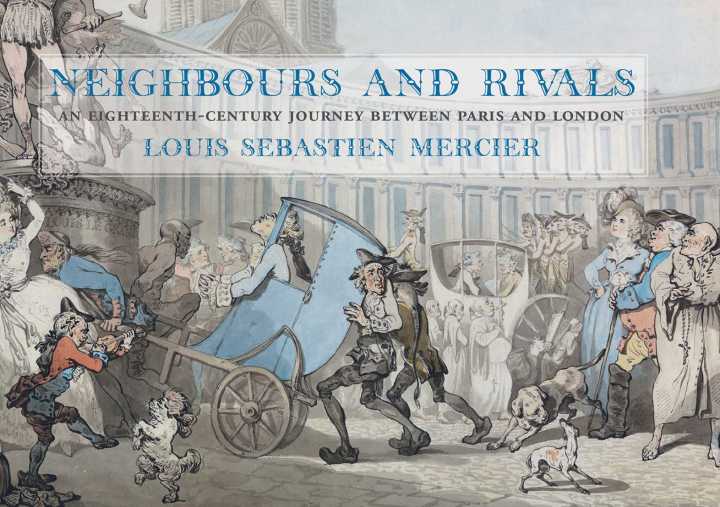
Louis-Sébastian Mercier, Neighbours and Rivals: An Eighteenth-Century Journey between Paris and London, translated by Laurent Turcot and Jonathan Conlin (London: Pallas Athene, 2025), 284 pages, ISBN: 978-1843682707, £25 / $33.
The great French journalist Louis-Sébastien Mercier’s descriptions of an optimistic, utopian 18th-century London, translated by Laurent Turcot and Jonathan Conlin.
Louis-Sébastien Mercier (1740–1814) first traveled to London and began recording his impressions in 1780. An exemplar of a new form of journalistic, reflective literature, his account presents emotive representations of the city as collections of experiences, habits, and personalities. And differently from Dickens’s London or Baudelaire’s Paris, with their contrasts of opulence and misery, Mercier describes a less familiar urban environment—more optimistic, perhaps even utopian. His version of London is, in fact, a projection of his philosophical imagination—not simply a rounded portrait but also a reflection of what he hoped Paris could become. For this first publication in English, Laurent Turcot and Jonathan Conlin’s translation preserves the life and humor of Mercier’s text. It is illustrated with contemporary images, with an emphasis on Thomas Rowlandson and Gabriel-Jacques de Saint-Aubin, the first Parisian flâneur-artist.
Jonathan Conlin, a senior lecturer at the University of Southampton, specializes in modern British cultural history from the 18th century to the present, with a focus on urban history. His previous books include The Nation’s Mantelpiece, Evolution and the Victorians, and Civilisation. Laurent Turcot is a professor of history at l’Université du Québec à Trois-Rivières, specializing in the 16th to the 19th century, particularly urban culture and leisure.
Study Day | C. F. R. Lisiewsky on His 300th Birthday
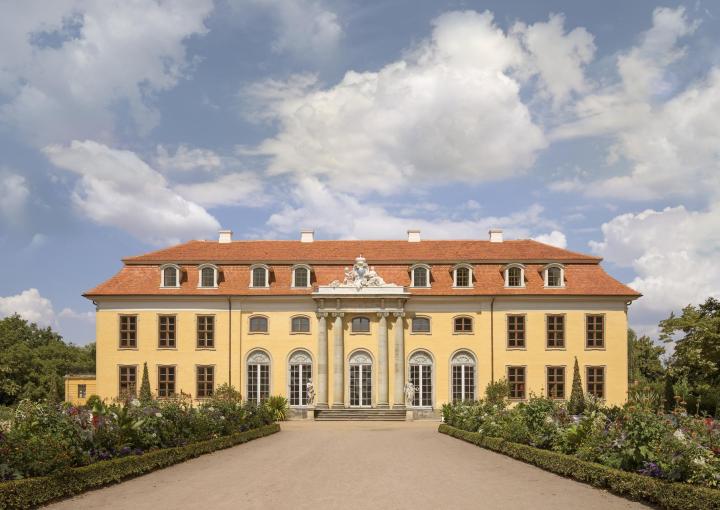
Located near Dessau, Schloss Mosigkau, was built by Princess Anna Wilhelmine of Anhalt-Dessau in the 1750s.
◊ ◊ ◊ ◊ ◊
From ArtHist.net:
Auf einen Blick mit … C. F. R. Lisiewsky. Matinée zum 300. Geburtstag
Schloss Mosigkau, Dessau-Rosslau, 15 June 2025
Registration due by 13 June 2025
2025 jährt sich der Geburtstag des Malers Christoph Friedrich Reinhold Lisiewsky (1725–1794) zum 300. Mal—Anlass, um diesen (nicht nur) für Anhalt-Dessau bedeutsamen Künstler mit einer Veranstaltung zu würdigen. Lisiewsky, der meist im Schatten von Künstlerkollegen wie Anton Graff oder Antoine Pesne steht, hat zwanzig Jahre als Hofmaler in Anhalt-Dessau gewirkt und hier zahlreiche Spuren hinter lassen. Im Schloss Mosigkau, wo im Jahr 2010 die erste Retrospektive zu Lisiewsky unter dem Titel „Teure Köpfe“ gezeigt wurde und wo sich heute eine umfangreiche Sammlung von Gemälden des Malers befindet, will die Matinee mit Fachvorträgen und einer Führung neue Blicke auf Lisiewsky und dessen Umfeld eröffnen.
Bitte melden Sie sich bis zum 13.6.2025 bei Jana Kittelmann an: jana.kittelmann@gartenreich.de. Aktuelle Informationen zur Veranstaltung finden sich unter: https://www.gartenreich.de/de/aktuelles/veranstaltungen?y=2025&m=6
p r o g r a m m
13.00 Begrüßung — Jana Kittelmann und Maria Zielke (Kulturstiftung Dessau-Wörlitz)
13.05 Grußwort — Wolfgang Savelsberg (Dessau)
13.15 Zur Einführung oder Blicken, Sichten, Sehen im Zeitalter Lisiewskys — Jana Kittelmann (KsDW)
13.30 Falten, Warzen und Triefnasen. Hässlichkeit als Programm bei den Herrenbildnissen von C.F.R. Lisiewsky — Kilian Heck (Universität Greifswald)
14.00 Pause
14.15 Lisiewsky und das ‚veristische‘ Porträt — Reimar F. Lacher (Gleimhaus Halberstadt)
14.45 Beobachtungen zur Maltechnik C.F.R. Lisiewskys als Hofmaler, Alchemist und Restaurator — Maria Zielke (KsDW)
15.00 Führung zu Gemälden Lisiewskys — Andreas Mehnert (KsDW)
ab 15.30 Ausklang auf der Schlossterrasse










 Enfilade
leave a comment