New Book | Versailles: Une Histoire Naturelle
From La Découverte (as noted at Cour de France.fr) . . .
Grégory Quenet, Versailles: Une Histoire Naturelle (Paris: La Découverte, 2015), 220 pages, ISBN: 978-2707184948, 19€.
 On croit bien connaître Versailles — son château, ses perspectives étudiées et ses jardins au cordeau — ce lieu du pouvoir qui se met majestueusement en scène et incarne à lui seul la France et son histoire. Le domaine actuel de Versailles ne représente pourtant que le dixième de celui d’autrefois. Au sein de l’immense Grand Parc, dynamique, vivant et giboyeux, les habitants des villages enclavés comme la nature devaient se soumettre au bon vouloir du roi. Car, à Versailles, le monarque veut chasser en toute saison, voir jaillir les grandes eaux sur un site austère. Rien n’est trop grand pour faire plier la nature : on convoque la science pour construire un réseau hydraulique pharaonique, des murs d’enceinte pour parquer le gibier, dont l’abondance nuit aux cultures. Mais la nature et les hommes résistent : les animaux s’échappent ou se multiplient, incontrôlables, les paysans se jouent des contraintes, braconnent, volent du bois, détériorent les réseaux. On renforce les frontières, règles, contrôles et sanctions. Souvent en vain.
C’est à la découverte de cet autre Versailles, animal, organique, que nous convie Grégory Quenet, loin du stéréotype d’une nature aménagée, rationalisée et contrôlée, « à la française ». Une visite passionnante qui prend à revers l’histoire officielle du rapport entre
pouvoir et nature en France.
Grégory Quenet est historien, membre de l’Institut universitaire de France et professeur d’histoire de l’environnement à l’université de Versailles-Saint-Quentin. Il a notamment publié Les Tremblements de terre en France aux XVIIe et XVIIIe (Champ Vallon, 2005) et Qu’est-ce que l’histoire environnementale? (Champ Vallon, 2014).
◊ ◊ ◊ ◊ ◊
C O N T E N T S
Introduction: Une autre histoire
I Naissance: Le château dans son environnement
1 L’animal Versailles
2 Conservation de la nature et cohabitation au sein du Grand Parc
II Croissance: Flux de matières et réseaux
3 De l’emprise hydraulique
4 Diviser pour (tenter de) mieux régner
III Régénération: Parquer et conserver
5 Le gouvernement de la nature
6 Des inégalités sociales et environnementales
IV Mort: Versailles, oeuvre d’art et musée
7 Révolution au domaine
8 De l’agonie du Grand Parc à la création du musée national
Conclusion: Pour une histoire environnementale de la France
Working Group | Home Subjects, ca. 1750–1900

Arthur Devis, The John Bacon Family, 1742–43, 30 x 52 inches (76.2 x 131.1 cm), oil on canvas (New Haven: Yale Center for British Art, Paul Mellon Collection).
◊ ◊ ◊ ◊ ◊
Thanks to Historians of British Art for sponsoring the “Home Subjects” panel at the 2015 meeting of the College Art Association last week in New York. The panel kicked off a series of activities that the organizers of Home Subjects are planning over the course of the next few years in an attempt to bring together scholars interested in the display of art in the the private or domestic interior. Our hope is to make connections across traditional period boundaries in order to encourage and facilitate research and discussion about the role art played in the decoration of the private interior and, in turn, how the display of art in the private interior shaped the direction of contemporary art. Further information about the topics Home Subjects would like to address can be found on our blog. We also encourage anyone interested in participating or sharing ideas to sign up for our email list at homesubjects@gmail.com. Stay tuned for blog posts, calls-for-papers, and more!
Melinda McCurdy, The Huntington Library, Art Collections and Botanical Gardens, San Marino, CA
Morna O’Neill, Wake Forest University, Winston-Salem, NC
Anne Nellis Richter, Independent Scholar and part-time faculty, American University, Washington, DC
2015 Dresden Summer Academy
From Staatliche Kunstsammlungen Dresden:
Dresden Summer Academy
Dresden, 22–29 August 2015
Applications due by 30 April 2015
 During this intensive seven-day course the participants explore the city of Dresden, its great monuments, and its museums. The main theme is the study of the collections in a context that considers the princely attitudes of the Saxon rulers during the late Renaissance, the magnificent royal patronage of the arts, and flourishing of courtly display especially in the 18th-century Augustan Age, and the role of the monarchy in 19th-century bourgeois society.
These collections are presented in the beautiful royal palaces in and around Dresden where their meaning and importance can be studied in the original surroundings. With their modern and often highly innovative exhibitions and the diversity of the themes explored in them, the museums and their collections are essential features of the vibrant cultural life and lively discourse that characterise the city of Dresden today.
Scholarships are available and are intended for candidates who are unable to pay the fee personally or whose organisation / institution cannot support them in full.
New Book | Sir John Soane’s Influence on Architecture from 1791
From Ashgate:
Oliver Bradbury, Sir John Soane’s Influence on Architecture from 1791: A Continuing Legacy (Aldershot: Ashgate, 2015), 480 pages, ISBN: 978-1472409102, $165.
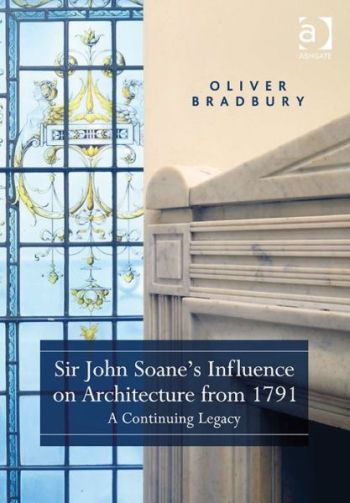 Sir John Soane’s Influence on Architecture from 1791: A Continuing Legacy is the first in-depth study of this eighteenth-century British architect’s impact on the work of others, extending globally and still indeed the case over 200 years later. Author Oliver Bradbury presents a compelling argument that the influence of Soane (1753–1837) has persevered through the centuries, rather than waning around the time of his death. Through examinations of internationally-renowned architects from Benjamin Henry Latrobe to Philip Johnson, as well as a number of not so well known Soanean disciples, Bradbury posits that Soane is perhaps second only to Palladio in terms of the longevity of his influence on architecture through the course of more than two centuries, from the early 1790s to today, concluding with the recent return to pure revivalism. Previous investigations have been limited to focusing on Soane’s late-Georgian and then post-modern influence; this is the first in-depth study of his impact over the course of two centuries. Through this survey, Bradbury demonstrates that Soane’s influence has been truly international in the pre-modern era, reaching throughout the British Isles and beyond to North America and even colonial Australia. Through his inclusion of select, detailed case studies, Bradbury contends that Soane’s is a continuing, not negated, legacy in architecture.
Oliver Bradbury is an independent researcher, based in London.
◊ ◊ ◊ ◊ ◊
C O N T E N T S
List of Figures
Preface
Acknowledgements
Introduction
1 Imitation: A survey of Soane’s influence on his pupils and contemporaries in Great Britain, North America and Australia, 1791–c. 1850, with a case study
2 The Survival of Soane? Wilderness years: collapse of Soane’s influence and reputation; ridicule and critical nadir, 1850–1884
3 Transmutation: Soane’s influence on late nineteenth- and twentieth-century Classicism, beginning with Beresford Pite, and the revival in interest and a new appreciation of Soane’s achievements, 1885–1956
4 Soane and Modernity: The influence of Soane on twentieth-century Modernism and Classical revivalism, 1953 until now
Select Bibliography
Index
Exhibition | Building a Dialogue: The Architect and the Client

Joseph Michael Gandy, John Soane’s Designs for Holy Trinity Church, Marylebone, in variously Norman, Gothic and Neoclassical Manners (London: Sir John Soane’s Museum)
◊ ◊ ◊ ◊ ◊
Press release for the exhibition:
Building a Dialogue: The Architect and the Client
Sir John Soane’s Museum, London, 17 February — 9 May 2015
Sir John Soane’s Museum presents Building a Dialogue: The Architect and the Client, an exhibition exploring the delicate, complex, and sometimes difficult relationship between clients and architects, charting the development of the architectural profession from Elizabethan to Victorian times. Analysing exemplary projects by Sir John Soane and the work of and influence on the profession by some of the most illustrious British architectural pioneers—Sir Christopher Wren (1622–1723), William Chambers (1723–96), Robert Adam (1728–92) and his brother James Adam (1732–94)—Building a Dialogue will look at the intrinsic dynamics of architectural commissions in an unprecedented display of rare pieces from the Museum collection.

John Soane, Elevation of the façade of No. 13 Lincoln’s Inn Fields in London, ca. 1812 (London: Sir John Soane’s Museum)
The commissioning process for Soane’s buildings—including Dulwich Picture Gallery and Holy Trinity Church and Wren’s Royal Naval Hospital—will be presented through a unique body of work, which includes never before seen drawings, private and public documents, letters, correspondence, and models, in one of the most comprehensive surveys of the architecture profession ever displayed at Sir John Soane’s Museum. A key area of interest is the client’s role within the process. Client typologies will be examined through a series of historical case studies, focusing on different types of commissions: the private client, the public client, the State as a client, and (unusually) a posthumous client commission.
One of the exhibition’s highlights, a recently discovered drawing of the façade of the Museum, will be displayed for the first time. Conservators found the drawing in 2014 hidden behind a painting within a frame in the Museum. Soane produced very few drawings of his home at Lincoln’s Inn Fields, as typically these were part of the presentation process to the client; this newly discovered drawing is thus a rare and precious depiction of the architect’s own vision for the building.
Sir John Soane’s work at Dulwich Picture Gallery forms one of the exhibition case studies. The project and its construction presents a unique client-architect relationship, as Soane designed the gallery to the posthumous specifications of his friend Sir Francis Bourgeois. Bourgois stipulated in his will (following his death in 1811) that Soane be given the commission to design and execute the Picture Gallery.
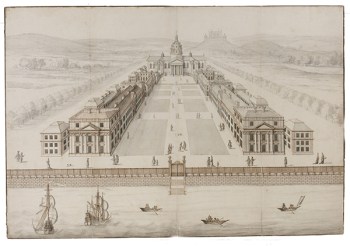
Leonard Knyff, Perspective presentation drawing of a design for an enlarged hospital with a central domed hall and chapel range, 1695, pen and ink (London: Sir John Soane’s Museum)
Problematic client relationships will also be explored through projects such as Soane’s Holy Trinity Church, Marylebone and Wren’s Royal Naval Hospital. Both these state-sponsored projects were characterised by radical changes to the architect’s initial vision brought about by the strong opinions of the patrons. In particular Wren’s initial concept of the Royal Naval Hospital envisaged demolishing Inigo Jones’s Queen’s House, something vetoed in the strongest manner possible by the King. Wren’s initial vision will be illustrated by drawings by Hawskmoor and Knyff, which have previously not been shown to the public. In the instance of Soane’s initial designs for Holy Trinity Church—one of three churches Soane undertook as part of a broader campaign of church building instigated by the Church Commissioners to celebrate the defeat of Napoleon in 1815—Soane’s classical vision was vetoed by both the parish and the Commissioners on grounds of cost and of style. Soane was forced to produce Norman and Gothic alternatives, both styles with which he was uncomfortable. On display will be Joseph Michael Gandy’s drawing showing the perspectives of eight designs for churches, including the various designs for Holy Trinity.

Robert Adam’s Admiralty Screen, 1760s (London: Sir John Soane’s Museum)
Early forms of ‘marketing’ will shape an important section of the display. In the early modern period architects transmitted ideas to prospective clients and to other architects through ‘pattern books’. The Thorpe Album is an exceptionally rare and important example of a late Elizabethan/early Jacobean architectural manuscript, which is central to our understanding of British architecture and how architectural ideas are transmitted in this early period. By the 18th century, however, recognisably modern ways of ‘marketing’ architectural projects and practices can be seen. The Adam brothers were pioneers in this field. They deployed cheap popular prints such as that of the Admiralty Screen in Whitehall to reach a broad audience of the general public while also producing ‘deluxe’ publications outlining their approach to design and architecture. The Works in Architecture of Robert and James Adam, published in 1778 by the Adam office, was intended to appeal to both prospective patrons and also to the architectural profession per se. The idea of persuading the general public as well as patrons is something that contemporary architects utilise as a strategy.
Another channel of communication with the public and with potential clients was given by the Royal Academy Annual Exhibition where architectural drawings were shown alongside paintings and watercolours. In order to make his architectural drawings stand out amongst the displays, Sir William Chambers highlighted them with distinctive blue borders. However, his drawings were still small in scale in comparison to the oil paintings and watercolours included in the Exhibition. Soane radically changed the way in which architecture was represented in the Annual Exhibition by utilising scale and heightened atmospheric effects in his office drawings. Utilising the visionary talent of his draughtsman Joseph Michael Gandy, Soane presented architectural projects such as his unexecuted plans for rebuilding Downing Street and Whitehall in an extremely theatrical, dramatic manner, ensuring that his architectural drawings would have as much impact as the oil paintings and watercolours displayed alongside them.
Abraham Thomas, Director of Sir John Soane’s Museum says: “Architectural drawings have a profound ability to record and articulate the various design discussions that occur within an office or between an architect and a client. I’m delighted that this exhibition not only draws upon gems from the Museum’s collection of over 30,000 architectural drawings but also reminds us that Sir John Soane’s home was the site of a busy architectural practice, embedded in the heart of the building, where such conversations happened every day. The exhibition also makes a connection between historical and contemporary contexts, by exploring the multi-faceted ways in which architects, especially Soane himself, have always engaged with, and re-defined, the notion of a ‘client’—showing us how design ideas have continued to express themselves through the drawing process, from Soane’s time through to the present day.”
Symposium | Surfaces, 15th–19th Centuries
From NYU’s Institute of Fine Arts:
Surfaces, 15th–19th Centuries
Institute of Fine Arts, New York University, 27 March 2015
Organized by Noémie Etienne, Mellon Postdoctoral Fellow, Institute of Fine Arts-NYU
This one-day symposium addresses the issue of surface in paintings, architecture and photography in Europe between the 15th and 19th centuries. The focus of this reflection is an examination of how
surfaces function: how do their specific properties challenge representation or the viewer? How do they determine the consumption and engagement with the object? Later variations such as graffiti, repairs, or traces of multiple hand, may also be of interest in understanding how the surface of an artwork is redefined over time.
P R O G R A M M E
9:30 Introduction, Noémie Etienne (Andrew W. Mellon Postdoctoral Fellow, Institute of Fine Arts-NYU)
9:45 Session I: An Anthropology of Surfaces
• Charlotte Guichard (Researcher, Centre National de la Recherche Scientifique (CNRS), Paris), Scratched Surfaces: Graffiti in Early Modern Rome
• Catherine Girard (Lecturer and Andrew Mellon Postdoctoral Fellow, Columbia University), Ambiguous Ref(l)ection: Experiencing French Rococo Paintings of Hunting Meals
• Juanita Solano (PhD Candidate) and Laura Panadero (MA Candidate in Conservation, Institute of Fine Arts-NYU), Search of Depth: Deterioration and Consumption of Daguerreotype and Albumen Photographs
11:45 Lunch Break
1:00 Session II: Making and Seeing
• Diane Bodart (Assistant Professor, Department of Art History and Archaeology, Columbia University), Los borrones de Ticiano: The Venetian Brushstroke and Its Spanish Translations
• Francisco Chaparro (PhD Candidate) and Matthew Hayes (PhD Candidate, Institute of Fine Arts-NYU), ‘Distant Strokes’: The Surface and the Painter in Las Meninas
• Daniella Berman (PhD Candidate) and Kari Rayner (MA Candidate in Conservation, Institute of Fine Arts-NYU), ‘Is this the stuff of painting?’: The Question of Finish in Eighteenth-Century France
3:00 Break
3:30 Session III: Surface as Contact Zone: Texture and Touch
• Étienne Jollet (Professor, Paris 1 Panthéon-Sorbonne), The Touch of Things: Surface Contacts in Chardin’s Still-lives
• Christina Ferando (Visiting Assistant Professor, Williams College, Williamstown), The Deceptive Surface: Perception and Sculpture’s Skin
• Susan Sidlauskas (Professor, Department of Art History, Rutgers, University), John Singer Sargent and the Physics of Touch
Call for Papers | Les Acteurs de la Rocaille
From H-ArtHist:
Les Acteurs de la Rocaille
Institut national d’histoire de l’art (INHA), Paris, 1–3 October 2015
Proposals due by 29 April 2015
 L’étude des arts décoratifs fédère aujourd’hui une large communauté de chercheurs et engage, par-delà l’histoire artistique des objets et des décors, des spécialités et des compétences variées (littérature, critique, esthétique, sociologie, visual studies, gender studies). Dans la perspective des travaux d’envergure menés sur la production rocaille de certains grands ornemanistes (Jacques de Lajoüe, Juste-Aurèle Meissonnier, François Boucher), le colloque Les acteurs de la rocaille entend opérer un retour à l’objet tout en mettant à profit les récentes conclusions énoncées dans le domaine des sciences humaines.
Marquant le 300e anniversaire du début de la Régence, dont la rocaille fut l’une des expressions majeures, il explorera cet art libre et inventif dans le domaine du décor, des arts décoratifs et de l’architecture. L’objectif visé sera de mieux comprendre le rôle historique de chacun des acteurs de la rocaille tout au long du XVIIIe siècle, depuis sa conception jusqu’à sa diffusion, à Paris, en province et dans le reste de l’Europe.
Les propositions préciseront le nom de l’intervenant, ses coordonnées institutionnelles, le titre de la communication proposée, et un résumé de 500 mots maximum. Elles seront envoyées avant le 30 avril 2015 à l’adresse suivante: lesacteursdelarocaille@gmail.com. Un retour sur l’examen des candidatures sera donné à la fin du mois de mai 2015. Le colloque se tiendra à Institut national d’histoire de l’art les 1er, 2 et 3 octobre 2015.
Organisation scientifique: Michaël Decrossas (INHA), Alexia Lebeurre (Université Bordeaux Montaigne), Marie-Pauline Martin (Aix-Marseille Université, CNRS TELEMME UMR 7303), Claire Ollagnier (Labex – CAP / INHA, Ghamu).
◊ ◊ ◊ ◊ ◊
Note (added 22 March 2015) — Also see the call for papers for Reconsidering the Rococo: 18th to 21st Centuries / Penser le Rococo (XVIIIe–XXIe Siècle) at the University of Lausanne (5–6 November 2015).
New Book | The Challenge of Emulation in Art and Architecture
From Ashgate:
David Mayernik, The Challenge of Emulation in Art and Architecture: Between Imitation and Invention (Aldershot: Ashgate, 2013), 296 pages, ISBN: 978-1409457671, $110.
 Emulation is a challenging middle ground between imitation and invention. The idea of rivaling by means of imitation, as old as the Aenead and as modern as Michelangelo, fit neither the pessimistic deference of the neoclassicists nor the revolutionary spirit of the Romantics. Emulation thus disappeared along with the Renaissance humanist tradition, but it is slowly being recovered in the scholarship of Roman art. It remains to recover emulation for the Renaissance itself, and to revivify it for modern practice.
Mayernik argues that it was the absence of a coherent understanding of emulation that fostered the fissuring of artistic production in the later eighteenth century into those devoted to copying the past and those interested in continual novelty, a situation solidified over the course of the nineteenth century and mostly taken for granted today. This book is a unique contribution to our understanding of the historical phenomenon of emulation, and perhaps more importantly a timely argument for its value to contemporary practice.
David Mayernik is a practicing artist and architect, and an Associate Professor at the University of Notre Dame’s School of Architecture.
◊ ◊ ◊ ◊ ◊
C O N T E N T S
Preface
Introduction
1 On Imitation
2 On Emulation: A Part of Emulation, Or Something Else Again?
3 The Theater of Aspirations: Apprenticeship as Performance
4 An Atelier of Rivals: Constructive Competition
5 The Mosaic of History: Tesserae and Continuum
6 Metamorphosis: Found in Translation
7 On Invention
8 The End of Emulation
9 Coda: The Case for Emulation
Bibliography
Index
Call for Papers | Women in the Global Eighteenth Century
From the Call for Papers:
Women in the Global Eighteenth Century
Seton Hall University, South Orange, New Jersey, 5–6 November 2015
Proposals due by 15 May 2015
Plenary lecture by Dr. Lynn Festa, Associate Professor of English, Rutgers University

Maria Sibylla Merian, Plate 1 from Dissertation in Insect Generations and Metamorphosis in Surinam, 1719 (National Museum of Women in the Arts).
In The Global Eighteenth Century, Felicity Nussbaum and her contributors urged scholars to see the eighteenth century as ‘wide’: a period with a geographical as well as temporal sweep. Such a perspective, Nussbaum contended, would require different, more complex narratives of the people, events, systems, and discourses of the age. In the spirit of our namesake Aphra Behn, whose poetry, drama, plays, and translations reflect a complex awareness of a widening world, The Aphra Behn Society for Women in the Arts, 1660–1830 takes up the challenge posed by The Global Eighteenth Century to invite papers exploring any aspect of women and the arts in this ‘global eighteenth century’. How does a wider, potentially global, lens change the view of people, places, and things both familiar and strange, domestic and imperial, Us and Other? How does gender affect those views?
The Aphra Behn Society for Women and the Arts invites papers addressing the intersection of gender and the global eighteenth century from a wide variety of disciplines, including but not limited to Literature, History, Art History, Music History, Modern Languages, Philosophy, Religious Studies, and Women and Gender Studies. We welcome papers
on this topic from all sub-fields of these disciplines.
Papers might address the following topics:
• Investigations or representations of ‘difference’ in literature and the sister arts
• Representations of social and political authority
• The arts, women, and empire
• Women and the construction of literary, artistic, domestic, public, national, imperial, and colonial spaces
• Women and travel writing
• Women and diaspora
• Women and the metropole
• Women and indigenous knowledge
• Women, genre (textual, visual, musical, etc.), and space/place
• Notions of performance and gender
• Notions of gender and race, class, religion, or other markers, perhaps under pressure in a widening context
• Gender and encountering the Other
• Women, modernity, and post-colonial situations
• Women and the colonial or post-colonial Enlightenment
As always, we also welcome abstracts for papers not related to the conference theme. Please upload 1–2 page abstracts or panels to the conference website by May 15, 2015. Conference registration includes all conference events, including the a luncheon, the concluding banquet, a performance by Seton Hall students, and a reception with the rare books librarians and university archivists to view highlights of the university’s collection. The Aphra Behn Society also sponsors a graduate student travel award ($150) and a graduate student essay prize ($150 and the possibility of publication in ABO: Interactive Journal for Women in the Arts, 1640–1830). For more information, please see the conference website or contact the conference organizers, Dr. Kirsten Schultz at Kirsten.schultz@shu.edu or Dr. Karen Gevirtz at Karen.gevirtz@shu.edu.
Sponsored by the Aphra Behn Society for Women in the Arts, 1660–1830, the College of Arts and Sciences, and the Women and Gender Studies Program at Seton Hall University.
Call for Papers | Entering the City, 1700 to the Present
From H-ArtHist:
Entering the City: Spaces, Transports, Perceptions, and Representations
Brussels, 15–16 October 2015
Proposals due by 15 March 2015
Organized in Brussels on 15 and 16 October 2015, the international conference, Entering the City: Spaces, Transports, Perceptions, and Representations from the 18th Century to the Present, is an initiative of the MICM-arc research project (micmarc.ulb.ac.be) based at the Université libre de Bruxelles. The conference will provide a forum for exploring the ways and means of entry into the urban space and the resulting impressions and representations of that experience, one closely related to the themes of mobility, culture and metropolitan identity at the heart of the MICM-arc research project.
Enclosed by fortified walls, ancient and medieval cities were delineated by clear boundaries. Access via land routes was clearly marked by city gates. Historians have extensively studied the controlling function of such thresholds as well as their symbolic dimensions. The growth and industrialization of urban centers changed the way in which they were approached from the exterior. In the 19th century, new modes of transportation and suburban sprawl rendered old city gates obsolete and radically changed the ways in which cities were accessed. Today, roundabouts and off-ramps seem to have replaced those gates, and the infrastructure that lines the routes connecting one town to another makes it difficult if not impossible to perceive their boundaries. Moreover, an increasing part (if not the majority) of entrances into urban space are no longer the result of a gradual progression along a traditional route but often pass through the intermediate zones of train stations and airports that lead to urban zones without further transition. These changes affect travelers and the experience of travel. Beyond analyzing the entry-points to the city, it is also necessary to envisage the symbolic, subjective dimension of passing from one space to another, to study the perceptions and representations associated with entering the city.
The aim of the conference is to reflect upon the manners in which the city is entered, in terms of the evolution of peripheries, modes of transport, the urban planning of the spaces involved and the experience of entering the city itself. The organizers envisage a resolutely interdisciplinary exchange involving the participation of historians, geographers, architects and urban planners, sociologists, and art historians. Papers will permit comparisons between different historical periods and different urban centers, with special attention being given to the case of Brussels. The period in question extends from the 18th century to the present day and embraces a range of models from the pre-industrial town to the post-industrial metropolis.
1) The first focus of the conference is devoted to the spaces through which both occasional and regular travelers move to access the city, as well as the means of transport involved. The slow and steady arrival with a defined point of entry defined by the transportation and origin of the journey of the 18th and early 19th centuries was supplanted and upended by new and varied manners of entering the city: more rapid, sometimes underground or through the air, centralized through train stations, relegated to the peripheral zones in the case of airports, or allowing travelers to avoid central zones in the case of ring roads. Of particular interest in the present context are approaches that theorize the act of entering the city, the notion of city limits, questions of accessibility, the spatial forms of urban entrances, and particular means of transportation. More particular points of inquiry might include:
• Is it possible to create typology of city entrances (spaces, infrastructures, landscapes)? Can one speak of the homogenization of these paces via the existence of a particular sort of dominant architecture, or are should such entrances be understood as attempts by various municipalities to distinguish themselves from their neighbors?
• What sort of skyline has presented itself to the traveler at the city entrance at different points in history? Are there models of city planning specifically adapted to these functional and symbolic zones?
• How are the entrances to cities built, designed, and landscaped? What sort of infrastructure (hotels, museums, markets, businesses) and functions (economic, touristic, cultural, healthcare, etc.) are grouped around the urban transport infrastructure found at a city’s points of entry? What forms do these infrastructures take? What aspects are rendered visible or invisible? What symbolism is implied by architectural choices? What considerations are made in conjunction with spaces of mobility and consumer activities?
• What public and private forces model the entrances to cities? Take for example, the neighborhoods surrounding train stations dominated by hotels and hotel-related businesses in the late 19th and early 20th centuries.
2) A second area of focus of the conference will be devoted to perceptions of entering the urban space. The spaces that mark arrival in the urban space and their appearance, be it infrastructure or landscape, affect the way in which the city is first perceived, shaping experience and memory. The arrival by boat in Venice cemented the city’s reputation as a town built on water, just as architectures of iron and glass of the 19th-century train stations defined the typology of the new modern metropolis. Choices of materials and architectural gestures continue to define present day ambitions embodied in the new train stations and airports of the present day. Before arriving at a destination, the conditions in which it is approached (speed, view, sounds, smells) offers a unique impression of the city. As a result a particular panorama or a neighborhood can be disproportionately influential upon first impressions without necessarily being representative of the larger urban area which remains to be discovered. The starting point of the journey, be it a small or large town, a foreign country, perhaps a suburb, and the frequency of the route traveled (for work or tourism, as an immigrant or asylum seeker), both have an impact upon the perception of one’s first encounter with a city. In moving from one city to another, the traveler leaves one point of reference and encounters new environments and experiences through mobility that affects the vision of each city that is visited. Questions evoked by the perception of the arrival in a city might include:
• What marks the entrance into a city and how is it perceivable or staged through physical boundaries, signs, and monuments? What might the absence of evident dramatization reveal? How has the appearance of city entrances evolved with the evolution of the city itself?
• How does the time passed in entering a city and eventual stops along the way allow for perception of its age, architecture, social structures, topography, in a word, its identity?
• How do means of transportation affect the perception of one’s entrance into a city?
• How does one know one has arrived? What factors upon leaving a train, plane, parking lot constitute thresholds or symbols of arrival?
• How are our perceptions of arrival in a city influenced by the place from which we come or the frequency with which we make the journey? What characterizes the experience of a tourist compared to that of a commuter or regular resident?
3) The third area of focus deals with representations of arrival in the urban space. A mix of experience, previous knowledge (through travel guides or the description of others), personal sensations all contribute to the representation of arrivals in the urban space, which in turn can be studied from a historic, artistic or symbolic point of view. The arrival in a city often provides the starting point for fictional plots or the articulation of their form and is a literary topos in and of itself from the Bildungsroman to contemporary novels. The act of entering the urban space often represents the hopes of the traveler and is associated with the expectations they have for a city in which they will grow and develop as they perceive it for the first time. The expectations created by travel guides and the accounts of other travelers are complemented by representations in art and literature and are juxtaposed with new perceptions as the traveler enters the city. Capturing and transforming memories, filtering and accumulating perceptions, diverse forms of literature and art frequently deal with the entrance into the city. Questions related to this inquiry involving representation of urban spaces in both their anticipation and the actual experience of entering a city include:
• How do travel guides of the past and present describe the entry points of the city?
• How do new modes of communication lead travelers to forge an impression of a destination before they arrive?
• What forms has the entrance into the urban space taken in literature? How have these forms developed over the past three centuries? Is there a recurring dramaturgy that unifies their treatment?
• How have sites of modernity linked to movement inspired avant-gardes? Do they remain a pertinent field of artistic exploration?
• Are there current creative projects linked to the notion of entering a city?
• It is not unusual for municipalities to situate artworks that influence traveler’s perceptions at the entry points of their territory and other zones of mobility. Is this a contemporary trend or the conjugation of a historical practice?
The questions proposed here in connection to the three zones of inquiry are far from exhaustive and represent a few suggested starting points for further reflection. The received propositions will be selected according to their pertinence, originality and capacity to encourage exchange through complementary reflection. Please send your title and proposed abstract, in English or French (a maximum of 2500 characters), before 15 March 2015 to micmarc@ulb.ac.be. Final selection will be made at the end of March 2015 and the results will be communicated in early April. You may also direct questions regarding this call to micmarc@ulb.ac.be.










 Enfilade
leave a comment