Call for Papers | AAH Student Summer Symposium: Fashion & Art
From AAH:
Fashion and Art History
University of York, 29–30 June 2015
Proposals due by 27 March 2015
The Association of Art Historians (AAH) Summer Symposium is a two-day annual conference highlighting post-graduate research. It takes place at a different university each year in early Summer.
Fashion and art often follow a shared trajectory of social, political, and historical circumstances. In collaboration with the University of York, the AAH’s annual Student Summer Symposium will explore the relationship between fashion and art, by inviting papers that engage with this subject across a wide range of chronological and theoretical perspectives.
The influence of fashionable dress on artists and patrons of art has recently become a popular and productive avenue for research in art history, while fashion designers have likewise been shown to engage continuously with historical and fine art as sources of inspiration. Fashion and Art History invites papers that build upon these conversations while also addressing questions that continue to be debated in art and fashion history circles: What evidence does art provide for how dress operates within society? Is fashion ‘art’? Should fashion history be taught alongside art history in academic curricula? When should these objects be displayed in galleries alongside each
other, and how does this change the way we understand artworks and fashionable dress? Finally, how might the tools and methodologies of these related disciplines aid the study of their respective subjects?
We welcome contributions from all periods and contexts that engage with the relationship between art and fashion within aesthetic, cultural, social, and material frameworks. Topics may include, but are not limited to:
• The engagement of artists, sitters, and patrons of works art with fashion
• Artworks and visual imagery as evidence for understandings of historical dress
• Artists as fashion designers and style setters
• The dissemination of fashionable dress through artworks
• Fashion designers as artists and the status of fashion as an art
• Historical revivals in fashion and the role of visual culture in this process
• Exhibitions devoted to fashion history, and the display of fashion in art galleries
• Developing relationships between fashion and art and its histories
Abstracts of no more than 250 words for 20-minute papers plus a 100-word biography should be submitted as a single Word document to Anna Bonewitz, Serena Dyer, Sophie Littlewood, and Sophie Frost at fashionandarthistory2015@gmail.com by 27 March 2015. The symposium is open to all, however speakers are required to be AAH members.
Travel Diaries of Crown Prince Friedrich Christian, 1738–40
I imagine many Enfilade readers will be interested to learn of Maureen Cassidy-Geiger’s transcriptions of the unpublished diaries of Crown Prince Friedrich Christian, documenting his travels in Italy from 1738 to 1740. –CH
◊ ◊ ◊ ◊ ◊
From Cassidy-Geiger’s introduction to the project:
Incognito: The ‘Comte du Lusace’ on the Grand Cure in Italy, 1738–40 — The unpublished travel accounts of Crown Prince Friedrich Christian (1722–63) of Saxony/Poland, a disabled tourist traveling in Italy in 1738–40 as ‘Comte de Lusace’, and related documentation and research by Maureen Cassidy-Geiger.
The Prince and I
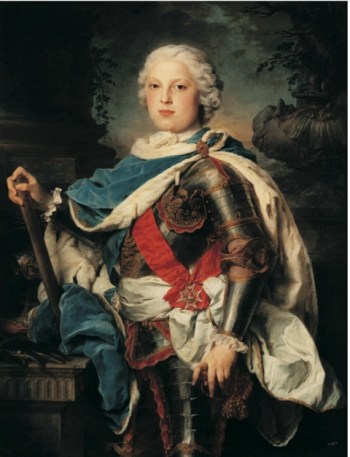
Pierre Subleyras, Portrait of Prince Friedrich Christian of Saxony, 1739 (Dresden, Gemäldegalerie)
I first met Friedrich Christian, Crown Prince of Saxony/Poland, in 2004 in the State Archives in Dresden. I was gathering material for a book and stumbled across the handwritten travel diaries of his Italian odyssey in 1738–40. Sixteen years old and crippled by scoliosis and what was termed “palsy” (probably cerebral palsy), his Grand Tour was less a gap year than an all-out effort to find a cure for his condition in medicine or religion and safeguard the succession. Crowned Elector in 1763, he died prematurely from smallpox, aged 41, after reigning for 74 days. Thus he ended up a footnote in history books instead of a legend. And in 2004, I adopted him as my subject, hero and muse. . . .
The handwritten journals of his two-year odyssey are the guidebooks for this journey of mine, of his. The prince wrote daily, in school-boy French, in the words of a dutiful and obedient child on the uncertain road to manhood. A Catholic crown prince of a Protestant state held tight by the Jesuits and buttressed by the Bohemian mysticism of the court of Vienna, he sat at the center of an able-bodied swirl, incognito as Comte
de Lusace though hardly anonymous. . . .
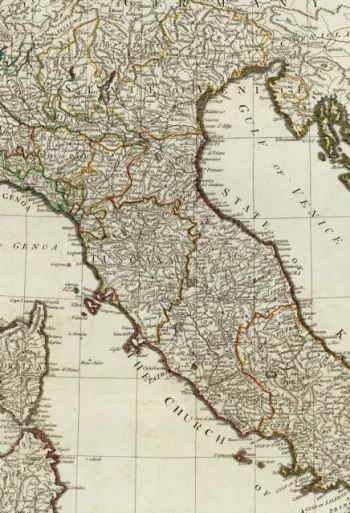
A New Map of Italy . . . from Monsr. D’Anville (London, Robert Sayer, 1790)
To date, I have twice driven the historic itinerary and have conducted research in situ in Dresden, Naples, Rome and Venice, towards an annotated publication. For the moment, however, this WordPress blog is an experimental platform for sharing the contemporary accounts with interested colleagues. The transcriptions retain the inaccuracies, idiosyncrasies and misspellings of the originals and await thorough proofreading and corrections; autocorrect has also introduced inadvertent errors, for which I apologize. . . .
The site is available here»
Exhibition | Sweet 18: Contemporary Art, Fashion, and Design
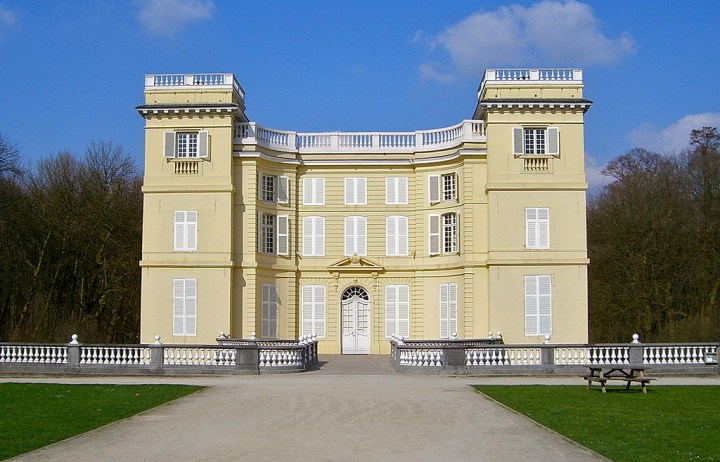
Kasteel d’Ursel at Hingene (Bornem), Belgium.
Photo from Wikimedia Commons, 4 May 2009.
◊ ◊ ◊ ◊ ◊
Press release for the exhibition:
Sweet 18: Contemporary Art, Fashion, and Design Inspired by the 18th Century
Kasteel d’Ursel, Hingene, Belgium, 1 May — 5 July 2015
Curated by Luisa Bernal, Dieter Van Den Storm, Wim Mertens, Tamara Berghmans, and Hélène Bremer
This spring the former summer residence of the aristocratic d’Ursel family will be the setting for the exhibition Sweet 18, presenting the 18th century through the eyes of fifty contemporary designers, artists, and fashion designers—from Erwin Olaf and Wim Delvoye to Walter van Beirendonck and Philippe Starck.

Jessica Harrison, Painted Lady (10), found ceramic, enamel paint, 22 x 17 x 13cm, 2014.
We all have somewhere in our minds the same images of the 18th century: wigs and hooped petticoats, towering hairstyles and elegant furniture, fine porcelain on lavishly decked tables, sensual portraits and frivolous paintings. The 18th century was the time of the Enlightenment and of the flowering of the arts and sciences. But it also created a playful, artificial world for aristocrats wanting to escape reality and immerse themselves in fantasy. A charmed world of pleasure, abundance, and voluptuousness, of pastel tints and curlicues, a world that inspires many an artist to this day. Spreading themselves over all three floors of the castle, these artists will show you the 18th century as you have never seen it before.
Sweet 18 has been brought together by the following team of curators: Luisa Bernal (art), Dieter Van Den Storm (design), Wim Mertens (fashion), Tamara Berghmans (photography) and Hélène Bremer (art).
Ode to Marie Antoinette
Whether it be for her extravagant lifestyle, influential fashion sense or her tragic death, French Queen Marie-Antoinette still speaks to our imagination. Director Sofia Coppola’s film spear- headed the revival. For pop stars like Madonna and Beyoncé, she is also a powerful icon. German illustrator Olaf Hajek gives his own take on her in the Black Antoinette series while top Dutch photographer Erwin Olaf offers up a gory portrait of the queen: beheaded.
Exuberant Fashion
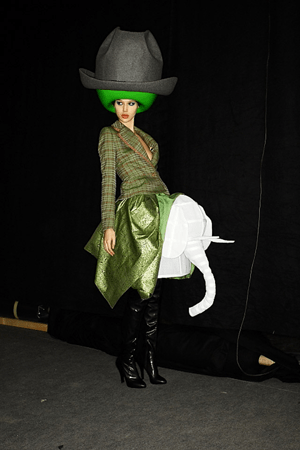
Walter Van Beirendonck. Foto: Ronald Stoops
The extravagant wardrobe of Marie-Antoinette is the springboard for many a contemporary fashion designer: from the minimalism of Japanese Yohji Yamamoto and eccentricity of German Bernhard Willhelm to French fashion houses Nina Ricci and Thierry Mugler. American artist Yasemen Hussein recreates one of her wigs in metal, and English milliner Stephen Jones is inspired by her to create his evocative hats. The outsized dresses, tight corsets, and tailored jackets of Belgian designers Walter Van Beirendonck and Olivier Theyskens also sample the 18th century.
Transparent Plastic en Burnt Wood
Dutch designer Hella Jongerius immersed herself in the archives of the German porcelain manufactory Nymphenberg to come up with plates which combine hand-painted patterns and little sculptured animals, all done in 18th-century style. Designer Maarten Baas literally set fire to a number of antique chairs before reworking them in lacquer. His Smoke Chair has become a classic. Even more famous is French star designer Philippe Starck’s Ghost Chair, which references a Louis XV chair in a pared-down, transparent design. Spanish designer Jaime Hayon’s lounge chair and an outlandish seat by British designer Nina Saunders also find a home in the exhibition. One absolute high point is L’ornement jamais by Swiss designer Philippe Cramer, an outstanding piece of pine furniture executed in 18th-century style and partially dipped in liquid gold.
Deformed Status Symbols
The fine china of Meissen, Sèvres, and Wedgwood remains to this day an inexhaustible source of inspiration. The sculptural groups of American artist Chris Antemann may look like replicas but reveal themselves on closer inspection to be rather wicked tableaux, full of forbidden fruit. British artist Jessica Harrison makes superficially sweet female figurines that are actually hideously mutilated, with their deformed heads and coloured tattoos. With War and Pieces, Dutch ceramicist Bouke de Vries offers a modern interpretation of the extravagant banquets that were thrown the night before a battle. British artist Amy Hughes’s Trésor découvert suggests treasure that has been lying buried for centuries under that same battlefield, treasure that has lost its gleam but has a story of the past and its rediscovery to tell.
Fêtes Galantes
In Stavronikita Project Austrian photographer Andreas Franke recreates 18th-century festivities. By situating them in the unusual setting of a sunken ship he emphasises the beauty that underlies decadence and decline. The tableaux of Canadian artist Ray Caesar border on the surreal, while the work of English painter Patrick Hughes plays games with the laws of perspective.
Pastoral Scenes

Richard Saja
Nothing is more typical of the 18th-century domestic interior than ‘toile de Jouy’, cotton wall- coverings depicting scenes of rural life. American artist Richard Saja pimps its little cowherds into clowns or punks, while the French Collectif Ensaders transforms them into figures of fantasy and Virginie Broquet gives them an erotic spin. Scottish design studio Timourous Beasties substitutes its idyllic villages with views of the London skyline, while French artist Joël Ducorroy reduces it to its bare essentials. American Beth Katleman brings toile de Jouy wallpaper to life in a vast 3D construction, introducing flea market finds into her installation to accentuate the strangeness of the effect.
Lavish Finery
British artist Jo Taylor translates the extravagant stucco ornament of the grand 18th-century house into three-dimensional porcelain objects. American Molly Hatch’s porcelain plates, when set together, form a landscape painting covering an entire wall. Taking as her inspiration the bizarre wigs of the French court, English artist Kathy Dalwood turns
casts of utilitarian objects into plaster portrait busts.
Made in Belgium
Belgian artists easily hold their own amongst all these international heavyweights. Isabelle Copet lays a gigantic lace collar in the pool behind the castle. In the park Michaël Aerts places an inverted statue of Louis XIV on a pedestal made of flight cases and builds a seven metre high obelisk from the same black cases. Two twisted sculptures by Wim Delvoye overlook the entrance hall. Zaza contributes a print. In the mirrored room Bart Ramakers has filmed a richly imaginative ballet on the theme of romantic love. Painter Jan Devliegher exhibits gigantic porcelain plates and Nick Ervinck has printed two stunningly designed vases in 3D. A design for a bedroom by architect Koen Deprez combines classic panelling and Fragonard paintings with Stanley Kubrick’s 2001: A Space Odyssey. Pieter Theuns (BOX) has composed music inspired by Mozart for the exhibition.
Kasteel d’Ursel
For nearly four centuries Kasteel van Hingene was the favourite summer residence of the aristocratic d’Ursel family. Every summer the Duke would travel with family and servants to his magnificent country house. Now it is the property of the Province of Antwerp, which is restoring it to its former glory. In 2014 Kasteel d’Ursel won the ‘Flemish Heritage Award’.
The exhibition begins on the first floor and leads you through the noble family’s former bedchambers. The service stairs bring you directly to the second floor where once the servants and the children of the family were accommodated. The circuit ends in the hall of mirrors and the reception rooms of the ground floor. The restored castle, with its characteristic Chinese interior decoration, is the perfect setting for this contemporary look at the 18th century.
Research Project | Marrying Cultures: Queens Consort, 1500–1800
This HERA-funded research project on queens consort will be of interest to many readers. Upcoming events are scheduled to take place throughout Europe: Wolfenbüttel, Berlin, Oxford (in conjunction with Kensington Palace), Warsaw, and Stockholm. –CH
Marrying Cultures: Queens Consort and European Identities, 1500–1800
Marrying Cultures is a three-year research project funded by HERA (Humanities in the European Research Area) focusing on the foreign consort as agent of cultural transfer. The case studies to be investigated are the Polish princesses Katarzyna Jagiellonka, Duchess of Finland and Queen of Sweden (1526–83), and Zofia Jagiellonka, Duchess of Braunschweig-Wolfenbüttel (1464–1512); Hedwig Eleonora of Schleswig-Holstein-Gottorp, Queen of Sweden (1636–1715), and Charlotte Amalie of Hessen-Kassel, Queen of Denmark (1650–1714); the Portuguese princess Catarina of Braganza, Queen of Great Britain (1638–1705); Maria Amalia of Saxony, Queen of the Two Sicilies and Queen of Spain (1724–1760); and Luise Ulrike of Prussia, Queen of Sweden (1720–82).
Working with colleagues in historic palaces, museums and libraries (including Kensington Palace, the Victoria and Albert Museum and the National Portrait Gallery, London; the Royal Armoury, Stockholm, and the Duke August Library, Wolfenbüttel), the project members will also consider how it is that certain consorts become embedded in national cultural memory and others do not.
Partners
Historic Royal Palaces (Kensington Palace, London): Dr Joanna Marschner
National Portrait Gallery, London: Dr Catharine Macleod
Victoria and Albert Museum, London: Dr Julius Bryant
Livrustkammaren (The Royal Armoury), Stockholm: Dr Malin Grundberg
The Museum of Polish History, Warsaw: Monika Matwiejczuk
Supportive Institutions
Herzog August Bibliothek, Wolfenbüttel: Professor Hellwig Schmidt-Glintzer
Hochschule für Musik, Theater und Medien, Hannover: Professor Susanne Rode-Breymann
Husgerådskammaren (The Royal Collections), Stockholm: Dr Lars Ljungström
Turku Castle and Historical Museum: Olli Immonen

Exhibition | Vivienne Westwood: Cut from the Past

◊ ◊ ◊ ◊ ◊
From Danson House:
Vivienne Westwood: Cut from the Past
Danson House, Bexleyheath, Kent, 1 April — 31 October 2015
The 18th century is the high point of art and culture. —Dame Vivienne Westwood
The impact of 18th-century art and design on the work of distinguished British fashion designer Vivienne Westwood is celebrated in a new exhibition at Danson House this spring. Vivienne Westwood: Cut from the Past brings together for the first time a number of her ground-breaking designs, and explores the collections that proved to be her turning point both critically and commercially.
Danson House, a splendidly restored Georgian villa, provides a tailor-made backdrop to the exhibition which highlights Westwood’s seminal work of the 1990s which was influenced by the 18th century. Designs and outfits on show make particular reference to the Rococo paintings of French artists Watteau and Boucher. Westwood’s passion for 18th-century design is also reflected in some earlier pieces from the ‘Cut, Slash and Pull’ and ‘Mini Crini’ collections, and the Malcom McLaren and Vivienne Westwood ‘Seditionaries’ Collection.
Caroline Worthington, Chief Executive, Bexley Heritage Trust said, “We are delighted to be working together with the Victoria & Albert Museum for the first time to bring cutting edge design back to Danson House for the 2015 season—just as the original owners, the Boyd family, did in the 18th century.”
◊ ◊ ◊ ◊ ◊
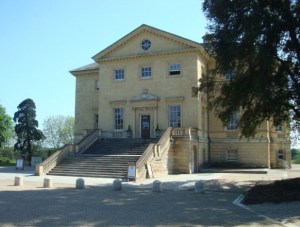 Danson House boasts a suite of rooms created for Sir John Boyd, a man besotted with his young bride. Enjoy this superb example of 18th-century architecture with its classical proportions, elegant interiors and rich symbolism celebrating love and marriage. Designed as a retreat from the hustle and bustle of central London, Danson House was completed in 1766. Sir John Boyd was a sugar merchant and vice-chairman of the British East India Company. Together with the notable architect Sir Robert Taylor, Boyd created this homage to the Golden Age of Antiquity, filling it with art and sculpture from his travels on the Continent. Today his home gives us a fascinating insight into fashionable
Georgian life.
Exhibition | Love Bites: Caricatures by James Gillray
From the Ashmolean:
Love Bites: Caricatures by James Gillray
Ashmolean Museum, Oxford, 26 March — 21 June 2015
Curated by Todd Porterfield

James Gillray, Design for a Naval Pillar, 1800
(New College, Oxford)
To mark the 200th anniversary of the death of British caricaturist James Gillray (1757– 1815), the Ashmolean presents more than 60 of Gillray’s finest caricatures from the outstanding collection of New College, Oxford.
James Gillray trained as a professional copyist at the Royal Academy and then staked his professional life on caricature, amongst the first generation of artists to do so. He produced more than a thousand prints, some the fruit of months of reflection, others banged out at lightning speed, responding to but also creating instant controversies on the very day of the event. His prints were divisive and partisan: in 1798 a Tory Lord would congratulate him for having “been of infinite service in lowering them [the Whigs] and making them look ridiculous,” while the exiled Napoleon, well aware of Gillray’s anti-French propaganda, was reported to have said that the British engraver did more than all the armies of Europe to bring him down.
Love Bites: Caricatures by James Gillray is curated by Professor Todd Porterfield of the University of Montreal. The exhibition has been generously supported by The Paul Mellon Centre for Studies in British Art and the Friends of the Ashmolean.
In connection with the exhibition, the Ashmolean Museum will host a conference, James Gillray@200: Caricaturist
without a Conscience?, on the 28th and 29th of March 2015.
Conference | James Gillray@200: Caricaturist without a Conscience?
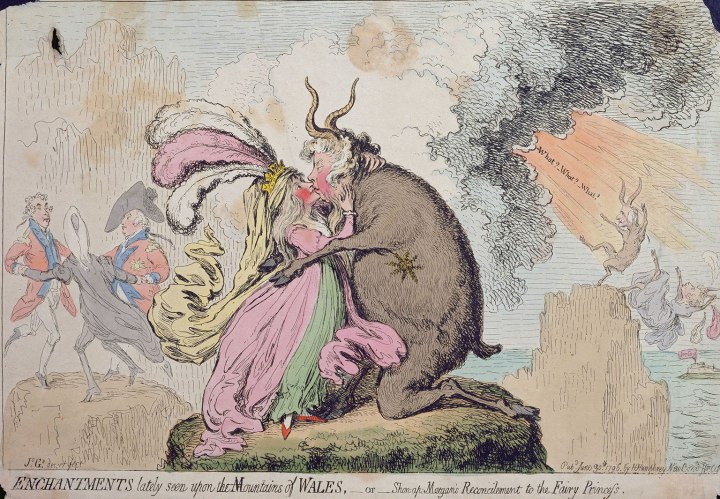
James Gillray, Enchantments Lately Seen upon the Mountain of Wales, 1796
(New College, Oxford)
◊ ◊ ◊ ◊ ◊
From New College, Oxford:
James Gillray@200: Caricaturist without a Conscience?
Ashmolean Museum, Oxford, 28–29 March 2015
Organised by Todd Porterfield, Université de Montréal; Martin Myrone, Tate Britain; and Michael Burden, New College, Oxford; with Ersy Contogouris, Université de Montréal
To commemorate the 200th anniversary of Gillray’s death, and in conjunction with the Ashmolean Museum’s exhibition, Love Bites: Caricatures of James Gillray, based on New College’s outstanding collection, we are organizing a two-day symposium at the Ashmolean Museum to hear and see the latest Gillray scholarship.
James Gillray’s reputation in the two centuries since his death has been as varied and layered as his prints. Trained at the Royal Academy, he failed at reproductive printmaking, yet became, according to the late-eighteenth-century Weimar journal London und Paris, one of the greatest European artists of the era. Napoleon, from his exile on St Helena, allegedly remarked that Gillray’s prints did more to run him out of power than all the armies of Europe. In England, patriots had hired him to propagandize against the French and touted him as a great national voice, but he was an unreliable gun-for-hire. At a large public banquet, during the heat of anti-Revolutionary war fever, he even raised a toast to his fellow artist, the regicide, Jacques-Louis David. Gillray produced a highly individual, highly schooled, and often outlandish body of work with no clear moral compass that undermines the legend of the caricaturist as the voice and heart of the people.
◊ ◊ ◊ ◊ ◊
S A T U R D A Y , 2 8 M A R C H 2 0 1 5
10.00 Registration and coffee
10:30 Session I: Gillray in the Media Age
• Douglas Fordham, University of Virginia, ‘A Media Critic for the Intaglio Age’
• Esther Chadwick, Yale University, ‘Gillray’s Tree of Liberty: Political Communication and Epistolary Networks in the Radical 1790s’
• Kate Grandjouan, Visiting Associate Professor, Department of Art History, University of Belgrade, ‘Gillray’s French Jokes: The “Sick-list” Casualties of the 1790s’
12.00 Lunch
1:00 Session II: Gillray in the Colonial Networks: Positionings on Race and Slavery
• Julie Mellby, Graphic Arts Curator within Rare Books and Special Collections at Firestone Library, Princeton University, ‘The Sale and Resale of English Beauties in the East Indies’
• Amanda Lahikainen, Aquinas College, ‘James Gillray and Representations of Napoleon’s Egyptian Campaign: Islam as Republican Sacrilege’
• Katherine Hart, Senior Curator of Collections & the Barbara C. and Harvey P. Hood 1918 Curator of Academic Programming, Hood Museum of Art, Dartmouth College, ‘James Gillray, Charles James Fox, and the Abolition of the Slave Trade: Caricature and Displacement in the Debate over Reform’
2.30 Coffee
3:00 Session III: The Artist and Formal Means
• Ersy Contogouris, Université de Québec à Montreal, ‘Gillray’s Preparatory Drawings’
• Cynthia Roman, The Lewis Walpole Library, Yale University, ‘James Gillray and the Satiric Alternative to Painting History’
6.30 Reception
7.00 Dinner
S U N D A Y , 2 9 M A R C H 2 0 1 5
9.00 Visit to the exhibition, Love Bites: Caricatures of James Gillray
10:15 Session IV: The Artist and Literary Means
• David Taylor, Assistant Professor, Department of English and Comparative Literary Studies, University of Warwick, ‘Gillray, Milton, and the “Caricatura Sublime”’
• Rachel M. Brownstein, Professor of English, City University of New York, ‘James Gillray and Jane Austen: Aesthetic Affinities’
11.15 Coffee
11:45 Session V: Gillray, the People, the Academy and Revolution
• Vic Gatrell, Caius College, Cambridge, ‘Gillray Reconsidered: ‘The Voice and Heart of the People’?
• Katarzyna Murawska-Muthesius, Associate Lecturer, Department of History of Art, Birkbeck College, University of London, ‘Caricature’s Unconscious: James Gillray and the Academy’
• Ian Haywood, Professor of English Co-Director, Centre for Research in Romanticism University of Roehampton, London, ‘Gillray’s Valediction: The Life of William Cobbett’
1.15 Lunch
Snite Museum Acquires Pressly Collection of James Barry Prints
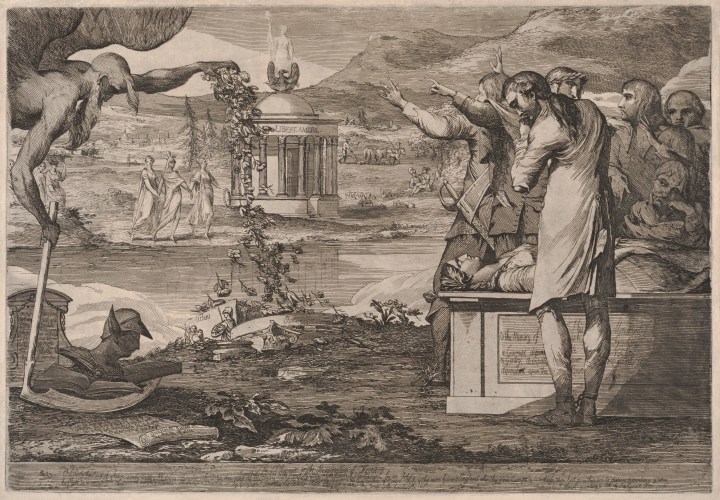
James Barry, The Phoenix or The Resurrection of Freedom, 1775/ca. 1790, etching and engraving with traces of aquatint, 17 x 24.1 inches (plate). Snite Museum of Art, gift of William and Nancy Pressly in honor of the Stent Family, 2015.002.001.
Click here to enlarge
◊ ◊ ◊ ◊ ◊
Press release (30 January 2015) from the Snite Museum of Art:
Snite Museum Expands Irish Art Collection at the University of Notre Dame with the William and Nancy Pressly Collection of James Barry Prints
The Snite Museum of Art announces the acquisition of a significant portfolio of 28 prints by the quixotic Irish artist James Barry (1741–1806). Rich in symbolism and technically inventive, these new additions to the collection promise to enhance the University of Notre Dame’s position as a leading center for Irish, eighteenth-century, art historical, and trans-Atlantic studies. The artist’s dramatic compositions, grand scale, and heroic subjects offer visitors, connoisseurs, students, and scholars much to contemplate and enjoy.
“This is a first-rate acquisition of one of the most influential artists of the eighteenth-century British Atlantic world. It will be thrilling to see how our students in early American, Irish, and British history interpret such a rich and complex set of materials,” said Patrick Griffin, chair and Madden-Hennebry Professor of History at the University of Notre Dame.
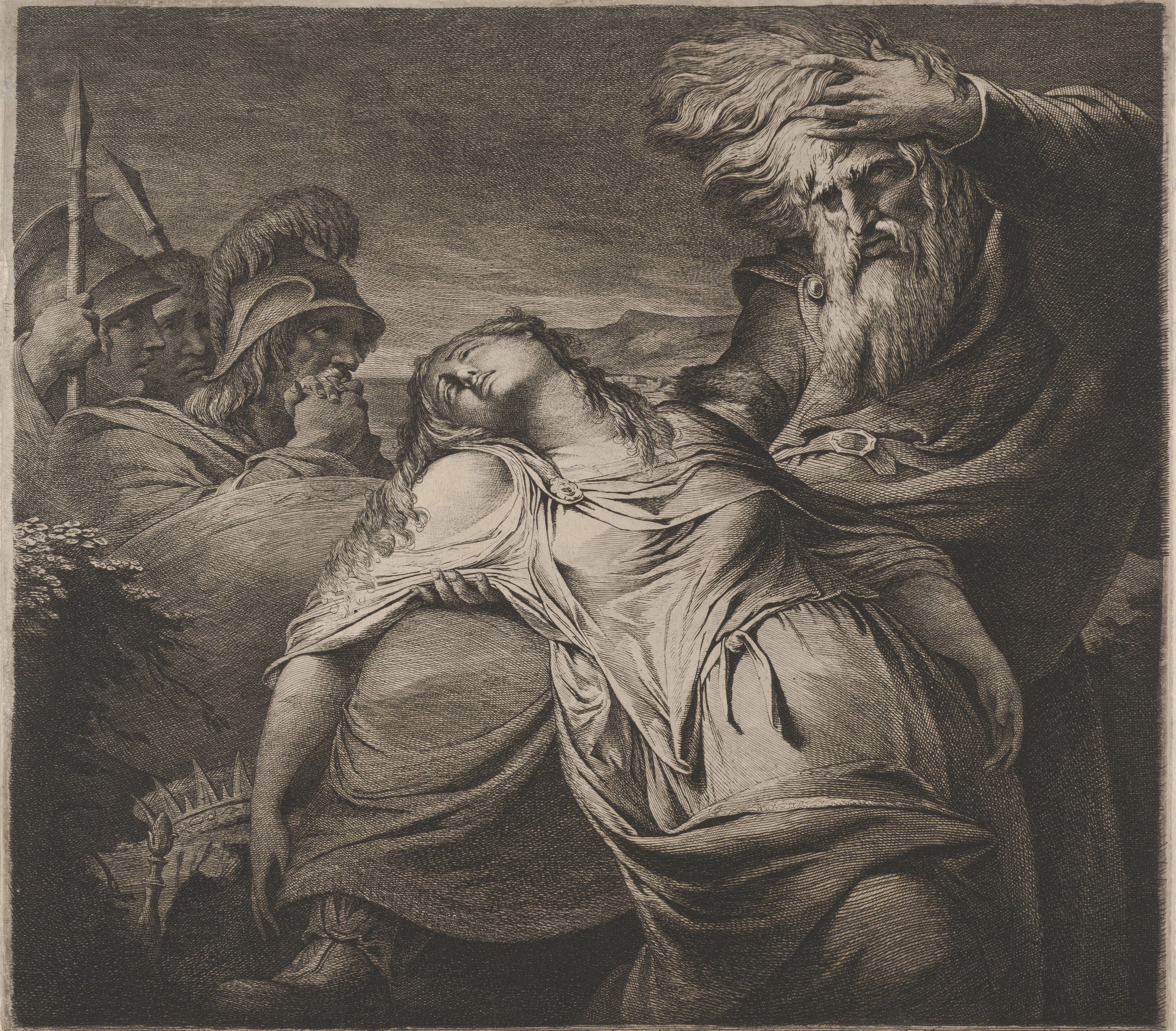
James Barry, King Lear and Cordelia, etching and engraving, 1776/1791, 19.5 x 22.2 inches (sheet). Snite Museum of Art, The William and Nancy Pressly Collection acquired with funds made available by the F. T. Stent Family, 2015.001.001.
Included in the portfolio are many rare, lifetime impressions of some of the Catholic artist’s most provocative images skewering British society or weighing in on contentious current events, such as the war in the American colonies. Barry was a member of the Royal Academy but was eventually expelled for his belligerence and acrimony.
Printmaking for Barry was more than just an opportunity to market his ideas to a wide audience. Self-taught in the arts of printmaking, he used it to work out iconographical and compositional problems. It was part of his creative process, and the prints can be used to chart his ever-evolving positions on political issues and his increasing technical acumen. Multiple states of the same print in which the more experimental aquatint technique was effaced in favor of conventional engraving suggest the artist’s lamentable concession to a market that did not appreciate his innovations. He was one of the earliest practitioners of lithography shortly after its invention around 1800, a singular example of which is also part of this portfolio.
This remarkable collection was built over four decades by Nancy and William Pressly, the foremost scholar on James Barry and professor emeritus of eighteenth- and nineteenth-century European art at the University of Maryland. Pressly said, “Over the years, as I looked and relooked at these prints, I was amazed at both the subtlety and richness of Barry’s process, but he never pursued virtuosity for its own sake: all is in the service of his passion to transform his audience, a transformation, however, that places great demands on his viewer.”
Barry produced over 40 prints during his career. The William and Nancy Pressly Collection represents more than half of that production, making the University of Notre Dame and the Yale Center for British Art the two largest repositories of his work in the United States.
The acquisition of eighteen of the prints was made possible by a generous gift from the F. T. Stent Family with ten additional prints donated by the Presslys themselves.
New Book | Women Artists: The Linda Nochlin Reader
Due out this summer from Thames & Hudson:
Linda Nochlin, Women Artists: The Linda Nochlin Reader, edited by Maura Reilly (London: Thames & Hudson, 2015), 434 pages, ISBN: 978-0500239292, $50.
 Linda Nochlin is one of the most accessible, provocative, and innovative art historians of our time. In 1971 she published her essay “Why Have There Been No Great Women Artists?”—a dramatic feminist call-to-arms that called traditional art historical practices into question and led to a major revision of the discipline.
Women Artists brings together twenty-nine essential essays from throughout Nochlin’s career, making this the definitive anthology of her writing about women in art. Included are her major thematic texts “Women Artists After the French Revolution” and “Starting from Scratch: The Beginnings of Feminist Art History,” as well as the landmark essay and its rejoinder “‘Why Have There Been No Great Women Artists?’ Thirty Years After.” These appear alongside monographic entries focusing on a selection of major women artists including Mary Cassatt, Louise Bourgeois, Cecily Brown, Kiki Smith, Miwa Yanagi, and Sophie Calle. Women Artists also presents two new essays written specifically for this book and an interview with Nochlin investigating the position of women artists today.
Linda Nochlin is a highly celebrated feminist art historian. She is the Lila Acheson Wallace Professor of Modern Art Emerita at the Institute of Fine Arts, New York University. Her major books include Courbet, Representing Women, and Women, Art, and Power.
Maura Reilly has worked as a critic for Art in America and as a lecturer at the Museum of Modern Art, New York. She has held curatorial positions at the Brooklyn Museum and at the American Federation of Arts, New York. She is coauthor, with Linda Nochlin, of Global Feminisms: New Directions in Contemporary Art.
Call for Papers | Sixth Annual Feminist Art History Conference
Sixth Annual Feminist Art History Conference
American University in Washington, D.C., 6–8 November 2015
Proposals due by March 2015
This annual conference builds on the legacy of feminist art-historical scholarship and pedagogy initiated by Norma Broude and Mary D. Garrard at American University. To further the inclusive spirit of their groundbreaking anthologies, we invite papers on subjects spanning the chronological spectrum, from the ancient world through the present, to foster a broad dialogue on feminist art-historical practice. Papers may address such topics as: artists, movements, and works of art and architecture; cultural institutions and critical discourses; practices of collecting, patronage, and display; the gendering of objects, spaces, and media; the reception of images; and issues of power, agency, gender, and sexuality within visual cultures. Submissions on under-represented art-historical fields, geographic areas or national traditions, and issues of race and ethnicity are encouraged.
To be considered for participation, please provide a single document in Microsoft Word. It should consist of a one-page, single-spaced proposal of unpublished work, up to 500 words in length for a 20-minute presentation, followed by a curriculum vitae of no more than two pages. Please title the document “[last name]-proposal”. Submit materials with the subject line “[last name]-proposal” to: fahc6papers@gmail.com. Submission Deadline: May 15, 2015. Invitations to participate will be sent by July 1. Send general queries to: fahc2015queries@gmail.com.
Keynote speaker: Professor Amelia Jones, University of Southern California: “The Curating of Feminist Art (or is it the Feminist Curating of Art?)”
Sponsored by the Art History Program and the Department of Art, College of Arts and Sciences, American University. Organizing committee: Juliet Bellow, Norma Broude, Kim Butler Wingfield, Mary D. Garrard, Helen Langa, Andrea Pearson, and Ying-chen Peng










 Enfilade
leave a comment