The Prado Acquires the Juan Bordes Library
Press release (27 January 2015) from the Prado:

Trattato della Pittura di Leonardo da Vinci . . . di Stefano della Bella (Florence, 1792).
The Museo del Prado is providing detailed information on the content of one of its most recent acquisitions: the Juan Bordes Library. This is one of the most important bibliographical holdings in the world for the study of the human figure, consisting of treatises and drawing manuals from the 16th to the 20th centuries. Within this acquisition, the Museum has received as a donation a sketchbook by the studio of Rubens. It is currently considered the closest to the lost original by the master and also includes two original works by his hand.
The Juan Bordes Library is a unique example of a bibliographical holding specialised in the key areas within artists’ training and the theory of the human figure. Comprising around 600 volumes assembled by Bordes, the library focuses on texts and manuscripts that were used in the training of artists from the 16th to the 20th centuries. Due to their functional nature, these texts have not in the past merited the attention of bibliophiles or art historians. As Gombrich noted in his book Art and Illusion: “it is no mere paradox to say that the rarity of these books in our libraries is symptomatic of their past importance. They were simply, used, torn and handled in workshops and studios, and even surviving ones are often poorly bound and incomplete.” As a result, these manuals and treatises constitute an extremely valuable holding for a knowledge of the methods employed in the training of artists and amateurs in studios and academies. They also tell us about the evolution of aesthetics and the dissemination of artistic models.
 The Bordes Library is structured into six large sections, organised to reflect the key disciplines in an artist’s training, in addition to a group of manuscripts of different types, notably the sketchbook by Rubens received as a donation. The importance of this library is reflected in Juan Bordes’s own 2003 book, Historia de las teorías de la figura humana. El dibujo, la anatomía, la proporción, la fisionomía (History of the Theories of the Human Figure: Drawing, Anatomy, Proportion and Physiognomy), in which he studied the function and history of these books and their role and significance in artists’ training.
This bibliographic holding now joins other specialist libraries acquired by the Prado in recent years: the Cervelló Library, specialising in art theory and celebrations; the Correa Library, which focuses on the art of printmaking and the illustrated book; the Madrazo Library, an example of a library belonging to a dynasty of artists; the libraries of José Álvarez Lopera and Julian Gallego, which are characteristics libraries of art historians who primarily specialised in Spanish art; and the library of Félix de Azúa, centred on aesthetics and the philosophy of art. Through this strategy of acquiring specialist libraries, the Museo del Prado is not only helping to preserve the Spanish bibliographical heritage but also to provide its Study Centre with the research tools necessary for fulfilling its primary mission.
◊ ◊ ◊ ◊ ◊
S T R U C T U R E O F T H E B O R D E S L I B R A R Y
1. Drawing Manuals
This is undoubtedly one of the most important and valuable areas within the Bordes Library, both for the number of items and their rarity. The eminently functional nature of these manuals means that very few of them survived, on occasions only as single copies. Given that they were copied or republished in response to the different requirements of each moment, on many occasions they varied from one edition to another, so that each surviving copy is now almost unique. As a whole this group is extremely important as the study of it will reveal not only differences in the way of teaching drawing at different historical periods but also the models selected,thus reflecting taste of the time. It can be said that this group represents the systematic assembly of the largest surviving group of drawing manuals. Among its contents are three of the founding texts of this type by Fialetti, Cousin and Carracci, as well as examples of the most important ones from later centuries by Rubens, Ribera, Bloemaert etc.
2. Artistic Anatomies
Combining scientific knowledge and art, from Vesalius’s pioneering text onwards, treatises on anatomy reveal the key role of the study of the human figure in artists’ training. Together with life drawing and the copying of plaster casts, the study of anatomy through printed treatises, with particular attention to the study of bones and muscles, was one of the basic principles of an artist’s training. The increasing availability of images in the 19th century made high quality visual media available to students, encouraging a naturalistic approach to the representation of the human body in art. The Bordes Library is particularly rich in treatises from that century, copiously illustrated and with colour assuming a key role. Their relationship with the art of their time is striking, as evident, for example,in the numerous drawings by José Madrazo in the Prado’s collection. Particularly important was the interest in “anatomising classical sculptures,” in other words, anatomical models based on the great paradigms of classical sculpture, once again indicating the close links between science and art.
3. Proportion
As Michelangelo noted, having a compass in one’s eye for constructing harmonious, well-proportioned figures was one of the basic principles of artistic creation. Since Alberti and Dürer’s fundamental treatises, the quest for ideal human proportions within the variety of the human body has been an ongoing interest of artists, evolving in parallel to aesthetic changes. As a result, over the course of the centuries numerous treatises were published that offered artists a repertoire of proportions, either of real human models or of classical sculptures, determining the principles that should govern the construction of the human figure. Although fewer in number than the works in the previous sections, the Bordes Library has examples from different periods and centres, ranging from the 17th to the 20th centuries and from Europe to South America. These texts reveal the spread of a teaching model based on mathematics.
4. Physiognomy
Facial expressions were the subject of the fourth area of an artist’s training. Starting in the Renaissance with Della Porta’s Della Fisionomia dell’ Huomo, followed by the works of Le Brun and Lavater (also represented in this library by a manuscript) and concluding with 19th-century treatises such as Duchenne’s, physiognomy has been a subject of interest both to artists and writers. The Bordes Library contains a notable group of these works, with the principal authors represented by several different editions, allowing for an understanding of the evolution of artistic concerns.
5. Treatises on Painting and Drawing
Complementing the four fundamental areas outlined above, the Bordes Library also has treatises on the practice of drawing and painting, in which these disciplines are related to anatomy, proportion and physiognomy. These varied treatises were widely disseminated and of enormous theoretical importance. Leonardo, Alberti and Hogarth are among the authors represented in different editions. In other cases these treatises, published in different European countries, have hardly been the subject of study, although they must have provided the theoretical bases for many artists. The importance placed on art theory in recent years means that not only the major treatises but other works represented by fine copies in the Bordes Library are of enormous scholarly value.
6. Iconography
Repertoires of portraits and works of art, both paintings and sculptures, make up the smallest section within the library although one that represents a type of publication which was widely disseminated in the past. The fact that repertoires of this type were normally costly, large-format publications and thus not within the reach of all artists led Juan Bordes to focus on books which were more accessible to them, normally in small format and simply illustrated. Nonetheless, the library contains notable examples of visual repertoires, including Perrier’s on classical sculpture and Padre Nadal’s Imágines de la Historia Evangélica, which was exceptionally important for the dissemination of Counter-Reformation models.
7. Manuscripts
The Bordes Library includes a small but exceptional group of manuscript treaties. They are of equal rarity to many of the manuals referred to in the first section and can be classified into two principal groups: manuscripts that constitute the original of a subsequently published or unpublished text (Lavater and his treatise on physiognomy), and those that take the form of notebooks made in the context of the artist’s studio, copying sketches or other notebooks by the master.
Outstanding among them is the above-mentioned notebook by Rubens, known as the Bordes Manuscript. This is a remarkably important example as it constitutes the first proof of the existence of a lost notebook by Rubens in which he set out his ideas on anatomy, proportion, symmetry, optics, architecture and physiognomy and also made numerous drawings. The Bordes Manuscript is the most important of the four known copies, given that in addition to being a direct copy of the original it contains two drawings by Rubens himself. The Museo del Prado houses the largest and finest collection of paintings by Rubens.
Display | Prud’hon: Napoleon’s Draughtsman
Looking ahead to the summer at Dulwich:
Prud’hon: Napoleon’s Draughtsman
Dulwich Picture Gallery, London, 23 June — 15 November 2015
In coordination with London’s celebrations surrounding the 200th anniversary of the Battle of Waterloo, Dulwich Picture Gallery presents Prud’hon: Napoleon’s Draughtsman, the first UK exhibition devoted to Pierre-Paul Prud’hon (1758–1823), a painter and draughtsman who, through his distinctive and unconventional vision, emerged as one of the most exceptional talents working in post-Revolutionary Paris.

Pierre-Paul Prud’hon, Seated Nude with Arm Extended, black and white chalk on blue-tinted (Gray: Le Musée Baron Martin)
A selection of 13 works on paper will celebrate Prud’hon as court artist to Napoleon and Joséphine Bonaparte and as one of France’s greatest draughtsmen. The display will focus on the artist’s extraordinary life studies in white and black chalk, remarkable for their ethereal forms, subtlety of light and shade, and mastery of expression. Whether sketched quickly or finished to perfection, the drawings reveal Prud’hon’s working processes, exploring the constant experimentation that led to the unique blend of Romantic expression and Neoclassical forms that marked him out amongst his contemporaries.
Prud’hon, unlike many of his contemporaries, drew from the live model throughout his career giving him the freedom to focus on certain forms or details without the confines of specific commissions. His drawings, which range from preparatory studies for interior decoration to allegorical compositions (conveying meaning through symbolic figures, actions, imagery, and events) not only demonstrate his incredible skill but also provide a sense of contact with the heart and mind of the artist. On his preferred medium of thick blue paper you can catch a glimpse of his ideas unfolding beneath his chalk, an expression of his thoughts at the moment of creation.
◊ ◊ ◊ ◊ ◊
Known for its outstanding collection of drawings, pastels, and prints by Pierre-Paul Prud’hon, the Musée Baron Martin in Gray is housed in an eighteenth-century château (refurbished between 1777 and 1783), built on the site of a medieval fortress (the fourteenth-century tower remains). More information is available here.
Editorial | Digital Textbooks / Thomas Buser’s History of Drawing

Jacques-Louis David, The Intervention of the Sabine Women, 1794. Black chalk, pen and black ink, gray wash with white heightening on two sheets and five fragments of paper pasted together, 25.7 x 34 cm (Paris: Louvre; photo: T. Le Mage).
Click here for more information.
◊ ◊ ◊ ◊ ◊
As someone regularly faced with assigning new editions of textbooks that seem increasingly overpriced, I wonder how long it will be until resources such as the basic art history survey text are available digitally for free. Yes, these are choppy waters—pedagogically, methodologically, ideologically, and as business practice—further complicated by recent legislation, primarily from California: SB48 signed into law in 2010 along with SB 1052 and SB 10532 signed in 2012. But I think the stakes are high in our getting this right.
Thomas Buser’s History of Drawing, which surveys Western drawing from the fifteenth to twentieth centuries, seems worth noting to me as an early example of what we might see more of in the coming years. I imagine most instructors would assign pieces in conjunction with other materials, but the price (free) facilitates such flexibility. If students in a studio drawing course are introduced to eighteenth-century artists they otherwise wouldn’t know about, that seems useful to me. In the context of a survey, I can imagine building one or two individual class sessions around the topic of drawing with this as a starting point for students. While there aren’t notes—an all too common and unfortunate characteristic of the textbook genre that could be rectified in the digital realm—there is a reasonably extensive bibliography, excluding (at least presently) the twentieth century.
With permissions an ever moving target, we’ve made huge strides during the last decade toward more open policies. Buser has adopted an approach that likely wouldn’t work with publishers (or profits) involved, but again this strikes me as a gain. If the image selection is admirable, in most cases the image quality is not. On the other hand, Buser’s text is also a work in progress, one of the biggest advantages of this new format.
I don’t usually voice opinions too loudly here (I try not to voice many opinions even softly and I’m certainly not speaking on behalf of HECAA), but here’s my concern: if art history—and I have in mind a discipline much larger than the eighteenth century—doesn’t move toward more affordable digital options, we will be further marginalized, characterized as an intellectual luxury, available only to a small, elite segment of higher education. At least at its best, the museum as an institution is premised on public access; it’s time we find some way to extend this vision to introductory art history texts.
–Craig Hanson
◊ ◊ ◊ ◊ ◊
From Busser’s History of Drawing:
History of Drawing is a textbook and reference book available free to anyone who loves drawings. . . .Thomas Buser earned his doctorate in Art History from NYU’s Institute of Fine Arts in 1974. He taught courses in Baroque Art and the course History of Prints and Drawings at the University of Louisville until his retirement in 2005. He has published Religious Art in the Nineteenth Century in Europe and America (two volumes, 2002) and the textbook Experiencing Art Around Us (second edition, 2006).
The Art Bulletin, December 2014
The eighteenth century in The Art Bulletin:
The Art Bulletin 96 (December 2014)
A R T I C L E S
• Cheng-hua Wang, “Whither Art History? A Global Perspective on Eighteenth-Century Chinese Art and Visual Culture,” pp. 379–94.

The Chang Gate (left), 1734, and Three Hundred and Sixty Trades (right), woodblock prints produced in Suzhou, ink and colors on paper; each is 43 x 22 inches (Hiroshima: Umi-Mori Art Museum)
Here, I endeavor to engage the global turn by exploring the connectedness of the world in art that drew China and Europe together in the eighteenth century. My main purpose is to highlight the new scholarship on the art and visual culture of the High Qing dynasty (ca. 1680s–1795). These recent studies reveal that the extent to which the globalized situation was engaged in the art production of the High Qing court and local societies far exceeds previous expectations. Notwithstanding the revered legacy of traditional research on Sino-European artistic interactions of the early modern period, it did not pay much attention to the multiple routes, channels, and contact zones within a global context, nor did it make in-depth explorations into the agency of the Qing emperors, painters, printmakers, and consumers on the issue of how Qing art adopted European styles. Consequently, these new lines of thought have, on the one hand, increased the importance of the comparatively marginal subfield of early modern Sino-European artistic interactions in the studies of Chinese art and, on the other, generated a major revision—not merely a fine-tuning—of the dominant narrative of High Qing art and visual culture (379) . . .
• Nóra Veszprémi, “The Emptiness behind the Mask: The Second Rococo in Painting in Austria and Hungary,” pp. 441–62.
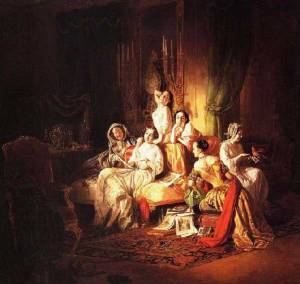
József Borsos, The Morning after the Masquerade (Girls after the Ball) 1850 (Budapest, Hungarian National Gallery)
At the time of its revival in mid-nineteenth-century Austria, the Rococo style was suffused with often contradictory meanings. Regarded as both outdated and fashionable, Austrian and French, simple and pompous, superficial and full of spiritual value, it prompted musings on time, history, and national identity. Closely connected to both the decorative arts and the imagery of popular prints, paintings of the Rococo revival often evoked contemporary concerns about the commodification of art in the industrialized modern world. The ambiguous responses engendered by the Rococo gained special significance in the context of the political tension between Austria and Hungary.
R E V I E W S
• Rebecca Zorach, Review of Andrea Feeser, Maureen Daly Goggin, and Beth Fowkes Tobin, eds., The Materiality of Color: The Production, Circulation, and Application of Dyes and Pigments, 1400–1800 (Ashgate, 2012); and Jeffrey Jerome Cohen, ed., Prismatic Ecology: Ecotheory beyond Green (University of Minnesota Press, 2013), pp. 489–91.
• Brian Kane, Review of Whitney Davis, A General Theory of Visual Culture (Princeton University Press, 2011), pp. 491–93.
Call for Papers | Artistic Correspondences: Rome and Europe, 1700–1900
From H-ArtHist:
Artistic Correspondences: Rome and Europe in the 18th and 19th Centuries
Rome, 15–16 June 2015
Proposals due by 1 March 2015
Epistolary correspondence among artists is a privileged source to unravel the dynamics of intellectual exchange across regional and national boundaries, as it requires a research agenda necessarily focused on ‘mobility’, and a transnational approach and methodology avoiding the rhetorical pitfalls of past European historiography. By focusing on the cosmopolitan context of 18th- and 19th-century Rome as a paradigmatic field of enquiry, the research network Artistic Correspondences: Rome and Europe in the 18th and 19th Centuries aims to recast epistolary exchanges among artists as an inescapable source of information on the transnational circulation of a shared stock of artworks, people, books, models, technical and critical skills across Europe. The organizing research team would like to meet other academics and research groups working on the same topic in order to explore new opportunities of collaboration at a European level.
The workshop to be held in Rome, 15–16 June 2015, is intended to explore new forms of research collaboration and dissemination of sources (e.g. networks, databases, digital repositories, etc.). The ultimate goal of the workshop is to initiate a debate leading to the construction of a digital platform of artists’ correspondences in the modern era. The workshop endorses a synchronic and diachronic approach to the study of artistic correspondences that will enable the mapping of geographical trajectories and cultural exchanges. We particularly welcome proposals illustrating the role of artists’ letters as a tool to study the history and historiography of collections from a comparative and interdisciplinary perspective; as a source offering new clues on the education and professional training of artists and their self promotion (e.g., the links between artists and institutions, artists and patrons, artists and intellectuals, etc.); as a document to trace the circulation of ideas and practices, rather than for sketching individual biographies (with a focus, therefore, on itineraries, geographies, social exchange, etc.); as a material providing insight on technical and specific terminology (e.g. words of practice, description of works of art, etc.).
Abstracts (maximum 200 words) for 25-minute papers should be submitted to Serenella Rolfi (serenella.rolfi@uniroma3.it) before 1 March 2015. We intend to provide travel allowance and/or accommodation for speakers with accepted papers.
Conference Committee: Serenella Rolfi (Dipartimento di Studi Umanistici, Università di Roma TRE), Giovanna Capitelli (Dipartimento di Studi Umanistici, Università della Calabria), Susanne Adina Meyer (Dipartimento di Scienze della formazione, dei beni culturali e del turismo, Università di Macerata), Ilaria Miarelli Mariani (Dipartimento di Lettere, Arti e Scienze Sociali, Università di Chieti), Christoph Frank and Carla Mazzarelli (Istituto di Storia e Teoria dell’arte e dell’architettura, Università della Svizzera Italiana), Maria Pia Donato (CNRS Institut d’Histoire Moderne et Contemporaine). With the cooperation of KNIR, Koninklijk Nederlands Instituut Rome and of the Svenska Institutet i Rom.
New Book | The Marble Index: Roubiliac and Sculptural Portraiture
From Yale UP:
Malcolm Baker, The Marble Index: Roubiliac and Sculptural Portraiture in Eighteenth-Century Britain (London: The Paul Mellon Centre for Studies in British Art, 2015), 420 pages, ISBN: 978-0300204346, £50 / $85.
 Providing the first thorough study of sculptural portraiture in 18th-century Britain, this important book challenges both the idea that portrait necessarily implies painting and the assumption that Enlightenment thought is manifest chiefly in French art. By considering the bust and the statue as genres, Malcolm Baker, a leading sculpture scholar, addresses the question of how these seemingly traditional images developed into ambitious forms of representation within a culture in which many core concepts of modernity were being formed. The leading sculptor at this time in Britain was Louis François Roubiliac (1702–1762), and his portraits of major figures of the day, including Alexander Pope, Isaac Newton, and George Frederic Handel, are examined here in detail. Remarkable for their technical virtuosity and visual power, these images show how sculpture was increasingly being made for close and attentive viewing. The Marble Index eloquently establishes that the heightened aesthetic ambition of the sculptural portrait was intimately linked with the way in which it could engage viewers familiar with Enlightenment notions of perception and selfhood.
Malcolm Baker is distinguished professor of art history at the University of California, Riverside.
◊ ◊ ◊ ◊ ◊
C O N T E N T S
1 Introduction: Addressing the Sculptural Portrait
Part I Characteristics: The Bust and the Statue as Genres
2 The Place of Sculptural Portraiture
3 Sculptural Conventions and Meaning
4 Setting up the Bust and the Statue
5 Making Images
Part II Exemplary Cases: Sitters, Patrons, Sculptors and Viewers
6 A Portrait Sculptor, his Sitters and his Viewers: Roubiliac and his Career
7 Celebrating the Illustrious
8 Groups, Networks, and Connections
9 Contemporary Heads
Appendices
Notes
Bibliography
Illustration credits
Index
A detailed table of contents is available (as a PDF file) here»
Lecture | Jenny Uglow on Living in Britain through Napoleon’s Wars
This evening at 8:00, in connection with the Waterloo 200 events:
Jenny Uglow, In These Times: Living in Britain through Napoleon’s Wars
Army & Navy Club, 36–39 Pall Mall, London, 29 January 2015
 Join prize-winning author Jenny Uglow as she explores the many ways in which the Napoleonic Wars touched the lives of ordinary people. Discover the moving story of everyday people, struggling through hard times and opening new horizons that would change their country for a century ahead.
Bookings for the Celebrity Speakers can be made online at nam.ac.uk or via the ticket hotline on 020 7881 6600. Standard tickets are available for £10. SOFNAM, Students, Military and Senior tickets are available for £7.50. Proof of ID is required when collecting tickets. Concessions can only be booked via the ticket hotline.
The Army & Navy Club offer a two-course dinner in their Coffee Room fine dining restaurant before each talk. Combined ‘Dinner & Talk’ bookings can only be made by calling 020 7881 6600. Standard tickets are available for £32.50 and concessions for £30.
Call for Papers | Irishness? Changing Perspectives on Irish Identity
From the conference website:
Irishness? Changing Perspectives on Irish Identity, 1700–1914
Department of History, Classics and Archaeology, University of Edinburgh, 14 May 2015
Proposals due by 28 February 2015
Papers are invited from postgraduates and early career researchers for a one-day workshop at the University of Edinburgh. The workshop will explore the changes that took place in Irish society and identity formation between 1700 and 1914. We hope to move away from the standard narrative of rebellion and famine which currently dominate conferences on Irish history and studies. While acknowledging the role played by politics and rebellion in the moulding of Irish society, this workshop will approach the changes in how Irish people saw themselves, and how they were seen by others, from angles that are often excluded from the mainstream academic narrative. We hope to attract papers from students of cultural, social and economic history, history of art, literature, and other fields to create a truly interdisciplinary discussion on the idea of what constitutes Irish identity.
In accordance with the non-traditional approach of this workshop, the format of the event will consist of morning and afternoon panels of papers from a variety of disciplines, followed by a late afternoon roundtable discussion, which although led by a senior academic, will encourage all attendees to engage on issues raised by the research earlier in the day, and on discussion of the future of the wider field of Irish Studies.
While this one-day workshop will be primarily concerned with Ireland and Irish society, we are keen to stress that Irish society was not purely influenced by the events within the national-boundaries of Ireland and the wider United Kingdom. To this end, this workshop will also incorporate notions of, and ideas about, ‘Irishness’ which involve those who self-identified, or were identified by others, as Irish, whatever their ancestry, religious inheritance, current location, or personal allegiances.
Abstracts of 200–300 words that relate to this theme are sought. Please send enquiries and abstracts to organisers Maeve O’Dwyer and Sophie Cooper (perspectivesonirishness@gmail.com) by 28 February 2015. The workshop will take place on 14 May 2015 at the University of Edinburgh.
New Book | Architecture 1600–2000: Art and Architecture of Ireland
From Yale UP:
Edited by Rolf Loeber, Hugh Campbell, Livia Hurley, John Montague, and Ellen Rowley, Architecture 1600–2000: Art and Architecture of Ireland (London: The Paul Mellon Centre for Studies in British Art, 2014), 600 pages, ISBN: 978-0300179224, $150.
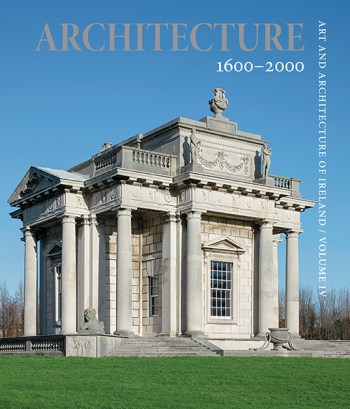 Art and Architecture of Ireland is an authoritative and fully illustrated survey that encompasses the period from the early Middle Ages to the end of the 20th century. The five volumes explore all aspects of Irish art—from high crosses to installation art, from illuminated manuscripts to Georgian houses and Modernist churches, from tapestries and sculptures to oil paintings, photographs and video art. This monumental project provides new insights into every facet of the strength, depth and variety of Ireland’s artistic and architectural heritage.
Architecture, 1600–2000 is the most complete survey of architecture in Ireland ever published. The essays in this volume cover all aspects of Ireland’s built environment, not only buildings but infrastructure, landscape development, public and private construction and much else. The volume challenges and expands the traditional understanding of Irish ‘architecture’, giving novel and exciting interpretations of the field and, by means of many striking illustrations, encourages us to think anew about the environment that surrounds us.
Rolf Loeber holds professorships at the University of Pittsburgh, where he oversees research on the causes of crime as well as mental health problems in young people. He has published extensively on Irish architecture, the history of fiction, and social, economic and plantation history. Hugh Campbell is professor of architecture at University College, Dublin, where he is currently head of the School of Architecture. He has published extensively on subjects from Irish architecture and urbanism to photography and urban space. Livia Hurley is an architect and architectural historian working in private practice in Dublin. Her research interests include urban history and the study of industrial sites and monuments. John Montague is assistant professor in the College of Architecture, Art and Design at the American University of Sharjah, UAE. His research interests include medieval and early modern architecture, and urban mapping. He is co-author, with Colm Lennon, of John Rocque’s Dublin: A Guide to the Georgian City (Dublin, 2010). Ellen Rowley is an architectural historian, researching 20th-century architecture in Ireland and beyond. She has written extensively on architectural modernism and edited a collection of Irish architectural writing: Patterns of Thought (2012). She is a research fellow at Trinity College Dublin.
New Book | Nathaniel Clements: Politics, Fashion, and Architecture
Published by Four Court Press and available from Artbooks.com (the book launch takes place in Dublin on Thursday, 12 February 2015 at the Royal Irish Academy) . . .
Anthony Malcomson, Nathaniel Clements (1705–77): Politics, Fashion, and Architecture in Mid-Eighteenth-Century Ireland (Dublin: Four Courts Press, 2015), 290 pages, ISBN: 978-1851829149, €55 / $75.
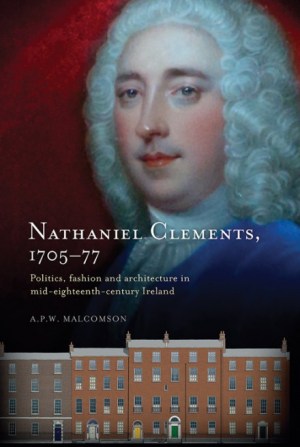 This book argues that Nathaniel Clements was an enlightened patron of architecture, not a practising architect, and that he influenced upper-class residential development in Dublin and popularised a particular form of Palladian ‘villa-farm’ (or modest country house) partly because of who he was—a high-ranking and well-connected government official and an arbiter of fashion and taste. The two places where his architectural influence is still strongly felt today are the high-fashion enclave of Henrietta Street, Dublin, of which he created about one-third in the period 1733 c.1740, and the Phoenix Park, of which he was Ranger, where he made important improvements to the landscape and where he built in 1752–57 a new Ranger’s Lodge which forms the nucleus of today’s Áras an Uachtaráin. The book provides a detailed analysis of these aesthetic achievements and (following Clements’ death) of the re casting of the Ranger’s Lodge as a British viceregal residence during the period 1782–c.1800. It concludes with a broader discussion of the ‘amateur’ tradition in British and Irish architecture and of Clements’ place among the ‘amateurs’ who dominated the art form in the decades before the coming-of-age of a fully-fledged architectural profession.
Anthony Malcomson was director of the Public Record Office of Northern Ireland from 1988 until 1998, and during a career in archives which began in 1967 has sorted and listed the papers from c.75 Irish country houses. His publications, mainly based on the evidence of this material, include Nathaniel Clements: Government and the Governing Elite in Ireland, 1725–75 (2005), Virtues of a Wicked Earl: The Life and Legend of William Sydney Clements, 3rd Earl of Leitrim, 1806–78 (2009), and John Foster (1740–1828): The Politics of Improvement and Prosperity (2011).










 Enfilade
leave a comment