Exhibition | Fashioning the Body: An Intimate History of the Silhouette
Press release for the upcoming exhibition at the BGC:
Fashioning the Body: An Intimate History of the Silhouette
Musée des Arts Décoratifs, Paris, 5 July — 24 November 2013
Bard Graduate Center, New York, 3 April — 26 July 2015
Curated by Denis Bruna
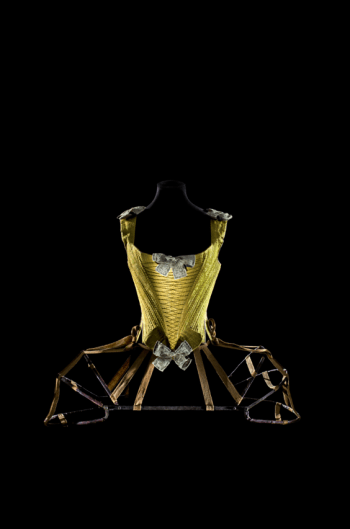
Whalebone corset. France, ca. 1740–60. Silk satin damask, braided silk, linen bows covered in silk and decorated with metallic thread, whalebone, linen lining. Les Arts Décoratifs, PR 995.16.1. Articulated pannier. France, ca. 1770. Iron covered with leather, fabric tape. Les Arts Décoratifs, depot du musée national du Moyen Âge-Thermes et hotel de Cluny 2005, Cluny 7875. Photographer: Patricia Canino.
Having garnered high acclaim at the Musée des Arts décoratifs in Paris in 2013, the exhibition Fashioning the Body: An Intimate History of the Silhouette will be on display at the Bard Graduate Center from April 3 through July 26, 2015. The exhibition will present the many devices and materials that women and men have used to shape their silhouettes from the seventeenth century to today, including panniers, corsets, crinolines, bustles, stomach belts, girdles, and push-up brassieres. The exhibition will also look at how lacing, hinges, straps, springs, and stretch fabrics have been used to alter natural body forms.
Curated by Denis Bruna, curator of pre-19th-century fashion and textile collections at the Musée des Arts décoratifs and professor at the École du Louvre, the exhibition will explore the history of what has long been ‘behind the scenes’ in clothing and fashion—far beyond the corset, the best-known device for shaping the figure. This show, which draws heavily on the Paris museum’s unrivaled costume collection, is the first of its kind, and the Bard Graduate Center will be its only venue in North America.
Although a broad array of silhouette-shaping garments has evolved over the course of fashion history, and techniques have been refined, the purpose of such garments has remained consistent: to flatten the stomach, compress the waist to the point of hollowing it out, support the bust, lift the breasts (and sometimes flatten them), and add curves to the hips. In short, comfort was superseded by appearance until about 1900, when couturiers such as Paul Poiret launched, however fleetingly, a vogue for ‘natural’ lines.
The tricks for fashioning women’s bodies have always confounded belief, from the earliest boned bodices through today’s push-ups. Spread across three floors of the Bard Graduate Center Gallery’s townhouse, Fashioning the Body opens with the seventeenth-century silhouette, exemplified by a rare women’s Spanish doublet, which was internally reinforced to be more rigid. Structured with armatures and other mechanisms, the garments of the eighteenth century enforced the erect posture prized first by the aristocracy and later by an influential bourgeoisie in order to convey a sense of superiority through the display of an idealized physical form. The epitome of the transformed female silhouette is the late eighteenth-century formal or court dress, examples of which will be on display alongside the undergarments that molded their distinctive silhouettes. In men’s fashion, the exhibition explores how padded jackets provoked arched torsos; how calf enhancers, stomach belts, and codpieces were worn; and how variations on these enhancements continued into the nineteenth century and beyond. The exhibition will also include garments for children, who wore corsets beginning in the seventeenth century.
Fashioning the Body continues into the nineteenth century, in which the corset held tyrannical sway, embodying the voguish insistence on a ‘wasp waist’, accentuated by the excessive ballooning of crinoline. After 1870 this kind of boned hoopskirt disappeared and was replaced by the bustle—also known as the faux-cul (fake buttocks), ‘shrimp tail’, or strapontin (jump seat)—which gave women an odd and sinuous profile reminiscent of a goose. Undergarments were never as abundant or as concealed as they were in the nineteenth century. The exhibition will continue with the brassiere and girdle, including examples used by men, and eventually the bust-enhancing and push-up bras of today. These devices were designed to create a plunging look for even the slimmest figures, reflecting the dictates of the canons of beauty at a time when bodies are modeled more by diets, body building, and surgery than by clothing.
In addition to complete outfits shaped by these hidden structural contraptions, the exhibition will also feature moving mannequins wearing mechanized reconstructions of panniers, crinolines, and bustles in order to show how the undergarments worked. The exhibition space will also include an area where visitors can try on specially made replicas of corsets, eighteenth-century panniers, and crinolines in order to understand the workings of these structures, which have played such an important role in the history of fashion.
Denis Bruna has a doctorate in history from the University of Paris I Panthéon-Sorbonne. He joined Les Arts Décoratifs in 2011 as curator of textile and fashion collections before the nineteenth century. He is also a professor and director of research in the history of fashion, costume, and textiles at the École du Louvre. His research focuses on the history and iconography of the costume, dress, and customs of the body. He has published several books and was the curator of the 2012 exhibition Fashioning Fashion: Two Centuries of European Fashion 1700–1915.
The Bard Graduate Center is a graduate research institute in New York City. The Center’s Gallery exhibitions and publications, MA and PhD programs, and research initiatives explore new ways of thinking about decorative arts, design history, and material culture. Founded in 1993, the BGC is an academic unit of Bard College. Fashioning the Body is the third in a series of collaborations between the Musée des Arts décoratifs and the Bard Graduate Center, which included Chinese Cloisonné (2011) and Discovering the Secrets of Soft-Paste Porcelain at the Saint-Cloud Manufactory, ca. 1690–1766 (1999).
The Musée des Arts décoratifs, housed in the Louvre building, is a unique, private institution composed of a specialized library, teaching facilities, and an ensemble of prestigious museums, including the Musée Nissim de Camondo and the Musée des Arts décoratifs. The Musée des Arts décoratifs fulfills a unique role in the French cultural landscape. Its six thousand objects on view in 10,000 square meters of exhibition space highlight the skills of craftsmen through the centuries, the evolution of styles, technological innovation, and the creativity of artists in enriching our day-to-day environ- ment. It is the only museum able to pay tribute to all the great names that have forged the history of French taste, from Boulle, Sèvres, Aubusson, Christofle, Lalique, and Guimard to Mallet Stevens, Le Corbusier, Perriand, and Starck. The museum’s chronological itinerary guides visitors through all the major styles and movements, from Gothic to Louis XVI, Art Nouveau, Art Deco, and modern design. Les Arts Décoratifs also boasts exceptional fashion and textile collections, among the finest in the world, and a vast collection of advertising posters, films, and objects. The wealth of these collections enables Les Arts Décoratifs to run a program of ten to fifteen thematic and monographic exhibitions covering every historic and contemporary aspect of the decorative arts.
◊ ◊ ◊ ◊ ◊
The Bard Graduate Center, in collaboration with Yale University Press, will publish an English-language version of the book that accompanied the exhibition in Paris, which is now out of print:
Denis Bruna, ed., with photographs by Patricia Canino, Fashioning the Body: An Intimate History of the Silhouette (New Haven: Yale University Press, 2015), 272 pages, ISBN: 978-0300204278, $50.
 This unique survey offers fascinating insights into the convoluted transformations employed by both men and women to accommodate the fickle dictates of fashion. With high design, wit, and style, Fashioning the Body tracks the evolution of these sartorial devices—from panniers, crinolines, and push-up bras to chains, zippers, and clasps—concealed beneath outer layers in order to project idealized figures. Women’s corsets constricted waists; exaggerated buttocks and hips counterbalanced jutting bust lines; and chic, aerodynamic silhouettes compressed breasts and flattened bellies. Yet masculine fashion has been no stranger to these tortuous practices. Men flaunted their virility by artificially broadening their shoulders, applying padding to their chests, and slipping codpieces over their groins. With more than 200 beautiful illustrations—including reproductions of superb historic advertisements—Denis Bruna reveals the industry and art of these contrivances meant to entice and beguile as well as assert status and power. Contemporary haute-couture designers Thierry Mugler, Jean Paul Gaultier, Rei Kawakubo for Comme des Garçons, Christian Lacroix, and Vivienne Westwood are featured in this indiscreet tour of intimate fashion history.
Exhibition | Fantastical Worlds: Adam Friedrich von Löwenfinck
From the Staatliche Kunstsammlungen Dresden:
Fantastical Worlds: Painting on Meissen Porcelain
and German Faience by Adam Friedrich von Löwenfinck (1714–1754)
Zwinger, Dresden, 1 October 2014 — 22 February 2015

Adam Friedrich von Löwenfinck, Meissen, 1734
To mark the 300th anniversary of the birth of Adam Friedrich von Löwenfinck, the Porzellansammlung of the Staatliche Kunstsammlungen Dresden presents a comprehensive exhibition of this artist’s oeuvre, bringing together around 100 selected porcelain and faience exhibits from the Dresden Porzellansammlung, private collections and renowned museums, including the Metropolitan Museum of Art, New York, the Rijksmuseum, Amsterdam, the Reiss-Engelhorn Museum, Mannheim, and the Museum für Kunst und Gewerbe, Hamburg.
Adam Friedrich von Löwenfinck (1714–1754) was one of the most important ceramic painters of the eighteenth century. He began his career at the Meissen Porcelain Manufactory in 1728, but by 1736 had fled to escape restrictions on his artistic development and difficult working conditions in the painters’ workshops. His life then took an adventurous path to a succession of faience manufactories, starting with Bayreuth and moving on by way of Fulda to Strasbourg-Haguenau. Due to his exceptional artistic abilities, but also to his guile and lack of scruples, Löwenfinck eventually rose from lowly journeyman painter to manufactory director.
Inspired by the painted decoration on Chinese and Japanese porcelain in the collection of August the Strong, he created a fantastic world inhabited by vibrantly colourful, fabulous creatures. He later took these exotic motifs, as well as his knowledge of both East Asian and European flower painting, with him as he travelled, transferring them from one workplace to the next. As Löwenfinck did not sign his works, for a long time it was impossible to attribute them with any certainty: as a result, his oeuvre long remained completely unrecognised, even among specialists.
The life and works of this exceptional artist were the focus of several years of research conducted by the Porzellansammlung of the Staatliche Kunstsammlungen Dresden. The results of this project are now presented in a comprehensive anniversary exhibition. Systematic evaluation of archive sources, including manufactory reports and case files, shed light on previously little known aspects of social conditions in the porcelain and faience manufactories of the time, and enabled a fundamental and thorough reassessment of his work.
◊ ◊ ◊ ◊ ◊
◊ ◊ ◊ ◊ ◊
From Arnoldsche Art Publishers:
Ulrich Pietsch, Phantastische Welten: Malerei auf Meissener Porzellan und deutschen Fayencen von Adam Friedrich von Löwenfinck, 1714–1754 (Stuttgart: Arnoldsche Art Publishers, 2014), 384 pages, ISBN: 978-3897904200, 78€.
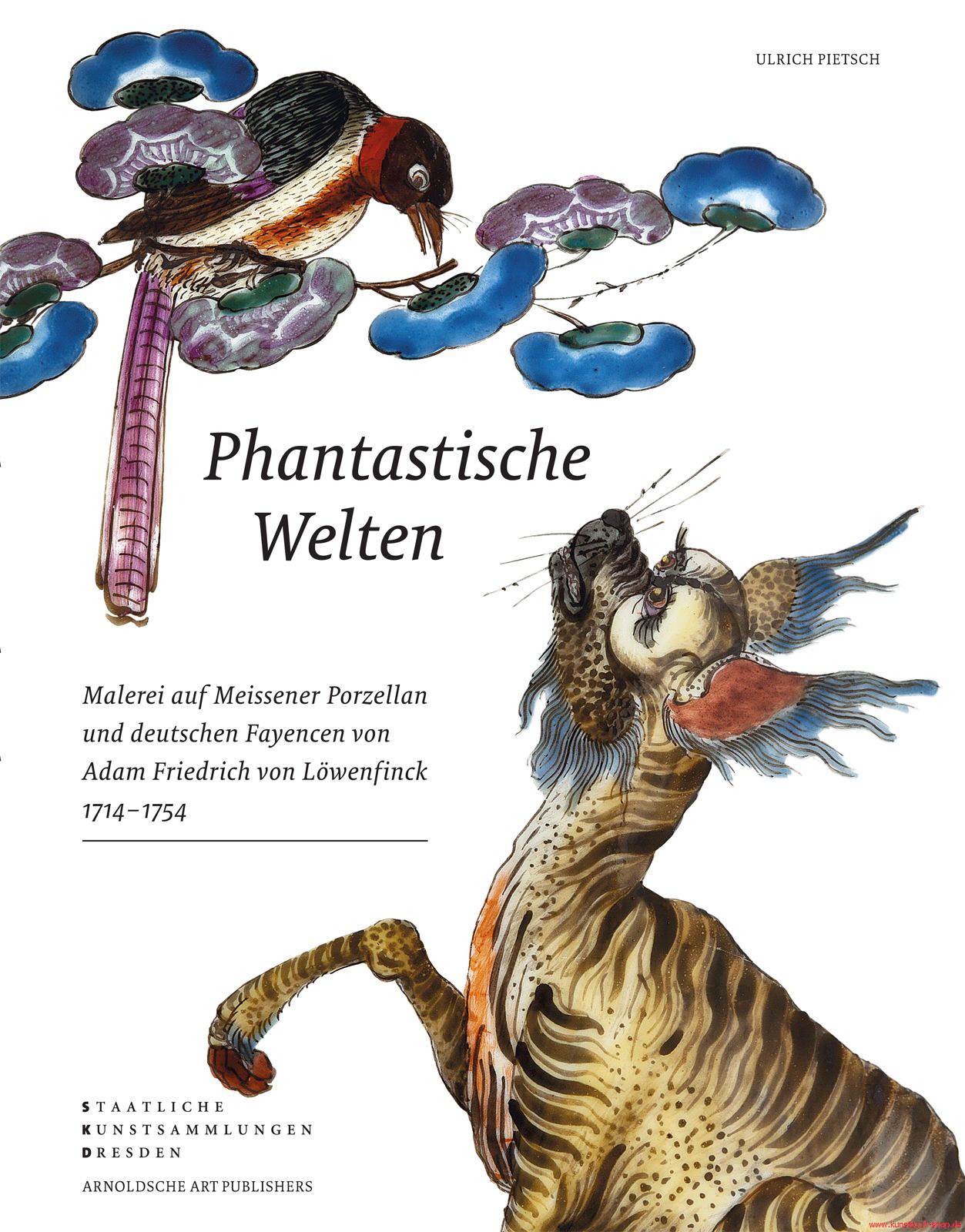 Adam Friedrich von Löwenfinck (1714–1754) war einer der bedeutendsten Keramikmaler des 18. Jahrhunderts. Er begann seine Karriere 1728 in der Porzellan-Manufaktur Meissen, die er wenige Jahre später wieder verließ, um der Einschränkung seiner künstlerischen Entfaltung und den schwierigen Arbeitsbedingungen in den Malerstuben zu entfliehen. Sein abenteuerlicher Lebensweg führte ihn in verschiedene Fayence-Manufakturen, darunter Bayreuth, Ansbach, Fulda, Höchst und Straßburg-Haguenau. Aufgrund seiner außergewöhnlichen künstlerischen Fähigkeiten, aber auch durch Geschick und Skrupellosigkeit stieg Löwenfinck schließlich vom einfachen Malergesellen in die Position eines Manufakturdirektors auf. Löwenfinck ist bekannt für seine fantastische Welt bunt schillernder und märchenhafter Fabeltiere. Er beeinflusste und prägte nachhaltig die Keramikmalerei seiner Zeit und wirkte stilprägend auf viele andere Manufakturen des 18. Jahrhunderts in Europa. Aufgrund fehlender Künstlersignaturen ist sein Werk umstritten und wurde bislang kontrovers diskutiert.
Die vorliegende Publikation ist das Ergebnis eines mehrjährigen Forschungsprojektes der Porzellansammlung Dresden, mit der nun erstmals eine grundlegende Untersuchung der Biografie und des OEuvres Adam Friedrich von Löwenfincks vorgelegt wird.
Call for Articles | Special Issue of Perspective on Textiles
From H-ArtHist:
Thematic Issue of Perspective: La Revue de l’INHA—Textiles
Submissions due by 31 March 2015
The forthcoming thematic issue of Perspective: La Revue de l’INHA (slated for publication in December 2016 and conceived jointly with the Mobilier national and the Manufactures nationales) will be devoted to textiles across different periods and different places of production and use. The double purpose of this issue is to bring together articles that represent the state of recent—or even ongoing (in the case of Switzerland, Germany and France)—research, while at the same time following single diachronic threads: from medieval embroidery to Louise Bourgeois’s arachnid works, from the ornamentation of the body in antiquity to the Silk Road… It will provide an occasion to examine the textile craft as portrayed by Diego Velázquez in Las Hilanderas (1657, Madrid, Museo Nacional del Prado); indeed, this seminal painting from the artist’s abundant oeuvre inspires precisely the sort of innovative study that considers the notion of textile as a metaphorical and intermedial space, whereby the canvas reveals itself as both surface and subject.
While textiles offer art history a plethora of objects and subjects, the field must also open itself to interdisciplinary dialogue involving labor history, gender studies, and museum studies, as well as material culture studies, postcolonial studies, economic history, and geopolitics, especially as it relates to the procurement of raw materials. Art history is similarly strengthened when it brings scientific and technical history to bear on the fabrication of hand-made or industrial artifacts. The history of artisans and other agents, from producers to consumers, also offers particularly rich areas of study, on topics ranging from the Cévennes weavers of yesteryear to today’s Bangladeshi textile workers to visitors at the Centre national du costume de scène (National Center for Stage Costumes) in Moulins. In the context of a denationalized history of art, it is possible to examine—to name just a few—the industry of Indian-inspired cotton fabrics in eighteenth-century Europe, the international distribution in the twentieth century of ready-made clothing manufactured in China, or the many avatars of African textiles that reappear, for example, in the contemporary art of Yinka Shonibare, but that can also be traced through the long history of Benin appliqué cloths or the appropriation of ancestral textile practices in contemporary art of the Maghreb.
The issue will delve into the worlds of cultivation (sowing and harvesting), manufacture (weaving, dyeing, tailoring), and local and international commerce, and, more generally, examine the manifold uses of textiles in all periods and in all the corners of the globe. Artists have constantly been reinventing their relationship to textility as both ideal and material, from Mesoamerican feather cloth to Jana Sterbak’s Flesh Dress, not to mention the well-established archetypal relationship with abstract painting. Finally, a diachronic exploration of the history of textile institutions is also encouraged, ranging from centuries-old traditional manufactures to franchised fashion institutes such as the Parsons The New School for Design, now established in New York, Paris, and Shanghai. Similarly, much can be gained from looking more closely at museums involved in the conservation, restoration, or exhibition of textiles, or even the re-creation of old textiles and the commissioning of contemporary creations (Aubusson, Beauvais, The Gobelins).
These numerous topics (textile archeology, printed embroidery materials, theories of the arabesque, sampling processes, etc.) and objects (wall hangings, rugs, lace, clothing, upholstery, stage props, sculpted draperies, and so on) represent a variety of leads that Perspective wishes to explore. The thematic issue on textiles will comprise articles representing multiple forms and contents. Proposals may fall into one of two categories: either a synthetic article highlighting a particular aspect of textiles (25,000 characters/4,000 words) or a historiographical study concentrating on a specific medium, territory of production, or historical period whose textile specificity (in terms of materials, style, etc.) remains to be defined (45,000 characters/7,000 words).
This call for papers does not aim to cover all of the projected subjects. All submissions are therefore welcome, although we wish to favor, as far as possible, a trans-chronological approach. Submissions will be examined by the editorial committee for the issue, which includes Marc Bayard, Marion Boudon-Machuel, Catherine Breniquet, Pascale Charron, Rossella Froissart, Charlotte Guichard, Rémi Labrusse, Anne Lafont, Johanne Lamoureux, Philippe Malgouyres, Sara Martinetti, Nicole Pellegrin, Zahia Rahmani, Katie Scott, Philippe Sénéchal, Philippe Thiébaud, Merel van Tilburg, and Tristan Weddigen.
Please send submissions (a 2000–3000 character/300–500 word abstract and a 2–3 line biography) to revue-perspective@inha.fr by March 31, 2015.
Exhibition | Jean-Etienne Liotard
On this summer at the Scottish National Gallery (more information to come in the spring). . .
Jean-Etienne Liotard
Scottish National Gallery, Edinburgh, 4 July — 13 September 2015
Royal Academy, London, 24 October 2015 — 31 January 2016
Curated by MaryAnne Stevens, William Hauptman, and Christopher Baker

Jean Étienne Liotard, Laura Tarsi, ‘A Grecian Lady’, watercolour and bodycolour on ivory, ca 1745–49 (Cambridge: Fitzwilliam Museum)
A stunning exhibition celebrating one of the greatest artists of the eighteenth century. The work of Jean- Étienne Liotard (1702–89) has been rarely exhibited, and this is the first time it will be comprehensively celebrated in Britain.
Liotard enjoyed a long career, and his finest portraits display an astonishing hyper-realism achieved through a combination of incredible, intense observation and remarkable technical skills. He excelled at the delicate art of pastel, but also drew, painted in oil, created enamels, and was a refined miniaturist and printmaker. His activity was prodigious: Liotard wrote a treatise on painting, was a collector, a dealer, a traveller and an artistic innovator. In the age of Mozart and Casanova, he was a key international figure whose achievement deserves to be better known. Highlights of this important show include famous portraits, startling self-portraits, and brilliant experiments with genre and still-life subjects from the end of his career.
◊ ◊ ◊ ◊ ◊
Update (added 5 July 2015) — From the press release:
The National Galleries of Scotland is delighted to announce a major exhibition in the summer of 2015 celebrating one of the greatest yet little- known artists of the eighteenth century. The work of Jean-Étienne Liotard (1702–1789) has rarely been exhibited and this is the first time it will be comprehensively celebrated in Britain. Liotard enjoyed a long career and his finest portraits display an astonishing hyper-realism achieved through a combination of incredible, intense observation and remarkable technical skills.
Liotard was one of the most sophisticated artists of eighteenth-century Europe; a brilliant, witty portraitist, he excelled at the delicate art of pastel, but also drew, painted in oil, created enamels and was a refined miniaturist and printmaker. According to his contemporary Horace Walpole “Truth prevailed in all his works.” In some respects he also displayed striking modernity as a highly accomplished self-publicist, formulating a powerful ‘eastern’ image of himself following his period in Constantinople, by wearing exotic clothes and growing a long beard, which became as much a focus of curiosity as his portraits. His activity was prodigious: Liotard wrote a treatise on painting, was a collector, a dealer, a traveller and an artistic innovator. In the age of Mozart and Casanova, he was a key international figure, whose achievement deserves to be better known.
Born in Geneva, he travelled extensively, working in Amsterdam, The Hague, Venice, Rome and Naples. He spent four years in Constantinople depicting foreign residents in the city and developed a fascination with near- eastern fashions and customs. His career also took him to the courts of Vienna, Paris and London, where he portrayed the families of Empress Maria Theresa, King Louis XV and Augusta, Princess of Wales, creating images of great candour and charm.
Christopher Baker, Director of the Scottish National Portrait Gallery, and one of the exhibition’s curators commented: “This exhibition will be a revelation to many visitors who are unfamiliar with Liotard’s dazzling achievement. He was undoubtedly one of the most remarkable and idiosyncratic artists of the eighteenth century, and his work and career are fascinating, as they touch on themes such a travel, orientalism, court art, fashion and technical experimentation.”
Liotard depicted a number of important British patrons, in addition to members of the Royal family, such as the actor David Garrick, and some of his key works remain in U.K. public and private collections. Highlights of the exhibition will also include a selection of his startling self-portraits and brilliant experiments with genre and still life subjects that date from late in his career.
◊ ◊ ◊ ◊ ◊
Christopher Baker, Duncan Bull, Marc Fehlmann, William Hauptman, Neil Jeffares, Aileen Ribeiro, MaryAnne Stevens, Jean-Etienne Liotard (London: Royal Academy Publications, 2015), 224 pages, ISBN: 978-1907533990, £35.
 Renowned during the eighteenth century for his exquisite portraits and works in pastel, not to mention his outlandish Orientalist outfits, Jean-Etienne Liotard (1702–1789) painted some of the most significant rulers and aristocrats in Europe, including the entire British Royal Family. A peripatetic artist who worked in the Near East as well as in major European capitals, Liotard was born in Geneva and studied in Paris, before travelling to Italy and then on to Constantinople, in the company of Lord Duncannon. While there he painted the local residents as well as the British community, and adopted the eccentric style of dress that, when he later visited London, saw him become known as ‘The Turk’. This volume, accompanying the first exhibition of his works to be shown in the United Kingdom, illuminates the career of this unique artist, showcasing a variety of his extraordinary works, including portraits, drawings
and enamels.
Christopher Baker is Director of the Scottish National Portrait Gallery.
Duncan Bull is Curator of Foreign Paintings at Rijksmuseum, Amsterdam.
Marc Fehlmann is Associate Professor of Archaeology and Art History at Eastern Mediterranean University, Northern Cyprus.
William Hauptman is an independent scholar.
Neil Jeffares is an art historian with a particular interest in eighteenth-century pastels.
Aileen Ribeiro is Emeritus Professor at the Courtauld Institute of Art.
Mary-Anne Stevens, an independent curator, worked as Director of Academic Affairs at the Royal Academy for 29 years.
◊ ◊ ◊ ◊ ◊
Note (added 17 January 2016) — Neil Jeffares has compiled an extensive errata for the catalogue, available at his website.
The British and Irish Studies Intelligencer
As a follow-up to yesterday’s posting of the call for papers for this year’s meeting in November of the North American Conference of British Studies, I would draw readers’ attention to The British and Irish Studies Intelligencer (BISI), a blog founded in the summer of 2014 under the auspices of the NACBS. While its reach extends well beyond the eighteenth century, for those of you working within the field of British Studies, there will be items of potential interest. A piece from last month, for instance, by Robin Eagles, “John Wilkes the Tourist: Travel in 18th-century England,” occasioned by the publication of Eagles’s edition of The Diaries of John Wilkes 1770–1797 (London Record Society, 2014), addresses not only Wilkes’s travels but underscores the usefulness of his diaries for eighteenth-century travel more generally thanks to the specificity of his notes.
As a member of BISI’s editorial board, I encourage you to have a look at the submissions page, and please feel free to contact me with questions or ideas for contributions. –CH
Editorial Board
Elaine Chalus, Bath Spa University
Craig Hanson, Calvin College
Jason M. Kelly, Indiana University-Purdue University Indianapolis
Isaac Land, Indiana State University
Bloggers
Caroline Boswell, University of Wisconsin, Green Bay
Stephen Jackson, University of Sioux Falls
Call for Papers | NACBS in Little Rock, 2015

Skyline of Little Rock, Arkansas, from the top of the River Market parking deck looking southwest, March 2005. Photo by Bruce Stracener, via Wikimedia Commons.
◊ ◊ ◊ ◊ ◊
From NACBS:
North American Conference of British Studies Annual Meeting
Little Rock, Arkansas, 13–15 November 2015
Proposals due by 3 March 2015
The NACBS (North American Conference on British Studies) and its Southern affiliate, the Southern Conference on British Studies, seek participation by scholars in all areas of British Studies for the 2015 meeting. We will meet in Little Rock, Arkansas, November 13–15, 2015 (in conjunction with the meeting of the Southern Historical Association). We solicit proposals for panels on Britain, the British Empire and the British world. Our interests range from the medieval to the modern. We welcome participation by scholars across the humanities and social sciences.
We invite panel proposals addressing selected themes, methodology, and pedagogy, as well as roundtable discussions of topical and thematic interest, including conversations among authors of recent books and reflections on landmark scholarship. We are particularly interested in submissions that have a broad chronological focus and/or interdisciplinary breadth. North American scholars, international scholars and Ph.D. students are all encouraged to submit proposals for consideration. Panels typically include three papers and a comment, and ideally a separate chair; roundtables customarily have four presentations, as well as a chair; proposals which only include papers will be less likely to succeed. We are not able to accommodate individual paper proposals; those with paper ideas may search for additional panelists on lists such as H-Albion or at venues such as the NACBS Facebook page. Applicants may also write to the Program Chair for suggestions (nacbsprogram@gmail.com).
In addition to the panels, this year we will be sponsoring a poster session. The posters will be exhibited throughout the conference, and there will be a scheduled time when presenters will be with their posters to allow for further discussion.
All scholars working in the field of British Studies are encouraged to apply for the 2015 conference. Panels that include both emerging and established scholars are encouraged; we welcome the participation of junior scholars and Ph.D. candidates beyond the qualifying stage. To foster intellectual interchange, we ask applicants to compose panels that feature participation from multiple institutions. No participant will be permitted to take part in more than one session.
More information is available here»
Call for Papers | Classical Influences on Georgian Stourhead
Thanks to Hélène Bremer for passing along this CFP:
Classical Influences on Georgian Stourhead
Stourhead, Wiltshire, 11–12 November 2015
Proposals due by 31 March 2015
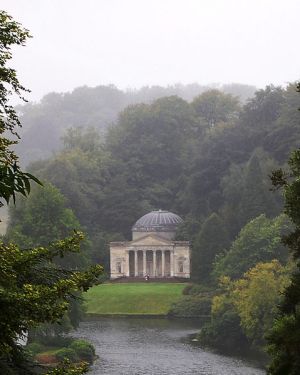
Pantheon at Stourhead, via Wikimedia Commons. Photo by Luke Gordon, 14 August 2007.
The gardens at Stourhead feature a number of elements influenced by the legacy of classical Rome. Henry Hoare, the owner of Stourhead from 1741 to 1783, travelled to Rome as part of his own Grand Tour and his chief architect, Henry Flitcroft, was part of Lord Burlington’s circle. On Day 1 of this event we will explore classical influences on the eighteenth-century English country garden. On Day 2 we will consider classical influences solely in the context of the garden and wider estate at Stourhead.
We invite papers on all aspects of classical influences on the eighteenth-century English garden and particularly the following topics:
• The influence of the Grand Tour on eighteenth-century English country gardens
• Visitor accounts of Stourhead and other eighteenth-century English country gardens
• Eighteenth-century English country garden designers
• The picturesque and the design and reception of the eighteenth-century English country garden
• Depiction of the eighteenth-century English country garden in the fine arts
• The country garden and publishing: newspapers, periodicals, guidebooks and journals
• Topographical poetry
• Theories of meaning in the eighteenth-century English country garden
• Relationships between houses, gardens and wider estates
• Lord Burlington and his circle
• The influence of classical Roman literature on the eighteenth-century English country garden
• Greek influences in eighteenth-century English country gardens
If you would like to present a paper, then please send a 300-word abstract to Dr. John Harrison at: jeh87@my.open.ac.uk by 31st March 2015.
Keynote Speakers
Roey Sweet, author of Cities and the Grand Tour: The British in Italy, 1690–1820 (University of Leicester); and Richard Wheeler, National Specialist in Garden History (National Trust)
Installation | A Voyage to South America

Unidentified artist, active in Cuzco, Peru, Our Lady of the Rosary of Chiquinquirá with Female Donor, late 17th/early 18th century (Carl and Marilynn Thoma Collection)
◊ ◊ ◊ ◊ ◊
From the AIC:
A Voyage to South America: Andean Art in the Spanish Empire
Art Institute of Chicago, 11 November 2014 — 21 February 2016
While the Art Institute has a long tradition of collecting and displaying works from the pre-Hispanic cultures of South America, this long-term installation offers the museum’s first presentation of work from the viceregal period. Fourteen paintings and related works on paper—including pieces from the collection of Chicagoans Marilynn and Carl Thoma never before displayed in a museum, as well as important loans from the Newberry Library and Denver Art Museum—introduce visitors to explorers, artists, and patrons who lived in the Spanish-governed Andes during the 17th, 18th, and 19th centuries.
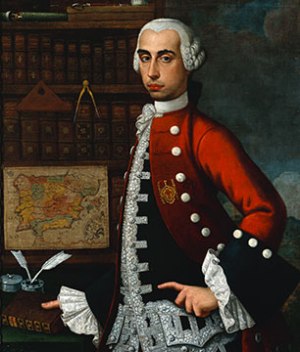
Unidentified artist, active in Spain, Portrait of Antonio de Ulloa y de la Torre-Guiral, 1768–70
(Carl and Marilynn Thoma Collection)
The metaphorical guide of this journey is Antonio de Ulloa (1716–95), a Spanish naval officer and cartographer who traveled to South America with a French scientific mission in the 1730s and 1740s. His portrait introduces the group of works assembled—paintings of identified sitters, signal works by important South American artists, and devotional paintings that include historical figures. Each work has its own direct link to individual biography and lived experience in the New World, offering a more personal look at the themes of exploration and discovery and bringing to life the culture and artistic production in South America as European conventions combined with indigenous traditions.
The installation is accompanied by a bilingual brochure as well as bilingual treatment of all object labels, wall texts, and audio guide stops. Select works have also been added to the museum’s ‘Closer’ app, featuring slide shows, videos, archival materials, and more for further insight into this unique period of cultural convergence.
At noon on 17 February 2015, Victoria Sancho Lobis, associate curator in the Department of Prints and Drawings, will discuss the exhibition.
◊ ◊ ◊ ◊ ◊
Chicago’s Newberry Library will host a symposium on Latin America in the Early Colonial Period on Saturday, 11 April 2015, exploring related material in the sixteenth and seventeenth centuries.
Rebecca Long Appointed Curator at the Art Institute of Chicago

◊ ◊ ◊ ◊ ◊
From the press release (9 January 2015) . . .
The Art Institute of Chicago announces the appointment of Rebecca Long as the Patrick G. and Shirley W. Ryan Associate Curator in the Department of Medieval to Modern European Painting and Sculpture. She will be responsible for Italian and Spanish painting and sculpture before 1750.
A specialist in the art of 16th- and 17th-century Spain and Italy, Long is currently Associate Curator of European Painting and Sculpture before 1800 at the Indianapolis Museum of Art. There she spearheaded work on the forthcoming catalogue of the museum’s Clowes Collection, offering the first scholarly and technical analysis of that important collection of masterworks of the Italian, Spanish, Netherlandish and German schools. She will assume her Art Institute duties on February 27, 2015.
“We are delighted to welcome Rebecca to the Art Institute,” said Sylvain Bellenger, Searle Chair and Curator, Medieval to Modern European Painting and Sculpture. “She is not just a scholar; she enjoys sharing her knowledge and passion to reveal the freshness in a work of art and to enlighten our diverse audiences, one of the museum’s key missions. Every Old Master was once a contemporary artist. Rebecca approaches the art of the Italian Renaissance with the aim of awakening for us the energy and immediacy the works held for the patrons and creators of their time.”
Long will be receiving her Ph.D. from New York University’s Institute of Fine Arts in early 2015, with a dissertation on Bartolomé Carducho and the role of Italian artists in the Spanish court during the Renaissance. She received her M.A. in art history and archaeology from New York University and her B.A. (magna cum laude), in the history of art and architecture as well as business administration, from the University of Pittsburgh. She has been awarded multiple prestigious fellowships, including those at the Metropolitan Museum of Art, the Villa La Pietra in Florence, and, most recently, the Harvard University Center for Italian Renaissance Studies at the Villa I Tatti, also in Florence. Long has actively presented her research at such venues as the National Gallery of Art’s Center for Advanced Studies in the Visual Arts and the annual conferences of the College Art Association, the Renaissance Society of America, and the Sixteenth Century Society. Forthcoming publications include the Catalogue of the Clowes Collection at the Indianapolis Museum of Art and essays in After Trent: Rethinking Art around 1600 and Sobre Vicente Carducho: Diálogos de la Pintura.
“I am thrilled to be joining the Art Institute,” said Long. “For a curator, the opportunity to work in a museum environment that combines a strong commitment to scholarship with an equal commitment to engaging visitors is a dream come true. I look forward to getting to work.”
Exhibition | The Critique of Reason: Romantic Art, 1760–1860

George Stubbs, A Lion Attacking a Horse, 96 x 131 inches (243.8 x 332.7 cm), 1762 (New Haven: Yale Center for British Art, Paul Mellon Collection B1977.14.71)
◊ ◊ ◊ ◊ ◊
From the YCBA:
The Critique of Reason: Romantic Art, 1760–1860
Yale University Art Gallery, New Haven, 6 March — 26 July 2015
Curated by Cassandra Albinson, Nina Amstutz, Elisabeth (Lisa) Hodermarsky, Paola D’Agostino, and Izabel Gass
The first major collaborative exhibition between the Yale University Art Gallery and the Yale Center for British Art, The Critique of Reason offers an unprecedented opportunity to bring together treasures of the Romantic art movement from the collections of both museums. The exhibition comprises more than three hundred paintings, sculptures, medals, watercolors, drawings, prints, and photographs by such iconic artists as William Blake, Théodore Géricault, Francisco de Goya, and J. M. W. Turner. This broad range of objects challenges the traditional notion of the Romantic artist as a brooding genius given to introversion and fantasy. Instead, the exhibition’s eight thematic sections juxtapose arresting works of art that reveal the Romantics as attentive explorers of their natural and cultural worlds as well as deeply invested in exploring the mysterious, the cataclysmic, and the spiritual. The richness and range of Yale’s Romantic holdings will be on display, presented afresh for a new generation of museumgoers.
The Critique of Reason: Romantic Art, 1760–1860 has been co-organized by the Yale Center for British Art and the Yale University Art Gallery. The curators are, at the Center, A. Cassandra Albinson, Curator of Paintings and Sculpture, and Nina Amstutz, Postdoctoral Research Associate, and, at the Gallery, Elisabeth (Lisa) Hodermarsky, Sutphin Family Senior Associate Curator of Prints and Drawings, and Paola D’Agostino, Nina and Lee Griggs Assistant Curator of European Art; and Izabel Gass, Graduate Research Assistant, is at the Center and Gallery. The exhibition has been made possible by the Art Gallery Exhibition and Publication Fund and the Robert Lehman, B.A. 1913, Endowment Fund, as well as by funds from the Yale Center for British Art Program Endowment.
◊ ◊ ◊ ◊ ◊
Note (added 30 March 2015) — In connection with the exhibition, Yale is hosting a two-day symposium, The Romantic Eye, 1760–1860 and Beyond, 17–18 April 2015. More information is available here»










 Enfilade
leave a comment