Exhibition | Ornements: Chefs-d’oeuvre de la Collection Jacques Doucet
From INHA:
Ornements, XVe-XVIIIe Siècles: Chefs-d’oeuvre de la Collection Jacques Doucet
Institut national d’histoire de l’art, Galerie Colbert, Paris, 2 October — 31 December 2014
 La Bibliothèque de l’Institut national d’histoire de l’art, héritière de la Bibliothèque d’art et d’archéologie créée par le couturier Jacques Doucet (1853–1929) à partir de 1908, est aujourd’hui riche de plus de 25 000 estampes d’ornement, réunies en près de 700 volumes. Son fonds d’estampes couvre la production, tant française qu’italienne ou allemande, du XVIe au XVIIIe siècle. Sources importantes pour les historiens des arts décoratifs, de l’architecture, de l’estampe, ces œuvres ont fait l’objet d’un catalogage informatisé et d’une numérisation, dans le cadre du programme « Histoire de l’ornement » de l’INHA. L’exposition, organisée dans la salle Roberto Longhi de la Galerie Colbert, correspond à l’achèvement de ce programme et à la parution d’un livre consacré à la collection d’estampes d’ornement de l’INHA, publié en coédition par Mare et Martin et l’INHA.
À travers la présentation d’une cinquantaine d’estampes, où se déploie une multiplicité de motifs (rinceaux, frises, fleurs, volutes, grotesques, trophées, cuirs…), l’exposition permet d’éclairer les fonctions de l’estampe d’ornement, mais aussi le contexte de sa production et de sa diffusion, et enfin, son statut d’objet d’étude et de collection. Sont particulièrement mis en valeur les points forts de la collection Doucet, telles les estampes allemandes des XVIe–XVIIe siècles (Martin Schongauer, Virgil Solis, Albrecht Dürer), les gravures d’orfèvres « cosses de pois » du premier XVIIe siècle (Jean Toutin), mais aussi les estampes françaises du XVIIIe siècle représentant rocailles et chinoiseries (Pillement, Huquier), ainsi que leurs copies européennes. Des objets d’art permettent de resituer la place de l’estampe au sein du processus de création. Enfin, reliures remarquables, états rares, épreuves coloriées, illustrent l’histoire des praticiens, amateurs ou collectionneurs de ces estampes, tel Edmond Foulc, dont la collection fut acquise par Jacques Doucet en 1914.
Commissariat
Michaël Decrossas, Lucie Fléjou
Remerciement
Jérémie Cerman, Rose-Marie Chapalain, Sophie Derrot, Elli Doulkaridou, Ludovic Jouvet, Léonie Marquaille, Étienne Tornier, Céline Ventura-Teixeira, qui par leur travail de catalogage des recueils d’ornement des collections Jacques Doucet de la Bibliothèque de l’INHA permettent aujourd’hui cette exposition. Ainsi que la Cité de la céramique, Sèvres & Limoges, musée national de Sèvres et Les Arts Décoratifs pour leurs prêts.
◊ ◊ ◊ ◊ ◊
From INHA:
Michaël Decrossas and Lucie Fléjou, eds, Ornements, XVe–XIXe Siècles: Chefs-d’œuvre de la Bibliothèque de l’INHA, Collections Jacques Doucet (Paris: INHA-Mare & Martin, 2014), 384 pages, ISBN: 979-1092054378, 37€.
 Marquant l’aboutissement d’un programme de recherche porté par l’Institut national d’histoire de l’art depuis 2010, cet ouvrage réunit vingt-six essais abordant quelques-unes des questions les plus intéressantes posées par l’ornement entre le XVIe et le XIXe siècle, et sa place dans l’histoire de l’art, qu’il s’agisse des estampes d’ornement ou des styles d’ornement (rococo, rocaille, « à l’antique »), ou encore d’artistes comme Jean Lemoyne, Gabriel Huquier, Charles Percier et Pierre-François-Léonard Fontaine. Un chapitre de l’ouvrage est consacré à Jacques Doucet, le grand couturier collectionneur qui est à l’origine de la Bibliothèque de l’INHA, laquelle conserve un fonds exceptionnel d’environ 25 000 estampes d’ornement.
Avec la collaboration de Jean-François Bédard (Syracuse University, New York), Michèle Bimbenet-Privat (musée du Louvre), Jean-Gérald Castex (Cité de la céramique – Sèvres & Limoges), Jérémie Cerman (université Paris-Sorbonne), Catherine Chédeau (université de Franche-Comté), Michaël Decrossas (INHA), Marzia Faietti (Galleria degli Uffizi), Lucie Fléjou (INHA), Rossella Froissart (université de Provence), Jean-Philippe Garric (université Paris 1 Panthéon-Sorbonne), Marianne Grivel (université Paris-Sorbonne), Caroline Heering (université catholique de Louvain), Rémi Labrusse (université Paris Ouest Nanterre La Défense), Corinne Le Bitouzé (Bibliothèque nationale de France), Guy-Michel Leproux (École pratique des hautes études), Estelle Leutrat (université de Rennes 2), Marie-Pauline Martin (université de Provence), Véronique Meyer (université de Poitiers), Christian Michel (université de Lausanne), Odile Nouvel-Kammerer (musée des Arts décoratifs), Anne Perrin-Khelissa (université de Toulouse II – Le Mirail), Antoine Picon (Harvard University), Sébastien Quéquet (musée des Arts décoratifs), Kristel Smentek (MIT, Massachusetts), Carsten-Peter Warncke (Georg-August-Universität Göttingen)
Display | William Hogarth, 1697–1764
Now on view at Tate Britain:
William Hogarth, 1697–1764
Tate Britain, London, 27 October 2014 — 26 April 2015
Bristol Museum & Art Gallery, Summer 2015
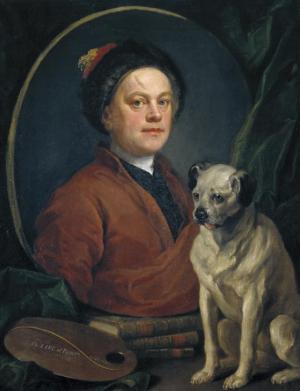
William Hogarth, The Painter and his Pug, 1745 (London: Tate, purchased 1824).
This display marks the 250th anniversary of the death of Hogarth. It includes almost all of his paintings in the Tate Collection, as well as prints, drawings and rarely seen items from the Tate Library and Archive.
The story of art in this country often begins with William Hogarth, who died in late October 1764. Satirist, printmaker, portraitist, history painter and art theorist, in the two hundred and fifty years since his death Hogarth has regularly been positioned as the founding father of British art. This persistent notion was reflected in the early years of Tate’s displays: for decades his was the earliest British work on show at Tate.
Hogarth first gained recognition painting scenes from the theatre. He went on to make his name with his darkly humorous ‘modern moral’ series depicting the declining fortunes of foolish or ignoble characters, and brought similar vivacity to the polite interiors of his ‘conversation piece’ portraits. In 1735 he founded an academy for artists and later wrote a treatise on the aesthetic theories he developed over the course of his career. Whether painting, printmaking or writing, he was concerned with forging and defending a distinctly British art.
In 1951 Tate mounted the first major exhibition of Hogarth’s work since 1814. Tate gained independence from the National Gallery in 1955 and started acquiring works in its own right, and further exhibitions and displays followed reflecting research into Hogarth’s life and art. From the early 1950s Tate also acquired work by earlier British artists, allowing Hogarth to be seen in the context of his predecessors: an innovative champion of British art, but by no means the first British artist.
Read more about Hogarth at the Tate
The online materials are useful, particularly Tim Batchelor’s account of the “Exhibitions and Displays” of Hogarth’s work at Tate (11 November 2014). –CH
Exhibition | Miniaturportraits um 1800
From the Wallraf-Richartz-Museum:
Im Blauen Salon: Miniaturportraits um 1800
Wallraf-Richartz-Museum & Fondation Corboud, Cologne, 14 November 2014 — 1 February 2015
 Mehr als 170 gemalte Porträts an einer Wand? Was klingt, wie ein Ding der Unmöglichkeit, wird im Wallraf wahr. Im Winter 2014/15 zeigt das Museum eine faszinierende Sammlung von Miniaturporträts aus dem 18. und 19 Jahrhundert: Da posiert der Musiker mit stolzer Miene am Klavier, ein Junge im Sonntagsstaat lächelt gequält und die feine Dame mit dem Silberblick schaut schüchtern am Betrachter vorbei. Das sind nur drei der en miniature gemalten Personen, aber sie lassen das breite Spektrum der Sammlung erahnen. Die kaum bierdeckelgroßen Werke kamen als Schenkung ans Wallraf und sind nun erstmals öffentlich zu sehen.
Miniaturporträts erfreuten sich vor rund 200 Jahren großer Popularität. Auf Pergament, Papier und sogar Elfenbein ausgeführt, dienten sie der Erinnerung an geliebte Mitmenschen. Die hochspezialisierten Maler hoben dabei gerne die besonderen Merkmale der Dargestellten lebendig hervor und schufen damit die vielleicht persönlichsten kunsthistorischen Zeugnisse überhaupt. Erst gegen Ende des 19. Jahrhunderts wurden die Miniaturporträts von der Fotografie verdrängt.
Workshop | The Enlightenment and Sacred Space

◊ ◊ ◊ ◊ ◊
From the Kunsthistorisches Institut at Tübingen:
Aufklaerung und sakraler Raum
Ästhetische Strategien und religiöses Wissen im katholischen Milieu des 18. Jahrhunderts
Eberhard Karls Universität Tübingen, Kunsthistorisches Institut, 29 November 2014
In Kooperation mit dem Graduiertenkolleg 1662 „Religiöses Wissen im vormodernen Europa (800–1800)“
Der Workshop thematisiert theologische und ästhetische Strategien der Kirchenerneuerung im monastischen Milieu der zweiten Hälfte des 18. Jahrhunderts. Im Austausch zwischen kunst- und kirchenhistorischer Forschung werden Ausstattungen sakraler Räume und Predigttexte im Kontext einer katholisch motivierten Aufklärung in den Jahrzehnten vor der Säkularisation diskutiert: die Rolle von Bildern, Objekten und Dekorationen, theologischen und künstlerischen Konzepten bei der Vermittlung religiösen Wissens in Auseinandersetzung mit im weitesten Sinne aufklärerischen Denkmustern und Handlungsfeldern.
Die Entscheidungen über die Neuordnung der Kirchenräume hingen von diversen thematischen, formalen und liturgischen Postulaten ab. Über eine Dichotomie von Barock und Klassizismus hinaus geraten Bildordnungen und Raumstrukturen, die Inszenierung figürlicher Darstellungen, ihre Einbindung oder Nichteinbindung in rituelle Praktiken und die offensive Zurschaustellung historischer Überlieferung im Spannungsfeld von institutioneller Legitimation und inhaltlicher Neubewertung in den Blick. Im Fokus der Beiträge stehen konkrete Phänomene – Predigten, ortsfeste und mobile Ausstattungen, Fresken, Stuck, Altarbilder, Grabmonumente und liturgisches Mobiliar bzw. ihre diskursive Reflexion –, die auf ihre mediale Funktion hin untersucht werden.
P R O G R A M M
9.10 Birgitta Coers und Markus Thome (Tübingen), Begrüßung und Einführung
9.30 Florian Bock (Tübingen), Inszenierung oder Entzauberung der Liturgie? Katholische Predigten und Kirchenraum zwischen 1650 und 1800
10.40 Dörte Wetzler (Jena), Aufgeklärte Wies? Überlegungen zum Einfluss der katholischen Aufklärung auf das Bild- und Ausstattungsprogramm der Wallfahrtskirche zum gegeißelten Heiland (1745–1754)
11.30 Lorenz Enderlein (Tübingen), „Umbettungen“. Retrospektive Sepulturen in barocken Klosterkirchen
14.00 Ute Engel (München), „Simplicitet, welche mit sanfter Gefaelligkeit verschwetert“. Deckengemälde von Johann Baptist Enderle in Kurmainz
15.10 Katinka Häret-Krug (Mainz), Die Ausstattung der Bronnbacher Klosterkirche in der zweiten Hälfte des 18. Jahrhunderts – Reaktion auf die katholische Aufklärung in den Bistümern Mainz und Würzburg?
16.00 Meinrad von Engelberg (Darmstadt), Aufklärung und Renovatio – Ergebnisse und Abschlussdiskussion
Organisation
Dr. Birgitta Coers
Jun.-Prof. Dr. Markus Thome
Graduate Student Workshop | Representing Slavery
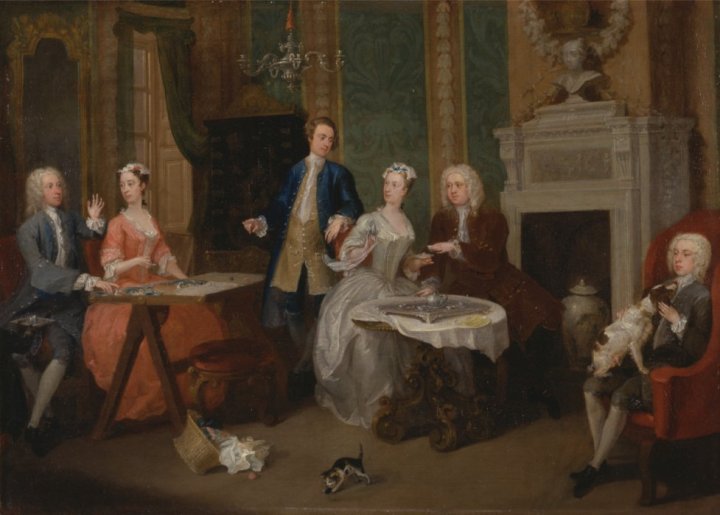
William Hogarth, Portrait of a Family (New Haven: Yale Center for British Art, Paul Mellon Collection). An interactive site includes images, a timeline of events, and audio commentaries on a selection of works included in the exhibition. Chi-ming Yang, for instance, describes some of the ways Hogarth’s painting might be understood to aestheticize race and skin color in relation to global commodities (both people and things).
◊ ◊ ◊ ◊ ◊
From the Yale University Library:
Workshop for Graduate Students | Representing Slavery in Eighteenth-Century Atlantic Britain
The Yale Center for British Art, New Haven and The Lewis Walpole Library, Farmington, 9–10 December 2014
Applications due by 1 December 2014
In December 2014, The Lewis Walpole Library and the Yale Center for British Art will jointly host a two-day workshop for graduate students focusing on two current Yale University exhibitions related to the visual culture of slavery: Figures of Empire: Slavery and Portraiture in Eighteenth-Century Atlantic Britain and Prospects of Empire: Slavery and Ecology in Eighteenth-Century Atlantic Britain. The workshop will provide an opportunity to explore these complementary exhibitions in depth and to examine additional materials related to the topic selected from the rich holdings of both institutions with curatorial and academic scholars working in the field. The workshop is open to graduate students from a variety of disciplines whose work would benefit from participation in this collaborative exploration of the topic.
Prospects of Empire is curated by Heather Vermeulen, Doctoral Candidate in African American Studies and American Studies, Yale University, and Hazel V. Carby, Charles C. & Dorathea S. Dilley Professor of African American Studies and Professor of American Studies, Yale University. The exhibition explores the notion of empire’s ‘prospects’—its gaze upon bodies and landscapes, its speculations and desires, its endeavors to capitalize upon seized land and labor, as well as its failures to manage enslaved persons and unruly colonial ecologies.
Figures of Empire is curated by Esther Chadwick and Meredith Gamer, PhD candidates in the Department of the History of Art at Yale University, and Cyra Levenson, Associate Curator of Education at the Yale Center for British Art. The exhibition explores the coincidence of slavery and portraiture in eighteenth-century Britain.
The workshop will take place at the Yale Center for British Art, New Haven, and the Lewis Walpole Library in Farmington and will offer exhibition walk-throughs with the curators of each exhibition and additional presentations and conversation in a study room setting. Lead discussants for the workshop will be Gillian Forrester, Senior Curator of Prints and Drawings, Yale Center for British Art, and Dian Kriz, Professor Emerita, Art History, Brown University. Additional participating scholars working in the field include Paul Grant Costa, Executive Editor, Yale Indian Papers Project, and Marisa Fuentes, Assistant Professor, Women’s and Gender Studies and History, Rutgers University. The program will also include a talk at 2:00 on Tuesday at the Yale Art School by artist Fred Wilson, whose groundbreaking project Mining the Museum (1992–93) at the Maryland Historical Society initiated his ongoing critique of the ways in which museums consciously or unwittingly reinforce racist beliefs and behavior, followed by a walk-through of Figures of Empire with the artist at 4:00.
Participants will be provided with accommodations at the Lewis Walpole Library guest house in Farmington, Connecticut. Shuttle transportation between Farmington and New Haven will be provided. A syllabus and list of readings will be provided in advance of the workshop.
Application Procedures
Applications must be submitted electronically. Please include a CV and a brief statement (of no more than one page) outlining how your research interests intersect with the focus of this workshop and what benefits you expect from participating. Applications and questions about content, organization or practicalities of the workshop should be emailed to Cynthia Roman, Curator of Prints, Drawings and Paintings, The Lewis Walpole Library cynthia.roman@yale.edu. Space is limited. The deadline for receipt of applications is Monday, 1 December 2014.
Call for Papers | The Many Faces of Slavery
From cfp.english.upenn.edu:
The Many Faces of Slavery: Non-Traditional Slave Experiences in the Atlantic World
University of Montpellier, 21–22 May 2015
Proposals due by 31 January 2015
Plenary speakers: Professor Jacques de Cauna (CNRS/EHESS CIRESC) and Professor Herbert S. Klein (Columbia University)
By the 18th century, racial slavery had matured into a fully-fledged, firmly established, profitable form of labour in the Atlantic World. In slave societies, the development of the plantation unit led both to the geographical concentration of the slave population and to a growing homogenization of the activities bondsmen performed. However, throughout the Atlantic World, the existence of phenomena such as urban slavery, slave self-hiring, quasi-free or nominal slaves, domestic slave concubines, slave vendors, slave sailors, slave preachers, slave overseers, and many other types of “societies with slaves,” broadens our traditional conception of slavery by complicating the slave experience. This conference does not aim to challenge the significance of the plantation system, but, by using it as a paradigm, seeks to assess the extent and nature of non-traditional forms of slavery in the context of the historical evolution of labour in the Atlantic World.
In order to do so, this conference seeks to ask the following questions:
Were certain locations, historical periods and economic conditions more favourable to the diversification of the slave experience? How does the variety of slave experience inform the essence of slavery itself? What strategies did slaves employ to negotiate or manoeuvre themselves into different relationships with their masters or with their societies? Did the privileges that certain slaves benefit from, such as geographic or social mobility, undermine the slave system by subverting the established social and racial order? At what point did slave autonomy develop from an act of the assertion of agency and become an act of rebellion? Could it be argued that the development of non-traditional forms of slavery was the result of deliberate political choices?
The themes this conference endeavours to explore include, but are not limited to:
Urban slavery
Hiring out of slaves and slave self-hire
Industrial slavery
Slave hierarchies within plantation culture
Subsistence slavery
Manumission by self-purchase or by a relative
Nominal or quasi-free slaves
Slaves owned by non-traditional owners (women, free blacks, indigenous people, institutions)
Socialising across legal or racial lines (i.e. between slaves and free people of colour or whites)
Spaces of negotiation
Slave geographic and social mobility
Slaves in the westward migration
Runaway slaves and Maroon communities
Please send proposals of no more than 300 words in English (for papers or panels) and a brief CV mentioning your institutional affiliation to manyfacesofslavery@gmail.com by January 31st, 2015. Notification of acceptance will be sent by February 20th 2015. We welcome papers that cover any region of the Atlantic World as well as proposals for round table discussions.
Conference organisers: Lawrence Aje (University of Montpellier), Catherine Armstrong (Loughborough University), and Lydia Plath (Canterbury Christ Church University).
Call for Papers | Circulations of Objects in Natural History
From the conference website:
Knowing Things: Circulations and Transitions of Objects in Natural History
Museum für Naturkunde Berlin, Germany, 23–24 March 2015
Proposals due by 1 December 2014
With this call for papers we invite researchers and young scholars from different fields—including, but not limited to, the history and theory of collections, museum studies, cultural history, art history and aesthetics—to present exemplary moments of transition in the history of natural specimens and to explore the impact of spatial and disciplinary mobility on the history and theory of natural history objects.
The goal of this conference is to contribute to the history and theory of these Wissensdinge (Objects of Knowledge) by reconstructing historical transitions and threshold areas within their institutional contexts, the collection and the museum. Can we identify different phases in the mobility of things of knowledge? How do various spaces of knowledge, such as the laboratory, the collection and the exhibition, influence the ways of handling natural history objects? How do meanings attributed to these objects vary in different contexts? Rather than constructing a ‘biography’ oriented towards the life cycle of the object, should we not instead be telling a history of fractures and shifts? Finally, to what extent does an expanded, multidisciplinary approach impact the use, meaning and presentation of Wissensdinge?
The focus of the conference will be on case studies. These will provide the basis for exploring the degree to which this fundamental characteristic of Wissensdinge—their mobility—can serve as a point of departure for better understanding natural history objects. Using the history of tangible objects within their institutional framework, we want to examine the extent to which Wissensdinge are shaped, not only by their materiality, but rather by their migration through diverse realms of knowledge, through technical settings, and through scientific, political, as well as cultural discourses. Furthermore, we want to ask how these settings and discourses are in turn shaped by things of knowledge. The conference will focus on the time period between the mid-19th century and the present.
The conference is organized by the research department PAN – Perspectives on Nature (Perspektiven auf Natur), Museum für Naturkunde Berlin in cooperation with the scientific collections of the Humboldt-Universität and with the base project “Mobile Objects” in the Cluster of Excellence “Image Knowledge Gestaltung: An interdisciplinary Laboratory.”
The event will take place from March 23rd to 24th, 2015 at the Museum für Naturkunde Berlin. The conference will be held in English. Please include in the application an abstract (max. 500 words) and a short CV. The deadline for submission is December 1st, 2014 at: pan@mfn-berlin.de
Keynote speaker: Lynn K. Nyhart
The complete Call for Papers and additional details are available here»
Charles E. Peterson Fellowship
From H-ArtHist:
Charles E. Peterson Fellowship
Applications due by 2 January 2015
In a joint program with the Athenaeum of Philadelphia, the Society of Architectural Historians is pleased to offer an annual fellowship that will support the participation of a graduate student in the research and writing for a volume in the Buildings of the United States (BUS) series and/or SAH Archipedia, the Society’s online architectural resource. This fellowship was established in 2008 in honor of Charles E. Peterson, FAIA, founder of the Historic American Buildings Survey. The recipient will research some aspect of American architecture prior to 1860, which he/she may choose from a list of topics provided by authors of forthcoming BUS books. The prize will be presented at the Society’s annual conference in April and will be announced in the SAH Newsletter following the conference.
The Award
The committee will award the fellowship by February 1, 2014, at which time the recipient will choose from the pre-defined list of available topics. The fellowship grant of $2,000 will be contingent upon the recipient’s completion of the project, which is expected to require no more than 100 hours of work. A portion of the award ($500) will be paid in early June to cover the recipient’s immediate expenses. The balance of the award ($1500) will be payable upon completion of the project. The completed project must be submitted to SAH by August 31, 2014.
Criteria for Application
The fellowship is intended for students currently enrolled in graduate programs in art or architectural history, architectural design, urban planning, historic preservation, landscape architecture, American studies, or related disciplines. Preference will be given to SAH members. The successful applicant does not need to reside in Philadelphia, although the Athenaeum will be glad to have the fellowship recipient use its collections. Applications will be reviewed by a committee composed of BUS/SAH Archipedia editors, authors, and Athenaeum staff. You do not have to be a member of SAH to apply for this fellowship, but membership is encouraged.
Application Details
Applicants must submit the following:
• Cover letter discussing their research interests and professional goals
• CV or resumé
• Brief writing sample (5–10 pages)
• Letter of recommendation from an advisor or principal professor
Applications for the 2015 award will be accepted up to January 2, 2015. Apply at the SAH website.
Call for Papers | The Allure of Rome for Joao V of Portugal
From H-ArtHist:
The Allure of Rome: João V of Portugal and His Cultural Policy in the European Context
New University, Lisbon, 15–18 July 2015
Proposals due by 19 December 2014
João V (1689–1750) is believed to be the Portuguese Sun King. He not only put Portugal into the European politics raising its prestige to unknown levels but he also developed an ambitious artistic policy supported by huge spending in art, music and luxury items. Considering João V’s transcendence, it is surprising the relatively lack of interest showed by non-Portuguese historians regarding his role in the European cultural context. This panel will deal with the King’s artistic policy in Europe with especial attention to Rome. Rome was the dreamed city of the ‘gentiluomini’ and artists who used to travel to Italy to improve their education and their training. Joao V wanted to spend some time enjoying his own Grand Tour but his political responsibilities didn’t allowed him to take that journey. This ‘viaggio mancato’ was without doubt some kind of frustration and part of his artistic policy can be better understood if we keep that in mind.
The king went through great artistic/cultural investments to display his wealth and power and to achieve a stronger position in Europe, but also because he obviously has a very particular taste. He supported lavish ambassadors entrées, made substantial donations to the Pope and became (in absentia) one of the most generous art patrons in Rome. He commissioned hundreds of masterpieces, namely the magnificent sculptures for his Royal palace in Mafra or the sumptuous San Rocco’s chapel in Lisbon, and he and his courtiers became some of the most influential collectors in the awakening of the Grand Tour. We encourage papers dealing with (but not only):
• Cultural milieu and artistic trade in the Embassies
• The print collection and the Mariettes
• Art market in Rome
• Collectors and diplomats as trade agents for the king
Contact: Pilar Diez del Corral (FCSH, Univ. Nova de Lisboa), pcorral@fcsh.unl.pt
Cumberland Art Gallery Opens at Hampton Court Palace

Cumberland Art Gallery at Hampton Court Palace
Photo from a tweet by Patrick Baty, who assisted with the project
◊ ◊ ◊ ◊ ◊
Press release (28 October 2014) from Historic Royal Palaces on the opening of the Cumberland Art Gallery:
This November, a stunning new art gallery will open at Hampton Court Palace, occupying a newly restored suite of rooms designed by William Kent for a Georgian prince. The Cumberland Suite—one of the earliest surviving examples of the Gothic Revival style—is situated at the heart of the palace, where Tudor meets Baroque and will now house changing displays of artworks, principally from the Royal Collection, reflecting the palace’s long history as a destination for the work of renowned artists.
The rooms designed by William Kent for William Augustus, the Duke of Cumberland, the youngest son of King George II, were the last major royal commission undertaken at Hampton Court. They will become a fitting backdrop for a display of treasures from the other legacy of Hampton Court’s royal residents: the Royal Collection. This winter, to mark the opening of the gallery, visitors will discover a selection of the Collection’s finest paintings: masterpieces by Holbein, Van Dyck, Rembrandt, Caravaggio, Bassano, and Gainsborough, and other artists who worked for, or were collected by, four centuries of royal patrons.
After two years of meticulous research, Kent’s Cumberland Suite has been returned as closely as possible to his original scheme. The great architect created a suite of rooms for a young prince which embraced the latest Palladian fashions but also took inspiration from the palace’s Tudor past. One of the rooms, the Duke’s large light closet, will be opened to the public for the first time in 25 years, to display the 12 smaller ‘Grand Canal’ views of Venice painted by Canaletto at the zenith of his career.
Hampton Court Palace has a long history of displaying great works of art. Over the centuries, successive monarchs filled the state apartments with splendid works of art for the private enjoyment of the royal family, or as imposing statements of regal authority. Although the palace’s life as a royal residence came to an end in the eighteenth century, thousands of artworks, now part of the Royal Collection, are still in their original locations and form part of the story of the palace today.
The Cumberland Art Gallery is a new dedicated space for artworks from the Royal Collection and will enable visitors to view and explore them in a gallery setting. The selection of paintings in our opening display broadly reflects the period of royal residency at Hampton Court, from the Tudor period to the middle years of the 1700s, when great royal collectors and connoisseurs, like King Charles I and Frederick Prince of Wales, assembled one of the largest and finest art collections of its kind in the world.










 Enfilade
leave a comment