Lecture | Jenny Uglow on Living in Britain through Napoleon’s Wars
This evening at 8:00, in connection with the Waterloo 200 events:
Jenny Uglow, In These Times: Living in Britain through Napoleon’s Wars
Army & Navy Club, 36–39 Pall Mall, London, 29 January 2015
 Join prize-winning author Jenny Uglow as she explores the many ways in which the Napoleonic Wars touched the lives of ordinary people. Discover the moving story of everyday people, struggling through hard times and opening new horizons that would change their country for a century ahead.
Bookings for the Celebrity Speakers can be made online at nam.ac.uk or via the ticket hotline on 020 7881 6600. Standard tickets are available for £10. SOFNAM, Students, Military and Senior tickets are available for £7.50. Proof of ID is required when collecting tickets. Concessions can only be booked via the ticket hotline.
The Army & Navy Club offer a two-course dinner in their Coffee Room fine dining restaurant before each talk. Combined ‘Dinner & Talk’ bookings can only be made by calling 020 7881 6600. Standard tickets are available for £32.50 and concessions for £30.
Call for Papers | Irishness? Changing Perspectives on Irish Identity
From the conference website:
Irishness? Changing Perspectives on Irish Identity, 1700–1914
Department of History, Classics and Archaeology, University of Edinburgh, 14 May 2015
Proposals due by 28 February 2015
Papers are invited from postgraduates and early career researchers for a one-day workshop at the University of Edinburgh. The workshop will explore the changes that took place in Irish society and identity formation between 1700 and 1914. We hope to move away from the standard narrative of rebellion and famine which currently dominate conferences on Irish history and studies. While acknowledging the role played by politics and rebellion in the moulding of Irish society, this workshop will approach the changes in how Irish people saw themselves, and how they were seen by others, from angles that are often excluded from the mainstream academic narrative. We hope to attract papers from students of cultural, social and economic history, history of art, literature, and other fields to create a truly interdisciplinary discussion on the idea of what constitutes Irish identity.
In accordance with the non-traditional approach of this workshop, the format of the event will consist of morning and afternoon panels of papers from a variety of disciplines, followed by a late afternoon roundtable discussion, which although led by a senior academic, will encourage all attendees to engage on issues raised by the research earlier in the day, and on discussion of the future of the wider field of Irish Studies.
While this one-day workshop will be primarily concerned with Ireland and Irish society, we are keen to stress that Irish society was not purely influenced by the events within the national-boundaries of Ireland and the wider United Kingdom. To this end, this workshop will also incorporate notions of, and ideas about, ‘Irishness’ which involve those who self-identified, or were identified by others, as Irish, whatever their ancestry, religious inheritance, current location, or personal allegiances.
Abstracts of 200–300 words that relate to this theme are sought. Please send enquiries and abstracts to organisers Maeve O’Dwyer and Sophie Cooper (perspectivesonirishness@gmail.com) by 28 February 2015. The workshop will take place on 14 May 2015 at the University of Edinburgh.
New Book | Architecture 1600–2000: Art and Architecture of Ireland
From Yale UP:
Edited by Rolf Loeber, Hugh Campbell, Livia Hurley, John Montague, and Ellen Rowley, Architecture 1600–2000: Art and Architecture of Ireland (London: The Paul Mellon Centre for Studies in British Art, 2014), 600 pages, ISBN: 978-0300179224, $150.
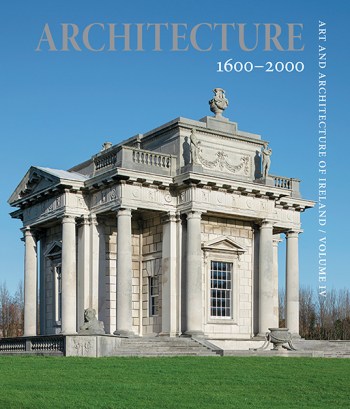 Art and Architecture of Ireland is an authoritative and fully illustrated survey that encompasses the period from the early Middle Ages to the end of the 20th century. The five volumes explore all aspects of Irish art—from high crosses to installation art, from illuminated manuscripts to Georgian houses and Modernist churches, from tapestries and sculptures to oil paintings, photographs and video art. This monumental project provides new insights into every facet of the strength, depth and variety of Ireland’s artistic and architectural heritage.
Architecture, 1600–2000 is the most complete survey of architecture in Ireland ever published. The essays in this volume cover all aspects of Ireland’s built environment, not only buildings but infrastructure, landscape development, public and private construction and much else. The volume challenges and expands the traditional understanding of Irish ‘architecture’, giving novel and exciting interpretations of the field and, by means of many striking illustrations, encourages us to think anew about the environment that surrounds us.
Rolf Loeber holds professorships at the University of Pittsburgh, where he oversees research on the causes of crime as well as mental health problems in young people. He has published extensively on Irish architecture, the history of fiction, and social, economic and plantation history. Hugh Campbell is professor of architecture at University College, Dublin, where he is currently head of the School of Architecture. He has published extensively on subjects from Irish architecture and urbanism to photography and urban space. Livia Hurley is an architect and architectural historian working in private practice in Dublin. Her research interests include urban history and the study of industrial sites and monuments. John Montague is assistant professor in the College of Architecture, Art and Design at the American University of Sharjah, UAE. His research interests include medieval and early modern architecture, and urban mapping. He is co-author, with Colm Lennon, of John Rocque’s Dublin: A Guide to the Georgian City (Dublin, 2010). Ellen Rowley is an architectural historian, researching 20th-century architecture in Ireland and beyond. She has written extensively on architectural modernism and edited a collection of Irish architectural writing: Patterns of Thought (2012). She is a research fellow at Trinity College Dublin.
New Book | Nathaniel Clements: Politics, Fashion, and Architecture
Published by Four Court Press and available from Artbooks.com (the book launch takes place in Dublin on Thursday, 12 February 2015 at the Royal Irish Academy) . . .
Anthony Malcomson, Nathaniel Clements (1705–77): Politics, Fashion, and Architecture in Mid-Eighteenth-Century Ireland (Dublin: Four Courts Press, 2015), 290 pages, ISBN: 978-1851829149, €55 / $75.
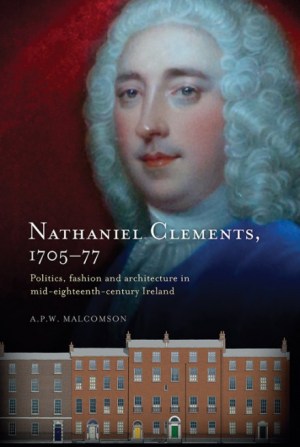 This book argues that Nathaniel Clements was an enlightened patron of architecture, not a practising architect, and that he influenced upper-class residential development in Dublin and popularised a particular form of Palladian ‘villa-farm’ (or modest country house) partly because of who he was—a high-ranking and well-connected government official and an arbiter of fashion and taste. The two places where his architectural influence is still strongly felt today are the high-fashion enclave of Henrietta Street, Dublin, of which he created about one-third in the period 1733 c.1740, and the Phoenix Park, of which he was Ranger, where he made important improvements to the landscape and where he built in 1752–57 a new Ranger’s Lodge which forms the nucleus of today’s Áras an Uachtaráin. The book provides a detailed analysis of these aesthetic achievements and (following Clements’ death) of the re casting of the Ranger’s Lodge as a British viceregal residence during the period 1782–c.1800. It concludes with a broader discussion of the ‘amateur’ tradition in British and Irish architecture and of Clements’ place among the ‘amateurs’ who dominated the art form in the decades before the coming-of-age of a fully-fledged architectural profession.
Anthony Malcomson was director of the Public Record Office of Northern Ireland from 1988 until 1998, and during a career in archives which began in 1967 has sorted and listed the papers from c.75 Irish country houses. His publications, mainly based on the evidence of this material, include Nathaniel Clements: Government and the Governing Elite in Ireland, 1725–75 (2005), Virtues of a Wicked Earl: The Life and Legend of William Sydney Clements, 3rd Earl of Leitrim, 1806–78 (2009), and John Foster (1740–1828): The Politics of Improvement and Prosperity (2011).
The French Sculpture Census Now Online
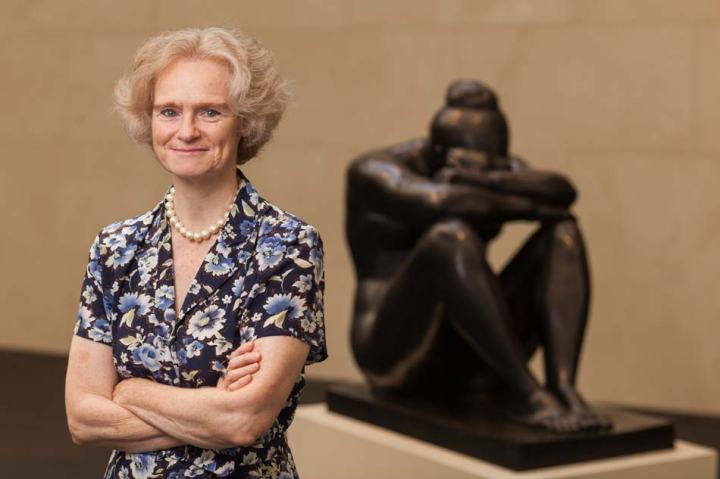
The brainchild of Laure de Margerie, the French Sculpture Census came online in December 2014 with its first 7,000+ records. Hosted by the Nasher Sculpture Center in Dallas with funding from a variety of institutions, the website aims to provide a list of French sculpture produced between 1500 and 1960 that can now be found in American public collections, museums, public buildings, historic homes, or displayed in public space. The completed census is expected to include between 15,000 and 20,000 records. More information is available here»
◊ ◊ ◊ ◊ ◊
From the Nasher Sculpture Center:
Stories from the French Sculpture Census
Nasher Sculpture Center, Dallas, 21 February 2015
From beloved works by Matisse and Rodin in museum collections to American icons like the Statue of Liberty, French sculpture has had a rich and indelible impact on the cultural landscape of the United States. In celebration of a new website that reveals the extent of this shared creative history, Laure de Margerie and panelists from the project’s international partner institutions will share stories of favorite works drawn from the database of the French Sculpture Census.
Laure de Margerie, Director of the French Sculpture Census, was Senior Archivist and head of the Sculpture Archives at the Musée d’Orsay in Paris, from 1978 through 2009. In this position she curated several exhibitions including Facing the Other: Charles Cordier (1827–1905), Ethnographic Sculptor (Paris, Quebec City, New York, 2004/05). She was part of the team who installed the sculpture collection at the opening of the museum in 1986 and co-authored the collection catalogue (1986). De Margerie also worked as archivist in charge of historic buildings in Normandy in Rouen (1983–1985) and oversaw rights and reproductions at the National Archives in Paris (1991–1992). She was awarded a fellowship at the Clark Art Institute, in Williamstown, MA (2000/01), and was the Sculpture and Decorative Arts Department guest scholar at the J. Paul Getty Museum in Los Angeles, CA (Fall 2011).
The Census of French Sculpture in American Public Collections is the first comprehensive catalogue of French sculpture in the United States. It lists all existing French sculpture, dating from 1500 to 1960, in American public collections. Not only does it take account of works in museums, but also in historic houses, government buildings (the White House, for example), corporate collections, and public space. The scope of the census is vast, both in space and time, and currently includes 7,500 works by 680 artists in 305 locations.
Hosted by the Nasher Sculpture Center and supported by a consortium of institutions in the U.S. and France, the French Sculpture Census will be the largest existing website solely dedicated to sculpture. The Census of French Sculpture in American Public Collections is a project of the University of Texas at Dallas and the Nasher Sculpture Center, Dallas, in coproduction with the Institut National d’Histoire de l’Art (INHA), Paris, the Musée d’Orsay, Paris, and the Musée Rodin, Paris, with the participation of the Ecole du Louvre, Paris.
New Book | Perronneau: Un Portraitiste dans l’Europe des Lumières
Published by Arthena and available from Artbooks.com:
Dominique d’Arnoult, with a preface by Xavier Salmon, Perronneau, ca. 1715–1783: Un portraitiste dans l’Europe des Lumières (Paris: Arthena, 2015), 440 pages, ISBN: 978-2903239541, 130€ / $190.
 Le portrait, particulièrement le portrait au pastel, connaît une vogue considérable dans une Europe du XVIIIe siècle où l’on ne dénombre pas moins de deux mille portraitistes. Succédant à Hyacinthe Rigaud (1659–1743) et à Nicolas de Largillierre (1656–1746), puis à Jean-Marc Nattier (1685–1766), deux grandes figures dominent la scène française au milieu de ce siècle : Maurice Quentin Delatour et Jean-Baptiste Perronneau, son cadet d’une dizaine d’années.
Perronneau reçoit sa formation de dessinateur à Paris où il se fait rapidement remarquer. Agréé à l’Académie royale de peinture et de sculpture en 1746, il y est reçu en 1753 avec ses portraits à l’huile du peintre Jean-Baptiste Oudry et du sculpteur Lambert Sigisbert Adam. Dans la tradition de l’Académie, Perronneau s’emploie à donner un prolongement à l’art de grands maîtres comme Van Dyck et Rembrandt, interprété dans un esprit nouveau.
Ses portraits vont être le plus souvent figurés en buste, peints au pastel ou à l’huile. L’enjeu alors est de concilier la ressemblance avec la science picturale propre à la grande peinture, tout en donnant une impression de facilité, voire une forme de désinvolture (la sprezzatura), qui doit dissimuler le travail de l’artiste. C’est un art qui doit de plus rencontrer la satisfaction du modèle. À la cour de Versailles comme à la ville, il est alors de bon goût de ne pas laisser paraître son rang sur son portrait : la simplicité est à la mode. Perronneau y excelle, sachant donner à des portraits travaillés au cours d’un grand nombre de séances l’impression qu’ils sont réalisés dans l’instant. Il devient ainsi l’un des peintres favoris du public du Salon du Louvre de 1746 à 1765.
La rivalité entre Perronneau et Delatour va s’afficher pendant plus de vingt ans au cours desquels l’un et l’autre vont exposer plus de cent portraits au Salon. Delatour ira même jusqu’à se confronter à son rival en 1750, en faisant exposer son autoportrait à côté de son propre portrait demandé à Perronneau. Les carrières des deux artistes restent cependant distinctes: Delatour peint la famille royale et la Cour, Perronneau préfère trouver une clientèle dans les capitales provinciales et étrangères. Ses modèles appartiennent à des milieux sociaux divers, aussi bien à la grande aristocratie qu’au monde du négoce ou à celui des arts.
C’est la vision d’une autre France, d’une autre Europe que celle habituellement représentée par ses rivaux qui apparaît sous les pastels et les pinceaux de Perronneau, celle d’un monde des Lumières en mouvement. En butte à la critique qui lui reproche notamment de choisir des modèles inconnus du grand public à partir de 1767 et voyant sa position à Paris compromise, Perronneau prend le parti de s’éloigner de la capitale et de la France où il ne revient plus qu’épisodiquement après 1773. Ses itinéraires le conduiront alors dans les villes européennes où résident les grands négociants et financiers, en Hollande et en Allemagne essentiellement. À la fin de sa vie, il entreprend un long voyage à Saint-Pétersbourg et Varsovie, avant de s’éteindre à Amsterdam en 1783.
Journée d’étude | Mode, luxe et metiers a Paris au 18e siecle
From H-ArtHist:
Mode, luxe et metiers a Paris au 18e siecle
Hôtel Soubise, Paris, 3 February 2015
Cette journée d’étude organisée par l’association ART & LUXE à l’hôtel Soubise, 60 rue des Francs Bourgeois à Paris, mardi 3 février 2015, de 14h à 17h, aura pour thème les métiers de la mode et du luxe à Paris au 18e siècle.
À cette occasion seront réunis des spécialistes de l’estampe de mode, de l’histoire des métiers et du style: Pascale Cugy, Clare Haru Crowston, Christian Baulez et Georgina Letourmy-Bordier. Pascale Cugy, auteur d’une thèse récente sur l’estampe de mode, mettra en images les métiers de la mode et du luxe sous l’Ancien Régime. La présence exceptionnelle de Clare Haru Crowston, professeur d’histoire de l’Europe moderne, résidant aux Etats-Unis et travaillant sur l’apprentissage en France sous l’Ancien Régime, permettra une rencontre unique au sujet de ses récentes recherches sur les marchandes de modes à Paris au 18e siècle. Cette journée sera aussi l’opportunité offerte par Christian Baulez, conservateur général honoraire du Patrimoine, de présenter le mobilier récemment acquis par le musée des archives nationales pour l’hôtel de Rohan à Paris. Georgina Letourmy-Bordier, expert en éventails, assistée de Sylvain Le Guen, éventailliste, aborderont ensemble ce métier bien particulier, sur lequel peu de travaux sont encore accessibles, et feront une démonstration en objets.
◊ ◊ ◊ ◊ ◊
P R O G R A M M E
14:00 Corinne Thépaut-Cabasset (Paris): Accueil
14:30 Pascale Cugy (Université Rennes-2): Costumes grotesques: Mettre en images les métiers de la mode et du luxe en France sous l’Ancien Régime
15:00 Clare Haru Crowston (University of Illinois, Urbana-Champaign): Les marchandes de modes, un métier célèbre mais encore peu connu
15:30 Christian Baulez (Château de Versailles): Mathieu Debauve, menuisier en sièges des Voyer d’Argenson
16:00 Georgina Letourmy-Bordier (Paris): Entre atelier et boutique, les éventaillistes parisiens au XVIIIe siècle
16:30 Sylvain Le Guen (Paris): Fabriquer l’éventail aujourd’hui
17:00 Discussion
La session sera suivie d’une visite des salons du premier étage où sont exposés les sièges réalisés par Mathieu Debauve sur les dessins de Charles de Wailly, acquis en 2012 pour le musée des Archives nationales de France.
Dans la limite des places disponibles et sur inscription à :
Association ART & LUXE
38 boulevard Henri IV 75004 Paris
art-luxe@live.fr
New Book | Back to the Garden: Nature and the Mediterranean World
From Yale UP:
James H. S. McGregor, Back to the Garden: Nature and the Mediterranean World from Prehistory to the Present (New Haven: Yale University Press, 2015), 384 pages, ISBN: 978-0300197464, $38.
 The garden was the cultural foundation of the early Mediterranean peoples; they acknowledged their reliance on and kinship to the land, and they understood nature through the lens of their diversely cultivated landscape. Their image of the garden underwrote the biblical book of Genesis and the region’s three major religions.
In this important melding of cultural and ecological histories, James H. S. McGregor suggests that the environmental crisis the world faces today is a result of Western society’s abandonment of the ‘First Nature’ principle—of the harmonious interrelationship of human communities and the natural world. The author demonstrates how this relationship, which persisted for millennia, effectively came to an end in the late eighteenth century, when ‘nature’ came to be equated with untamed landscape devoid of human intervention. McGregor’s essential work offers a new understanding of environmental accountability while proposing that recovering the original vision of ourselves, not as antagonists of nature but as cultivators of a biological world to which we innately belong, is possible through proven techniques of the past.
James H. S. McGregor is the author of five books on world cities. He is emeritus professor of comparative literature at the University of Georgia and lives in Cambridge, MA.
Doctoral Studentship | ‘Nature’ in China and Europe, 1500–1800
From H-ArtHist:
Doctoral Studentship: Conceptualising ‘Nature’ in China and Europe, 1500–1800
University of Exeter, 1 September 2015 — 31 August 2018
Applications due by 15 February 2015
The College of Humanities at the University of Exeter is offering a PhD studentship beginning in September 2015, working for the EU Marie Curie-funded project ‘Nature Entangled’ led by Dr Yue Zhuang (Chinese Studies) at the University of Exeter:
One Doctoral Studentship (open to UK/EU and International students) with all tuition fees paid and annual maintenance grant for three years. The maintenance grant will be £13,863 per year.
The subject of your studentship will be the history of conceptualising ‘Nature’ in China and Europe from 1500–1800. Working across disciplines—art (architectural) history, cultural history and China-Europe relations—you will examine the historical legacy shared between China and Europe in envisioning the ‘natural’ living environment in relation to the well-being of citizens and the state.
The studentship will also offer joint supervision by an eminent professor, Prof. Shaoxin Dong at the National Institute of Advanced Humanistic Studies in Fudan University, Shanghai, China. The student will spend one/half year in China for research and fieldwork. The student will benefit from library and archival resources from across the consortium as well as activities such as student events, conferences and the fostering of peer support networks.
Successful applicants normally have a good first degree (at least 2.1, or international equivalent) in a relevant field of humanities, and have obtained, or are currently working towards, a master’s degree at Merit level, or international equivalent. If English is not your native language then you will also need to satisfy our English language entry requirements. English (fluent) and Chinese (advanced level) are essential whilst other languages such as Italian, Latin, French, or Dutch are desirable. You will be an active member of a research team of four and will contribute to the project’s publications as well as produce an outstanding PhD thesis.
To be considered for this Doctoral award, you must complete an online web form where you must submit some personal details and upload a covering letter setting out your suitability for this project, a full CV, research proposal, transcripts, details of two referees and, if relevant, proof of your English language proficiency, by 15 February 2015. Your research proposal should be no more than 4 sides of A4 in length and should be related to the history of ideas of ‘Nature’ in the landscape discourses of China and Europe in 1500–1800.
In addition you must also ensure that your referees email their references to the Postgraduate Administrator at humanities-pgadmissions@exeter.ac.uk by 15 February 2015. Please note that we will not be contacting referees to request references, you must arrange for them to be submitted to us by the deadline.
References should be submitted by your referees to us directly in the form of a letter. Referees must email their references to us from their institutional email accounts. We cannot accept references from personal/private email accounts, unless it is a scanned document on institutional headed paper and signed by the referee. All application documents must be submitted in English. Certified translated copies of academic qualifications must also be provided. Guidelines on submitting references to us can be found on our dedicated page, where you can also download a copy of our institutional reference form for your referees to complete and return to us, or for them to use as a guide.
More information is available here»
Conference | Tracing the Heroic through Gender: 1650, 1750, 1850
As posted at H-ArtHist:
Heroes—Heroizations—Heroisms: Tracing the Heroic through Gender
Freiburg Institute for Advanced Studies, 26–28 February 2015
In most societies the heroic is in many ways gendered. When considering the heroic, attributes of masculinity might first come to mind. Yet, from a historical perspective it becomes apparent that heroizations also often have feminine connotations. The social and cultural production of the heroic cannot be analyzed exclusively in terms of masculinity; nor can we regard women or femininity merely as exceptions in this field. Rather, we need to reconsider the relational character of the category gender. We propose to use gender as an analytical tool in a new way. Metaphorically speaking, gender as a ‘tracer’ can help us uncover new aspects of heroic ideas and concepts. In natural science experiments, a ‘tracer’ passes through different environments and reacts to each of them in a different way. Hence, the tracer is not the object of study, but is used to examine a third element: our conference shall try to use gender systematically to ‘trace’ various historical ‘environments’ of the heroic. By using gender as a tracer, the conference will explore forms, mediums and processes of heroization as well as discourses of heroic transgression, exceptionality or veneration. The conference will focus on three points in time (1650, 1750, 1850) and the continuities and transformations that may become apparent from interrelating the tracing results in a diachronic perspective.
Please register by an informal e-mail: info@sfb948.uni-freiburg.de. More information is available at the research program website. Questions may be directed to Andreas Friedrich, andreas.friedrich@sfb948.uni-freiburg.de.
◊ ◊ ◊ ◊ ◊
T H U R S D A Y , 2 6 F E B R U A R Y 2 0 1 5
14:00 Introduction
Panel 1: 1650
14:30 Women in writings on the heroic in 17th-century academic instruction, Joseph Freedman (Montgomery, Alabama)
15:15 Anti-heroes: Masculinity and civic ethics in literary academies of 17th-century Florence, Eva Struhal (Québec)
16:30 Gendering fear: Transformations of courage and masculinity in heroic drama, Christiane Hansen (Freiburg)
17:15 Testing times for anxious he-roes: Tracing the end of a heroic figuration in England and France, ca. 1650, Andreas Schlüter (Freiburg)
Evening Lecture
18:30 From viragos to valkyries: Transformations of the heroic woman from the 17th to the 19th century, Helen Watanabe-O’Kelly (Oxford)
F R I D A Y , 2 7 F E B R U A R Y 2 0 1 5
Panel 2: 1750
9:30 (Keynote lecture) When heroes sigh… Sentimental heroism in 18th-century opera, Melanie Unseld (Oldenburg)
11:00 A reigning woman as a heroic monarch? Maria Theresa and the roles of emperor, wife and mother, Anne-Marie Wurster (Freiburg)
11:45 Creating and subverting German models of ‘Galanterie’? Heroes and heroines in texts by Christian Friedrich Hunold and Maria Aurora von Königsmarck, Madeleine Brook (Oxford)
Panel 3: 1850
14:00 Heroism of a melancholy look from blue eyes, Petra Polláková (Prague)
14:45 What is the Polish peasant hero’s gender? Representations of peasant citizenship in Polish culture, ca. 1850, Alicja Kusiak-Brownstein (Ann Arbor, Michigan)
15:30 Untangling the heroic from the sacrifice: Malwida von Meysenbug’s attempt to appropriate a common female topos in and for her political novel Phädra (1885), Birgit Mikus (Oxford)
Lecture and Round-table Discussion
16:45 Rethinking the heroic: Difference as a tracer?, Monika Mommertz (Freiburg)
Concert Talk
20:00 ‘En travesti’ The female as male in early 19th-century operas, Thomas Seedorf (Karlsruhe/Freiburg)
Mezzosoprano: Felicitas Brunke / Piano: Freya Jung
S A T U R D A Y , 2 8 F E B R U A R Y 2 0 1 5
Panel 4: Connections
9:30 Gendering the operatic sound of the heroic: 1647 – 1749 – 1843, Anke Charton (Leipzig)
10:15 Victorian male heroes and romance in Elizabeth Bowen’s short fiction, Laura Lojo-Rodríguez (Santiago de Compostela)
11:15 The tragic hero and the gendered imaginary in early modern German drama, Barbara Becker-Cantarino (Columbus, Ohio)










leave a comment