Conference | Neoclassical Reverberations of Discovering Antiquity
As noted at H-ArtHist; abstracts are available here.
Neoclassical Reverberations of Discovering Antiquity
Archivio di Stato, Turin, 6–9 October 2014
Twelfth Conference of the ICTM Study Group for the Iconography of the Performing Arts, Istituto per i Beni Musicali in Piemonte
M O N D A Y , 6 O C T O B E R 2 0 1 4
9.30 Registration
10.00 Welcome and Introduction
10.30 Frame Session
Chair: Cristina Santarelli (Istituto per i Beni Musicali in Piemonte, Torino)
• Christian Greco (Museo Egizio, Torino), The Role Played by Turin in the Field of Aegyptological Research
• Zdravko Blažeković (Research Center for Music Iconography, The Graduate Center, CUNY), Ancient Organology before and after Herculaneum
• Paola d’Alconzo (Università “Federico II”, Napoli), Facing Antiquity Departure and Return: Naples in the Eighteenth Century
• Michela Costantini (Torino), Common Antiquarian Interests Found in the Epistolary Exchanges between the Architect and Piedmontese Erudite Francesco Ottavio Magnocavalli and Members of the Roman Arcadia in the Middle of the Eighteenth Century: The Case of the Ancient Theater of Herculaneum
13.00 Lunch
15.00 Neoclassicism in European Painting, Sculpture and Applied Arts, Part I
Chair: Nicoletta Guidobaldi (Università di Bologna, Dipartimento di Beni Culturali, Ravenna)
• Jordi Ballester Gibert (Universitat Autònoma de Barcelona), Music and Poetics of Ancient Rome in the Work of the Spanish Painter Mariano Fortuny (1838–1874)
• Daniela Castaldo (University of Salento, Lecce), Ancient Music in Paintings of Lawrence Alma-Tadema (1836–1912)
• Cristina Santarelli (Istituto per i Beni Musicali in Piemonte, Torino), From A Musician to The Quartet: Albert Moore (1841–1893) between Classicism and Aesthetic Movement
• Alexandra Voutrya (Aristotle University, Thessaloniki), Ingres, Apollo, Mozart and Music
• María Isabel Rodríguez López (Universidad Complutense de Madrid), Chant and Enchantments: Iconography of Orpheus, from Gluck to Moreau
• Elena Le Barbier Ramos (Universidad de Oviedo), Ancient Musical Iconography in Neoclassical Painting
T U E S D A Y , 7 O C T O B E R 2 0 1 4
9.30 Neoclassicism in European Painting, Sculpture and Applied Arts, Part II
Chair: Daniela Castaldo (Università del Salento, Lecce)
• Anna Maria Ioannoni Fiore (Conservatorio Statale di Musica “L. D’Annunzio”, Pescara), Neoclassical Influences in the Depiction of Landscapes on Castelli Maioliche: The Ethical Value of Music among Myths and Ancient Ruins
• Nicoletta Guidebaldi (Università di Bologna Dipartimento di Beni Culturali, Ravenna), Rediscovering Antiquity and Musical Myths in Felice Giani’s Pictorial Cycles in Faenza
• Esma Sulejmanagic (Muzi?ka akademija, Sarajevo), Music Iconography on Numismatic Products of Antiquity and the Nineteenth Century: Antique Musical Practice and Neoclassical Musical Symbolism
11.00 Coffee
11.30 Keynote Address by Elena Barassi (Università di Pavia, sede di Cremona), Iconography of Iconography: Dance in Ancient Roman Representations, Canova’s Works and Reproductions in Engraving
1.00 Lunch
15.00 Neoclassicism in European Painting, Sculpture and Applied Arts, Part III
Chair: Jordi Ballester Gibert (Universitàt Autònoma de Barcelona)
• Licia Mari (Università Cattolica del Sacro Cuore, Brescia & Archivio Storico Diocesano, Mantova), Saints, Myths, Allegories in the Scenographic Frescos by Giorgio Anselmi
• Carlo Fiore (Conservatorio di Musica ‘Vincenzo Bellini’, Palermo) and Floriana Tessitore (Teatro Massimo, Palermo), The Teatro Massimo in Palermo between Modernism and Neoclassicism
• Luis Correia de Sousa and Luzia Valeiro Rocha (Centro de Estudos de Sociologia e Estética Musical, Universidade Nova de Lisboa), New Fashions, Old Models: The Antiquity Charm in Portuguese Musical
Neoclassicism
16.30 Coffee
17.00 Free Papers
• Emma Petrosyan (Institute of Archaeology and Ethnography, Armenian National Academy of Sciences, Yerevan), Music and Dance in Statues and Gemmes from Artashat
• Maryam Dolati Fard (Tehran), The Relationship Between Text and Music in Persian Manuscripts: Ilkhanid to Safavid Era, Images of Oud Player
W E D N E S D A Y , 8 O C T O B E R 2 0 1 4
9:30 Neoclassical Attitudes in Operatic Stage, Part I
Chair: Maria Teresa Arfini (Università della Valle d’Aosta)
• Diana Blichmann (Roma), The Temple of Jupiter Statore in La Clemenza di Tito of Pietro Metastasio and Giovanni Carlo Galli Bibiena
• Maria Ida Biggi (Fondazione Cini / Università “Ca’ Foscari”, Venezia), Borsato, Bagnara and Basoli: Archaelogical References and Reverberations on the Venetian and Bolognese Neoclassical Stage
• Gabriella Olivero (Torino), The “New” Babylon by Alessandro Sanquirico
11.00 Coffee
11.30 Keynote address by Mercedes Viale Ferrero (Torino), The Last Day of Pompeii as Imagined by Alessandro Sanquirico, or: How to Rebuild Pompeii in Order to Destroy It
13.00 Lunch
15.00 Neoclassical Attitudes in Operatic Stage, Part II
Chair: Maria Ida Biggi (Fondazione Cini /Università Ca’ Foscari, Venezia)
• Inna Naroditskaya (Northwestern University), Elizaveta of Russia – A Euro-Asian Princess and Heir of Roman Augustus: A Spectacle of Coronation and Imperial Opera
• Dario de Cicco (Conservatorio Statale di Musica “Giuseppe Verdi”, Torino / Université de Genève), Verdi and the Egyptian Culture between Anegdots, Epistolar Sources and Imagination
• Donatella Melini (Fondazione “Antonio Carlo Monzino”, Milano), “Or che i Numi son vinti, a me la cetra, A me l’altar!”: Stories and Iconographies about the Lyra Made for Arrigo Boito’s Nerone
• Timothy Flynn (Olivet College, MI), Classical Reverberations in the Music and Life of Camille Saint-Saëns (1835–1921)
T H U R S D A Y , 9 O C T O B E R 2 0 1 4
9.30 Neoclassical Attitudes in Operatic Stage, Part III
Chair: Jordi Ballester Gibert (Universitàt Autònoma de Barcelona)
• Sanna Litti (Hyvinkää, Finland), Heroism in Gasparo Spontini’s Opera La Vestale
• Maria Teresa Arfini (Università della Valle d’Aosta), Around Antigone: Reflections on Iconography and Music in the German Revival of the Classical Tragedy
• Maia Sigua (Tbilisi State Conservatory), The Concept of Tragedy after Aristotle and Daphne by Richard Strauss
11.00 Coffee
11.30 Antiquaria: Documents and Testimonies through the Ages
Chair: Maria Teresa Arfini (Università della Valle d’Aosta)
• John McKay (University of South Carolina, School of Music), Roles for Musical Curiosities in Kircher’s Antiquarian Visions
• Stefania Macioce (Università “La Sapienza”, Roma), Apollo: Figurative Variations of a Neoclassical Ideal
• Francesca Cannella (Università del Salento, Lecce), «Gli eroi della storia favolosa e le invenzioni per essi nobilitate»: The Myth of the Argonauts between Musical Iconography and Literary Invention of the Modern Age
13.00 Lunch
15.00 Musical Impressions from the Grand Tour
Chair: Alexandra Voutyra (Aristotle University, Thessaloniki)
• Siegwart Reichwald (Petrie School of Music, Converse College, Spartanburg, SC), Eyes Wide Open: The Compositional Impact of Mendelssohn’s Artistic and Religious Grand Tour Experiences
• Sylvain Perrot (French School at Athens), Musical Impressions in Views of Greece during the Nineteenth Century
• María Jesús Fernández Sinde (Universidad Complutense de Madrid), Music Dreaming: Iconographic Sources from Spanish Painters? Recreation of Identities and Grand Tours
Terra Foundation Research Travel Grants to the U.S.
Terra Foundation Research Travel Grants to the United States
Applications due by 15 January 2015
The Terra Foundation offers Research Travel Grants to enable scholars outside the United States to consult resources that are only available within the United States. These grants provide support for research on topics concerning American art and visual culture prior to 1980. Grant funding is available for short-term travel (3 months maximum) that gives scholars:
• an opportunity to discover new source material
• experience works of art first-hand in museums and private collections
• consult local archives and library collections
• establish professional networks for future research
Funds can be used for related transportation, lodging, meals, and research fees and expenses. They cannot be used for the purchase of computers or other equipment. The foundation accepts proposals from only doctoral students and postdoctoral and senior scholars outside the United States. Please visit our website for eligibility and grant requirements, application form, and information about funding.
Exhibition | Sade: Attacking the Sun
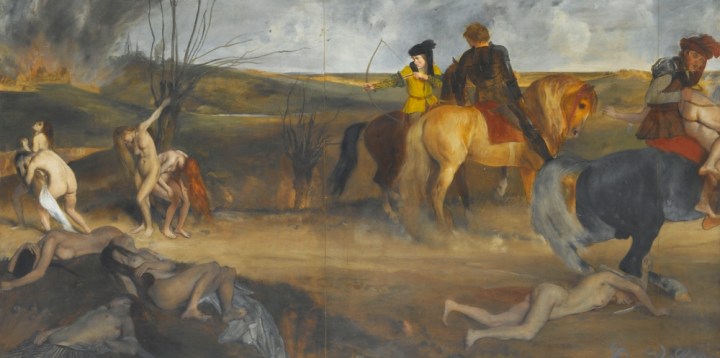
Edgar Degas, Scène de guerre au Moyen-âge, 1865
(Paris, Musée d’Orsay, RF 2208)
◊ ◊ ◊ ◊ ◊
From the d’Orsay:
Sade: Attacking the Sun / Attaquer le soleil
Musée d’Orsay, Paris, 14 October 2014 — 25 January 2015
Curated by Annie Le Brun, Laurence des Cars, and Leila Jarbouaï
Alphonse Donatien de Sade (1740–1814) completely transformed the history of both literature and the arts, first as an underground writer, and later by becoming a veritable legend in his lifetime. Following the analysis of the writer Annie Le Brun, a specialist of de Sade, the exhibition will be focusing on the revolution of representation opened up by the author’s writings. Topics addressed will be the ferocity and singularity of desire, deviation, extremes, the weird and the monstrous, desire as a principle of excess and imaginary recomposition of the world, through works by Goya, Gericault, Ingres, Rops, Rodin, Picasso…
The press release (as a PDF file in French) is available here»
◊ ◊ ◊ ◊ ◊
From Gallimard:
Annie Le Brun, Sade: Attaquer le Soleil (Paris: Éditions Gallimard, 2014), 336 pages, ISBN: 978-2070146826, 45€.
 Le propos de cet ouvrage est de montrer comment, avant d’avoir une importance majeure dans la pensée du XXe siècle, l’oeuvre du marquis de Sade a induit une part de la sensibilité du XIXe siècle, quand bien même le personnage et ses idées y auront-ils été tenus pour maudits. Car si Baudelaire, Flaubert, Huysmans, Swinburne, Mirbeau…, sans parler d’Apollinaire, s’y sont référés à titres divers, tout porte à croire que la force de cette pensée est aussi d’avoir rencontré, révélé, voire provoqué ce qui agite alors en profondeur l’expression plastique, concernant autant l’inscription du désir que son pouvoir de métamorphose. C’est l’image du corps en train d’être bouleversée de l’intérieur, annonçant une révolution de la représentation. Que ce soit évident chez Delacroix, Moreau, Böcklin…, ce qui est en jeu n’est pas sans inquiéter aussi Ingres, Degas ou Cézanne et bien sûr Picasso… Et cela tandis que Félicien Rops, Odilon Redon, Alfred Kubin se rapprochent d’une expression restée jusqu’alors marginale (curiosa ou folie), avant que le surréalisme, se réclamant de Sade, ne reconnaisse le désir comme grand inventeur de forme. A retrouver ce cheminement, il sera possible de mesurer combien à dire ce qu’on ne veut pas voir, Sade aura incité à montrer ce qu’on ne peut pas dire. Ou comment le XIXe siècle s’est fait le conducteur d’une pensée qui, incitant à découvrir l’imaginaire du corps, va amener à la première conscience physique de l’infini.
Annie Le Brun, commissaire général de l’exposition, auteur notamment, chez Gallimard, de Soudain un bloc d’abîme, Sade (1986), On n’enchaîne pas les volcans (2006), Si rien avait une forme, ce serait cela (2010), et Les arcs-en-ciel du noir : Victor Hugo (2012).
Exhibition | The Kama-Sutra: Spirituality and Eroticism in Indian Art
Though thematic rather than chronologically-based, the exhibition seems to include a substantial number of eighteenth-century objects, with some attention to the Western reception of the Kama-Sutra. From the Pinacothèque de Paris:
Le Kâma-Sûtra: Spiritualité et érotisme dans l’art indien
Pinacothèque de Paris, 2 October 2014 — 11 January 2015
Curated by Alka Pande and Marc Restellini

Acrobatic couple, Tamil Nadu; late 18th or early 19th century, carving on wood, 91 x 49 x 14.5 cm
(Collection of Michel Sabatier, La Rochelle)
For its Autumn-Winter season 2014–15, the Pinacothèque de Paris will put on an unusual exhibition: The Kama-Sutra: Spirituality and Erotism in Indian Art. Attributed to a Brahman who might have written it in the 4th century of our era, the Kama-Sutra makes up one of the major texts of medieval Hinduism and is not a pornographic book, as it is often described in the Western world. It is divided up into seven sections (adhikarana): society, social concepts, sexual union, as regards the spouse, as regards extra-marital relationships, as regards courtesans, as regards the arts of seduction.
Around 330 outstanding works including those of Shriji Arvind Singh Mewar, maharana of Udaipur and the remarkable collection of Beroze and Michel Sabatier—sculptures, paintings, miniatures, objects of daily life, and ‘pillow books’, illustrated works that were offered to the newlyweds until the 19th century in order to give them an erotic education—organized according to the seven sections of the Kama-Sutra, will be exhibited in the Pinacothèque de Paris. The exhibition, unadvised for minors, will explain the erotic aesthetics specific to the erotic aesthetics of Indian cultural life and to Hinduism. It will also attempt to understand why the Western world casts such a deformed look on that very unusual book.
From the French Embassy in New Delhi:
Alka Pande, renowned art historian and author of many books on erotic art, has been appointed as the curator for this exhibition. Dr. Alka Pande’s first book was itself an introduction to this great Sanskrit treatise, the Kama Sutra, that she wrote in 1999. Since then, she has been constantly exploring the frontier of love, desire, longing, sexuality and genders in her many books: Indian Erotica, a visual journey along the erotic art of the Indian subcontinent (2002); Ardhanarishvara: The Androgyn, an exploration of the frontiers of the genre, based upon the Hindu concept of Shiva as half-man half woman (2005); The New Age Kama Sutra for Women, her first attempt to transpose this text to the modern times (2008), Kama Sutra: The Quest for Love, a visual journey through some of the most explicit erotic works of art (2008); Leela: An Erotic Play of Verse and Art, an illustrated collection of Indian Poetry (2009); and Shringara: The Many Faces of Indian Beauty, a reflection on the Indian concept of feminine beauty (2011).
Marc Restellini is an art historian and a Modigliani scholar. He has been working in Japan for many years, and has been the artistic director of the Musée du Luxembourg in Paris, where he has exhibited masters like Rodin, Raphaël and Modigliani. In 2007, he has opened the Pinacothèque, the first private art museum in Paris, situated Place de la Madeleine. In less than a decade, it has become one of the most visited museum in Paris, close on the heels of the Louvre and the Pompidou Centre. What sets the Pinacothèque apart is the artistic vision of Marc Restellini whose ambition is to look at art history with an fresh perspective, creating bridges and transversality in the way exhibition are conceptualised, and reaching out to a wider public.
The press release (as a PDF file in French) is available here»
◊ ◊ ◊ ◊ ◊
Call for Papers | Interdisciplinary Perspectives on the Domestic Interior
Making A Home: Interdisciplinary Perspectives on the Domestic Interior
University of Sussex, Brighton, 7–8 May 2015
Proposals due by 30 November 2014
Keynote Speaker: Dr. Flora Dennis, Senior Lecturer, Art History, University of Sussex
I believe that one can never leave home. I believe that one carries the shadows, the dreams, the fears and the dragons of home under one’s skin, at the extreme corners of one’s eyes and possibly in the gristle of the earlobe.
—Maya Angelou
The late Maya Angelou once wrote, “The ache for home lives in all of us.” This nostalgia for home—be it a physical space or geographical place, a moment in time, a person / people, or a state of mind—continues to be of central interest to artists, writers, and thinkers. Crossing lines between the private and public spheres, and extending
into important explorations of nationhood and belonging, different areas of research into the home seek to expand our understanding of how physical space has been used, transformed, and conceptualised throughout history. Some aspects of this pursuit include less-tangible features: Interactions between people, objects and spaces; the complex process of memory-making; the role of sentiment; and creating a sense of belonging can transform a dwelling into a home. In turn, these interactions have the power to transform the individual and the home, and to shape a sense of identity, whether as an individual, family, or nation.
This two-day interdisciplinary conference invites proposals from doctoral students and early career researchers for 20-minute papers that explore the question of what makes a home, and how homes make us. Papers may consider homes both past and present and from a variety of perspectives such as material culture studies, art history, gender
studies, anthropology, postcolonial studies, critical race studies, and geography. Topics may include, though are not limited to:
• Historical constructions of home
• Public versus private spaces/spheres
• Domestic production and consumption
• Notions of domesticity, gender and identity
• Representations of home in art, music and literature
• Religion, ritual and belief in the home
• Institutional or non-familial homes
• Historic homes and heritage sites
• Architecture and interior design
• Sociability and sociality
• Ideas of nation / nationhood
• Diaspora and belonging
• Colonial and postcolonial histories
Please email an abstract of no more than 250 words to Michele Robinson and Emma Doubt at MakingAHome2015@gmail.com by 30 November 2014. Along with your abstract please include your name, institution, paper title and brief biography. Successful applicants will be notified by 1 February 2015. All speakers will be invited to attend a complimentary dinner in Brighton the evening of 7 May 2015.
Call for Papers | ISECS 2015 Panel—Pictures in Motion: Portraiture
Now accepting proposals for this panel for next year’s ISECS Congress in Rotterdam:
Pictures in Motion: Portraiture around the World during the Long Eighteenth Century
ISECS Congress, Rotterdam, 26–31 July 2015
Proposals due by 12 January 2015 (though earlier submissions encouraged)
Organiser: Jennifer Germann, jgermann@ithaca.edu
Portraits and portraitists moved between courts, capitals, nations, and colonies in an ebb and flow that followed the tides of imperialism, markets, and diplomacy. Indeed, while portraits were understood as emphasizing the unique individual who could be regarded as a ‘defined location’ at the heart of the image, these representations frequently gesture to the world beyond the sitter to situate and elevate him or her. Portraiture was a dynamic artistic practice throughout the long eighteenth century due, in part, to the various exchanges that portraits occasioned and pictured. This panel turns its attention to the practice of portraiture and to portraits produced during this period with an emphasis on their global circulation. What motivations, rewards, and disincentives existed for artists who traveled for their work? What artistic and cultural exchanges were occasioned by this movement? How were portraits used to facilitate other transactions, whether mercantile or diplomatic? In what sense can we understand portrait production as a global phenomenon, as opposed to an international or cosmopolitan one and distinct from national schools? How does portraiture help us understand what it meant to be global in the eighteenth century? Topics might include the exchange between distinct traditions of portraiture in terms of approaches and conventions, the use of portraits in diplomacy (as, for example, in marriage arrangements), and artists who traveled for and in search of clients. Interdisciplinary papers are welcome with an emphasis on cultural exchange through portraits and global portrait practices. Submissions concentrating on the late seventeenth and first half of the eighteenth century are particularly encouraged.
Call for Papers | Portraiture as Interaction
◊ ◊ ◊ ◊ ◊
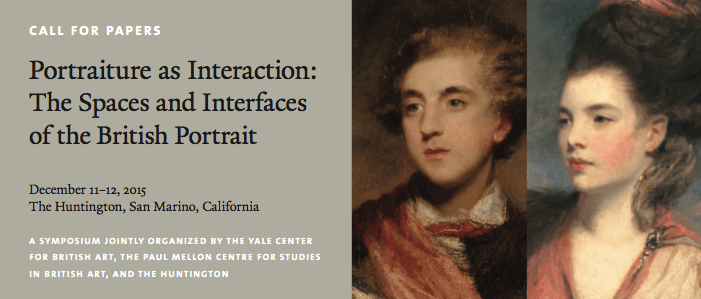
Portraiture as Interaction: The Spaces and Interfaces of the British Portrait
The Huntington, San Marino, California, 11–12 December 2015
Proposals due by 7 November 2014
A symposium jointly organized by the Yale Center for British Art, the Paul Mellon Centre for Studies in British Art, and the Huntington
This symposium has been inspired by the important collections of British portraits at the Huntington Art Gallery and the Yale Center for British Art, and by an upsurge of scholarly interest in the interactive nature of portraiture—both in its intrinsic character and as a curatorial construct.
Portraiture implies an interaction between the sitter and the spectator. It often rehearses an interaction between two or more protagonists and regularly focuses on the interaction between the person(s) represented and his, her, or their surroundings. Portraits—of husbands and wives, sisters and brothers, friends, and colleagues—are often depicted by artists and arranged by curators so as to interact with each other in meaningful ways. As they are created, and once they are completed, portraits (and the figures they represent) interact with their settings: with the studio, the exhibition space, the domestic interior, the public building or square; and with the objects, people, and spaces found in those settings. The same portrait, or portraits of the same sitter, can also find themselves interacting with each other across different media—paint, print, sculpture, and more.
Furthermore, curators are continually thinking about the ways in which the portraits they display—and the individuals these pictures portray—will relate with each other across and around a gallery. The Thornton Portrait Gallery at the Huntington and the galleries at the Yale Center for British Art exemplify portraiture’s continuing forms of interaction: implied and actual, pictorial and physical, and formal and figural.
This two-day international symposium will use the rich collections at the Center and the Huntington Art Gallery and the different concepts of interaction outlined above as points of departure and return, in order to open up new approaches to the history and workings of British portraiture up to the present. Participants will be encouraged to offer original and innovative readings of individual portraits, groups of portraits, portrait galleries, and portraiture as a genre. Talks that respond explicitly to works in the collections of the Huntington and the Center are particularly encouraged.
We invite proposals for thirty-five to forty-minute papers on this theme from scholars working in any discipline. Cross-disciplinary and comparative studies are particularly welcome. Please e-mail abstracts of no more than three hundred words, along with a short CV, to ycba.research@yale.edu. The deadline for proposals is November 7, 2014.
Travel and accommodations will be provided for speakers arriving from outside the Los Angeles area, and meals will be provided for all.
Conference | Carlo Fontana (1638–1714): Celebrato Architetto
From the Accademia Nazionale di San Luca:
Carlo Fontana (1638–1714): Celebrato Architetto
Accademia Nazionale di San Luca, Rome 22–24 October 2014
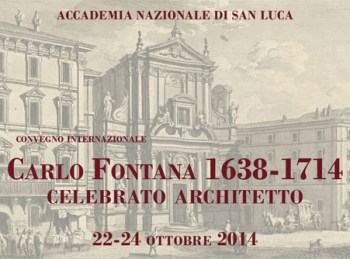 Convegno internazionale in occasione del trecentesimo anniversario della morte di Carlo Fontana
The conference is dedicated to the architect Carlo Fontanaon the occasion of the 300th anniversary of his death. The protagonist of Roman architecture as the Baroque was waning, Fontana—descending from a famous dynasty of Ticinese architects—organized the teaching and the practice of architecture based on the exercise of drawing and geometry. His workshop thus prefigured modern design studios. The propagandistic usage of graphic sheets and printed volumes illustrating and diffusing Fontana’s works and ideas constituted yet another factor of his modernity. In fact, Fontana understood perfectly the dimension of intellectual and creative freedom of print, liberating himself from a dependence on patrons and from morphological and typological conventions of his time.
Promo ufficiale del Convegno Fontana 2014 sul sito dell’Accademia Nazionale di San Luca.
Comitato scientifico: Paolo Portoghesi, Francesco Moschini, Giuseppe Bonaccorso, Elisabeth Kieven
Convegno organizzato da: Accademia Nazionale di San Luca, Roma;
Bibliotheca Hertziana – Max-Plank-Institut für Kunstgeschichte, Roma.
Con la collaborazione di: Dipartimento di Ingegneria dell’Impresa, Università di Roma “Tor Vergata”
◊ ◊ ◊ ◊ ◊
2 2 O T T O B R E 2 0 1 4
10.00 Saluti e presentazione
• Paolo Portoghesi (Presidente dell’Accademia Nazionale di San Luca) e Francesco Moschini (Segretario Generale dell’Accademia Nazionale di San Luca)
• Giuseppe Bonaccorso (Università di Roma Tor Vergata), Elisabeth Kieven (Bibliotheca Hertziana, Roma), Omaggio a Hellmut Hager
10.40 1: Genealogia familiare e esordi architettonici (Coordina: Andrea Spiriti)
• Stefania Bianchi (Archivio Storico di Mendrisio; Accademia di Architettura di Mendrisio), Intorno ai Fontana: spunti anagrafici e ipotesi interpretative
• Andrea Spiriti (Università degli Studi dell’Insubria, Varese), Fontana e gli Odescalchi
• Dimitri Ticconi (“Sapienza” Università di Roma), La collaborazione tra Carlo Fontana e l’atelier di Carlo Rainaldi nell’ambito dei cantieri delle chiese gemelle di piazza del Popolo
• Simona Zani (Roma), Carlo Fontana e la razionalizzazione dell’impulso barocco. L’esordio per i Chigi e altri interventi nei Castelli Romani
12.20 2: Teatro e scenografie (Coordina: Elena Tamburini)
• Elena Tamburini (Università di Bologna), Carlo Fontana, architetto di teatro e di scene, e la “scuola romana”
• Alessandro Spila (“Sapienza” Università di Roma), Scenografia ed Effimero nell’eredità di Carlo Fontana: il mecenatismo del cardinale Carlo Colonna
• Dominique Lauvernier (Caen University), Carlo Fontana, stage designer
15.00 3: L’ambizione dell’architetto: progetti e architetture per lasciare un segno (Coordina: Augusto Roca de Amicis)
• Fabio Colonnese (“Sapienza” Università di Roma), «La Maestria di eccellenti artefici». Note sulla costruzione e la divulgazione della Cappella Cybo di Carlo Fontana
• Carla Benocci (Sovrintendenza Capitolina ai Beni Culturali, Roma), Carlo Fontana e i giardini Colonna e Chigi: progettazione, rappresentazione, rapporti con la cultura francese
• Angela Marino (Università degli Studi dell’Aquila), Il progetto di Carlo Fontana per il palazzo Chigi a San Quirico d’ Orcia
• Bruno Mussari (Università degli Studi Mediterranea di Reggio Calabria), Carlo Fontana a Siena: idee e ipotesi progettuali tra tradizione e innovazione
16.45 4: Fontana architetto. temi e approfondimenti (Coordina: Francesco Moschini)
• Marcello Fagiolo (“Sapienza” Università di Roma), Carlo Fontana e Bernini
• Paolo Portoghesi (“Sapienza” Università di Roma), Fontana versus Borromini. Una cerniera nella cultura del barocco
• Giuseppe Bonaccorso (Università di Roma Tor Vergata), L’attualità di Carlo Fontana
• Giovanna Curcio (Università Iuav, Venezia), Carlo e Francesco Fontana
• Elisabeth Kieven (Bibliotheca Hertziana, Roma), Sulla grafica di Carlo Fontana
19.30 Evento musicale
2 3 O T T O B R E 2 0 1 4
9.30 5: Incisioni e volumi a stampa: propaganda e ambizione trattatistica (Coordina: Werner Oechslin)
• Werner Oechslin (Stiftung Bibliothek Werner Oechslin, Einsiedeln), Carlo Fontana, l’impatto e il successo internazionale e le ragioni della mancata fama internazionale nella storiografia del barocco
• Aloisio Antinori (Università degli Studi del Molise), Le origini dell’affermazione internazionale di Carlo Fontana: il ruolo delle stampe
• Kimberley Skelton (independent scholar, USA), Empiricism, the Imagination, and Carlo Fontana’s Inverted Architectural Book
• Erik Wegerhoff (Technische Universität, München), Una restituzione in senso inverso: il progetto di Carlo Fontana per il Colosseo
11.10 6: Idraulica e infrastrutture suburbane (Coordina: Mario Bevilacqua)
• María Margarita Segarra Lagunes (Università Roma Tre), Carlo Fontana e i progetti per il Tevere
• Fabrizio Di Marco (“Sapienza” Università di Roma), Carlo Fontana e Cornelio Meyer. La disputa sulla scienza idraulica
• Marisa Tabarrini (“Sapienza” Università di Roma), Dagli Effetti delle acque di Vincenzo Della Greca all’ Utilissimo trattato sulle acque correnti: metodo, fonti e apografia in Carlo Fontana teorico
• Michela Lucci (Università di Roma Tor Vergata), Carlo e Girolamo Fontana tecnici al servizio dei Colonna
15.00 7: Committenti stranieri, progetti per l’estero e cantieri controllati a distanza (Coordina: Marcello Fagiolo)
• Sara Muniain Ederra (Universidad San Jorge, Zaragoza) e Jorge Fernández-Santos Ortiz-Iribas (Universitat Jaume I, Castelló), Carlo Fontana e la Spagna: prospettive di indagine
• Iacopo Benincampi (Roma), Carlo Fontana e il Santuario di Loyola, progettazione italiana e pratiche costruttive spagnole
• Friedrich Polleroß (Institut für Kunstgeschichte der Universität, Wien), Carlo Fontana e i rappresentanti imperiali a Roma
• Pavel Kalina (Czech Technical University, Prague), Carlo Fontana and Bohemia: Architect’s Vision and Builder’s Reality around 1700
• Tommaso Manfredi (Università degli Studi Mediterranea di Reggio Calabria), Carlo Fontana e l’architettura residenziale nell’Europa del primo Settecento
17.20 8. I viaggi e i committenti “di lingua italiana” (Coordina Aurora Scotti)
• Lorenzo Finocchi Ghersi (Università Iulm, Milano), Carlo Fontana e Palladio: il progetto per «un casino in Venezia»
• Andrea Bonavita (Politecnico di Milano), Sergio Monferrini (Archivio Dal Pozzo d’Annone), «Huomo… abbondante di parole» all’«acquisto… di tanti padroni»: Carlo Fontana in Lombardia
• Francesco Repishti (Politecnico di Milano), La ricerca di un architetto “romano”. Carlo Fontana e il Duomo di Milano
• Maria Gabriella Pezone (Seconda Università di Napoli), Carlo Fontana e Napoli
• Valentina Russo (Università degli Studi di Napoli), «Una memoria al vivente». Carlo Fontana e i progetti di fine Seicento per la cattedrale di Napoli
2 4 O T T O B R E 2 0 1 4
9.30 9: Fontana e l’antico: dal progetto al restauro (Coordina: Howard Burns)
• Enrico Da Gai (Roma), «Per accompagnare l’antico…»: Carlo Fontana e il restauro/riuso dei monumenti antichi • Maria Vitiello (“Sapienza” Università di Roma), Particolarità ed “incongruenze” del portico settecentesco di S. Maria in Trastevere
• Marcello Villani (Università degli Studi G. d’Annunzio), Carlo Fontana Architetto per la Reverenda Fabbrica di S. Pietro
• Nicoletta Marconi (Università di Roma Tor Vergata), Carlo Fontana per la basilica Vaticana: la cappella del Battesimo, il trasporto del sepolcro porfirico di Ottone II e altri «straordinari riattamenti»
11.20 10: Professione e conoscenza tecnica (Coordina: Claudia Conforti)
• Hermann Schlimme (Bibliotheca Hertziana, Roma), Carlo Fontana e la cupola di Montefiascone alla luce di nuovi rilievi
• Maria Grazia D’Amelio (Università di Roma Tor Vergata), Fabrizio De Cesaris (“Sapienza” Università di Roma), Roma 1700: pareri e perizie di Carlo Fontana sull’architettura e sulla città
• Barbara Tetti (“Sapienza” Università di Roma), Carlo Fontana. Sistemi costruttivi per apparati effimeri. Il catafalco di Pedro II in S. Antonio dei Portoghesi
• Alicia Adamczak (École du Louvre; Institut catholique de Paris), Carlo Fontana sculturae inventor. Il ruolo dell’architetto nei cantieri di scultura del tardo barocco romano
15.00 11: Insegnamento e apprendistato presso fontana: tra atelier e accademia (Coordina: Giuseppe Bonaccorso)
• Rosa Maria Giusto (Napoli), Carlo Fontana, la formazione dell’architetto e il «senso pratico del mestiere»
• Giuseppe Dardanello (Università di Torino), Affinità e discontinuità nel disegno di Filippo Juvarra e Carlo Fontana
• John Pinto (Princenton University), The Legacy of Carlo Fontana: Nicola Michetti and the Pallavicini-Rospigliosi Chapel in S. Francesco a Ripa
• Francesco Amendolagine, Federico Bulfone Gransinigh (Università degli Studi di Udine), Architettura e arte plastica nell’opera di Carlo e Baldassarre Fontana: un connubio perfetto
16.50 12: Carlo e il rapporto con allievi, epigoni e collaboratori (Coordina: Elisabeth Kieven)
• Peter Heinrich Jahn (Technische Universität, Dresden), Early impacts in the German Holy Roman Empire of Carlo Fontana’s design for a memorial church inside the Colosseum (Johann Lucas Hildebrandt and Matthäus Daniel Pöppelmann)
• Martin Olin (Swedish Institute in Rome), «Le vieux Chevalier Charles Fontana vit-il encore ou non?». Nicodemus Tessin and the Fontana style in the North
• Saverio Sturm (Università di Roma Tre), L’eredità svedese di Carlo Fontana. Gli architetti della Corona di
Svezia, da Nicodemus Tessin il vecchio a Carl Gustav Tessin
• Elena Manzo (Seconda Università degli Studi di Napoli), La lezione di Carlo Fontana in Danimarca: tecniche e modelli
• Marco Rosario Nobile, Domenica Sutera (Università di Palermo), Nelle terre degli eretici. L’opera degli allievi di Carlo Fontana in Sicilia
19.10 Conclusioni
Paolo Portoghesi, Francesco Moschini, Giuseppe Bonaccorso, Elisabeth Kieven
Exhibiton | The Château de Versailles in 100 Masterpieces
From the exhibition website:
The Château de Versailles en 100 Chefs-d’oeuvre
Musée des Beaux-Arts, Arras, 27 September 2014 — 20 March 2016
Curated by Beatrix Saule
 Major pieces from the Château de Versailles’ collections on show in Arras for 18 months.
Paintings, sculptures, furniture, objets d’art… Visitors will discover works executed by the greatest artists of the seventeenth and eighteenth centuries made from the most precious of materials, like the bust of Louis XIV originally installed on the Ambassadors’ Staircase, the monumental Gobelins tapestries, the Dauphin’s fine writing desk, the original sculpture from the Latona Fountain, Marie-Antoinette’s porcelains, or the sculptural group Apollo Served by the Nymphs, a monument of seventeenth-century French sculpture. These masterpieces line the visitors’ route as they explore the various places and periods of the Château de Versailles. The exhibition is organised into six settings, constituting a veritable private tour of the royal residence:
• Marble, bronze, gold and silver
• Wood panelling and marquetry
• Water and fountains
• Parks and forests
• Flowers and fields
• Festivities and fireworks
Exhibition | Goya: A Lifetime of Graphic Invention

Francisco de Goya y Lucientes, Bulls of Bordeaux.
Spanish Fun. Plate No. 3. 1825, lithograph
(Dallas: Meadows Museum, SMU)
◊ ◊ ◊ ◊ ◊
Press release (18 September 2014) from the Meadows Museum:
Goya: A Lifetime of Graphic Invention
Meadows Museum, Dallas, 21 September 2014 — 1 March 2015
Curated by Alexandra Letvin
The Meadows Museum announces its fall exhibition, Goya: A Lifetime of Graphic Invention. On view from September 21, 2014, through March 1, 2015, the exhibition will launch the Meadows’ 50th anniversary year by presenting the entirety of the Museum’s holdings of printed works by Francisco José de Goya y Lucientes (1746–1828): 222 etchings, four lithographs, and three trial proofs.
The exhibition will provide visitors with a rare opportunity to view complete first edition sets of Goya’s four great print series—Los Caprichos (The Caprices, 1799), Los Desastres de la Guerra (The Disasters of War, 1810–19), La Tauromaquia (Bullfighting, 1816), and Los Disparates (The Follies, 1815–23)—as well as the Museum’s holdings of Goya’s paintings, which will be displayed alongside the prints. Curated by Meadows/Kress/Prado Fellow Alexandra Letvin, Goya: A Lifetime of Graphic Invention will also feature the Museum’s recent gift of a trial proof from Los Disparates, Disparate Puntual (Punctual Folly), and closely follows the Meadows’ acquisition of Portrait of Mariano Goya (1827), one of the artist’s final paintings, in 2013. The Meadows houses one of the largest public collections of Goya’s works in the United States, and the exhibition will enable visitors to experience for the first time the Meadows’ extensive Goya holdings at once, further enhancing the Museum’s role as a leader in the study and presentation of Spanish art.
“Goya’s mastery in prints marked a turning point in the evolution of graphic art and had a profound influence on the work of later artists, such as Manet and Picasso,” says Mark A. Roglán, the Linda P. and William A. Custard Director of the Meadows Museum and Centennial Chair in the Meadows School of the Arts. “As the Meadows Museum’s collection is one of the largest depositories of Goya’s works— including the recent acquisition of a late portrait of his grandson, which was a gift in honor of our anniversary—it seems appropriate to kick off the celebration with an exhibition of his genius.”
Goya, widely regarded as one of the most important artists in Western history, represents both the culmination of the Old Master tradition and the beginning of modernity. A witness to decades of political upheaval and social unrest, he began experimenting with printmaking in the late 1770s. The most ambitious endeavor of his early career was a group of 11 etchings (1599–1660) after paintings by Diego Velázquez housed in the Spanish Royal Collection, three of which will be featured in the exhibition alongside other examples of Goya’s early prints, including a rare trial proof for an unpublished etching. Shortly thereafter, following an illness that left him permanently deaf, Goya produced 28 drawings titled Sueños (Dreams), which formed the initial core and inspiration for the artist’s first large-scale print series, Los Caprichos. These 80 aquatint etchings engage a variety of themes—including the complex relationship between men and women, ignorance, superstitious beliefs, and witchcraft—and offer a view of human weakness and irrationality that is both deeply personal and imbued with critical social commentary.
“Over the course of his career, Goya produced almost 300 etchings and lithographs that reveal his personal vision, tireless invention, and enthusiasm for technical experimentation,” said Roglán. “This exhibition presents his printed oeuvre as an integral—indeed, defining—component of his life and career, and invites visitors to experience the Museum’s paintings by Goya in the context of his lifelong engagement with printmaking.”
Following the Napoleonic occupation of Spain and the abdication of Bourbon King Ferdinand VII in 1808, Goya began working on a group of small, compact etchings meditating on the atrocities of war—its causes, manifestations, and consequences—that underscore the senselessness of violence, which ravaged Spain during this decade of turmoil. Published posthumously as Los Desastres de la Guerra, these prints take on a documentary character, illustrating the effects of the conflict on individual soldiers and citizens, as well as arresting scenes of starvation, degradation, and humiliation. Concurrent to his work on Los Desastres, Goya began developing La Tauromaquia, a series of 33 aquatint etchings examining the art of bullfighting, today regarded as Goya’s largest and most technically accomplished printed works. Bullfighting, recognized as a quintessentially Spanish practice, had regained popularity during this time, and La Tauromaquia tells the story of the bullfighting tradition and culture from its origins in Spain to the legendary performances of contemporary masters. Etchings on the reverse of seven plates indicate that Goya had initially conceived La Tauromaquia in broader terms—Goya: A Lifetime of Graphic Invention will include prints of two of these additional designs to offer unique insight into Goya’s editing and selection process prior to publication. Goya revisited the subject of bullfighting a decade later, producing four large-scale lithographs known as the Bulls of Bordeaux (1825), which will also be on display.
Goya’s final print series, Los Disparates, comprises 22 etchings that depict a range of enigmatic, dreamlike subjects—from the playful to the monstrous—that continue to fascinate scholars and viewers alike. Commonly translated as “The Follies,” these works were created during the last years of the artist’s life and remain without conclusive interpretation. Seeking to match the prints’ thematic ambiguities, Goya’s technical approach pushed the medium of etching to its limits, employing aquatint to manipulate light and shadow to create a sense of haunting otherworldliness. Los Disparates was first published by the Royal Academy of San Fernando in Madrid in 1864, and it is unclear as to whether the artist intended these works to be published as a series. While Goya’s intentions may remain unknown, Goya: A Lifetime of Graphic Invention will illuminate an under-recognized aspect of Goya’s artistic legacy by showcasing the artist’s ongoing thematic and technical experimentation in the medium of printmaking, which helped to push the techniques of the Old Masters into the modern era.
This exhibition has been organized by the Meadows Museum, SMU. A generous gift from The Meadows Foundation has made this project possible.










 Enfilade
leave a comment