Study Day | Rome, Naples, Paris, Lisbon: Musical Practices
From the conference programme:
Roma, Nápoles, Paris, Lisboa: artistas, estilos e repertórios em trânsito ao longo do século XVIII
Casa-Museu Dr. Anastácio Gonçalves, Lisbon, 7 October 2014
 Grupo de Investigação ESTUDOS HISTÓRICOS E CULTURAIS EM MÚSICA do INET-MD/FCSH-UNL
P R O G R A M A
10:00 ROMA COMO MODELO
(Moderador: Rui Vieira Nery)
• Pilar Diez del Corral: “Para nos ter Roma inveja”: artistas ibéricos e o paradigma romano em confronto
• Cristina Fernandes: Lázaro Leitão Aranha (1678–1767), secretário régio da Embaixada do Marquês de Fontes e Principal da Patriarcal: um agente na circulação de modelos culturais e musicais entre Roma e Lisboa
11:00 Coffee Break
11:30 PERCURSOS ARTÍSTICOS E PROFISSIONAIS
(Moderadora: Cristina Fernandes)
• Vanda de Sá: Irmandade da Gloriosa Virgem e Mártir Santa Cecília dos Professores da Arte da Música da Corte de Lisboa – Implementação local na segunda metade do século XVIII: os casos de Évora e Porto
• Fernando Miguel Jalôto: ‘D. Antonio Tedeschi, Virtuoso della Cappella Reale’: 37 anos ao serviço de Sua Majestade Fidelíssima
• Diana Vinagre: João Baptista André Avondano/Jean-Pierre Duport: a ligação improvável à escola francesa de violoncello
13:00 Almoço
14:30 REPERTÓRIOS E PRÁTICAS MUSICAIS
(Moderadora: Vanda de Sá)
• Rui Vieira Nery: Do “som tremendo” aos “minuetes saltitantes”: o órgão litúrgico português na visão dos viajantes estrangeiros
• Cristiana Spadaro: A realização do baixo contínuo nos Motetes de Giovanni Giorgi destinados à Patriarcal de Lisboa
• Pedro Castro: A problemática de classificação das serenatas no tempo de D. Maria I: exemplos ibéricos e italianos
• Maria João Albuquerque: A circulação de edições de música parisienses em Lisboa nos finais do séc. XVIII
16:30 Coffee Break
17:00 MOMENTO MUSICAL
(precedido de breve apresentação da Linha Temática do INET-MD “Abordagens Históricas à Performance Musical”, a funcionar a partir de 2015)
• Anónimo Português? (século XVIII)
Obras para instrumento melódico e baixo contínuo em Sol menor / Sonata: [Adagio] & [Allegro] – Minuet
Biblioteca Geral da Universidade de Coimbra, MM63
• José António Carlos de Seixas (1704–1742)
Sonata para cravo nº 19-7 em Lá Maior / Allegretto – Adagio – Allegro
Biblioteca Nacional de Portugal, MM338
• Jean-Pierre Duport (1741–1818)
Sonata para violoncelo e baixo op.2 n.º1 em Fá Maior / Allegro – Andante – Allegretto
Paris, 1772
• Juan Bautista Plà (fl. 1747–73) ou José Plà (1728–1762)
Sonata para oboe e baixo contínuo em Dó menor / Allegretto – Andante – Allegro assai
Kungliga Musikaliska Akademiens Bibliotek – Estocolmo
Pedro Castro, oboé barroco; Diana Vinagre, violoncelo barroco; Fernando Miguel Jalôto, cravo
Exhibition | Embroidery Inspired by the Garden
As noted at the website of the Chelsea Physic Garden:
Inspired by the Garden
Royal School of Needlework, London, 8 September 2014 — 20 March 2015
Curated by Susan Kay-Williams
The Royal School of Needlework will exhibit a display of embroideries with a garden theme at its home at Hampton Court Palace.

Silk shading 18th-century floral display
Almost since the start of embroidery, capturing flowers and the natural world has been an irresistible subject for stitch. Embroidery lends itself perfectly to capturing the textures, colours, shapes and movement of nature and on show will be beautiful pieces of work including traditional floral interpretations and a host of more unusual embroidery subjects from vegetables and fruit to fungi.
The exhibition will feature historic work from the RSN Collection together with current embroideries by RSN students and tutors—all inspired by the natural world using a variety of stitched techniques. Historical pieces date from the 18th century and the exhibition will come right up-to-date with pieces submitted in Summer 2014 for the RSN Degree, Certificate and Diploma courses. Techniques will include silk shading (also known as ‘painting with a needle’) as well as canvaswork, blackwork, metal thread embroidery, crewelwork and raised embroidery.
Dr Susan Kay-Williams, Chief Executive of the RSN and curator of the exhibition says, “Embroidery is such a versatile medium that it can transform a humble vegetable into a work of art; it can reveal new elements of a flower and maximise the sense of colourful riot that is a garden in full bloom. This exhibition which takes us through the autumn and winter months will give food for thought for the gardener, the embroiderer and the lover of colour, right through to spring.”
Individuals and groups are welcome, though pre-booking is essential. Tours are on set dates and times each month: £16 per person for 1.5hr tour or £22 per person for 2hr curator’s tour. All places must be pre-booked.
◊ ◊ ◊ ◊ ◊
As described by Wikipedia:

1903 home of the School of Art Needlework; the building was demolished in 1962 (photo from the website of Brisbane-based architect Michael Heath-Caldwell).
The Royal School of Needlework (RSN) is a hand embroidery school in the United Kingdom, founded in 1872 and now based at Hampton Court Palace.
It has an archive of over 30,000 images covering every period of British history. There are also over 5,000 textile pieces, including lace, silkwork, whitework, Jacobean embroidery and many other forms of embroidery and needlework.
The Royal School of Needlework is a registered charity and has always been under royal patronage. The current patron is Her Majesty Queen Elizabeth II.
The RSN began as the School of Art Needlework in 1872 founded by Lady Victoria Welby. The first President was Princess Christian of Schleswig-Holstein, Queen Victoria’s third daughter, known to the RSN as Princess Helena. She received help from William Morris and many of his friends in the Arts and Crafts movement. It received its royal prefix in March 1875 when Queen Victoria consented to become its first patron. The word ‘Art’ was dropped from the title in 1922.
Its initial space was in a small apartment on Sloane Street, employing 20 women. The school had grown to 150 students, moving in 1903 to Exhibition Road, near to the Victoria and Albert Museum. The purposed-built building was designed by group of architects, including prominent British ‘Arts and Crafts’ architect James Leonard Williams (d.1926), who designed All Saints church in Oxted (1914–28) and St George’s in Sudbury, Middlesex (1926–27). The school moved from Princes Gate in Kensington to Hampton Court Palace in 1987 . . .
More information about the RSN’s 1903 home is available in volume 38 of the Survey of London, South Kensington Museums Area (1975), pp. 231–32, available online here.
Call for Essays | Terra Foundation for American Art Essay Prize
Terra Foundation for American Art International Essay Prize
Submissions due by 15 January 2015
The Terra Foundation for American Art International Essay Prize recognizes excellent scholarship by a non-U.S. scholar in the field of historical American art. Manuscripts should advance the understanding of American art, demonstrating new findings and original perspectives. The prize winner will be given the opportunity to work toward publication in American Art, the Smithsonian American Art Museum’s scholarly journal. He or she will also receive a $1,000 cash award and a travel stipend of up to $3,000 to give a presentation in Washington, D.C., and meet with museum staff and fellows. This annual prize is supported by funding from the Terra Foundation for American Art.
Ph.D. candidates and above who have not published in American Art previously are eligible to participate in the competition. Essays may focus on any aspect of historical (pre-1980) American art and visual culture; however, architecture and film studies are not eligible. Preference will be given to submissions that address American art within a cross-cultural context and offer new ways of thinking about the material. A strong emphasis on visual analysis is encouraged.
Submissions for the 2015 prize must be sent to TerraEssayPrize@si.edu by January 15, 2015. For more information about eligibility and the format for submissions, please visit www.americanart.si.edu/research/awards/terra.
Exhibition | First Sight: Recent Acquisitions of Prints and Drawings
Press release (13 June 2014) from the Scottish National Gallery:
First Sight: Recent Acquisitions of Prints and Drawings
Scottish National Gallery, Edinburgh, 14 June — 12 October 2014
 A group of around 30 outstanding drawings, watercolours, and prints will go on display at the Scottish National Gallery this summer in an exhibition which highlights some of the superb recent additions to the permanent collection. The aptly named First Sight exhibition will provide the general public with the chance to see many of these fabulous acquisitions for the first time following careful conservation treatment. It also offers an incredibly diverse experience, with pieces ranging from large-scale exhibition watercolours to small working sketches, from Rembrandt in the 17th century to Paul Cézanne in the late 19th century.
Acquisitions on show for the first time include an evocative watercolour by James Skene of Rubislaw which was inspired by The Heart of Midlothian, the celebrated novel by his close friend Sir Walter Scott; a delicate watercolour of Glasgow Cathedral by painted by David Roberts in 1829; and a colourful Neapolitan costume study by Giovanni Battista Lusieri from the late 18th century. J. M. W. Turner’s spectacular watercolour of Rome from Monte Mario, 1820, will once again be on show after it was briefly included in the Turner in January exhibition in 2013, along with a delicate red chalk drawing from about 1710 by Jean-Antoine Watteau. Both these pieces were allocated to the Galleries by the Government’s Acceptance in Lieu scheme.

Giovanni Battista Lusieri, A Young Woman (Rosalina Scala) with her Daughter, in Traditional Neapolitan Dress, probably 1780s
(Scottish National Gallery)
There are also landscapes by artists new to the collection, such as the Italian watercolourist Carlo Labruzzi and British artists Thomas Miles Richardson Junior and Francis Nicholson, as well as prints from the magnificent bequest made by celebrated art collectors Henry and Sula Walton in 2012, which includes etchings by Goya, Jean-Franҫois Millet, and Edouard Manet.
The Scottish National Gallery’s collection of prints and drawings has been built up through purchase, donation and bequest over many years. The generosity of supporters, donors, funding bodies and organisations has together helped to make the continued growth of this much treasured collection possible.
Works of art on paper make up the largest area of the Gallery’s permanent collection, comprising around 30,000 prints, drawings, watercolours, sketchbooks, and antiquarian volumes. When not on display, this vast resource is made available to the general public in the Prints and Drawings Study Room at the Scottish National Gallery.
Pamela Long among the 2014 MacArthur Fellows
I take inordinate pleasure each fall in seeing who’s included among the year’s MacArthur Fellows. It is inevitably a stimulating assortment of individuals producing intriguing work across wide-ranging scholarly, artistic, and cultural fields. I was especially happy to find Pamela Long among the 2014 recipients. I know only her work (particularly Openness, Secrecy, Authorship), but it’s encouraging to see this kind of recognition and substantive financial support go to an independent scholar. To the extent that the MacArthur ‘Genius Awards’ receive mainstream press coverage, one might at least hope that it gives the public a glimpse of another model of what it means to be a scholar (including the challenges). While Long’s current project focuses on the infrastructure of Renaissance Rome, it will, I imagine, be of interest to scholars addressing the Eternal City in the eighteenth-century, too. –CH
From the MacArthur Foundation:
Pamela O. Long is an independent historian of science and technology who is rewriting the history of science, demonstrating how technologies and crafts are deeply enmeshed in the broader cultural fabric. Through meticulous analysis of textual, visual, antiquarian, and archival materials from across Europe, Long investigates how literacy, language, authorship, trade secrecy, and patronage regulated the interactions of scholars, artisans, architects, and engineers of the early modern period.
Her prize-winning book, Openness, Secrecy, Authorship: Technical Arts and the Culture of Knowledge from Antiquity to the Renaissance (2001), presents groundbreaking analysis of the co-evolution of artisans as writers and technological openness as an ideal in scientific inquiry. Long illustrates the complex relationship between authorship and the ownership of intellectual property; the act of authorship simultaneously makes information public—at least to those with access to the text—and asserts the author’s ownership of that information. Her second sole-authored book, Artisan/Practitioners and the Rise of the New Sciences, 1400–1600 (2011), revisits a central issue in the history of science: the influence of artisans, craftsmen, and engineers on the introduction of empirical methodologies into science. Long discards the historical framing of dichotomies—artist or scholar, practice or theory—by identifying arenas of communication and collaboration among individuals arrayed across a continuum from artisan to scholar.
Her work in progress is a cultural history of engineering in Rome between 1557 and 1590. Long connects the humanistic study of ancient texts and artifacts by sixteenth-century Romans to their development of innovative approaches to engineering problems like flood control—a linkage not commonly recognized among historians and philosophers. In works ranging from academic treatises to booklets for a general audience, Long has changed our understanding of the artisanal and intellectual heritage of modern science.
Pamela O. Long received a B.A. (1965), M.A. (1969), and Ph.D. (1979) from the University of Maryland, College Park, and an M.S.W. (1971) from Catholic University of America. She has held a series of fellowships and visiting positions at prestigious institutions, including Princeton University, the Getty Research Institute, the American Academy in Rome, the Folger Shakespeare Library in Washington, D.C., and the National Humanities Center.
Call for Papers | Heroes and Things
Heroes – Heroizations – Heroisms
Transformations and Conjunctures from Antiquity to the Modern Day
Freiburg, 19–20 Nov 2015
Proposals due by 15 November 2014
The discussion in history and the cultural sciences usually views heroic figures and their deeds as manifestations of human autonomy and agency. The planned conference confronts this viewpoint with the question of how the heroic is intertwined with material objects across various epochs and cultures. The goal is to gain a new perspective on assumptions concerning heroic agency and inquire into the relevance of current theoretical approaches (such as actor network theory, assemblage theory, new materialism) for discussions on the heroic as well as on the challenge the heroic presents for the material turn.
By virtue of their physicality, heroic figures themselves have a material dimension that influences their actions. But the capacity for heroic agency is also linked to the world of things and determined in a positive and a negative sense by artefacts and other objects, technologies, and media as well as their structures. The basic thesis of the conference is that the capacity for heroic agency manifests itself in charged assemblages of human and nonhuman protagonists, in the complex interactions between heroic figures and the influence of things they make use of, take action against, or even fuse with: from Hercules’ club to “machine heroes.” The conference invites papers focused on history, society, aesthetics, and the media that explore the following central aspects of this premise:
1) Things as conditions, extensions, and potentialisations of heroic agency: How dependent are heroic figures on their material attributes (weapons, armour, other implements)? Are things what make the hero into a hero in the first place? What material attributes are associated with the charisma of heroic figures? How and under what conditions do things and technologies serve to extend or augment the capacity for heroic agency? When and how do such extensions become catalysts for characterising the heroic? Is it possible to make out historical trends for such processes?
2) Things as resistance to and limitation of heroic agency: Under what circumstances are the possibilities of heroic agency limited by material circumstances? What natural objects or artefacts must heroes clash with to prove their exceptional abilities? What does it mean when heroes are confronted with the agency of artefacts or natural objects? How do technological and scientific innovations affect the possibilities of heroic agency (e.g., weapons of mass destruction or surveillance technologies that limit autonomous agency)? Which technologies tend to promote individual heroism and which collective heroism? Under what social or political conditions did or does this happen? Can heroism be paid for or rewarded by material means?
3) Things as modifications, optimisations, or substitutions of the hero’s body: How does the materiality of the hero’s own body limit his or her capacity for agency, and how is it possible to compensate for this limitation through modification of the hero’s body? How far do imagination and reality go in this respect? When and with what consequences for our understanding of the heroic does the body of the hero finally itself become a thing (machine heroes, cyborgisation) and at what point is the hero substituted entirely by things (drones instead of soldiers)?
4) Things as heroes: Can nonhuman agency be heroised or become the hero’s antagonist? Under what circumstances and with what intentions are things themselves heroised in reality or in the imagination?
The conference will be held in English and German (with translations).
Please send your abstract of up to 300 words by 15 November 2014 to info@sfb948.uni-freiburg.de.
Peabody Essex Museum Acquires 18th-Century Indian Export Textiles
Press release (10 September 2014) from PEM:
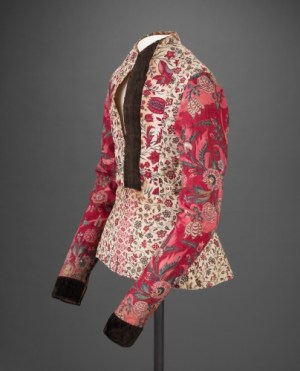 The Peabody Essex Museum (PEM) is pleased to announce the acquisition of a singular collection of rare early 18th-century Indian textiles made for export to the Netherlands. The collection of more than 100 pieces, including hand-painted chintz palampores (bed covers), an embroidered palampore, as well as extraordinary examples of Dutch costumes, was assembled in the Netherlands between the 1920s and 1960s by a private collector, A. Eecen-van Setten. Carefully stewarded by Eecen’s granddaughter, Lieke Veldman-Planten, the Veldman-Eecen Collection has been preserved in exceedingly fine condition for the better part of the last century. The acquisition, funded by anonymous donors, significantly enhances PEM’s world-renowned Asian Export Art collection, and offers insight into 18th-century textile production, design, and trade.
Between 1650 and 1750, cotton textiles were imported in large quantities from eastern India to the Netherlands by the VOC (Dutch East India Company). Decorated with sinuous floral and foliage patterns, Indian cotton was commonly referred to as ‘chintz’ after the north Indian word chitra meaning ‘spotted’ or ‘sprinkled’. Indian chintzes were prized globally for their vivid and durable colors-something that European textile manufacturers were unable to match until the mid-18th century. These vibrant textiles were particularly popular in the Netherlands, where they were used for nearly everything-clothing, upholstery, bed hangings and even wall coverings. The Veldman-Eecen Collection features nearly a dozen Indian cotton chintz bed covers (palampores), as well as unusual examples of men’s dressing gowns (banyans), and women’s and children’s chintz clothing.
Collected at a time when chintz textiles were not well studied, the Veldman-Eecen Collection would be virtually impossible to assemble today given the scarcity of such textiles in the contemporary market. The collection, which also includes a selection of related European-printed textiles from the late 18th to the early 20th centuries, is enhanced by a detailed journal, or Sits Boek (chintz book), in which A.Eecen-van Setten chronicled her acquisitions. Selections from the collection will be on view in Asia in Amsterdam, a forthcoming 2016 exhibition co-organized by PEM and the Rijksmuseum.
PEM’s Asian Export Collection
The Peabody Essex Museum’s Asian Export Art Collection is the world’s most comprehensive collection of decorative art made in Asia for export to the West. Consisting of over 25,000 objects made in China, Japan and India for the Western market between the 15th and 21st centuries, items include works in porcelain, lacquer, paintings, silver, textiles, and ivory among others. The collection reflects the complex and fascinating interaction between the artistic and cultural traditions of East and West.
The Peabody Essex Museum
The Peabody Essex Museum (PEM) is one of the oldest and fastest growing museums in North America. At its heart is a mission to transform people’s lives by broadening their perspectives, attitudes and knowledge of themselves and the wider world. PEM celebrates outstanding artistic and cultural creativity through exhibitions, programming and special events that emphasize cross-cultural connections and the vital importance of creative expression. Founded in 1799, the museum’s collection is among the finest of its kind boasting superlative works from around the globe and across time—including American art and architecture, Asian export art, photography, maritime art and history, as well as Native American, Oceanic and African art. PEM’s campus affords a varied and unique visitor experience with hands-on creativity zones, interactive opportunities, performance spaces and historic properties, including Yin Yu Tang: A Chinese House, a 200-year-old house that is the only example of Chinese domestic architecture on display in the United States.
Eve Kahn recently wrote about the acquisition for The New York Times (28 August 2014).
Exhibition | Goya’s Tapestry Cartoons in the Context of Court Painting
From the Prado:
Goya’s Tapestry Cartoons in the Context of Court Painting
Los Cartones de Tapices de Goya en el Contexto de la Pintura Cortesana
Museo Nacional del Prado, Madrid, 24 November 2014 — 3 May 2015

Francisco de Goya, The Pottery Vendor, 1778
(Madrid: Prado, P00780)
Opening in November and coinciding with the remodelling of the galleries on the second floor of the Museum’s south wing that house Goya’s cartoons and the collection of 18th-century Spanish paintings, the Museo del Prado will be presenting an exhibition on Goya’s tapestry cartoons, to be shown in its temporary exhibition galleries. The cartoons will be displayed alongside loans from other collections and paintings on deposit or not habitually on display in order to establish an innovative dialogue between Goya’s cartoons and the works of other artists of his own time or earlier. This dialogue will reveal the artist’s links with earlier tradition, the inspiration of the classical world, which was of such fundamental importance in the second half of the 18th century, and his range of contemporary sources.
In addition, the exhibition will reveal how the tapestry cartoons are essential for an understanding of the artist’s work and for an appreciation of his particular technique, unique and varied artistic resources and the particular nature of his models, with their characteristic appearances and distinctive gestures. Together these elements laid the way for Goya’s subsequent creations in his small-format paintings, drawings and print series.
New Book | The Country House: Material Culture and Consumption
From English Heritage:
Andrew Hann and Jon Stobart, eds., The Country House: Material Culture and Consumption (Swindon: English Heritage, 2014), 256 pages, ISBN: 978-1848022331, £70.
 This book presents a series of conference papers exploring the material culture of the country house and its presentation to the public. There is an academic interest in the consumption practices of the elite as well as in the country house as a lived and living space that was consciously transformed according to fashion and personal taste. Importantly there is also a concern amongst curators to present a coherent narrative of historic properties and their contents to the modern visitor.
The proceeding address a number of current academic debates about elite consumption practices and the role of landed society as arbiters of taste. By looking at the country house as lived space, many of the papers throw up interesting questions about the accumulation and arrangement of objects, the way in which rooms were used and experienced by both owners and visitors, and how this sense of ‘living history’ can be presented meaningfully to the public.
Andrew Hann is Properties Historians’ Team Leader at English Heritage; Jon Stobart is Professor of History at the University of Northampton.
The Met Launches App for iPhone, iPad, and Touch

◊ ◊ ◊ ◊ ◊
Press release (2 September 2014) from The Met:
The Met App provides an easy way for the museum’s community—locally and globally—to stay current with what’s happening at the museum.
Thomas P. Campbell, Director and CEO of The Metropolitan Museum of Art, announced that the Museum will launch today its flagship smartphone app—titled simply The Met—developed exclusively for iPhone, iPad, and iPod touch. This free digital resource is the easiest way to see what’s happening at the Met every day, wherever you are. . .
Mr. Campbell said: “With so much to see and do at the Met on a daily basis, we wanted to create a simple yet personalized way for our community to find the art, exhibitions, and events that matter most to them. The new app is a pocket-sized, customizable tool that puts the Met at users’ fingertips. It will be great for both New Yorkers and everyone in our global community who wants to stay connected with the Met—from anywhere in the world.”
Sree Sreenivasan, the Museum’s Chief Digital Officer, added: “In developing the app, we hope to provide our audiences with what’s most useful to them, and in the most engaging way. We want this app to offer an enjoyable starting point for many new relationships with the Museum, right now and in the future.”The Met app is supported by Bloomberg Philanthropies.“Bloomberg Philanthropies made an extraordinary and important investment in the Met’s digital initiatives, and this innovative new app is just one of the results,” Mr. Campbell continued. “The foundation is an amazing, forward-thinking partner whose generous support will expand the Met experience exponentially across the globe.”
“The Metropolitan Museum is one of the world’s most important cultural institutions, and the museum’s new app will help open peoples’ eyes to its extraordinary collection and programs like never before. The Met app makes a day at the museum even more rewarding; and by making it possible to experience the museum even when you’re not there, the app is a wonderful way to bring art into more lives, more often,” said Michael R. Bloomberg, founder of Bloomberg Philanthropies and three-term mayor of New York City.
The Met app helps users discover the galleries, works of art, media, events, facilities, information, and resources that best meet their interests—both in its main building along Fifth Avenue and at The Cloisters museum and gardens, the Metropolitan Museum’s branch for medieval art and architecture in Upper Manhattan.
The app provides information on current exhibitions and when they will close; must-see highlights of the collection; a way to purchase an admission; activities for families and children; syndication of the Met’s highly popular Twitter feed, which carries up-to-the-minute messages and announcements; and much more. Users can swipe both vertically and horizontally within the app, and its contents can be shared seamlessly through users’ social media accounts.
One of the highlights of the app is a set of themed lists of artworks that provide fresh, often playful, perspectives on the Met’s permanent collection. These include: “Grand Spaces and Hidden Nooks,” “Animals: See One, Be One,” “Hidden in Plain Sight,” “Medieval Love” (for The Cloisters), and “Met-Staches,” which shows works of art with mustachioed subjects. For the more avid users there is also a hidden feature to discover: the Museum’s popular “Artwork of the Day.”
“This is an entirely original type of museum app,” said Loic Tallon, the Met’s Senior Mobile Manager. “At the start of this project we took a step back and asked people what they wanted to see in a Met app. They told us three things: make it useful, make it simple, make it delightful. We know there’s a lot to do at the Met, and what we heard was that people wanted our app to answer easily their most essential questions about the Museum: ‘Where should I start? What’s happening today? What can my kids do there? Can you show me something fresh?’ These are the types of questions about the Museum for which our audience wants to turn to their phone, and our app, for answers. At the same time we had to make the app as beautiful as it was useful—a product worthy of the museum itself. We worked with Instrument, one of the world’s leading digital agencies, to design and build an app that would meet those goals, and I believe we have. The Met app balances beauty with utility.”
The Met app includes a special area designated for use by the Museum’s Members, a group more than 150,000 strong. It provides news and updates as well as information about special events organized for Members. Museum Memberships can also be purchased through the app.
The Met app was produced by the Metropolitan Museum’s Digital Media Department in collaboration with Instrument, an independent digital creative agency in Portland, Oregon, and with the assistance of staff from across the Museum, in departments including Information Systems & Technology, Education, and Design. The Museum is now developing a version of The Met app for Android users, and this will launch in 2015. . . .










 Enfilade
leave a comment