Exhibition | Democratic Designs: American Folk Paintings
From the Chrysler Museum:
Democratic Designs: American Folk Paintings from the Chrysler Museum
Willoughby-Baylor House, Norfolk, Virginia, 16 August 2014 — 5 April 2015
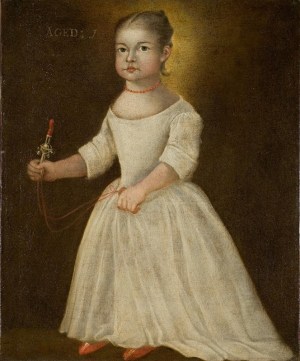
Attributed to Joseph Badger, Portrait of a Child, oil on canvas, ca. 1750 (Chrysler Museum of Art)
The Federal-era Willoughby-Baylor House provides a perfect historical setting for an exhibition of highlights from the Chrysler Museum’s deep early American collections.
Democratic Designs explores the work of artists with considerable ambition and talent, but limited access to professional training. The exhibition includes works by Ammi Phillips, Edward Hicks, Erastus Salisbury Field, and their contemporaries. The exhibition triumphantly displays individual creativity and native genius. Many pieces in this show are gifts from the pioneering collectors Bernice Chrysler Garbisch, sister of Walter P. Chrysler, Jr., and her husband Col. Edgar William Garbisch.
The Baroque in the Construction of a National Culture in Francoist Spain
From Taylor & Francis:
Bulletin of Spanish Studies: Hispanic Studies and Researches on Spain, Portugal and Latin America 91.5 (2014).
Special issue on ‘The Baroque in the Construction of a National Culture in Francoist Spain’, edited by Paula Barreiro López, Carey Kasten and Tobias Locker.
The baroque was both praised and attacked by critics for overwhelming the viewer through art. Yet its indisputable importance in Hispanic tradition and its characteristic intensity made the baroque an important element of culture during the regime of Francisco Franco (1939–1975). Not only did the baroque anchor official Francoist culture, its influence was also apparent in the regime’s politics, which used the baroque as an ideological legitimising tool in intellectual discourses. This interdisciplinary special issue is the first single volume to examine the influence of baroque tradition on Francoist Spain, analyzing cultural and political examples of twentieth-century reinterpretations of the baroque. For example, the concept of hispanidad, which underpinned Spain’s foreign policy and influenced international perceptions of the country, contained many baroque elements. By analysing its imprint on Spain’s culture industry both at home and abroad this special issue demonstrates the essential role the baroque played in the creation of a national and cultural identity during the dictatorship in Spain.
• Tobias Locker, “The Baroque in the Construction of a National Culture in Francoist Spain: An Introduction,” pp. 657–71.
• Till Kössler, “Education and the Baroque in Early Francoism,” pp. 673–96.
• Carey Kasten, “Staging the Golden Age in Latin America: José Tamayo’s Strategic Ascent in the Francoist Theatre Industry,” pp. 697–714.
• Paula Barreiro López, “Reinterpreting the Past: The Baroque Phantom during Francoism,” pp. 715–34.
• Noemi De Haro-García and Julián Díaz-Sánchez, “Artistic Dissidence under Francoism: The Subversion of the Cliché,” pp. 735–54.
• Johannes Großmann, ” ‘Baroque Spain’ As Metaphor. Hispanidad, Europeanism and Cold War Anti-Communism in Francoist Spain,” pp. 755–71.
• Julio Montero and María Antonia Paz, “Lo barroco en la televisión franquista: tipos y temas; actores y escenarios,” pp. 773–92.
Exhibition | Caroline Watson and Female Printmaking
Opening next month at The Fitzwilliam:
Caroline Watson and Female Printmaking in Late Georgian England
The Fitzwilliam Museum, Cambridge, 23 September 2014 — 4 January 2015
Curated by David Alexander
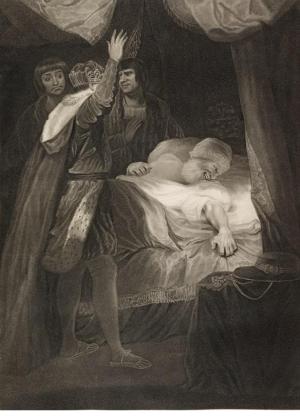
Caroline Watson, The Death of Cardinal Beaufort, stipple and etching after Sir Joshua Reynolds, 1792.
Caroline Watson (1760/61–1814) can be seen as the first British woman professional engraver. Many women in Britain had made prints before her day, but she was the first to make an extended career as an independent engraver. Nearly all those who had earlier made prints were either amateurs, making prints for amusement, or members of printmakers’ families, playing their part in family enterprises. The interest of her career is increased because she was working at a time when women were becoming more important as print buyers; some of her output reflected this change and the accompanying popularity of prints catering to feminine taste. She received support from other women, including recognition from Queen Charlotte, who appointed her ‘Engraver to the Queen’ in 1785, after she had been working for only five years. Later she was encouraged by the wealthy Bute family, particularly by the 4th Earl’s second wife, whose guest she was on several occasions at Luton Park, where Lord Bute, had one of the finest picture collections in England.
At the same time as finding support from other women Caroline Watson was encouraged by several influential men who saw advantage in using her skills; at the start of her career there were the painters Robert Edge Pine, Sir Joshua Reynolds and Ozias Humphry, as well as the printseller John Boydell, all of whom must have known her father; at the end of her career there was William Hayley, a poet and man of letters who befriended many artists. He both admired her as an ailing woman working on her own, and saw her as a reliable and talented collaborator. Having previously employed William Blake to engrave book illustrations he instead employed Caroline Watson on his Life of Romney, 1809. She did not owe her success to patronage, but to her great skill and dedication as an engraver; however the accidents of patronage were an important element in any artist’s career, especially for a woman who was of a retiring nature and not particularly robust in health.
The 200th anniversary of Watson’s death and the fact that the Fitzwilliam and the Folger Library own a number of unpublished letters by her to Hayley, which throw much light on her situation and way of life, provide a suitable opportunity not just to look at her career but to examine printmaking by women in the Britain of her time.
◊ ◊ ◊ ◊ ◊
Caroline Watson and Female Printmaking in Late Georgian England
The Fitzwilliam Museum, Cambridge, 24 September 2014
David Alexander, Honorary Keeper of British Prints and curator of the exhibition, will give a lunchtime talk at 1:15 on Wednesday, 24 September in the Seminar Room. Free admission is by token, 1 per person, available at the Courtyard Entrance desk from 12.45 on the day of the talk.
◊ ◊ ◊ ◊ ◊
Note (added 28 September 2014) — The catalogue is available from the Fitzwilliam:
David Alexander, Caroline Watson and Female Printmaking in Late Georgian England (Cambridge: Fitzwilliam Museum, 2014), 126 pages, ISBN 978-0957443464, £15.
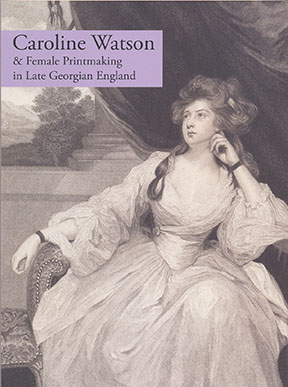 Caroline Watson, who died in 1814, can be seen as the first professional woman engraver, in the sense that she worked independently rather than as a member of a family of engravers. Over a career of thirty years she engraved more than a hundred very delicate prints in the stipple, or dotted manner, which was particularly suited for reproducing miniature portraits. The catalogue, which contains a chronological list of her prints, puts her in the context of the female printmaking of her time, and shows how exceptional was her achievement in working in a male dominated profession. The catalogue carries a transcription of sixteen letters written to her last major employer, William Hayley, which throw much light on the working methods of engravers in general.
Exhibition | Silent Partners: Artist and Mannequin
Press release (4 August) from The Fitzwilliam:
Silent Partners: Artist and Mannequin from Function to Fetish
The Fitzwilliam Museum, Cambridge, 14 October 2014 — 25 January 2015
Musée Bourdelle, Paris, 31 March — 12 July 2015
Curated by Jane Munro
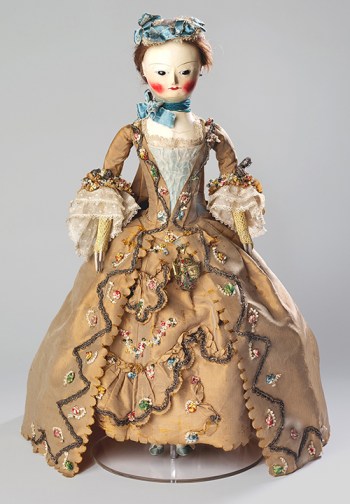
Fashion doll with costume and accessories, 1755–60; wood, gesso, paint, glass, human hair, knitted cotton, satin, silk, gilt braid, wire, silk gauze, linen, cotton, and silk satin, 60 x 42 x 43 cm (London: V&A Museum)
Every picture tells a story … but it does not always give away its secrets. For much of its existence, the artist’s mannequin, or lay figure, was one of art’s best-kept.
Now, for the first time, Silent Partners will unveil the mannequin’s secret life to show how, from being an inconspicuous studio tool, a piece of equipment as necessary as easel, pigments and brushes, the lay figure became the fetishised subject of the artist’s painting, and eventually, in the twentieth century, a work of art in its own right.
A common figure in the studios of painters and sculptors from the Renaissance onwards, this ‘artful implement’ was used to study perspective, arrange compositions, ‘rehearse’ the fall of light and shade and, especially, to paint drapery and clothing. But, while even the very greatest artists condoned its use, the mannequin best served its purpose by remaining ‘silent’: too present or visible in the finished picture, the mannequin could make figures appear stiff and unnatural, and so betray the tricks of the artist’s trade.
The nineteenth century was a turning point. Mannequin-making became a profession in its own right and Paris, especially, became a leading centre of production. Competition was fierce to create and perfect the ‘naturalistic’ mannequin, one that was life-size with an articulated skeleton that could move in realistic ways and an exterior finish that was painted and padded to look—sometimes eerily—human.
And as the mannequins became an increasingly sophisticated human replica, so they emerged from the anonymity of the studio to take their place, centre stage, on the canvas. At first the mannequin featured humorously, in witty visual games of ‘hide and seek’ and double entendre. However, throughout the course of the nineteenth century, painters such as Degas began to represent it in more troubling ways, playing on the unnerving psychological presence of a figure that was realistic, yet unreal, lifelike, yet lifeless. Others—photographers especially—explored in more voyeuristic terms how the relationship between male painter and female mannequin played out behind closed doors, revealing the studio as a place of potent erotic encounter.

Paul Huot, Female Mannequin, ca. 1816; wood, metal, horsehair, wax, silk, cotton and painted papier-mâché head, 163 x 65 cm, (Museumslandschaft Hessen Kassel, Sammlung Angewandte Kunst)
By the end of the century, innovations in the manufacture of mannequins shifted to the shop window dummy, the lay figure’s closest kin. Again, Paris led the way, and the fashion mannequin was transformed by firms such as Pierre Imans and Siégel from a schematic approximation of the human form into an uncannily realistic surrogate that inspired both consumerist longing and sexual fantasy.
This distinctively modern mannequin—one that reflected the life and elegance of its era—set a new challenge for twentieth-century painters and photographers. Featureless and expressionless, they haunted the paintings of the Italian metaphysical painters Giorgio de Chirico and Carlo Carrà, while the Surrealists celebrated the ‘modern’ mannequin as a manifestation of the ‘marvellous’, an object that could reveal the artist’s—and our—secret unconscious desires.
One of the most wide-ranging and ambitious shows ever hosted at the Fitzwilliam, the exhibition will feature over 180 paintings, drawings, books and photographs as well as fashion dolls, trade catalogues, a series of extraordinary patent documents and videos that will surprise and at times disturb. There will be paintings and drawings by Fra Bartolommeo, Cézanne, Poussin, Gainsborough, Millais, Ford Madox Brown, Courbet, Wilhelm Trübner, Kokoschka and Degas as well as photographs by and of Surrealist artists such as Bellmer, Raoul Ubac, Dalì and Man Ray; two works by Jake and Dinos Chapman will form a twenty-first-century coda. But among the most striking and fascinating exhibits will be the mannequins themselves: from beautifully carved sixteenth-century figures to haunting wooden effigies once belonging to Sickert (and maybe Hogarth) and painted dolls of full human height, top-of-the range models that were highly sought after by artists throughout Europe.
◊ ◊ ◊ ◊ ◊
From Yale UP:
Jane Munro, Silent Partners: Artist and Mannequin from Function to Fetish (New Haven: Yale University Press, 2014), 280 pages, ISBN: 978-0300208221, $65.
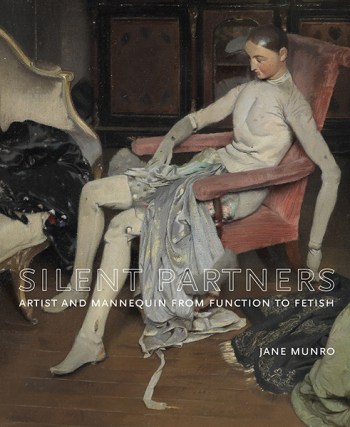 The articulated human figure made of wax or wood has been a common tool in artistic practice since the 16th century. Its mobile limbs enable the artist to study anatomical proportion, fix a pose at will, and perfect the depiction of drapery and clothing. Over the course of the 19th century, the mannequin gradually emerged from the studio to become the artist’s subject, at first humorously, then in more complicated ways, playing on the unnerving psychological presence of a figure that was realistic, yet unreal—lifelike, yet lifeless.
Silent Partners locates the artist’s mannequin within the context of an expanding universe of effigies, avatars, dolls, and shop window dummies. Generously illustrated, this book features works by such artists as Poussin, Gainsborough, Degas, Courbet, Cézanne, Kokoschka, Dalí, Man Ray, and others; the astute, perceptive text examines their range of responses to the uncanny and highly suggestive potential of the mannequin.
Jane Munro is a curator in the Department of Paintings, Drawings and Prints at the Fitzwilliam Museum and director of studies in history of art at Christ’s College at the University of Cambridge.
HBA Travel Award for Graduate Students
Historians of British Travel Award
Proposals due by 15 September 2014
HBA is accepting applications for this year’s Travel Award. The award is designated for a graduate student member of Historians of British Art who will be presenting a paper on British art or visual culture at an academic conference in 2015. The award of $750 is intended to offset travel costs. Applicants must be current members of HBA. To apply, send a letter of request, a copy of the letter of acceptance from the organizer of the conference session, an abstract of the paper to be presented, a budget of estimated expenses (noting what items may be covered by other resources), and a CV to Renate Dohmen, Prize Committee Chair, HBA, brd4231@louisiana.edu. The deadline is September 15, 2014.
2013 Dissertation Listings
From caa.reviews:
Dissertation Listings
PhD dissertation authors and titles in art history and visual studies from US and Canadian institutions are published each year in caa.reviews. Titles can be browsed by subject category or year.
Titles are submitted once a year by each institution granting the PhD in art history and/or visual studies. Submissions are not accepted from individuals, who should contact their department chair or secretary for more information. Department chairs: please consult our dissertation submission guidelines for instructions. The annual deadline is January 15 for titles from the preceding year.
In 2003, CAA revised the subject area categories of art history and visual studies used for all our listings, including dissertations. These categories are listed in the Dissertation Submission Guidelines.
◊ ◊ ◊ ◊ ◊
The index for 2013 lists four eighteenth-century dissertations completed:
• Beachdel, Thomas, “Landscape Aesthetics and the Sublime in France, 1750–1815” (CUNY, P. Mainardi)
• Jarvis, M. W., “Noir/Blanc: Representations of Colonialism and Cosmopolitanism in Eighteenth-Century Painting” (UC San Diego, N. Bryson)
• Knowles, Marika, “Pierrot’s Costume: Theater, Curiosity, and the Subject of Art in France, 1665–1860” (Yale, C. Armstrong)
• Lenhard, Danielle, “Reading with One Hand: Suggestive Folds and Subversive Consumption in Jean-Honore Fragonard’s The Bolt” (Stony Brook University, J. Monteyne)
◊ ◊ ◊ ◊ ◊
and forty-three dissertations in progress, including:
• Athens, Elizabeth, “Figuring a World: William Bartram’s Natural History” (Yale, T. Barringer)
• Hafera, Alison, “Images of Mourning and Melancholia in France, 1780–1830” (UNC Chapel Hill, M.Sheriff)
• Helprin, Alexandra, “Art and Servitude on the Sheremetev Estates” (Columbia, A. Higonnet)
• Lee, Hyejin, “‘Tout en l’air’: Visual and Material Representations of Air in Eighteenth-Century France” (UNC Chapel Hill, M. Sheriff)
• Mayer, Tamar, “Consequences of Drawing: Self and History in Jacques-Louis David’s Preparatory Practices” (Chicago, R. Ubl, M. Ward)
• Peterson, Laurel O., “The Decorated Interior: Artistic Production in the British Country House, 1688–1745” (Yale, T. Barringer)
• Polzak, Kailani, “Picturing Circumnavigation and Science: English, French, Russian, and Prussian Observations of Oceania, 1768–1822” (UC Berkeley, D. Grigsby)
• Ridlen, Michael T., “Prud’hon and the Graceful Style” (Iowa, D. Johnson)
• Strasik, Amanda K., “Representations of Childhood in Late Eighteenth- and Early Nineteenth-Century France” (Iowa, D. Johnson)
New Book | Art at the Origin
From the publisher:
Hans Christian Hönes, Kunst am Ursprung. Das Nachleben der Bilder und die Souveränität des Antiquars (Bielefeld: Transcript Verlag, 2014), 330 pages, ISBN 978-3837627503, 38€.
 The book provides a systematic study of the spectacular and often highly speculative art theories and art-historical narratives of such renowned antiquaries as Pierre d’Hancarville, Richard Payne Knight, and James Christie. Hans Christian Hönes analyses their theories on the origins of art and interprets the theory of history resulting from these hypotheses on the beginnings of art as a narrative of »survival«, bearing a surprisingly close resemblance to ideas culminating around 1900 in the writings of Aby Warburg.
Die spektakulären und höchst spekulativen Geschichtsentwürfe und Bildtheorien bedeutender Antiquare wie Pierre d’Hancarville und Richard Payne Knight stehen in diesem Buch erstmals im Fokus der Analyse. Hans Christian Hönes beleuchtet deren Theorien über den Ursprung der Kunst und das, so die These, daraus resultierende Narrativ eines bis in die eigene Gegenwart virulenten »Nachlebens« dieser Ursprünge. So offenbart sich ein Geschichtsentwurf, der überraschende Parallelen zu Theorien aufweist, wie sie um 1900 im Werk Aby Warburgs kulminieren. Die Studie zeigt: Das Anliegen der Protagonisten ist weniger die Suche nach historistischer Wahrheit—sondern vielmehr die
Konstruktion einer souverän entworfenen, polemischen und
romanhaften Kunstübung.
Hans Christian Hönes is Research Associate of the international research group Bilderfahrzeuge: Warburg’s Legacy and the Future of Iconology at the Warburg-Institute London.
Hand Fans, Goose Necks, and Archery Contests
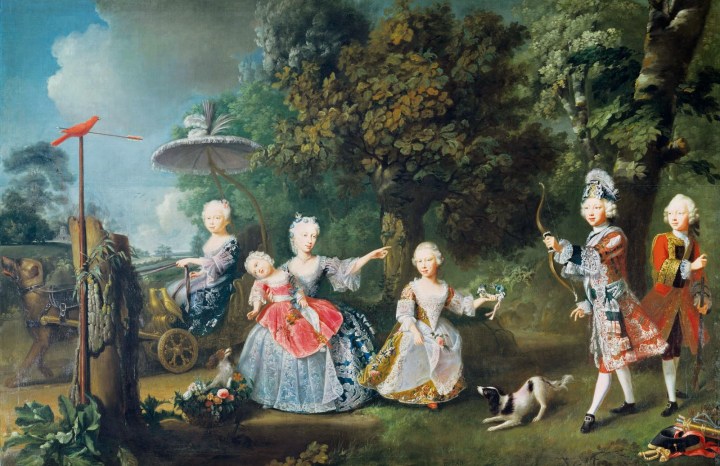
Barthélemy du Pan, The Children of Frederick, Prince of Wales, 1746
Royal Collection Trust/© Her Majesty Queen Elizabeth II 2014
◊ ◊ ◊ ◊ ◊
Pierre-Henri Biger’s website dedicated to the history of fans, Place de l’Eventail, recently published a notice related to seventeenth- and eighteenth-century target contests, commonly held in mid-August, involving a live goose (or more precisely, the goose’s neck, cou de l’oie).1 Biger quotes from Paul Sébillot’s Le Folklore de France (Paris, 1906), to make sense of a mis au rectangle (pictured at the website):
In Grez-Doiceau, in the Walloon Brabant, the second day of the fair, a live goose was hanging from a rope which brought together the upper ends of two long poles stuck in the ground. A man perched on a trestle remembered all the calamities which had hit the town during the past year, and accused the goose to be the cause. . .2
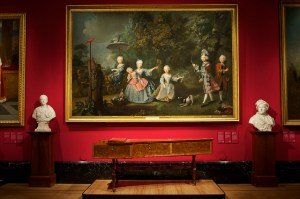
Installation view of The First Georgians, The Queen’s Gallery, Buckingham Palace, 2014.
With The First Georgians exhibition (on view at The Queen’s Gallery in London until October 12) still fresh in my memory, it’s hard to not to think of Barthélemy du Pan’s 1746 large-scale portrait of The Children of Frederick, Prince of Wales (Royal Collection), which depicts the future George III as having just struck a wooden popinjay.3 The prince wears the tartan of the Royal Company of Archers—which, as a British regimental uniform, was exempt from the 1745 ban on Scottish national dress. Bearing in mind Desmond Shawe-Taylor’s suggestion that we understand the picture as “an early example of the process by which Scottish identity became something manly and romantic, rather than threatening and rebellious,” I wonder if rustic traditions of shooting a living bird as part of a celebration with ‘atonement/scapegoat’ undertones might add another layer of relevant associations.4 I’m not sure how far I would push the point: the two contests weren’t the same thing (particularly from an animal rights perspective), and with folk festivals, it’s difficult to pin down specifics (times, places, meanings, &c.). Still, Biger’s piece, at the very least, suggests a larger context for archery contests and their pictorial representation in the eighteenth century and might encourage us to look to fans for useful points of comparison.
–Craig Ashley Hanson
1. Pierre-Henri Biger’s piece is available in both English and French. On the topic generally, see Biger’s recent article, “Introduction à l’éventail européen aux XVIIe et XVIIIe siècles,” Seventeenth-Century French Studies 36 (July 2014): 84–92. The issue, edited by Katherine Ibbett, is dedicated to the topic of fans. The table of contents is available as a PDF file here.
2. Paul Sébillot, Le Folklore de France (Paris, 1906), volume 3, pp. 247–48.
3. The Royal Collection’s online entry for Barthélemy du Pan’s The Children of Frederick, Prince of Wales is available here.
4. Desmond Shawe-Taylor makes the point in the entry for the painting from the exhibition catalogue, which he also edited, The First Georgians: Art & Monarchy, 1714–60 (London: Royal Collection Trust, 2014), p. 366.
Exhibition | Picturing Mary: Woman, Mother, Idea
From the NMWA:
Picturing Mary: Woman, Mother, Idea
National Museum of Women in the Arts, Washington, D.C., 5 December 2014 — 12 April 2015
Curated by Timothy Verdon
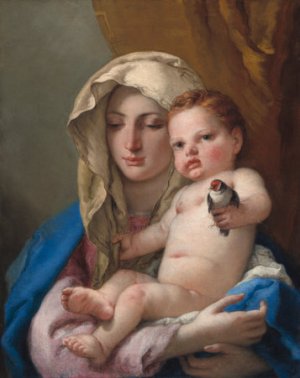
Giovanni Battista Tiepolo, Madonna of the Goldfinch, ca. 1767–70 (National Gallery of Art, Washington, D.C., Samuel H. Kress Collection #1943.4.40)
Appearing throughout the entire world, her image is immediately recognizable. In the history of Western art, she was one of the most popular subjects for centuries. Picturing Mary: Woman, Mother, Idea is a landmark exhibition at the National Museum of Women in the Arts (NMWA), bringing together masterworks from major museums, churches and private collections in Europe and the United States. Iconic and devotional, but also laden with social and political meaning, the image of the Virgin Mary has influenced Western sensibility since the sixth century.
Picturing Mary examines how the image of Mary was portrayed by well-known Renaissance and Baroque artists, including Botticelli, Dürer, Michelangelo, Pontormo, Gentileschi and Sirani. More than 60 paintings, sculptures and textiles are on loan from the Vatican Museums, Musée du Louvre, Galleria degli Uffizi, Palazzo Pitti and other public and private collections—many exhibited for the first time in the United States.
“Among the most important subjects in Western art for more than a millennium was a young woman: Mary, the mother of Jesus. Her name was given to cathedrals, her face imagined by painters and her feelings explored by poets,” said exhibition curator and Marian scholar Monsignor Timothy Verdon, director, Museo dell’Opera del Duomo, Florence, Italy. “This exhibition will explore the concept of womanhood as represented by the Virgin Mary, and the power her image has exerted through time, serving both sacred and social functions during the Renaissance and Baroque periods.”
Picturing Mary is the newest project in an ongoing program of major historical loan exhibitions organized by NMWA, including An Imperial Collection: Women Artists from the State Hermitage Museum (2003) and Royalists to Romantics: Women Artists from the Louvre, Versailles, and other French National Collections (2012). In addition to illustrating the work of women artists, NMWA also presents exhibitions and programs about feminine identity and women’s broader contributions to culture. Picturing Mary extends, in particular, the humanist focus of Divine and Human: Women in Ancient Mexico and Peru, a large-scale exhibition organized by NMWA in 2006.
The full press release (16 July 2014) is available as a PDF file here»
◊ ◊ ◊ ◊ ◊
From ACC Distrbution:
Timothy Verdon, Melissa R. Katz, Amy Remensnyder, Miri Rubin, Kathryn Wat, Picturing Mary Woman, Mother, Idea (New York: Scala Arts Publishers, 2014), 160 pages, ISBN: 978-1857598957, $45 / £30.
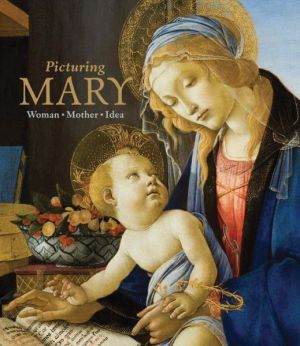 Iconic and devotional, but also fraught with social and political significance, the image of the Virgin Mary has shaped Western art since the sixth century. Depictions of the Virgin Mary in art through the ages are examined from a unique combination of Christian, Jewish, Muslim and contemporary art-historical perspectives. The thought-provoking texts examine Mary’s image as an enthroned queen, a tender young mother and a pious woman, demonstrating how her personification of womanhood has resonated throughout history to the present day.
Timothy Verdon is director of Museo dell Opera di Santa Maria del Fiore. Melissa R. Katz is Luther Gregg Sullivan Fellow in Art History, Wesleyan University. Amy Remensnyder is associate professor, Department of History at Brown University. Miri Rubin is Professor of Medieval and Early Modern History, Queen Mary University of London. Kathryn Wat is Chief Curator,
National Museum of Women in the Arts.
Call for Panels | College Art Association 2016, Washington, D.C.
I’m posting this particular call for panel proposals while wearing my hat as vice-president of the Historians of British Art. The announcement also serves as a general reminder, however, that all session ideas (in addition to those from affiliates) are due to CAA by Friday, 12 September 2014. HBA’s internal due date is Friday, 5 September. I’ve also included below the call for session proposals for the HECAA panel, which members should have received via email several days ago (if you’re a member and didn’t get a copy, please email Michael Yonan). –CH
◊ ◊ ◊ ◊ ◊
HBA Session Proposals for the 2016 College Art Association Conference
Washington, D.C., 3–6 February 2016
Proposals due by 5 September 2014
The Historians of British Art, an affiliate society of the College Art Association, welcomes proposals from members for its main session at the annual CAA conference in 2016 (February 3–6). Ideally, the session will accommodate a range of interests and multiple periods within the larger field of British art. Once HBA’s selection committee decides on a proposal, the individual(s) proposing the topic will need to follow the regular CAA procedures for panel submissions. Feel free to contact Craig Hanson with any questions, CraigAshleyHanson@gmail.com.
◊ ◊ ◊ ◊ ◊
HECAA Session Proposals for the 2016 College Art Association Conference
Washington, D.C., 3–6 February 2016
Proposals due by 29 August 2014
The Historians of Eighteenth-Century Art & Architecture, an affiliate society of the College Art Association, welcomes proposals from members for its main session at the annual CAA conference in 2016 (February 3–6). Please submit proposals to Michael Yonan, who will then submit them to the membership for a vote. In order to meet CAA’s deadlines, proposals will need to be emailed no later than 29 August 2014. Please include your name, affiliation, the title of the proposed panel, and a brief description of its theme. Three to four sentences should suffice.










 Enfilade
leave a comment