2013 Dissertation Listings
From caa.reviews:
Dissertation Listings
PhD dissertation authors and titles in art history and visual studies from US and Canadian institutions are published each year in caa.reviews. Titles can be browsed by subject category or year.
Titles are submitted once a year by each institution granting the PhD in art history and/or visual studies. Submissions are not accepted from individuals, who should contact their department chair or secretary for more information. Department chairs: please consult our dissertation submission guidelines for instructions. The annual deadline is January 15 for titles from the preceding year.
In 2003, CAA revised the subject area categories of art history and visual studies used for all our listings, including dissertations. These categories are listed in the Dissertation Submission Guidelines.
◊ ◊ ◊ ◊ ◊
The index for 2013 lists four eighteenth-century dissertations completed:
• Beachdel, Thomas, “Landscape Aesthetics and the Sublime in France, 1750–1815” (CUNY, P. Mainardi)
• Jarvis, M. W., “Noir/Blanc: Representations of Colonialism and Cosmopolitanism in Eighteenth-Century Painting” (UC San Diego, N. Bryson)
• Knowles, Marika, “Pierrot’s Costume: Theater, Curiosity, and the Subject of Art in France, 1665–1860” (Yale, C. Armstrong)
• Lenhard, Danielle, “Reading with One Hand: Suggestive Folds and Subversive Consumption in Jean-Honore Fragonard’s The Bolt” (Stony Brook University, J. Monteyne)
◊ ◊ ◊ ◊ ◊
and forty-three dissertations in progress, including:
• Athens, Elizabeth, “Figuring a World: William Bartram’s Natural History” (Yale, T. Barringer)
• Hafera, Alison, “Images of Mourning and Melancholia in France, 1780–1830” (UNC Chapel Hill, M.Sheriff)
• Helprin, Alexandra, “Art and Servitude on the Sheremetev Estates” (Columbia, A. Higonnet)
• Lee, Hyejin, “‘Tout en l’air’: Visual and Material Representations of Air in Eighteenth-Century France” (UNC Chapel Hill, M. Sheriff)
• Mayer, Tamar, “Consequences of Drawing: Self and History in Jacques-Louis David’s Preparatory Practices” (Chicago, R. Ubl, M. Ward)
• Peterson, Laurel O., “The Decorated Interior: Artistic Production in the British Country House, 1688–1745” (Yale, T. Barringer)
• Polzak, Kailani, “Picturing Circumnavigation and Science: English, French, Russian, and Prussian Observations of Oceania, 1768–1822” (UC Berkeley, D. Grigsby)
• Ridlen, Michael T., “Prud’hon and the Graceful Style” (Iowa, D. Johnson)
• Strasik, Amanda K., “Representations of Childhood in Late Eighteenth- and Early Nineteenth-Century France” (Iowa, D. Johnson)
New Book | Art at the Origin
From the publisher:
Hans Christian Hönes, Kunst am Ursprung. Das Nachleben der Bilder und die Souveränität des Antiquars (Bielefeld: Transcript Verlag, 2014), 330 pages, ISBN 978-3837627503, 38€.
 The book provides a systematic study of the spectacular and often highly speculative art theories and art-historical narratives of such renowned antiquaries as Pierre d’Hancarville, Richard Payne Knight, and James Christie. Hans Christian Hönes analyses their theories on the origins of art and interprets the theory of history resulting from these hypotheses on the beginnings of art as a narrative of »survival«, bearing a surprisingly close resemblance to ideas culminating around 1900 in the writings of Aby Warburg.
Die spektakulären und höchst spekulativen Geschichtsentwürfe und Bildtheorien bedeutender Antiquare wie Pierre d’Hancarville und Richard Payne Knight stehen in diesem Buch erstmals im Fokus der Analyse. Hans Christian Hönes beleuchtet deren Theorien über den Ursprung der Kunst und das, so die These, daraus resultierende Narrativ eines bis in die eigene Gegenwart virulenten »Nachlebens« dieser Ursprünge. So offenbart sich ein Geschichtsentwurf, der überraschende Parallelen zu Theorien aufweist, wie sie um 1900 im Werk Aby Warburgs kulminieren. Die Studie zeigt: Das Anliegen der Protagonisten ist weniger die Suche nach historistischer Wahrheit—sondern vielmehr die
Konstruktion einer souverän entworfenen, polemischen und
romanhaften Kunstübung.
Hans Christian Hönes is Research Associate of the international research group Bilderfahrzeuge: Warburg’s Legacy and the Future of Iconology at the Warburg-Institute London.
Hand Fans, Goose Necks, and Archery Contests
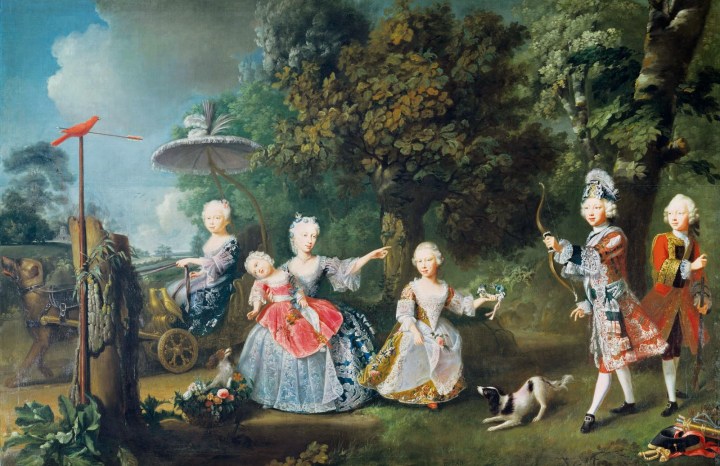
Barthélemy du Pan, The Children of Frederick, Prince of Wales, 1746
Royal Collection Trust/© Her Majesty Queen Elizabeth II 2014
◊ ◊ ◊ ◊ ◊
Pierre-Henri Biger’s website dedicated to the history of fans, Place de l’Eventail, recently published a notice related to seventeenth- and eighteenth-century target contests, commonly held in mid-August, involving a live goose (or more precisely, the goose’s neck, cou de l’oie).1 Biger quotes from Paul Sébillot’s Le Folklore de France (Paris, 1906), to make sense of a mis au rectangle (pictured at the website):
In Grez-Doiceau, in the Walloon Brabant, the second day of the fair, a live goose was hanging from a rope which brought together the upper ends of two long poles stuck in the ground. A man perched on a trestle remembered all the calamities which had hit the town during the past year, and accused the goose to be the cause. . .2
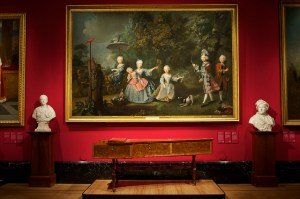
Installation view of The First Georgians, The Queen’s Gallery, Buckingham Palace, 2014.
With The First Georgians exhibition (on view at The Queen’s Gallery in London until October 12) still fresh in my memory, it’s hard to not to think of Barthélemy du Pan’s 1746 large-scale portrait of The Children of Frederick, Prince of Wales (Royal Collection), which depicts the future George III as having just struck a wooden popinjay.3 The prince wears the tartan of the Royal Company of Archers—which, as a British regimental uniform, was exempt from the 1745 ban on Scottish national dress. Bearing in mind Desmond Shawe-Taylor’s suggestion that we understand the picture as “an early example of the process by which Scottish identity became something manly and romantic, rather than threatening and rebellious,” I wonder if rustic traditions of shooting a living bird as part of a celebration with ‘atonement/scapegoat’ undertones might add another layer of relevant associations.4 I’m not sure how far I would push the point: the two contests weren’t the same thing (particularly from an animal rights perspective), and with folk festivals, it’s difficult to pin down specifics (times, places, meanings, &c.). Still, Biger’s piece, at the very least, suggests a larger context for archery contests and their pictorial representation in the eighteenth century and might encourage us to look to fans for useful points of comparison.
–Craig Ashley Hanson
1. Pierre-Henri Biger’s piece is available in both English and French. On the topic generally, see Biger’s recent article, “Introduction à l’éventail européen aux XVIIe et XVIIIe siècles,” Seventeenth-Century French Studies 36 (July 2014): 84–92. The issue, edited by Katherine Ibbett, is dedicated to the topic of fans. The table of contents is available as a PDF file here.
2. Paul Sébillot, Le Folklore de France (Paris, 1906), volume 3, pp. 247–48.
3. The Royal Collection’s online entry for Barthélemy du Pan’s The Children of Frederick, Prince of Wales is available here.
4. Desmond Shawe-Taylor makes the point in the entry for the painting from the exhibition catalogue, which he also edited, The First Georgians: Art & Monarchy, 1714–60 (London: Royal Collection Trust, 2014), p. 366.
Exhibition | Picturing Mary: Woman, Mother, Idea
From the NMWA:
Picturing Mary: Woman, Mother, Idea
National Museum of Women in the Arts, Washington, D.C., 5 December 2014 — 12 April 2015
Curated by Timothy Verdon
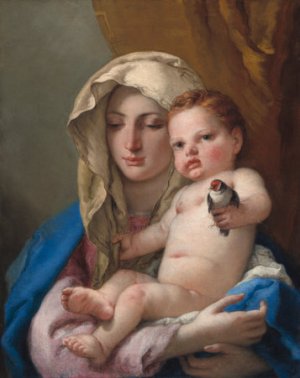
Giovanni Battista Tiepolo, Madonna of the Goldfinch, ca. 1767–70 (National Gallery of Art, Washington, D.C., Samuel H. Kress Collection #1943.4.40)
Appearing throughout the entire world, her image is immediately recognizable. In the history of Western art, she was one of the most popular subjects for centuries. Picturing Mary: Woman, Mother, Idea is a landmark exhibition at the National Museum of Women in the Arts (NMWA), bringing together masterworks from major museums, churches and private collections in Europe and the United States. Iconic and devotional, but also laden with social and political meaning, the image of the Virgin Mary has influenced Western sensibility since the sixth century.
Picturing Mary examines how the image of Mary was portrayed by well-known Renaissance and Baroque artists, including Botticelli, Dürer, Michelangelo, Pontormo, Gentileschi and Sirani. More than 60 paintings, sculptures and textiles are on loan from the Vatican Museums, Musée du Louvre, Galleria degli Uffizi, Palazzo Pitti and other public and private collections—many exhibited for the first time in the United States.
“Among the most important subjects in Western art for more than a millennium was a young woman: Mary, the mother of Jesus. Her name was given to cathedrals, her face imagined by painters and her feelings explored by poets,” said exhibition curator and Marian scholar Monsignor Timothy Verdon, director, Museo dell’Opera del Duomo, Florence, Italy. “This exhibition will explore the concept of womanhood as represented by the Virgin Mary, and the power her image has exerted through time, serving both sacred and social functions during the Renaissance and Baroque periods.”
Picturing Mary is the newest project in an ongoing program of major historical loan exhibitions organized by NMWA, including An Imperial Collection: Women Artists from the State Hermitage Museum (2003) and Royalists to Romantics: Women Artists from the Louvre, Versailles, and other French National Collections (2012). In addition to illustrating the work of women artists, NMWA also presents exhibitions and programs about feminine identity and women’s broader contributions to culture. Picturing Mary extends, in particular, the humanist focus of Divine and Human: Women in Ancient Mexico and Peru, a large-scale exhibition organized by NMWA in 2006.
The full press release (16 July 2014) is available as a PDF file here»
◊ ◊ ◊ ◊ ◊
From ACC Distrbution:
Timothy Verdon, Melissa R. Katz, Amy Remensnyder, Miri Rubin, Kathryn Wat, Picturing Mary Woman, Mother, Idea (New York: Scala Arts Publishers, 2014), 160 pages, ISBN: 978-1857598957, $45 / £30.
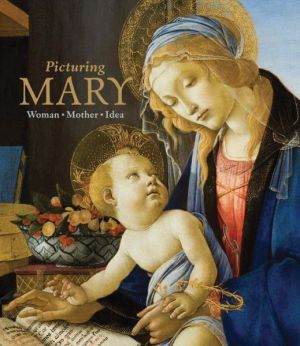 Iconic and devotional, but also fraught with social and political significance, the image of the Virgin Mary has shaped Western art since the sixth century. Depictions of the Virgin Mary in art through the ages are examined from a unique combination of Christian, Jewish, Muslim and contemporary art-historical perspectives. The thought-provoking texts examine Mary’s image as an enthroned queen, a tender young mother and a pious woman, demonstrating how her personification of womanhood has resonated throughout history to the present day.
Timothy Verdon is director of Museo dell Opera di Santa Maria del Fiore. Melissa R. Katz is Luther Gregg Sullivan Fellow in Art History, Wesleyan University. Amy Remensnyder is associate professor, Department of History at Brown University. Miri Rubin is Professor of Medieval and Early Modern History, Queen Mary University of London. Kathryn Wat is Chief Curator,
National Museum of Women in the Arts.
Call for Panels | College Art Association 2016, Washington, D.C.
I’m posting this particular call for panel proposals while wearing my hat as vice-president of the Historians of British Art. The announcement also serves as a general reminder, however, that all session ideas (in addition to those from affiliates) are due to CAA by Friday, 12 September 2014. HBA’s internal due date is Friday, 5 September. I’ve also included below the call for session proposals for the HECAA panel, which members should have received via email several days ago (if you’re a member and didn’t get a copy, please email Michael Yonan). –CH
◊ ◊ ◊ ◊ ◊
HBA Session Proposals for the 2016 College Art Association Conference
Washington, D.C., 3–6 February 2016
Proposals due by 5 September 2014
The Historians of British Art, an affiliate society of the College Art Association, welcomes proposals from members for its main session at the annual CAA conference in 2016 (February 3–6). Ideally, the session will accommodate a range of interests and multiple periods within the larger field of British art. Once HBA’s selection committee decides on a proposal, the individual(s) proposing the topic will need to follow the regular CAA procedures for panel submissions. Feel free to contact Craig Hanson with any questions, CraigAshleyHanson@gmail.com.
◊ ◊ ◊ ◊ ◊
HECAA Session Proposals for the 2016 College Art Association Conference
Washington, D.C., 3–6 February 2016
Proposals due by 29 August 2014
The Historians of Eighteenth-Century Art & Architecture, an affiliate society of the College Art Association, welcomes proposals from members for its main session at the annual CAA conference in 2016 (February 3–6). Please submit proposals to Michael Yonan, who will then submit them to the membership for a vote. In order to meet CAA’s deadlines, proposals will need to be emailed no later than 29 August 2014. Please include your name, affiliation, the title of the proposed panel, and a brief description of its theme. Three to four sentences should suffice.
New Book | Italian Master Drawings from the Princeton Art Museum
From Yale UP:
Laura M. Giles, Lia Markey, and Claire Van Cleave, Italian Master Drawings from the Princeton University Art Museum (New Haven: Yale University Press, 2014), 334 pages, ISBN: 978-0300149326, $65.
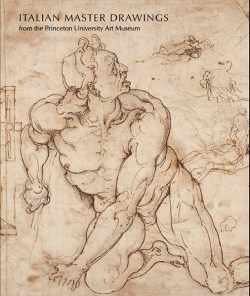 This richly illustrated volume offers a new look at the exceptional collection of Italian drawings at the Princeton University Art Museum. An introductory essay by Laura M. Giles chronicles the history and significance of the collection, and nearly one hundred of the collection’s masterworks are treated with essay-length entries and full-page images. The first scholarly examination of the collection since Felton Gibbons’s comprehensive publication of 1977, the catalogue includes an appendix of more than 150 drawings that have entered the collection since—many previously unpublished, and all fully documented with short entries. Highlights include works by celebrated masters, including Carpaccio and Modigliani, from the early Renaissance through the early Modern periods, with an emphasis on the collection’s renowned holdings of works by Luca Cambiaso, Guercino, and the two Tiepolos.
Laura M. Giles is the Heather and Paul G. Haaga Jr., Class of 1970, Curator of Prints and Drawings at the Princeton University Art Museum. Lia Markey is a lecturer in the department of art and archaeology at Princeton University, specializing in Italian Renaissance art. Claire Van Cleave is the author of Master Drawings of the Italian Renaissance (2007).
The 2013 Georgian Group Architectural Awards
The most recent architectural awards from The Georgian Group were announced last October (yes, I realize the posting is long, long overdue), with nominations open for the 2014 awards until September 19. –CH
◊ ◊ ◊ ◊ ◊
The Georgian Group’s Architectural Awards, sponsored by international estate agents Savills and now in their twelfth year, recognise exemplary conservation and restoration projects in the United Kingdom and reward those who have shown the vision and commitment to restore Georgian buildings and landscapes. Awards are also given for high-quality new buildings in Georgian contexts and in the Classical tradition.
Entries for the 2014 awards are now being accepted. There is no entry fee. Schemes must be in the United Kingdom, Isle of Man or Channel Islands and must have reached practical completion between 1st January 2013 and 1st August 2014. For the purpose of the Awards, the term ‘Georgian’ embraces the period of classical ascendancy in Britain and is taken to mean 1660–1840. The owner’s consent is a condition of entry. Please send a description of your project with a selection of images to robert@georgiangroup.org.uk or to The Georgian Group, 6 Fitzroy Square, London W1T 5DX by 5pm on Friday 19 September 2014.
More information is available here»
◊ ◊ ◊ ◊ ◊
More information about the 2013 results and additional pictures are available here»
2 0 1 3 W I N N I N G A N D C O M M E N D E D S C H E M E S

Restoration of a Georgian Country House
Winner
Townhead, Slaidburn, Lancs (pictured above)
By and for Robert Staples
Early C18 stone house. Previously on buildings at risk register, acquired by present owners 2010, conservatively restored using traditional methods.
Commended
Hadlow Tower, Tonbridge, Kent
Thomas Ford and Partners for The Vivat Trust
1832 by Walter Barton May as part of a now largely demolished country house. 185ft Gothic folly in brick with covering of Roman cement. On World Monuments Fund Watch List by 2003. Now restored and refaced, with lantern (removed after storm damage in 1987) rebuilt.
◊ ◊ ◊ ◊ ◊
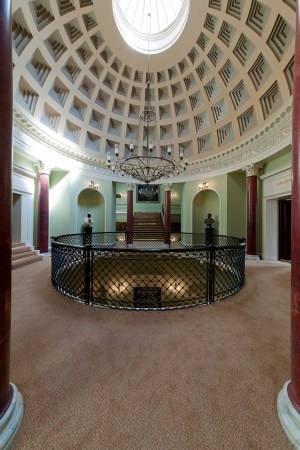 Restoration of a Georgian Interior
Winner
Theatre Royal Drury Lane, London (shown at right)
RHWL for The Really Useful Group Theatres
Restoration of Grand Saloon, The King’s and Prince’s Staircases and the Rotunda. Redecoration with advice from John Earl, Lisa Oestreicher and Edward Bulmer to match as closely as possible Benjamin Dean Wyatt’s original design. Installation of copy of Canova’s Three Graces in the Rotunda.
Commended
Great Fulford, near Exeter, Devon
Ceiling by Geoffrey Preston for Francis Fulford
New decorated plaster ceiling for the C17 double cube Great Dining Room. The original ceiling collapsed C19 and the room was then abandoned until C20; in 1960 a temporary ceiling composed of acoustic tiles was installed to make the room habitable. The 1700 picture hang has also been largely reinstated.
◊ ◊ ◊ ◊ ◊
Restoration of a Georgian Building in an Urban Setting
Winner
Mostyn House, 42 Vale Street, Denbigh
Milrick Ltd for John and Janis Franklin
1722 townhouse, restored in project initiated by Denbighshire County Council and part-funded by Townscape Heritage Initiative with HLF support. Main elevation fully returned to its original appearance, with removal of pebbledash and excrescences (later oriel window to first floor and bay windows to ground floor). Façade limewashed. Internally, lost oak panelling and missing section of oak staircase re-created.
Commended
116 High St, Boston, Lincolnshire
Anderson and Glenn for Heritage Lincolnshire
1728 merchant’s townhouse, later bank; by end of C20, gardens concreted over and house officially at risk and near to collapse. Compulsorily purchased by local authority and restored by building preservation trust supported by Architectural Heritage Fund and HLF. Envelope conserved and some lost features reinstated. Interior fitted out for office use and premises for small businesses built in grounds, giving a boost to a part of Boston cut off by a 1960s ring road.
Commended
107 Great Mersey Street, Liverpool L5
Brock Carmichael for Rotunda Ltd
1820s house, the only Georgian building left in Kirkdale area of Liverpool, near docks. In atrocious condition and on buildings at risk register by 2003, Urgent Works Notice served in 2007. HLF-funded project to restore envelope and restore or replace internal fabric.
◊ ◊ ◊ ◊ ◊
Reuse of a Georgian Building
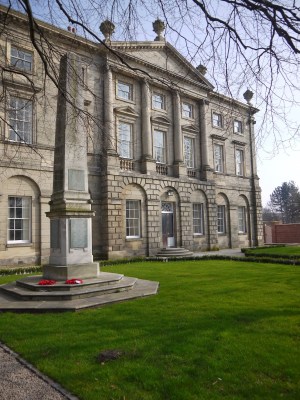 Winner
St. Helen’s House, Derby (shown at right)
Brownhill Hayward Brown for Richard Blunt
1766 by Joseph Pickford, Grade I, one of the finest C18 townhouses to survive in a provincial city. Sold by the Strutt family to Derby School in the 1860s, in educational use till 2004, since when vacant and formally at risk. Bought by Richard Blunt in 2006, now restored and converted to office use, the recession having put paid to a planned hotel conversion.
Commended
Norwood House, Beverley, East Riding
Elevation Design for The Brantingham Group (specialist advice from Patrick Baty)
1765, Grade I townhouse, acquired by local authority 1907 and used as a girls’ school until 1990s, then disused; deteriorated to the point where it was formally at risk. Arson in 2004 damaged the Rococo drawing room and the 1825 Grecian library. Subject to unsympathetic proposals but now sensitively restored and let in its entirety to a culinary school who use it in part as a restaurant.
Commended
Stable block, Sulby Hall, Northants
JWA Architects for Mr and Mrs Sandercock
1790s, attributed to Soane. Sulby Hall was demolished in 1952 and the surviving stable block was subsequently in various uses including as a store for farm equipment and grain. By 2005 it was ruinous and roofless. Natural England initiated restoration as part of a management plan for the owners’ mixed farm and the stable block, fully restored, is now used as a stable yard for stallions in a national breeding programme.
◊ ◊ ◊ ◊ ◊
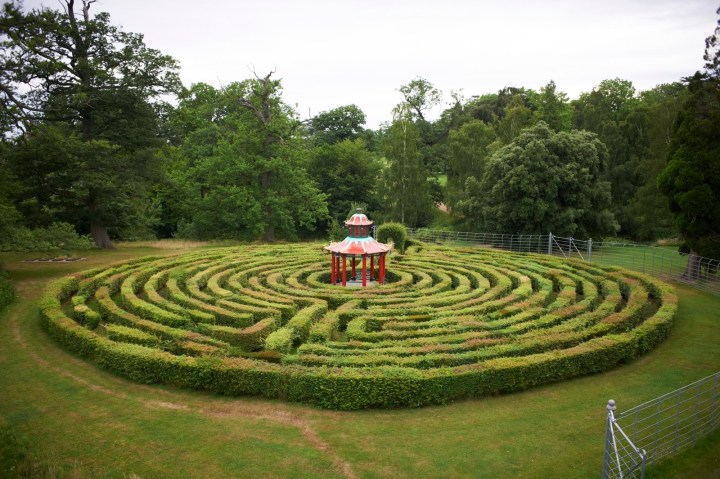
Restoration of a Georgian Garden or Landscape
Winner
Repton pleasure grounds, Woburn, Beds (pictured above)
Woburn Abbey gardeners for The Duke of Bedford
Restoration, and re-creation where lost, of the Georgian pleasure gardens and garden buildings, including Holland’s Chinese dairy, Repton’s pagoda, temple, aviary and cone house and Wyatville’s Camellia House.
Commended
Cow Pond, Windsor Great Park, Berkshire
Russ Canning for The Crown Estate
Part of the ten-year Royal Landscape Project to reinstate the lost historic landscapes of Windsor Great Park. Cow Pond, part of Wise’s 1712 plan for the Park and taking the form of a canal, was overgrown by 2008 and had regressed to swamp. Restoration included dredging and draining, construction of a Baroque footbridge and arbour and new planting.
Commended
Sir James Tillie Mausoleum, Pentillie Castle, Saltash, Cornwall
Cliveden Conservation for Ted Coryton
1713, in ruinous condition and covered in vegetation when Pentillie bought by present owners in 2007. Fully restored following archaeological survey, damaged Tillie statue repaired, vault excavated.
◊ ◊ ◊ ◊ ◊
New Building in the Classical Tradition
Winner
Onslow Park, near Shrewsbury, Salop
Craig Hamilton for Mr and Mrs John Wingfield
Schinkelesque country house on established estate. Five-bay, the centre three bays slightly recessed with arched openings to ground floor, forming an arcade on the garden front. Rendered with stone dressing. Top-lit stair hall with gallery and spiral cantilevered staircase.
Commended
Oval cricket ground, London SE11 (new forecourt pavilion)
Hugh Petter of Adam Architecture for Surrey County Cricket Club
Forecourt pavilion in brick with Bath stone dressing, replacing functional C20 banqueting suite. Central portico articulated with stone columns with bespoke Prince of Wales feather capitals and surmounted by stone urns.
◊ ◊ ◊ ◊ ◊
Giles Worsley Award for a New Building in a Georgian Context
Winner
8B Aubrey Road, London W8
Craig Hamilton Architects for Mr and Mrs Andrew Deacon
New classical mews house replacing former mews in grounds of 25 Holland Park Avenue (1820s). Soanean echoes, especially in recessed arches and rectangular sculpture gallery. Public façade composed of pediment and Diocletian window above full-width front door imitating typical mews garage door.
Commended
A lodge for a country house in Gloucestershire
Craig Hamilton for a private client
Classical lodge in stone on cruciform plan, each axis terminating at either end in a broken pediment; deep block-modillion cornice.
Commended
Trinity Church Terrace, Trinity Street, Borough, London SE1
By and for London Realty
Terrace of ten five-storey houses, forming infill development adjoining Trinity Church Square and designed to harmonise with existing context.
New Book | Warm Flesh, Cold Marble
From Yale UP:
David Bindman, Warm Flesh, Cold Marble: Canova, Thorvaldsen, and Their Critics (New Haven: Yale University Press, 2014), 220 pages, ISBN: 978-0300197891, $55.
 This brilliant book focuses on the aesthetic concerns of the two most important sculptors of the early 19th century, the great Italian sculptor Antonio Canova (1757–1822) and his illustrious Danish rival Bertel Thorvaldsen (1770–1844). Rather than comparing their artistic output, the distinguished art historian David Bindman addresses the possible impact of Kantian aesthetics on their work. Both artists had elevated reputations, and their sculptures attracted interest from philosophically minded critics. Despite the sculptors’ own apparent disdain for theory, Bindman argues that they were in dialogue with and greatly influenced by philosophical and critical debates, and made many decisions in creating their sculptures specifically in response to those debates.
Warm Flesh, Cold Marble considers such intriguing topics as the aesthetic autonomy of works of art, the gender of the subject, the efficacy of marble as an imitative medium, the question of color and texture in relation to ideas and practices of antiquity, and the relationship between the whiteness of marble and ideas of race.
David Bindman is Emeritus Durning-Lawrence Professor of the History of Art, University College London, and visiting professor, history of art, Harvard University.
Open House London 2014

From Open City:
Open House London 2014
London, 20–21 September 2014

Forty Hall, the 17th-century estate, is one of the 800 properties included in the Open House London programme.
Open House London, created and delivered by the independent non-profit organisation Open-City, is the capital’s largest annual festival of architecture and design. Now in its 22nd year, it is a city-wide celebration of the buildings, places and neighbourhoods where we live and work. By providing free and open access to 250,000 across 30 boroughs to more than 800 outstanding examples of historic and contemporary buildings, on-site projects and public spaces, it remains the most powerful medium for engaging everyone in a better appreciation of their city.
A full listing of the included sites will be posted on 15 August 2014 at the event website.
Exhibition | Collecting History
From The Wallace Collection:
Collecting History
The Wallace Collection, London, 6 November 2014 — 15 February 2015

George Cruishank, Polly and Lucy Takeing off the Restrictions, 1812, Hertford House Historic Collection (2007.36).
The Wallace Collection is not allowed to add to its main collection, which remains as it was when bequeathed by Lady Wallace in 1897. But ever since the foundation of the Wallace Collection, the library has acquired archival material and works of art to help illuminate the history of the collection and its founders. This exhibition will showcase the wide variety of the Hertford House Historic Collection including the often hilarious satirical cartoons concerning the Prince Regent’s obsessive passion for the 2nd Marchioness of Hertford.










 Enfilade
leave a comment