Exhibition | Longitude Punk’d

◊ ◊ ◊ ◊ ◊
In connection with the exhibition Ships, Clocks, and Stars: The Quest for Longitude; from the Royal Museums Greenwich:
Longitude Punk’d
National Maritime Museum, Greenwich, 10 April 2014 — 4 January 2015
Steampunk artists have taken over the Royal Observatory! Let madcap inventors, stargazing scientists, and extremely elegant explorers take you on an adventure into a world where scientific convention and the laws of nature have been re-written. Their fabulous narrative lavishly reinterprets the science and drama of the 18th-century quest to find longitude at sea, inspired by the 300th anniversary of the Longitude Act
Explore this exclusive exhibition of eccentric inventions specially created by steampunk luminaries including award-winning novelist Robert Rankin—exuberantly blurring the boundaries between art and science, fact and fiction. Don’t miss this chance to see something completely unique, never tried before and in the last place you would expect to see it. Meet time-travelling Astronomer Royal Nevil Maskelyne, observe Martian goings-on through our Victorian telescope, or come to a themed Steampunk film screening in our Punk’d events season (including The Adventures of Baron Munchausen).
Longitude Punk’d is part of Royal Museums Greenwich’s Longitude Season, celebrating the tercentenary of the Longitude Act with exhibitions, special events, and planetarium shows.
Exhibition | The Art and Science of Exploration, 1768–80

William Hodges, A View of the Monuments of Easter Island (Rapanui), ca.1776
(London: National Maritime Museum, BHC1795)
◊ ◊ ◊ ◊ ◊
Press release (17 June 2014) from the Royal Museums Greenwich:
The Art and Science of Exploration, 1768–80
Queen’s House, Greenwich, from 7 August 2014
This August The Art and Science of Exploration, 1768–80 opens in the newly refurbished rooms at the centre of the Queen’s House. Exploring the crucial role of artists on Captain Cook’s three voyages of discovery, the exhibition will be the first time that Stubbs’s Portrait of a Large Dog (Dingo) and The Kongouro from New Holland (Kangaroo) will be on display since they were acquired by the National Maritime Museum in November 2013.
When Cook’s first expedition to the South Pacific returned to Britain in 1771, he brought back accounts and images of extraordinary lands, people, flora and fauna. Returning twice more over the following decade, Cook established a pattern for voyages of discovery that combined scientific investigation with artistic response. The newly-acquired Stubbs paintings will be joined by portraits, landscapes and scenes of encounters with Pacific islanders by William Hodges and John Webber as well as botanical prints and original drawings by Sydney Parkinson.
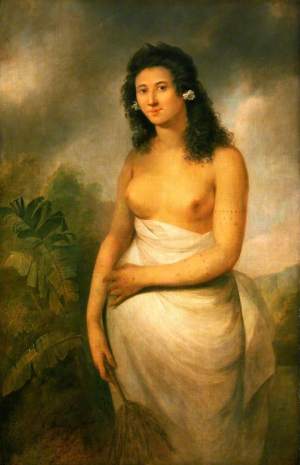
John Webber, Poedua, the Daughter of Orio, ca.1784 (London: National Maritime Museum, BHC2957)
Artists played an essential role on Captain Cook’s three voyages, producing both scientific records and imaginative responses to the unfamiliar lands that they encountered, forever influencing how the British public saw the Pacific. William Hodges was to become the first professional English painter to meet people previously unaffected by European contact, whilst John Webber’s painting of Poedua, the Daughter of Orio is one of the earliest portraits of a Polynesian woman by a European painter. The artists’ works were crucial to how places and discoveries were brought back and interpreted by those in Britain. Hodges’s paintings, particularly Tahiti Revisited, show how artists adapted the techniques and styles learnt in Europe to depict these exotic scenes for a British audience.
The middle section of The Art and Science of Exploration, 1768–80 looks at the work of Hodges, the artist who experimented and developed the most during his explorations with Cook and shared an interest in climate with the scientific men on board. He produced bright, vibrant studies that were on-the-spot responses to his environment with none of the classical allusion added to his later finished paintings. On display is Hodges’s A View of the Cape of Good Hope, Taken on the Spot, From On Board the Resolution, exhibited at the Free Society of Artists before he returned, along with eight of his small sketches, including the last oil study made on the second voyage, View of Resolution Bay in the Marquesas.
The third aspect of the exhibition focuses on the 30,000 dried plants and 955 botanical drawings by Sydney Parkinson that were brought back from Cook’s first voyage. The sheer quantity of new plants recorded was a defining feature of this expedition. Parkinson died during the return journey but his patron, the naturalist Joseph Banks planned to produce a book, employing a large group of artists to complete watercolours and engravings based on Parkinson’s sketches. However, it was not until the 1980s that all 743 prints were made. On display will be Parkinson’s original drawing, the watercolour, copper plate, engraving proof (all on loan from the Natural History Museum), and final print of two specimens collected at Endeavour River, Northern Queensland in 1770.
This exhibition shows the important role that artists had on the Cook voyages and on the European understanding of these faraway lands. They produced extraordinary images which worked both as scientific records of carefully planned exploration, as well as sensitive representations of an unfolding new world.
◊ ◊ ◊ ◊ ◊
Note (added 19 August 2014) — In April 2015 George Stubbs’s The Kongouro from New Holland will start a 12-month tour to four UK museums: The Horniman Museum and Gardens in London, The Captain Cook Memorial Museum in Whitby, The Grant Museum of Zoology at UCL, and the Hunterian Museum in Glasgow.
New Book | Meissen Snuffboxes of the Eighteenth Century
Published by Hirmer and distributed The University of Chicago Press:
Gerhard Röbbig, ed., Meissen Snuffboxes of the Eighteenth Century (Munich: Hirmer Verlag, 2014), 350 pages, ISBN: 978-3777421377, $65.
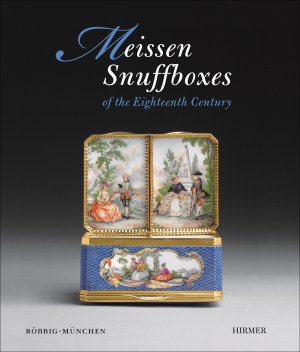 Originally praised for its medicinal purposes, powdered tobacco emerged as a fashionable stimulant among Europe’s high-society during the eighteenth century. To accommodate this novel pastime, elegant ladies and gentleman of the era sought to complete their look with tabatières, or elaborately painted porcelain snuffboxes.
Meissen Snuffboxes presents more than one hundred of the finest snuffboxes produced by the European porcelain manufacturer Meissen throughout the eighteenth century. Among the first manufacturers to cater to the rapidly growing demand for these tiny treasures, Meissen developed a wide range of snuffboxes, each fastidiously painted by the company’s most adept painters and incorporating motifs from the entire Meissen repertoire. In addition to 250 full-color photographs, this comprehensive catalog includes detailed descriptions of each item by eminent scholars in the field, as well as contributions that discuss current scholarship. Beautifully illustrated, Meissen Snuffboxes offers an incredible amount of information and shows how these tiny containers provide some of the most intimate insight available into the courtly life of the eighteenth century.
◊ ◊ ◊ ◊ ◊
C O N T E N T S
Essays
• Barbara Beaucamp-Markowsky, Porcelain Snuffboxes of the Eighteenth Century: An Introduction
• Hans Ottomeyer, Snuffboxes and the Taking of Snuff: On the Purpose of Luxury
• Lorenz Seelig, Precious Snuffboxes in Princely Collections of the Eighteenth Century
• Heike Zech, Pleasure and Principle: Collecting Snuffboxes from 1800 Onwards
• Ulrich Pietsch, Eighteenth-Century Meissen Porcelain Snuffboxes
• Sarah-Katharina Acevedo, Image and Symbol: On the Use and Meaning of the Snuffbox as Reflected by Meissen Figures of the Eighteenth Century
Catalogue
Appendix: The Work Reports of Meissen Modellers and Decorators Concerning Snuffboxes, selected and transcribed by Ulrich Pietsch
Literature
Index
Exhibition | The Art of Golf: The Story of Scotland’s National Sport
Press release (11 July 2014) for the current exhibition:
The Art of Golf: The Story of Scotland’s National Sport
The Scottish National Gallery, Edinburgh, 12 July — 26 October 2014

David Allan, William Inglis (ca. 1712–1792), Surgeon and Captain of the Honourable Company of Edinburgh Golfers (Scottish National Gallery)
The Scottish National Gallery is delighted to take part in the sporting celebrations taking place this summer in Scotland with The Art of Golf: The Story of Scotland’s National Sport. The exhibition will overlap with two important events: the Commonwealth Games, Glasgow (23 July–3 August) and the Ryder Cup, Gleneagles (23–28 September), the biennial competition played between teams of professional golfers representing the United States and Europe. The Art of Golf explores golf as a subject of fascination for artists from the seventeenth century to the present day, with a particular emphasis on the emergence of the sport in Scotland.
The Art of Golf will bring together around 60 paintings and photographs—as well as a selection of historic golfing equipment—with works by artists such as Rembrandt van Rijn (1606–1669), Sir Henry Raeburn (1756–1823), Hendrick Avercamp (1585–1634) and Paul Sandby (1731–1809) illustrating the origins of the game. Other highlights will include Sir John Lavery’s (1846–1951) beautiful 1920s paintings of the golf course at North Berwick, a coastal resort 25 miles east of Edinburgh, and colourful railway posters for popular destinations such as Gleneagles, which illustrate the boom in golfing tourism in the inter-war years. Stunning images of golf courses from Brora to the Isle of Harris by contemporary photographer Glyn Satterly and spectacular aerial shots by artist and aviator Patricia Macdonald will bring the exhibition up to present day. Generous loans from a number of famous Scottish golf clubs, the British Golf Museum in St Andrews and private collectors have been secured for this exhibition.
The centrepiece of the show will be the greatest golfing painting in the world, Charles Lees’s 1847 masterpiece The Golfers. This commemorates a match played on the Old Course at the Royal and Ancient Golf Club, St Andrews, by Sir David Baird and Sir Ralph Anstruther, against Major Hugh Lyon Playfair and John Campbell of Saddell. It represents a veritable ‘who’s who’ of Scottish golf at that time and was famously reproduced in a fine engraving which sold in great quantities. Lees (1800–80) made use of photography, at a time when it was in its infancy, to help him design the painting’s overall composition. The image in question, taken by photography pioneers D O Hill & Robert Adamson, will be included in the show and Lees’s preparatory drawings and oil sketches will also be displayed alongside the finished painting to offer visitors further insight into the creation of this great work. Impressions of The Golfers are now in many of the greatest golf clubhouses around the world. The painting is jointly owned by the National Galleries of Scotland and the Royal and Ancient Golf Club of St Andrews.

David Allan, The Prize of the Silver Golf: Officer Carrying a Decorated Golf Club, Two Soldiers with Drums behind Him, ca. 1785 (Scottish National Gallery)
Golf has been played in Scotland since at least the fifteenth century. Whilst its origins are obscure, it is undoubtedly close to the Netherlandish game of ‘colf’, which was played over rough ground or on frozen waterways, and involved hitting a ball to a target stick fixed in the ground or the ice. ‘Colvers’ playing on the frozen canals are seen in Dutch seventeenth-century paintings which form the earliest part of the show. In Scotland the game is often played over ‘links’ courses, originally rough common ground where the land meets the sea. The majority of Scotland’s famous old courses, such as St Andrews or North Berwick, are links courses. In Edinburgh, the early links courses of Bruntsfield, Leith and Musselburgh are shown in works by Sandby and Raeburn.
Michael Clarke, Director of the Scottish National Gallery, said: “This show is designed to be fun and to bring together two publics, lovers of art and lovers of golf. Where better to do this than in this world-class gallery, with its great Old master and Scottish paintings, which is situated in Scotland’s beautiful capital city of Edinburgh, and through which so many golfers pass on their way to our internationally renowned courses.”
◊ ◊ ◊ ◊ ◊
From ACC Distribution:
Michael Clarke and Kenneth McConkey, The Art of Golf (Woodbridge: Antique Collectors Club, 2014), 72 pages, ISBN: 978-1906270674, £13.
 The Art of Golf illustrates how the noble game has been depicted in European art from the seventeenth century to the present day. This fascinating story is told by images in a variety of media, from paintings and prints to photographs and posters. The centrepiece is Charles Lees’s The Golfers, 1847, which depicts a match played on the Old Course at St Andrews in 1847, and is one greatest golfing painting in the world. In his essay Michael Clarke, director of the Scottish National Gallery, outlines the story behind the development of the game, while art historian Kenneth McConkey discusses the series of paintings of golf at North Berwick made by Sir John Lavery in the years following the Great War.
Michael Clarke is Director of the Scottish National Gallery in Edinburgh. He has published widely, including books on English watercolours, the landscape painter Camille Corot, and his second, revised edition of The Oxford Concise Dictionary of Art Terms was published in 2010. Most recently he co-curated the international exhibition Impressionist Gardens (2010–11) and wrote the exhibition catalogue of French Drawings in the Scottish National Gallery (2011). Kenneth McConkey is Professor of Art History and Dean of the Faculty of Arts and Design, the University of Northumbria at Newcastle. He has written extensively about late Victorian and Edwardian painting.
◊ ◊ ◊ ◊ ◊
The politics of gender, golf, and Scottish identity will soon go to the polls. On September 18 (the same day, Scots vote to stay or secede from Britain), members of the Royal and Ancient Golf Club (roughly 2500 men) will vote on the question of whether women may be admitted. As reported by The New York Times, for Louise Richardson, the principal of the University of St. Andrews, the discriminatory policy is also a “workplace hurdle.” Karen Crouse’s article, “In St. Andrews, a Heavy Knock on a Neighbor’s Door: First Female President of University of St. Andrews Fights for Admittance at Royal and Ancient Golf Club,” appeared in the paper on 11 July 2014.
Update (added 22 September 2014) — As Crouse reports in The New York Times (18 September 2014). . .
The Royal and Ancient Golf Club voted overwhelmingly to admit its first female members. . . . Peter Dawson, the secretary of the club, announced the results of a postal balloting of the club’s 2,400 male members, many of whom were on site in matching blue jackets and patterned blue ties. About three-quarters of the members participated in the voting, he said, with 85 percent of them opting to accept women. . .
Call for Essays | Art History and Disability Studies
From H-ArtHist:
Edited Volume: Art History and Disability Studies
Proposals due by 15 September 2014
Contributions are sought for an interdisciplinary collection of essays on art history and disability studies for an edited volume to be published by Ashgate Publishing Co., as part of the series Interdisciplinary Disability Studies. Art history has not been as influenced by disability studies as have other disciplines of the humanities. Art historians have analyzed images by and about disabled people without integrating disability studies scholarship, while many disability studies scholars refer to images, but do not necessarily incorporate art historical research and methodology. This edited volume centers on interdisciplinary art history and disability studies scholarship.
Papers may address issues such as the following:
• Specific representations of disability throughout art history, including works by disabled and nondisabled artists
• Portraits of disabled individuals throughout history, with visible and/or invisible impairments
• Scientific, anthropological, and vernacular images of disability and how they have influenced fine art
• Representations that display disability and eroticization
• Performance in the forms of artworks and in the everyday lives of disabled individuals
• Theories and implications of looking/staring versus gazing in disability studies and in art history
• Examples of visual art that represent and/or challenge stereotypes of disability
Submissions due by September 15, 2014. All submissions must represent previously unpublished work. Please send an abstract of no more than 300 words and a CV to Ann Millett-Gallant (amillett@nc.rr.com) and Elizabeth Howie (ehowie@coastal.edu). Selected authors will be notified by October 15, 2014 and will contribute a full length essay of approximately 6000 words by April 1, 2015. All chapters will be reviewed by the editors before submission to the publisher and will be subject to an additional external review.
New Book | The Gods Want Blood
A new English translation of the 1912 novel, published last year and recently released in paperback from Alma Classics:
Anatole France, The Gods Want Blood, translated by Douglas Parmée (Richmond, Alma Classics, 2013), 256 pages, ISBN: 978-1847493194, $15.
 Set in Paris during the years of the Reign of Terror, The Gods Want Blood centres on the rise to power of the Jacobin sympathizer Évariste Gamelin, a young painter who becomes a juror on a local Revolutionary tribunal. Caught up in the bloodthirsty madness surrounding him, he helps to dispense cruel justice in the name of his ideals, while at the same time succumbing to his own petty instincts of revenge when he jealously pursues a rival for the affections of his lover Élodie.
Benefiting from Anatole France’s meticulous historical research, this fascinating and timeless novel sheds light on a complex world of rival factions and institutions of state terror and vividly portrays the lives and psyches of ordinary people who are complicit in acts of public barbarity.
◊ ◊ ◊ ◊ ◊
From The TLS Blog:
Adrian Tahourdin, “Anatole France and Proust,” The TLS Blog (19 September 2013).
A new translation of Anatole France’s novel Les Dieux ont soif is being published next month by Alma Classics, as The Gods Want Blood. First published in 1912, the book is set during the Terror of 1793–4 and features, fleetingly, both Marat and Robespierre. As its translator Douglas Parmée writes in his introduction, the novel has contemporary resonance: its main character, the mediocre painter (pupil of Jacques-Louis David) and revolutionary fanatic Évariste Gamelin “would surely make a first-rate suicide bomber.” France did his research thoroughly, with the result that his novel, in Parmée’s words, “bears throughout the stamp of historical authenticity.” . . .
The full posting is available here»
New Book | How to Ruin a Queen
From John Murray (a publishing house with its own eighteenth-century history: founded in 1768, the company remained under the Murray family’s control until 2002). . .
Jonathan Beckman, How to Ruin a Queen: Marie Antoinette and the Diamond Necklace Affair (John Murray, 2014), 400 pages, ISBN: 978-1848549982.
 A tale of greed, lust, deceit, theft on an extraordinary scale, charlatanry, kidnapping, assassination and escape from prison.
On 5 September 1785, a trial began in Paris that would divide the country, captivate Europe and send the French monarchy tumbling down the slope towards the Revolution. Cardinal Louis de Rohan, scion of one of the most ancient and distinguished families in France, stood accused of forging Marie Antoinette’s signature to fraudulently obtain the most expensive piece of jewellery in Europe—a 2,400-carat necklace worth 1.6 million francs. Where were the diamonds now? Was Rohan entirely innocent? Was, for that matter, the queen? What was the role of the charismatic magus, the comte de Cagliostro, who was rumoured to be two-thousand-years old and capable of transforming metal into gold?
This is a tale of political machinations and extravagance on an enormous scale; of kidnappings, prison breaks and assassination attempts; of hapless French police disguised as colliers, reams of lesbian pornography and a duel fought with poisoned pigs. It is a detective story, a courtroom drama, a tragicomic farce, and a study of credulity and self-deception in the Age of Enlightenment.
Jonathan Beckman is senior editor of Literary Review. He has degrees in English from the University of Cambridge and Intellectual and Cultural History from Queen Mary, University of London. In 2010, he won the Royal Society of Literature Jerwood Award for Non-Fiction.
New Book | Donatien Alphonse Francois de Sade
From Assouline:
Jean-Pascal Hesse, Donatien Alphonse Francois de Sade (Paris: Assouline, 2014), 192 pages, ISBN: 978-1614282020, $75.
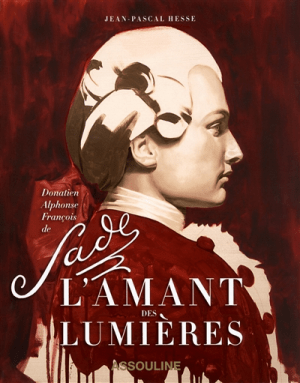 Man of letters, philosopher, and politician, the Marquis de Sade is one of the most controversial figures since the eighteenth century, but recently psychology, theater, cinema, and literary criticism have shed new light on his life and works. Lacoste Castle in the South of France, one of the properties of the Sade family, became the refuge of the Marquis between periods of incarceration. Thanks to the Sade family opening its archives for the first time, historian Jean-Pascal Hesse examines Sade’s story through previously unpublished documents and imagery and walks in the Marquis’ footsteps in his beloved château.
Originally from the region of Lacoste, historian Jean-Pascal Hesse is the author of a number of books, including Pierre Cardin: 60 Years of Innovation (2010), Maxim’s: Mirror of Parisian Life (2011), and The Palais Bulles (2012), all in close collaboration with Pierre Cardin and published by Assouline. He also serves on the Paris city council, and directs cultural events for the mayor of the 16th arrondissement.
Call for Papers | Dr Richard Mead: Physician, Philanthropist, Collector
From The Foundling Museum:
Dr Richard Mead: Physician, Philanthropist, Collector
The Foundling Museum, London, 20 October 2014
Proposals due by 15 August 2014

Allan Ramsay, Dr Richard Mead, 1747
(London: The Foundling Museum)
We invite proposals for papers for this cross-disciplinary one day conference hosted by the Foundling Museum. The conference is running in conjunction with the Museum’s autumn exhibition The Generous Georgian: Dr Richard Mead, which runs from 26 September 2014 to 4 January 2015. The exhibition, supported by the Wellcome Trust, the City of London and Verita, will consider the life, work and collections of Richard Mead (1673–1754), one of the founding governors of the Foundling Hospital.
Proposals on a variety of subjects relating to Mead and his context are welcome, including but not limited to the themes of the exhibition: his medical practice, his collecting and connoisseurship and his charitable activities. Proposals from early career professionals and works in progress are welcome.
All enquiries regarding the conference should be addressed to stephanie@foundlingmuseum.org.uk. Please e-mail proposals (approximately 200 words) to stephanie@ foundlingmuseum.org.uk by 15 August, 2014 with a brief biography (no more than 200 words). Some assistance with travel may be available; please indicate your needs when you send in your proposal.
Speakers will include:
Ludmilla Jordanova, Professor of History and Visual Culture at
the University of Durham and advisor to the exhibition
Stephanie Chapman, The Foundling Museum Curator
Conference | Textile Spaces: Silk in 18th-Century Courtly Interiors
From H-ArtHist:
Textile Spaces: Silk in 18th-Century Courtly Interiors /
Textile Räume: Seide im höfischen Interieur des 18. Jahrhunderts
Potsdam, 17–20 September 2014
Registration due by 1 September 2014
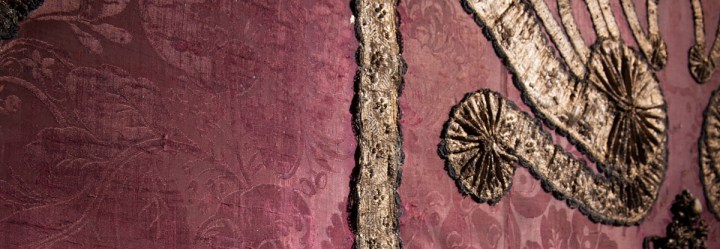
During the reign of Frederick II Berlin became a European centre of silk-production. Up to the present day the Prussian palaces give an impression of the high quality of decorative silks from the Berlin and Potsdam manufactures. On the occasion of the publication of the scholary catalogue about Prussian silks and textile decoration, the Prussian Palaces and Gardens Foundation Berlin-Brandenburg (SPSG) holds an international conference in Potsdam from September 17th to 20th. International speakers, including scholars, curators and conservators examine the importance of textile decoration and put the Prussian silks into a European context.
The conference is a co-operation with the Association of Conservators (Verband der Restauratoren). Guided tours through the New Palace at Sanssouci, the Orangery Palace and Cecilienhof Palace are on offer. If you wish to attend, please note that registration and advance payment are required. The fee includes guided tours, lunches and refreshments. Registration ends at September 1st.
◊ ◊ ◊ ◊ ◊
W E D N E S D A Y , 1 7 S E P T E M B E R 20 1 4
9:30 Introduction by Samuel Wittwer, Director of Palaces and Collections, Prussian Palaces and Gardens Foundation Berlin-Brandenburg (SPSG)
9:45 Susanne Evers (Potsdam), Berliner Seiden in den Schlössern Friedrichs II
10:10 Corinne Thépaut-Cabasset (Paris), Silk for Versailles, 1680s–1780s
10:35 Marzia Cataldi Gallo (Genua), Genoese Textiles for Interior Decoration
11:00 Discussion
11:25 Tea and coffee
11:50 Tatjana Lekhovich (St. Petersburg), Textile Decoration of the 18th Century in Russian Palaces: From National Traditions to Grand European Styles
12:15 Bo Vahlne (Stockholm), Velvet, Damask and Taffeta in the Swedish Royal Palaces during 18th Century
12:40 Discussion
13:00 Lunch
14:00 Sabine Schneider (Dresden), Das Paradeappartement Augusts des Starken von 1719 im Dresdner Residenzschloss – Textile Ausstattung und Zeremoniell
14:25 Margitta Hensel (Dresden), Überlegungen zur textilen Ausstattung der Appartements im Sächsischen Palais zu Warschau unter König August III
14:50 Lieselotte Hanzl-Wachter (Wien), “von roth und gelb geflamten Dafend” – Textilien aus Schloss Hof
15:15 Discussion
15:40 Tea and coffee
16:10 Anika Reineke (Zürich), Von der Tapisserie zum Damast. Bild- und Raumrezeption seidener Wandbespannungen im 18. Jahrhundert
16:35 Anna Jolly (Riggisberg), „en suite“ – Ausdrucksformen eines textilen Gestaltungskonzeptes
17:00 Discussion
19:00 Dinner
T H U R S D A Y , 1 8 S E P T E M B E R 2 0 1 4
8:30 Karin Thönnissen (Krefeld), A la mode – eine gewebte Chinoiserie als Wandbespannung
8:55 Sjoukje Colenbrander, (Amsterdam), Chinese Silks Imported to Europe
9:20 Friederike Wappenschmidt (Neuwied), Chinesische Tapeten aus Seide und Papier – Ästhetische Differenz, Materialbewertung und Rezeption
9:45 Discussion
10:10 Tea and coffee
10:40 Silke Kreibich (Berlin), Posamenten in den preußischen Schlössern – Entwicklung und Datierung der Muster des 18. Jahrhunderts
11:05 Viktoria Pisareva (Dresden), Posamenten in den spätbarocken Innenausstattungen Augusts des Starken (reg. 1694–1733)
11:30 Annabel Westman (Richmond), A Luxury Necessity: The Use of Trimmings on 18th-Century State Beds in Britain
11:55 Discussion
12:20 Lunch
13:30 Isa Fleischmann-Heck (Krefeld), Angebot und Nachfrage – Produktpalette und Angebotspolitik aufstrebender Seidenfirmen in den preußischen Provinzen am Niederrhein im 18. Jahrhundert
13:55 Jens Bartoll (Potsdam), Berliner Seiden – Naturwissenschaftliche Untersuchung der Farbstoffe und Pigmente
14:20 Christa Zitzmann (Potsdam), Entwicklungsstand der preußischen Seidenweberei nach Auswertung gewebetechnischer Analysen
14:45 Nadja Kuschel (Potsdam), Die goldenen Posamente aus dem Tressenzimmer von 1768. Restaurierung und Kopie
15:10 Discussion
15:35 Tea and coffee
17:30 Guided tour through the New Palace at Sanssouci
For the programme for Friday and Saturday (19–20 September), please consult the conference website.










 Enfilade
leave a comment