Call for Papers | Ad Vivum?

As noted at The Early Modern Intelligencer (from the Birkbeck Early Modern Society) . . .
Ad Vivum?
The Courtauld Institute of Art, London, 21–22 November 2014
Proposals due by 15 August 2014
Organised by Joanna Woodall and Thomas Balfe
The term ad vivum and its cognates al vivo, au vif, nach dem Leben and naer het leven have been applied since the thirteenth century to depictions designated as from, to or after (the) life. This one and a half day event will explore the issues raised by this vocabulary in relation to visual materials produced and used in Europe before 1800, including portraiture, botanical, zoological, medical and topographical images, images of novel and newly discovered phenomena, and likenesses created through direct contact with the object being depicted, such as metal casts of animals.
It is has long been recognised that the designation ad vivum was not restricted to depictions made directly after the living model, and that its function was often to advertise the claim of an image to be a faithful likeness or a bearer of reliable information. Viewed as an assertion of accuracy or truth, ad vivum raises a number of fundamental questions about early modern epistemology—questions about the value and prestige of visual and/or physical contiguity between image and original, about the kinds of information which were thought important and dependably transmissible in material form, and about the roles of the artist in this transmission. The recent interest of historians of early modern art in how value and meaning are produced and reproduced by visual materials which do not conform to the definition of art as unique invention, and of historians of science and of art in the visualisation of knowledge, has placed the questions surrounding ad vivum at the centre of their common concerns.
This event will encourage conversation and interchange between different perspectives involving a wide range of participants working in different disciplines, from postgraduate students to established academics. It seeks to encourage dialogue and debate by devoting a portion of its time to sessions comprising short, 10-minute papers, which will allow a variety of ideas and areas of expertise to be drawn into the discussion.
Topics may include, but are not limited to:
• The role of images, including book illustrations, described as ad vivum in early modern natural history, geography, cosmography, medicine and other investigative disciplines
• The meanings of ad vivum in relation to sacred images, portraiture, landscape depiction, animal imagery, and other types of subject matter involving a claim to life-likeness
• The connections between ad vivum and indexical images: death masks; life casts; the moulage; auto-prints made from natural phenomena
• The connections between concepts of ad vivum and graphic media: the print matrix; imitation and reproduction in print; drawings, diagrams which claim to be ad vivum
• The concept of ad vivum in cabinets of curiosities, sets and series, other groupings and collections
• The application of the phrase ad vivum and its cognates to specific images, and usages and discussions of the terminology in early modern texts
• The use of ad vivum in relation to images of the marvellous and the incredible, including monsters and other prodigies of nature
We invite proposals for:
1) 20-minute papers
2) Short, 10-minute (maximum 1,000-word) papers which will address one example or theme, or make one argument persuasively.
Please send proposals of no more than 250 words by 15 August 2014 to joanna.woodall@courtauld.ac.uk and thomas.balfe@courtauld.ac.uk.
The Call for Papers as a PDF file is available here» (from the blog Origins of Science as a Visual Pursuit)
◊ ◊ ◊ ◊ ◊
Note (added 29 July 2014) — The original version of this posting included the original, published dates of November 20–21; those dates, however, have shifted slightly and are reflected above and in the new PDF file with the Call for Papers. The conference is now scheduled for 21–22 November 2014.
Call for Papers | Representing the Habsburg-Lorraine Dynasty
From H-ArtHist (which includes the CFP in German). . .
Representing the Habsburg-Lorraine Dynasty in Musical,
Visual Media, and Architecture, c. 1618–1918
Vienna, 8–10 June 2015
Proposals due by by 31 October 2014
This international conference will take place in Vienna from the 8th to the 10th of June 2015. It will be devoted to the new interdisciplinary research program ‘Representing Habsburg’—one of the main current research fields of the Institute for History of Art and Musicology (IKM) of the Austrian Academy of Sciences focusing on the history of fine arts and music in Austria and Central Europe in their general European context. We invite submissions of papers from all art-related disciplines (history of art, musicology, history, theatre history, cultural studies etc.) to the five panels described below.
Representing the Habsburg-Lorraine Dynasty
The IKM intends to build its new research priority by subjecting the visual and musical culture of the Central European Habsburgs to completely new and extensive scrutiny. In particular, it plans to cast new light on the paradigm of a specifically ‘Habsburg’ representation that research has all but disregarded until now. Hence it is important to judge, on a case by case basis, how representation functioned in the complex relationship between the addresser and the addressee, the sender and the receiver, and which decision-makers favoured which kinds of communication networks. The investigations should also include the estates and social groups (the nobility, the clergy, the guilds and the municipalities) which functioned as the principal addressees of Habsburg activities. Consequently, the new research priority will need to ask how social groups reacted to dynastic activities (e.g. entries into the city, the idolisation of rulers, monuments, imperial and municipal halls containing portraits of regents and sculptural decorations), and how specific forms of representation were expressed in this process.
I. Topics and Media of Representation
On the premise that Habsburg representation was a successful mode of balancing (outward) self-presentation and (inward-looking) self-interpretation, it can be asked whether visual arts and music (as well as theatre) shared similar topics (topoi) and narratives. Is a Habsburg ‘code of virtues’ bound to be considered a compulsory basis for all participating court arts, or are there other social practices or political interests responsible for establishing a canon of subjects (e.g. Christian iconography or Classical mythology)? Are disruptions discernible in the process of actualizing panegyrics through musical and artistic production? How do innovations interact with the traditional representation of potentates? In the light of the courtly arts’ preeminent aim of representing the dynasty or the state, may we perceive any media-specific differences?
II. Ceremonial Spaces and the ‘Public’
Since the early modern period, music, visual arts, architecture and panegyric literature have been used for the plurimedial definition and design of the ceremonial space. The strategies used will be examined in more detail in this section: Are there differences in defining ceremonial space for different kind of publics (public space, sacred space, court space)? The question of how the architectural site related to plurimedially generated ceremonial space is of particular importance. Does immovable architecture only set the boundaries of the ceremonial space, or does it—together with music—constitute this area? This refers to court architecture as well as to sacred and urban architecture. The latter could be examined particularly in the context of the ruler’s ‘adventus’.
III. Dynasty, State and Nation
What was the relationship between the ruling Habsburg dynasty and the concepts of state and/or nation from the 18th century until the collapse of the monarchy? Was a primarily dynastic representation superseded by a state representation and—in the course of time—even pushed aside by concepts of national representations? Taking into consideration a wide range of artistic, architectural and musical genres (including for example, in the case of architecture infrastructural buildings and urbanism, and in the case of music ‘popular’ genres like operettas) we are interested in the structural/institutional characteristics of this kind of political representation, in their impact and intricacies and their intended signifying functions. We also welcome contributions that focus on oppositional representations or exemplify ‘regional’ and/or ‘peripheral’ forms within the empire as well as on a global level (e. g. in relation to associated courts overseas).
IV. Church and Representation
The Counter-Reformation led to a ‘propaganda campaign’, also carried out in the fields of the arts, in which the struggle for the ‘true faith’ and the ‘Pietas Austriaca’ were declared to be the causa prima of the dynasty, also by means of the arts. A crucial issue is the importance of representing religion in general and the Pietas Austriaca in particular at the intersection of court, city and church. How did the Habsburgs utilize the cult for their personal representation? And in contrast, how did religious communities use the dynasty (and even their close relationship with the dynasty) for their own purposes? To what extent was the ‘Pietas Austriaca’ politically deployed as a mode of symbolic communication, and which topoi were used by the (court) arts? Did music and art occupy a specific position in religious rituals such as pilgrimages, processions or services at Stations of the Cross (Stationsgottesdienste), which served to represent the ruler?
V. Decision Makers
If we understand dynastic representation not as a centrally determined top-down strategy but rather as the result of a complex intertwining of particular action and reaction processes, the following questions have to be posed (concerning the monarch’s advisors and decision makers from the institutions involved): What groups (imperial/royal family, court institutions, antiquarians and so on) participated in decisions and why? Is it possible to read their intentions out of historic sources? Are there similarities or differences with strategies of other dynasties? Beyond that, case studies of non-courtly Habsburg representation can be of interest. Analyses of such works should illuminate the circumstances of dynastic representation in the Habsburg monarchy.
Conference language: German and English
Lectures: 20 minutes
Abstracts: max. 2000 characters, CV (max. 500 characters)
Contact:
Univ.-Doz. Dr. Werner Telesko
Österreichische Akademie der Wissenschaften / Austrian Academy of Sciences
Institut für kunst- und musikhistorische Forschungen (IKM), Direktor /
Institute for History of Art and Musicology (IKM), Director
Dr. Ignaz Seipel-Platz 2
A-1010 Wien
werner.telesko@oeaw.ac.at
New Book | The Cobbe Cabinet of Curiosities
From The Paul Mellon Centre and Yale UP:
Arthur MacGregor ed., The Cobbe Cabinet of Curiosities: An Anglo-Irish Country House Museum (London: The Paul Mellon Centre for British Studies, 2014), 480 pages, ISBN: 978-0300204353, $125 / £75.
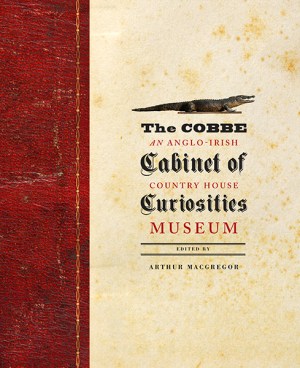 This lavishly produced volume presents a survey and analysis of a fascinating cabinet of curiosities established around 1750 by the Cobbe family in Ireland and added to over a period of 100 years. Although such collections were common in British country houses during the 18th and 19th centuries, the Cobbe museum, still largely intact and housed in its original cabinets, now forms a unique survivor of this type of private collection from the Age of Enlightenment.
A detailed catalogue of the objects and specimens is accompanied by beautiful, specially commissioned photographs that showcase the cabinet’s component elements. Reproductions of portraits from the extensive collection of the Cobbe family bring immediacy to the narrative by illustrating the personalities involved in the collection’s development. Scholars contribute commentary on the significance of the objects to their collectors; also included are essays outlining, among other topics, the place of the cabinet of curiosities in Enlightenment society and the history of the Cobbe family. Extracts from the extensive family archive place the collection in its social context.
Arthur MacGregor is a former senior assistant keeper in the Department of Antiquities at the Ashmolean Museum, Oxford.
Conference | Houses as Museums / Museums as Houses
From H-ArtHist:
Houses as Museums / Museums as Houses
The Wallace Collection, London, 12–13 September 2014
Registration due by 31 August 2014
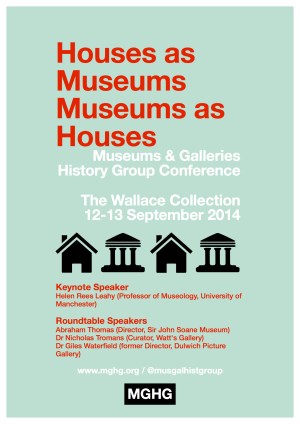 The relationship between museums and domestic spaces is a long and complex one. Museums were born in the houses of collectors, while the reconstruction of the house or domestic room—of ‘home’, effectively—continues to be an influential if controversial model for museum display. On the other hand, museums have at times invested heavily in the idea of their spaces as public, scientific and definitively non-domestic. The line between house and museum is therefore also one between public and private, scientific and domestic; and house-museums/museum-houses have acted both to confirm, to alter, and to undermine this line completely.
The 2014 Museums and Galleries History Group (MGHG) conference seeks to understand the historical development of this relationship by investigating the ways in which museums have acted as houses, and houses have acted as museums. It will also explore the ways in which house-museums and museum-houses have been positioned in boundary zones of space and time, and what effect they have had on those boundaries. The programme
can be viewed and tickets can be purchased here.
◊ ◊ ◊ ◊ ◊
F R I D A Y , 1 2 S E P T E M B E R
10.00 Registration and refreshments
10.30 Introduction
10.45 1: The Early Modern Legacy (Chair: Stephanie Bowry)
• Theda Jurjens, ‘Artists’ houses: spaces of knowledge, artistic production and social reputation’
• Cristiano Guarneri (IUAV University, Venice), ‘A private display for a public space: The Statuario Pubblico (1587–96), a Venetian approach to the display of ancient sculpture’
• Thomas Schauerte (City of Nuremberg Art Collections), ‘From memorial to museum: The Dürer house in Nuremberg’
12.15 Curator’s introduction to the Great Gallery rehang
12.30 Private view of Great Gallery
13.15 Lunch break
14.30 2: Architecture and Museums / Houses (Chair: Sarah Longair)
• Jeremy Aynsley (University of Brighton), ‘Curating Bauhaus houses, 1923–2019’
• Maria D’Annibale Williams (Ohio University), ‘Museum space in Fascist Verona and the display of social identity: A case study’
• Jane Whittaker (Bowes Museum), ‘Mrs Bowes’s mansion and galleries at Barnard Castle, Durham’
16.00 Tea and coffee
16.30 Roundtable: ‘Curating Houses as Museums’ with Abraham Thomas, Nicholas Tromans, and Giles Waterfield (Chair: Mark Westgarth)
17.30 Wine reception
S A T U R D A Y , 1 3 S E P T E M B E R
10.00 Tea and coffee
10.30 Keynote lecture by Helen Rees Leahy, ‘The pleasures and paradoxes of house museums’
11.30 3: Concepts and Approaches (Chair: Elena Greer)
• Sophie Forgan (Captain Cook Memorial Museum), ‘Interpretation and anthropological approaches to the historic house museum’
• Lydia Brandt (University of South Carolina), ‘George Washington’s Mount Vernon: America’s First House (museum)’
• Helen Williams (Northumbria University), ‘The literary house museum: An eighteenth-century invention?’
13.00 Lunch break
14.15 4: Modern Spaces, Art and Houses / Museums (Chair: Barbara Lasic)
• Flaminia Gennari Santori (Syracuse University Florence), ‘Tropical baroque – Vizcaya: A Venetian-inspired house museum in Miami’
• Angela Bartholomew (VU University Amsterdam), ‘Chambres d’amis and the mediation of site (1986)’
• Louise Shannon (V&A), ‘Creating “Tomorrow”: Norman Swann moves into the V&A’
15.45 Tea and coffee
16.15 5: Science at Home and on Display (Chair: Ilja Nieuwland)
• Elisabeth Hoffman (University of Kassel), ‘Art and science: the interior of Wilhelm von Humboldt’s home as a museological and epistemological concept’
• Helen McCormack (Glasgow School of Art), ‘The anatomist at home: The Great Windmill Street Anatomy School and Museum’
• Caroline Morris (University of the West of England), ‘”…Fit like a snail to its shell”‘
All conference sessions except the Great Gallery view take place in the lecture theatre. Tea and coffee are provided in the Meeting Room. Wine reception takes place in the Café. Lunch is not provided, but there are many places for lunch very close to the Wallace Collection. The Wallace collection opens at 10.00 so please do not arrive earlier.
New Book | Visions of Britain, 1730–1830
From Palgrave Macmillan:
Sebastian Mitchell, Visions of Britain, 1730–1830: Anglo-Scottish Writing and Representation (Basingstoke: Palgrave Macmillan, 2013), 304 pages, ISBN: 978-1137290106, $90.
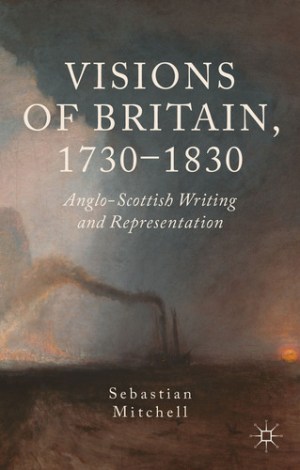 Visions of Britain is an inquiry into the literary and visual representation of Great Britain in the eighteenth century and early nineteenth century. The book considers the inter-relationship of text and image for the purposes of national projection. It analyses an extensive range of poems, novels, journals, drawings, satirical prints, portraits, landscapes, and history paintings. The study follows recent discussions of Anglo-Scottish writing in this period in the attempt to determine the salient characteristics of the imaginative depiction of the Kingdom of Britain, but challenges their more confident claims for the development of a progressive integrated nationhood. It argues instead that the most engaging literary and visual accounts of Britain in this era subject their imagery to extensive artistic pressure, threatening to dismantle the national vision at the moment of its construction.
Sebastian Mitchell is Lecturer in English Literature at the University or Birmingham.
◊ ◊ ◊ ◊ ◊
C O N T E N T S
List of Illustrations
Acknowledgments
1. Introduction
2. Thomson’s Vision of Britannia
3. Smollett and Dialectical Nationalism
4. Ramsay, Hume, and British Portraiture
5. Ossian, Wolfe, and the Death of Heroism
6. Boswell: Self, Text, Nation
7. Scott, Turner, and the Vision of North Britain
Bibliography
Index
Display | Fancy Pants

The Great Master of the Fashionable Hair Style, mid-18th century, hand-colored etching by an unidentified artist. The Minnich Collection, The Ethel Morrison Van Derlip Fund, 1966 P.17,468
From the MIA:
Fancy Pants: Beyond the Gray Flannel Suit
Minneapolis Institute of Arts, 19 July — 14 December 2014
Let’s face it: men’s fashion is pretty boring. But, it wasn’t always so. There was an age when men used their clothing to stand out rather than to fit in. Often that meant ruffles, embroidery, wigs, slashed sleeves, stuffed shirts, jerkins, leggings, jewels, and cod pieces. This exhibition may inspire you to clear your closet of muted garb to make room for a little self-expression.
New Book | Re-imagining Heritage Interpretation (& Happy 4th)
Anyone anticipating a proper Fourth of July posting might have a look back at the notice posted in May for Magna Carta: Cornerstone of Liberty, which just opened at Boston’s MFA. Less directly, this book from Ashgate might stimulate broader thoughts on issues of heritage interpretation, a field that in the United States too rarely comes into art historical conversations. In any case, a happy Fourth of July to all of you who mark the day. -CH
◊ ◊ ◊ ◊ ◊
Russell Staiff, Re-imagining Heritage Interpretation: Enchanting the Past-Future (Aldershot: Ashgate, 2014), 202 pages, ISBN: 978-1409455509, $110.
 This book challenges traditional approaches to heritage interpretation and offers an alternative theoretical architecture to the current research and practice. Russell Staiff suggests that the dialogue between visitors and heritage places has been too focused on learning outcomes, and so heritage interpretation has become dominated by psychology and educational theory, and over-reliant on outdated thinking. Using his background as an art historian and experience teaching heritage and tourism courses, Russell Staiff weaves personal observation with theory in an engaging and lively way. He recognizes that the ‘digital revolution’ has changed forever the way that people interact with their environment and that a new approach is needed.
Russell Staiff holds a PhD in art history from the University of Melbourne where he was the foundation lecturer in the postgraduate visual arts and tourism program. He began his life in heritage and tourism as a guide in Italy. Currently, he teaches in the heritage and tourism program at the University of Western Sydney and Silpakorn University, Bangkok. He researches the various intersections between cultural heritage, communities and tourism with a particular emphasis on Southeast Asia.
◊ ◊ ◊ ◊ ◊
C O N T E N T S
Prologue: the known, the unknown and other ruminations
1 Anecdotes and observations
2 Tilden: beyond resurrection
3 The somatic and the aesthetic: embodied heritage experiences
4 Visual cultures: imagining and knowing through looking
5 Narratives and narrativity: the story is the thing
6 Digital media and social networking
7 Conversing across cultures
8 Enchantment, wonder and other raptures: imaginings outside didacticism
Call for Papers | River Cities: Historical and Contemporary
From H-ArtHist (with the full call for papers available as a PDF file here). . .
River Cities: Historical and Contemporary
Dumbarton Oaks, Washington, D.C., 8-9 May 2015
Proposals due by 14 September 2014
The dynamic relationships between cities and their rivers, a landscape of potentially critical adaptability and resilience, is the focus of the 2015 Garden and Landscape Studies Symposium at Dumbarton Oaks. Building on the emergence of urban humanities and urban landscape history, we propose to consider the urban river as a city-making landscape deserving of careful reading and analysis: past, present, and future.
The subject of this symposium builds on a new multi-year initiative in urban landscape studies, which Dumbarton Oaks is launching in 2015 with support from the Andrew W. Mellon Foundation. Its principal goal is to create a dialogue between designers and scholars to address the landscape consequences of advancing urbanization. With this task in mind, the 2015 symposium aims to bring together the work of contemporary designers with the historical perspectives of scholars, encouraging practitioners and historians to bridge the gaps between their modes of thinking. We consider historians to include those in art history, urban history, and architectural history among others. We would particularly welcome proposals for collaborative or paired presentations by designers and historians working on similar topics or the same city.
Please submit a 300-word abstract to Thaisa Way (tway@uw.edu) by September 14, 2014 to be considered for the 2015 Dumbarton Oaks Garden and Landscape Studies symposium: River Cities: Historical and Contemporary. If accepted, full papers will be due on March 1, 2015 for presentation in May 2015 (most likely May 8–9, 2015). For more information, contact Thaisa Way, University of Washington, tway@uw.edu.
New Book | Vincennes and Early Sèvres Porcelain
From the V&A:
Joanna Gwilt, Vincennes and Early Sèvres Porcelain from the Belvedere Collection (London: V&A Publishing, 2014), 256 pages, ISBN: 978-1851777730, £60 / $80.
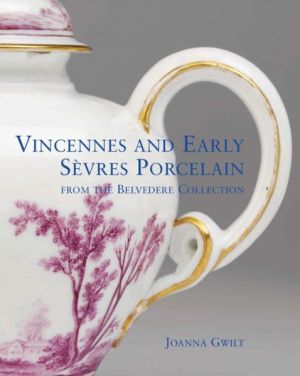 The opulent wares of the renowned Sèvres manufactory are prominently displayed in palaces and art galleries throughout the world. By contrast, the comparative delicacy and simplicity of the beautiful wares of the Vincennes porcelain works, from which the Sèvres factory evolved, remain relatively unknown, even to porcelain experts, who will find much that is alluring and surprising in this remarkable book. Detailed photographs and lavish illustrations reveal the rich variety of styles and increasingly complex gilding that mark out the products of Vincennes and early Sevres, including such innovations as the introduction of sculptural figures during the late 1740s. Much of these novel designs were initially inspired by the work of leading artists of the time—including François Boucher. The ebook that accompanies the printed version contains additional photographs, showing every piece in close detail, making it perfect for scholars, collectors and enthusiasts.
Joanna Gwilt is a specialist in eighteenth-century French decorative arts and formerly the Assistant Curator at the Royal Collection and also of the Wallace Collection, London. She is the author of French Porcelain for English Palaces: Sèvres from the Royal Collection (2009).
A digital preview is available here»
New Book | Place-making for the Imagination, Strawberry Hill
From Ashgate:
Marion Harney, Place-making for the Imagination: Horace Walpole and Strawberry Hill (Aldershot: Ashgate, 2013), 326 pages, ISBN: 978-1409470045, £50 / $100.
 Drawing together landscape, architecture and literature, Strawberry Hill, the celebrated eighteenth-century ‘Gothic’ villa and garden beside the River Thames, is an autobiographical site, where we can read the story of its creator, Horace Walpole. This ‘man of taste’ created private resonances, pleasure and entertainment—a collusion of the historic, visual and sensory. Above all, it expresses the inseparable integration of house and setting, and of the architecture with the collection, all specific to one individual, a unity that is relevant today to all architects, landscape designers and garden and country house enthusiasts. Avoiding the straightforward architectural description of previous texts, this beautifully illustrated book reveals the Gothic villa and associated landscape to be inspired by theories that stimulate ‘The Pleasures of the Imagination’ articulated in the series of essays by Joseph Addison (1672–1719) published in The Spectator (1712). Linked to this argument, it proposes that the concepts behind the designs for Strawberry Hill are not based around architectural precedent but around eighteenth-century aesthetics theories, antiquarianism and matters of ‘Taste’.
Using architectural quotations from Gothic tombs, Walpole expresses the mythical idea that it was based on monastic foundations with visual links to significant historical figures and events in English history. The book explains for the first time the reasons for its creation, which have never been adequately explored or fully understood in previous publications.
The book develops an argument that Walpole was the first to define theories on Gothic architecture in his Anecdotes of Painting (1762–71). Similarly innovative, The History of the Modern Taste in Gardening (1780) is one of the first to attempt a history and theory of gardening. The research uniquely evaluates how these theories found expression at Strawberry Hill. This reassessment of the villa and its associated landscape reveals that the ensemble is not so much a part of the conventionally-conceived linear progression of eighteenth-century architectural style but, rather, is an original essay in contemporary aesthetics.
Marion Harney is Director of Studies, Conservation of Historic Gardens and Cultural Landscapes at the University of Bath.
◊ ◊ ◊ ◊ ◊
C O N T E N T S
Preface: Walpole Moves from Strawberry Hill to Connecticut
Introduction: ‘Things Come to Light’: Experiment and Experience, The Philosophical and Cultural Context
1. ‘The Pleasures of the Imagination’: Tropes of Taste
2. ‘Giving an Idea of the Spirit of the Times’: Anecdotes and Antiquarianism
3. ‘I Am Going to Build a Little Gothic Castle at Strawberry Hill’: Creation of a Seat, part 1
4. ‘The Art of Creating Landscape’: Creation of a Seat, part 2
Epilogue: ‘A Genius is Original, Invents. Taste Selects, Perhaps Copies with Judgement’










 Enfilade
leave a comment