New Book | Slavery and the Invention of Dutch Art
From Duke UP, with a talk on Thursday at BGC:
Caroline Fowler, Slavery and the Invention of Dutch Art (Durham: Duke University Press, 2025), 176 pages, ISBN: 978-1478028093 (hardcover), $125 / ISBN: 978-1478031321 (paperback), $30.
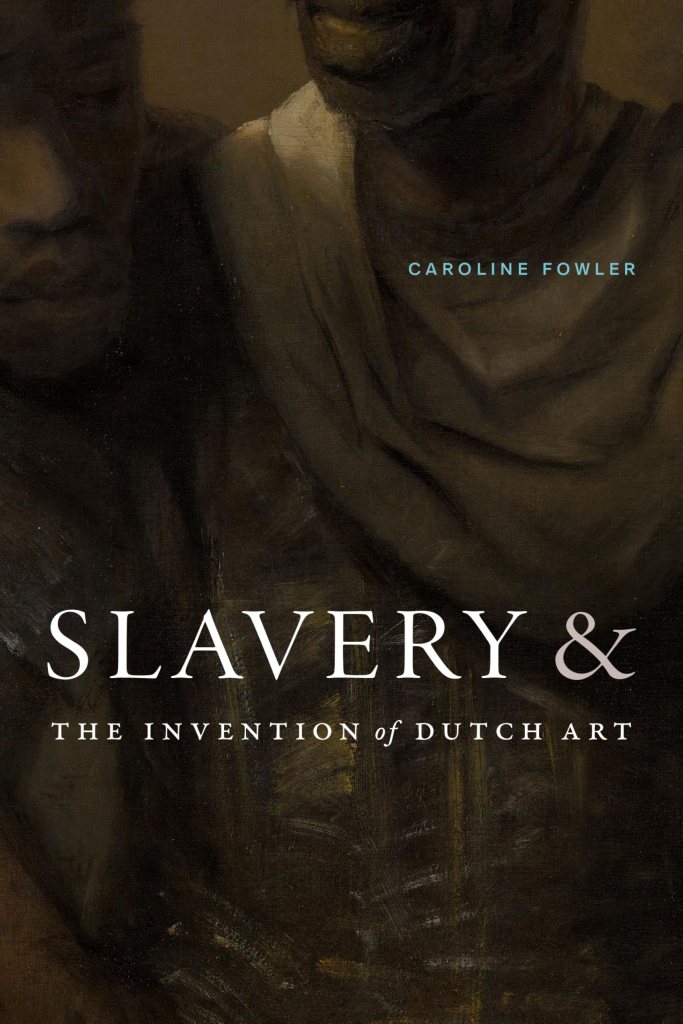 In Slavery and the Invention of Dutch Art, Caroline Fowler examines the fundamental role of the transatlantic slave trade in the production and evolution of seventeenth-century Dutch art. Whereas the sixteenth-century image debates in Europe engaged with crises around the representation of divinity, Fowler argues that the rise of the transatlantic slave trade created a visual field of uncertainty around picturing the transformation of life into property. Fowler demonstrates how the emergence of landscape, maritime, and botanical painting were deeply intertwined with slavery’s economic expansion. Moreover, she considers how the development of one of the first art markets was inextricable from the trade in human lives as chattel property. Reading seventeenth-century legal theory, natural history, inventories, and political pamphlets alongside contemporary poetry, theory, and philosophy from Black feminism and the African diaspora, Fowler demonstrates that ideas about property, personhood, and citizenship were central to the oeuvres of artists such as Rembrandt van Rijn, Hercules Segers, Frans Post, Johannes Vermeer, and Maria Sibylla Merian and therefore inescapably within slavery’s grasp.
Caroline Fowler is Starr Director of the Research and Academic Program at the Clark Institute. She is the author of The Art of Paper: From the Holy Land to the Americas and Drawing and the Senses: An Early Modern History.
c o n t e n t s
Acknowledgments
Introduction: Transubstantiation across Atlantic Worlds
1 Art Markets and Futures Speculation
2 Seascapes and Landscapes
3 Monuments and Architectural Painting
4 Domestic Interiors and Natural History
Conclusion: Historiography and Race
Notes
Bibliography
Index
◊ ◊ ◊ ◊ ◊
Slavery and the Invention of Dutch Art | A Conversation with Caroline Fowler and Helga Davis
Bard Graduate Center, New York, 13 February 2025, 6pm
Caroline Fowler will speak with renowned artist and podcaster Helga Davis about the book Slavery and the Invention of Dutch Art, thinking about the role of poetics in writing history, the importance of Black feminism in rethinking art history, and the ways in which ‘Old Master’ painting continues to impact how the world is seen and interpreted.
Registration is available here»
Call for Papers | Representing the Body
From the Call for Papers (Dorothy Johnson is slated to give a keynote address). . .
VariAbilities 2025 | Exploring Representations of the Body across Visual Disciplines
Mercy University, New York, 11–15 June 2025
Proposals due by 14 February 2025
 The representation of the body is a fundamental aspect of human culture, reflecting societal values, norms, and power structures. From ancient civilizations to contemporary times, various visual disciplines have been employed to create different forms of bodily representation to convey meaning, express emotions, to teach and tell stories. This conference seeks to examine a wide range of representations across multiple visual forms, and across a wide history, shedding light on the ways in which they intersect, diverge, and influence one another.
Some of the key questions we shall address might be:
• How do different visual disciplines (e.g., medical imagery and illustration, painting, photography, sculpture) represent the human body, and what are the implications of these representations?
• What role does performance play in bodily representation, and how do various forms of performance (e.g., doctor/patient interactions, dance, theatre, music) shape our understanding of the body?
• How do word-based and image-based portrayals of the body differ (e.g. literary and cinema, poetry and portraits), and what insights can be gained by comparing these approaches?
• In what ways do representations of the body reflect social attitudes towards gender, race, class, VariAbility, and other forms of identity?
These some of the many questions you may wish to explore, you may have others! Please email a 300-word proposal to Variabilities8@gmail.com by 14 February 2025. The event will take place at the Mercy University Campus in Manhattan, where there is some dorm accommodation for delegates should they choose it. There is also some scope for online presentations for those who have travel issues. Come and tell us what the ‘body’ means to you. More information is available here.
Lea Stephenson Announced as PAFA Curator
From the press release, via Art Daily:
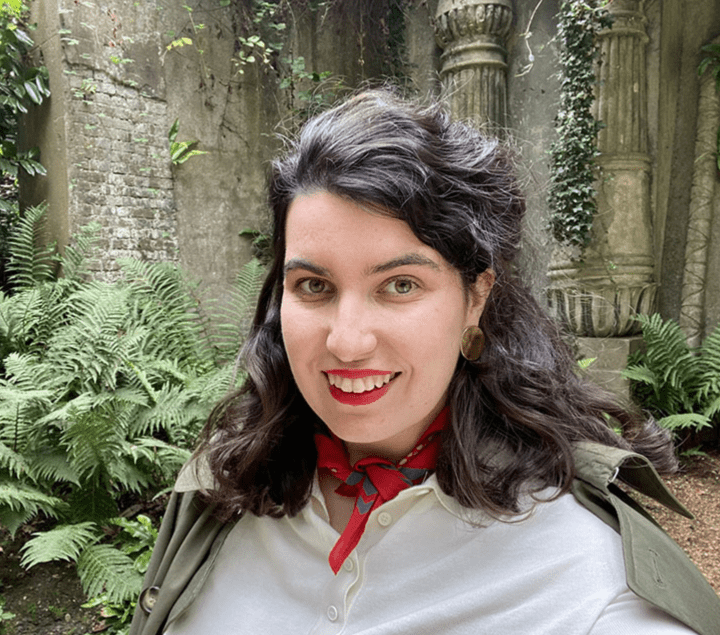 The Pennsylvania Academy of the Fine Arts (PAFA), the first museum and school of fine arts in the United States, today announced Lea Stephenson as the next Kenneth R. Woodcock Curator of Historical American Art, effective 10 February 2025. In this role, Stephenson will work to strengthen the development, research, presentation, and growth of PAFA’s renowned collection of historical American art, reporting directly to Interim Museum Director Harry Philbrick. “We are thrilled to welcome Lea to PAFA,” said Philbrick. “Her extensive background as a curator and educator and her deep knowledge of American art and art history make her an excellent addition to our team.”
Currently, Stephenson is a PhD candidate in art history at the University of Delaware, completing her dissertation on “‘Wonderful Things’: Egyptomania, Empire, and the Senses, 1870–1992,” which looks at American and British artists and collectors in Egypt during the Gilded Age. Stephenson is also the Luce Foundation Curatorial Fellow in American Paintings and Works on Paper for Historic Deerfield in Massachusetts, expanding the collection, curating exhibitions and programming, writing for publication, and fundraising.
“It is an honor to be chosen as the next Kenneth R. Woodcock Curator of Historical American Art,” said Stephenson. “It is an especially exciting time to be joining PAFA, particularly with the work in progress to curate the museum’s first, new permanent exhibition in some 20 years and prepare for its installation in 2026. PAFA is an American treasure and central to the story of America’s art history, and I could not be more excited to join.”
Stephenson’s experience in the museum world includes her recent work as exhibition curator for Historic Deerfield as well as contributions to exhibitions at the University of Delaware, The Preservation Society of Newport County (Rhode Island), Dallas Museum of Art, The Clark Art Institute (Williamstown, Massachusetts), and Marie Selby Botanical Gardens (Sarasota, Florida). A published author, Stephenson has written multiple essays including “Racial Capital: Peter Marié’s Miniatures and Gilded Age Whiteness” and “The Potter Overmantel: Black Presence and the Sense of ‘Touch’.” She has two forthcoming essays: “Early Transformations in American Art: From the Colonies to an Emerging Republic,” which examines Deerfield Academy’s American art collection and major themes in American art history, specifically 18th-century to Federal period paintings and works on paper, and the other on James Wells Champney’s illustrations and collaborations with Elizabeth Williams Champney.
Stephenson holds a BA in art history from Temple University and a MA in the history of art from Williams College.
Exhibition | Art of Commerce: Trade Catalogs in Watson Library

.
Voss und compagnie, Muster zu Zimmer-Verzierungen und Ameublements, 1794–95, 2 volumes with color illustrations, 27 × 43 cm
(New York: The Watson Library, The Metropolitan Museum of Art).
◊ ◊ ◊ ◊ ◊
Not exactly an 18th-century exhibition, but fun to see the narrative start there. From The Met (where the following text includes links).
Art of Commerce: Trade Catalogs in Watson Library
The Metropolitan Museum of Art, New York, 6 January — 4 March 2025
Art of Commerce: Trade Catalogs in Watson Library features a selection of the library’s extensive holdings of sale catalogs. Watson Library has almost two thousand trade catalogs published in many countries from the eighteenth century to the present. Objects featured include furniture, jewelry, tiles, ironwork, glasswork, lighting, stoves, tableware, textiles, decorative paper, artist’s materials, fashion, typography, automobiles, and musical instruments. Numerous catalogs illustrate works of art or related objects now in The Met collection.
The library has strong holdings of Art Deco trade catalogs including Modern furniture design = Le dessin moderne des meubles—a colorful furniture portfolio by Czech architect Karel Vepřek—and Van Clef Arpels présentent, an elegantly illustrated accessories publication designed by Draeger Frères, the most innovative graphic designers and printers of the period. Both catalogs are on display in the exhibition.
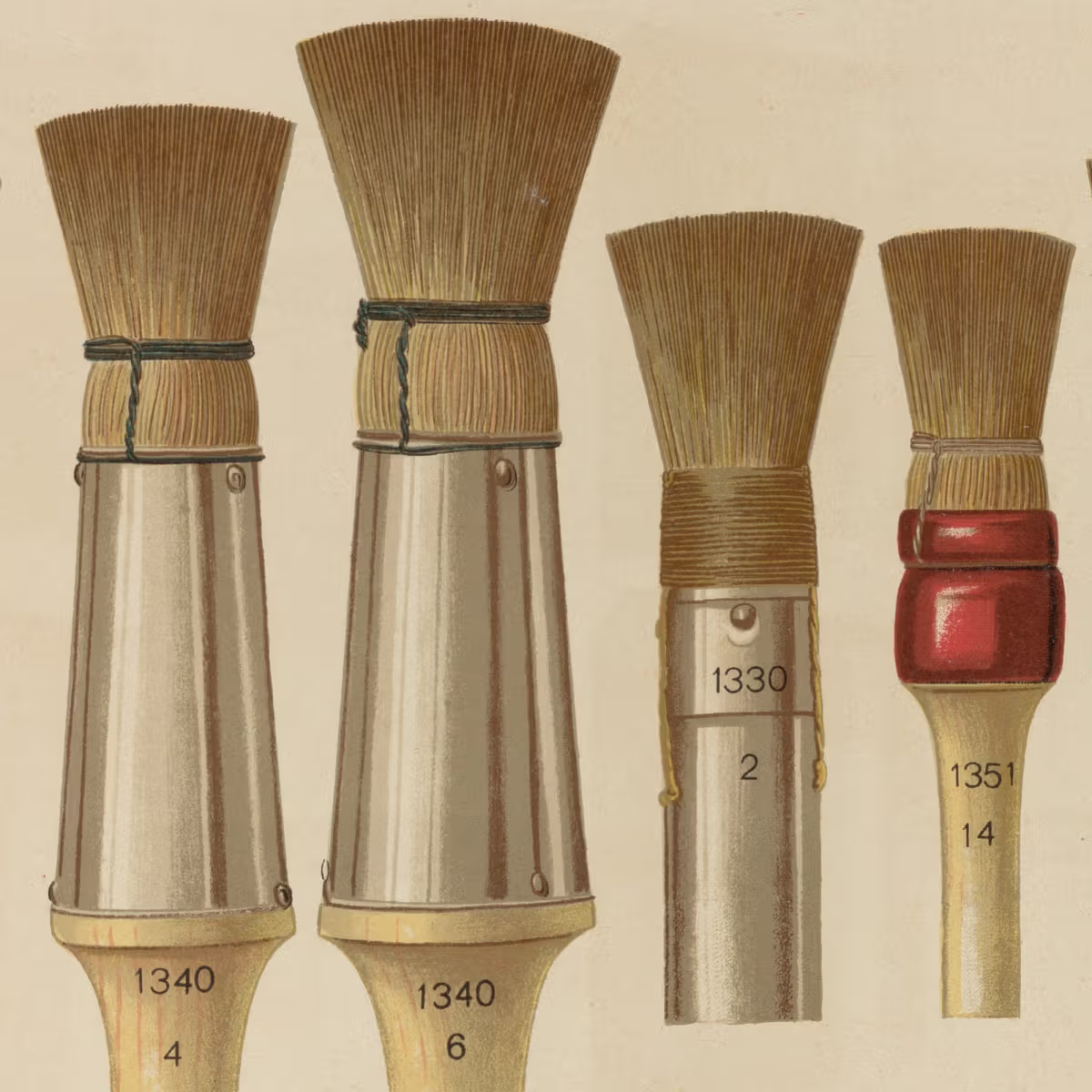
Detail of a page of brushes from Pinselfabrik Ernst Findeisen GmbH. Erstklassige Pinsel-Fabrikate Für Kunst-Handwerk u. Industrie: Ernst Findeisen, Ravensburg (Ravensburg: Ernst Findeisen, early 20th century), illustrated book, 1 volume, 21 × 31 cm (New York: The Watson Library, The Metropolitan Museum of Art).
Trade or sale catalogs—also called commercial or manufacturer’s catalogs—are printed publications advertising products of a particular trade or industry. Sale catalogs were often used in shops or showrooms to promote a company’s products. Examples include the massive Reed and Barton catalog Artistic workers in silver & gold plate from 1885 that illustrates the entire inventory of the company. Since their invention, automobiles have been creatively promoted through catalogs. Automobile catalogs in the library’s collection range from vivid brochures to oversized car showroom copies with moveable diagrams and transparencies to intrigue and persuade the customer, including 1953 Chevrolet and 1961 Buick.
Sale catalogs are valuable sources for determining the date and authenticity of objects and are often highly expressive of their historical moment. They frequently represent the most innovative and creative examples of printing and graphic design, used by manufacturers and publishers to best illustrate their products. Watson’s trade catalogs include striking illustrations reproduced in lithography, chromolithography, embossing, and pochoir. Many of the catalogs in the exhibition have striking designs and demonstrate graphic innovation that can be as compelling as the objects they promote.
Among the more unusual and appealing trade catalogs in the exhibition is a German Art Nouveau-inspired cake decorating book from 1910 and a baby carriage catalog from 1934 offering Art Deco styled tubular steel baby prams. These trade catalogs demonstrate the distillation of major art movements applied to quotidian objects.
The earliest trade catalog in the exhibition is Muster zu Zimmer-Verzierungen und Ameublements, a neo-classical interior design catalog by luxury German manufacturer Voss und Compagnie, offering entire rooms that can be bought en masse or as separate pieces. It is illustrated with richly toned hand-colored engravings that detail the design and color of the objects.
One of the library’s most fragile and weighty catalogs is Album des principaux modeles de verres: produits spéciaux en verre coulé. It is a magical trade catalog with sixty-five intact glass samples manufactured by French glassmaker Saint-Gobain. Founded during the time of Louis XIV, the company remains a manufacturer of glass for construction.
The majestic ironwork catalogue of Maison Garnier has pink-tinted papers and was bound in Morocco leather as a special copy for Rémy Garnier, the son of the firm’s founder. The firm’s initials are boldly blind stamped on the cover.
The most unusual and perhaps unexpected catalog, Urinoirs, illustrates the decorative ironwork structures of urinals (or pissoirs) that adorned the streets of Paris from the 1840s to the mid-twentieth century. The ornamentation of these structures demonstrates an impulse to beautify the animated street life of Paris and other cities.
Many of the trade catalogs have been digitized. All of the trade catalogs in Watson Library are accessible and can be consulted in the Florence and Herbert Irving Reading Room. The thirty-three on display will be available immediately after the exhibition’s closing in early March 2025. Information on using the library is here.
New Book | The Empire’s New Cloth
Available soon from Yale UP (and please note Rado’s upcoming BGC talk, noted below) . . .
Mei Mei Rado, The Empire’s New Cloth: Cross-Cultural Textiles at the Qing Court (New Haven: Yale University Press, 2024), 208 pages, ISBN: 978-0300275148, $75.
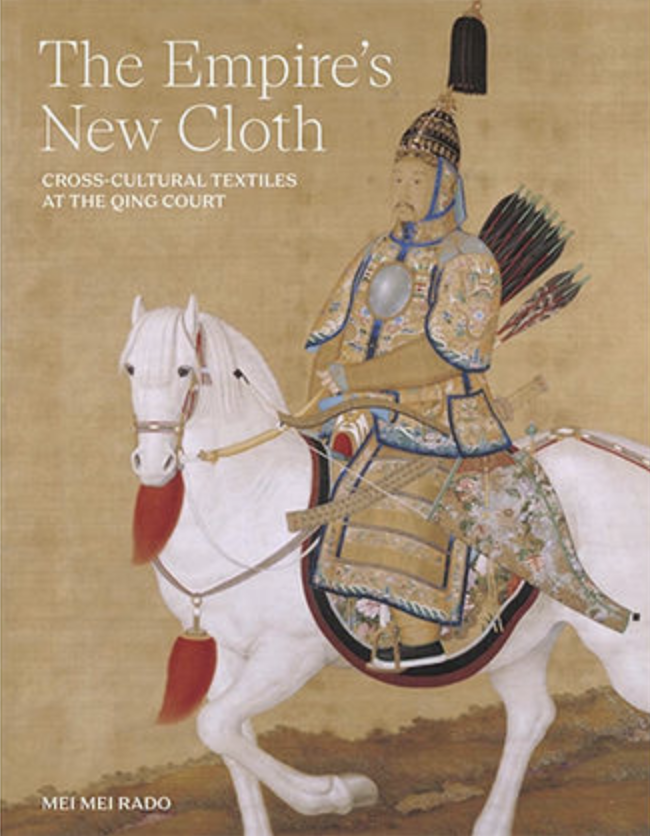 A groundbreaking study of textiles as transcultural objects in the Qing court that provides a new understanding of the interconnectedness of the early modern world
In the early modern period luxury textiles circulated globally as trade goods and diplomatic gifts, fostering cultural exchange between distant regions. By the eighteenth century, both China and Europe had developed a splendid tradition of silk and tapestry weaving. While the role of Chinese silk imports in Europe has been well studied, this book reconstructs the forgotten history of the eastward movement of European textiles to China and their integration into the arts and culture of the Qing Empire. The Empire’s New Cloth explores how Qing court workshops adapted European textile designs and techniques and uncovers the specific uses and meanings of these textiles in imperial military ceremonies, religious spaces, and palace interiors. Through careful study of a wide range of previously unpublished objects, Mei Mei Rado illuminates how these cross-cultural textiles provided the visual and material means for the Qing ruler to convey political messages. By revealing how Qing imperial patrons and artisans responded and assigned meanings to European influences, this beautifully illustrated volume highlights the reciprocity in eighteenth-century Sino-European exchanges and centers textiles within the dynamic global flow of objects and ideas.
Mei Mei Rado received her MA from the University of Chicago and her PhD from Bard Graduate Center, New York, where she is currently an assistant professor. Her research and teaching focus on the history of textiles, dress, and decorative arts in China and France from the eighteenth to the early twentieth centuries, especially on Sino-French exchanges. From 2020 to 2022 she was associate curator of costume and textiles at Los Angeles County Museum of Art, and previously she has held research fellowships in the Department of European Sculpture and Decorative Arts at the Metropolitan Museum of Art and in the Department of Court Arts at the Palace Museum, Beijing..
◊ ◊ ◊ ◊ ◊
Mei Mei Rado | The Empire’s New Cloth
Bard Graduate Center, New York, 19 February 2025, 6pm
Registration is available here»
Call for Applications | Chinese Object Study Workshops, 2025
From ArtHist.net:
Materials and Methods in Chinese Calligraphy
University of Michigan Museum of Art, Ann Arbor, 9–13 June 2025
On Jewelness: Buddhist Materiality in Sino-Himalayan Art, 1400–1800s
Asian Art Museum of San Francisco, 18–22 August 2025
Applications due by 3 March 2025
An essential element in the training of art historians and curators is object-based learning in an immersive and supportive museum environment. This hands-on experience is critically important to scholars’ developing skills in close observation, connoisseurship, and art historical and conservation analysis. The China Objects Study Workshop—currently administered by the National Museum of Asian Art and starting 2025 the University of Michigan Museum of Art—is designed to cultivate a sensitivity to the importance of objects and a holistic understanding of art that can only be achieved through in-person examination. The workshops, occurring twice yearly, provide selected graduate students in the field of pre modern Chinese art history with an immersive experience in the study of objects through a week-long intensive session at rotating North American museums. During the week the students also develop insights into museum operations and practices as well as working relationships that can advance scholarly exchange and enduring professional connections.
The program is funded by the Kingfisher Foundation and administered by the University of Michigan Museum of Art. The program is open to graduate students enrolled in, or accepted to, a PhD program in the field of Chinese art history at a North American or European university. Graduate students from other art history–related programs and/or who are working closely with Chinese art objects are welcome to apply as well. Applicants may be of any nationality and may apply for more than one workshop. Housing, most meals, and a transportation stipend will be provided for each participant.
Students are welcome to apply for both workshops in a single application, addressing their background and interest in each workshop in separate application statements. One recommendation letter for the two workshop topics is sufficient. The application deadline is March 3, and decisions will be announced by March 31. To apply, please visit the link here.
The two following workshops are offered in 2025:
Materials and Methods in Chinese Calligraphy
University of Michigan Museum of Art, Ann Arbor, 9–13 June 2025
This workshop aims to engage participants in an immersive study of the materials, tools, and techniques used in writing and researching calligraphy. Participants will closely examine a rich collection of Chinese calligraphy from the Lo Chia-Lun Collection of Chinese Calligraphy at the University of Michigan Museum of Art in Ann Arbor, MI, alongside pieces from the museum’s longstanding collection of Chinese art. The workshop will cover all aspects of calligraphy as an art object as well as the writing process and methods. This includes materials and techniques for writing and mounting, seal placement, and para-matter and content (such as frontispiece, signature, colophon, etc.). Through the practice of close looking and group discussion in front of the pieces, the workshop helps participants understand the formation of styles and modes of display and reception. In doing so, the workshop encourages participants to master the skills necessary for researching any given piece of calligraphy within a historical context and to explore new possibilities for establishing research methodologies that expand the study of Chinese art history as a holistic field.
Workshop Leaders
• Lihong Liu, University of Michigan
• Qianshen Bai, Zhejiang University
• Natsu Oyobe, University of Michigan Museum of Art
On Jewelness: Buddhist Materiality in Sino-Himalayan Art, 1400–1800s
Asian Art Museum of San Francisco, 18–22 August 2025
Jewels are a ubiquitous presence in Buddhist literary and material culture. From the Three Jewels of Buddhism to the visual and material instantiation of the wish-fulfilling jewel, the frequent appearance of jewels as metaphor and material inspires cross-disciplinary inquiries into Buddhist world-making. How might a close study of objects shed new light on jewelness in Buddhist discourse and visual culture? This workshop explores the theme of jewelness through a selection of Sino-Himalayan objects in the collection of the Asian Art Museum of San Francisco. Drawing on Buddhist objects from the 14th to the 19th centuries that highlight the connection between China and the Himalayas, the workshop will offer students the hands-on opportunity to study a range of media. They include stone carvings, glazed ceramics, glass, bronze images, precious stone inlays, illuminated manuscripts, relics and reliquaries, sculptures in dry lacquer and wood, as well as pigments and painted representations. Topics to be explored include luster, luminescence, and translucency; related ritual and technological processes; history of transcultural exchanges; broader aesthetics of opulence and splendor in Chinese and Tibetan Buddhism; and the dialectics of transparency and opacity, concealment and revelation.
Workshop Leaders
• Wen-shing Chou, Hunter College & The Graduate Center, CUNY
• Ellen Huang, ArtCenter College of Design
• Jeffrey S. Durham, Asian Art Museum of San Francisco
Nationalmusée Luxembourg Acquires Three Works by Monique Daniche
As noted by Adam Busiakiewicz at Art History News, the Nationalmusée Luxembourg (MNAHA) recently acquired three portraits by Monique Daniche, who worked in Strasbourg at the turn of the 18th and 19th centuries—one from Tajan (12 June, lot 90) and two from Gros & Delettrez (18 November, lot 283). From the MNAHA:
Michelle Kleyr and Ruud Priem, “New Acquisition: A Female Painter from Strasbourg Steps into the Limelight,” MuseoMag #1 (2025).
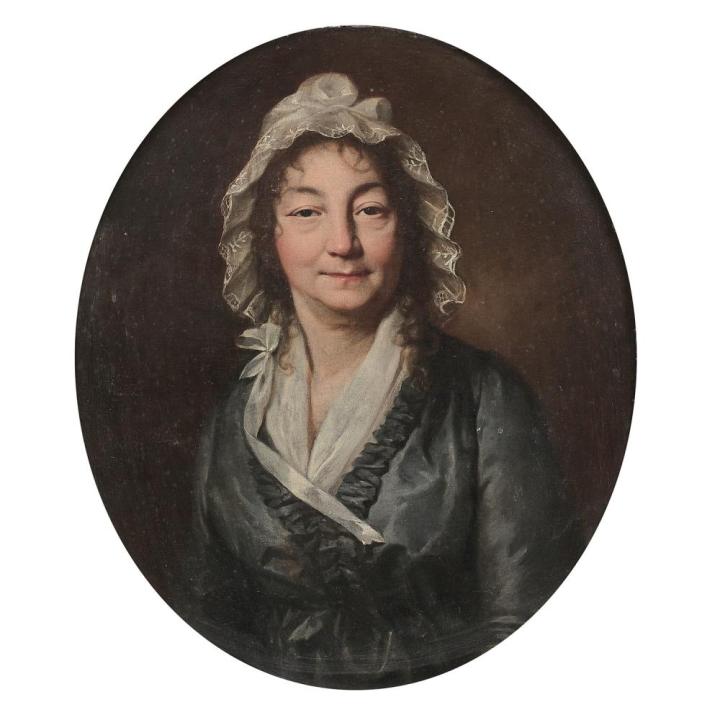
Monique Daniche, Portrait of Catherine Hubscher (1753–1835), known as ‘Madame Sans-Gêne’, ca. 1800 (Luxembourg: MNAHA).
• Monique Daniche, Portrait of Jean Nicolas Michel Tinchant (1770–1835), ca. 1793, oil on canvas, 76 × 62 cm (Luxembourg: MNAHA).
• Monique Daniche, Portrait of Jeanne Louise Thérèse Hebenstreit (1770–1849), ca. 1793, oil on canvas, 76 × 62 cm (Luxembourg: MNAHA).
• Monique Daniche, Portrait of Catherine Hubscher (1753–1835), known as ‘Madame Sans-Gêne’, ca. 1800, oil on canvas, 64 × 55 cm (Luxembourg: MNAHA).
Many museums around the world are actively trying to redress the balance in their collections of European paintings before 1850 where, in general, female portraits and especially works painted by women artists are far outnumbered by their male counterparts. With a limited budget and stiff international competition, the museum’s department of fine arts is always looking for rare opportunities to acquire work in that field on the art market. This year [2024], we were fortunate enough to acquire no less than three works by the French painter Monique Daniche (1737–1824), who was working as a much sought-after portraitist for the Strasbourg elite in the late 18th and early 19th century. Preliminary research on these portraits has revealed some remarkable stories so far.
Little is certain about Daniche’s biography and oeuvre. We know that her father Jean Tanisch (c.1700–1775) was born near Trier and recorded living between 1736 and 1742 in the Valsesia alpine valley, where he married Monique’s Tuscan mother, Rose Rossi (c.1714–1778). Our painter was born in 1737 as Marie Monique Rose Tanisch in Varallo (Piedmont), before her family relocated to Strasbourg around 1743. Although they changed their surname to ‘Daniche’ to make it sound more French, Monique kept signing her work as ‘Tanisch’. Her family was made up of painters, with her father teaching Monique and her younger siblings Ursule (1742–1822), Antoine Clément (b.1744), and Pierre (b.1752).
Almost none of their paintings are signed, and it is difficult to determine which work should be attributed to which specific family member, especially since they worked together on some paintings during their careers, Monique and Ursule in particular. As no signed works by Ursule are known to date, we assume that she collaborated exclusively with her older sister, perhaps as her assistant. Both women lived and worked together in Strasbourg all their lives, did not marry, and never seem to have left Alsace. The early years of their careers focused primarily on religious paintings for the altars of churches in Strasbourg and the surrounding area. With the dispossession and dispersal of church property during the political upheavals of the French Revolution, the sisters’ painting practice shifted to an entirely different genre, with Monique Daniche concentrating almost exclusively on portraiture from 1790 onwards.
Much of the information we have about the life and work of Monique Daniche was unearthed by the Strasbourg historian Alain Luttringer in a publication of Cahiers alsaciens d’archeologie, d’art et d’histoire 43 (2000). The addresses of her residences and workshops, the fact that the sisters employed a servant and lent considerable amounts of money, and an idea of the extent of Monique’s original oeuvre are entirely based on his research. Luttringer identified at least 35 works painted by Monique Daniche, with another 12 works attributed to her. Overall, it is a small artistic oeuvre, of which just over a dozen works have survived. . . .
The full essay is available here»
Master Drawings New York, 2025
Happening this week, with more information here:
Master Drawings New York, 2025
1–8 February 2025, New York
Taking place in more than 25 galleries on New York’s Upper East Side, Master Drawings New York is the premier U.S. art fair for exceptional drawings and works on paper from all periods, paired with complementary paintings, photographs, and sculpture.
◊ ◊ ◊ ◊ ◊
From The Drawing Foundation:
Master Drawings Symposium 2025
Villa Albertine, The Payne Whitney Mansion, New York, 4 February 2025, 4pm
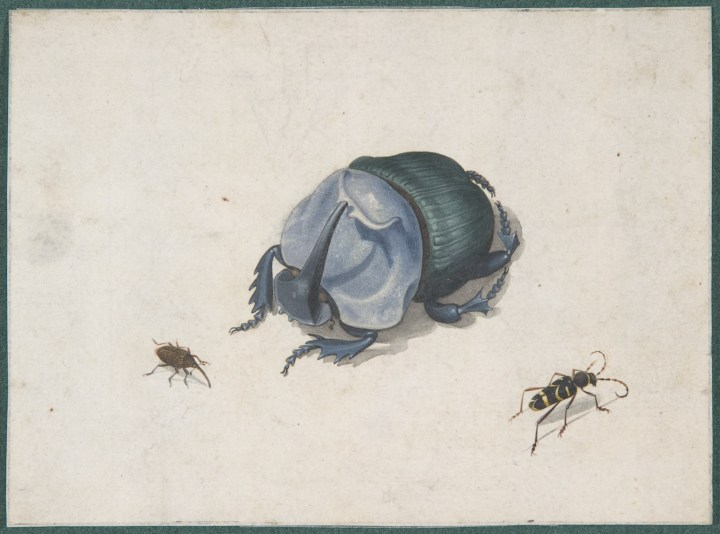
Pieter Holsteyn II, Blue Rhinoceros Beetle, Chestnut Weevil, and Wasp, ca. 1650–60, gouache and watercolor (New York: The Metropolitan Museum of Art).
This year’s winner is Olivia Dill, a PhD candidate at Northwestern University and current Moore Curatorial Fellow at the Morgan Library & Museum. Her prize-winning research was conducted during her two years as the recipient of the Diamonstein-Spielvogel Fellowship at the Metropolitan Museum of Art, a training program combining experience in three departments: Drawings and Prints, Paper Conservation, and Scientific Research. Besides assigning a previously anonymous watercolor of three insects, including an iridescent Rhinoceros beetle native to Brazil, to seventeenth-century Dutch natural history artist Pieter Holsteyn II (1614–1673), Ms. Dill used an interdisciplinary approach and technical analysis of several blue pigments, particularly smalt (ground cobalt and glass), to shed light on the artist’s color choices and his efforts to translate the beetle’s iridescence on a sheet of paper.
2024 runner-up Tamara Kobel, MA from the University of Bern and a former fellow at the Zentralinstitut für Kunstgeschichte in Munich, will delve into the fascinating world of Swiss artist Wilhelm Stettler (1643–1708). Focusing on his ‘Eyerstock’, a rich artistic tool of sketches and doodles that he described as his fertile pantry of motifs, she helps us understand what role his diverse sources (a menagerie of finely drawn animals, war machines, musical instruments, skeletons, flowers, temples, and ships) played in the artist’s career and creative process.
Master Drawings Symposium celebrates winners of its Ricciardi Prize. This event is organized by The Drawing Foundation in partnership with Master Drawings, and in association with Master Drawings New York 2025. The Symposium is made possible through the generous support of the Tavolozza Foundation.
Master Drawings, Winter 2024
In the latest issue of Master Drawings:
Master Drawings 62.4 (Winter 2024)
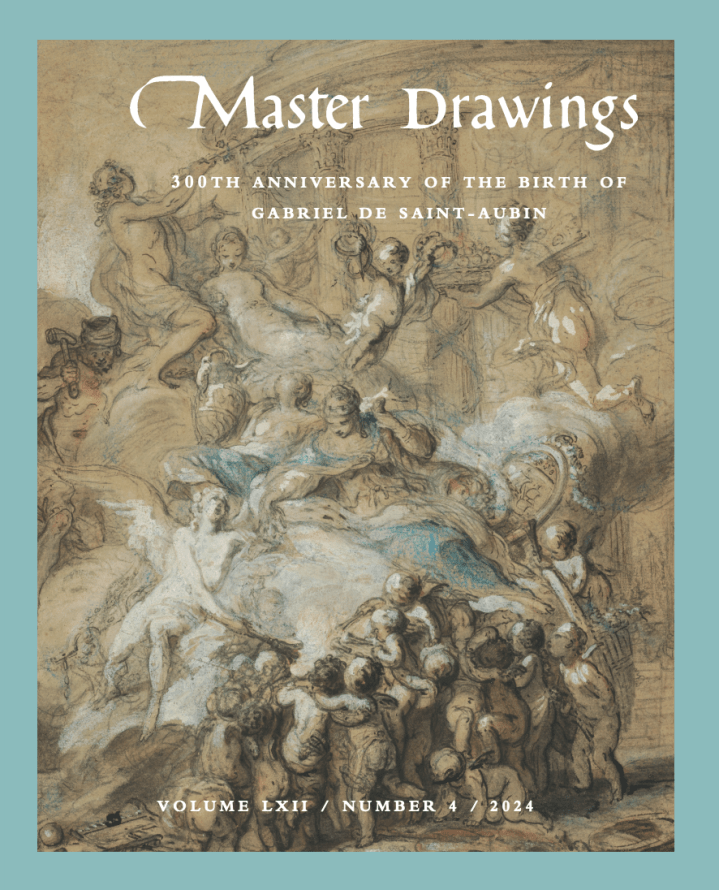 a r t i c l e s
• Perrin Stein, “The Crown, the City, and the Public: Saint-Aubin’s Images of Paris.”
• Kim de Beaumont, “A Curious Swan Song for Gabriel de Saint-Aubin: The Comte d’Estaing’s New World Naval Exploits.”
• Margaret Morgan Grasselli, “A Drawing by Hubert Robert and Jean Robert Ango: Correcting a Technical Description.”
• Sarah Catala, “Signed ‘Roberti’: Drawings by Hubert Robert and Jean Robert Ango.”
• Kee Il Choi Jr., “Learning to Draw: The Éducation visuelle of Alois Ko and Étienne Yang.”
r e v i e w s
• Aaron Wile, Review of the exhibition catalogue Claude Gillot: Satire in the Age of Reason, by Jennifer Tonkovich.
• Eduoard Kopp, Review of the exhibition catalogue, Promenades on Paper: Eighteenth-Century French Drawings from the Bibliothèque Nationale de France, edited by Esther Bell, Sarah Grandin, Corinne Le Bitouzé, and Anne Leonard.
• Ashley E. Dunn, Review of the exhibition catalogue Impressionists on Paper: Degas to Toulouse-Lautrec, by Ann Dumas, Leïla Jarbouai, Christopher Lloyd, and Harriet Stratis.
o b i t u a r y
• Perrin Stein, Obituary for Alaster Laing.
In Memoriam | Rosalind Savill (1951–2024)
Dame Rosalind Savill (1951–2024), DBE, FSA, FBA
A memorial service is being planned for Dame Rosalind Savill by her daughter Isabella Calkin and brother Hugh Savill, to take place in London on a week day in late spring or early summer. So that an appropriate venue can be found, it would be incredibly helpful for Isabella and Hugh to have an idea of the number of people who would like to attend. If you hope to come, could you kindly register your interest as soon as possible at the following email address: RosMemorial@outlook.com. Please feel free to share the news with anyone you think may also be interested in attending.
From The Wallace Collection:
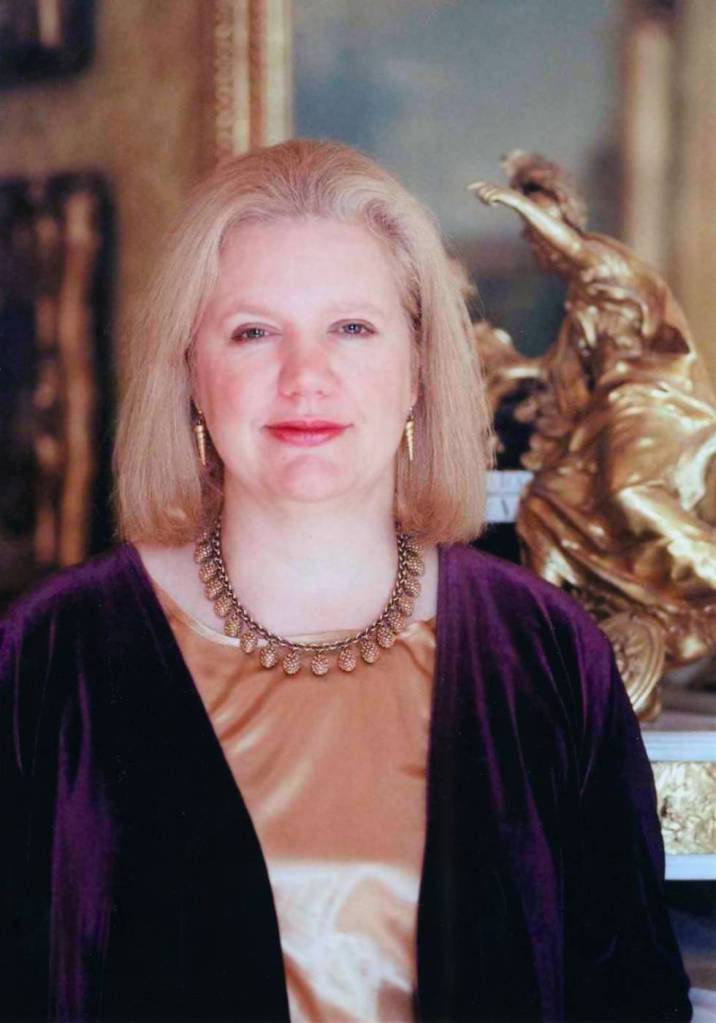 The Wallace Collection is deeply saddened by the recent passing of Dame Rosalind Savill, who was Director of the museum from 1992 until 2011.
Following her studies at the University of Leeds and a position in the ceramics department at the Victoria and Albert Museum, Dame Rosalind joined the Wallace Collection in 1974 as a museum assistant. In 1978, she became Assistant to the Director and further developed her life-long passion for the Collection’s outstanding 18th-century French decorative arts, particularly the sumptuous porcelain created by the Sèvres Manufactory. Many years of research culminated in Dame Rosalind’s publication of these treasures in her 1988 Catalogue of Sèvres Porcelain, which remains a ground-breaking work of reference for French ceramic studies.
From here, Dame Rosalind was appointed Director of the Wallace Collection in 1992. With great energy and tenacity, she brought vital change to the museum, transforming it from an undervisited and underappreciated institution into a cultural landmark, made open and relevant to all. Her most ambitious undertaking was developing the Centenary Project. With generous funding from the Heritage Lottery Fund, the Monument Trust, the Wolfson Foundation, and private individuals, this created a glazed courtyard, as well as new exhibition, learning, library, and event spaces, while securing the very foundations of the building itself. Dame Rosalind breathed new life into the galleries, too, by leading on their refurbishment and rehanging, giving them the splendid character that is much loved today. These galleries also played host to daring exhibitions under her leadership, including showing works by Lucian Freud in 2006 and Damien Hirst in 2009, which looked to reframe the museum within contemporary contexts and led to an unprecedented rise in visitor numbers.
Dame Rosalind’s extraordinary achievements and expertise were recognised far beyond the Wallace Collection. She was awarded a National Art Collection Fund Prize in 1990, appointed a CBE in 2000 and a DBE in 2009 for her services to the arts, and most recently made an officer of the Ordre des Arts et Lettres in 2014. She also served as a trustee to numerous institutions, including the Royal Collection, the Samuel Courtauld Trust, and the Buccleuch Living Heritage Trust, as well as on the advisory committees of the Royal Mint and English Heritage and the academic committee of Waddesdon Manor. In 2011, Dame Rosalind retired from the museum but continued her research on Sèvres, publishing in 2021 Everyday Rococo, a magisterial study of Madame de Pompadour and her patronage of the porcelain factory. Objects were always at the very centre of Dame Rosalind’s work, and she had an insatiable desire to understand them, through close looking and handling, and strongly encouraged others to do so, too. Above all, she was an inspiring communicator and teacher, playing a pivotal role for generations of art lovers, historians, and critics.
The Wallace Collection wishes to celebrate Dame Rosalind’s unwavering commitment and contribution to this remarkable museum and extends heartfelt condolences to her family and friends.
In memory of Dame Rosalind’s profound contribution to the study of French decorative arts, in 2025 the Collection will inaugurate an annual memorial lecture in her name. In the spirit of her passion for sharing her knowledge with the public, each year the Dame Rosalind Savill Memorial Lecture will enable a leading scholar to share new insights into the world of 18th-century French arts and culture.
–Xavier Bray, Director, on behalf of all the Trustees and Staff at The Wallace Collection










 Enfilade
leave a comment