New Book | Eighteenth-Century Sicily: Rebuilding after Natural Disaster
From Amsterdam UP:
Martin Nixon, Architecture, Opportunity, and Conflict in Eighteenth-Century Sicily: Rebuilding after Natural Disaster (Amsterdam: Amsterdam University Press, 2023), 284 pages, ISBN: 978-9463725736, €134 / $154.
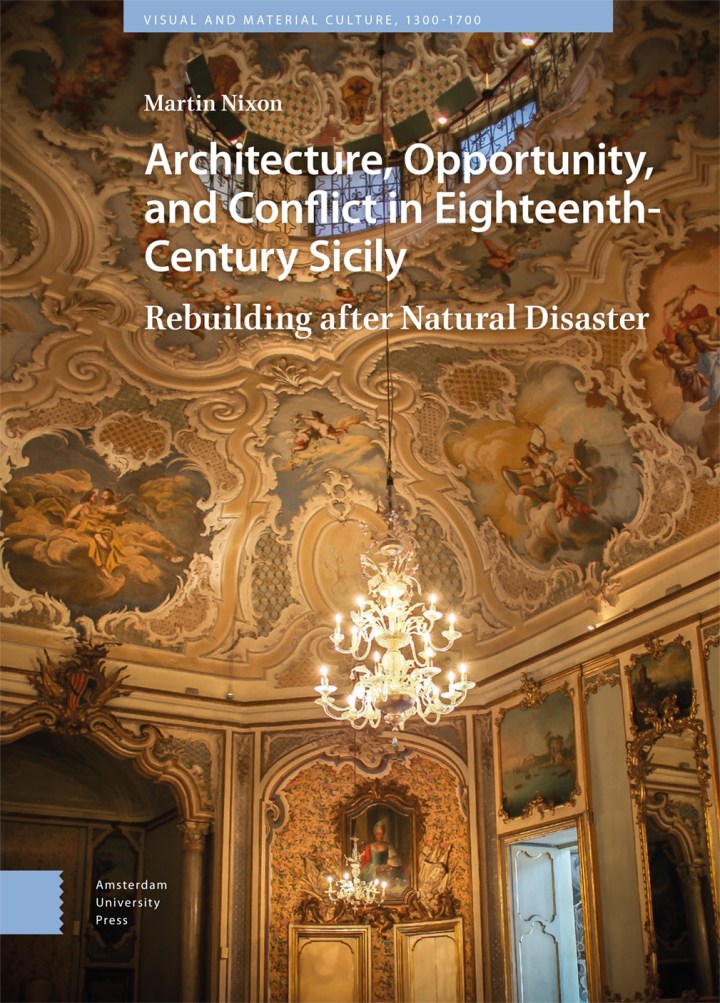 The catastrophic Sicilian earthquake of 1693 led to the rebuilding of over 60 towns in the island’s south-west. The rebuilding extended into the eighteenth century and gave opportunities for the reassertion and the transformation of power relations. Although eight of the towns are now protected by UNESCO, the remarkable architecture resulting from this rebuilding is little known outside Sicily.
This is the first book-length study in English of this interesting area of early modern architecture. Rather than seek to address all of the towns, five case studies discuss key aspects of the rebuilding by approaching the architecture from different scales, from that of a whole town to parts of a town, or single buildings, or parts of buildings and their decoration. Each case study also investigates a different theoretical assumption in architecture, including ideas of the Baroque, rational planning, and the relegation of decoration in architectural discourse.
Martin Nixon is Assistant Professor of Art History at Zayed University, United Arab Emirates. His research interests include Southern Italian art and architecture, architecture and political power, urbanism and territorial transformation, the reception of architectural ornament, and questions of cultural and stylistic hybridity in architecture. Nixon completed his doctoral dissertation on the eighteenth-century rebuilding of the Val di Noto, Sicily with York University in 2018. In 2011, he received the John Fleming Travel Award to assist his doctoral research in Sicily. He completed an MA in Art History at the Open University in December 2007 with a dissertation on the eighteenth-century Sansevero Chapel in Naples.
c o n t e n t s
List of illustrations
Acknowledgments
Introduction
1 Sicily as a Colonial Possession c. 1600–1750: Subordination and Resistance
2 The Hexagonal Towns of Avola and Grammichele: Urbanism, Fortification, and Coercion
3 The Palaces of Noto: Ornament, Order, and Opportunism
4 The Palazzo Biscari in Catania: Lightness, Refinement, and Distinction
5 The Palazzo Beneventano in Scicli: Trauma and Violence
6 The Palaces of Ragusa: Abundance, Famine, and the Grotesque
Conclusion
Glossary
Bibliography
Index
Call for Papers | Lost Cities in a Global Perspective
From ArtHist.net:
Lost Cities in a Global Perspective: Sources, Experience, and Imagery, 15th–18th Centuries
University of Campania ‘Luigi Vanvitelli’, Caserta, 16–17 October 2025
Proposals due by 15 March 2025
In conjunction with the Research Project “The Vesuvian Lost Cities before the ‘Discovery’: Sources, Experience, and Imagery in Early Modern Period” (VeLoCi)
In 1972 Italo Calvino published the book Invisible Cities, encouraging a reflection on modern megalopolises starting from the reactivation of the imaginary arising from the memory of historical cities. In “Cities and Memory 3,” Calvino states that “the city does not tell its past, it contains it like the lines of a hand, written in the corners of the streets, in the grilles of the windows, in the handrails of the stairs, in the antennas of the lightning rods, in the poles of the flags,” underlining how the knowledge of a city passes through the discovery of material elements (space) and immaterial elements (history).
More recently, Salvatore Settis (Se Venezia muore, 2014 / If Venice Dies, 2016) postulated that “Cities die in three ways: when they are destroyed by a ruthless enemy (like Carthage, which was razed to the ground by Rome in 146 BC); when a foreign people settles there by force, driving out the natives and their gods (like Tenochtitlan, the capital of the Aztecs that the Spanish conquistadores destroyed in 1521 and then built Mexico City on its ruins); or, finally, when the inhabitants lose their memory of themselves, and without even realizing it become strangers to themselves, enemies of themselves. This was the case of Athens.”
Many cities across the world have disappeared over the centuries, abandoned (but perhaps never forgotten), destroyed by natural disasters, or buried under new urban layers (Teotihuacán, Chichén Itzá, Copàn, Tulum, Angkor, Petra, Rome, Pompeii, Herculaneum, Brescia), re-emerging for different reasons. Fascinating historians, explorers, archaeologists, architects, and artists, ‘lost cities’—both literally and metaphorically—have continued to exist in literary sources, descriptions, chronicles, and sometimes in iconographic representations.
Pompeii and Herculaneum are two of the most famous cities that disappeared due to natural disasters. Despite historiographical and narrative traditions claiming that their ‘discovery’ occurred only in conjunction with the start of the Bourbon excavations in the 18th century, the VeLoCi project has demonstrated that even before the start of systematic excavations, material traces of the existence of these ancient cities had emerged and that there was no lack of literary, antiquarian, and scientific sources dedicated to their history. In other cases, cities that disappeared following catastrophes or simple stratification were not unearthed, despite their historical past being well known.
What was then the perception, the relationship of coexistence and study and knowledge with the buried/lost cities in the different cultures of the world in the early modern era? What phenomena or episodes have reactivated their systematic research? What are the operational, scientific, and epistemological approaches to the discovery of the past? What are the reasons that suggest seeking and valorising the past?
Starting from the case study of the Vesuvian cities, the international conference Lost Cities in a Global Perspective: Sources, Experience, Imagery in Early Modern Period (XV–XVIII Century) aims to investigate in an interdisciplinary and comparative way the material and imaginary dimensions assumed by lost cities before the birth of archaeology as a science in the 18th and 19th centuries. We invite scholars from a variety of disciplines, including architectural history, art and literary history, history, history of science, archaeology, cultural studies, and other related fields, to submit papers examining cases from any geographical context. Interdisciplinary approaches are particularly welcome, as are contributions that reflect on the exchange of knowledge and cultures at a global level.
Topics may include (but are not limited to):
• Travel Accounts and Exploration: the role of European explorers and missionaries in shaping the narratives of lost cities in Asia, Africa, and the Americas.
• Historiographical approaches: the role of early modern historians and intellectuals in constructing and reconstructing the idea of lost cities.
• Myth and Reality: what role did legends and fantastic narratives have in shaping lost cities and how did they intertwine with emerging archaeological or geographical knowledge.
• Visual Culture and cartography: the role of representations of lost cities in art and cartography.
• Colonialism and Cultural Exchange: the impact of colonial expansion on the perception of lost cities and the relationship with native cultures.
• Material Culture and Archaeology: proto-archaeology and antiquarian research in exploring the physical remains of lost cities and ancient civilizations.
• Literature and Lost Cities: the role of literature in constructing of the idea of lost cities, from utopian and dystopian narratives to adventure tales.
• Cultural Memory and Identity: how did the notion of lost cities has served as a tool for constructing cultural memory and national identity, and how did societies have preserved or forgotten this memory.
• Environmental Factors and Natural Disasters: what role has climate change, natural disasters, and geographical displacement played in the disappearance of cities.
The two-day conference—organised by Giulia Ceriani Sebregondi, Francesca Mattei, and Danila Jacazzi—is promoted by the PRIN 2022 research project “VeLoCi — The Vesuvian Lost Cities before the ‘Discovery’: Sources, Experience, Imagery in Early Modern Period” at the end of its duration and will be hosted at the University of Campania ‘Luigi Vanvitelli’, in Caserta, Italy. VeLoCi will organise and pay for accommodation and reimburse travel costs (economy class) for the speakers. At the end of the conference, the publication of some contributions in a peer-reviewed collective volume will be evaluated. Scientific and organisational secretariat by Giorgia Aureli and Giorgia Pietropaolo.
Participation in the conference is free of charge. The conference languages are Italian and English. Abstracts, in PDF format (maximum 1500 characters, about 250 words) in Italian or English, must include a title and a short biography (maximum 1500 characters, about 250 words). Please send the material to ve.lo.ci.prin@gmail.com by 15 March 2025. Notification of accepted proposals will be sent around 15 April. Please note that this CFP is also open to PhD students and independent scholars.
Scientific Committee
Candida Carrino, Giulia Ceriani Sebregondi, Kathleen Christian, Bianca de Divitiis, Danila Jacazzi, Francesca Mattei, Tanja Michalsky, Massimo Osanna, Francesco Sirano
New Book | Shoes and the Georgian Man
From Bloomsbury:
Matthew McCormack, Shoes and the Georgian Man (London: Bloomsbury Visual Arts, 2025), 208 pages, ISBN: 978-1350358676 (hardback), £85, $100 / ISBN: 978-1350358669 (paperback), £29, $40.
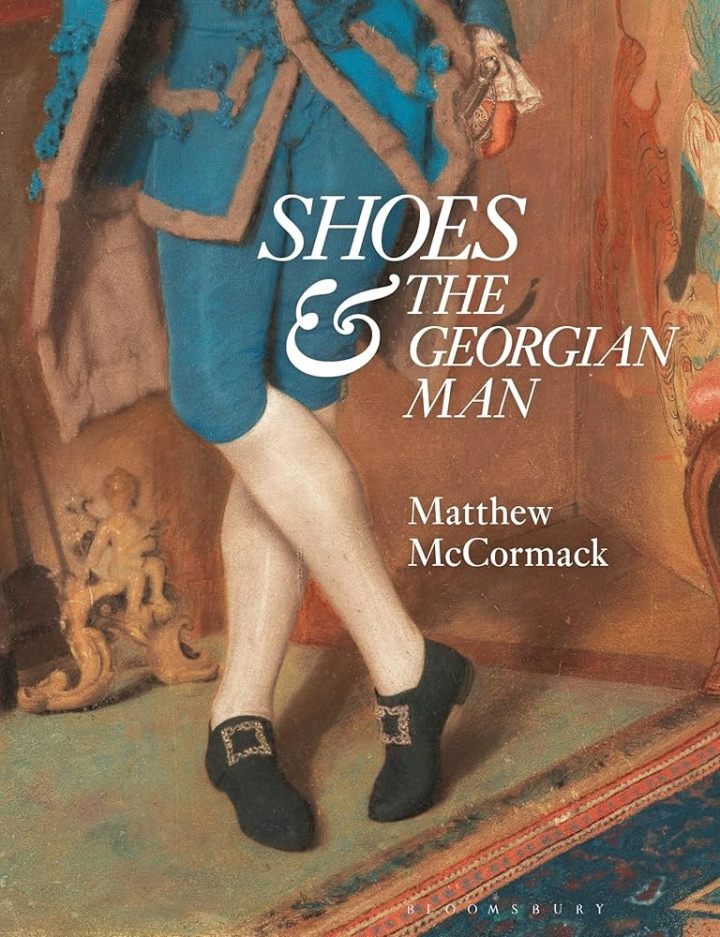 Shoes are everyday objects, but they are loaded with meaning. This book reveals how shoes played a powerful role in the wider story of shifts in gender relations in 18th-century Britain. It focuses on the relationship of shoes with the body and its movements, and therefore how what we wear on our feet relates closely to social, occupational, and gender roles. It also uses footwear to explore topics such as politics, war, dance, and disability. Thinking about shoes as material objects, McCormack studied historic shoes first-hand in museums, in order to ascertain their physical properties and what they would have been like to wear. Worn shoes preserve traces of the wearer’s body in their indentations, stretches and scuffs, providing a unique primary source about their wearer. This approach forges new connections between the histories or material culture, gender, and the body, and sheds new light on what it meant to be a man in the 18th century.
Matthew McCormack is Professor of History at the University of Northampton, course leader for MA History, and a Fellow of the Royal Historical Society and of the Higher Education Academy. His previous books include The Independent Man: Citizenship and Gender Politics in Georgian England, Embodying the Militia in Georgian England, and Citizenship and Gender in Britain, 1688–1928. He edited the Journal for Eighteenth-Century Studies (2015–20).
c o n t e n t s
List of Figures
Acknowledgements
Introduction
1 Georgian Men and Their Shoes
2 Shoes and the Body
3 Shoes and Politics
4 Boots and Masculinity
5 Gout Shoes and Disability
6 Dancing Feet
7 The Soldier’s Shoe
Conclusion: Wearing Georgian Shoes
Select Bibliography
Index
Registration for an online conversation about the book is available via Eventbrite:
Online Conversation: Shoes and the Georgian Man
Tuesday, 11 March 2025, 2pm EDT
Serena Dyer talks with Matthew McCormack about his new book, Shoes and the Georgian Man, published by Bloomsbury in January 2025. By Leicester Branch of the Historical Assn.
New Book | The Turban
From Reaktion Books with distribution by The University of Chicago Press:
Chris Filstrup and Jane Merrill, The Turban: A History from East to West (London: Reaktion Books, 2025), 264 pages, ISBN: 978-1836390749, £20 / $30.
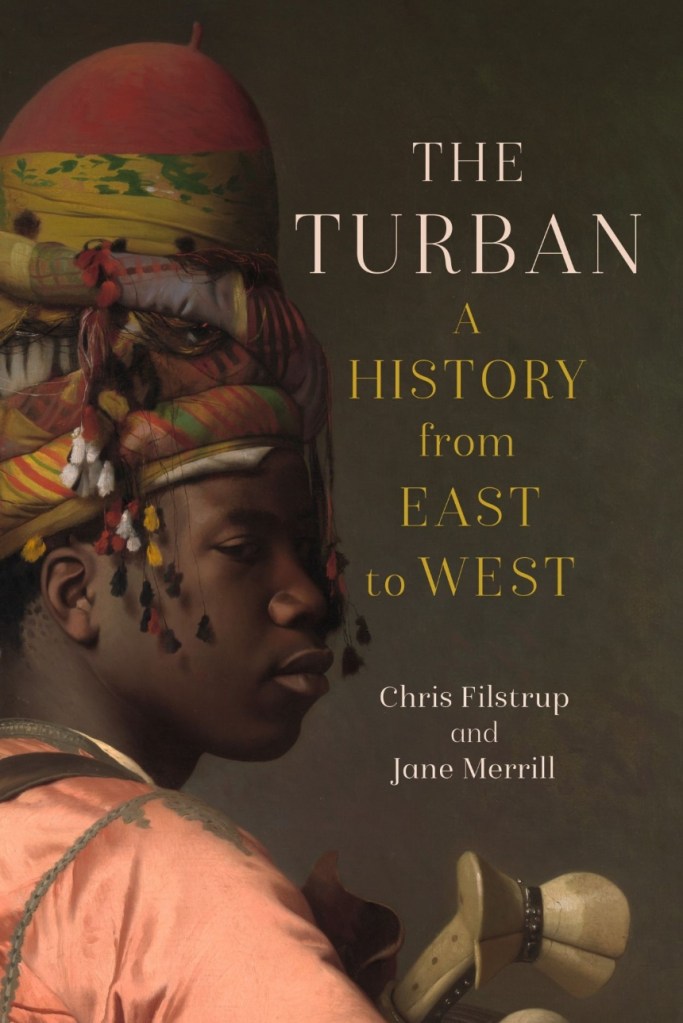 A superbly illustrated history of the turban, from Arabian origins to global cultural icon.
A turban is a strip of cloth folded and wrapped around the head; however, this description includes multifarious forms across space and time. This book follows the turban as it moves from the Arabian Peninsula through the Ottoman Empire to Europe and the Americas. It directs the reader’s gaze from traditional and religious uses of the turban into the realms of international trade, Renaissance art and contemporary fashions. Turbans, as this book shows, have moved in and out of Western culture, at times considered archaic and forgotten, then noticed and reinstated as major accessories. Today Sikh men are recognized by their distinctive headwraps, and the turban remains an important part of Black culture. This book explores the turban’s many adaptations worldwide.
Chris Filstrup was Chief of the Oriental Division at the New York Public Library and Dean of Libraries at Stony Brook University. He is co-author with Jane Merrill of The Wedding Night (2011) among other titles. He lives in Alexandria, Virginia.
Jane Merrill has written for many national U.S. magazines and is the author of The Showgirl Costume (2018) and other cultural histories. She lives in Saint George, Maine.
c o n t e n t s
Introduction
1 A Path into Western Iconography
2 Trade, Diplomacy and Depiction
3 Nabobs, Adventurers and Travellers
4 Masques and Turquerie
5 Riding the Magic Carpet
6 A Neoclassical Accessory
7 Individual Expressions: Africa and the Caribbean
8 Cultural Tourism and Authenticity since 1900
References
Bibliography
Acknowledgements
Photo Acknowledgements
Index
New Book | The Virtues of Underwear
From Reaktion Books, with distribution by The University of Chicago Press:
Nina Edwards, The Virtues of Underwear: Modesty, Flamboyance and Filth (London: Reaktion Books, 2024), 224 pages, ISBN: 978-1789149562, £20 / $28.
 Unravels the intimate narratives woven into the fabric of our most personal garments.
Stories are woven into the fabric of our most personal garments. From the first loincloths to the intricate layers of shapewear, the concealed world of underwear is capable of expressing individual desire and also aspects of society at large. An indicator of the vagaries of fashion, underwear can be simple or elaborate. It both safeguards and exposes, reflecting our hopes and experiences. Underwear can embarrass and excite, amuse and shame us. This book illuminates the sometimes profound significance of the garments we wear beneath our outer clothing. It discusses the history of both women’s and men’s underwear, and global cultures of dress.
Nina Edwards is a freelance writer based in London. Her books include Darkness: A Cultural History (2018) and Pazazz: The Impact and Resonance of White Clothing (2023), both published by Reaktion Books.
c o n t e n t s
Introduction
1 What Is Underwear For?
2 Codpiece and Corset
3 Modesty and the Immodest Torso
4 Outer to Under and Back Again
5 Fabric and Fit
6 Medical and Other Practical Matters
7 Economic and Religious Concerns
8 The Underwear Drawer
Glossary
References
Bibliography
Acknowledgements
Photo Acknowledgements
Index
Exhibition | L’Isle-Adam across Three Centuries
Now on view:
Trois siècles à L’Isle-Adam
Musée d’art et d’histoire Louis Senlecq, L’Isle-Adam, 20 October 2024 — 21 September 2025
 À vingt-cinq kilomètres à vol d’oiseau de Paris, L’Isle-Adam se trouve aux portes du parc naturel régional du Vexin français, du Pays de France et du département de l’Oise. Qualifiée de « paradis terrestre » par Honoré de Balzac dans une lettre qu’il écrit à sa soeur en 1819, la ville bénéficie d’un environnement exceptionnel situé entre rivière et forêt domaniale. Avec l’exposition Trois siècles à L’Isle-Adam, les visiteurs sont invités à un voyage à travers l’histoire et le patrimoine de la cité adamoise et de son territoire.
Organisé de manière chronologique et couvrant une période allant du XVIIIe au milieu du XXe siècle, le parcours s’articule autour des grandes thématiques représentées dans les collections du musée. L’histoire et l’évolution urbaine de L’Isle-Adam y sont évoquées : des fastes des princes de Conti au développement de la villégiature et des loisirs. Le passé industrieux de la ville est également mis en avant, avec les manufactures de terres cuites décoratives qui ont fait la célébrité de L’Isle-Adam de la fin du XIXe au début du XXe siècle.
La région ayant attiré de nombreux artistes, c’est aussi à travers l’oeil des peintres que l’on découvre les paysages des bords de l’Oise et de la campagne environnante, par les toiles de Jules Dupré (1811–1889), Léon Victor Dupré (1816–1879), Auguste Boulard père (1825–1897), Renet-Tener (1846–1925), Fernand Quignon (1854–1941) et Emilio Boggio (1857–1920).
L’exposition rassemble peintures, sculptures, aquarelles, gravures, affiches publicitaires, cartes postales et photographies anciennes, toutes issues du fonds du musée.
Burlington Magazine Scholarship | French 18th-Century Art
From The Burlington:
The Burlington Magazine Scholarship | French 18th-Century Fine and Decorative Art
Applications due by 30 March 2025
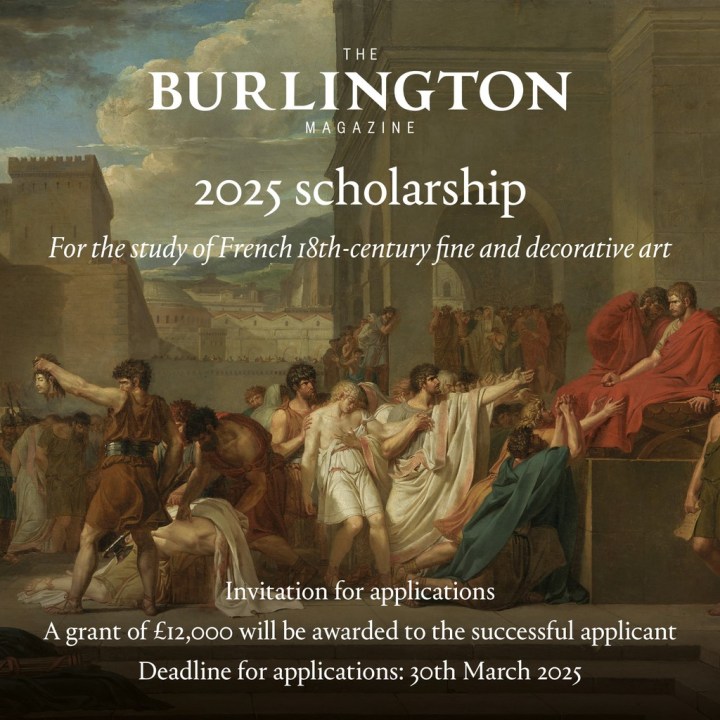 Applicants must be studying, or intending to study, for an MA, PhD, post-doctoral or independent research in the field of French 18th-century fine and decorative arts within the 12-month period the funding is given. The start date of successful applications should be at the beginning of the academic year (generally September). Earlier start dates will be considered for independent scholars or post-doctoral research. The funding is open to UK and international applicants. Research funded by this scholarship may lead to the submission of articles for publication in the Magazine: as such, the panel are looking for object related research, of the kind that the Burlington publishes.
To apply, please send your CV, description of project/research (no longer than 2 pages of A4), budget, proof of Institution you are attending/will attend to: scholarship@burlington.org.uk. Applications must be sent in PDF or Word document (.docx) format. Applications can only be submitted via email by 30 March 2025. The successful applicant will be notified by 31 May 2025.
The Burlington Magazine, January 2025
.
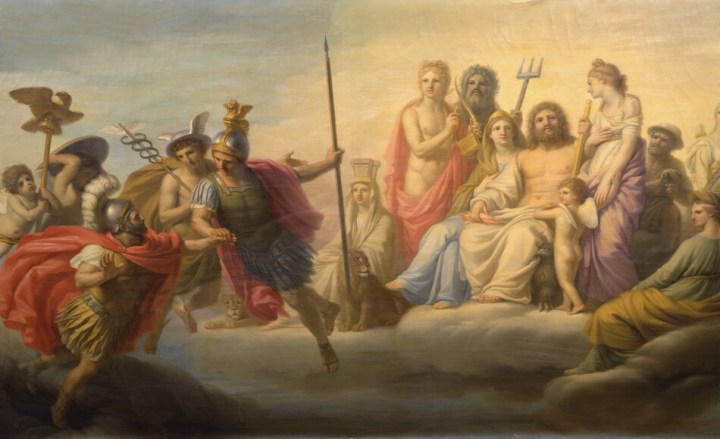
Stefano Tofanelli, Apotheosis of Romulus before the Gods of Olympus, 1790, oil on canvas, 208 × 318 cm
(Rome: Palazzo Altieri)
◊ ◊ ◊ ◊ ◊
The long 18th century in the January issue of The Burlington:
The Burlington Magazine 167 (January 2025)
e d i t o r i a l
• “A One Billion Pound Gift,” p. 3.
“Now you can gasp,” said the Chairman of the Trustees of the British Museum to guests at a recent fundraising dinner. He had just revealed the valuation of £1billion for the magnificent collection of Chinese ceramics that has been given to the museum by the Sir Percival David Foundation. Munificence on this scale is normally only associated with the richest of American museums, so a new record seems to have been set in the European context by this extraordinary gesture.
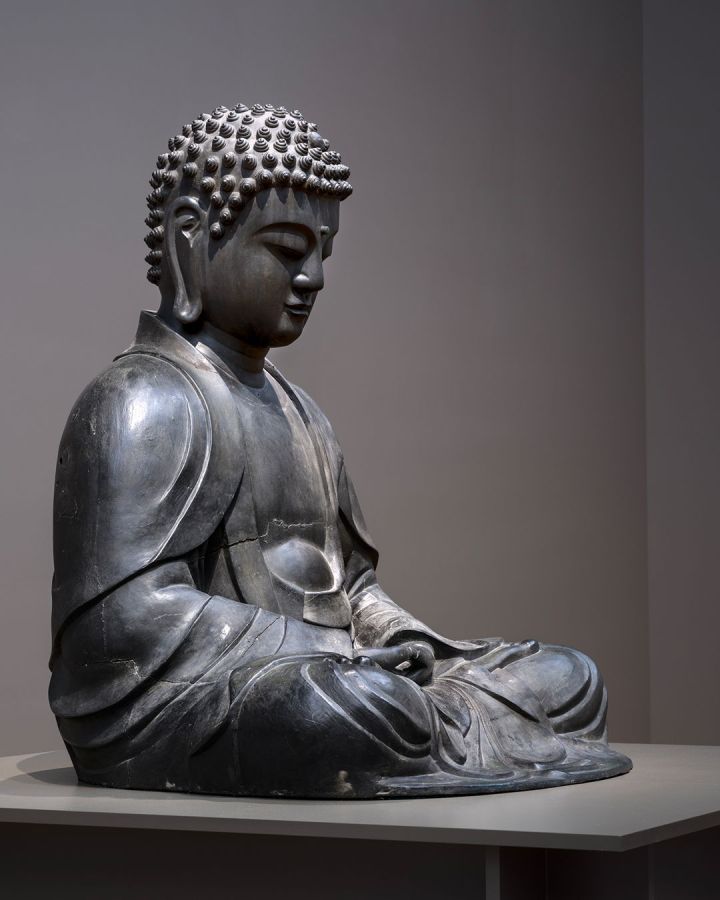
Buddha Amida (Amitabha), Japan, 1716 (Collection Wereldmuseum). Included in the exhibition Asian Bronze: 4,000 Years of Beauty.
s h o r t e r n o t i c e s
• Pilar Diez del Corral Corredoira, “A Project for the Church of Menino Deus, Lisbon, by Vieira Lusitano,” pp. 26–29.
• Alessio Cerchi, “Stefano Tofanelli’s Deification of Aeneas by Venus Rediscovered,” pp. 29–31.
r e v i e w s
• Lori Wong and Sujatha Arundathi Meegama, Review of the exhibition Asian Bronze: 4,000 Years of Beauty (Rijksmuseum, 2024–25), pp. 35–37.
• Delphine Bastet, Review of Grands décors restaurés de Notre-Dame de Paris, edited by Caroline Piel and Emmanuel Pénicaut (Silvana Editoriale, 2024), pp. 62–63.
• Peter Humfrey, Review of Anne Nellis Richter, The Gallery at Cleveland House: Displaying Art and Society in Late Georgian London (Bloomsbury, 2024), pp. 71–72.
Conference | Nature into Art
From ArtHist.net:
Nature into Art
Schloss Nymphenburg, Munich, 11–12 February 2025
Registration due by 2 February 2025
From 26 November 2024 to 16 March 2025, the Alte Pinakothek in Munich is hosting the world’s first major monographic exhibition on Rachel Ruysch. The exhibition is a collaborative effort between the Alte Pinakothek, the Toledo Museum of Art, and the Museum of Fine Arts, Boston. Rachel Ruysch (1664–1750) has always been regarded as one of the most important flower painters in European art, but her life and work have remained insufficiently researched to date. In addition to her perfected fine painting technique, her still lifes—featuring flowers, leaves, fruits, and insects rendered in the finest detail—reflect her interest in botanical and scientific subjects.
In conjunction with the exhibition Rachel Ruysch: Nature into Art and the CODARTfocus in Munich, the workshop Nature into Art will take place February 11–12 at Schloss Nymphenburg in München. The workshop aims to deepen new perspectives gained from the exhibition, particularly regarding the interplay between art and science. The speakers represent the interdisciplinary approach of the exhibition, which are derived from different scientific fields, such as art history, conservational sciences, postcolonial studies, and gender studies, as well as researchers with a botanical focal point. The workshop is intended to sustainably deepen the network of scholars with unique scientific approaches and from different countries, universities, research institutions, and museums. Participation of students from the University of Konstanz will involve the next generation of scholars and raise awareness for current research in the field of early modern painting.
Participation in the event is free of charge, but registration is requested. For more information and to register for the workshop, please contact laura.kromer@uni-konstanz.de until 2 February 2025.
Organizers
Christopher Atkins (Center for Netherlandish Art at the Museum of Fine Arts in Boston), Robert Felfe (University of Graz), Karin Leonhard (University of Konstanz), and Thijs Weststeijn (University of Utrecht)
t u e s d a y , 1 1 f e b r u a r y
9.00 Arrival
9.30 Opening Remarks
10.00 Morning Talks
• Marlena Schneider (Doerner Institut – Bayerische Staatsgemäldesammlungen) — Art Technological Insights on Five Paintings by Rachel Ruysch from the Former Wittelsbach Electoral Collections
• Kirsten Derks (University of Antwerp) — Tried and Tested? Rachel Ruysch’s Working Methods in Her Mature and Late Works
• Larissa van Vianen (University of Amsterdam) — From Observation to Publication: Pierre Lyonet and the Art of 18th-Century Natural History
• Jaya Remond (Ghent University) — Printing Floral Imagery in Northern Europe, c. 1590–1610: Pictorial Discourses and Frames of Representation
13.30 Lunch
14.30 Afternoon Talks
• Marie Amélie Landrin (Sorbonne University) — Rachel Ruysch: Botanical Art at the Intersection of Science and Patronage
• Laura Kromer (University of Konstanz) — The Companion Pieces of Rachel Ruysch: Intertwinings of Pictorial Combination
• Catherine Powell-Warren (KU Leuven) — TBA
17.00 Closing Remarks
17.30 Reception
18.00 Judith Noorman (University of Amsterdam) — Presentation
w e d n e s d a y , 1 2 f e b r u a r y
10.00–12.00 Study day in the exhibition Rachel Ruysch: Nature into Art at the Alte Pinakothek, Munich
Students from the University of Konstanz will offer tailored guided tours.
New Book | Reading the World, British Practices of Natural History
Coming in March from the University of Pittsburgh Press:
Edwin Rose, Reading the World: British Practices of Natural History, 1760–1820 (Pittsburgh: University of Pittsburgh Press, 2025), 408 pages, ISBN: 978-0822948513, $65.
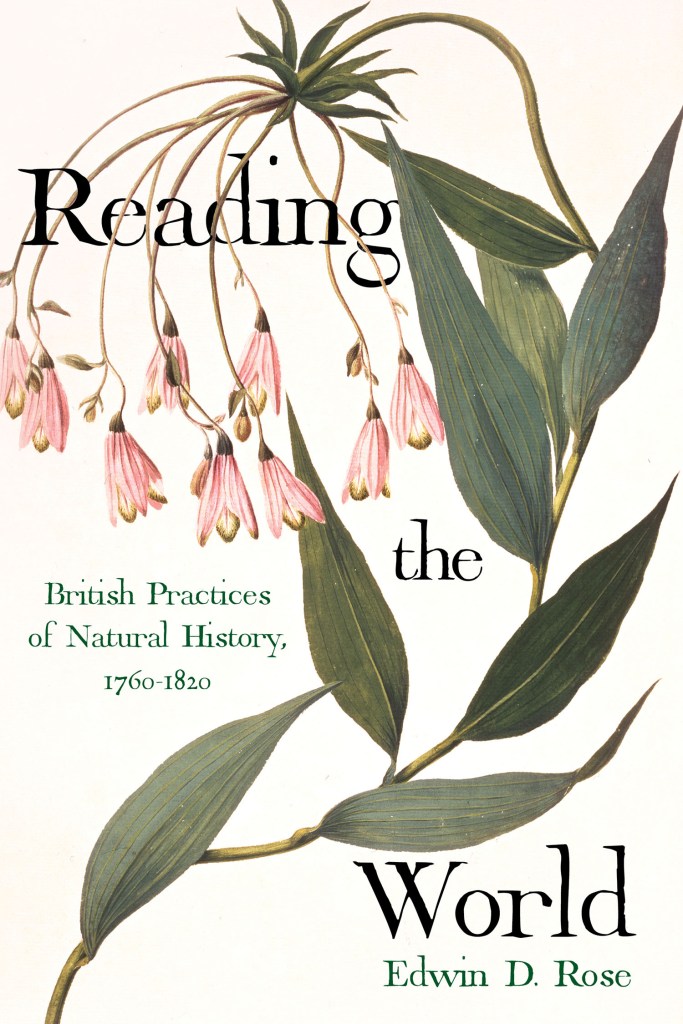 In the eighteenth and nineteenth centuries—a period that marked the emergence of a global modernity—educated landowners, or ‘gentlemen’, dominated the development of British natural history, utilizing networks of trade and empire to inventory nature and understand events across the world. Specimens, ranging from a Welsh bittern to the plants of Botany Bay, were collected, recorded, and classified, while books were produced in London and copies distributed and used across Britain, Continental Europe, the Pacific, Asia, and the Americas. Natural history connected a diverse range of individuals, from European landowners to Polynesian priests, incorporating, distributing, synthesizing, and appropriating information collected on a global scale. In Reading the World, Edwin D. Rose positions books, natural history specimens, and people in a close cycle of literary production and consumption. His book reveals new aspects of scientific practice and the specific roles of individuals employed to collect, synthesize, and distribute knowledge—reevaluating Joseph Banks’s and Daniel Solander’s investigations during James Cook’s Endeavour voyage to the Pacific. Uncovering the range of skills involved in knowledge production, Rose expands our understanding of natural history as a cyclical process, from the initial collection and identification of specimens to the formal publication of descriptions to the eventual printing of sources.
Edwin D. Rose is currently AHRC Research Fellow in the Department of History and Philosophy of Science at the University of Cambridge and Advanced Research Fellow at Darwin College, Cambridge. From May 2025 he will be a Leverhulme Trust Early Career Research Fellow in the School of Philosophy, Religion, and History of Science at the University of Leeds.










 Enfilade
leave a comment