Exhibition | Pierre-Antoine Demachy (1723–1807)
Adapted from the Office of Tourism of Versailles:
Le Témoin Méconnu: Pierre-Antoine Demachy (1723–1807)
Musée Lambinet, Versailles, 15 February — 18 May 2014
 The Musée Lambinet in Versailles dedicates a unique exhibition to Pierre Antoine Demachy. This little-known artist of the eighteenth century, whose work has never before been showcased in a single exhibition, is a fabulous witness of his time. Strongly influenced by Italian art, Demachy applied to Paris cityscape types practiced by Canaletto and Guardi. He was among the artists whom the Empress Catherine II of Russia in 1768 placed an order through its ambassador to France, and the Count of Angivillers purchased for Louis XVI a view of the Seine at the Salon of 1783.
The work of Demachy will be presented through the following seven themes:
• Architectural whims and fantasy views
• Views related to the Louvre
• Demolition of churches and fire the Foire Saint-Germain
• Church interiors
• Other views in and around Paris
• Historic Events
• Views of the Seine and cityscapes
The press release, which includes a checklist of the major works exhibited, is available here»
◊ ◊ ◊ ◊ ◊
The catalogue is available from Artbooks.com:
Françoise Roussel-Leriche and Marie Petkowska Le Roux, Le Témoin Méconnu: Pierre-Antoine Demachy, 1723–1807 (Paris: Magellan, 2014), 216 pages, ISBN: 978-2350742809, $55.
New Book | The Architectural Capriccio
From Ashgate:
Lucien Steil, ed., The Architectural Capriccio: Memory, Fantasy and Invention (Aldershot: Ashgate, 2014), 548 pages, ISBN: 978-1409431916, £90 / $125.
 Bringing together leading writers and practicing architects including Jean Dethier, David Mayernik, Massimo Scolari, Robert Adam, David Watkin and Leon Krier, this volume provides a kaleidoscopic, multilayered exploration of the architectural capriccio. It not only explains the phenomena within a historical context, but moreover, demonstrates its contemporary validity and appropriateness as a holistic design methodology, an inspiring pictorial strategy, an efficient rendering technique and an optimal didactic tool. The book shows and comments on a wide range of historic masterworks and highlights contemporary artists and architects excelling in a modern updated, refreshed and original tradition of the capriccio. The capacity of the capriccio to create an imaginary, imagined or ‘analogue’ reality by combining and relocating existing or invented buildings and places in uniquely suggestive drawings and paintings offers unprecedented insights in the ‘Architectural Mind’.
Unlike what the word capriccio might suggest, it is not ‘capricious’ but indeed follows complex rules of realism and figuration, as well as coherent narratives and semantics. It is a playful reflection of the dialectics of the real and the ideal. The capriccio does not challenge the mechanism of reality, but questions the mechanic and linear reading of the real, of life and of art and offers a large palette of threads, figures, tones and nuances to illustrate and contribute creatively to the complexity of a sustainable built and living architectural environment.
Lucien Steil is an Associate Professor in Architecture at the University of Notre Dame, Indiana and Rome.
◊ ◊ ◊ ◊ ◊
C O N T E N T S
• Foreword: Capriccio: The efficacy of spatial narrative, Michael Graves
• Preface: The Architectual Capriccio: Memory, fantasy, invention, Lucien Steil
• Introduction, Alireza Sagharchi
• ‘Il Capriccio’, Definition of the capriccio (caprice) in the French Larousse Dictionary, trans. Julie Kleinman
• Meaning and purpose of the Capriccio, David Mayernik
• The poietic image, Samir Younés
• The Capricci of Giovanni Paolo Panini, David Mayernik
• Patronage in the golden age of the Capriccio, Selena Anders
• The grand tour, Lucien Steil
• Capriccio: The leap of the goat or the unexpected, Jose Cornelio da Silva
• Metaphors for a political urban landscape: Schinkel’s Capricci of a ‘new Athens-on-the-Spree’, Jean-François Lejeune
• J.M. Gandy’s composite views for John Soane, William Palin
• American Capriccio: Imaginary architecture in nineteenth-century painting, Gail Leggio
• The Capricci of Carl Laubin, David Watkin
• Symmetria and ethics: The didactic Capriccio, David Ligare
• Settings: Emily Allchurch and the old masters, Xavier Bray and Minna Moore Ede
• Massimo Scolari, Leon Krier
• Drawing, Leon Krier
• Capriccio, Leon Krier
• ‘Imago Luxemburgi’, Leon Krier
• The Capriccio and poetical realism, Lucien Steil
• Urban chiaroscuro (after Piranesi): Behind the scenes, Emily Allchurch
• Sublime architecture: Capricci in sketchbook and paintings, Lucien Steil
• Le Corbusier’s eye and the vanishing point of modernity, David Brain
• The architectural project: An homage to Rob Krier, Lucien Steil
• ‘La citta analoga’: Thoughts on the urban Capriccio for the design of real cities, Pier Carlo Bontempi
• Magical realism in Miami, Javier Cenicaceleya
• A very British Capriccio, Alireza Sagharchi
• Building the Capriccio, Robert Adam
• Capricci capricciosi, Ettore Maria Mazzola
• The double nature of the architectural Capriccio: From pictorial fiction to urban reality, Jean Dethier
• Postface: ‘techne’ and technology, Lucien Steil
• The aura of the computer generated image: Or virtuosity and the cult of the artifact, Dialog between Alireza Sagharchi and Gil Gorski
• Index
Exhibition | Things We Do in Bed
From the exhibition description at Art Daily:
Things We Do in Bed
Danson House, Bexleyheath, Kent, 1 April — 31 October 2014
Curated by Tracy Chevalier
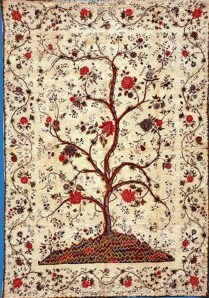
Tree of Life Quilt cropped, detail, c.1810 (Jen Jones Welsh Quilt Centre)
Things We Do in Bed celebrates quilts and their continuing links to what goes on behind the bedroom door. Featuring quilts and quilt works dating from the 18th and 19th centuries, alongside contemporary work, the exhibition is displayed through the five bedrooms in Danson House, with each room focusing on a different bed activity: Birth, Sleep, Sex, Illness, Death.
The exhibition features a lively mix of antique and contemporary quilts including:
• intricate 18th- and 19th-century cot quilts with quilted feathers and flowers and colourful patchwork designs
• a new ‘sleep quilt’ from Fine Cell Work, a charity that teaches prisoners to sew; prisoners all over the UK were asked to make squares exploring their feelings about sleep, and join them together in this quilt
• Karina Thompson’s quilt which captures an echocardiogram examining the maker’s heartbeats
• Grayson Perry’s Right to Life quilt, made as a provocative response to the abortion debate in the USA
 • Sue Watters’ hand stitched quilt, Unchained Melody which she made sitting by her husband’s side while he was in the final stages of Alzheimer’s, with sewing and music as her solace
Tracy Chevalier is an internationally bestselling author of seven novels. In her most recent book, The Last Runaway, her heroine is a quilter. As well as learning a lot about quilts, Tracy learned to quilt by hand. As she says: “Since researching quilts for my last novel, I have fallen hard for the varied and miraculous artistry of quilting. With this show I explore how quilting relates to bedroom activities, in both practical and abstract ways. For traditionalists, there are jaw-dropping examples of antique quilt-making. For contemporary art lovers, there are works that push boundaries and emotions.”
◊ ◊ ◊ ◊ ◊
Hannah Duguid writes about the exhibition for The Independent (8 April 2014).
Call for Papers | Facing the Unknown: Anonymity in the History of Art
From the symposium website:
Student Symposium | Facing the Unknown: Anonymity in the History of Art
The Cleveland Museum of Art, 24 October 2014
Proposals due by 15 June 2014
The Case Western Reserve University/Cleveland Museum of Art Joint Graduate Program in Art History & Museum Studies invites submissions from all areas of art history for the 40th Annual Cleveland Symposium. Facing the Unknown: Anonymity in the History of Art seeks papers which address the theme of anonymity or the unknown in the visual arts. The obscurity of an artist, subject, function, or context may be a byproduct of the passage of time, of traditional cultural practices, or a conscious decision on the part of the maker. This symposium aims to explore the ways in which an anonymous aspect of a work may influence its interpretation, function, classification, or perceived value throughout the object’s history.
Potential topics include, but are not limited to:
• Anonymous artists or makers
• Images of unknown subjects or for unknown patrons
• Objects with undetermined function or context
• Works of questionable authenticity, attribution, dating, or provenance
• Objects with elements that have been deliberately effaced, obscured, or omitted
• Lost works of art
• Previously unknown, unstudied, or unpublished artists or artworks
• Intentional use of anonymity, including works that mask or conceal identity
Doctoral and master’s degree students in art history and related disciplines are invited to submit a 250-word abstract and C.V. to clevelandsymposium@gmail.com by June 15, 2014. Applicants will receive notification of their status via email by August 1, 2014.
The 40th Annual Cleveland Symposium will be held in conjunction with the Symposium in Honor of Ellen G. Landau, Andrew W. Mellon Professor Emerita in the Humanities, to take place on Saturday, October 25, 2014 at the MOCA Cleveland. The keynote speaker for both events is Dr. Joan Marter, Board of Governors Professor of Contemporary Painting and Sculpture, Rutgers University, who will speak after the conclusion of the program on Friday October 24.
Newly Conserved and Renovated Salon Doré Unveiled

◊ ◊ ◊ ◊ ◊
The newly restored Salon Doré has just opened at the Legion of Honor Museum in San Francisco:
The Salon Doré from the Hôtel de La Trémoille is one of the finest examples of French Neoclassical interior architecture in the United States. Richly carved and ornately gilded, it was designed during the reign of Louis XVI as the main salon de compagnie—a receiving room for guests—of the Hôtel de La Trémoille on the rue Saint-Dominique in Paris.
After being moved not less than seven times between 1877 and today, its appearance and presentation was greatly changed from its original aspect. For a period of 18 months from 2012 to 2014, the Fine Arts Museums of San Francisco closed the Salon Doré and the adjacent British art gallery at the Legion of Honor to allow for the comprehensive conservation and renovation of this important 18th-century period room.
Over the course of the conservation and renovation project, curators, conservators, and architects reinstated the room’s original floor plan, restored the gilding and paint, repaired and replaced key carved elements, and installed an 18th-century parquet floor, a coved ceiling, windows, and new lighting.
In its new installation, a new program of period furnishings bring renewed focus to the room’s character and original purpose by demonstrating the social function of the room as a salon de compagnie, a formal room for receiving guests and conversation. The renovated Salon Doré at the Legion of Honor is a truly groundbreaking museum display that sets a new standard for American period rooms.
◊ ◊ ◊ ◊ ◊
The museum’s website includes several instructive videos explaining the project.
The Style Saloniste, the blog of Diane Dorrans Saeks, includes a report (31 March 2014) by Philip Bewley, who spoke with both the museum curator Martin Chapman and project architect Andrew Skurman.
New Book | Globes: 400 Years of Exploration, Navigation, and Power
From The University of Chicago Press:
Sylvia Sumira, Globes: 400 Years of Exploration, Navigation, and Power (Chicago: The University of Chicago Press, 2014), 224 pages, ISBN: 978-0226139005, $45.
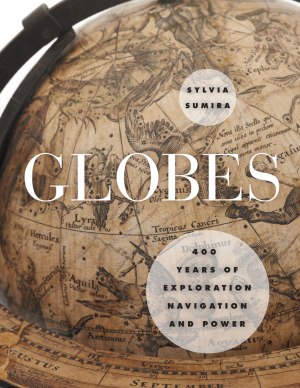 The concept of the earth as a sphere has been around for centuries, emerging around the time of Pythagoras in the sixth century BC, and eventually becoming dominant as other thinkers of the ancient world, including Plato and Aristotle, accepted the idea. The first record of an actual globe being made is found in verse, written by the poet Aratus of Soli, who describes a celestial sphere of the stars by Greek astronomer Eudoxus of Cnidus (ca. 408–355 BC). The oldest surviving globe—a celestial globe held up by Atlas’s shoulders—dates back to 150 AD, but in the West, globes were not made again for about a thousand years. It was not until the fifteenth century that terrestrial globes gained importance, culminating when German geographer Martin Behaim created what is thought to be the oldest surviving terrestrial globe. In Globes: 400 Years of Exploration, Navigation, and Power, Sylvia Sumira, beginning with Behaim’s globe, offers a authoritative and striking illustrated history of the subsequent four hundred years of globe making.
Showcasing the impressive collection of globes held by the British Library, Sumira traces the inception and progression of globes during the period in which they were most widely used—from the late fifteenth century to the late nineteenth century—shedding light on their purpose, function, influence, and manufacture, as well as the cartographers, printers, and instrument makers who created them. She takes readers on a chronological journey around the world to examine a wide variety of globes, from those of the Renaissance that demonstrated a renewed interest in classical thinkers; to those of James Wilson, the first successful commercial globe maker in America; to those mass-produced in Boston and New York beginning in the 1800s. Along the way, Sumira not only details the historical significance of each globe, but also pays special attention to their materials and methods of manufacture and how these evolved over the centuries.
Sylvia Sumira is a leading authority on historic globes and one of few conservators in the world to specialize in printed globes. She worked at the National Maritime Museum, Greenwich before setting up her own studio, where she carries out conservation work for museums, libraries, and other institutions, as well as for private owners. She lives in London.
Exhibition | The Three Graces of Antonio Canova

From the Canova Museum:
Le Grazie di Antonio Canova
Museo e Gipsoteca Antonio Canova, Possagno, 6 December 2013 — 4 May 2014
Canova le ha interpretate in due esemplari, molto simili. Il primo, ora all’Ermitage di San Pietroburgo, glielo commissionò Josephine de Beauharnais, all’epoca moglie di Napoleone; il secondo al Duca di Bedford che, visto il gesso che lo scultore teneva nel suo atelier romano, lo supplicò di creargli un ulteriore esemplare in marmo. Canova riprese il modello, apportando piccoli cambiamenti e, quasi per allontanare il momento di distacco dall’opera, l’accompagnò personalmente sino alla nuova dimora inglese. Oggi quel magnifico marmo è equamente suddiviso, sette anni ciascuno, dalla National Gallery of Scotland di Edimburgo e dal Victoria & Albert Museum di Londra.
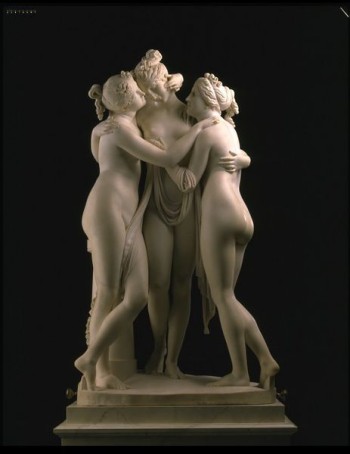
Antonio Canova, The Three Graces (London: V&A)
Dall’inizio di quelle vicende sono passati esattamente due secoli: il modello originale in gesso delle Grazie è infatti datato 1813. In questi due secoli la fama delle tre bellezze canoviane è diventata universale. La sinuosità delle forme femminili, la delicatezza e la morbidezza nonché la ricercata levigatezza del marmo determinano un gioco di luci ed ombre che affascinano chiunque le ammiri.
Nella sua Casa-Museo, nella natia Possagno, Canova lasciò il gesso originale della prima versione delle Grazie, quel gesso su cui aveva lavorato per creare il suo capolavoro. La levigatezza del marmo finale era qui ricreata da una patina in cera d’api. A Possagno giunse anche il gesso tratto dalle Grazie inglesi, quale documento da conservare a perenne memoria dell’arte del grande scultore.
Grazia e violenza non vanno d’accordo. Lo conferma, se ce ne fosse bisogno, il destino dei due capolavori del Canova. I gessi, con altre opere conservate nella Gipsoteca vennero investiti dalla nuvola di calcinacci causata dai cannoneggiamenti austroungarici durante la Prima Grande Guerra, quando Possagno, ai piedi del Grappa, era zona di battaglia. Particolarmente gravi i danni subiti dal gruppo “inglese” che vide le Grazie ritrovarsi con volti e busti drammaticamente lesionati. All’indomani del conflitto, Stefano e Siro Serafin, custodi e abilissimi restauratori, sanarono molti dei danni. Non agirono invece sulle Grazie di Bedfod che, deturpate trovarono sede nella sala del consiglio comunale di Possagno, a stridente ricordo di un guerra terribile per il paese. Il secondo gruppo di Grazie, restaurato è esposto nell’Ala Scarpiana della Gipsoteca.
A cent’anni dallo scoppio della Grande Guerra, mentre l’Europa si appresta a ricordare quel centenario, anche le Grazie “inglesi” risorgono, ritrovando tutte le loro parti. Quello che i Serafin non si sentirono di fare lo consente ora la tecnologia.
Grazie alla collaborazione delle National Galleries of Scotland, di Edinburgo, proprietari del prezioso marmo, è stato possibile fotografare e scansionare l’opera e grazie all’elettronica si è riusciti a ricomporre le parti mancanti al gesso di Possagno.
“Se Canova avesse lasciato sul marmo una sola impronta digitale, la ritroveremmo sul gesso restaurato”. Ad affermarlo è Mario Guderzo Direttore del Museo e Gipsoteca Antonio Canova di Possagno che, con Ugo Soragni, Direttore Regione per i Beni Culturali, Giuseppe Pavanello, dell’Università di Trieste e Direttore del Centro Studi Canoviani di Possagno, Marica Mercalli, Soprintendente per i Beni Storici e Artistici ed Etnoantropologici per le Province di Venezia, Padova, Belluno e Treviso e Aidan Weston Lewis, dello Scottish National Gallery di Edinburgo, Guancarlo Cunial della Gipsoteca di Possagno, componenti dell Comitato Scientifico della mostra. A dire dell’incredibile grado di perfezione raggiunto da questa tecnica, che aveva già dato prova di sé per un altro gesso di Canova, la Danzatrice, anch’essa deturpata dalla guerra, che ha ritrovato braccia e cembali.
In mostra, dal 7 dicembre al 4 maggio, si potranno ammirare entrambi gruppi delle Grazie, quello “russo”, e quello “inglese” così recuperato. Con i gessi, i due bozzetti, l’uno proveniente dal Museo di Lione, il secondo oggi di proprietà del Museo di Bassano. Poi tempere, disegni, incisioni, sempre intono al tema delle Grazie.
Mostra nella mostra è l’esposizione delle crude immagini della Gipstoteca e dei Gessi di Canova all’indomani dei bombardamenti: immagini concesse da due archivi pubblici, drammatiche nella volontà di costituire una precisa documentazione di un orrore.
“Questa mostra, afferma il Presidente della Fondazione Canova, Giancarlo Galan, sarà un’ulteriore conferma della centralità del patrimonio canoviano conservato gelosamente a Possagno e ne sottolineerà l’impegno espresso in termini di tutela e valorizzazione delle opere. Rimane fondamentale per la Storia dell’arte quanto Canova ha voluto lasciare alla sua terra facendola, così, diventare il centro mondiale dell’arte del grande Scultore.
New Book | Mimesis Across Empires
From Duke UP:
Natasha Eaton, Mimesis across Empires: Artworks and Networks in India, 1765–1860 (Durham: Duke University Press, 2013), 352 pages, ISBN: 978-0822354802, $30.
 In Mimesis Across Empires, Natasha Eaton examines the interactions, attachments, and crossings between the visual cultures of the Mughal and British Empires during the formative period of British imperial rule in India. Eaton explores how the aesthetics of Mughal ‘vernacular’ art and British ‘realist’ art mutually informed one another to create a hybrid visual economy. By tracing the exchange of objects and ideas—between Mughal artists and British collectors, British artists and Indian subjects, and Indian elites and British artists—she shows how Mughal artists influenced British conceptions of their art, their empire, and themselves, even as European art gave Indian painters a new visual vocabulary with which to critique colonial politics and aesthetics. By placing her analysis of visual culture in relation to other cultural encounters—ethnographic, legislative, diplomatic—Eaton uncovers deeper intimacies and hostilities between
the colonizer and the colonized, linking artistic mimesis to the larger colonial
project in India.
Natasha Eaton is a Lecturer in the History of Art at University College London.
◊ ◊ ◊ ◊ ◊
C O N T E N T S
List of Illustrations
Acknowledgments
Introduction
1. Colonizing the Exotic: Indian and Colonial Art in London
2. The Mirroring of Mirrors: Nostalgia, Sovereignty, and Unhomely Images in Calcutta
3. Mimicking Kingship: Sovereign Genealogies, Vernacular Landscape, and the Work of William Hodges
4. Art and Gift in India: Mimesis and Inalienability
5. Sacrifice and the Double: Physiognomy, Divination, and Ethnographic Art in India
Conclusion
Notes
Works Cited
Index
New Book | Colour, Art, and Empire
From Macmillan:
Natasha Eaton, Colour, Art, and Empire: Visual Culture and the Nomadism of Representation (London: I. B. Tauris, 2013), 416 pages, ISBN: 978-1780765198, $105.
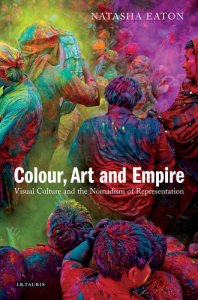 Colour, Art and Empire explores the entanglements of visual culture, enchanted technologies, waste, revolution, resistance and otherness. The materiality of color offers a critical and timely force-field for approaching afresh debates on colonialism. Located at the thresholds of nomenclature, imitation, mimesis and affect, this book analyses the formation of color and politics as qualitative overspill. Here color can be viewed both as central and supplemental to early photography, the totem, alchemy, tantra and mysticism. From the 18th-century Austrian empress Maria Theresa, to Rabindranath Tagore and Gandhi, to 1970s Bollywood, color makes us adjust our take on the politics of the human sensorium as defamiliarizing and disorienting.
Color wreaks havoc with western expectations of biological determinism, objectivity and eugenics. Beyond the cracks of such discursive practice, color becomes a sentient and nomadic retort to be pitted against a perceived colonial hegemony. Its alter materiality’s and ideological reinvention as a resource for independence struggles, makes color fundamental to multivalent genealogies of artistic and political action and their relevance to the present.
Natasha Eaton is a Lecturer in the History of Art at University College London.
◊ ◊ ◊ ◊ ◊
C O N T E N T S
1. Introduction: Chromo Zones and the Nomadism of Colour
2. Alchemy, Painting and Revolution in India, 1750–1860
3. Supplement, Subaltern Art, Design and Dyeing in Britain and South Asia, 1851–1905
4. Part 1: Still Dreaming of the Blue Flower? Race, Anthropology and the Colour Sense
5. Part 2: Creole Laboratory: Anthropology and Affect in the Torres Strait
6. Swadeshi Colour Throughout the Philtre/Filter of Indian Nationalism, 1905–1947
Exhibition | Baroque Paintings from the Francesco Molinari Collection
From the Uffizi:
Rooms of the Muses: Baroque Paintings from the Francesco Molinari Collection
Uffizi, Florence, 11 February — 11 May 2014

Carlo Magini, Still-life with Vegetables, Bread, Calf’s Head, and Kitchen Utensils, ca. 1760–1800
The Molinari Pradelli private collection is internationally renown and the most important formed in Bologna in the twentieth century. The famed orchestra conductor Francesco Molinari Pradelli (1911–1996) traveled all over the world during his professional career and loved collecting high quality works of art.
With over 100 paintings from the collection, the Uffizi Gallery pays homage to a prestigious conductor who worked in Florence at the helm of the Maggio Musicale Fiorentino and at the Teatro Comunale. The conductor had success all over the world, in Europe and America, from Vienna to San Francisco to New York’s Metropolitan Opera. His growing passion for collecting paintings started in the 1950s, first with nineteenth-century works and then discovering Baroque painting. He developed an attraction for still-lifes, a genre just beginning to garner interested from scholars. Great art historians from Europe and America came to admire the maestro’s large private collection of seventeenth- and eighteenth-century painting from various Italian schools and the particular attention for models.










 Enfilade
leave a comment