Call for Papers | CAA in New York, 2015
The following selection of panels may be of interest for scholars of the eighteenth century, though readers are encouraged to consult the full Call for Participation. HECAA members are asked to pay special attention to two sessions: 1) a commemorative panel for Donald Posner chaired by Andria Derstine and Rena Hoisington and 2) a new scholars workshop led by Jennifer Milam (details for the latter will follow soon). –CH
◊ ◊ ◊ ◊ ◊
103rd Annual Conference of the College Art Association
New York, 11–14 February 2015
Proposals due by 9 May 2014
The 2015 Call for Participation for the 103rd Annual Conference, taking place February 11–14 in New York, describes many of next year’s sessions. CAA and the session chairs invite your participation: please follow the instructions in the booklet to submit a proposal for a paper or presentation. This publication also includes a call for Poster Session proposals.
◊ ◊ ◊ ◊ ◊
Donald Posner and the Study of Seventeenth- and Eighteenth-Century French and Italian Art
Andria Derstine, Allen Memorial Art Museum, Oberlin College; Rena M. Hoisington, Baltimore Museum of Art, Andria.Derstine@oberlin.edu and RHoisington@artbma.org
Donald Posner (1931–2005), the Ailsa Mellon Bruce Professor of Fine Arts at the Institute of Fine Arts, New York University, was one of a select group of art historians who, beginning in the 1950s and 1960s, significantly advanced scholarly inquiry into the Italian and French Baroque. From his first published article, on Le Brun’s Triumphs of Alexander series (1959), to his work on Annibale Carracci, Caravaggio, Domenichino, Lanfranco, Callot, and Poussin, his work helped to initiate and direct future research in the field. In the late 1960s and early 1970s, he began to turn his attention toward the eighteenth century—then a notably understudied area. His publications on Watteau, Fragonard, Boucher, Tiepolo, Rigaud, and Nattier set standards for art historical scholarship and greatly contributed to the burgeoning interest in this ‘new’ century. As wide-ranging as the topics he took up was his critical method, encompassing connoisseurship, patronage and collecting, iconography, stylistic issues, taste, and aesthetics, among others. Posner promoted and encouraged research and publication over the course of his long career, and served CAA as Editor-in-Chief of The Art Bulletin from 1968 to 1971 and as Chairman of The Art Bulletin Editorial Board from 1991 to 1994. Ten years after his death, this panel celebrates Posner’s rich legacy by inviting papers that take up particular areas of his field of inquiry and present new information, or that are stimulated by his scholarship and relate to his broad interests.
◊ ◊ ◊ ◊ ◊
Artistic Exchange between the Spanish and British Empires, 1550–1900
Michael A. Brown, The San Diego Museum of Art; and
Niria E. Leyva-Gutiérrez, Long Island University C.W. Post Campus, michael.alexander.brown92@gmail.com and Niria.Leyva-Gutierrez@liu.edu
This session will focus on the vibrant cultural, political, and economic connections between early modern Spain and Britain and how these histories played out in their American colonies between the years 1550 and 1900. While recent exhibitions and publications have examined the compelling rivalry between the two empires, the nature of artistic exchange between England and Spain and how it unfolded in the Americas is a topic that has received scant scholarly attention. Papers should address any aspect of artistic exchange between Spain and England in North and South America and the Caribbean. We encourage proposals with an interdisciplinary, global purview. Emerging and early career scholars are especially welcome to submit proposals.
◊ ◊ ◊ ◊ ◊
Remaking the American Gallery
Sharon Corwin, Colby College Museum of Art, scorwin@colby.edu
In recent years major museums across the United States have been opening and reopening galleries devoted to American art, from the National Gallery of Art (2009) and the Museum of Fine Arts Boston (2010) to the Crystal Bridges Museum of American Art (2012) and the Colby College Museum of Art (2013). This session invites speakers to reflect on these efforts to remake the “American gallery” and specifically examine the kinds of histories of American art that museums are putting on display. How are those histories being (re)constructed in the twenty-first century? What work are they doing for particular institutions, collectors, curators, scholars, students, and museum visitors? In what ways are new museum installations reinforcing and challenging the parameters (or the very notion) of the American canon? Speakers may explore such questions through contemporary case studies; interpretive surveys of historiography, criticism, and institutional practices; or creative proposals to remake an American gallery.
◊ ◊ ◊ ◊ ◊
Rethinking American Art and the Italian Experience, 1760–1918
Melissa Dabakis, Kenyon College; and Paul Kaplan, Purchase College, State University of New York, dabakis@ kenyon.edu and paul.kaplan@purchase.edu
This session will focus on Italy as a key destination for Americans between the years 1760 and 1918. Examining the ways in which artists engaged the social, political, and aesthetic life of the Italian peninsula, papers should expand the ground upon which visual imagery has been understood by situating it within the dynamic process of transatlantic exchange. This panel seeks papers that offer new avenues of study by locating and analyzing the hybrid aesthetic practices that developed from encounters with Italian cultural traditions. How did American artists adopt, transform, and even translate modern Italian beliefs and aesthetic practices in their own artwork? How did the categories of gender, race, and religion inform artistic production across national boundaries? How were these artists and artworks received by Italian and American critics? We especially invite Italian scholars with research interests in transatlantic exchange and expatriate studies to submit paper proposals.
◊ ◊ ◊ ◊ ◊
Making and Being Made: Visual Representation and/of Citizenship
Corey Dzenko, University of North Carolina, Greensboro; and Theresa Avila, independent scholar, cjdzenko@gmail.com and sahibah@hotmail.com
Traditionally defined by an individual’s membership and level of participation within a community, “citizenship” results in access to benefits or rights, as described by scholars such as Eric Hobsbawm. Yet citizenship moves beyond political framings. According to Aiwha Ong, cultural citizenship is a “dual process of self-making and being-made” but done so “within webs of power linked to the nation-state and civil society.” Taking citizenship as a political position, cultural process, and intertwining of both, this panel examines the role of art and visual culture in reflecting, confirming, or challenging ideals of citizenship across historical periods and media. We seek proposals that engage with the questions: How does citizenship inform artistic and visual practices? And how do images inform citizenship? Topics may include but are not limited to nation building, civic practices, transnationalism, civil rights, politics of identity, labor, border zones, affects of belonging, and activism.
◊ ◊ ◊ ◊ ◊
The Art of Travel: People and Things in Motion in the Early Modern Mediterranean
Elisabeth Fraser, University of South Florida, fraser@usf.edu
For centuries artists, diplomats (ambassadors, consuls, and interpreters), and merchants served as cultural intermediaries in the Mediterranean. Stationed in port cities and other entrepôts of the Mediterranean, these go-betweens forged intercultural connections even as they negotiated and sometimes promoted cultural misunderstandings. They also moved objects of all kinds across time and space. Focusing on the early modern period from roughly 1600 to 1850, this session will consider how the mobility of art is intertwined with diplomatic and trade networks in the international arena of the Mediterranean. With the theorist Arjun Appadurai, we consider “ways in which people find value in things and things give value to social relations,” investigating analogies and relationships between the work performed by artists, diplomats, and merchants. How does the work of art participate in, foster, or resemble diplomatic negotiation or commercial exchange? Papers investigating any aspect of visual and material culture are welcome.
◊ ◊ ◊ ◊ ◊
Shifting Sands: ‘Ancient’ Art and the Art Historical Canon
Amy Gansell, St. John’s University; and Ann Shafer, Rutgers University, gansella@stjohns.edu and ann.shafer@rutgers.edu
This session critiques the art-historical canon by investigating the terminology “ancient” across cultural boundaries. We define a “canon” as an established list of sites, monuments, and objects considered most representative of a tradition. Although the current canon has evolved to include global cultures, outmoded periodizations linger. When, how, and why did ancient art become canonized as such? We aim to take stock of the viability of our present criteria for classifying art as ancient, to investigate how regional subcanons of ancient material have developed, and to explore the impact of discovery, exhibition, and publication. Considering future frameworks of conceptualization, how might ancient art be situated within the global perspective? When issues of authenticity, provenance, and loss arise, should the canon preserve the memory? We welcome contributions from scholars of any period or culture, artists, publishers, and museum professionals whose work transforms the very concept of ancient art in the art-historical canon today.
◊ ◊ ◊ ◊ ◊
White People: The Image of the European in Non-Western Art during the ‘Age of Exploration’, 1400–1750
James Harper and Philip Scher, University of Oregon, harperj@uoregon.edu and pscher@uoregon.edu
How did the rest of the world see Europeans during the so- called Age of Exploration? This session focuses on images of “Westerners” dating from the onset of European expansion to the beginning of the industrial period. While much has been written about Western images of Europe’s others, this session reverses the direction of the gaze, consider ing the African, Asian, Pacific Islander, and Native North or South American as the makers and the European as the object. Whether their exposure to Europeans was fleeting or sustained, first- or secondhand, artists and artisans around the world distilled their impressions of the encounter into images of foreign soldiers, sailors, merchants, missionaries, explorers, and colonists. Culturally specific, these often tell as much about the makers as they do about those they depicted. Papers are invited from a variety of cultural traditions, and interdisciplinary approaches are encouraged.
◊ ◊ ◊ ◊ ◊
Skeuomorphic: The Skeuomorph from the Acropolis to iOS
Nicholas Herman, The Courtauld Institute of Art; and Sarah M. Guérin, Université de Montréal, nicholas.herman@courtauld.ac.uk and s.guerin@umontreal.ca
A skeuomorph, from Greek σκεῦος (vessel) and μορῦή (form), is an object that adopts essential structural features of its predecessor as ornament. While not strictly necessary, these features connect the new to the old, rendering an object recognizable or more palatable to its audience. Examples include stone modillions on Greek temples derived from the structural elements of wooden architecture; print- ed fonts resembling their handwritten antecedents; faux- wood paneling; and, most topically, touchscreen software that mimics the appearance of three-dimensional items such as notebooks, agendas, and clocks. At the intersection of ergonomics, historicism, and illusionism, the skeuomorph can be revealed as a frequent feature across many historical periods. This session seeks papers that consider instances of skeuomorphism from antiquity to the present, and solicits especially analyses that reach beyond descriptive categories to investigate the motivations, intentions, and ideologies behind seemingly redundant visual continuities that survive at times of technological change.
◊ ◊ ◊ ◊ ◊
Historic Preservation and Changing Architectural Function
Maile Hutterer, Rutgers, The State University of New Jersey, maile.hutterer@rutgers.edu
This session explores shifts in the visual and physical experience of premodern buildings and monuments as a consequence of their preservation, which intrinsically alters the way historians and visitors interact with those spaces. Sometimes this intervention comes in the form of fences or newly created parvis, and other times by means of changed accessibility, signage, or purpose. The session welcomes papers on subjects from all geographical locations. It seeks to understand more fully how structures operate as records that reflect changing social practice and how that social practice might be reconstructed. If the function of a monument changed, for what purpose was it adapted and was there any resulting amendment to the fabric? Does its preservation obscure or highlight the full range of activities for which it was used, and why or how might it do so? How do the theories and practices of architectural preservation and landmark status account for the intrinsically transformative nature of restoration and conservation?
◊ ◊ ◊ ◊ ◊
Architecture in Islamic Painting
Abdallah Kahil, Lebanese American University, Abdallah.kahil@lau.edu.lb
This session addresses the representation of architecture in Islamic painting. Architectural structures and decoration are often included in Islamic paintings from most periods; they form either an independent visual entity or sets for scenes. The forms and roles of architectural representations in Islamic painting stimulate various methodological and formal approaches. These include exploring spatial concepts and representations, relationships between the architectural representation and visual culture of a specific period or style, the relationship between physical architecture and painted architecture, the imaginative renderings of painters, the formulaic representation, and so on. The architectural decorations in these paintings are so varied and rich in details. Some of them may correspond to the decoration of existing buildings, and some may not. This session is open to exploring all aspects of architectural representation and architectural decoration within the painting, and between the painting and the physical world throughout the periods between thirteenth and eighteenth centuries.
◊ ◊ ◊ ◊ ◊
Unfolding the Enlightenment
Alyce Mahon, University of Cambridge; and
Nebahat Avcioglu, Hunter College, City University of New York, am414@cam.ac.uk and navciogl@hunter.cuny.edu
What was the value of the Enlightenment for the artist, and how have artists responded to it since? While the Enlightenment is a well-known critical and historical paradigm, associated with an established set of ideas and objects in art, literature, philosophy, and science, this panel asks how we might go beyond existing formulations by seeking to understand the Enlightenment in terms of the expression of flexibility and hybridity in noncanonical art forms such as costume albums, carnets de voyages, livres d’artiste, and performance art. From the late eighteenth century to the present day, artists have explored the Enlightenment and its legacy in various media and historical and geographical contexts. They have challenged and undermined its obsession with knowledge, truth, and classification and exploited its preoccupation with the relationship of ethics to aesthetics, the private to the public, art to the state, and the collector to the museum. We welcome proposals that ask what forms have been taken by these representations of the Enlightenment and its legacy, and what insights they have offered.
◊ ◊ ◊ ◊ ◊
Original Copies: Art and the Practice of Copying
Stephanie Porras, Tulane University, sporras@tulane.edu
Technologies of copying—printing, casting, digital duplication—have always engendered debates about artistic authorship and invention. Copying can be viewed as a debasement and as creative praxis. Albrecht Dürer complained about copyists but also advised young artists learning to draw to “copy the work of good masters until you attain a free hand.” Copying can also produce originality. Andy Warhol’s copies of Brillo Boxes expose this paradox, asking (in Arthur Danto’s words), “What is the difference between two things, exactly alike, one of which is art and one is not?” This session seeks papers addressing techniques and functions of artworks that copy other objects (drawings, prints, casts, rubbings, photographs) produced from the early modern period to today, as well as the legal, ethical, philosophical, and ontological issues embedded in copying. Covering a wide temporal and material range, the session aims to encourage a broader dialogue about the problematic status of the copy in the history of art.
◊ ◊ ◊ ◊ ◊
Art Historical Scholarship and Publishing in the Digital World
Emily Pugh, Center for Advanced Study in the Visual Arts, National Gallery of Art; and Petra Chu, Seton Hall University, emily@emilypugh.com and petra.chu@shu.edu
In recent years computing technologies have opened up new avenues of inquiry and new publishing formats for art-historical research. Yet these new opportunities are not without challenges and raise a number of questions. Do computer-based tools represent merely a more expedient way to answer existing art-historical research questions, or can they inspire art historians to ask (and answer) entirely new questions? What are the options available for publishing new kinds of scholarly data (datasets, three-dimensional images)? What about copyright? And funding? Are there models for best practices for collaborative projects or for working with technical specialists? What are the implications of such approaches for peer review and tenure? Scholars who have used computing technology in their research and publishing are invited to join this panel to discuss their approaches and practices, to analyze what has worked or has not, and in the process to answer some of the questions raised above.
◊ ◊ ◊ ◊ ◊
What Have You Done for Art History Lately? Initiatives for the Future of a Discipline
Karen J. Leader, Florida Atlantic University; and Amy K. Hamlin, St. Catherine University, karen.leader@nyu.edu and akh218@nyu.edu
This session emerges out of the so-called crisis in the humanities, and our objective is to change the conversation toward constructive engagement, using art history as a platform. This Open Forms session will showcase eight to ten initiatives. Examples might include projects that promote positive outcomes in the political and employment arena, classroom innovations that rejuvenate the discipline for a twenty-first-century audience, museum practices that capture the centrality of the physical en- counter with the object in the digital age, or ideas that embrace crowdsourcing or collective activity. This session will represent the outcome of our multiyear, multiplatform project to partner with current and former CAA officers, CAA-affiliated committees and caucuses, and other art professionals. We invite proposals for short presentations on results-oriented initiatives that are concrete vs. anecdotal and that are grounded in best practices. A project website more thoroughly describes our vision: https:// sites.google.com/site/arthistorythat/.
◊ ◊ ◊ ◊ ◊
Performative Architecture before the Modern Era
Wei-Cheng Lin, University of North Carolina at Chapel Hill, wclin@email.unc.edu
When speaking of how art engages viewers, one is already considering its performative potential as an active agent in shaping and mediating the world. This panel seeks more specifically to explore architecture’s performativity, not as the structural frame of a theater, so to speak, but as the construction of a theatrical space as well as an essential component of the performance, before it was built with modern technologies. Recent research in architecture has already turned our attention less to what it looks like than what it does, thus shifting our focus to experience rather than interpretation of architecture, asking how it acts upon the beholder and transforms the perceived reality. We are chiefly interested in how architecture creates or provokes synesthetic and kinesthetic experience, and how architecture orchestrates the built environment in such a way that it, for example, performs the sacred, enacts memories, elicits desire, commands authority, and produces social drama.
◊ ◊ ◊ ◊ ◊
Guerilla Approaches to the Decorative Arts and Design
Haneen Rabie, Princeton University; and Catherine Whalen, Bard Graduate Center, hrabie@princeton.edu and whalen@bgc.bard.edu
The methodological conventions of art-historical practice remain inadequate for a thorough appreciation of objects classed as decorative art and design. In a broad “material turn,” researchers in a diverse array of academic fields have begun to consider such objects and proffer alternative frameworks for their study. This panel seeks to move the decorative arts and design further toward the center of our own field with rich, rigorously analytical, multidisciplinary studies that treat them as both document and text, material and abstracted, evidentiary and productive of meaning. The organizers encourage “guerilla” approaches that strategically deploy extradisciplinary analytical tools as needed. We welcome submissions from scholars at all levels whose papers focus on decorative art and design while demonstrating thoughtfully derived theoretical, methodological, and interpretive models.
◊ ◊ ◊ ◊ ◊
Techniques of Reversal
Jennifer L. Roberts and David Pullins, Harvard University, roberts6@fas.harvard.edu and pullins@fas.harvard.edu
This panel explores reversal as a generative operation across a wide range of media, geography, and historical contexts including printmaking, casting, counterproofing, and photography. While art historians have often assumed that a technical understanding of these processes is sufficient, this panel aims to elucidate how basic physical operations that demand an understanding of an image and its inverse might inform more abstract modes of thinking. How is reversal inherent to processes of reproduction and of conceptualizing images in three dimensions? How might formal solutions result from material and technological change? How might “negative intelligence” embody broader cultural beliefs and ideas or engage with problems of symmetry, bodily orientation, and oppositionality? We hope to explore the perspectives of both makers and viewers. And while we seek to highlight historical and geographic breadth and diversity of media (including such traditionally under- interrogated forms as marquetry, metalwork, or weaving), contextual specificity will also be crucial, notably in relation to materials and technology.
◊ ◊ ◊ ◊ ◊
Global Baroques: Shared Artistic Sensibilities in the Seventeenth and Eighteenth Centuries
Ünver Rüstem, Columbia University, ur2124@columbia.edu
Arguably the first truly global artistic style, the Baroque achieved extraordinary reach during the seventeenth and eighteenth centuries, spreading far beyond its original European context. Little regard, however, has been paid to non-Western aspects of the Baroque outside the colonial framework, despite the style’s manifest impact on regions such as the Ottoman Empire, Iran, India, and China. This session explores the Baroque’s global dimensions in a manner commensurate with the phenomenon itself, encompassing topics and geographies that fall outside the field’s traditional purview. Contributions are invited from scholars concerned with all global expressions of Baroque art and architecture, including Europeanists engaged in cross-cultural perspectives. Relevant topics include the Baroque as an international aesthetic of power; the roles of trade, export, and travel in spreading the style; the meaningfulness or otherwise of Baroque ornament in its global iterations; Orientalism, Occidentalism, and cultural appropriation in the Baroque; and the intellectual and conceptual factors behind the style’s worldwide success.
◊ ◊ ◊ ◊ ◊
Composite Art in the Colonies of Europe: Stealing, Smiting, Enshrining, Erasing, Recarving, and Recontextualizing
Kaylee Spencer, University of Wisconsin-River Falls; and Linnea Wren, Gustavus Adolphus College, kaylee. spencer@uwrf.edu and lwren@gustavus.edu
The term spolia, which derives from the Latin word for “spoils” of war, refers to architectural and sculptural materi- als reused in new monuments, thus creating composite works of art. This panel focuses on spoliated works of art that came into being through the encounter of Europe with the broader world during the Colonial era. What meanings were transferred from Europe to territories on other continents? To what extent was spoliation motivated by pragmatic necessities? How was the materiality of spolia understood by both colonizer and colonized? What potentials for propaganda, imperialism, compliance, or resistance existed in spoliated forms? How did spolia function in the rapidly shifting visual cultures of colonized territories? How do discussions of spoliation in colonial contexts inform dialogues surrounding art criticism today? To engender dialogues about these types of questions, we seek papers of geographic breadth between 1400 CE and the present.
◊ ◊ ◊ ◊ ◊
The Global History of Design and Material Culture
Paul Stirton, Bard Graduate Center, Stirton@bgc.bard.edu
In recent years, the “global history of art” has become a familiar theme in teaching and research, but the global history of design and the decorative arts remains a formidable prospect. As histories of design, craft, and material culture find a wider application in colleges, this session will address the problems of teaching at undergraduate and graduate level, seeking to confront both practical and theoretical questions: how to expand the canon and yet retain some degree of coherence to the field; the lack of introductory tools for teaching particular regions or subject areas; the problems of Eurocentrism; the separation of “indigenous” and “colonial” studies in the Americas; disciplinary boundaries between design, craft, decorative arts, and material culture; also the boundaries between art and design historians, anthropologists, and archaeologists; questioning the role of the survey as a pedagogical method. Papers may consider topics from any period or region, but should aim to highlight underlying conceptual, methodological, or pedagogical problems that relate to the larger histories of design and material culture.
◊ ◊ ◊ ◊ ◊
Early Modern Cross-Cultural Conversions
Claudia Swan, Northwestern University; and
Bronwen Wilson, University of East Anglia, c-swan@northwestern.edu and bronwen.wilson@me.com
The mobility of people, things, and forms of knowledge between Islamic and European lands in the early modern world, and the intriguing ways in which artifacts activated conversations and creativity across geographical boundaries, have been the focus of much recent scholarly attention. This session seeks contributions concerning early modern cross-cultural and transregional conversions, transformations, and metamorphoses. Cross-cultural interaction has a long history, and one premise of this session is that societies and cultures are always already entangled. By using the terms “conversions,” “transformations,” and “metamorphoses,” then, instead of “encounters” or “exchanges,” this session shifts the focus away from categories of identity, otherness, and hybridity to explore the potential for creativity and imagination—for reorientations of material and pictorial forms—that are opened up by cross-cultural interplay. We seek papers that explore, for example, how forms and ideas were transformed or underwent conversion, and how disorientation, temporality, and concerns with religion manifested in visual and material forms. How might such forms allow us to rethink art-historical categories such as periodization and style?
◊ ◊ ◊ ◊ ◊
The Period of the Period Room: Past or Present?
Elizabeth A. Williams, Rhode Island School of Design Museum, eawilliams@risd.edu
In 1904 Charles L. Pendleton bequeathed his collection of decorative arts to the Rhode Island School of Design (RISD), and in 1906 RISD opened Pendleton House, the country’s first muse- um wing dedicated to the display of American decorative arts. Built to replicate Pendleton’s 1799 house in Providence with eight contextualized period rooms, Pendleton House is ripe for reassessment after nearly 110 years of existence. Yet, among the myriad options of reconsidered interpretation and display, which is the most engaging, the most educational, and the most accurate? What criteria must a period room achieve to be deemed authentic and worthy? This session will rigorously explore and debate the viability of the contextualized period room within the environment of a museum, historical property, or other public institutions and venues. Papers addressing the complex issues of contextualized period installations with innovative approaches, theory, research, and experience from all perspectives are welcome.
◊ ◊ ◊ ◊ ◊
Note (added 14 April 2014) — The original version of the posting referenced the HECAA-sponsored Posner session but did not include the full description.
Exhibition | Etruscan Enchantment
From Holkham Hall:
Etruscan Enchantment: From the Secrets of Holkham Hall to the Wonders of the British Museum
Seduzione Etrusca: Dai Segreti di Holkham Hall alle Meraviglie del British Museum
Museo dell’Accademia Etrusca e della Città di Cortona, Palazzo Casali, Cortona, 22 March — 31 July 2014
◊ ◊ ◊ ◊ ◊
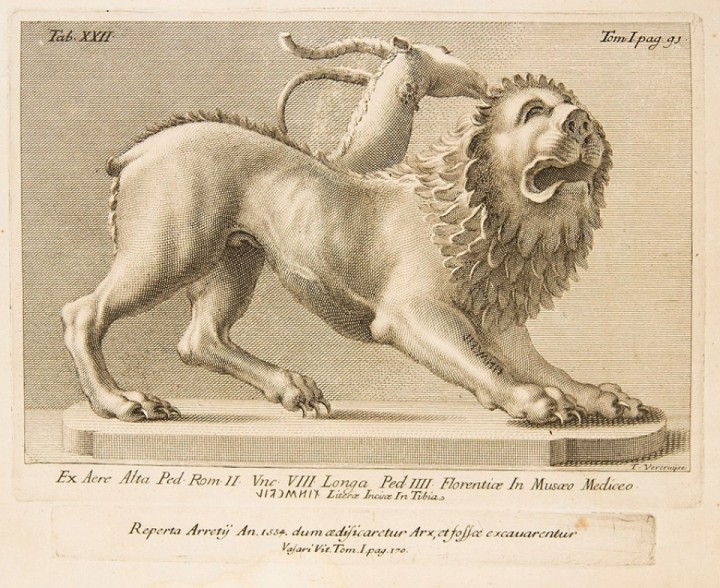
2014 will see Holkham Hall’s largest international collaboration since the eighteenth century. From March to July, the MAEC (Museo dell’Accademia Etrusca e della Città di Cortona) in Cortona, Tuscany, will host an exhibition of sculpture, paintings, prints, drawings and manuscripts drawn from the Uffizi museums in Florence, the Vatican Museums, the British Museum in London, and Holkham Hall.
 The exhibition, which will run from 22nd March to 31st July, centres on a moment of crucial importance in the history of archaeology and of Tuscany itself, that is the publication of Thomas Dempster’s De Etruria regali (On Royal Tuscany) in Florence in 1723 and 1726. The publication was entirely funded by the young Thomas Coke, the builder of Holkham Hall, and led to the foundation in 1727 of one of most important learned societies in Italy, the Accademia Etrusca. Since its beginnings, the Accademia has been housed in the medieval Palazzo Casali in Cortona, now the home of the MAEC itself.
Thomas Dempster (1579–1635) was an impoverished Scottish nobleman who taught at universities throughout Europe, and ended his career as Professor of Humanities in Bologna. Between 1616 and 1619, he compiled the De Etruria Regali, a monumental history of the Etruscan (broadly, Tuscan) people, the very first attempt to demonstrate the existence of a highly developed civilisation in Italy before the Romans. The work remained unpublished in Dempster’s lifetime, and survived in only one copy, in his own handwriting. This unique manuscript copy was purchased for Thomas Coke by his Grand Tour tutor-governor, Thomas Hobart, in July 1719, from the Florentine scholar Anton Maria Salvini, at a price of eleven guineas. It is still in the library at Holkham Hall, as MS 501.
Thomas Coke returned the manuscript to Florence and paid for the publication of work at a cost of over 2,000 Florentine scudi. Under the supervision of the antiquarian Senator Filippo Buonarotti, whom Coke and Hobart had visited several times while they were in Italy, a substantial programme of illustration was added to the printed edition. For the first time, a work of ancient history was based on the evidence of surviving artefacts and objects rather than on written sources, laying the foundations for modern archaeology. The printed volumes were dedicated to the Grand Dukes of Tuscany, whose dynasty was traced in the text back to the Etruscans themselves! The frontispiece to volume 2 is a portrait of Grand Duke Gian Gastone de’ Medici. He was the last of the line, and on his death in 1737, the family who had dominated Tuscany for centuries died out.
The importance of Coke’s role was only fully understood in 2007 with the discovery at Holkham by Dr Suzanne Reynolds of the accounts for the production process, documenting payments to the artists, engravers, and editors who worked on the project. These documents will be on display in the exhibition, along with the autograph manuscript of the text. Also on display will be the original drawings and copper plates for the illustrations which were discovered in the attics at Holkham by the 5th Earl of Leicester in 1964. The drawings were in the original leather wallet in which they had been sent back to England from Italy after publication.
Some three hundred years after Thomas Coke first arrived in Italy in November 1713, Holkham is also lending paintings, drawings and manuscripts that attest to his passion for Italian history and art. Highlights include Procaccini’s Tarquinius and Lucretia, paintings and drawings by Claude and Vanvitelli, and some of the most beautifully illuminated medieval manuscripts of ancient history from the Holkham Library.
-Dr Suzanne Reynolds (Curator of Manuscripts and Printed Books, Holkham Hall) September 2013
At Auction | Indian and Islamic Art at Bonhams
From the Bonhams press release:
Bonhams Sale 21720 | Indian and Islamic Art
London, 8 April 2014
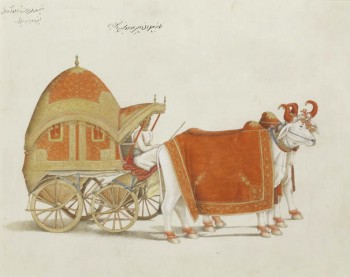
Lot 299: Painting from the Fraser Album of The Bullock-drawn Carriage of Prince Mirza Babur, Delhi, 1815–19
Bonhams will sell three stunning images from The Fraser Album, discovered amongst the papers of this Scottish family in 1979, at its next auction of Indian and Islamic art on April 8th in London. The Album consists of more than ninety watercolors of breathtaking quality, which provide an extraordinary portrait of life in and around Delhi in the early 19th century. This was an area which was relatively unknown to the British at that date, with Mughal control ceded to them only in 1803 and the Emperor nominally in power.
James Baillie Fraser (1783–1856) and his brother William (1784–1835) came from Inverness. William went to India aged 16 as a trainee political officer in the East India Company while James arrived a year later, taking a commercial position in Calcutta. James, a talented artist himself, published collections of views of the Himalayas and of Calcutta.
When James joined William in Delhi in 1815 the two brothers commissioned local artists to depict servants, tradesmen and figures from the irregular military units, some of which were employed by the British, including Gurkha soldiers and the colourfully-attired troopers of bodies such as Skinner’s Horse. More than one artist was employed on the paintings which go to make up the album. The best examples are usually attributed to Ghulam Ali Khan, but it is likely that the rest were produced by other members of his family. The works date between 1815 and 1820. The two lots in the present sale capture the richness of ceremonial life in Delhi, and are also representative of the British fascination with types of transport and servants which appears in other more typical examples of Company School painting.
The first image is of an elephant and driver, probably from the Mughal Emperor’s stable, with a hunting howdah equipped with a rifle, bows and a pistol, from Delhi or Northern India, 1815–19 (estimate £20,000–30,000).
The second Fraser Album image is of the bullock-drawn carriage of Prince Mirza Babur, Delhi or Northern India, 1815–19 (estimate £20,000–30,000). The inscriptions read: ‘The special chariot of the son of the spiritual preceptor of the horizons (Murshidzada-i afaq), Mirza Babur Bahadur’. The honorific title refers to Mirza Babur’s father, the Mughal Emperor Bahadur Shah II, in his role as a Sufi spiritual leader.
The third image is that of a cotton-carder at work, attributed to the artist Ghulam ‘Ali Khan (fl. 1817–55) Delhi, circa 1820 (estimate £20,000–30,000). This detailed and technically accurate painting shows a captured moment from daily life. The action depicted is in fact strictly referred to as ‘bowing’, running the taut string of the bow across the pile of fibers to fluff up the cotton.
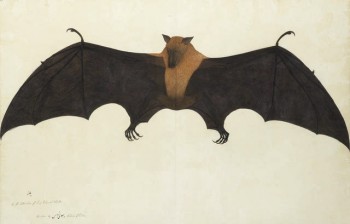
Lot 292: A painting by Bhawani Das from the Impey Album,
A Great Indian Fruit Bat, or Flying Fox (Pteropus giganteus),
Calcutta, ca 1778–82
Another important painting in this Bonhams sale of Indian and Islamic art is from the Impey Album, by the artist Bhawani Das: a Great Indian Fruit Bat, or Flying Fox (Pteropus giganteus) Calcutta, circa 1778–82. The Great Indian Fruit Bat, or Flying Fox, has a wingspan of 1.5 meters, well captured in this painting. This is a pen and ink, watercolor with gum arabic, heightened with bodycolour, on watermarked paper, inscribed at lower left In the Collection of Lady Impey at Calcutta/Painted by [in Persian in nasta’liq script, Bhawani Das] Native of Patna, (estimate £80,000–120,000).
Sir Elijah Impey was the East India Company’s Chief Justice of Bengal from 1774 to 1782. He was a well-known patron of Indian artists, but his wife, Mary, Lady Impey, who joined him in Calcutta in 1777, was particularly interested in the flora and fauna of the surrounding area, creating her own menagerie. She then commissioned studies of animals and plants from various artists from the nearby city of Patna, the most senior of whom were the Muslim Shaykh Zayn-al-Din, and the Hindus Ram Das and Bhawani Das, the painter of the present lot. The precision of these artists’ technique, which stemmed from the Mughal tradition, appealed to British patrons, and the technique and the subject-matter have become known as ‘Company School’. The series commissioned by Lady Impey (as well as others in a similar style by unknown artists) are particularly striking because of their large size, using sheets of English watermarked paper. There were 326 works in the original series, which were brought back to England with the Impeys in 1783, and were sold at Phillips (now Bonhams) in London in 1810.
◊ ◊ ◊ ◊ ◊
Note (added 10 April 2014) — The painting of the great Indian fruit bat sold for £458,500, four times its presale estimate. More information is available here»
ed to sell for £80,000-£120,000, but
Exhibition | Andreas Schlüter and Baroque Berlin
To mark the 300th anniversary of Andreas Schlüter’s death, the Bode-Museum mounts this exhibition:
Schloss Bau Meister: Andreas Schlüter and Baroque Berlin
Bode-Museum, Berlin, 4 April — 13 July 2014
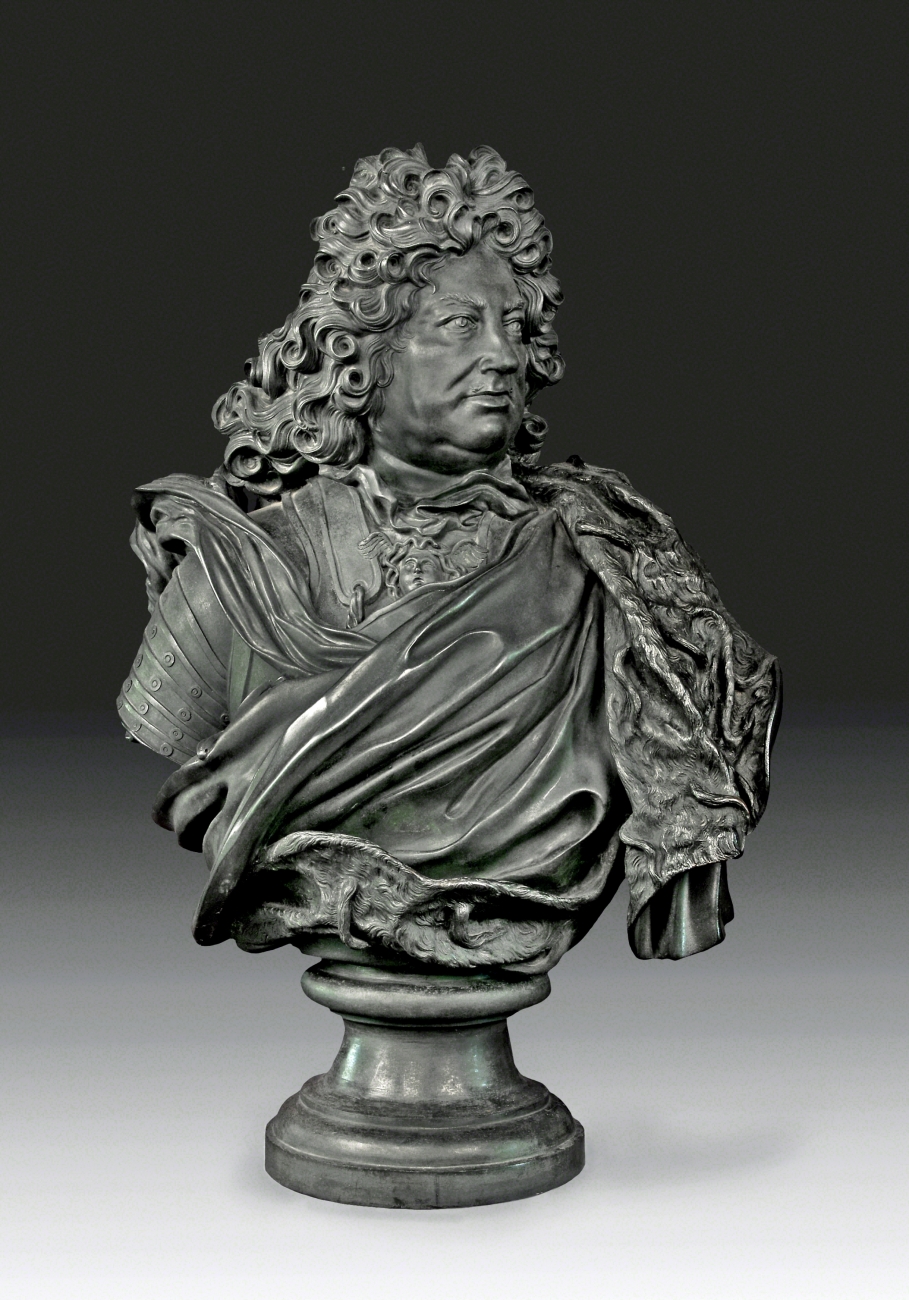
Bust of Landgrave Frederick II of Hesse Homburg, Berlin, 1701, bronze © Bad Homburg v. d. Höhe, Palace, Photo: Renate Deckers-Matzko
Andreas Schlüter (1659/60–1714) was a Baroque artist par excellence. Celebrated by his contemporaries as the ‘Michelangelo of the North’, Schlüter was not only a sculptor, but also an architect, town planner, and designer of magnificent interiors which were created to give lustre, for the first time, to the ambitious and emerging royal capital of Berlin. To commemorate the 300th anniversary of his death, the Bode-Museum is now holding the first ever major exhibition to be devoted to this important Berlin artist.
During the reign of Elector Friedrich III (from 1701 Friedrich I, ‘King in Prussia’), Schlüter was appointed official court sculptor and was entrusted with a variety of artistic roles in the Prussian capital, during a time when Prussia was emerging as a nascent new power.
This retrospective takes in all aspects of his multifaceted work and, enriched by numerous outstanding loans, recreates the opulent world that this creator of Baroque Berlin fashioned and inhabited. The exhibition in the Bode-Museum runs from 4 April until 13 July 2014 and is spread over a total of 16 galleries and side rooms. On display are not only Schlüter’s own works, but also those of the greatest role models of his time, including sculptures by such distinguished artists as Gian Lorenzo Bernini, Francesco Mochi, Francois Girardon, and Antoine Coysevox.
More information is available at the exhibition website.
◊ ◊ ◊ ◊ ◊
Published by Hirmer, the catalogue is available from Artbooks.com:
Hans-Ulrich Kessler, ed., Andreas Schlüter: Schöpfer des Barocken Berlin (Munich: Hirmer Verlag, 2014), 540 pages, ISBN: 978-3777421995, 50€ / $95.
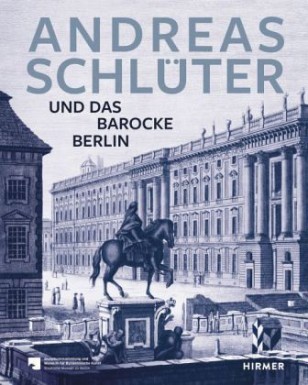 Andreas Schlüter (1659/60–1714), der bedeutendste Architekt und Bildhauer der Barockzeit nördlich der Alpen, verwandelte um 1700 Berlin in eine moderne, barocke Residenzstadt. Anlässlich seines 300. Todestages erzählt das opulente Katalogbuch die spannende Geschichte von Schlüters künstlerischem Werdegang und bietet einen fundierten Überblick über sein Œuvre.
Zunächst am Hof des polnischen Königs tätig, wurde Schlüter 1694 von Kurfürst Friedrich III. von Brandenburg, ab 1701 König Friedrich I. von Preußen, nach Berlin berufen. Fortan war er als Hofkünstler maßgeblich an der Umsetzung der Repräsentationsstrategien seines königlichen Auftraggebers beteiligt, wobei er sich an so glanzvollen Kunstzentren wie Rom und Paris orientierte. In 25 Beiträgen stellen namhafte Kenner Schlüters Werk umfassend vor, beginnend mit den Jahren in Danzig und Polen über seine Berliner Blütezeit mit Hauptwerken wie dem Reiterstandbild des Großen Kurfürsten,
dem Zeughaus und dem Berliner Schloss bis hin zu seinem
Spätwerk, der Berliner Villa Kameke.
Call for Papers | Art History— Adaptation—Knowledge—Society
Art History—Adaptation—Knowledge—Society
Budapest, 20 June 2014
Proposals due by 30 April 2014
Organized by Zoltán Dragon and Miklós Székely
The end of art history was first envisioned by Hans Belting Munich’s inaugural lecture in 1983. Belting later reconsidered his theory, but the creed of art history and its consciousness have not been affected. In recent decades, the demands of society, social inclusion, forms, communications, infrastructure, and the environment have changed several times, but the discipline of art history still uses the same methodology, it interprets the actualities by applying the same structures. Meanwhile, the social utility of traditional art historical research is questioned and its usability is thrown into doubt. Other fields of the humanities adopted new structures, approaches, new interdisciplinary areas. It seems as if in the discipline of art history, change is not enforced by the profession in the strict sense, but by the commissioners and those interested. The importance of art historians is also diminished by new employment practices, when professionals of information technology, communication, and museum education are more likely to be employed in museums or in the traditional places related to heritage conservation. As a sign of the crisis, university students often neglect art historical studies and focus their interest instead on art management and curatorial studies. Belting has envisioned the future of art history in a kind of science of the image / Bildwissenschaft, but traditional art historical practices can well be represented by new emerging professionals of the reformed higher educational system. One crucial question concerns the historical focus of art history. Can art history identify itself as a historical (backward looking) field of the humanities, reflecting mainly on history, in spite of the palpable interest in contemporary interpretation of events? Creativity and the use of innovative approaches have been equally characteristic of art history, the preservation of cultural heritages, and museology. As an initiative aiming at renewal, a one-day workshop will be organized. Its purpose is to provide a forum for innovative, progressive, proactive and even provocative ideas and approaches, presenting solutions that are appropriate responses to today’s challenges through their relevant contemporary approach.
Topic Frames
1. Image and image preservation. A work of art is not always merely a matter of what is seen or how it is viewed. Works of art can be a demonstration, a performance, and documentation—if the space and time of the work have been limited, or if the work of art has been destroyed altogether. How do museums adapt in their acquisition practices to technological advancements and social changes? During the canonization-process of the works, what new contemporary meanings are added, provoked by new circumstances and surpassing the traditional framework of art history? And what happens with objects outside the museums: graffitis, tags, documents of festivals, performances, demonstrations, digital tools and mediums?
2. Monument, community, space use. Is there such a thing as a community monument, instead of or in addition to national monuments? What are the new challenges with respect to the protection of monuments caused by private “contemporary use” of public spaces? What are innovative solutions and what is the appropriate attitude to adopt towards contemporary renovations? What are the roles and limits of virtual reconstructions, their educational use, and how do they challenge traditional methods in monument conservation?
3. Museum and innovation. The post-museum is still one of the most commonly cited concepts of the museum in the theoretical discourse on museums. But what is beyond the post-museum? What are the characteristics of an innovation-based acquisition policy? What potentials are there in the stronger cooperation between the external research into the museum world and the integration of partialities into the scientific research? What are potential future solutions for real-time online publication of archival materials, and what is the next step in the participatory museum concept?
4. Changes in the history of art history methodologies are also a question of shifts of focus lies. The modern-day equivalent of taking notes on index-cards is database construction, while image albums, popularizing articles will be replaced by the photo galleries and Wikipedia. Constructing databases exempts one from interpretation and transforms the research topic into dry data, while simultaneously democratizing the data itself. The democratization of scholarship takes place on the pages of Wikipedia. But what is the future of new publications of data, essays and monographs? How will they be published, and on the basis of what, and for whom?
5. Knowledge-based society. What should be taught in public schools about the history of art and what should be taught outside the schools? Can the instruction of art history be transformed at the university level? What new educational models would be appropriate at the secondary school level or in postsecondary education? How can the transfer of knowledge be adapted to the changed social, scholarly and technological contexts?
Presentations are in ‘TED -style’. If you wish to share your vision, your ongoing research or recent scholarly findings, we encourage you to join us for the workshop! Prepare a presentation of no more than 15 minutes in length. Send us an outline by 30 April to conference@centrart.hu We will compile the program by mid-May and then reply to participants. Info on broadcasting will be provided later.
Regarding the application, there are no formal criteria: you can send short abstracts, portfolios, presentations, etc. The point is to see what questions or problems you are interested in and whether you are aware of the theoretical background, and also to give you a chance to outline your conception clearly. Be sure to write a few lines about yourself and to provide us with your contact details. The conference will be broadcast online and recorded, and the recording will be made publicly available via video-sharing. Speakers from abroad are welcome to join the event virtually and also to hold presentations via online communication mediums (Skype, Google hangout, etc). We invite you to join us as a speaker or participant for our event on the spot in Budapest or via internet on 20 June, 2014.
New Book | The Material Culture of the Jacobites
From Cambridge UP:
Neil Guthrie, The Material Culture of the Jacobites (New York: Cambridge University Press, 2014), 284 pages, ISBN: 978-1107041332, $95.
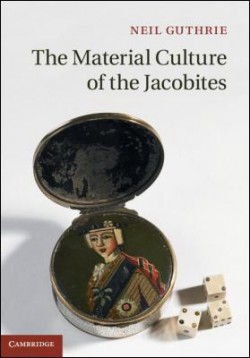 The Jacobites, adherents of the exiled King James II of England and VII of Scotland and his descendants, continue to command attention long after the end of realistic Jacobite hopes down to the present. Extraordinarily, the promotion of the Jacobite cause and adherence to it were recorded in a rich and highly miscellaneous store of objects, including medals, portraits, pin-cushions, glassware and dice-boxes. Interdisciplinary and highly illustrated, this book combines legal and art history to survey the extensive material culture associated with Jacobites and Jacobitism. Neil Guthrie considers the attractions and the risks of making, distributing and possessing ‘things of danger’; their imagery and inscriptions; and their place in a variety of contexts in the seventeenth and eighteenth centuries. Finally, he explores the many complex reasons underlying the long-lasting fascination with the Jacobites.
Neil Guthrie is a lawyer by profession and has published articles on Jacobite material culture, law, and literary history, including “Johnson’s Touch-piece and the ‘Charge of Fame’: Personal and Public Aspects of the Medal in Eighteenth-Century Britain,” in The Politics of Samuel Johnson (edited by H. Erskine-Hill and J. C. D. Clark, 2012).
C O N T E N T S
Introduction
1. ‘By things themselves’: the danger of Jacobite material culture
2. ‘Many emblems of sedition and treason’: patterns of Jacobite visual symbolism
3. ‘Their disloyal and wicked inscriptions’: the uses of texts on Jacobite objects
4. ‘Tempora mutantur et nos mutamur in illis’: phases and varieties of Jacobite material culture
5. ‘Those who are fortunate enough to possess pictures and relics’: later uses of Jacobite material culture
Bibliography
Exhibition | Architectural Drawings of the Eighteenth Century
From the Museo di Roma:
Architectural Drawings of the Eighteenth Century / Disegni di architettura del Settecento
Museo di Roma, 20 December 2013 — 30 June 2014
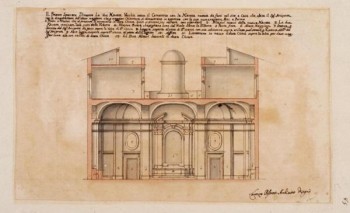
Lorenzo Possenti, Progetti per la nuova chiesa di Sant’Andrea a Gallicano, ca. 1731–33
The drawings exhibited in the “Hall of graphics” were selected from the collection of the Museum of Rome and come mainly from the collection of Antonio Muñoz. They testify the various architectural structures in Rome during the eighteenth century, which have greatly contributed to the creation of the image of the city.
In addition to the projects for monumental works commissioned by the popes, such as the Trevi Fountain, the facade of St. John Lateran, St. Paul Outside the Walls, there are those for minor works, such as small shrines, oratories, fountains and especially houses. A new type of building was conceived in this period: the apartment building, which helps to dramatically change the appearance of the city by marking its “gentrification.”
The designs, both by major architects (Ferdinando Fuga, Nicola Salvi) and other less well-known ones (Andrea Francesco Nicoletti, Girolamo Toma), are always very imaginative and extremely elegant from the point of view of graphics, especially those presenting the project to the potential buyer, the only means available to an artist to promote their work. Sketches, study sheets, design or academic drawings, and publications also allow to follow and better understand some important debates of the period relating to the “modern style” of the Roman Barocchetto opposed to the more austere “old style” or the difference between reproduction and imitation.
New Book | Four Emperors and an Architect
From Oxbow Books:
Alicia Salter, Four Emperors and an Architect: How Robert Adam Rediscovered the Tetrarchy (Lexicon Publishing, 2013), 196 pages, ISBN: 978-0957571907, £20.
 The eighteenth century saw an explosion of interest in the architecture of ancient Rome, spawning the phenomenon of the Grand Tour. The palace of Diocletian at Split, however, remained unappreciated and under the radar until its 1757 rediscovery by the young British architect, Robert Adam. This superbly illustrated volume narrates Adam’s pioneering work and the influence it had on his own architectural practice, interweaving his story with that of Diocletian himself and his colleagues in power, the Tetrarchs. Above all Alicia Salter explores their architecture, showing how it was used to symbolise their rule, and describing in detail not only the palace at Split, but work by the other Tetrarchs in their capitals at Milan, Trier, Nicomedia and Thessalonica, as well as at Rome itself.
Alicia Salter read history at St. Hilda’s College, Oxford. After marriage and three children, she graduated to Art History (The Study Centre at The Victoria and Albert Museum), specialising in the history of architecture—her great love. For seventeen years, together with two friends, she ran her own small business—Art Circle—concentrating on the great wealth of art to be found in a city such as London. Some years later research into the work of Sir Robert Taylor led to an interest in Robert Adam and his archaeological survey of Diocletian’s palace in Split.
More information is available at book’s website.
Conference | The Sculpture of the Écorché
From the Henry Moore Institute:
The Sculpture of the Écorché
Henry Moore Institute, Leeds, 7 June 2014

Thomas Mewburn Crook ‘Stage 9a: Anatomical Studies of the Human Figure from the Flat’ 1893 Pencil, ink and watercolour on paper Leeds Museums & Galleries (Henry Moore Institute Archive)
This one-day conference takes the écorché as its subject, reconsidering the many ways that models of the flayed figure have been understood from the sixteenth century to the present day. Across seven papers, the conference addresses the écorché variously as a teaching object for the education of sculptors, as a scientific model crucial to the understanding of anatomy, as a sculptural process and as a sculptural object in its own right.
The écorché has frequently operated across disciplinary boundaries and registers of respectability. Makers of wax écorchés in the eighteenth century, such as the Florentine Clemente Susini (1754–1814), were highly acclaimed during their lifetimes, with their work sought by prestigious collectors. By the nineteenth century, however, wax had come to be seen as a merely preparatory, or even a disreputable, medium for sculpture with its capacity for forensic detail and mimetic reproduction of bone, muscle and skin operating against the prevailing neoclassical tendency towards ideal form. As a result of this change in taste, the écorché in plaster of Paris became the primary teaching object for anatomical studies in European academies and schools of art into the twentieth century.
The conference will be chaired by Professor Fay Brauer (University of East London/University of New South Wales College of Fine Arts), Dr Nina Kane (University of Huddersfield) and Dr Rebecca Wade (Henry Moore Institute). Advanced booking is required for this event. Book here.
◊ ◊ ◊ ◊ ◊
S A T U R D A Y , 7 J U N E 2 0 1 4
10.30 Registration
11.00 Introduction
11.10 Panel 1: Cigoli and Ceroplastics: Wax Écorché in Seventeenth-Century Italy
• Roberta Ballestriero (Open University), Under the Wax Skin: Representation of the Écorché in the Art of
Ceroplastics
• Lisa Bourla (University of Pennsylvania), Cigoli’s Écorché, Giambologna’s Studio and the ‘Poe Paradox’
12.20 Lunch
1.30 Panel 2: Dissection as Sculptural Practice: Criminality, Pathology, and the Academy
• Meredith Gamer (Yale University), ‘A necessary inhumanity’: William Hunter’s Criminal Écorchés
• Naomi Slipp (Boston University), Thomas Eakins and the Écorché: Understanding the Human Body in Three
Dimensions
• Natasha Ruiz-Gómez (University of Essex), In Sickness and in Health: Doctor Paul Richer’s Écorché at the École
des Beaux-Arts
3.30 Tea
4.00 Panel 3: Écorché, Modernism, and the Sculptural Canon
• Elena Dumitrescu (National University of Arts, Bucharest), The Écorché by Brancusi and Gerota: An Artwork Created at the School of Fine Arts of Bucharest
• Stefan Grohé (University of Cologne), An Anatomy of Sculpture: The ‘Ecorche, dit de Michel-Ange’ and its Transformations in Modern Art
5.20 Closing remarks
Exhibition | In the Library: Deforming and Adorning
Of the 29 volumes on display (dating from 1471 to 1973), 8 are from the eighteenth century, including Reynolds’s copy of Walpole’s Anecdotes of Painting and Christoph Gottlieb von Murr’s copy of Philipp von Stosch’s gem collection, Description des Pierres gravés du feu Baron de Stosch.
From the National Gallery of Art in Washington:
In the Library: Deforming and Adorning with Annotations and Marginalia
National Gallery of Art, Washington, D.C., 3 March — 27 June 2014
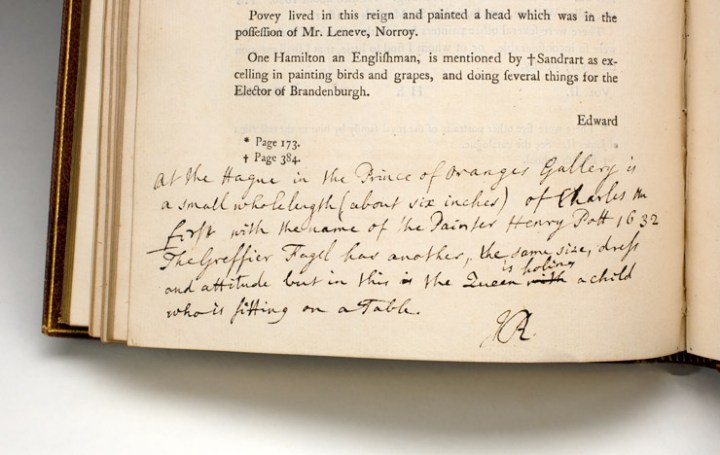
Horace Walpole, Anecdotes of Painting in England (Strawberry Hill, 1762–1771). National Gallery of Art Library, Gift of Joseph E. Widener. The remarks throughout this four-volume set reveal that this copy of an important 18th-century work on British paintings once belonged to Sir Joshua Reynolds (1723–1792). His commentary illuminates his relationship with the author and his role as the head of the Royal Academy of Arts.
◊ ◊ ◊ ◊ ◊
This exhibition highlights a selection of rare books that are unique not because of their content or imprint, but because of the one-of-a-kind markings and additions that readers of the past made to the printed text. From their hand-written marginal commentary and sketches to custom bindings with extra pages and illustrations to editorial notes, each of these books has been transformed from a standard mass-printed volume into a uniquely personal object. They illuminate us with insights into the texts themselves, as well as the readers who read, enjoyed, and annotated them—and the relationships between the two.
The printing press was introduced in the West by Johannes Gutenberg in the 15th century. Prior to this, manuscripts were often copied by hand—a laborious process that was both expensive and prone to errors. In contrast, the printed page permitted the creation and distribution of exact copies of a book to a wide audience. This revolutionary technology changed the spread of knowledge forever.
Yet even a mass-printed volume has the potential to survive as a unique artifact: perhaps all other copies of a particular edition are destroyed; perhaps an individual copy gains notoriety through its provenance, having belonged to a figure of historical importance; or perhaps the book is bound in a peculiar way. In the hand-press period, variance in collation is common for a variety of reasons. Alterations to the text might be made during the print run; moreover, bookbinding was performed separately from the actual publishing process, which allowed for the possibility of pages being lost, added, trimmed, or bound in a different order.
In spite of all these variations, the specific focus of this exhibition is alterations made to the text by readers. The books on view all began as copies identical to hundreds or thousands of others, but each has been transformed by the addition of new information. Many include annotations ranging from navigational aids to detailed critiques of the text.
In the manuscript era, extra-large margins were sometimes provided for scholars to provide commentary, known as glosses. Many early printed books incorporated these earlier glosses along with the main text, and modern readers continued the tradition of adding their own thoughts in the margins. Benjamin Franklin was known to have penned entire debates with authors in the blank spaces of his books; other readers adorned the text with sketches and illustrations. Some readers had their books rebound and included extra material such as prints, notes, and correspondence. In several cases, the author has made editorial notes and revisions for the next edition of his book.










 Enfilade
leave a comment