Call for Essays | Art and Social Change, La Salle University Art Museum
Art and Social Change: The Collection of La Salle University Art Museum
Abstracts for an edited volume due by 30 June 2014; completed essays due by 30 January 2015
We are seeking scholarly essays (3,000–6,000 words) for an edited book on the subject of art and social change. The book will focus on Western art from the Renaissance to about 1950 (after which artists-activists and art for social change become important themes—and the focus of numerous other recent books). Scholarly essays should address some aspect of the subject and should ideally engage with one or more artworks in the collection of La Salle University Art Museum. (See the museum’s website for images of artworks on display; detailed lists of artworks in storage are also available on request.)
We welcome proposals from established scholars, recent Ph.D. recipients, upper level graduate students and museum professionals. The deadline for submission of abstracts (300–600 words) is June 30, 2014, with notification by August 30, 2014. The deadline for completed essays is January 30, 2015, with peer reviews taking place in early spring 2015. More information is available here.
Please direct proposals and inquiries to the editors:
Susan Dixon, Ph.D., Chair/Associate Professor Art History, La Salle University Deptartment of Fine Arts, dixons@lasalle.edu
Klare Scarborough, Ph.D., Director/Chief Curator, La Salle University Art Museum, scarborough@lasalle.edu
Call for Papers | The Monkey in the 17th and 18th Centuries
The call for papers includes a bibliography. From Le Blog de L’ApAhAu:
Le singe aux XVIIe et XVIIIe siècles: Figure de l’art, personnage littéraire & curiosité scientifique
CLARE Université Bordeaux Montaigne, 28–29 May 2015
Proposals due by 15 June 2014
 Colloque international, organisé par Florence BOULERIE, CEREC [Centre de Recherches sur l’Europe Classique (XVIIe et XVIIIe siècles)], EA 4593 CLARE, Université Bordeaux Montaigne, Bordeaux (France), et Katalin BARTHA-KOVÁCS, Université de Szeged (Hongrie)
Le singe figure dans les représentations littéraires et artistiques depuis l’Antiquité, en particulier autour du culte des singes dans l’Égypte ancienne ; on le rencontre fréquemment au Moyen âge, notamment dans la statuaire, illustrant la symbolique chrétienne de l’homme déchu, et il reste familier dans l’imaginaire burlesque de la Renaissance (voir à ce sujet la journée d’étude « Singes et singeries à la Renaissance », Chantilly, 15 mars 2014, organisée par l’Atelier XVIe siècle de l’université Paris-Sorbonne).
Au XVIIe siècle, l’intérêt pour cet animal connaît cependant un essor nouveau : les singes prolifèrent dans les fables et les représentations allégoriques, devenant figures du double trompeur et images satiriques de la vanité humaine. La mode des chinoiseries à la fin du XVIIesiècle vient renforcer la vogue des représentations picturales de singes, avant que le XVIIIe siècle ne s’enthousiasme pour les singeries… et les singes, animaux de compagnie fort prisés au milieu du siècle.
Allégorie de l’artiste (peintre, écrivain, acteur), le singe interroge aussi sur l’humain d’un point de vue religieux, moral et philosophique. Les naturalistes l’observent, le dessinent ; l’on découvre de nouvelles espèces au gré des explorations géographiques, de sorte que la limite entre l’homme et le singe est parfois bien près de chanceler.
Notre colloque entend éclairer les multiples aspects du singe dans la culture européenne des XVIIeet XVIIIe siècles : la mode picturale des « singeries », à son apogée vers 1740, doit être replacée dans un contexte artistique (l’héritage des peintres flamands), littéraire (la tradition de la fable concurrencée par les nouveaux visages du singe littéraire) et anthropologique (les interrogations sur l’homme et les espèces). (more…)
Call for Papers | Congress of German Art Historians: The Value of Art
From the Verband Deutscher Kunsthistoriker:
33rd Congress of German Art Historians | The Value of Art
Johannes Gutenberg University of Mainz, 24–28 March 2015
Proposals due by 14 May 2014
The social and political function of art is currently being interrogated, more intensively and thoroughly than we have seen in a long time. The explosive nature of the Cornelius Gurlitt case is thereby a daily topic of discussion, as are forgeries and the relevance of everything that, subsequent to the iconic turn, we might term the upward revaluation of the art work or of images per se. Not least in view of these many debates, the Verband Deutscher Kunsthistoriker e. V. (Association of German Art Historians) and the Institute of Art History at the Johannes Gutenberg University of Mainz, as joint organizers of the 2015 Congress of German Art Historians, have chosen “the value of art” as the central theme of its multi-day conference.
During the meeting, the spotlight will fall in particular on those research activities that reflect the current social and political status of the discipline of art history, and also that of its objects and institutions. The twelve sessions making up the programme each approach the conference’s theme from a different perspective and thereby clearly demonstrate how the enquiry into values and evaluations is reflected in a wealth of aspects and current academic discourses within art history’s various professional groups. The sessions that have been chosen correspondingly include those that take a completely fresh look at traditional art-historical forms and contexts, such as gold, the Church and court art. Other sessions go on to discuss the question of the value of art for our own present. In an epoch in which museums, and the role they play in cultural education and the preservation of the arts, no longer enjoy automatic social acceptance, the question of the value of art is being raised with increasingly urgency. The sessions will therefore ask, from the perspective of today, how the value of art, and more generally the medium of the image, restates itself in museums, churches and cultural landscapes, as well as in other disciplines such as the neurosciences.
Following the call for sessions in autumn 2013, interested colleagues are warmly invited to submit their proposals (1–2 pages) for individual papers to be delivered in the sessions outlined below. Each session can accommodate five 30-minute papers. The final selection will be made by the heads of each session and the members of the board at a joint meeting.
Please send your proposals to:
Verband Deutscher Kunsthistoriker e. V.
Haus der Kultur
Weberstraße 59a
53113 Bonn
◊ ◊ ◊ ◊ ◊
S E S S I O N S (more…)
English Collaborative Doctoral Award: At Home With Books
AHRC-funded English Collaborative Doctoral Award: At Home With Books
The University of Oxford Faculty of English Language & Literature and The Geffrye Museum of the Home are pleased to announce a new English Collaborative Doctoral Award (AHRC-funded): ‘At home with books: the role and history of reading in domestic contexts in the long eighteenth century.’
Applicants are sought for a three year, fully funded studentship to work towards a DPhil (PhD) in the Faculty of English, University of Oxford on the AHRC project ‘At home with books: the role and history of reading in domestic contexts in the long eighteenth century.’ This collaborative doctoral award (CDA) will be supervised jointly by Dr Abigail Williams, of the University of Oxford, Ms Hannah Fleming, Curatorial Department of the Geffrye Museum, and a member of the Learning and Engagement Department of the Geffrye Museum. The Geffrye Museum in East London is a leading centre for the study of home, with a focus on middle class urban homes over 400 years.
The studentship will commence in October 2014 and is open to UK nationals, or EU nationals who have resided in the UK for 3 years or more. The successful applicant will normally have achieved a Master’s degree with distinction (or equivalent) in literary studies or history, or will have done so by October 2014. It would be an advantage to have a solid grounding in the literature or history of the seventeenth and eighteenth century.
Applicants for this position should apply online by Friday 18 April 2014 at http://www.ox.ac.uk/admissions/postgraduate_courses/index.html and quote reference ENGL AHWB Studentship in the ‘Departmental Studentship Applications’ section of page 6 of the application form. Interviews for the studentship will be conducted in late April or May. Further information on the studentship and details on how to apply may be found here. If you would like to discuss this informally, please contact Dr Abigail Williams or Hannah Fleming.
More information (as a PDF file) is available here»
The Burlington Magazine, March 2014
The (long) eighteenth century in The Burlington:
The Burlington Magazine 156 (March 2014)
 A R T I C L E S
• François Marandet, “The Pool of Bethesda by Louis Chéron: A Modello Discovered at the Wellcome Library, London,” pp. 162–63.
An oil-sketch by Louis Chéron in the Wellcome Library, London, is identified as a study for the large painting of the Pool of Bethesda (1683) in S. Pantaleone, Venice.
• Massimo Favilla and Ruggero Rugolo, “A Portrait of a Baby Girl by Lorenzo Tiepolo,” pp. 164–69.
An attribution to Lorenzo Tiepolo of a Portrait of a Baby Girl in a High Chair (c.1770–76).
R E V I E W S
• Jocelyn Anderson, Review of Geoffrey Tyack, ed., John Nash: Architect of the Picturesque (English Heritage, 2013), pp. 175–76.
• Uta Christina Koch, Review of the exhibition Fragonard: Poetry and Passion / Poesie und Leidenschaft, pp. 194–95.
• Francis Russell, Review of the exhibition Pietro Bellotti: Another Canaletto, pp. 198–99.
Smithsonian American Art Museum’s 2014 Fellows Lectures
All three afternoons look interesting; I include only Amy Torbert’s talk here only because most of the sessions address the nineteenth and twentieth centuries. -CH
Smithsonian American Art Museum’s 2014 Fellows Lectures
Smithsonian American Art Museum, Washington, D.C., 7–9 May 2014
The Fellowship Program at the Smithsonian American Art Museum cordially invites you to attend three afternoons of lectures in American art delivered by Smithsonian art history research fellows. The talks will be held in the museum’s McEvoy Auditorium, located at 8th and G Streets NW, Washington, D.C. This event is open to the public and no reservations are required. For further information, please contact Amelia Goerlitz at (202) 633-8353 or email AmericanArtFellowships@si.edu.
Thursday, 8 May, 2:00
Amy Torbert, Predoctoral Fellow (National Portrait Gallery), University of Delaware
“Robert Sayer’s Empire: The Geographies of Prints, 1770–1800”
A full list of speakers is available here»
Call for Papers | Port Cities in the Early Modern World, 1500–1800
Port Cities in the Early Modern World, 1500–1800
Philadelphia, 5–7 November 2015
Proposals due by 15 September 2014
Co-sponsored by the McNeil Center for Early American Studies, the Program in Early American Economy and Society, and Temple University.
In the early modern period, advances in maritime technology redrew the global map-not only through the ‘discovery’ of new worlds, but by reorienting patterns of commerce and migration to transform what had been peripheries into vital nodes of exchange, power, and culture. Port cities rose to occupy a critical space, mediating between their own hinterlands and an oceanic world of circulation and exchange. Highly local institutions and networks influenced and reacted to global networks and the movements of people, goods, fashions, ideas, and pathogens. This conference will explore comparisons and connections among ports in the age of sail. Through broadly comparative papers and revealing case studies this conference provides a forum to explore comparisons and contrasts, diversity and congruence, competition and emulation, among far-flung port cities on a global scale. Among the topics the organizers hope to explore are socio-political organization, economic and labor patterns, and cultural productions
We seek proposals from scholars at all stages of their careers. Committed participants include Christopher Hodson, Richard Kagan, Willem Klooster, Christian Koot, Kris Lane, Ty Reese, Philip Stern, and David Wheat.
Paper proposals should include an abstract of no more than 500 words and a one-page curriculum vita. Papers, which will be pre-circulated, should be approximately 7,500 words in length. Please e-mail paper proposals to mceas@ccat.sas.upenn.edu by September 15, 2014. All queries should be sent to the conference organizer, Jessica Choppin Roney (roney@ohio.edu). The program committee will reply by December, 2014.
Some support for participants’ travel and lodging expenses will be available for paper presenters.
New Book | Chinese Wallpaper in National Trust Houses
From The East India Company at Home, 1757–1857 Newsletter (March 2014); note that the booklet is available for free download as a PDF file.
Emile de Bruijn, Andrew Bush, and Helen Clifford, Chinese Wallpaper in National Trust Houses (Newcastle upon Tyne: National Trust, 2014), 50 pages.
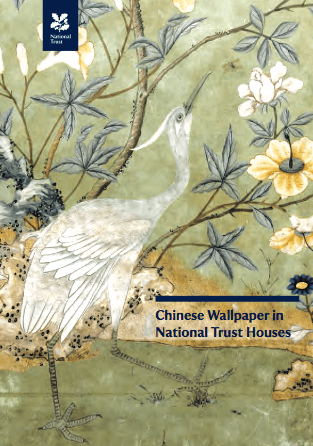 On the evening of 20 March Emile de Bruijn, Andrew Bush and Helen Clifford were delighted to celebrate the publication of Chinese Wallpaper in National Trust Houses, at the China Tang Suite at the Dorchester Hotel, London, providing the opportunity to thank the contributing team of collaborators including curators, conservators, entrepreneurs and scholars. Special thanks go to the hosts who made this venue possible. Copies of the National Trust’s catalogue of a group of historic Chinese wallpapers based on the latest research and conservation can be bought from Shop.nationaltrust.org.uk. The 50-page booklet is entitled Chinese Wallpapers in National Trust Houses and includes nearly 50 colour pictures, introductory essay, location map of sites including non-NT examples and a bibliography.
The booklet is also available as a PDF file.
More information about the The East India Company at Home Project is available here»
Renovation and Conservation at the YCBA and the Beinecke
For those of you thinking ahead in terms of fellowships at Yale, bear in mind these planned closures for 2014 and 2015. 2016, however, seems like a fine time to be in New Haven!
◊ ◊ ◊ ◊ ◊
From the Beinecke:
The Beinecke Rare Book & Manuscript Library will undergo a major renovation beginning at the end of May 2015. The renovation will replace the library’s mechanical systems and expand its research, teaching, storage, and exhibition capabilities. The library will reopen in September 2016.
A temporary reading room in the Sterling Memorial Library will provide researchers access to the library’s collections while work is under way. Beginning in April 2014, access to various collections will be limited as we prepare the library for closure. Please consult our closed collections schedule for information about when specific collections will be unavailable.
We invite you to learn more about the project, and follow our progress as we prepare the library for another 50 years as a world-class center of research and scholarship.
◊ ◊ ◊ ◊ ◊
From the YCBA:
. . . Planning is well underway for the second phase of the project, which will take place in 2015. The focus of this next phase will be the renewal of the public galleries on the second, third, and fourth floors, as well as the refurbishment of the Lecture Hall. The project will also address improvements related to life safety and accessibility, and extensive building-wide mechanical and electrical upgrades will be made. Visitors will have limited access to the building and no special exhibitions will be mounted or visiting fellowships awarded. When the Center reopens in January 2016, its collections will be completely reinstalled in the elegant, sky-lit galleries of the fourth floor, and three focused exhibitions, featuring specific aspects of the Center’s collection, will be on view in the second- and third-floor galleries.
◊ ◊ ◊ ◊ ◊
From Yale UP
Peter Inskip and Stephen Gee in association with Constance Clement, Louis I. Kahn and the Yale Center for British Art: A Conservation Plan (New Haven: Yale University Press, 2012), 200 pages, ISBN 978-0300171648, $50.
 The standing of the Yale Center for British Art as one of the world’s great museums and study centers finds expression in its remarkable building, designed by Louis I. Kahn (1901–1974). In this important and innovative volume, two architects offer a plan to ensure the proper stewardship of the building in order to preserve its essence as a great architectural structure. Peter Inskip and Stephen Gee describe the design, construction, and subsequent renovation of the building; assess its cultural significance; analyze the materials that comprise it (steel, concrete, glass, white oak, and travertine); and shed light on its evolution over the four decades since it was built. Drawing on their extensive experience developing conservation plans for both historic sites and modern buildings, they propse a series of policies for the Center’s conservation into the future.
Peter Inskip and Stephen Gee are with the London-based firm Peter Inskip + Peter Jenkins Architects. Constance Clement is Deputy Director of the Yale Center for British Art.
At Auction | Stubbs’s Tygers at Play (Two Leopard Cubs)

George Stubbs, Tygers at Play, 40 by 50 inches, c.1770–75 (est. £4–6 million)
Press release (27 March 2014) from Sotheby’s:
Tygers at Play, one of George Stubbs’s most celebrated works, is to lead Sotheby’s London Evening Sale of Old Master and British Paintings on 9 July 2014. Painted circa 1770–75, this masterful depiction of two leopard cubs ranks among Stubbs’s most popular subjects, reproduced in numerous prints. The painting itself, however, has rarely been seen in public, having been exhibited only four times since its original appearance at the Royal Academy of Arts in London. Testament to the artist’s exceptional eye for capturing the animal form, this admirably preserved work boasts impeccable provenance, having been sold only once since it was commissioned from the English painter. It remained in the possession of a single family until 1962, when it was acquired by the present owners. Coming from a distinguished British aristocratic collection, Tygers at Play will be offered with an estimate of £4–6 million.
Talking about the sale of the painting, Julian Gascoigne, Specialist, British Paintings at Sotheby’s commented: “Major big cat compositions by Stubbs very rarely appear at auction. Having only passed through two careful owners since it was painted, this work is in perfect condition, down to the delicate whiskers of the leopards, which is exceptionally rare for a work of this date. Never has the art market been so global and the universal beauty of Stubbs’s animals appeals today to an ever-growing array of collectors across the world. We therefore very much look forward to exhibiting this extraordinary work in Hong Kong, Moscow, New York, and London in the three months leading up to the sale.”
Of Stubbs’s four paintings of leopards, Tygers at Play is by far the most ambitious and dramatic. This rare example of the artist’s understanding of animal anatomy is also illustrative of his preoccupation with wild and exotic animals from the late 1760s and 1770s, which resulted in some of Stubbs’s greatest paintings, including his famous Lion and Horse series (a theme which emanated from his encounter with classical antiquity in Rome in 1754), as well as his famous paintings of an Indian Rhinoceros (c.1790/91, Hunterian Museum, Royal college of Surgeons), a Zebra presented to Queen Charlotte in 1762 (Paul Mellon Collection, Yale Centre for British Art, New Haven), and his portrait of The Kongouro from New Holland, recently acquired by the National Maritime Museum, Greenwich.
The seemingly incorrect title, Tygers at Play, which was used by Stubbs in the Royal Academy exhibition in 1776 and in the lettering for the engraving in 1780, seems curiously old fashioned given the artist’s studious and observant depiction of what are quite clearly leopards. A possible explanation would be that before circa 1750 the word tiger, or tyger was used as the generic term for all striped or spotted members of the cat family that were not lions.
Stubbs’s fascination with exotic animals was partly a symptom of the rise of menageries in mid-18th century London, stocked with wild beast brought back from Africa and India by men like Warren Hastings, and the contemporary fascination with exotic specimens from far off lands, which was fuelled by expeditionary voyages such as Captain Cook’s journey to the South Pacific in 1766 and his subsequent discovery of Australia in 1770.
Worldwide Exhibitions
Hong Kong Convention Centre: 3–7 April 2014
Moscow, New Manege Exhibition Hall: 25–27 April 2014
Sotheby’s New York: 31 May – 4 June 2014
Sotheby’s London: Early July 2014










 Enfilade
leave a comment