Joshua Lane Appointed Curator of Furniture at Winterthur
As reported at ArtFix Daily (24 February 2014). . .
 Dr. David P. Roselle, Director of Winterthur Musem, Garden & Library, announced the appointment of Joshua W. Lane as the Lois F. and Henry S. McNeil Curator of Furniture at Winterthur Museum.
“Josh Lane is one of the leading scholars in the field of early American furniture,” said Roselle, “and we look forward to welcoming him to Winterthur.” He will start his new position on April 14, 2014.
Lane received his B.A. in American Studies from Amherst College and his M.Phil. from Yale. He worked at the Connecticut Historical Society and the Stamford Historical Society before moving to Historic Deerfield, where he has curated the furniture collection since 2000. In addition, Lane served as the Director of the Summer Fellowship Program at Historic Deerfield between 2005 and 2012.
His most recent exhibitions include Into the Woods: Crafting Early American Furniture, an innovative examination of the materials, tools, and evidence of workmanship in furniture: and Furniture Masterworks: Tradition and Innovation in Western Massachusetts, part of Four Centuries of Massachusetts Furniture, a collaborative project involving eleven institutions including Winterthur Museum.
“Josh is highly regarded for his exhibitions, teaching, research, and scholarship,” said Linda S. Eaton, John L. and Marjorie P. McGraw Director of Collections, “and we are all delighted that he is coming to Winterthur.”
New Books | Beastly London / Gorgeous Beasts
Along with these two books (the second of which I should have posted months ago), readers interested in animals may find useful the review essay by Simona Cohen, “Animal Imagery in Renaissance Art,” in Renaissance Quarterly 67 (March 2014): 164–80. -CH
From Reaktion:
Hannah Velten, Beastly London: A History of Animals in the City (London: Reaktion Books, 2013), 288 pags, ISBN: 978-1780231679, £29 / $50.
 Horse-drawn cabs rattling through the streets, terrified cattle being herded along congested thoroughfares to Smithfield market, pigs squealing and grunting in back yards—London was once filled with a cacophony of animal noises (and smells). But over the last thirty years, the city seems to have finally banished animals from its streets, apart from a few well-loved beasts such as the ravens at the Tower of London and the shire horses that pull the Lord Mayor’s golden coach.
Londoners once shared their homes with all kinds of animals—pets, livestock and vermin—and the streets were full of horses, cattle and the animal entertainers that performed to passers-by. Animals from all corners of the globe were imported through London’s docks and exotic beasts became popular attractions at venues such as the Zoological Gardens or lived in the private menageries of kings and naturalists. The city’s residents were entertained by performing fleas, mathematically gifted horses and dancing bears, as well as more bloodthirsty pursuits such as shooting and dog- and cockfights. In the Victorian age the city, not before time, became the birthplace of animal welfare societies and animal rights campaigns. Yet just as conditions gradually improved for the beasts of London, markets, slaughterhouses and dairies began to be moved to the suburbs, and the automobile eventually replaced the horse. The number of resident animals fell, and they are no longer a large part of everyday life in the capital—apart from a stalwart few, such as pets, pigeons and pests. Beastly London explores the complex and changing relationship between Londoners of all backgrounds and their animal neighbours, and reveals how animals helped to shape the city’s economic, social and cultural history.
Hannah Velten is a freelance writer based in Fletching, Sussex, and the author of Cow (Reaktion, 2007) and Milk (Reaktion, 2010).
C O N T E N T S
Introduction: Revealing the Beasts
1. Livestock: Londoners’ Nuisance Neighbours
2. Working Animals: Straining Every Muscle
3. Sporting Animals: Natural Instincts Exploited
4. Animals as Entertainers: Performance, Peculiarity and Pressure
5. Exotic Animals: The Allure of the Foreign and the Wild
6. Pampered Pets and Sad Strays
7. London Wildlife: The Persecuted and the Celebrated
Final Thoughts: An Apology and a Pardon
References
Acknowledgements
Photo Acknowledgements
Index
◊ ◊ ◊ ◊ ◊
From Penn State UP:
Joan B. Landes, Paula Young Lee, and Paul Youngquist, eds., Gorgeous Beasts: Animal Bodies in Historical Perspective (University Park: Pennsylvania State University Press, 2012), 258 pages, ISBN: 978-0271054018, $50.
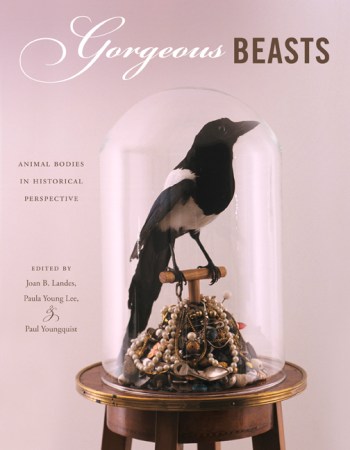 Gorgeous Beasts takes a fresh look at the place of animals in history and art. Refusing the traditional subordination of animals to humans, the essays gathered here examine a rich variety of ways animals contribute to culture: as living things, as scientific specimens, as food, weapons, tropes, and occasions for thought and creativity. History and culture set the terms for this inquiry. As history changes, so do the ways animals participate in culture. Gorgeous Beasts offers a series of discontinuous but probing studies of the forms their participation takes.
This collection presents the work of a wide range of scholars, critics, and thinkers from diverse disciplines: philosophy, literature, history, geography, economics, art history, cultural studies, and the visual arts. By approaching animals from such different perspectives, these essays broaden the scope of animal studies to include specialists and nonspecialists alike, inviting readers from all backgrounds to consider the place of animals in history and art. Combining provocative critical insights with arresting visual imagery, Gorgeous Beasts advances a challenging new appreciation of animals as co-inhabitants and co-creators of culture.
Joan B. Landes is Walter L. and Helen Ferree Professor of Early Modern History and Women’s Studies at The Pennsylvania State University. Paula Young Lee is an independent scholar and the editor of Meat, Modernity, and the Rise of the Slaughterhouse (2008). Paul Youngquist is Professor of English at the University of Colorado.
C O N T E N T S
List of Illustrations
Acknowledgments
Introduction, Joan B. Landes, Paula Young Lee, and Paul Youngquist
1. Animal Subjects: Between Nature and Invention in Buffon’s Natural History Illustrations, Joan B. Landes
2. Renaissance Animal Things, Erica Fudge
3. The Cujo Effect, Paul Youngquist
4. On Vulnerability: Studies from Life That Ought Not to Be Copied, Ron Broglio
5. The Rights of Man and the Rights of Animality at the End of the Eighteenth Century, Pierre Serna, Translated by Vito Caiati and Joan B. Landes
6. Calling the Wild, Harriet Ritvo
7. Trophies and Taxidermy, Nigel Rothfels
8. Fishing for Biomass, Sajay Samuel and Dean Bavington
9. Daniel Spoerri’s Carnival of Animals, Cecilia Novero
A Conversation with the Artist Mark Dion, Joan B. Landes, Paula Young Lee, and Paul Youngquist
Bibliography
About the Contributors
Index
Installation | Molly Hatch’s ‘Physic Garden’ at the High Museum
Warm thanks to Courtney Barnes of Style Court for noting this one. More information and photos are available at her website. -CH
Press release (5 February 2014) from Atlanta’s High Museum of Art:
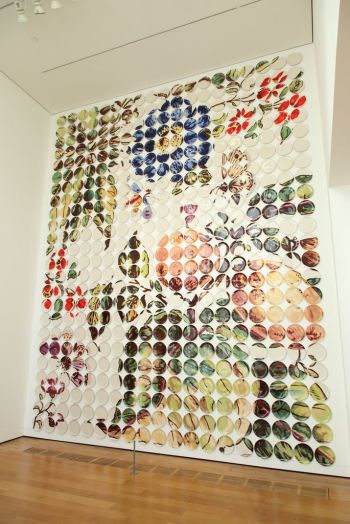
Two-story tall installation of 450 hand-painted plates were inspired by works in the High Museum’s Frances and Emory Cocke Collection of English Ceramics
◊ ◊ ◊ ◊ ◊
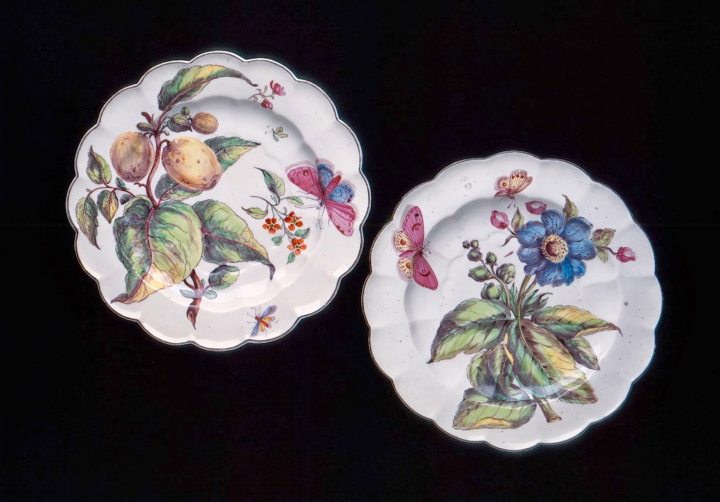
The High Museum of Art has commissioned contemporary ceramicist Molly Hatch to present Physic Garden, a two-story tall, hand-painted ‘plate painting’, which reinterprets works from its renowned decorative arts and design collection. On view starting March 12, the ‘plate painting’ will be installed in the High’s Margaretta Taylor Lobby and will be comprised of 456 plates featuring an original design inspired by two ca. 1755 Chelsea Factory plates from the Museum’s Frances and Emory Cocke Collection of English Ceramics, which totals more than 300 works.
 The historic source plates depict realistic flora and fauna in the Chelsea ‘Hans Sloane’ style of the early 1750s. The influential Chelsea Physic Garden, a botanical garden founded by the Society of Apothecaries in London in 1673, was leased by collector Hans Sloane and likely inspired neighboring factory porcelain decorators.
The High’s installation will be the largest ever produced by Hatch. She has created other works based on source material from the Metropolitan Museum of Art and Museum of Fine Arts, Boston. Hatch also designs her own line of products for national retailers such as Anthropologie.
“I am thrilled to work with such a talented contemporary artist as Molly and to have the outcome be such a dynamic and monumental acquisition for the High. One of the most exciting aspects of ‘Physic Garden’ is seeing the historic decorative arts and design collection through the lens of a creative young artist. We can’t wait for our visitors to experience this new work as well as revisit our important and beloved collection of English ceramics,” says Sarah Schleuning, curator of decorative arts and design at the High.
Hatch often sources historic works to make a contemporary counterpart, however this project marks the first time she is sourcing historic decorative arts from a museum collection to create a site-specific ‘plate painting’. To create the ‘plate painting’, Hatch digitally altered high-resolution images of the surface decoration of the source material to draft a new composition. She altered the original color, scale and composition of the Chelsea designs and then projected the new images onto 456 dinner plates (each 9.5 inches in diameter). She then hand-painted each plate using the projected image as a guide.
The complete installation will measure approximately 20 feet high by 17 feet wide. The Chelsea source plates are also on view in the High’s permanent collection Gallery 200, which patrons may visit to view the historic material. The High is acquiring the piece, which can re-installed by the Museum at future dates in smaller incarnations or in other locations.
“I encourage the viewer to see ceramics as a part of the fine art continuum—viewing plates as one would view a painting,” said Hatch. “For this installation, I’ve re-worked the surface imagery to create a new composition that reflects the historic. The artwork becomes an exploration of the relationship between the historic and the contemporary – crossing over categories of decorative art, design and fine art.”
Molly Hatch
Born in 1978, the daughter of a painter and a dairy farmer, Molly Hatch divided her childhood between physical labor, play, and creating art. She studied drawing, painting, printmaking, and ceramics and receiving her bachelor’s degree of fine arts from the Museum School in Boston in 2000. After several ceramic residencies and apprenticeships in the U.S. and abroad, she received her master’s degree of fine arts degree in ceramics at the University of Colorado in Boulder in 2008. In 2009, she was awarded the Arts/Industry Residency in Pottery at the John Michael Kohler Arts Center in Wisconsin, which laid the foundation for her career as an artist designer. Hatch works from her home studio in Northampton, Mass., on everything from designing and illustration to one-of-a-kind pieces. Her work has been widely collected and commissioned and is exhibited nationally and internationally at art fairs and museums. Hatch’s work has also been widely licensed in partnership with Anthropologie, Galison, Chronicle, and other companies for homeware and stationery products. Her work has been featured in numerous publications from House Beautiful magazine to online publications such as Design*Sponge and Apartment Therapy. For the last two years, Hatch has been teaching a tableware course at Rhode Island School of Design. She also teaches ceramic and illustration workshops across the country as well as online courses through Creativebug. Her first book will be released in 2015.
The Netherlands Yearbook for History of Art (NKJ) Now Online
◊ ◊ ◊ ◊ ◊
The Netherlands Yearbook for History of Art / Nederlands Kunsthistorisch Jaarboek (NKJ) is now available online via subscription with access to all 62 volumes dating back to 1947. The online version gives this unique and high quality publication an extra dimension. NKJ, reflecting the variety and diversity of approaches to the study of Netherlandish art and culture, is now even more accessible and easy to use. Each NKJ volume is dedicated to a particular theme. The latest volume (62) is dedicated to Meaning in Materials 1400–1800. For details see www.brill.com/nkjo or contact marketing@brill.com.
Exhibition | From Watteau to Fragonard: Les Fêtes Galantes
The exhibition opens today at the Jacquemart-André. In addition to the remarkably comprehensive 30-page press kit, the exhibition website, available in both French and English, is outstanding. -CH
From Watteau to Fragonard: Les Fêtes Galantes
Musée Jacquemart-André, Paris, 14 March — 21 July 2014
Curated by Christoph Vogtherr and Mary Tavener Holmes

Antoine Watteau, An Embarrassing Proposal, oil on canvas, ca. 1715–20
(Saint-Petersburg, Hermitage Museum)
◊ ◊ ◊ ◊ ◊
The Musée Jacquemart-André is delighted to be holding the exhibition From Watteau to Fragonard, les fêtes galantes. There will be approximately sixty works on display, mostly paintings lent for the occasion by major collections, predominantly public, from countries including France, Germany, the UK and the USA.
The poetical term fête galante refers to a new genre of paintings and drawings that blossomed in the early 18th century during the Regency period (1715–1723) and whose central figure was Jean-Antoine Watteau (1684–1721). Inspired by images of bucolic merrymaking in the Flemish tradition, Watteau and his followers created a new form, with a certain timelessness, characterised by greater subtlety and nuance. These depict amorous scenes in settings garlanded with luxuriant vegetation, real or imaginary: idealised dancers, women and shepherds are shown engaged in frivolous pursuits or exchanging confidences. The poetical and fantastical atmospheres that are a mark of his work are accompanied by a quest for elegance and sophistication characteristic of the Rococo movement, which flourished during the Age of Enlightenment, evidenced in his flair for curved lines and light colours.

Jean-Honoré Fragonard, A Game of Hot Cockles, oil on canvas, ca. 1775–80 (Washington, D.C., National Gallery of Art)
The exhibition offers a chance to rediscover the pioneering nature of Watteau’s output. These are works of great creativity, depictions of life outdoors in some of his finest paintings and most accomplished drawings. Nicolas Lancret (1690–1743) and Jean-Baptiste Pater (1695–1725) were greatly influenced by the master, their works revisiting and refining the codes of the fêtes galantes. Their imaginary scenes are anchored in reality, featuring locations, works of art and multiple details that would have been easily recognisable to their contemporaries.
The flexibility of the fête galante theme proved to be an invitation to experimentation and innovation, and the genre was to inspire several generations of artists, occupying a central place in French art throughout the 18th century. Works by other highly creative painters, such as François Boucher (1703–1770) and Jean-Honoré Fragonard (1732–1806), illustrate their very personal visions of the joys of the fête galante as first imagined by Watteau.
The Musée Jacquemart-André, with its marvellous collection of 18th-century French paintings, is the perfect setting for an exhibition looking at fêtes galantes. We are particularly pleased that several of the finest drawings from the period, from the collection created by Nélie Jacquemart and Édouard André, will also be on display as part of the exhibition.
The Curators
 Currently director of London’s Wallace Collection, Christoph Vogtherr is a specialist in 18th-century French painting. He is the author of an authoritative work on the subject, the catalogue raisonné of paintings by Jean-Antoine Watteau, Jean-Baptiste Pater, and Nicolas Lancret in Berlin and Potsdam, published in 2010. During 2011, he curated two successful exhibitions of works by Watteau at the Wallace Collection.
Mary Tavener Holmes holds a doctorate from the Institute of Fine Arts at New York University. A specialist in 18th-century French paintings and drawings, she has over thirty years’ experience as a curator, author and professor of European art. She has produced numerous publications, including A Magic Mirror: The Portrait in France, 1700–1900 (1986) and Nicolas Lancret: Dance before a Fountain (2006).
◊ ◊ ◊ ◊ ◊
The catalogue is available from Artbooks.com:
Christoph Vogtherr and Mary Tavener Holmes, De Watteau à Fragonard. Les Fêtes Galantes (Antwerp: Mercator, 2014), 224 pages, ISBN: 978-9462300453, €39.
Call for Papers | Decline—Metamorphosis—Rebirth
From the conference website:
Decline—Metamorphosis—Rebirth: International Conference for PhD Students
Ljubljana, Slovenia, 18–19 September 2014
Proposals due by 12 May 2014
Throughout history mankind has witnessed rises and declines of civilisations, governments and regimes, ideologies and ideas, cultural movements and artistic creativity. The periods of crisis in social as well as artistic fields are generally periods of reflection and pursuit of new ways. However, crises often bring about voices that advocate a return to old values and beliefs. Various connotations may be implied by the word decline, which in turn leads to different understandings of the concept. That is why the term itself rarely refers to something terminal—revivals of ideas, past ages and artistic movements are a common historical occurrence. In connection to these revivals and bearing in mind Heraclitus’s utterance »Ever-newer waters flow on those who step into the same rivers.«, new questions emerge: what is the effect of a new historical context on old, revived ideas, and what is the dialectical relationship between their manifestations in different periods of time?
The international conference Decline—Metamorphosis—Rebirth is intended for PhD students and recent PhD graduates from different fields of humanities and social sciences, who are invited to participate. Proposed topics for interdisciplinary analyses are:
• understanding and interpretation of concepts of decline, transformation/metamorphosis and rebirth in different periods and in different fields of humanities and social sciences
• artistic creation and modes of living in periods of decline, transformation and rebirth (the effect of social changes on artistic creativity, artistic and/or creative reactions on social changes)
• ways of understanding and attitudes towards historical phenomena, periods, and cultural heritage in different periods of time
• decline, transformation and rebirth of social systems, political structures, ideologies
• artistic and social contexts and the role of historicisms, neo- and post- styles in art
• decline, transformation and rebirth as iconographical motifs
• metamorphosis of iconographical motifs, ways in which they are perceived in new contexts
• forgotten, rediscovered or »rehabilitated« artists
• crisis, transformation, and rebirth in an individual artist’s oeuvre
• revival (Nachleben) of concepts and content within art historical periods
Abstract in English of maximum 400 words should be send, with the title of the paper, name and contact information (address, phone number, e-mail) until 12th of May 2014 by e-mail to phdconference2014@gmail.com or by post to Department of Art History, Faculty of Arts, Aškerčeva 2, SI-1000 Ljubljana, Slovenia (with the note ‘Conference for PhD students’).
Exhibition | Hatch, Match, and Dispatch, Part II
My nomination for notable exhibition title of the year comes from the current show at the Fan Museum in Greenwich (complete with the use of the older spelling of that third term and the irresistible ‘part II’). -CH
Hatch, Match & Despatch, Part II
The Fan Museum, Greenwich, 11 January — 1 June 2014
 An intriguing display of fans which commemorate births, marriages and deaths…
Covering a period of over 300 years (beginning in the mid seventeenth century), the exhibition reveals how fans recorded not only joyous occasions of national significance such as royal births and weddings but those of a darker, melancholic nature, too. From lavishly crafted examples given as part of a bride’s wedding trousseau to modest commemorative confections produced in quantity and designed to appeal to all pockets, these fans reveal an often subtle undercurrent of dynastic and political intrigue.
Hatch, Match & Despatch celebrates the theatricality of love, life and death—the foundations upon which all human experience is built.
Pictured on the French fan on the right-hand side of the poster is The Marriage of the Dauphin, ca. 1770.
Exhibition | The Exotic at Home: China in Portuguese Ceramics
From Lisbon’s National Azulejo Museum:
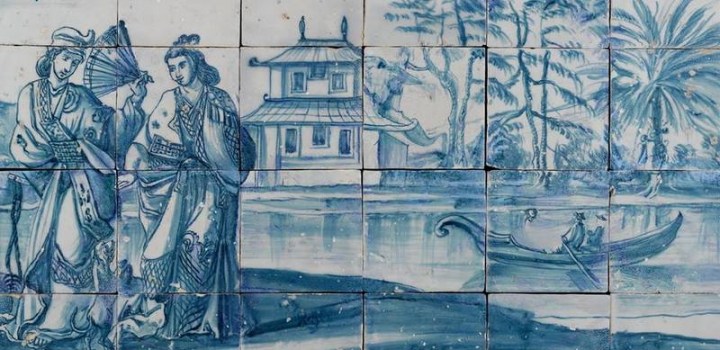
The Exotic is Never at Home? China in Portuguese Faience and Azulejo, 17th–18th Centuries
O Exótico nunca está em casa? A China na faiança e no azulejo portugueses (séculos XVII–XVIII)
Museu Nacional do Azulejo, Lisbon, 17 December 2013 — 29 June 2014
Curated by Alexandra Curvelo
◊ ◊ ◊ ◊ ◊
Since 1513, the Portuguese established a direct and regular contact between China and Europe. Taking on the role of suppliers and commercial brokers, Lusitanian adventurers and merchants progressively penetrated that immense kingdom, which was, perchance, the most exotic of the horizons dreamed and created in Europe since the Middle Ages. Exotic is a term of Latin origin, delivered from ancient Greek, meaning ‘outside’, an essential condition to arise one’s condition to marvel as it only exists after it is discovered. To this purpose the exotic object must always be transferred to a new context, in which it is reinterpreted, assuming another importance and meaning. But is the exotic always away from home, or are there moments in which it is ‘at the door’, if not even ‘in house’? These are the questions this exhibition aims to answer, by presenting the influence of China in Portuguese faience and azulejo in the 17th and 18th centuries.
◊ ◊ ◊ ◊ ◊
Dana Thomas writes about Lisbon in the March 2014 issue of Architectural Digest. . .
Be sure to pay a visit to the Museu Nacional do Azulejo (National Tile Museum), set in the opulent Madre de Deus Convent. Artist Joana Vasconcelos, who represented Portugal at last year’s Venice Biennale, calls it “one of Lisbon’s best-kept secrets.” The gem of the museum’s collection is a 75-foot-long mural from 1738 that’s made up of 1,300 tiles illustrating Lisbon before the earthquake of 1755, a cataclysm that destroyed much of the city and killed as many as 60,000 residents. Another impressive display of azulejos can be found at the São Vicente de Fora Monastery, which is decorated with tile panels depicting French poet Jean de La Fontaine’s fables. The hilltop monastery, in the historic residential neighborhood of Alfama, offers some of the finest views of the city. . .
The full article is available here»
Workshop | Italy in China: Beijing’s Old Summer Palace, Yuanmingyuan
From the Bibliotheca Hertziana in Rome:
Italy in China: The Western Buildings in the Old Summer Palace Yuanmingyuan in Beijing
Bibliotheca Hertziana, Max Planck Institute for Art History, Rome, 25 March 2014
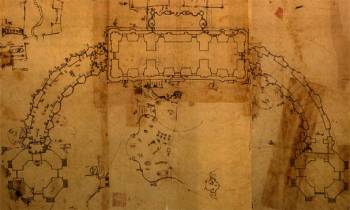 The Beijing Tsinghua Institute for Digitization THID (Tsinghua University Beijing) and the Bibliotheca Hertziana, Max Planck Institute for Art History, Rome are conducting collaborative research devoted to the now ruinous Western Buildings that are part of the Old Summer Palace Yuanmingyuan in Beijing, and which were planned and erected around 1750 by Italian/French Jesuits and Chinese architects and craftsmen. The aim of the project is to comprehensively investigate and understand the Western Buildings and to analytically visualise them in virtual 3D-models. The project examines the Sino-Western experience in the planning and construction processes with the mutual exchange of techniques and methods, concepts and models, and explores the interaction between Chinese and Western conceptions of architecture, gardens, fountains, construction and hydraulic technologies. The workshop aims to present this collaboration project to a wider audience and to give a report on the current state of the work in progress.
P R O G R A M M E
2:30 Welcome and Introduction: Sybille EBERT-SCHIFFERER (Rome), YIN Lina (Beijing), Elisabeth KIEVEN (Rome), and Hermann SCHLIMME (Rome)
3:00 YIN Lina (Beijing), The Yuanmingyuan: Current state of research and analysis of textual and visual sources
3:45 SHANG Jin (Beijing), The Western buildings: Research questions and the role of virtual 3D-models
4:30 Break
5:00 GAO Ming (Beijing) and PIAO Wenzi (Beijing), New findings based on the building survey and re-examination of historic photographs
5:45 Hermann SCHLIMME (Rome), Sino-Western knowledge transfer concerning plays of water and hydraulic technology: Benoist – Bélidor – Morland
6:30 Closing remarks
Scientific Concept: Yin Lina, Alexandra Harrer, Hermann Schlimme
Secretary: Ornella Rodengo, rodengo@biblhertz.it, 0039-06-69993-222
ASECS 2014, Williamsburg
2014 American Society for Eighteenth-Century Studies Conference
Williamsburg, 19–22 March 2014
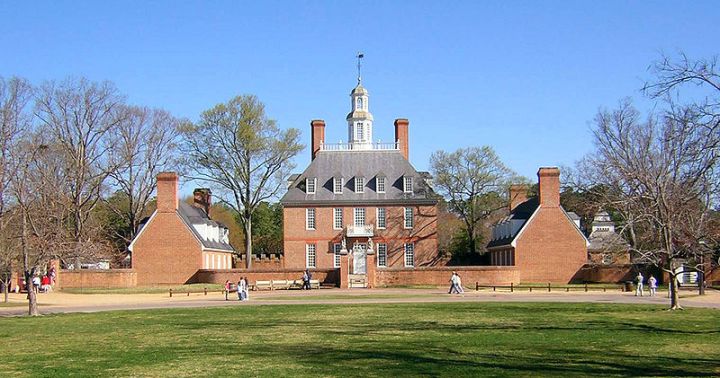
Governor’s Palace in Williamsburg, Virginia. The original structure was built between
1710 and 1722, with further additions made in the 1750s. Fire destroyed the
main house in 1781. The present building was constructed in the early 1930s.
Photo by Larry Pieniazek, 2006, from Wikimedia Commons.
◊ ◊ ◊ ◊ ◊
The 2014 ASECS conference takes place in Colonial Williamsburg, Virginia, March 19–22, at the Williamsburg Lodge. HECAA will be represented by two panels, on Friday, chaired by Denise Amy Baxter and Amy Freund and Jessica Fripp. Our annual luncheon and business meeting is also scheduled for Friday, between the two sessions. A selection of additional panels is included below (of the 221 sessions scheduled, many others will, of course, interest HECAA members). For the full program, see the ASECS website.
H E C A A S E S S I O N S
The Anne Schroder New Scholars’ Session (HECAA)
Friday, 21 March, 11:30–1:00, Colony Room A
Chair: Denise Amy BAXTER, University of North Texas
1. Diane WOODIN, University of North Carolina at Chapel Hill, “Noble Wit and Celestial Wonder in Early Modern France: The Strategic Scholarship of the Duchesse du Maine”
2. Blair DAVIS, University of California, Santa Barbara, “Roman Villas and French Garden Theory”
3. Alison HAFERA, University of North Carolina at Chapel Hill, “Quiet Spaces of Repose: The Garden as Site of Mourning in Eighteenth-Century France”
◊ ◊ ◊ ◊ ◊
Selfhood and Visual Representation in the Eighteenth Century (HECAA)
Friday, 21 March, 4:15–5:45, Allegheny Room A
Chairs: Amy FREUND, Texas Christian University AND Jessica FRIPP, Parsons The New School for Design
1. Emma BARKER, The Open University, “Blindness and Selfhood in Eighteenth-Century French Art”
2. Melina MOE, Yale University, “The Singular Macaroni or Macaroni Singularity”
3. Julia SIENKEWICZ, Duquesne University, “At Sea without a Guiding Star: Uncertain Selfhood in the Atlantic Watercolors of Benjamin Henry Latrobe”
O T H E R S E S S I O N S R E L A T E D T O T H E V I S U A L A R T S
W E D N E S D A Y , 1 9 M A R C H 2 0 1 4
Open House, Swem Library at the College of William and Mary
Wednesday, 19 March, 4:00–6:00
The Swem Library is noted for its strong special collections. Come to the Special Collections Research Center and browse selected rare books, manuscripts, and archives pulled specifically for the enjoyment of ASECS. Some of the treasures on display will be a unique first edition of Isaac Newton’s Principia, a first edition of the Book of Mormon, a list of slaves owned by the College of William and Mary, as well as letters from some of our founding fathers, George Washington, Thomas Jefferson, and James Monroe. All attendees and their guests are welcome and no registration is required.
T H U R S D A Y , 2 0 M A R C H 2 0 1 4
Textiles in the Long Eighteenth Century
Thursday, 20 March, 8:00–9:30, Allegheny Room B
Chair: Heidi A. STROBEL, University of Evansville
1. Courtney BEGGS, Bridgewater State University, “Reading Ribbons: Textile Tokens, The Foundling Hospital, and Stories of Maternity”
2. Emily WEST, McMaster University, “‘Hands without head would do little’: Mechanizing the Spinster”
3. Mei Mei RADO, Bard Graduate Center, “‘Western Tapestries’ Made in the Eighteenth-Century Chinese Court”
4. Ji Eun YOU, University of North Carolina, Chapel Hill, “Printed Fabrics and Textile on Prints: Interior Decoration during the French Revolution”
◊ ◊ ◊ ◊ ◊
Mind and Brain: Representing Cognition in Eighteenth-Century Culture
Thursday, 20 March, 8:00–9:30, Virginia Room C
Chair: Hannah Doherty HUDSON, University of Texas, San Antonio
1. Audrey HUNGERPILLER, University of South Carolina, “Clarissa’s Suffering: Theorizing Sympathy and Physical Pain in the Eighteenth Century”
2. Lucas HARDY, Youngstown State University, “‘Beatific Visions of God’: Jonathan Edwards’s Postures of Mind”
3. Stan BOOTH, University of Winchester, “Subtle Gestures: The Portrayal of the Ill and Less Able in Hogarth’s Work”
Respondent: Natalie PHILLIPS, Michigan State University
◊ ◊ ◊ ◊ ◊
Embodying the Past: The Rewards and Risks of Re-enactment
Thursday, 20 March, 9:45–11:15, Allegheny Room B
Chair: Mimi HELLMAN, Skidmore College
1. Sarah DAY-O’CONNELL, Knox College, “Singing as Translation: A ‘New Fidelity’ Approach to Performance and Meaning in Joseph Haydn’s Canzonettas”
2. Amber LUDWIG, Honolulu Museum of Art, “Re-Acting to the Past: Are Role-Playing Games Changing the Course of History?”
3. Matthew KEAGLE, Bard Graduate Center for the Decorative Arts, Design History, and Material Culture, “Coming Out of the (Costume) Closet: Re-Enactment, the Academy, and Me”
◊ ◊ ◊ ◊ ◊
Hogarth’s Legacy
Thursday, 20 March, 11:30–1:00, Allegheny Room C
Chair: Frédéric OGÉE, Université Paris Diderot
1. Isabelle BAUDINO, Ecole Normale Supérieure Lyon, “William Hogarth, Appropriation and the Construction of British Artistic Identity”
2. Frank FELSENSTEIN, Ball State University, “Hogarth’s Legacy: Does Rowlandson Fit?”
3. David A. BREWER, The Ohio State University, “Hogarth, Fictionality, and Reference”
◊ ◊ ◊ ◊ ◊
National Endowment for the Humanities Grants Projects (Roundtable)
Thursday, 20 March, 11:30–1:00, Colony Room A
Chair: Barbara ASHBROOK, National Endowment for the Humanities
1. Stephen KARIAN, University of Missouri
2. Chloe WIGSTON SMITH, University of Georgia
3. Devoney LOOSER, Arizona State University
◊ ◊ ◊ ◊ ◊
Ear, Nose, and Throat: The Other Senses of the Long British Eighteenth Century, I
Thursday, 20 March, 11:30–1:00, Colony Room C
Chair: Rivka SWENSON, Virginia Commonwealth University
1. Kathryn Strong HANSEN, The Citadel, “‘Smell a rat’: Scent and Authenticity in Burney’s Cecilia”
2. Jacqueline GRAINGER, University of Sydney, “Perfume in Print; or, the Legend of the French perfume Industry”
3. Christine GRIFFITHS, Bard Graduate Center, “‘A most pleasant Odiferous scent’: Aromatics in Early Eighteenth-Century Britain”
4. Emily C. FRIEDMAN, Auburn University, “One Scent Three Ways: Imagining the Eighteenth Century as the Age of Sulfur”
◊ ◊ ◊ ◊ ◊
Six Metaphors for the Mind (Roundtable)
Thursday, 20 March, 11:30–1:00, Piedmont Room C
Chair: Brad PASANEK, University of Virginia
1. Darryl P. DOMINGO, University of Memphis, “Archer’s Bow”
2. Joseph DRURY, Villanova University, “Musical Instrument”
3. Scott ENDERLE, Skidmore College, “Mazes”
4. Jess KEISER, Rice University, “Soldiers”
5. Kathleen LUBEY, St. John’s University, “Acorns”
6. Julie PARK, Vassar College, “Camera Obscura”
◊ ◊ ◊ ◊ ◊
Eighteenth-Century Brewing
Thursday, 20 March, 2:30–4:00, Virginia Room C
Chair: Frank CLARK, Supervisor, Historic Foodways, Colonial Williamsburg Foundation
(Fee for Tasting)
◊ ◊ ◊ ◊ ◊
Material Culture in the Atlantic World
Thursday, 20 March, 2:30–4:00, Allegheny Room A
Chair: Chloe WIGSTON SMITH, University of Georgia
1. Christian J. KOOT, Towson University, “From Manuscript to Print: The Transformation of an Early Modern Atlantic Map”
2. Kalissa HENDRICKSON, Arizona State University, “Imperial Commodities in Civic Pageantry”
3. Elizabeth A. WILLIAMS, Rhode Island School of Design Museum, “Fluid Contents: Navigating Material Culture in the Atlantic World”
◊ ◊ ◊ ◊ ◊
Materials, Artistic Process, and Meaning in the Eighteenth Century
Thursday, 20 March, 4:15–5:45, Allegheny Room C
Chairs: Sarah BETZER, University of Virginia AND Douglas FORDHAM, University of Virginia
1. Jason LAFOUNTAIN, School of the Art Institute of Chicago, “The Art-Experienced Wound and Nailhole Painting of the Moravian Brethren: Irrationality and Medium Specificity in the 1740s”
2. Francesca WHITLUM-COOPER, Courtauld Institute of Art, “La vie errante de Jean-Baptiste Perronneau (1715–1783): Pastel, Peregrinations and Instability in Eighteenth-Century Europe”
3. Melissa HYDE, University of Florida, “Pastel Trouble: The Matter of Rosalba Carriera and Quentin de La Tour”
4. Amelia RAUSER, Franklin and Marshall College, “Muslin, Marble, Ivory”
◊ ◊ ◊ ◊ ◊
Global Cities, I
Thursday, 20 March, 4:15–5:45, Liberty Room
Chair: Robert MARKLEY, University of Illinois
1. Andrew SCHULZ, Pennsylvania State University, “The Royal Botantical Garden and the ‘Recreation’ of Empire in Enlightenment Madrid”
2. Susan SPENCER, University of Central Oklahoma, “Scheming Capitalists and Suicidal Puppets: A Literature for Osaka in the Era of Edo”
3. Inhye HA, University of Illinois, “Autonomy and Gentility in Olaudah Equiano’s Eighteenth-Century American Waterfront Communities”
4. Nina Budabin MCQUOWN, Western University, Ontario, “Urban Farming: ‘Town Manures’ in Eighteenth-Century Soil and City”
◊ ◊ ◊ ◊ ◊
Eighteenth-Century Re-enactments
Thursday, 20 March, 4:15–5:45, Tidewater Room D
Chair: Sarah KAREEM, University of California, Los Angeles
1. Emily Hodgson ANDERSON, University of Southern California, “Ghosting Oroonoko”
2. Stuart SHERMAN, Fordham University, “Do Do Do What You’ve Done Done Done Before: Theatrical Reenactments and the Live Documentary”
3. Jessica LEIMAN, Carleton College, “‘The Enthusiasm of an Ingenuous Mind’: Reenacting La Nouvelle Héloïse”s
4. Chloe WIGSTON SMITH, University of Georgia, “Reenacting the Empire of Material Culture: Yinka Shonibare, Dutch Wax Prints, and Thomas Gainsborough”
◊ ◊ ◊ ◊ ◊
ASECS Members’ Reception
Thursday, 20 March, 6:00–7:00, Colony Room D&E
◊ ◊ ◊ ◊ ◊
F R I D A Y , 2 1 M A R C H 2 0 1 4
Cultures of the Machine
Friday, 21 March, 8:00–9:30, Colony Room A
Chair: Joseph DRURY, Villanova University
1. Amy FREUND, Texas Christian University, “‘The most beautiful of all inventions’: The Hunting Gun in Eighteenth-Century France”
2. Crystal B. LAKE, Wright State University, “Romantic Fictions and Dull Truths: Machines of War in the Long Eighteenth Century”
3. Christopher F. LOAR, Western Washington University, “Erasmus Darwin’s Machinery of Life”
◊ ◊ ◊ ◊ ◊
New Approaches to Eighteenth-Century Gardens
Friday, 21 March, 9:45–11:15, Allegheny Room C
Chairs: Jeffrey L. COLLINS, Bard Graduate Center AND Meredith MARTIN, New York University
1. Nicolle JORDAN, University of Southern Mississippi, “‘Her Fountains which so high their streames extend’: Garden Design and Gender Identity in the Poetry of Anne Finch”
2. Emily MANN, Courtauld Insitute of Art, “Designs on the Land: English Gardens on the Coast of West Africa”
3. Sally GRANT, Independent Scholar, “Caricature in the Garden: Encounters with the Dwarves at Villa Valmarana”
4. Julie Anne PLAX, University of Arizona, “The Hunting Park at Compiègne: Aesthetics, Economics, Environment, and Entertainment”
◊ ◊ ◊ ◊ ◊
Dissent, Protest, and Resistance in the Old and New World
Friday, 21 March, 9:45–11:15, Allegheny Room B
Chair: Gloria EIVE, Saint Mary’s College of California
1. Frieda KOENINGER, Sam Houston State University, “Don Santos Díez González, Civil Censor: Balancing Aesthetics, Politics, and Religion in 1790s Madrid”
2. Maria Soledad BARBÓN, University of Massachusetts, Amherst, “The Politics of Praise: Academic Culture and Viceregal Power in Late Colonial Peru”
3. María de las Nieves PUJALTE, Texas State University, San Marcos, “Poder y resistencia en las fronteras españolas en 1748 y en 1826—Testimonios en las obras de los viajeros Jorge Juan Cantacilia y Antonio de Ulloa”
4. Ramón Bárcena COLINA, Universidad de Oviedo y Universidad Complutense de Madrid, “Imperialism, Censorship, and Control in post-Napoleonic Spain and the European Empire: Francisco Goya y Lucientes’s Dissent”
◊ ◊ ◊ ◊ ◊
Graduate Student Mentoring Coffee
Opportunity for graduate students to meet with their assigned mentors
Friday, 21 March, 9:45–11:15, Heritage Room
◊ ◊ ◊ ◊ ◊
The Anne Schroder New Scholars’ Session (HECAA)
Friday, 21 March, 11:30–1:00, Colony Room A
Chair: Denise Amy BAXTER, University of North Texas
1. Diane WOODIN, University of North Carolina at Chapel Hill, “Noble Wit and Celestial Wonder in Early Modern France: The Strategic Scholarship of the Duchesse du Maine”
2. Blair DAVIS, University of California, Santa Barbara, “Roman Villas and French Garden Theory”
3. Alison HAFERA, University of North Carolina at Chapel Hill, “Quiet Spaces of Repose: The Garden as Site of Mourning in Eighteenth-Century France”
◊ ◊ ◊ ◊ ◊
Regimes of Visuality: Technologies of Vision (Science Studies Caucus)
Friday, 21 March, 11:30–1:00, Colony Room C
Chair: Jess KEISER, Rice University
1. Al COPPOLA, John Jay College, City University of New York, “Seeing Science”
2. Kevin CHUA, Texas Tech University, “Children’s Scientific Literature and the Cybernetic Example”
3. Susan LIBBY, Rollins College, “Rationalizing Colonialism, Mapping Slavery in the Encyclopedie Illustrations of New World Plantation Labor”
4. Alexander WRAGGE-MORLEY, Caltech and Huntington Library, “Writing as Visual Technology in Natural History and Natural Philosophy”
◊ ◊ ◊ ◊ ◊
HECAA Luncheon and Business Meeting
Friday, 21 March, 1:00–2:30, Virginia A
◊ ◊ ◊ ◊ ◊
Presidential Address, Awards Presentation, and ASECS Business Meeting
Friday, 21 March, 2:30–4:00, Virginia Room E&F
Joseph ROACH Yale University, “Invisible Cities and the Archeology of Dreams”
Presiding: Misty ANDERSON University of Tennessee, Knoxville
◊ ◊ ◊ ◊ ◊
Selfhood and Visual Representation in the Eighteenth Century (HECAA)
Friday, 21 March, 4:15–5:45, Allegheny Room A
Chairs: Amy FREUND, Texas Christian University AND Jessica FRIPP, Parsons The New School for Design
1. Emma BARKER, The Open University, “Blindness and Selfhood in Eighteenth-Century French Art”
2. Melina MOE, Yale University, “The Singular Macaroni or Macaroni Singularity”
3. Julia SIENKEWICZ, Duquesne University, “At Sea without a Guiding Star: Uncertain Selfhood in the Atlantic Watercolors of Benjamin Henry Latrobe”
◊ ◊ ◊ ◊ ◊
Exhibition Lecture, Threads of Feeling
Friday, 21 March, 5:00, Hennage Auditorium, Art Museums of Colonial Williamsburg
John STYLES, University of Hertfordshire, “Threads of Feeling: Foundlings, Philanthropy, and Textiles in Eighteenth-Century London”
When mothers left babies at London’s Foundling Hospital in the mid- eighteenth century, the Hospital often retained a small object as a means of identification, usually a piece of fabric. These swatches of fabric now form Britain’s largest collection of everyday textiles from the eighteenth century. They include the whole range of fabrics worn by ordinary women, along with ribbons, embroidery, and even baby clothes. Each scrap of fabric reflects the lives of an infant child and its absent parent. Collectively, they comprise a poignant, elegiac materialization of separation and loss. The lecture explains why the Foundling Hospital amassed these textiles and reflects on the capacity of such objects to perform emotional work. The exhibition Threads of Feeling, curated by John Styles, is at the DeWitt Wallace Decorative Arts Museum, in the Art Museums of Colonial Williamsburg. Limited numbers, pre-registration required. Register at the ASECS Registration Desk by 4:00.
◊ ◊ ◊ ◊ ◊
Women’s Caucus Masquerade Ball
Friday, 21 March, 9:00–12:00, Colony Room
Admission fee includes dessert and coffee; cash bar will be available
S A T U R D A Y , 2 2 M A R C H 2 0 1 4
Napoléon and the Art of Propaganda
Saturday, 22 March, 8:00–9:30, Allegheny Room A
Chair: Heidi KRAUS, Hope College
1. Wayne HANLEY, West Chester University, “General Bonaparte and His Artists: Appiani, Gros, and David”
2. Carole F. MARTIN, Texas State University, “Crossing the Alps: The Advent of the Napoleonic Era”
3. Heather MCPHERSON, University of Alabama at Birmingham, “The Napoleon Effect”
4. Susanne ANDERSON-RIEDEL, University of New Mexico, “Alexandre Tardieu’s Interpretation of Raphael’s Modernity for Napoleonic Art”
◊ ◊ ◊ ◊ ◊
Reproducing the Past in the Eighteenth Century
Saturday, 22 March, 8:00–9:30, Piedmont Room A
Chair: Alicia KERFOOT, The College at Brockport, State University of New York
1. Amy MALLORY-KANI, University at Albany, State University of New York, “‘These Perilous Times’: (Re)Inventing the (Early) Modern Woman in Mary Hays’s Female Biography”
2. Niall ATKINSON AND Susanna CAVIGLIA, University of Chicago, “The Eternal Modernity of Rome: The Poetics of the Past in French Eighteenth-Century Painting”
3. Susan EGENOLF, Texas A&M University, “The Arts of Etruria Reborn in Industrial England: Wedgwood’s Classical Aesthetic”
◊ ◊ ◊ ◊ ◊
Historical Reenactment, Living History, and Public History: Theorizing Generative Intersections between Tourists, Communities and Scholars” (Society of Early Americanists)
Saturday, 22 March, 9:45–11:15, Allegheny Room A
Chair: Joy A. J. HOWARD, Saint Joseph’s University
1. Michael TWITTY, Independent Food Historian and Interpreter, “‘No More Whistling Walk For Me,’ Historian and Food Interpreter”
2. Sara HARWOOD, Georgia State University, “Escaping the ‘Tourist Trap’: Recent Endeavors of the Witch House in Salem, Massachusetts”
3. Russell Taylor STOERMER, Colonial Williamsburg Foundation and the College of William and Mary, “Researching History for Living History Programs”
4. Tyler PUTNAM, University of Delaware, “Historic Trades Skills, Historical Scholarship, and Living History Interpretation”
5. Susan KERN, The College of William and Mary, “Students as Tourists, Critics, and Neighbors: Teaching Public History at William and Mary”
6. Janet S. ZEHR, Salem College, “Embodied and Disembodied Voices: Modes of Interpretation of Black and White Experience at Old Salem, North Carolina”
7. Wayne RANDOLPH, Colonial Williamsburg Foundation, “Where the Rubber Hits the Road: Bridging Academia to ‘The Masses’”
◊ ◊ ◊ ◊ ◊
Rousseau and the Visual
Saturday, 22 March, 9:45–11:15, Colony Room A
Chair: Melissa HYDE, University of Florida
1. John GREENE, University of Louisville, “Optical Allusions: Text and Image in Rousseau”
2. Brigitte WELTMAN-ARON, University of Florida, “Justice Disfigured: Rousseau’s Manuscript of Les Rêveries du promeneur solitaire”
3. Lauren CANNADY, Centre allemand d’histoire de l’art, Paris, “Between Reveries and Seduction: Rousseau in the Garden”
◊ ◊ ◊ ◊ ◊
Celebrating ‘Our King’ in an Age of Enlightenment: Commemorating Monarchs in Music, Print and Every Day Life in the British Atlantic World
Saturday, 22 March, 9:45–11:15, Tidewater Room B
Chair: Amanda E. HERBERT, Christopher Newport University
1. Anne WOHLCKE, California State University, Pomona, “The King at the Head of the Army: Commemorating King George II as a hero of the Austrian War of Succession”
2. Stephanie KOSCAK, University of California, Los Angeles, “Playing with Pictures of the King: Print Consumers, Royal Authority, and Aesthetic Vacuity”
3. Birte PFLEGER, California State University, Los Angeles, “Celebrating George II and Frederick the Great: Creating an Anglo-German Middle Ground in Colonial Pennsylvania”
◊ ◊ ◊ ◊ ◊
Gallery Talk, Threads of Feeling
Saturday, 22 March, 10:00, DeWitt Wallace Decorative Arts Museum
John STYLES, University of Hertfordshire, will discuss the ideas that shaped his exhibition Threads of Feeling in the gallery where it is displayed. Limited numbers, pre-register at ASECS registration desk.
◊ ◊ ◊ ◊ ◊
Beyond Goya: Culture High and Low in Spain and the New World during the Reign of Carlos IV 1789–1808 (Ibero-American Society for Eighteenth-Century Studies)
Saturday, 22 March, 2:00–3:30, Colony Room A
Chair: Janis A. TOMLINSON, University of Delaware
1. Liana EWALD, San Diego University, “Culture, Gender, National Society: Women in the Cartas Marruecase
2. Kelly DONAHUE-WALLACE, University of North Texas, “Jerónimo Antonio Gil, Laocoön’s Son, and the Spanish Enlightenment
3. Catherine JAFFE, Texas State University, “From Cape and Dagger to Didactic Novel: Molding Taste during the Reign of Carlos IV, or Count Belflor Lives to Fight Another Day”
4. Susan DEANS-SMITH, University of Texas at Austin, “Consuming Culture in Late Colonial Mexico City”
◊ ◊ ◊ ◊ ◊
Let’s Get Engaged!: Teaching Tradition in a Non-Traditional Classroom (Women’s Caucus)
Saturday, 22 March, 2:00–3:30, Colony Room C
Chairs: Heather KING, University of Redlands AND Srividhya SWAMINATHAN, Long Island University
1. Heidi A. STROBEL, University of Evansville, “Transforming Exclusion into Inclusion”
2. Laura LINKER, High Point University, “Engaging Bodies: Teaching the Restoration”
3. Kathleen ALVES, City University of New York, “Teaching Swift, Sex, and Race in the Two-Year College”
4. Glen COLBURN, Morehead State University, “Civilization and its Discontents in Early Eighteenth-Century Britain”
◊ ◊ ◊ ◊ ◊
Rhyme or Reason? The Aesthetics of Prayer (German Society for Eighteenth-Century Studies / Deutsche Gesellschaft für die Erforschung des 18. Jahrhunderts, DGEJ)
Saturday, 22 March, 2:00–3:30, Liberty Room
Chairs: Laura M. STEVENS, University of Tulsa AND Sabine VOLK-BIRKE, Martin-Luther-University, Halle
1. James A. WINN, Boston University, “Intimations of Jubilation: Christopher Smart’s Early Religious Poems”
2. Karissa E. BUSHMAN, Augustana College, “From Devotion to Mindless Adoration: Depictions of Prayer and Worship in Goya’s Works”
3. Michael ROTENBERG-SCHWARTZ, New Jersey City University, “Representing Prayer in English Travel Narratives”
4. Malinda SNOW, Georgia State University, “Isaac Watts’s Book of Common Prayer”
◊ ◊ ◊ ◊ ◊
Pop! Goes the Eighteenth Century
Saturday, 22 March, 2:00–3:30, Piedmont Room A
Chair: Guy SPIELMANN, Georgetown University
1. Dorothée POLANZ, University of Virginia, “Merchandizing Queen: Marie Antoinette, 1793–2013”
2. Kimberly CHRISMAN-CAMPBELL, Independent Scholar, “Lost at Sea: Ship Hats in Contemporary Fashion”
3. Alaina PINCUS, University of Illinois, “Austen’s Caché and the Twenty-First-Century Popular Romance”
◊ ◊ ◊ ◊ ◊
Gallery Talk, Threads of Feeling
Saturday, 22 March, 2:00, DeWitt Wallace Decorative Arts Museum
John STYLES, University of Hertfordshire, will discuss the ideas that shaped his exhibition Threads of Feeling in the gallery where it is displayed. Limited numbers, pre-register at ASECS registration desk.
◊ ◊ ◊ ◊ ◊
Migration, Society and the ‘Exceptional’ Gulf Coast
Saturday, 22 March, 3:45–5:15, Allegheny Room A
Chair: Susan GAUNT STEARNS, Northwestern University
1. Gordon SAYRE, University of Oregon, “The Mississippi Bubble and the Settling of Louisiana: Perspectives from the Memoir of Lieutenant Dumont”
2. Frances KOLB, Vanderbilt University, “Migration in Spanish Louisiana during the Years of Partition, 1763–1783”
3. Judith BONNER, The Historic New Orleans Collection, “From Sketches to Portraits: The Rise of Painting along the Gulf of Mexico in the Eighteenth-Century”
4. Kristin CONDOTTA, Tulane University, “A Taste of Home: Irish Foodways in Early New Orleans”
◊ ◊ ◊ ◊ ◊
Artistic Matters of Life and Death in Anatomical Study: Live Models, Cadavers and Ecorche Figures
Saturday, 22 March, 3:45–5:15, Allegheny Room B
Chair: Andrew GRACIANO, University of South Carolina
1. Josh HAINY, University of Iowa, “John Flaxman’s Anatomical Drawings: The Body as Theoretical Model”
2. Meredith GAMER, Yale University, “Tyburn’s Docile Bodies: Criminal Anatomies in Eighteenth-Century London”
3. Corinna WAGNER, University of Exeter, “Artists, Anatomists, and the Transparent Body: Categorical Impulse and Human Identity”
Respondent: Rebecca MESSBARGER, Washington University in St. Louis
◊ ◊ ◊ ◊ ◊
Antiquarianism (in Theory)
Saturday, 22 March, 3:45–5:15, Piedmont Room C
Chairs: Crystal B. LAKE, Wright State University AND Ruth MACK, State University of New York, Buffalo
1. Craig HANSON, Calvin College, “From Ancient Paintings to Illustrious Persons: Antiquarian Patronage and Illustration in the 1740s”
2. Joshua SWIDZINSKI, Columbia University, “Thomas Gray’s Unfinished History of English Poetry: Metrical Antiquarianism and the Problem of Literary History”
3. Jeff STRABONE, Connecticut College, “The Case of Robert of Gloucester’s Chronicle: Towards a Theory of Mediation in the Eighteenth Century”
◊ ◊ ◊ ◊ ◊
Eighteenth-Century Book Illustration, the Engraved Author Portrait, and the Formation of the Literary Canon
Saturday, 22 March, 3:45–5:15, Tidewater Room C
Chair: Kwinten VAN DE WALLE, Ghent University
1. Peter WAGNER, Universität Koblenz-Landau, “Swift’s Parody of Author Portraits”
2. Gerald EGAN, California State University, “Alexander Pope’s Master Hand”
3. Enid VALLE, Kalamazoo College, “Before and after the Inquisition: Author’s Portrait and Text Illustrations of Pablo de Olavide’s El Evangelio en Triunfo”
4. Geoffrey SILL, Rutgers University, “Versions of Defoe: Portraits of the Artist from His Works”
◊ ◊ ◊ ◊ ◊
Williamsburg Walking Tour, 1774
Saturday, 22 March, 3:45–5:15, departing from lobby of Colonial Williamsburg Conference Center
Led by William WARNER, University of California, Santa Barbara
This tour will highlight the events in Williamsburg Virginia between May 25th and June 1st, 1774, in the wake of news of the Boston Port Bill, which closed down Boston harbor as punishment for the destruction of the Tea in Boston Harbor the previous winter. The tour will begin at the Colonial Williamsburg Conference Center. You don’t need Williamsburg tickets because we will be walking by the outsides of key sites and buildings (not taking tours within them). We will use a time-line of key events, a map (provided by the tour guide, Professor Warner), as well as handouts from which participants will be able to read (perhaps even aloud!). The goal is to bring together place and political speech/writing so that we can consider how they work together to mediate the American Crisis during one week of 1774 in Williamsburg.










 Enfilade
leave a comment