Call for Papers | Family Patronage in Genoa, Rome, and Venice
Family Patronage in Early Modern Genoa, Rome, and Venice, 1500–1750
Bibliotheca Hertziana—Max-Planck-Institut für Kunstgeschichte, Rome, 8 September 2014
Proposals due by 15 April 2014
Among the increasingly monarchic arena of Early Modern Europe, the powerful Italian cities of Genoa, Rome, and Venice are exceptional. Genoa and Venice, the largest remaining republics in Italy, predominated the financial, mercantile, and military spheres of the Mediterranean. Rome’s religious authority and historical cachet, along with its sizable territory, were the foundations of its leading position. All three of these cities stand out for their oligarchic
power structures; while Genoa and Venice were led by governments elected from a restricted book of families, Rome fostered an aristocracy both parallel to and participating in the electoral principle of the Papal court. Therefore, in the absence of hereditary lords, power and prestige was shared among the ruling families. As a result, in all of these cities, the families could remain powerful even as the government changed.
Central challenges for these cities’ aristocratic families were how to figure their relationships to local power structures and balancing their own interests against those of the communal state. The particular social-political contexts nurtured different forms and strategies of representation than those deployed in monarchic and ducal societies. The oligarchic aristocracy had to submit to an abstract concept shaped by values and virtues such as equality and liberty rather than to a dynastic authority. Each of these societies experienced turning points when their political structures shifted and opened to new families—be they from outside the city or from non-noble stock—and their ruling classes sought new methods of representation and patronage to assert their role in the changed social scene. The reforms of 1576 to Genoa’s oligarchic government, the rising status of papal families in seventeenth-century Rome, and the opening of the Libro d’Oro in the context of Venice’s wars against the Ottoman Turks in the late seventeenth century were all moments from which such changes arose.
Against this background, this study day seeks to compare the demands and strategies of art and architectural patronage among these non-dynastic aristocratic groups. Although Genoa and Venice have often been mentioned in chorus, they have never been directly and critically compared. Because of their diverse political alliances and statuses, the differences in their governmental structures, as well as their differing territorial dispositions, two distinct types of an early modern republic developed. Furthermore, the exemplary role of Rome for the non-monarchic sphere—its permeable system of social ascension—still asks for a more differentiated view. While scholarship often focuses on the Papacy of Rome and likens it to a monarchy, we seek to understand the strategies of the ruling class while not in power.
We invite abstracts from scholars in all stages of their careers addressing key aspects and questions such as the following:
– How did individual families present themselves vis-a-vis rival families or the state?
– How and when did these representations take place?
– What were the spaces used for representation and how were they marked?
– How did these strategies change or shift through time or across political changes?
– Can we identify instances of collective patronage or patterns of patronage?
– Are there collective representations or patterns of representation?
– Did strategies differ between sacred and secular contexts? If so, how?
– How do we conceive of the dialectic of public / private in these societies?
Proposals for 25-minute papers should include the title of the paper, a 250– to 300-word abstract, the author’s institutional affiliation, a one-page CV, and full contact information. Papers may be submitted in English, French, German, and Italian. Proposals should be sent to both: Benjamin Eldredge (Bibliotheca Hertziana) eldredge@biblhertz.it and Bettina Morlang-Schardon (Bibliotheca Hertziana), morlangschardon@biblhertz.it.
Summer Institute | Rebuilding the Portfolio: Digital Humanities
This brings the number of summer institutes devoted to the digital humanities announced here at Enfilade up to three (with one in Los Angeles and one in Middlebury, Vermont). Try a keyword search (available to the right) for other opportunities.
Rebuilding the Portfolio: Digital Humanities for Art Historians Summer Institute
George Mason University, Fairfax, Virginia, 7–18 July 2014
Applications due by 15 March 2014
◊ ◊ ◊ ◊ ◊
Applications are now open for Rebuilding the Portfolio: Digital Humanities for Art Historians, a summer institute at the Roy Rosenzweig Center for History in New Media, George Mason University, supported by the Getty Foundation, July 7–18, 2014. The program is designed for 20 art historians, from different stages of their careers and from varied backgrounds, including faculty, curators, art librarians, and archivists who are eager to explore the digital turn in the humanities. We seek applications from individuals who have had very limited or no training in using digital methods and tools, or in computing. A tentative schedule is available here. We will accept applications until March 15, 2014.
Sheila Brennan and Sharon Leon
Co-Directors, Rebuilding the Portfolio: DH for Art Historians
Roy Rosenzweig Center for History and New Media, George Mason University
At CAA 2014 | British Country Houses and Gardens
Historians of British Art
British Country Houses: Architecture, Collections, and Gardens
Thursday, 13 February, 12:30–2:00, Hilton Chicago, 3rd Floor, Williford A&B
As late as last December, I announced a Call for Papers for a session at this week’s conference of the College Art Association. As one of Thursday’s lunch panels, the session had already been reserved for the Historians of British Art, and in my announcement I referenced “a spirit of nimble experimentation.” Well I’m thrilled to have three promising papers, the abstracts of which are available below (they obviously won’t be available through CAA). For anyone in Chicago this week, please turn up. The session is intended to be a productive opportunity for feedback and discussion. And as a midday session, it is open to the public without the usual CAA membership or conference registration fees (it’s entirely free). For easier printing, a PDF file of the abstracts is also available here.
Many thanks,
Craig Hanson
◊ ◊ ◊ ◊ ◊
William L. Coleman (University of California, Berkeley), ‘Both instructive and pleasant’: The Country House Garden in Vitruvius Britannicus
The Scottish architect Colen Campbell is best known not for any of his buildings nor for the influential offices he held during his lifetime but for his collection of engraved views of British country houses: Vitruvius Britannicus, or the British Architect. This project, issued in three volumes from 1715 to 1725 with nearly 300 folio plates has been called “the most ambitious publication of engraved material yet attempted in Britain.”1
While the mission of Vitruvius Britannicus is clear enough—the advancement of Palladian architecture in Great Britain as an alternative to Roman ecclesiastical influence through a direct appeal to those in a position to commission new country houses—there are major differences between the contents of the volumes of the book. In contrast to the first two entries in the series, which consist exclusively of plans, elevations, and occasional sections of noteworthy buildings, the 1725 third volume of also includes birds-eye views and elaborate perspectives of country-house gardens. Here, for the first time in the book, Campbell shows detailed information about the form of the grounds of the country houses he celebrates, often to the detriment of the architectural representation that has been central until this point. The garden images have rarely been commented upon in the literature on Vitruvius Britannicus despite the fact that Campbell alerted his audience to the significance of this material in an advertisement for Volume III, in which he wrote “the Author has made a great Progress in a Third Volume containing the Geometrical Plans of the most considerable Gardens and Plantations with large Perspectives of the most Regular Buildings, in a Method intirely new, and both instructive and pleasant.”2 If these plates are not merely “pleasant” but “instructive,” in what do they instruct?
This paper will argue that Campbell’s garden views should be understood as integral to his overarching goal of reforming British taste, rather than as decorative adjuncts to it, and that these plates suggest a new way of understanding a period in garden history that has proven problematic in the past. Christopher Hussey and John Harris, among others, have recognized that many English gardens built from about 1715 to 1730 differ from the Anglo-Dutch style that came before in their gradual departure from bi-lateral symmetry and their embrace of elaborate, classicizing outbuildings to create interesting perspectives, but do not yet reject geometric construction in the way the better known work of Capability Brown would later in the century.3 Rather than treating the gardens Campbell describes and represents in his book as aberrant or merely transitional, it will be productive to consider how they relate to his architectural project. Just as Volumes I and II of Vitruvius Britannicus argue for a British Palladianism to counter perceived Catholic decadence, so does Volume III make a case for what can be called the Neopalladian garden. While damning others with faint praise, Campbell held up as exemplary gardens that, by means of their citations of Palladio in buildings and their allusions to laborless Arcadian bounty, constituted an alternate horticultural modernity.
1. E. Harris, “Vitruvius Britannicus before Colen Campbell,” The Burlington Magazine 128 (May 1986), p. 340..
2. Campbell, Vitruvius Britannicus II, p. 8.
3. C. Hussey, English Gardens and Landscapes: 1700–1750 (New York, 1967), p. 132; J. Harris, “The Artinatural Garden” in C. Hind ed. The Rococo in England: A Symposium (London, 1986), pp. 8–9.
◊ ◊ ◊ ◊ ◊
Jocelyn Anderson (Courtauld Institute of Art), From Stowe to Mount Edgcumbe: Touring Collections in Gardens
In the eighteenth and early nineteenth centuries, as country-house tourism became increasingly popular, guidebooks for specific houses and gardens were published. Indicative of houses having thoroughly established themselves as destinations for polite tourists, these guidebooks provide critical evidence as to how these sites were presented to and remade for visitors. Many guidebooks focus on the art collections of houses, cataloguing pictures and sculptures and explaining them for readers. Several guidebooks, however, describe gardens, and close examination of these texts sheds new light on the public significance of these places. While garden historians have usefully analysed these cultivated landscapes from the perspective of designers and owners, guidebooks demonstrate that tourists’ experiences of these places would often have been quite different. This paper explores the guidebooks for three gardens and considers the significance of how these texts describe and comment on these sites.
By the middle of the eighteenth century, Viscount Cobham’s gardens at Stowe (Buckinghamshire) spread over 200 acres and contained over forty temples. They were among the most famous in Britain, and they had become a popular tourist attraction, complete with an inn for tourists’ convenience. Stowe’s first guidebook was published in 1744, and over the following sixty years, over twenty editions appeared. The gardens at Hawkstone (Shropshire) were not as famous, but the estate also had an inn for visitors, and ten guidebooks to its grounds were published between 1766 and 1811. It was known for its rugged natural landscape, which included a sharp ridge of sandstone hills and a deep ravine, along with an exceptionally eccentric collection of ornamental features. In the former aspect it was similar to Mount Edgcumbe (Devon), whose coastal site had inspired a garden which incorporated panoramic views of the ocean and walks along cliffs. Mount Edgcumbe was celebrated in the later eighteenth century, but it wasn’t until the early nineteenth century that its first guidebooks were published.
What these three gardens have in common is the approach guidebook authors took when they described them for visitors. The first, and most prominent, device adopted was the circuit, which organized both the guidebook and the garden itself. The circuit was the itinerary tourists were meant to follow while visiting the garden, leading them through both locations in space and descriptions on the page (depending on the garden, it was not necessarily circular). The circuit in all three of these guidebooks is constructed by a progression of entries about specific temples and locations; these are, in effect, descriptions of gardens written as chains of descriptions about destinations within them. Within this structure, the guidebooks provide detailed entries about each place where visitors were expected to pause during their tour. Many of these entries are extraordinarily attentive to detail, supplying information about everything from the architect who designed a temple to what might be visible on the distant horizon. Through these guidebooks’ approach, visits to these gardens are constructed as collections of close examinations and responses, similar to those which might be had touring the art collection inside a country house.
◊ ◊ ◊ ◊ ◊
Laurel O. Peterson (Yale University), Art, War, and Politics in William Kent’s North Hall at Stowe
In the late 1720s, Richard Temple, viscount Cobham, commissioned William Kent to design and decorate the interior of his north entrance hall at Stowe House. Kent had established himself as a leading artist in Britain, and he created a room for Cobham in the latest fashion. While only the grisaille and gold ceiling remains of Kent’s scheme, it is the oldest surviving interior at Stowe. This paper considers Kent’s and Cobham’s intertwining artistic, social, and political aims in the decoration of the North Hall, and argues for an interpretation of this space as representative of a vital artistic culture found in the early eighteenth-century country house.
The North Hall celebrates Cobham’s military career. The central allegorical ceiling panel portrays the young Cobham receiving a sword from Mars, and commemorates the date in 1702 when he received his own army regiment from William III. Cobham rose through the ranks, eventually serving as a lieutenant general under John Churchill, first duke of Marlborough, in the War of Spanish Succession. Cobham’s military career enabled his political and social rise; he served in the ministries of George I and ultimately was elevated to a viscountcy in 1718. While the expression of Cobham’s Whig ideologies through garden architecture is well known, this paper draws attention to the interior as a central part of his project. By representing a moment that celebrates his connection to William III, Cobham chose to emphasize his commitment to the Glorious Revolution of 1688, a political statement that aligned with his Opposition Whig politics. Other parts of Kent’s original decorative scheme, such as Christophe Veyrier’s marble relief of the Family of Darius before Alexander (c. 1680), reinforced the military theme.
The North Hall—the point of entry for any guest to Stowe House—formed one part of a larger temporal and spatial viewing experience. This paper suggests ways in which Kent’s decoration worked in dialogue with other spaces and works of art in various media in the building, such as the set of the Art of War tapestries (ca. 1706–12), woven by Judocos de Vos after designs by Lambert de Hondt.
This paper not only explores how the North Hall was invested with political meaning, but also examines the stakes in play with this aesthetic project. Contextualizing this space within a larger continuum of other interiors highlights the specific aims of both Cobham and Kent. Blenheim, the preeminent contemporary military palace, built for and decorated in honor of the Duke of Marlborough, Cobham’s former commander, is a particularly salient comparison. In addition, examining Kent’s ceiling in relation to his work at Kensington Palace and at Houghton Hall, as well as in relation to continental models, situates the artist’s work both within ambitious and distinguished artistic traditions and on the forefront of innovative design. Artistic production and ambition within the country house must be understood as concomitant with developing political roles of the landed elite. This paper suggests how a space such as Stowe’s North Hall must be considered a key site of artistic production, part of a dynamic artistic culture thriving in early eighteenth-century country houses.
Exhibition | Capturing the Castle: Watercolours of Windsor
From the exhibition press release (18 December 2013). . .
Capturing the Castle: Watercolours of Windsor by Paul and Thomas Sandby
The Drawings Gallery, Windsor Castle, 7 February — 5 May 2014
Curated by Rosie Razzall

Paul Sandby, The Lower Ward Seen from the Base of the Round Tower,
ca. 1760 (The Royal Collection)
◊ ◊ ◊ ◊ ◊
Twenty views of Windsor Castle by the great 18th-century watercolourists Paul and Thomas Sandby go on display at the Castle from 7 February. Created from the 1760s to the 1790s, they provide a fascinating insight into life at Windsor during the reign of George III (1760–1820), who used the Castle as an occasional country retreat for his growing family. The drawings will be displayed alongside a number of early guidebooks, showing what visitors to Windsor would have experienced some 250 years ago. 21st-century visitors can use a free app to explore the 18th-century views and compare them with the appearance of the Castle today.
 ‘The father of English watercolour’, Paul Sandby (1730–1809) and his older brother Thomas (1721–98) were among the founding members of the Royal Academy under the patronage of George III in 1768. They sometimes worked together, with Paul Sandby adding figures to his older brother’s landscapes.
Thomas Sandby was Draughtsman to William Augustus, Duke of Cumberland, and came to Windsor in 1746 following the Duke’s appointment as Ranger of Windsor Great Park. After Paul’s arrival in Windsor a few years later, the brothers set about producing views of the Castle from numerous angles and viewpoints, creating an unrivalled visual record of the building and surrounding area.
During this period the Castle became a popular tourist destination—the Precincts were open to the public, and access to the State Apartments was granted upon application to the Housekeeper. The Sandby watercolours show the informality of daily life around the Castle in the mid-18th century. They record soldiers chatting idly with the townsfolk, street traders hawking their wares, and elegantly dressed visitors strolling on the North Terrace, from where they could admire the views across the Thames Valley. The watercolours also document the appearance of the Castle before the major remodelling of the building by George III’s son, George IV, in the 1820s. In Paul Sandby’s View of the Quadrangle, from around 1765, the Round Tower appears significantly lower than it is today. Sixty-five years later it was heightened by some nine metres (30ft), and given Gothic-style battlements and a flag turret, creating Windsor’s now world-famous skyline.
◊ ◊ ◊ ◊ ◊
The Royal Collection Acquires Rare Portrait of Paul Sandby

Paul Sandby, The Quadrangle Looking West, ca. 1765
(The Royal Collection)
◊ ◊ ◊ ◊ ◊
Press release (4 February 2014) . . .
He is known for his beautiful views of Windsor, providing a fascinating insight into life at the Castle during the reign of George III (1760–1820). Now, 250 years later, a portrait miniature of Paul Sandby (1731–1809), ‘the father of English watercolour’, will go on display in a new exhibition at Windsor Castle and return the artist to the royal residence where he made his name. One of only a few known images of the artist, the miniature has been acquired by The Royal Collection Trust for the Royal Collection, which holds one of the world’s largest groups of work by Paul Sandby and his older brother Thomas. The miniature will be shown alongside some of Paul Sandby’s most famous views. The exhibition, Capturing the Castle: Watercolours of Windsor by Paul and Thomas Sandby, includes 20 works produced from the 1760s to the 1790s by the two brothers. They reveal the informality of daily life at Windsor during the reign of George III, who used the Castle as an occasional country retreat for his growing family.
 Despite his successful career as one of the founding members of the Royal Academy, Paul Sandby was rarely painted himself. A half-length portrait, the miniature shows Sandby at the age of 56 against a landscape with Windsor Castle in the background. He wears a blue coat, white waistcoat and cravat, and holds a porte-crayon, used for drawing with pieces of chalk, and an open sketchbook. The miniature was painted in 1787 by the Jersey-born artist Philip Jean (1705–1802), who also produced portraits of the British royal family, including George III and his consort Queen Charlotte.
Born in Nottingham, Paul Sandby arrived at Windsor in the early 1750s, following Thomas’s employment as Draughtsman to William Augustus, Duke of Cumberland (uncle to George III), who had been appointed the Ranger of Windsor Great Park in 1746. The brothers set about producing views of the Castle from numerous angles and viewpoints, creating an unrivalled visual record of the building and surrounding area.
The watercolours record soldiers chatting with the townsfolk, street traders hawking their wares, and elegantly dressed visitors strolling along the North Terrace and admiring the views across the Thames Valley. One particularly noticeable difference between the 18th-century Castle and that today is documented in the Sandbys’ watercolours: in The Quadrangle, Windsor Castle, looking west, c.1765, the iconic Round Tower appears significantly lower. It was heightened by some nine metres (30ft) 65 years later, as part of the George IV’s remodelling of the Castle. Gothic-style battlements and a flag turret were added, creating Windsor Castle’s now world-famous skyline. (more…)
Call for Papers | Houses as Museums / Museums as Houses
Call for Papers from the Museums and Galleries History Group:
Houses as Museums / Museums as Houses
Wallace Collection, London, 12–13 September 2014
Proposals due by 17 February 2014
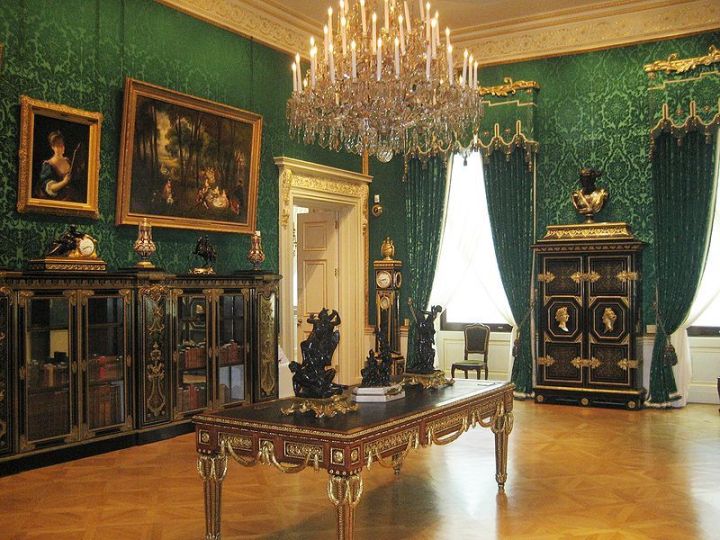
Back State Room, Wallace Collection, London
◊ ◊ ◊ ◊ ◊
The relationship between museums and domestic spaces is a long and complex one. Museums were born in the houses of collectors, while the reconstruction of the house or domestic room—of ‘home’, effectively—continues to be an influential if controversial model for museum display. On the other hand, museums have at times invested heavily in the idea of their spaces as public, scientific and definitively non-domestic. The line between house and museum is therefore also one between public and private, scientific and domestic; and house-museums/museum-houses have acted both to confirm, to alter, and to undermine this line completely.
The 2014 MGHG conference seeks to understand the historical development of this relationship by investigating the ways in which museums have acted as houses, and houses have acted as museums. It will also explore the ways in which house-museums/museum-houses have been positioned in boundary zones of space and time, and what effect they have had on those boundaries. The conference will take place at the Wallace Collection, London, on Friday 12 and Saturday 13 September 2014, itself an illustration of the ways in which houses may become museums, or are (re)designed as museums by their owner, as Hertford House was by Sir Richard Wallace.
We also encourage papers on aspects as diverse as the growth of the celebrity house museum, cabinets of curiosity, curatorial practices of the homeowner in contrast to those of the professional curator, and the development of open air museums and their approach to house reconstruction. Our focus is on the historical development of these themes, but papers which consider the interaction of historical and contemporary practice will also be considered. We encourage papers from museum professionals, researchers, and students from multiple disciplines.
Keynote speakers confirmed so far: Helen Rees Leahy, Professor of Museology at the University of Manchester.
Possible topics for papers include, but are not limited to:
•Country houses as museums
• Artist/writer/scientist house museums
• Houses converted into museums
•Museums in houses: cabinets of curiosity, children’s museums, amateur museumss
•Museums in other domestic settings such as ‘inn parlour’ museums
•Museums as places to live, for curators, caretakers and others
•Owners, custodians and curators
•Subjective and eccentric taxonomies
Please send proposals for papers, of no more than 250 words, with brief biographical information, to secretary@mghg.org, by Monday 17 February 2014.
Forthcoming Book | Between Formula and Freestyle: Nicolai Abildgaard
Due out in June from Archetype:
Troels Filtenborg, Between Formula and Freestyle: Nicolai Abildgaard and Eighteenth-Century Painting Technique (London: Archetype, 2014), 152 pages, ISBN: 978-1909492097, £38 / $80.
As the most important Danish history painter, Nicolai Abildgaard (1743–1809) worked in a century that saw marked shifts in the styles of painting, from the late Baroque via Rococo to Neoclassicism, as well as the emergence of art academies throughout Europe as the prevalent factor in the training of young artists. Abildgaard has been the subject of a number of studies through the years. Within this considerable body of research, however, little attention has been given to the technical material aspect of his art. This book presents results of a paint technical study of his oeuvre, from early student paintings to mature works from his later years.
As a result of the composite nature of his training in Copenhagen as well as in Rome in the 1760s and 70s, a number of factors in Abildgaard’s formative years were influential in shaping his painting methods and choice of materials. Defying a specific formula, his technique displays the coexistence of a stepwise, systematic approach, typical of academic painting, with a freer, more alla prima manner. However, in adopting a variety of interchanging methods, Abildgaard does not appear to be unique for his time. And although his practice may at times appear unorthodox and inconsistent, most of its separate components are found in works by his contemporaries, making his technique a reflection of different characteristic currents in 18th-century painting.
C O N T E N T S
Preface
Introduction
Painting supports: Fabrics, sizes and formats
Grounds
Underdrawings
Paint layers: Pigments and Varnishes
The Christiansborg series
The Terence series
Exhibition | Samuel Hieronymus Grimm, 1733–1794
From Bern’s Kunstmuseum:
Samuel Hieronymus Grimm, 1733–1794: A Very English Swiss
Kunstmuseum, Bern, 17 January — 21 March 2014
Curated by William Hauptman with Therese Bhattacharya-Stettler
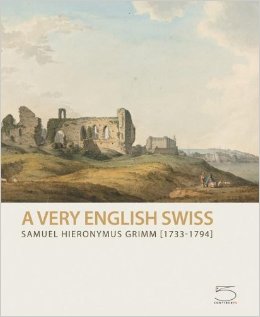 Samuel Hieronymus Grimm (1733–1794) is being presented in a comprehensive exhibition for the very first time. He pursued a career as topographer, illustrator, caricaturist and painter of watercolors, acquiring quite a reputation especially in England.
Grimm was born in Burgdorf and was initially devoted to poetry. Around 1760 he became interested in painting and took lessons with Johann Ludwig Aberli (1723–1786). In 1765 he went to Paris to continue his art studies with Jean-Georges Wille (1715–1808). There Grimm focused on landscape painting, going on long hikes with his art teacher in the countryside. In 1768 he moved to London, where he stayed for the rest of his life, working as both an illustrator and a caricaturist. With biting humor Grimm portrayed British society, fashion and politics. Around 1773, he was commissioned by Sir Richard Kaye to paint to watercolors. Kaye was to become one of his most devoted patrons, giving Grimm carte blanche to capture everything he found ‘unusual’. 2600 watercolors and drawings illustrating everyday subjects in Britain, the country’s architecture and the mores of its people were the outcome of Kaye’s patronage, producing a veritable illustrated encyclopedia of Georgian England during the 18th century. Grimm had numerous additional well-known personages as his patrons whom he accompanied on trips in England and Wales.
Grimm’s great popularity is due to the exactness of his representations; he was renowned for his speed with the pen, his moderate prices, and the perfection of his technique in sketching and painting outdoors. Specialists on British art see in Grimm one of the most talented topographers of his generation, his watercolors leave nothing to be desired and are equal to those of the best British masters of the time.
The exhibition combines examples from every genre Grimm worked in and will be accompanied by a richly illustrated catalogue in German and English. Prof. William Hauptman, Lausanne, is curator of the show, a great specialist for the period. Already in 1996 he was in charge of organizing the large John Webber exhibition at the Kunstmuseum Bern. Dr. Therese Bhattacharya-Stettler is co-curator.
William Hauptman, Samuel Hieronymus Grimm, 1733–1794: A Very English Swiss (Milan: 5 Continents Editions, 2014), 224 pages, ISBN: 978-8874396627, €35 / $45.
The Burlington Magazine Index Blog
A recent posting at British Art Research highlights The Burlington Magazine Index Blog. The work of Barbara Pezzini, the site has been up since November 2013. In a contribution posted 29 January 2014, Neil Jeffares examines “the language implicit and explicit in the coverage of pastels made before 1800 in The Burlington Magazine, with the aim of investigating how this journal participated in the formation of these attitudes.”
From the about page:

◊ ◊ ◊ ◊ ◊
The Burlington Magazine Index Blog is a weekly blog dedicated to all matters related to the history of The Burlington Magazine, written in an accessible style and aimed not just at scholars.
It includes, but it is not limited to, research and news on:
* The art writing of the magazine, recounted in both historiographic and biographical terms.
* The works of art that this journal treated in the two centuries of its existence: their attribution, conservation, critical reception, forgeries and circulation through reproductive engravings and photographs.
* The art world around these works, especially the network of commercial galleries and dealers that contributed to their circulation and interpretation.
This project, previously funded by the Andrew W. Mellon Foundation and currently supported by The Monument Trust, stems from The Burlington Magazine Index, for which there has been a compete re-reading and cataloguing of the whole contents of this journal from its inception in March 1903 until the present. The Burlington Magazine Index contains more than 40,000 records and refers to more than 10,000 artists. It is not only an essential reference for art historical investigation but also a primary source for research on art criticism, art historiography and the art market.
While researching for the Burlington Index, a wealth of new information has been uncovered: much of this it has either been published or it is currently being published in essay form, but much more is hidden in the database: this blog wishes to be a more discursive and engaging approach to some of that information.
As the current stage of the project is the indexing of some 90,000 historical advertisements of art dealers in the Burlington, this blog will have a bias on art galleries and, more widely, on the history of the art market and its intersections with art criticism.
This blog is written by me, Barbara Pezzini, with external contributors. I am an art historian and the Editor of The Burlington Magazine Index.
I welcome external contributions. Write to pezzini@burlington.org.uk
Thanks to: Dylan Armbrust, Alison Bennett, Bart Cornelis, Alan Crookham, Chris Hall, Caroline Elam, Ulrike Kern, Noti Klagka, Nicola Kennedy, Mark MacDonald, Olivia Parker, Madeleine Pearce, Mark Westgarth, Alison Wright and Foteini Vlachou for their contribution to this project.
Fellowship | 2015 NACBS-Huntington Library Fellowship
2015 NACBS-Huntington Library Fellowship
Applications due 15 November 2014
The NACBS, in collaboration with the Huntington Library, offers annually the NACBS-Huntington Library Fellowship to aid in dissertation research in British Studies using the collections of the library. The amount of the fellowship is $3000. A requirement for holding the fellowship is that the time of tenure be spent in residence at the Huntington Library. The time of residence varies but may be as brief as one month. Applicants must be U. S. or Canadian citizens or permanent residents and enrolled in a Ph.D. program in a U.S. or Canadian institution.
Nominations and applications for the 2015 award are invited. Please note that the applications are due on November 15, 2014. Applications should consist of a curriculum vitae, two supporting letters (one from the applicant’s dissertation advisor), and a description of the dissertation research project. The letter should include a description of the materials to be consulted at the Huntington and the reason that these are essential sources for the dissertation. (more…)
Exhibitions | Frozen Thames: Frost Fair, 1684 and 1814
Press release (29 January 2014) from the Museum of London:
Frozen Thames: Frost Fair 1814 and Frozen Thames: Frost Fair 1684 open at the Museum of London Docklands and Museum of London respectively, from Wednesday 29 January to Sunday 30 March 2014. The mini-exhibitions feature objects, paintings, keepsakes, engravings and etchings from the collection.
Why did the Thames freeze?
The Thames could freeze over not necessarily because it was colder these years, but because the river was much more sluggish and slow flowing than today. There was no embankment and the arches of the former London Bridge was much wider and protected by floating pontoons in front of them which impeded the current. Evidence for this is that after 1831 the old London Bridge—resting on its twenty solid piers—was demolished, and replaced with a new bridge with just five arches. No further Frost Fairs have been recorded since. Narrower and with fewer obstacles, the Thames now flows too fast to freeze, and the Thames Frost Fair is a spectacle we will probably never see again.
◊ ◊ ◊ ◊ ◊
Frozen Thames: Frost Fair 1814
Museum of London Docklands, 29 January — 30 March 2014

George Cruikshank and Thomas Tegg,
Gambols on the River Thames, February 1814.
◊ ◊ ◊ ◊ ◊
To the modern observer, it is a scene from London’s history that is difficult to comprehend. For just under one week, from 1 February 1814 until 5 February 1814, the River Thames, the artery of the city, froze completely solid between London Bridge and Blackfriars Bridge. Exactly 200 years ago this week, Londoners of all backgrounds took to the ice to revel in the event.
Georgina Young, Senior Curator at the Museum of London said: “The 1814 Frost Fair brightened the depths of London’s coldest winters. Imagine a travelling carnival and a street market rolled into one. Coffee houses, taverns and souvenir stalls formed improvised streets across the frozen Thames, with entertainments from skittles to swings ranged all around.”
The only surviving piece of gingerbread bought at the 1814 Frost Fair, is among a variety of objects, paintings, keepsakes, engravings and etchings which will go on display as part of two Frost Fair displays, running in parallel at the Museum of London Docklands near Canary Wharf and the Museum of London in the City of London.
The 1814 Fair was the last of its kind, but it was not the first. Between 1309 and 1814, the Thames froze at least 23 times and on five of these occasions, the freeze was extensive enough to support the weight of festivities, and a Frost Fair was born. The Museum of London collection evidences five Fairs in 1683–84, 1716, 1739–40, 1789 and 1814.
The display at the Museum of London Docklands includes a varied collection of original keepsakes from the 1814 Frost Fair, and important contemporary illustrations of the Fair, including two etchings by satirical artist, George Cruikshank, and a print by George Thompson.
For most people, a Frost Fair on the frozen Thames was a once in a lifetime occasion, and all kinds of mementoes were kept. These include fragments of stone chipped from Blackfriars Bridge, printed keepsakes, and a piece of gingerbread, bought at the Fair, which comes with an original handwritten note, identifying the purchaser as Thomas Moxon. The printed items were produced and sold by enterprising printers, who relocated their businesses onto the ice, turning crisis into opportunity. Indeed, when the Thames froze over, the normal workings of London froze with it—even the Thames Watermen converted their boats into temporary stages, and there are reports that an elephant was led across the Thames by Blackfriars Bridge.
◊ ◊ ◊ ◊ ◊
Frozen Thames: Frost Fair 1684
Museum of London, 29 January — 30 March 2014

Abraham Hondius, Frost Fair, 1684
(Museum of London)
◊ ◊ ◊ ◊ ◊
The star objects in the Museum of London display are two paintings by the Dutch artist, working in London, Abraham Hondius (c.1625–91) who was a notable artist in the expanding art market fostered by Charles II. The first painting depicts the frozen Thames in 1677 looking eastwards towards London Bridge (though this was not recorded as a ‘Frost Fair’), and the second, portrays the area of present day Temple on the north side of the river, in the grip of the 1684 Frost Fair.
Pat Hardy, Curator for Paintings, Prints and Drawings at the Museum of London, said: “Hondius brought with him from the Netherlands new painting and print techniques as well as an acute observation of contemporary life. The pleasures of the 1684 Fair are vividly captured.”
The paintings by Hondius appear alongside other works by unknown artists, which depict the 1684 Fair, and a later drawing of the 1716 Frost Fair, which grew even larger than its predecessor.











 Enfilade
leave a comment