Symposium | Millinery through Time
This in Williamsburg, just before ASECS. From the conference website:
Millinery through Time
Colonial Williamsburg, 16–19 March 2014
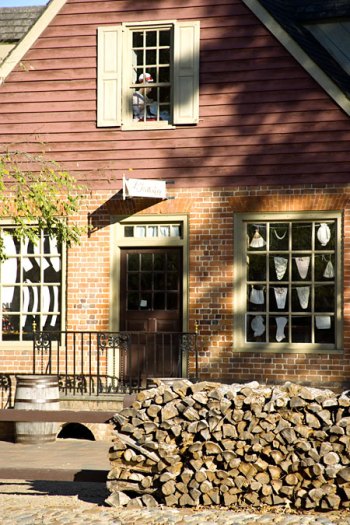 Colonial Williamsburg is pleased to celebrate the 60th anniversary of the opening of the Margaret Hunter Millinery Shop. For 60 years, the shop has interpreted the 18th-century business and craft of millinery with its ever-changing fashions. As fashion has evolved and changed with time, so has the trade. Millinery Through Time will explore the development of the trade from the 18th century, dealing with thousands of fashionable accessories, to the 21st century, specializing in a single fashionable item: hats.
This conference will present an understanding of the trade from a scholarly and a technical perspective through the collaboration of lectures, hands on workshops, and demonstrations. Join us as we step into the world of millinery, one of change, creativity, commerce, and fashion.
S U N D A Y , 1 6 M A R C H 2 0 1 4
5:00 Welcome, Jay Gaynor, director, Historic Trades, Colonial Williamsburg
• 60 Years at the Margaret Hunter, Janea Whitacre, mistress milliner and mantuamaker, Colonial Williamsburg
• The Margaret Hunter Shop in Media, Leslie Doiron Clark, associate producer, Productions, Publications, and Learning Ventures, Colonial Williamsburg
• Virtual Tour of the Margaret Hunter Shop: The 3D Virtual Reconstruction of the 18th-Century Interior, Peter Inker, Digital History Center, Colonial Williamsburg
• Collections for the Margaret Hunter Shop, Linda Baumgarten, curator, textiles and costumes, Colonial Williamsburg
6:00 Birthday Reception. Central Court. Guests are encouraged to wear their favorite costume. Prizes will be awarded.
M O N D A Y , 1 7 M A R C H 2 0 1 4
9:30 Welcome and announcement of prizes from the birthday reception.
9:45 The Milliner and Her Trade, Janea Whitacre, mistress milliner and mantuamaker, Colonial Williamsburg
10:30 Coffee
11:00 Monsieur Beaulard: The Man Who Dressed Marie-Antoinette, Kimberly Chrisman-Campbell, independent scholar, Glendale, California
11:25 ‘To set off every Female Perfection to the highest Advantage’: Milliners, Mantua-Makers, and Dressmakers in Popular Fiction, 1750–2012, Susan Holloway Scott, novelist and history blogger, Philadelphia
11:50 Cry Thief! 18th-Century Milliners and the World of Stolen Goods, Emma Cross, interpreter, Colonial Williamsburg
12:15 Lunch
12:45 Study drawers open in Textile Gallery, Linda Baumgarten, curator, textiles and costumes, and Kimberly Smith Ivey, curator, textiles and historic interiors, Colonial Williamsburg
1:45 ‘Just Imported…and to be Sold on Reasonable Terms by the Subscriber’: Visualizing 18th-Century Textiles through Primary Research, Angela Burnley, independent researcher and owner, Burnley & Trowbridge Co., Williamsburg
2:35 The Morning Ramble or the Milliner’s Shop, Sarah Woodyard, apprentice milliner and mantuamaker, Colonial Williamsburg
3:30 Afternoon refreshments
4:00 Inspired Globally But Created in Upstate New York: An Early 18th-Century Apron with Exotic Motifs, Mary D. Doering, independent scholar, collector, and guest curator, Falls Church, Virginia
4:25 A Mysterious Bit of Millinery: The Mask, Mark Hutter, journeyman tailor supervisor, Colonial Williamsburg, and Phillippe L. B. Halbert, Lois F. McNeil Fellow, Winterthur Program in American Material Culture, Winterthur Museum and the University of Delaware.
7:00 Play, The Milliners, with a question and answer session to follow the performance.
T U E S D A Y , 1 8 M A R C H 2 0 1 4
9:30 An American Identity: The Shoemaker’s Label in Revolutionary and Federal America, Meaghan Reddick, candidate for M.A. History of Decorative Arts, George Mason University, Fairfax, Virginia.
9:55 ‘Any thing elegant, in the form of a Turban’: Women’s Turbans in Fashion at the Turn of the 19th Century, Ann Buermann Wass, history/museum specialist, Maryland-National Capital Park and Planning Commission, Riverdale Park, Maryland
10:20 Coffee
10:50 Velvet and Silk Flowers for Millinery and Dressmaking, Mela Hoyt-Heydon, chairman, Theatre Arts Department, Fullerton College, Fullerton, California
11:40 ‘…what vulgar people calls a milliner’: How the Milliner Survived the Westward Expansion, Hat-Making, and French Lessons, Abby Cox, apprentice milliner and mantuamaker, Colonial Williamsburg
12:35 Lunch
1:05 Study drawers open in Textile Gallery, Linda Baumgarten, curator, textiles and costumes, and Kimberly Smith Ivey, curator, textiles and historic interiors, Colonial Williamsburg
2:00 Traffic Lights of Chic: American Millinery and American Style, 1937–1947, Nadine Stewart, adjunct professor, Montclair State University, Montclair, New Jersey
2:55 Shades of Grief: The Role of Millinery and Accessories as Indicators of Mourning in the 1860s, Samantha McCarty, Williamsburg
3:20 Ellen Carbery: Enterprising Milliner of Newfoundland, Cynthia Boyd, Ph.D. candidate, Department of Folklore, Memorial University of Newfoundland, St. John’s, Newfoundland and Labrador.
3:45 Afternoon refreshments
4:15 ‘Creative Abilities and Business Sense’: The Millinery Trade in Ontario, 1870–1930, Christina Bates
4:40 Millinery as a 21st-Century Occupation: A Current Example of a Career in Hat Making, Ignatius Creegan, Ignatius Hats, Petersburg, Virginia
W E D N E S D A Y , 1 9 M A R C H 2 0 1 4
An assortment of optional workshops are offered on Wednesday.
New Book | The Libertine: The Art of Love in Eighteenth-Century France
From Abbeville:
Michel Delon, ed., with a foreword by Marilyn Yalom, The Libertine: The Art of Love in Eighteenth-Century France (New York: Abbeville, 2013), 496 pages, ISBN: 978-0789211477, $150.
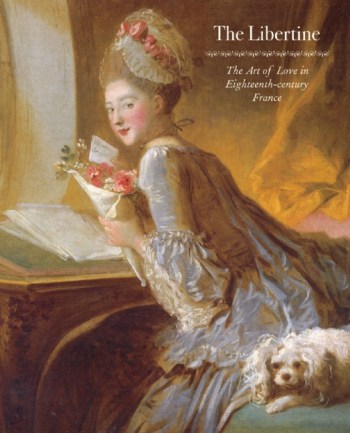 “Delon’s anthology… display[s] the dazzling breadth and depth of the 18th-century obsession with pleasures of the flesh. Certainly The Libertine is as lavish—with its sumptuous illustrations of luscious Rococo nudes and other toothsome lovelies—as an 18th-century bal masqué. But Delon’s analogy understates the dizzying diversity of the ball’s invitees. Priapic peasants, depraved duchesses, masked miscreants, sexy sylphs, coy mistresses, foot fetishists, human sofas (!) and a surprising abundance of naughty nuns: These raunchy revelers engage in one decadent mating dance after another, tirelessly chasing ‘it’, and gamely explaining why it matters.” —The New York Times
“That which both sexes then called ‘love’ was a kind of commerce that they entered into, often without inclination, where convenience was always preferred to sympathy, interest to pleasure, and vice to feeling.” Thus did one novelist describe the spirit that pervaded the twilight years of the Ancien Régime, the heyday of the libertine. Today this word typically evokes the excesses of a Sade or the cruel manipulations of Dangerous Liaisons, but the game of love, as the jaded French aristocracy played it, was most often characterized by a refinement of speech and manner, a taste for nuance over forthright assertion that finds its counterpart in the paintings of Fragonard and the operas of Mozart. The amours of the libertine also colored the intellectual life of the time, figuring into the great debates about natural instinct versus social institutions, and the proper limits of personal freedom.
This sumptuous volume re-creates the milieu of the libertine in all its lively decadence, bringing together more than eighty brief selections from eighteenth-century French literature, grouped into eight broad themes—including tales of seduction, fantasies of exotic lands, and the discoveries of youth—and introduced by an eminent French scholar. These pieces, which encompass fiction, drama, verse, essays, and letters, are the work of nearly sixty writers, some familiar to Anglophone readers—such as Voltaire, Rousseau, Diderot, and yes, the Marquis de Sade—and some much less so; indeed, many of the selections are hitherto untranslated. Each excerpt is accompanied by splendid reproductions of period artworks, many rarely seen, by Watteau, Boucher, Fragonard, and numerous others, that echo and heighten the mood of the texts.
Michel Delon, professor of French literature at the Sorbonne, is the author of several studies of the eighteenth-century libertine. He has edited the works of Diderot and Sade for the Bibliothèque de la Pléiade, as well as Routledge’s Encyclopedia of the Enlightenment.
Marilyn Yalom is a former professor of French and presently a senior scholar at the Clayman Institute for Gender Research at Stanford University. In 1991 she was decorated as an Officier des Palmes Académiques by the French Government. She is the author of widely acclaimed books such as Blood Sisters: The French Revolution in Women’s Memory (1993), A History of the Breast (1997), A History of the Wife (1997), and How the French Invented Love: 900 Years of Passion and Romance (2012). She lives in Palo Alto, California, with her husband, the psychiatrist and author Irvin D. Yalom.
Call for Papers | Perversions of Paper
While it’s a symposium especially geared toward book studies, it seems like some of you working on prints would have exciting examples of “papery aberrations.” -CH
Perversions of Paper
Birkbeck Material Texts Network and the Archive Futures Network
Keynes Library, Birkbeck College, University of London, 28 June 2014
Proposals due by 30 March 2014
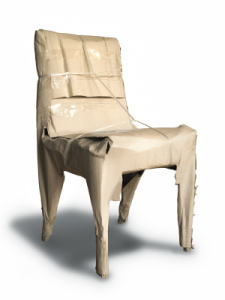 Perversions of Paper is a one-day symposium investigating the outer limits of our interactions with books and with paper. It considers unorthodox engagements with texts, from cherishing or hoarding them to mutilating and desecrating them, from wearing them to chewing them, and from inhaling their scent to erasing their content.
‘Perversion’ may apply to deviations from normal usage but also to our psychological investments in paper. To talk of having a fetish for books is common, but is there more to this than merely well-worn cliché? What part do books and other written artefacts play in our imaginary and psychic lives, and what complex emotional attachments do we develop towards them? Also, how might literary studies or cultural history register these impulses and acts; what kind of methodologies are appropriate?
This symposium invites reflections on perverse uses of—and relationships with—paper and parchment. We welcome proposals from a range of historical periods and disciplinary backgrounds, and from postgraduate students, as well as from more established academics. Contributors are invited to consider bookish and papery aberrations from any number of angles, including but not limited to: (more…)
Call for Papers | Fifth Annual Feminist Art History Conference
Fifth Annual Feminist Art History Conference
American University, Washington, D.C., 31 October — 2 November 2014
Proposals due by 15 May 2014
This annual conference builds on the legacy of feminist art-historical scholarship and pedagogy initiated by Norma Broude and Mary D. Garrard at American University. To further the inclusive spirit of their groundbreaking anthologies, we invite papers on subjects spanning the chronological spectrum, from the ancient world through the present, to foster a broad dialogue on feminist art-historical practice. Papers may address such topics as: artists, movements, and works of art and architecture; cultural institutions and critical discourses; practices of collecting, patronage, and display; the gendering of objects, spaces, and media; the reception of images; and issues of power, agency, gender, and sexuality within visual cultures. Submissions on under-represented art-historical fields, geographic areas, national traditions, and issues of race and ethnicity are encouraged.
To be considered for participation, please provide a single document in Microsoft Word. It should consist of a one-page, single-spaced proposal of unpublished work up to 500 words for a 20-minute presentation, followed by a curriculum vitae of no more than two pages. Please name the document “[last name]-proposal” and submit with the subject line “[last name]-proposal” to fahc5papers@gmail.com.
Submission Deadline: May 15, 2014. Invitations to participate will be sent by July 1.
Keynote speaker: Professor Lisa Gail Collins, Vassar College
Sponsored by the Art History Program and the Department of Art, College of Arts and Sciences, American University. Organizing committee: Kathe Albrecht, Juliet Bellow, Norma Broude, Kim Butler Wingfield, Mary D. Garrard, Helen Langa, Andrea Pearson, and Ying-chen Peng.
Call for Papers | Tracing the Heroic through Gender: 1650, 1750, 1850
Tracing the Heroic through Gender: 1650, 1750, 1850
Collaborative Research Cente 948, University of Freiburg, 26–28 February 2015
Proposals due by 28 March 2014
In most societies the heroic is in many ways gendered. Attributes of masculinity might first come to mind. Yet, from a historical perspective it becomes apparent that heroizations often also have feminine connotations. The social and cultural production of the heroic cannot be analyzed exclusively in terms of masculinity (and masculinity-studies), nor can we regard women or femininity simply as exceptions in this field. Rather, the relational character of the category gender needs to be taken seriously.
The fundamental relationality, the ‘constructedness’, and the historicity of gender are among the core assumptions in gender studies today. Based on this and by interdisciplinary cooperation the conference will examine forms, mediums and processes of heroization as well as discourses of heroic transgression, exceptionality or veneration for certain periods in time.
In order to give adequate consideration to the complexities of the historical entanglement between gender and heroization, we would like to use gender as an analytical tool in a new way. Speaking metaphorically, one might understand gender as a ‘tracer’ that ‘leads’ us, which way we may uncover new aspects of heroic ideas and concepts.
In today’s natural sciences, a tracer is a substance that helps with the exploration of certain organisms or environments. In experiments, the tracer passes through these environments and reacts to each of them in a different way. Hence, the tracer itself is not the object of study; rather a third element distinguishable from the tracer is explored. Therefore we propose to use gender systematically to ‘trace’ various historical ‘environments’ of the heroic. We are interested in gender relations, men and women as heroes or heroines and their (intersectionally differentiated) construction. Primarily, however, we are interested in
a. the heroic itself,
b. the historical contexts which shape the heroic,
c. its medial and performative manifestations and
d. its spatiotemporal trends and transformations.
We welcome scholars from all fields of the humanities and social sciences. The conference focusses on areas of European culture at three different points in time—1650, 1750 and 1850—which are to be discussed from the viewpoints of different disciplines. Proposals including an abstract of a maximum 2000 characters and a one-page
CV should be submitted by March 28, 2014 to gender@sfb948.uni-freiburg.de. The conference will be held in English. A collection of essays based on selected presentations from the conference is to be published. An extended version of the call for papers with further conceptual research questions can be found here.
Symposium | In Circulation: John Singleton Copley and Benjamin West
In addition to the topic, the format of this symposium looks interesting on several counts: the webinar format, the time (Friday afternoon and evening with a light supper and drinks between presentations), and the trans-Atlantic component (which presumably explains the timing). In the digital age, it seems fair to ask what a symposium should look like. I’m glad to see experiments like this one. -CH
From The Paul Mellon Centre:
In Circulation: John Singleton Copley and Benjamin West in England, France, and America
The Paul Mellon Centre, London, 28 March 2014
 This symposium and webinar follows on from the international loan exhibition American Adversaries: West and Copley in a Transatlantic World, held at the Museum of Fine Arts Houston between 5 October 2013 and 20 January 2014.
It explores aspects of the work and careers of the American-born artists Benjamin West and John Singleton Copley, focussing in particular on the ways in which they engaged with the exhibition and print cultures of their day, particularly in Britain, but also in France and America. The paintings of both artists moved between and across very different spaces of display, and were increasingly geared to satisfying the demands of a growing exhibition-going public. Just as importantly, Copley and West’s paintings were regularly translated into graphic form. Engravings as well as exhibitions promoted their work to audiences in Britain, France and America, and helped give both artists an international reputation.
The symposium and webinar will investigate the ways in which these forms of display and dissemination shaped both artists’ practice and reputations across transnational visual cultures. This event will be filmed and live-streamed to a group of scholars, students and curators at the MFA in Houston, who will be invited to ask questions of the speakers. It will also be live-streamed online, enabling an international audience to watch and respond to proceedings as they take place in London and submit questions to the speakers via an interactive website. A full symposium programme, with details of papers and ticketing, is available at The Paul Mellon Centre’s website.
P R O G R A M M E
15.15 Mark Hallett (The Paul Mellon Centre), Introduction
15.30 Emily Neff and Kaylin Weber (The Museum of Fine Arts, Houston), Introduce video of American Adversaries
16.00 Tea
16.15 Jane Kamensky (Brandeis University), Copley’s Revolutions
17.00 Stephane Roy (Carleton University), West’s General Wolfe in Eighteenth-Century France
17.45 Drinks and Light Supper
18.45 Rosie Dias (University of Warwick), Copley, West, and John Boydell: New Mechanisms of Patronage in
Late Eighteenth-Century London
19.30 Kaylin Weber (The Museum of Fine Arts, Houston), Displaying History: West’s Gallery and the Great Room
20.15 Drinks
20.30 Sarah Monks (University of East Anglia), Out of Time, Out of Place: Copley’s Last Pictures
21.15 Wendy Bellion (University of Delaware), West and Shakespeare in Early Nineteenth-Century Philadelphia
22.00 Mark Hallett and Emily Neff, Concluding Remarks
MoMA Appoints First Director of Digital Content and Strategy
Arriving at MoMA from the Royal Museums Greenwich, Fiona Romeo steps into a position that will, I imagine, become increasingly common if not essential for museums in the years ahead. Given her role, it’s especially interesting to see what her own web presence looks like. -CH
From the press release (7 February 2014). . .
 The Museum of Modern Art has appointed Fiona Romeo as Director of Digital Content and Strategy, a newly created position in which Ms. Romeo will provide vision and leadership across the organization to enable the Museum to build on its existing digital initiatives and refine its strategic direction and goals. Under the direction of Peter Reed, Senior Deputy Director for Curatorial Affairs, she will actively work with senior leadership to develop and grow digital engagement with MoMA’s diverse audiences, both on site and online. She will lead the Digital Media Department, overseeing a team of digital producers, developers, and designers. Ms. Romeo will join the Museum in April.
In her new role, Ms. Romeo will create a clear and achievable strategy that will connect all areas of the Museum and build upon the success of existing programs. Her purview will include MoMA’s website, MoMA.org, including the online collection and exhibition subsites; and digital tools and resources, such as mobile applications, digital in-gallery displays, and live-streamed events.
“Fiona’s appointment builds upon the Museum’s pioneering work in the digital realm, and is a reflection of the dynamic and vital role that digital content plays in the way people can participate in the life of the Museum,” said Glenn D. Lowry, Director of The Museum of Modern Art. “Her extensive museum experience and her background in social and interactive digital platforms makes her particularly well suited to lead MoMA’s innovative and multifaceted initiatives, which engage individuals with the richness of our collection and programs.” (more…)
Valentine’s Day at the Museum of London
As reported by Nick Clark for The Independent (30 January 2014). . .
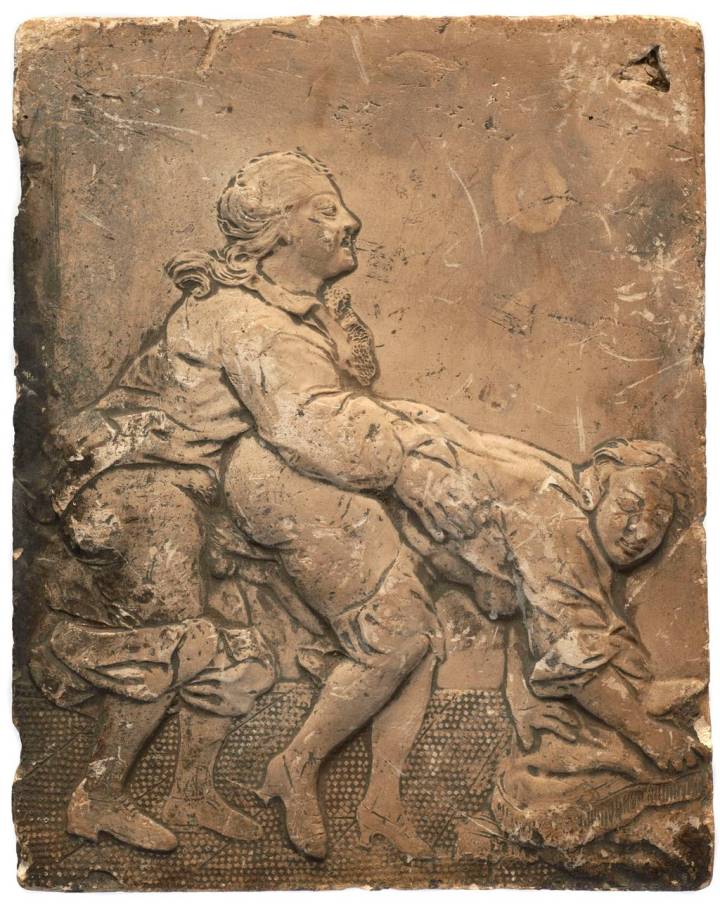
Detail of one of eight eighteenth-century plaster tiles discovered in 1962. Click on the image for the full view of another tile (with usual warnings about sexually explicit images).
For one night only. . . amorous visitors to the Museum of London will have the chance to see the steamy side of the 18th century. A series of erotic tiles, detailing various sexual positions and even spanking, will go on display for the first time at a late-night Valentine’s Day event at the site in the heart of the City. The eight tiles were discovered in 1962 after a fire in an upper room of one of London’s most memorable old pubs and remain shrouded in mystery.
Jackie Keily, curator at the museum, said: “We can’t normally display them because they are so graphic. It is a fascinating glimpse into the sexual history of London; so few of these artefacts survive.”
They will be part of an evening event called Late London: City of Seduction which is open to over 18-year-olds only. The tiles were discovered in 1962 following a fire at Ye Old Cheshire Cheese pub on Fleet Street and were handed to the museum shortly after.
The full article, with additional photos, is available here»
Details of Late London: City of Seduction are available here»
« Livraisons d’histoire de l’architecture » 26 (2013)
From the Centre André Chastel:
“Les Ministres et les arts,” numéro thématique des Livraisons d’histoire de l’architecture 26 (2013), €23.
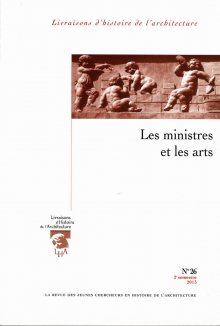 Basile Baudez, “Le comte d’Angiviller, directeur de travaux : le cas de Rambouillet”
Alexandre Burtard, “Sur la piste des orientations artistiques de Nicolas Frochot, premier préfet de la seine sous le Consulat et l’Empire”
Rose-Marie Chapalain, “L’abbé Terray, seigneur de la Motte-Tilly”
Marie-Claude Chaudonneret, “Les ministres de l’intérieur et les arts sous le Directoire”
Hélène Drutinus, “Jean Naigeon, conservateur du Luxembourg sous le Consulat : les rapports d’un conservateur avec le Sénat et le ministre de l’intérieur”
Dominique Massounie, “Philibert Orry et l’embellissement du territoire autour de l’Instruction de 1748 : genèse d’un paysage routier et urbain”
Gabriele Quaranta, “Deux générations à côté du pouvoir : quelques remarques sur les arts chez les de Fourcy”
Aleth Tisseau des Escotais, “Finances et arts pendant la Révolution et le Premier Empire : l’exemple du Garde-Meuble”
Summaries for a selection of the articles are available as a PDF file here»
Call for Papers | Art as Cultural Diplomacy: Eastern and Western Europe
Art as Cultural Diplomacy: (Re)Constructing Notions of Eastern and Western Europe
Berlin, 28–29 March 2014
Proposals due by 25 February 2014
Panel Organizer: Cassandra Sciortino, University of California, Santa Barbara
As part of the Third Euroacademia International Conference Re-Inventing Eastern Europe to be held in Berlin, the panel Art as Cultural Diplomacy seeks papers that explore the function of art (in its broadest definition) as an instrument of cultural diplomacy by the state and, especially, by nongovernmental actors. The main theme of the session is the question of art and diplomacy in Europe before and after the fall of the Berlin Wall. Papers are welcome that explore issues related to the role of art, diplomacy and the politicization of the European Union and its candidate countries, as are those which consider how the arts have pursued or resisted East-West dichotomies and other narratives of alterity in Europe and worldwide. The panel seeks to combine a wide range of interdisciplinary perspectives to explore how art—its various practices, history, and theory—are an important area of inquiry in the expanding field of cultural diplomacy. Selected papers will be invited for publication in a book.
Some examples of topics include:
• How can art serve as a neutral platform for exchange to promote dialogue and understanding between states?
• How can art, including organized festivals (i.e. film, art, music), cultivate transnational identities that undermine dichotomies of East and West, and other narratives of alterity in Europe and beyond it?
• The implications for art as an instrument of diplomacy in a postmodern age where geopolitics and power are increasingly mobilized by image-based structures of persuasion
• How has/can art facilitate cohesion between European Union member states and candidate states that effectively responds to the EU’s efforts to create ‘unity in diversity’?
• The politics of mapping Europe: mental and cartographic
• Community-based art as a social practice to engage issues of European identity
• The difference between art as cultural diplomacy and propaganda
• The digital revolution and the emergence of social media as platforms for art to communicate across social, cultural, and national boundaries?
• Diplomacy in the history of art in Europe and Eastern Europe
• Artists as diplomats
• Art history as diplomacy—exhibitions, post-colonial criticism, global art history, and other revisions to the conventional boundaries of Europe and its history of art
• The international activity of cultural institutes
If interested in participating, please send an abstract (maximum of 300 words) together with the details of your affiliation until 25th of February 2014 to cassandra.sciortino@berkeley.edu and application@euroacademia.eu. More information is available here










 Enfilade
leave a comment