New Book | Religieuses dans la ville, L’architecture des Visitandines
Available from Artbooks.com:
Laurent Lecomte, Religieuses dans la ville, L’architecture des Visitandines en France, XVIIe et XVIIIe siecles (Paris: Editions du Patrimoine, 2013), 304 pages, ISBN: 9782757701454, $110.
 Fondé par François de Sales et Jeanne de Chantal en 1610 à Annecy, l’ordre de la Visitation Sainte Marie a connu une expansion fulgurante à travers toute la France (134 couvents et églises à la Révolution). Reflet de l’attractivité de la spiritualité salésienne, ce mouvement de création conventuelle s’accompagne d’un prodigieux élan constructeur dont l’ampleur et l’originalité résultent principalement de la spécificité du monachisme féminin de la période post-tridentine. Assujetties à la règle de la clôture la plus stricte, les Visitandines sont aussi tenues de s’installer en ville et de s’ouvrir partiellement au “monde” extérieur. Enfin, elles doivent bâtir selon un plan type dans le but de maintenir l’unité architecturale de l’ordre, reflet de son unité spirituelle. Leurs constructions résultent des tensions entre les valeurs traditionnelles de l’idéal monastique (pauvreté, renoncement, isolement) et les contingences topographiques, économiques et sociales de la réalité urbaine. Richement illustré et documenté, cet ouvrage de référence propose une étude fouillée des apports architecturaux et urbanistiques d’un ordre féminin original.
Exhibition | Fame and Friendship
From the YCBA press release:
Fame and Friendship: Pope, Roubiliac, and
the Portrait Bust in Eighteenth-Century Britain
Yale Center for British Art, New Haven, 20 February — 19 May 2014
Waddesdon Manor, Buckinghamshire, 18 June — 26 October 2014
Curated by Malcolm Baker

Louis François Roubiliac, Portrait Bust of Alexander Pope, 1741, marble (Yale Center for British Art)
Opening in February 2014, the Yale Center for British Art, in collaboration with Waddesdon Manor, will present an exhibition on the eighteenth-century literary figure and poet Alexander Pope (1688–1744), whose sculpted portraits exemplified his fame at a time when the portrait bust was enjoying new popularity. Fame and Friendship: Pope, Roubiliac, and the Portrait Bust in Eighteenth-Century Britain will bring together paintings, sculptures, and materials that convey Pope’s celebrity status, high-lighted by a series of eight busts by Louis François Roubiliac (1702–1762), the leading sculptor of the period, to explore questions of authorship, replication, and dissemination.
Frequently used in antiquity to represent and celebrate writers, the portrait bust became the most familiar way of lauding famous writers in the eighteenth century, as the concept of authorship was being newly conceived. The signed and documented versions of Roubiliac’s busts of Pope, which span the years from 1738 to 1760, are among the most fascinating and iconic images of the poet. These early versions of Roubiliac’s bust are likely to have been made for Pope’s close friends, serving to articulate those friendships that were so important to him. Further, the comparisons of these related versions, together with copies from the period in marble, plaster, and ceramic, will provide a unique and unprecedented opportunity to understand the role of replication and repetition in eighteenth-century sculptural practice.
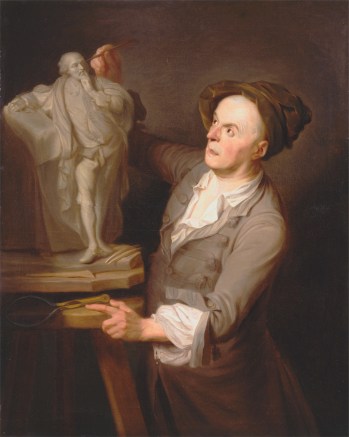
Adrien Carpentiers, Louis-Francois Roubiliac Modelling His Monument to Shakespeare, between 1760 and 1761 (Yale Center for British Art)
Complementing the sculptures of Pope will be busts of other sitters with whom Pope’s image was associated, reflecting the poet’s place in a developing literary canon, as well as a selection of painted portraits of the poet by artists such as Jonathan Richardson the Elder, Jean-Baptiste van Loo, and Sir Godfrey Kneller. Alongside these works will be a range of Pope’s printed texts. With their subtle changes in typography and their carefully planned illustrations and ornamental features, these early editions were produced under the watchful eye of Pope himself and were the outcome of the poet’s direct engagement with the materiality of the book and print.
Also presented will be lesser-known material about the Yale literary critic W. K. Wimsatt, who in the 1960s not only helped to make Yale a major center for the study of eighteenth-century literature (and Pope in particular), but spent twenty-five years researching the poet’s portraits, an achievement celebrated in this exhibition. As Wimsatt recognized, the relationship between Pope’s private persona and public fame was complex and ambiguous. Pope proved adept at managing the two while gradually establishing himself as an independent author, no longer dependent upon the support of noble patrons. Throughout his career, he astutely managed the presentation of his own image and reputation through both his published works and his portraits, especially those by Roubiliac.
Among the busts by Roubiliac will be a terracotta model (ca. 1738) from the collection of the Barber Institute of Fine Arts in Birmingham, England, and four marble pieces that he carved between 1738 and 1741. These busts have been assembled from a number of locations: the Center’s own collection; Temple Newsam House, Leeds Museums and Galleries; and the Shipley Art Gallery, Gateshead (formerly in the possession of the eighteenth-century actor David Garrick). Another, from a private collection, was made for Pope’s close friend, the brilliant young lawyer, William Murray, later first Earl of Mansfield, with whom the poet shared an enthusiasm for both the classics and the visual arts, particularly sculpture. Also on view will be an earlier marble bust of Alexander Pope made in 1730 by the Anglo-Flemish sculptor John Michael Rysbrack (1694–1770), from the collection of the National Portrait Gallery, London.
When this exhibition travels to Waddesdon Manor, the core group of busts of Pope by Roubiliac and some of the contextual material from the Yale Center for British Art will remain the same, but there will be an additional selection of painted portraits, a different range of printed texts lent by the British Library, and material that will illustrate the reception of Pope and his works in France in keeping with Waddesdon’s superb French collections.
Fame and Friendship: Pope, Roubiliac, and the Portrait Bust in Eighteenth-Century Britain is co-organized by the Center and Waddesdon Manor (The Rothschild Collection), where it will travel in June 2014. It is curated by Malcolm Baker, Distinguished Professor of the History of Art at the University of California, Riverside, and Honorary Senior Research Fellow at the Victoria and Albert Museum, London. The organizing curator at the Yale Center for British Art is Martina Droth, Associate Director of Research and Education, and Curator of Sculpture; and at Waddesdon Manor, Dr. Juliet Carey, Senior Curator of Paintings, Sculpture and Works on Paper.
P U B L I C A T I O N S & S C I E N T I F I C S T U D Y
 During the course of the exhibition, Yale University Press will be publishing The Marble Index: Roubiliac and Sculptural Portraiture in Eighteenth-Century Britain, Malcolm Baker’s study of the bust and the statue as genres [scheduled for release in August 2014]. Following the exhibition, a second book will appear as a volume in the series Studies in British Art, published by the Yale Center for British Art and the Paul Mellon Centre in collaboration with Yale University Press. The latter will include essays based on papers presented at the conferences at Yale and Waddesdon organized by the Center, the Paul Mellon Centre in London, and the Rothschild Foundation. It will also incorporate the results of a related research program of detailed digital scanning using the world-class facilities under development at the Yale Digital Collections Center at Yale’s West Campus. By analyzing the busts both visually and technically, this study aims to discover similarities and differences in surfaces, dimensions, construction, and materials, thus shedding new light on the studio practices of eighteenth-century sculptors. These findings will be the focus of a workshop to which leading figures in the field of eighteenth-century sculpture will be invited.
◊ ◊ ◊ ◊ ◊
Note (added 31 May 2014) — A more tightly focused catalogue will also be published by Paul Holberton:
Malcolm Baker, Fame and Friendship: Pope, Roubiliac and the Portrait Bust (London: Paul Holberton Publishing, 2014), 128 pages, ISBN: 978-0954731052, £15 / $25.
◊ ◊ ◊ ◊ ◊
Note (added 13 June 2014) — Waddesdon will host a study day (with a visit to Stowe) on July 10 and a conference on July 12.
Exhibition | The Artist’s View: Landscape Drawings
From the original Crocker Art Museum press release (23 April 2012) . . .
The Artist’s View: Landscape Drawings from the Crocker Art Museum
Crocker Art Museum, Sacramento, 22 September 2012 — 2 January 2013
Snite Museum of Art, Notre Dame, 12 January — 16 March 2014
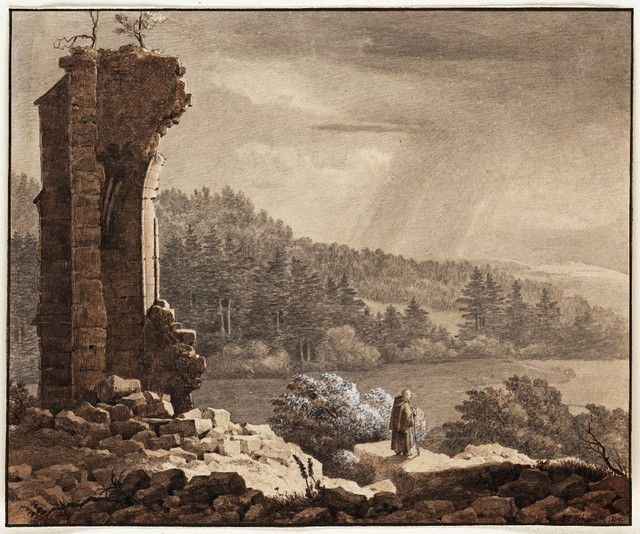
Johann Christoph Erhard, A Monk Visiting Ruins, 1814, graphite and wash on wove paper (Crocker Art Museum)
Featuring works by artists as diverse as Herman van Swanevelt and Camille Corot, this exhibition celebrates the beauty of landscape drawings from the major European schools. Spanning four centuries, The Artist’s View: Landscape Drawings from the Crocker Art Museum consists of 45 of the most important works in the collection, dating from the 16th through the 19th centuries.
This exhibition traces the historical context of landscapes from 17th-century Dutch and Flemish works, including a fine sheet by Anthonie van Waterloo and a newly-attributed Adriaen Frans Boudewijns, through 17th-century Italian and 18th-century German and French drawings. Works from 18th- and 19th-century Germany, which represent one of the heights of landscape drawing and are one of the collection’s major strengths, will also be featured.
Among the highlights of the The Artist’s View are two of the best surviving drawings by Willem van Bemmel, representing his Dutch and Italian periods. The first shows the artist himself at work recording a farmstead at the edge of a Northern forest, while the second, a view of the Colosseum, shows the transformation that Italian monuments and light worked on his style. This dialogue between Italy and the North is a major theme of the exhibition—French and German as well as Dutch and Flemish artists went to Italy to study the land, as illustrated by Hubert Robert’s Temple of Diana at Baia, near Naples, a new acquisition.
This exhibition also depicts how these artists often returned to themes explored by others. Corot’s scene of woodcutters at the edge of the forest shows the same humble labor as in Bemmel’s farmstead of three hundred years before. Such continuity among variety—of artists, their views, and the views they depicted—is part of the appeal of landscape drawing through the centuries.
New Title | India and Europe in the Global Eighteenth Century
From the publication flyer:
Simon Davies, Daniel Sanjiv Roberts, and Gabriel Sánchez Espinosa, eds., India and Europe in the Global Eighteenth Century (Oxford University Studies in the Enlightenment, previously SVEC, January 2014), 341 pages, ISBN 978-0729410809, £65 / €85 / $115.
 The long eighteenth century was a period of major transformation for Europe and India as imperialism heralded a new global order. Eschewing the reductive perspectives of nation-state histories and postcolonial ‘east vs west’ oppositions, contributors to India and Europe in the Global Eighteenth Century put forward a more nuanced and interdisciplinary analysis. Using eastern as well as western sources, authors present fresh insights into European and Indian relations and highlight:
• how anxieties over war and piracy shaped commercial activity
• how French, British and Persian histories of India reveal the different geo-political issues at stake
• the material legacy of India in European cultural life
• how novels parodied popular views of the Orient and provided counter-narratives to images of
India as the site of corruption
• how social transformations, traditionally characterised as ‘Mughal decline’, in effect forged new
global connections that informed political culture into the nineteenth century
C O N T E N T S
• Daniel Sanjiv Roberts, Introduction
• Anthony Strugnell, A view from afar: India in Raynal’s Histoire des deux Indes
• Claire Gallien, British orientalism, Indo-Persian historiography and the politics of global knowledge
• Javed Majeed, Globalising the Goths: ‘The siren shores of Oriental literature’ in John Richardson’s A Dictionary of Persian, Arabic, and English (1777–1780)
• Deirdre Coleman, ‘Voyage of conception’: John Keats and India
• Sonja Lawrenson, ‘The country chosen of my heart’: the comic cosmopolitanism of The Orientalist, or, electioneering in Ireland, a tale, by myself
• Daniel Sanjiv Roberts, Orientalism and ‘textual attitude’: Bernier’s appropriation by Southey and Owenson
• Felicia Gottmann, Intellectual history as global history: Voltaire’s Fragments sur l’Inde and the problem of enlightened commerce
• James Watt, Fictions of commercial empire, 1774–1782
• Gabriel Sánchez Espinosa, The Spanish translation of Bernardin de Saint-Pierre’s La Chaumière indienne: its fortunes and significance in a country divided by ideology, politics and war
• John McAleer, Displaying its wares: material culture, the East India Company and British encounters with India in the long eighteenth century
• Mogens R. Nissen, The Danish Asiatic Company: colonial expansion and commercial interests
• Lakshmi Subramanian, Whose pirate? Reflections on state power and predation on India’s western littoral
• Florence D’Souza, A comparative study of English and French views of pre-colonial Surat
• Seema Alavi, The Mughal decline and the emergence of new global connections in early modern India
Summaries
List of contributors
Bibliography
Index
“Adopting multi-disciplinary approaches, contributors stress the complexity, subtlety and intricacy of the remarkable global connections between India and Europe in the eighteenth century. This book will undoubtedly provoke not only lively debate, but also much further research.”
–Maria Misra (Keble College Oxford), author of Vishnu’s Crowded Temple: India since the Great Rebellion.
Voltaire Foundation, University of Oxford
Exhibition | The Art of the Louvre’s Tuileries Garden
Press release (20 September 2013) from the High Museum:
The Art of the Louvre’s Tuileries Garden
High Museum of Art, Atlanta, 3 November 2013 — 19 January 2014
Toledo Museum of Art, 13 February — 11 May 2014
Portland Art Museum, 14 June — 28 September 2014

Antoine Coysevox, Faun, 1709
The Art of the Louvre’s Tuileries Garden features more than 100 works, some of which have never traveled outside of Paris. These include large-scale sculptures from the garden that were created in the 17th, 18th, 19th, and 20th centuries by sculptors including François-Joseph Bosio, Antoine Coysevox, and Aristide Maillol along with paintings, photographs, and drawings that depict the Tuileries. Thirty-five works in the exhibition are from the collections of the Louvre.
The exhibition also explores how the 63-acre garden influenced and inspired French and American Impressionists such as Édouard Manet, Camille Pissarro, and Childe Hassam and photographers such as Eugène Atget, Henri Cartier-Bresson, and André Kertész. As part of the exhibition’s presentation in Atlanta, the High has turned the museum’s piazza into a landscaped park, inspired by the Tuileries Garden.
The ‘Paris on Peachtree’ experience begins as visitors arrive on the High’s piazza to find a dozen holly trees in planter boxes similar to those in the Tuileries Garden, installed to create a path to the exhibition entrance. Two sculptures by Maillol have been placed among the trees. The immersive experience continues in the galleries, where six sculptures that have never before left France and for centuries resided in the Tuileries Garden will greet visitors on the first level of the exhibition. The High is also devoting an entire gallery in the exhibition to a video titled “A Day in the Tuileries Garden,” featuring footage from the Garden projected on three walls.
Key works featured in the exhibition include:
• Antoine Coysevox, Faun, 1709
• François Joseph Bosio, Hercules Battling Achelous as Serpent, 1824
• Édouard Manet, Children in the Tuileries Garden, ca. 1861–62
• Childe Hassam, Tuileries Gardens, ca. 1897
• Camille Pissarro, The Tuileries Gardens in the Snow, 1900
• Aristide Maillol, Mediterranean or Latin Thought/Contemplation, 1923–27
• Henri Cartier-Bresson, The Terrace and Tree-lined Path, 1975
The exhibition examines how the Tuileries, which extends from the Musée du Louvre to the Place de la Concorde, evolved from its beginnings as an outdoor museum for French royalty to its role as one of the first public gardens in Europe, after which it served as both subject and inspiration for artists working in Paris.
Presented on the occasion of the 400th birthday of André Le Nôtre (1613–1700), The Art of the Louvre’s Tuileries Garden also celebrates the man commissioned by Louis XIV in 1664 to expand and transform the Tuileries into a formal French garden. One of the first public gardens in Europe, the Tuileries Garden was originally created in 1564 by Catherine de Medici as the garden for the Tuileries Palace, a palace that was originally part of the Louvre but which was destroyed following the Franco-Prussian War. Each monarch who lived in the palace left his or her own indelible mark on the Tuileries. Under the reign of Louis XV, the garden became known for its monumental outdoor sculpture collection. In 1667, just three years after Le Nôtre was hired, the Tuileries Garden became Paris’ first public park. The garden is still open to the public today.
The Art of the Louvre’s Tuileries Garden is co-organized by the High Museum of Art, the Toledo Museum of Art, and the Portland Art Museum, with the exceptional collaboration of the Musée du Louvre.
◊ ◊ ◊ ◊ ◊
From Yale UP:
Laura Corey, Paula Deitz, Guillaume Fonkenell, Bruce Guenther, Sarah Kennel, and Richard H. Putney, The Art of the Louvre’s Tuileries Garden (New Haven: Yale University Press, 2013), 176 pages, ISBN: 978-0300197372, $50.
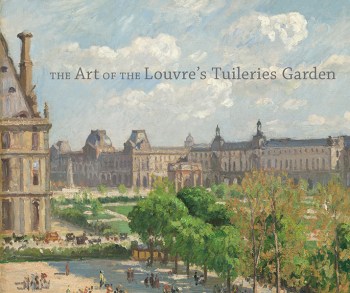 The Tuileries Garden is a masterpiece of garden design and one of the world’s most iconic public art spaces. Designed for Louis XIV by landscape architect André Le Nôtre, it served the now-destroyed Tuileries Palace. It was opened to the public in 1667, becoming one of the first public gardens in Europe. The garden has always been a place for Parisians to convene, celebrate, and promenade, and art has played an important role throughout its history. Monumental sculptures give the garden the air of an outdoor museum, and the garden’s beautiful backdrop has inspired artists from Edouard Manet to André Kertész.
The Art of the Louvre’s Tuileries Garden brings together 100 works of art, including paintings and sculptures, as well as documentary photographs, prints, and models illuminating the garden’s rich history. Beautifully illustrated essays by leading scholars of art and garden studies highlight the significance of the Tuileries Garden to works of art from the past 300 years and reaffirm its importance to the history of landscape architecture.
Laura D. Corey is consulting curator at the High Museum of Art. Paula Deitz is editor of The Hudson Review. Guillaume Fonkenell is curator of sculpture and museum historian at the Musée du Louvre. Bruce Guenther is chief curator and Robert and Mercedes Eichholz Curator of Modern and Contemporary Art at the Portland Art Museum. Sarah Kennel is curator of photographs at the National Gallery of Art, Washington, D.C. Richard H. Putney is an art historian and head of the Art Museum Practices program at the University of Toledo and Consulting Curator of Medieval Art at the Toledo Museum of Art.
In Theaters This Spring: Belle
◊ ◊ ◊ ◊ ◊
Belle is inspired by the true story of Dido Elizabeth Belle (Gugu Mbatha-Raw), the illegitimate mixed race daughter of a Royal Navy Admiral. Raised by her aristocratic great-uncle Lord Mansfield (Tom Wilkinson) and his wife (Emily Watson), Belle’s lineage affords her certain privileges, yet the color of her skin prevents her from fully participating in the traditions of her social standing. Left to wonder if she will ever find love, Belle falls for an idealistic young vicar’s son bent on change who, with her help, shapes Lord Mansfield’s role as Lord Chief Justice to end slavery in England.
◊ ◊ ◊ ◊ ◊
From Jamie Doward’s article for The Observer (12 January 2014) . . .
Directed by Amma Asante, who . . . was born in Britain but lives in the Netherlands, the film tells the story of Dido Elizabeth Belle, the daughter of an enslaved mother in the Caribbean, who went on to live at Kenwood House in north London under the protection of Lord Mansfield, the lord chief justice. While she was living there, in 1772, Mansfield ruled that a master could not carry a slave out of Britain by force, a judgment seen as a crucial step towards the abolition of slavery.
Misan Sagay, who wrote the screenplay, has said that understanding Belle is crucial to understanding Mansfield’s motivation. “The abolition story is often told without a black person being there,” she said recently. “But Belle, living with such a power whose judgments affected slavery, must have had some impact.”
◊ ◊ ◊ ◊ ◊
Exhibition | Dessins de François-André Vincent
From Paris Musées:
Le Trait en liberté: Dessins de François-André Vincent, 1746–1816
Musée Cognacq-Jay, Paris, 29 March — 29 June 2014
Curated by Benjamin Couilleaux
L’exposition présente l’étendue du talent de François-André Vincent, tout au long de sa carrière de dessinateur, à travers la variété de ses sujets et techniques.
Artiste aussi talentueux que protéiforme, et néanmoins méconnu, François-André Vincent (1746–1816) a marqué le paysage artistique français entre la fin du XVIIIe siècle et le début du XIXe. À partir d’une cinquantaine de feuilles issues de grandes collections publiques et privées de Paris, l’exposition présente l’étendue du talent de Vincent dessinateur, tout au long de sa carrière, à travers la variété de ses sujets et techniques. Débutant dans un style très esquissé, proche de Fragonard, Vincent s’est progressivement rallié à la majesté héroïque du néoclassicisme. Il s’est intéressé aussi bien au paysage qu’à la scène de genre, à la peinture d’histoire comme au genre animalier. Portraitiste génial, Vincent a produit toute une série de caricatures, comiques et fascinantes, mais aussi des portraits psychologiques d’une immense sensibilité. L’exposition permet ainsi de montrer des dessins rarement, voire jamais vus par le public, avec des regroupements inédits.
En parallèle, l’artiste fait l’objet d’un catalogue raisonné par Jean-Pierre Cuzin, ainsi que d’une grande rétrospective, d’abord présentée au musée des Beaux-Arts de Tours (du 18 octobre 2013 au 19 janvier 2014) puis au musée Fabre à Montpellier (du 8 février au 11 mai 2014). L’exposition du musée Cognacq-Jay s’intègre également dans l’actualité parisienne en s’associant à la Semaine du dessin 2014.
Lecture | Reynolds, Replication and Restoration
From The Institute of Conservation (ICON). . .
Alexandra Gent | Reynolds, Replication and Restoration:
Some Results from the Wallace Collection Reynolds Research Project
Grand Robing Room, Freemason’s Hall, 60 Great Queen Street, London 27 February 2014

Joshua Reynolds, The Strawberry Girl, 1772–73
(London: Wallace Collection)
The four-year Wallace Collection Reynolds Research Project is funded by The Paul Mellon Centre for Studies in British Art and the Wallace Collection’s Benefactors and donors. The Project will investigate Reynolds’ techniques and materials by examining twelve of his paintings in the Collection. The project is a collaboration between the Wallace Collection and the Conservation and Scientific Departments at the National Gallery.
The Project’s recent investigations have helped develop a better understanding of two elements of Reynolds’s practice: replication of images and the restoration of paintings. This talk will draw on historical sources coupled with technical analysis of paintings to explore these activities in Reynolds’s busy studio.
Replication
It is a well-known that Reynolds’s studio practice incorporated the production of copies. Often made by students or copyists, there is, however, anecdotal evidence Reynolds himself sometimes worked simultaneously on more than one version of the same subject; The Strawberry Girl may be one such painting. Technical analysis of the Wallace Collection’s Strawberry Girl will be discussed in relation to Reynolds’s own technical notes and contemporary accounts of his practice, together with technical analysis of Tate’s Age of Innocence, which overlies another version of the Strawberry Girl.
Restoration
The Wallace Collection’s portrait of Baltasar Carlos in Black and Silver, was owned by Reynolds and is thought to have been restored by him. The portrait’s technical analysis will be presented showing how its technique relates to that of Velazquez, what can be revealed about Reynolds’s restoration of the painting and how this compares to the analysis of Reynolds’s materials.
Alexandra Gent joined the Wallace Collection in December 2010 as Paintings Conservator for the Reynolds Research Project. She trained as a paintings conservator at The University of Canberra, Australia, graduating with a Bachelor of Applied Science in the Conservation of Cultural Materials in 1999. Since coming to the UK in 2000 she has been employed by English Heritage, Tate and the National Galleries of Scotland, as well as private studios in London and Oxfordshire. She is an accredited member of Icon and has a Masters in Culture, Policy and Management from City University London (2008).
Venue: In the Grand Robing Room at Freemason’s Hall, 60 Great Queen Street London WC2B 5AZ. Close to both Covent Garden and Holborn Tube Stations. Doors open at 6pm. Talk 6.30–8pm. Tickets: Icon members: £10, non-members: £15. Free wine and cheese including in price of ticket. Please register by sending your name and stating if you are an Icon member. Your name must be on the security list no later than Tuesday, 25th February 2014. RSVP Clare Finn +44 20 7937 1895 or finnclare@aol.com.
Lecture | Boulle as a Collector of Old Master Drawings
Later this month at The Wallace in connection with its History of Collecting Seminars:
Mia Jackson | Boulle the Connoisseur: ‘An Incurable Mania’
André-Charles Boulle as a Collector of Old Master Drawings
The Wallace Collection, London, 27 January 2014
André-Charles Boulle (1642–1732) was the most renowned ébéniste of his time, giving his name to the marquetry of turtleshell and brass that he brought to such perfection. He was also a voracious collector of works on paper and despite the success of his furniture, he died in debt. This is unsurprising given that the great collector, Pierre-Jean Mariette, his near-contemporary, said of him: ‘there was never a sale of prints and drawings at which he was not present and buying, often without having the means to pay’.
This seminar will focus on Boulle’s drawings—the types of drawings Boulle collected, the rôle drawings may have played in the production of his furniture and the importance of his collection in relation to those of his contemporaries and clientèle. This will reveal a collection much more complex than the ‘source délicieuse’ beloved of furniture scholars, that included not only the works of his fellow ‘illustres’ in the Louvre, but also works by artists such as Raphael, van Dyck, the Carraccis and a much-regretted lost theoretical notebook by Rubens.
Admission is free and booking is not required.
Mia Jackson (Queen Mary, University of London)
Monday, 5:30, 27 January 2014
Lecture Theatre, The Wallace Collection
Call for Articles | Living Images
2015 Issue of Horti Hesperidum: Living Images
Proposals due by 28 February 2014; complete papers due by 31 July 2014
The biannual journal Horti Hesperidum intends to devote the first issue of 2015 to ‘Living Images’. Literary texts can serve as a source for documenting an anthropological phenomenon during Classical Antiquity, the Middle Ages and the Modern Age: images perceived as living beings, capable of talking, acting and interacting with us. Special attention will be paid to the following topics:
1. The relationship between believers and devotional images;
2. Ekphrastic descriptions of living, talking, ‘real’ images;
3. Iconoclasm, i.e. the desire to ‘kill’ images in each historical age.
The titles of proposed contributions, together with an abstract of not more than 2500 characters (including spaces) and a CV, should be e-mailed to the journal’s editors by 28th February 2014 (horti-hesperidum@libero.it).
Whenever an abstract is accepted, the editorial board will consider the complete paper by 31 July 2014. This should not exceed 65,000 characters, including spaces, and may be accompanied by up to 10 images at a resolution of 300 dpi. If protected by copyright, permission to reproduce images should already have been obtained.










 Enfilade
leave a comment