Neapolitan Crèche at The Met
From The Met:
Christmas Tree and Neapolitan Baroque Crèche
The Metropolitan Museum of Art, New York, 26 November 2013 — 6 January 2014
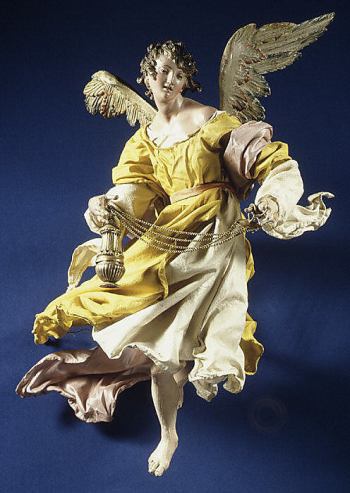
Angel, attributed to Giuseppe Sanmartino (Italian, 1720–1793), polychromed terracotta head; wooden limbs and wings; body of wire wrapped in tow; various fabrics, 14 inches (NY: The Met)
The Museum continues a longstanding holiday tradition with the presentation of its Christmas tree, a favorite of New Yorkers and visitors from around the world. A vivid eighteenth-century Neapolitan Nativity scene—embellished with a profuse array of diminutive, lifelike attendant figures and silk-robed angels hovering above—adorns the candlelit spruce. Recorded music and lighting ceremonies add to the enjoyment of the holiday display.
The annual Christmas installation is the result of the generosity, enthusiasm, and dedication of the late Loretta Hines Howard, who began collecting crèche figures in 1925 and soon after conceived the idea of combining the Roman Catholic custom of elaborate Nativity scenes with the tradition of decorated Christmas trees that had developed among the largely Protestant people of northern Europe. This unusual combination was presented to the public for the first time in 1957, when the Metropolitan Museum initially exhibited Mrs. Howard’s collection. More than two hundred eighteenth-century Neapolitan crèche figures were given to the Museum by Loretta Hines Howard starting in 1964, and they have been displayed each holiday season for nearly forty years. Linn Howard, Mrs. Howard’s daughter, worked with her mother for many years on the annual installation. Since her mother’s death in 1982, she has continued to create new settings for the Museum’s ensemble. In keeping with family tradition, Linn Howard’s daughter, artist Andrea Selby Rossi, joins her mother again this year in creating the display.

The exhibit of the crèche is made possible by gifts to The Christmas Tree Fund and the Loretta Hines Howard Fund.
The Museum’s towering tree, glowing with light, is adorned with cherubs and some fifty gracefully suspended angels. The landscape at the base presents the figures and scenery of the Neapolitan Christmas crib. This display mingles three basic elements that are traditional to eighteenth-century Naples: the Nativity, with adoring shepherds and their flocks; the procession of the three Magi, whose exotically dressed retinue echoes the merchants and travelers one may have encountered in bustling Naples at the time of the crèche’s creation; and, most distinctive, colorful peasants and townspeople engaged in their quotidian tasks. The theatrical scene is enhanced by a charming assortment of animals—sheep, goats, horses, a camel, and an elephant—and by background pieces serving as the dramatic setting for the Nativity, including the ruins of a Roman temple, several quaint houses, and a typical Italian fountain with a lion’s-mask waterspout.
The origin of the popular Christmas custom of restaging the Nativity traditionally is credited to Saint Francis of Assisi. The employment of manmade figures to reenact the hallowed events soon developed and reached its height of complexity and artistic excellence in eighteenth-century Naples. There, local families vied to outdo each other in presenting elaborate and theatrical crèche displays, often assisted by professional stage directors. The finest sculptors of the period—including Giuseppe Sammartino and his pupils Salvatore di Franco, Giuseppe Gori, and Angelo Viva—were called on to model the terracotta heads and shoulders of the extraordinary crèche figures. The Howard collection includes numerous examples of works attributed to them as well as to other prominent artists.
The Museum’s crèche figures, each a work of art, range from six to twenty inches in height. They have articulated bodies of tow and wire, heads and shoulders modeled in terracotta and polychromed to perfection. The luxurious and colorful costumes, many of which are original, were often sewn by ladies of the collecting families and enriched by jewels, embroideries, and elaborate accessories, including gilded censers, scimitars and daggers, and silver filigree baskets. The placement of the approximately fifty large angels on the Christmas tree and the composition of the crèche figures and landscape vary slightly from year to year as new figures are added.
Exhibition | Piranesi’s Antiquity: Findings and Polemics
From the Wallraf-Richartz Museum:
Piranesis Antike: Befund und Polemik / Piranesi’s Antiquity: Findings and Polemics
Wallraf-Richartz Museum, Cologne, 25 October 2013 — 26 January 2014
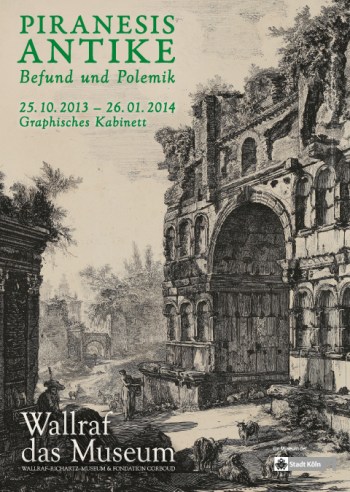 ‘Rome or Athens?’ In the eighteenth century, this simple and yet so complex question was at the heart of a vehement dispute concerning the exemplary function of classical antiquity for contemporary art. One major advocate of Rome was the artist Giovanni Battista Piranesi (1720–1778). Over a period of about 30 years, he produced more than 130 large-format etchings with views of ancient and modern Rome, as well as of buildings from the immediate surroundings. These etchings were compiled into a self-contained series under the title Vedute di Roma. Piranesi uses dramatic perspectives, strong contrasts between light and dark, and gigantic enlargements of sections of ancient buildings in order to convince his contemporaries of the importance of classical Rome.
Some 20 of these fascinating works can now (25 October 2013 to 26 January 2014) be seen in Cologne at the Wallraf-Richartz Museum’s Department of Drawings and Prints under the title Piranesi’s Antiquity: Findings and Polemics.
One of the most versatile Italian artists of the eighteenth century, Piranesi still fascinates us today with his extensive œuvre. During his lifetime he produced more than 1,000 etchings and thus left us impressive witnesses of his age. In addition to his graphic work, Piranesi also wrote numerous theoretical treatises, defending Roman civilization against the claims of Greek culture. The exhibition in Cologne shows how, in the large-format Vedute or views of Rome, the multifarious and contradictory ways in which classical antiquity was appropriated by the eighteenth century are superimposed. Meticulous archaeological investigations stand alongside market-oriented production of prints, and a polemical debate on the true legacy of antiquity (Rome versus Athens). By selling his views of Rome to foreign visitors to the city, Piranesi made a fortune and became well known throughout Europe.
This exhibition is being held to mark the 625th anniversary of the foundation of Cologne University. Together with teachers and students of art history and classical archaeology, the works were selected and researched from among the holdings of the university archives. The archive has 46 views of Rome by Piranesi, an unusual wealth of material for a university collection. It is the result of a donation by the university’s first Professor of Greek Philology, Dr Joseph Kroll.
Information on the exhibition symposium is available here»
Symposium | Piranesi and Antiquarian Knowledge
From ArtHist:
Piranesi und die Vermittlung antiquarischen Wissens im 18. Jahrhundert
Universität zu Köln, 23–24 January 2014

Giovanni Battista Piranesi, Temple of Coughing
(Entrance Hall of an Antique Villa), ca. 1763, etching
(Universität zu Köln, Universitätsarchiv, Inv. 700/14)
Wissen und Vorstellungen über die Antike sind in der Frühen Neuzeit in vielen Medien und Formaten vermittelt worden. Dazu zählen nicht nur die gelehrten antiquarischen Werke, sondern ebenso Gemälde und Opern mit antiken Themen, künstlich angelegte Ruinen und Landschaften oder systematisch angelegte Sammlungen von Kopien oder Originalen der bildenden Kunst.
Anlässlich der Ausstellung Piranesis Antike – Befund und Polemik im Wallraf-Richartz-Museum wird sich der Workshop mit der Frage beschäftigen, wie antiquarisches Wissen in der zweiten Hälfte des 18. Jhs. in den verschiedenen Gattungen und Medien über den Kreis der Gelehrten hinaus aufgenommen und vermittelt worden ist, z.B. durch die Aufnahme mythologischer oder historischer Themen. Dabei soll ein möglichst breites Spektrum an Gattungen vorgestellt werden. Zu untersuchen ist etwa, woher das Wissen über die Antike gewonnen wurde, für welches Publikum es gedacht war und wie es nach den Erfordernissen der jeweiligen Gattung umgeformt wurde.
◊ ◊ ◊ ◊ ◊
D O N N E R S T A G , 2 3 J A N U A R
Abendvortrag
18.00 Valentin Kockel (Augsburg), Ansicht – Plan – Modell. Die Visualisierung antiker Ruinen im 18. Jahrhundert
F R E I T A G , 2 4 J A N U A R
9.00 Dietrich Boschung (Köln) Begrüßung
9.15 Anne-Marie Leander Touati (Stockholm/Lund), Between vision and business. Choice pieces from the Piranesi collection in Stockholm
10.00 Dagmar Grassinger (Köln), Roms Größe wiederherstellen – Piranesis »Vasi antichi«
10.45 Kaffeepause
11.15 Alain Schnapp (Paris), Piranesi in der Zeit der lebenden Ruinen: Historische und künstlerische Ruinen
12.00 Mittagspause
13.30 Daniel Graepler (Göttingen), Zwischen antiquarischer Gelehrsamkeit und künstlerischer Praxis: Philipp Daniel Lipperts Daktyliothek
14.15 Jörn Lang (Leipzig), Wie Wissen Schönes schafft: Rezeption und Umformung antiquarischer Gelehrsamkeit in klassizistischem Wanddekor
15.00 Kaffeepause
15.30 Xenia Ressos (Innsbruck), Die Antike in Scherben – Antikenrezeption im Medium Porzellan
16.15 Abschlussdiskussion
Ort: Internationales Kolleg Morphomata, Universität zu Köln, Weyertal 59 (Rückgebäude: 3. Stock), 50937 Köln
Konzept: Dietrich Boschung
Kontakt: Semra Mägele, smaegele@uni-koeln.de
Conference | Aesthetic Enlightenments: Cultures of Natural Knowledge
From Birkbeck:
Aesthetic Enlightenments: Cultures of Natural Knowledge
Huntington Library, San Marino, 10–11 January 2014
Registration due by 10 January 2014
This two-day conference will examine the relationship between the aesthetic production and social circulation of knowledge about the natural world in the eighteenth century. It aims to connect literary, visual and discursive forms of analysis with approaches current within social history, in order to interrogate the relationship between social participation in science and the aesthetic and cultural forms of its making.
F R I D A Y , 1 0 J A N U A R Y 2 0 1 4
8:30 Registration and coffee
9:30 Welcome: Steve Hindle (The Huntington)
Remarks: Sarah Easterby-Smith (University of St. Andrews) and Emily Senior (Birkbeck, University of London)
10:00 Session 1: Knowledge Work and Circulation
Moderator: Margaret Jacob (University of California, Los Angeles)
• Londa Schiebinger (Stanford University), “The Atlantic World Medical Complex”
• Noah Heringman (University of Missouri), “Knowledge Work, or, Sciences from the Middle”
12:00 Lunch
1:00 Session 2: Hybrid Forms of Knowledge
Moderator: Lyle Massey (University of California, Irvine)
• Daniela Bleichmar (University of Southern California), “Chronicles without Words: The Study of Mexican Codices and Amerindian Knowledge in the Eighteenth Century”
• Jill H. Casid (University of Wisconsin, Madison), “Satyrosity”
3:00 Break
3:15 Session 3: Inscription, Translation, and Erasure
Moderator: Sarah Kareem (University of California, Los Angeles)
• Alan Bewell (University of Toronto), “Natures Lost in Translation”
• Matthew Daniel Eddy (Durham University), “How to Keep a Notebook: Inscription as a Visual Knowledge-Making Process for Early Modern Students”
S A T U R D A Y , 1 1 J A N U A R Y 2 0 1 4
9:00 Registration and coffee
9:30 Session 4: The Epistemology of Feeling
Moderator: Anne Mellor (University of California, Los Angeles)
• Jonathan Lamb (Vanderbilt University), “Blushing and Tattooing”
• Alan Richardson (Boston College), “Empathy for the Devil: From Mirror Neurons to Sympathy Theory to Shelley’s The Cenci”
11:30 Lunch
12:30 Session 5: Scholars and Communities
Moderator: Alexander Wragge-Morley (University of Oxford)
• Deirdre Coleman (University of Melbourne), “Henry Smeathman and the Cultures of Natural Knowledge”
• Dena Goodman (University of Michigan), “Collective Identity, Natural History, and Public Responsibility: Augustin-François Silvestre’s Eulogies for the French Society of Agriculture, 1801–1841”
2:30 Break
2:45 Session 6: Public Science, Education, and Professionalization
Moderator: Devin Griffiths (University of Southern California)
• Dahlia Porter (University of North Texas), “Anatomical Inventories, Medical Aesthetics: Body Parts and the Life of Things”
• Jan Golinski (University of New Hampshire), “Sublime Astronomy at the End of the Enlightenment: Adam Walker and the Eidouranion”
For registration, please email: researchconference@huntington.org
Study Day | Jean-Baptiste Oudry
From the programme:
Revoir Oudry: Pratiques, Discours et Ornement
Institut national d’histoire de l’art, Paris, 18 January 2014
 Cette journée d’études propose de jeter un regard oblique sur Jean-Baptiste Oudry (1686–1755) à travers ses conférences, ses rapports à l’ornement et la circulation de ses motifs, touchant ainsi aux questions de répétition et d’autorité. De ses conférences à l’Académie à son rôle de directeur de la manufacture de Beauvais et d’inspecteur de celle des Gobelins, des cours de dessins qu’il donne au prince Frédéric à sa réapparition dans l’art contemporain, l’œuvre et la fortune critique d’Oudry permettent de réfléchir aux rapports entre peinture et ornement dans l’art français du xviiie siècle. Plus largement, c’est la présence lacunaire d’Oudry dans les discours de l’histoire de l’art qui sera interrogée en ce qu’elle peut révéler des méthodes et de l’état de la discipline. En effet, en dépit d’un œuvre foisonnant et d’une carrière académique prestigieuse, Oudry n’a pas reçu l’attention muséographique et critique continue dont bénéficient Watteau, Boucher, Chardin ou Fragonard, et n’a pas bénéficié du renouveau des études sur l’art rococo dans le monde anglo-saxon. Les chercheurs européens et nord-américains invités proposent donc, au-delà des canons de sa peinture animalière, de revoir Oudry dans les marges de la discipline.
Journée d’études organisée : Michaël Decrossas (INHA), Catherine Girard (Harvard University/INHA) et David Pullins (Harvard University/CASVA)
Contacts : michael.decrossas@inha.fr | catherine.girard@yahoo.com | pullins@fas.harvard.edu
Jean-Baptiste Oudry, Quizzical Bird, xviiie siècle, Harvard Art Museums/Fogg Museum
◊ ◊ ◊ ◊ ◊
S A M E D I , 1 8 J A N V I E R 2 0 1 4
8.30 Accueil
9.00 Ouverture : Michaël Decrossas (INHA), Catherine Girard (Harvard University/INHA) et David Pullins (Harvard University/CASVA)
9.20 Introduction : Hal Opperman (University of Washington School of Art)
Session I – Discours
9.50 Présidence de séance et intervention liminaire : Christian Michel (Université de Lausanne)
10.10 René Démoris (Université Sorbonne Nouvelle – Paris 3), Situer Oudry dans la réflexion sur la peinture
10.40 Aaron Wile (Harvard University/Centre allemand d’histoire de l’art, Paris), Oudry, ou la couleur à l’œuvre
11.10 Discussion
11.20 Pause
Session II – Ornement
11.30 Présidence de séance et intervention liminaire : Katie Scott (Courtauld Institute of Art, Londres)
11.50 Michaël Decrossas, Pourquoi classer les planches d’Oudry dans les gravures d’ornements?
12.20 Valentine Toutain-Quittelier (Université Paris Sorbonne/Centre allemand d’histoire de l’art, Paris), Oudry et l’imaginaire vénitien : étude sur un succès de l’ornement sous la Régence
12.50 Discussion
13.00 Déjeuner
Session III – Arts décoratifs
14.40 Présidence de séance et intervention liminaire : Vincent Droguet (Château de Fontainebleau)
15.00 Christophe Huchet de Quénetain (Université Paris Sorbonne), L’influence de Jean-Baptiste Oudry, « peintre de chasses », sur les Arts décoratifs français du xviiie siècle
15.30 David Pullins, Drawing into and out of media in Jean-Baptiste Oudry’s oeuvre
16.00 Discussion
16.10 Pause
Session IV – Répétition et circulation
16.20 Présidence de séance et intervention liminaire : Ewa Lajer-Burcharth (Harvard University)
16.40 Claudia Schönfeld (St Georgen, Bade-Wurtemberg, collection Grässlin), Pratiques d’enseignement et réception d’Oudry à la cour de Mecklembourg
17.10 Catherine Girard, Atrophies masculines. Répétitions de la commande royale des « bois bizarres », de Louis XV à nos jours
17.40 Discussion et conclusion
Call for Articles | Collecting and Displaying in Portugal
As noted at ArtHist:
Collecting and Displaying in Portugal: From João V to the Estado Novo
Edited by Foteini Vlachou (Instituto de História da Arte, Faculdade de Ciências Sociais e Humanas, Universidade Nova de Lisboa)
Proposals due by 30 January 2014
During the last two decades, the interest in Portuguese collecting and collectors, as well as objects commissioned and purchased abroad during the maritime expansion has known a significant surge. The publications and exhibition catalogues of scholars such as Maria Antónia Pinto de Matos (the specialist on Chinese export porcelain) or Annemarie Jordan Gschwend have drawn attention to the extensive commerce of luxury and exotic goods between Portugal and her colonies. Other scholars, such as João Carlos Pires Brigola have pioneered the study of the early history of museums and collections in the late eighteenth and early nineteenth century, focusing on natural history museums. Individual collectors have also been studied (Manuel do Cenáculo Vilas-Boas and João Allen, for example), and various exhibition catalogues have been dedicated to them (such as the one on Henry Burnay). Teaching and research has also developed along these lines, notably the master’s degree on museum studies (Faculdade de Ciências Sociais e Humanas, Universidade Nova de Lisboa), and the research program “Fontes para a História dos Museus de Arte em Portugal,” both spearheaded by Raquel Henriques da Silva.
This volume aims to present to an international audience a comprehensive view of recent scholarly activity, but also—and most importantly—a panorama of the history of collections, exhibitions and museums in Portugal, roughly from the beginning of the eighteenth century till the end of Salazar’s regime. Methodological approaches that take into account the relationship between collecting and displaying practices and class, gender, national identity and citizenship, and/or focus on material culture will be especially welcome. The volume is under consideration with Ashgate Publishing (Series: The Histories of Material Culture and Collecting, 1700–1950, Series Editor: Michael Yonan, University of Missouri).
Topics will fall under four major headings:
• Collecting and Displaying the Empire — botanical gardens and naturalist specimens from the scientific expeditions, the development of concepts such as the Indo-Portuguese and related exhibition history, etc.
• Decorative Arts — collections of textiles, porcelain, etc., the importance of azulejos in both a local and colonial context, nineteenth-century exhibitions of decorative arts and the notion of ‘national’ art, etc.
• ‘European Traditions’ — prints and drawings collections, collections of copies and/or plaster casts, nineteenth-century Portuguese collectors, etc.
• Museums, Exhibitions and Collections during the First Republic and the Estado Novo — museums and the state, the proclamation of the Republic as a seminal moment in the institutional history of Portuguese museums, exhibiting Portugal abroad, etc.
Please send proposals of up to 500 words and a one page CV to Foteini Vlachou (nandia.vlachou@gmail.com) no later than January 30, 2014. Writers will be notified by the end of February 2014.
New Title | Landscapes of London
From Yale UP:
Elizabeth McKellar, Landscapes of London: The City, the Country, and the Suburbs, 1660–1840 (London: Paul Mellon Centre for Studies in British Art, 2013), 276 pages, ISBN: 978-0300109139, $85.
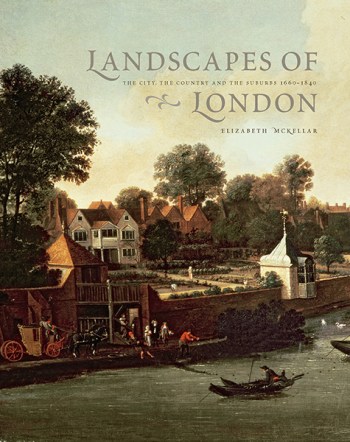 The idea of a “Greater London” emerged in the 18th century with the expansion of the city’s suburbs. In Landscapes of London, Elizabeth McKellar traces this growth back to the 17th century, when domestic retreats were established in outlying areas. This transitional zone was occupied and shaped by the urban middle class as much as by the elite who built villas there. McKellar provides the first major interdisciplinary cultural history of this area, analyzing it in relation to key architectural and planning debates and to concepts of national, social, and gender identities. She draws on a wide range of source materials, including prints, paintings, maps, poetry, songs, newspapers, guidebooks, and other popular literature, as well as buildings and landscapes. The author suggests that these suburban landscapes—the first in the world—were a new environment, but one in which the vernacular, the rustic, and the historic played a substantial part. This fascinating investigation shows London as the forerunner of the complex, multifaceted modern cities of today.
Elizabeth McKellar is senior lecturer and staff tutor in the
history of art, Open University.
From the V&A: The Château de Juvisy Appeal

Pierre-Denis Martin, The Château de Juvisy,
165cm x 265cm, ca. 1700
◊ ◊ ◊ ◊ ◊
From the V&A:
We need your help to raise £500,000 to make this significant acquisition in time for the opening of the Europe 1600–1800 galleries.
The next stage of the V&A’s FuturePlan sees the opening of our redeveloped Europe 1600–1800 galleries. To complete these galleries we need your help to make one of our most ambitious acquisitions to date—a major Baroque oil painting of the Château de Juvisy, by Pierre-Denis Martin, court painter to Louis XIV. An accurate depiction of a French château and gardens from the 17th century is very rare, and unusually for an architectural portrait of this kind, the scene is bursting with human activity. Martin provides an extraordinary and vivid insight into the many aspects of château life and there are currently no paintings like it in any museum in the UK.
 The painting will play a pivotal role in Gallery 5 of our seven redeveloped Europe 1600–1800 galleries, which will focus on the rise of France during 1660–1720. The painting will be displayed in a prominent position and the vast panorama, measuring 165cm x 265cm, will be the first thing you will see as you enter the space, setting the tone for the whole gallery. The arrival of Louis XIV is believed to be depicted in the foreground, and the gallery will explore the tastes and styles of his regency.
With the design of the new galleries complete and the building work now under way, we urgently need your support to ensure that we can purchase this significant centrepiece. The V&A has already managed to secure a large proportion of the £1,300,000 it will cost to purchase the painting, but we are not there yet. We urgently need your support to help raise £500,000 for this important painting to become a part of our collection. Your contribution towards this appeal, however large or small, will be vital to ensuring that we can make this ambitious acquisition in time.
Donate here»
The painting was only recently recognized as the work of Pierre-Denis Martin by Alan Rubin of Pelham Galleries; more information is available in this article, “Going Dutch: Buyers Aplenty at the Maastricht Art Fair,” The Economist (17 March 2010).
Exhibition | Wallpaper from the Deutschen Tapetenmuseums

Orangerie, Kassel
(Wikimedia Commons, November 2005)
◊ ◊ ◊ ◊ ◊
While this exhibition of wallpapers in Kassel addresses primarily the nineteenth century, there are eighteenth-century examples, and it’s useful to draw attention to the collection of the German Wallpaper Museum (Deutschen Tapetenmuseums), which includes some 23,000 objects. With plans for a new home in the works, the current exhibition is mounted in Kassel’s Orangerie, which itself dates to the opening decade of the eighteenth century. From the exhibition description:
Aufgerollt. Tapeten: Vom Entwurf an die Wand
Westpavillon der Orangerie, Kassel, 13 September 2013 — 12 January 2014
 Jeder kennt sie, fast jeder hat sie: Tapeten. Seit dem 18. Jahrhundert begeistern die in allen nur denkbaren Farben und Motiven gedruckten Wanddekore. Ob geometrisch oder malerisch, farbenfroh oder dezent, ob im 18. oder im 21. Jahrhundert entstanden: Bevor die Tapete ihre Wirkung als Wandschmuck entfalten kann, sind zahlreiche Arbeitsschritte notwendig, die von der Inspirations- und Entwurfsphase, über die Produktion bis hin zur Vermarktung reichen. Die Sonderausstellung des Deutschen Tapetenmuseums zeigt Objekte aus dem reichen Schatz der Sammlung, die dieses faszinierende Thema insbesondere für das 19. und frühe 20. Jahrhundert beleuchten. Gezeigt wird eine Vielfalt an Vorlagewerken, Tapetenentwürfen und Handdruckmodeln ebenso wie das fertige Produkt Tapete. Musterbücher und Werbebilder mit gesamten Wandabwicklungen lassen die Möglichkeiten der Vermarktung von Tapeten lebendig werden.
Das Schaufenster bietet einen Einblick in die fantastische Sammlung des Deutschen Tapetenmuseums, die mit fast 23.000 Objekten nahezu lückenlos die Geschichte der Tapete dokumentiert. Von 1976 bis 2008 im Hessischen Landesmuseum ausgestellt, wurde die Sammlung 2010 in ein fachgerechtes Depot verlagert. Ein Museumsneubau ebenso wie eine neue Dauerausstellung sind in Planung.
Call for Papers | The Visual Arts in Wales
Wales / Iâl / Yale: Graduate Student Symposium
Yale Center for British Art, New Haven, Connecticut, 5 April 2014
Proposals due by 22 January 2014
This one-day graduate student symposium considers the visual arts in Wales.
For centuries, Wales has been an integral and yet distinct part of the United Kingdom. Its history, language, and landscape have inspired artists of all kinds–from painters, sculptors, and architects to musicians, dancers, and poets.
Yale University itself has deep and enduring ties to the country. Founded in 1701 as the Collegiate School, it was renamed Yale College in 1718 after Elihu Yale (1649–1721), the original benefactor who was of Welsh ancestry. Indeed, the surname Yale comes from the Welsh place name Iâl. Elihu Yale himself is buried in his ancestral home in the churchyard of St. Giles Church, Wrexham, while Wrexham Tower at Yale University’s Saybrook College is modeled after St. Giles’s tower and incorporates an inscribed stone sent to the university as a gift from the church.
The symposium coincides with two exhibitions opening at the Yale Center for British Art in spring 2014 that feature Welsh artists and depictions of Wales: Richard Wilson and the Transformation of European Landscape Painting (March 6–June 1, 2014) is the first major exhibition devoted to the Penegoes-born artist in thirty years and explores
Wilson’s work in its broader European contexts, focusing on his transformative experience in Rome, where he spent nearly seven years in the 1750s; and, Art in Focus: Wales (April 4–August 10, 2014), the Center’s eighth annual Student Guide exhibition, presents depictions of Welsh landscape in the Center’s collections and their significance to
the history of landscape in British art.
Papers are invited on all topics relating to the visual arts in Wales including, but not limited to:
• standing stones, cromlechs, and stone circles in Wales
• medieval wall paintings in Welsh churches
• the production of Insular manuscripts in Wales
• landscape painting in Wales
• bardic imagery and Welsh nationalism
• the development of schools of art and architecture in Wales
• photography and Wales
• art and industry in Wales
• the architectural heritage of Wales
• public sculpture in Wales
• Welsh modernism in accounts of British modernism
• the historiography of art in Wales
• Welsh artists abroad
• Welsh art now
We invite proposals for 25-minute papers on this theme from graduate students working in any discipline. Cross-disciplinary and comparative studies are particularly welcome. Please e-mail abstracts of no more than 300 words by January 22, 2014.
lars.kokkonen@yale.edu
Lars Kokkonen
Postdoctoral Research Associate
Research Department
Yale Center for British Art
Travel and accommodations will be provided for speakers arriving from outside the New Haven area, and meals will be provided for all.










 Enfilade
leave a comment