Call for Papers | Emblems and Enigma: The Heraldic Imagination
From the conference website:
Emblems and Enigma: The Heraldic Imagination
An Interdisciplinary Symposium at the Society of Antiquaries of London, 26 April 2014
Proposals due by 10 January 2014

◊ ◊ ◊ ◊ ◊
Time has transfigured them into / Untruth –Philip Larkin
In his 1844 short story “Earth’s Holocaust,” Nathaniel Hawthorne sees heraldic signs reaching “like lines of light” into the past, but also as encrypted and obsolete. Proliferating and arcane, unique, ubiquitous, and inscrutable, the heraldic has been a major presence across the arts since medieval times; yet it remains, culturally and critically, enigmatic.
The organisers of this interdisciplinary symposium, Professor Fiona Robertson (St Mary’s University College) and Dr Peter Lindfield (University of St Andrews) invite proposals for twenty-minute papers on any aspect of the employment and perception of the heraldic in literature, history, art, architecture, design, fashion, and contemporary and historical practice.
The programme will include a keynote address by Professor Vaughan Hart (University of Bath); a special session on the heraldry of Horace Walpole’s Strawberry Hill and William Beckford’s Fonthill Abbey; and papers on eighteenth-century antiquaries’ exploration of the heraldic, and on heraldry in nineteenth-century British and American literature. Topics may include, but are not restricted to:
– the languages and grammar of heraldry
– armoiries parlantes, allusions and puns
– imaginary and fantastical heraldry
– decoration and display
– blazonry and identity: nations, groups, individuals
– mock- and sham-heraldics; parody and subversion
– practices of memory and memorialisation
– history, development, and modern practice
– blazon and the body
– heraldic revivalism; medievalism; romance
– enigma, error, and absence: the bar sinister and the blank shield
– individual designers, writers, and collectors
– gendered identity
– hierarchies of signs
– international and interdisciplinary perspectives
Proposals of 200 words should be sent to heraldics2014@gmail.com by 10 January 2014. More information can be found on the conference website. Fiona Robertson and Peter Lindfield plan to edit a collection of essays arising from the symposium.
Exhibition | Precious Antiquities: The Profane Museum
From the Vatican Museums:
Precious Antiquities: The Profane Museum at the Time of Pius VI
Room of the Aldobrandini Wedding, Vatican Museums, Rome, 2 October 2013 — 4 January 2014
Curated by Guido Cornini and Claudia Lega
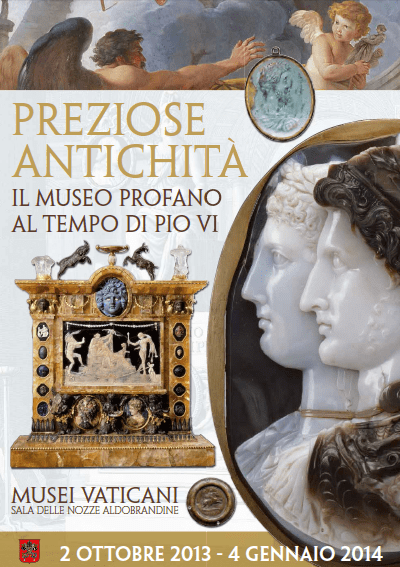 For the first time in over two hundred years, an exhibition will bring back to life in the Vatican the charm of the eighteenth-century collections of the Profane Museums at the time of Pius VI, before the Napoleonic requisitions. It offers a unique opportunity to see reunited, in their original museum context, works previously exhibited in the Museum and now conserved in prestigious international cultural institutions. The exhibition will open simultaneously with the new display of the historical collections of the Profane Museum.
The Profane Museum, the original nucleus of the collections of profane antiquities in the future complex of the Vatican Museums, was created by Clement XIII (Rezzonico, 1758–1769) and enriched with further collections and furnishings under Pius VI (Braschi, 1775–1799). The conclusion of this demanding restoration project, which involved the entire collection and its context, is an opportunity to imagine a momentary “homecoming” of a nucleus of antique gems and cameos, mounted in elaborate Neoclassical settings at the end of the eighteenth century, and a valuable numismatic collection of Greek, Etruscan and Roman exemplars. Involved in the dramatic wartime events of the Napoleonic period, these works were transported to France as a war indemnity following the assassination of General Mathurin-Léonard Duphot in Rome in 1798.
Curated by Guido Cornini and Claudia Lega, curator and assistant in the Department of Decorative Arts of the Vatican Museums, the exhibition Precious Antiquities: The Profane Museum at the Time of Pius VI – presented in the evocative surroundings of the Room of the Aldobrandini Wedding – displays for the first time in over two hundred years works such as the Augustus Group, with its splendid portrait of the emperor in chalcedony, the famous Carpegna Cameo of magnificently engraved onyx depicting the Triumph of Bacchus, the “Delle Paste” Group, with a glass cameo pinax depicting the loves of Bacchus and Ariadne, and other Groups and cameos masterfully reinterpreted and infused with new life by Luigi Valadier, celebrated silversmith in Rome at the time of Pius VI. (more…)
Call for Papers | Galloping History
Galloping History
Ankara, Turkey, 16-19 April 2014
Proposals due by 20 December 2013
There would hardly be any exaggeration in assuming that horses have been one of the most important companions to humankind since the development of civilized societies. Horses and equine culture have played a great many roles in almost all historical epochs. Thus, historical inquiry has encountered this phenomenon in a diverse spectrum of fields, including but not limited to military, social, economic, cultural, and literary aspects of human life and its historical evolution. However, since the Industrial Revolution and the technological progress it brought about, especially in transportation, horses and equine culture gradually digressed from the realm of everyday life. The perception of horses and the culture associated with an interest in horses in the contemporary world, as being distinctive of a certain socio-economic class, undermines the true significance of humankind’s relationship with these animals.
For the purpose of elucidating this point, I. D. Bilkent University Department of History and Bilkent Historical Society are jointly organizing a symposium entitled Galloping History, whose scholarly framework utilizes horses and equine culture. Accompanied by relevant social activities, the symposium aims both to bring together the most recent scholarly research, thereby opening up new and innovative discussions in the field, and to enhance the dialog between the world of academia and a wider audience. The panels to take place on the 17th and 18th of April will focus on horses and equine culture in Ottoman, European and American history, in accordance with the Department of History tracks. Researchers in the field, graduate students of all levels and history enthusiasts are welcome to submit abstracts to be evaluated by a board comprising of the Department of History faculty.
During the course of the four-day event, all expenses at I.D. Bilkent University (accommodation and meals) will be covered, but the participants are otherwise responsible for their own travel expenses. The finalized schedule of events and panels will be shared with the participants soon after the evaluation of abstracts is completed. (more…)
New Book | The Reception of Titian in Britain from Reynolds to Ruskin
Papers from a 2011 conference have recently been published by Brepols:
Peter Humfrey, ed., The Reception of Titian in Britain from Reynolds to Ruskin (Turnhout: Brepols, 2013), 258 pages, ISBN: 978-2503536750, 70€.
 This volume comprises sixteen essays on the reception of Titian by British painters, collectors and critics in the long nineteenth century. The main focus falls on the first three decades of the century, in the aftermath of the exhibition of the celebrated Orléans collection in London in 1798–99. But the chronology extends from Reynolds and his contemporaries, around the time of the founding of the Royal Academy in 1768, to the more diverse and complicated reactions of the Victorian age, and even into the twentieth century.
C O N T E N T S
• Peter Humfrey, Introduction: The Pre-History,
• Marin Postle, ‘That Titian of our times’: Sir Joshua Reynolds and the ‘Divine Titian’
• Jonathan Yarker, Copies and the Taste for Titian in Late Eighteenth-Century Britain
• Stephen Lloyd, ‘So much is Titian the rage’: Titian, Copies and Artist-Collectors in London c.1790–1830
• Rosie Dias, Colour, Effect and the Formation of an English School of Painting
• Linda Borean, Sir Abraham Hume as Collector and Writer
• Philippa Simpson, Titian in Post-Orléans London
• Anne Lyles, Constable and Titian
• Tom Nichols, Hazlitt and Titian: Progress, Gusto and the (Dis)Pleasure of Painting
• Godfrey Evans, ‘Vaulting ambition, which o’erleaps itself’: The Dukes of Hamilton and Titian
• Caroline Campbell, Titian in Nineteenth-Century British Fiction
•William McKeown, Getting at ‘the mind of Titian’in Ruskin’s Modern Painters
• Jason Rosenfeld, Millais and the ‘luster of Titian’
• Jeremy Howard, Titian’s Rape of Europa: Its Reception in England and Sale to America
• Catherine Whistler, Merchants and Writers: The Ashmolean’s Titian Collection and Some Nineteenth-Century Owners
• Susanna Avery-Quash, Titian at the National Gallery, London: An Unchanging Reputation?
Exhibition | Antonio Canova: The Seven Last Works
From The Met:
Antonio Canova: The Seven Last Works
Gallerie d’Italia, Milan, 4 October 2013 — 6 January 2014
The Metropolitan Museum of Art, New York, 22 January — 27 April 2014
Curated by Fernando Mazzocca and Matteo Ceriana
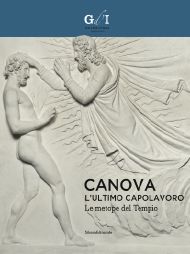 Antonio Canova (1757–1822), the greatest of all neoclassical sculptors, remains famous above all for the elegant nude mythological subjects that he carved exquisitely in marble. But he also worked in a deeply serious, deceptively simple style. This less familiar Canova is revealed in an extraordinary series of full-scale plaster models illustrating episodes from the Old and New Testaments. Such models, used to review his compositions before they were transferred into stone, were a distinctive feature of his sculptural practice. These Biblical scenes were made in connection with a project for 32 low reliefs that were to adorn the Tempio Canoviano, the church in his home town Possagno, which later became the artist’s mausoleum. He completed only seven models before his death. Six come from the Gallerie dell’Accademia in Venice, and one from the Gipsoteca in Possagno. Newly restored, they will all be lent for the first time to the United States. Drawing inspiration from ancient sculpture and early Renaissance masters, the models are striking for the marked linearity of the figures, arranged in brilliantly syncopated compositions. They constitute Canova’s last, profoundly moving masterworks.
◊ ◊ ◊ ◊ ◊
From the Gallerie d’Italia:
Canova. L’ultimo capolavoro. Le metope del Tempio
Gallerie d’Italia, Milan, 4 October 2013 — 6 January 2014
The Metropolitan Museum of Art, New York, 22 January — 27 April 2014
a cura di Fernando Mazzocca e Matteo Ceriana
L’esposizione è organizzata da Intesa Sanpaolo in partnership con la Soprintendenza Speciale PSAE e per il Polo Museale della città di Venezia e dei Comuni della Gronda lagunare e in collaborazione con la Fondazione Cariplo. Aperta al pubblico nella sede milanese fino al 6 gennaio 2014, la mostra sarà ospitata al Metropolitan Museum of Art di New York dal 20 gennaio al 27 aprile 2014.
Il recente restauro di sei bassorilievi in gesso conservati presso le Gallerie dell’Accademia di Venezia, ispirati a episodi dell’Antico e del Nuovo Testamento, e lo studio dei documenti ad essi relativi hanno portato alla luce opere di grande valore storico. Sono infatti state identificate nelle opere restaurate i modelli originali per le prime delle trentadue metope – i pannelli decorativi destinati a ritmare il fregio dorico – che Antonio Canova, moderno Fidia, intendeva realizzare per il pronao del Tempio della natia Possagno, l’edificio maestoso da lui stesso progettato ispirandosi all’architettura del Partenone e del Pantheon.
Lo scultore iniziò a lavorare ai modelli delle metope nel dicembre del 1821; ai primi di aprile del 1822 ne erano stati eseguiti sette, subito inviati dallo studio di Roma all’Accademia di Venezia, perché altrettanti scultori, scelti tra i migliori allievi dell’Accademia stessa, iniziassero a realizzarne la versione in marmo. La morte, sopraggiunta il 13 ottobre 1822, impedì allo scultore di portare a compimento il progetto. Insieme ai sei bassorilievi del Tempio, sono in mostra sette disegni preparatori, provenienti dal Museo Civico di Bassano del Grappa, in stretta relazione alle metope stesse, che testimoniano il costante interesse di Canova per i temi biblici e cristiani, così come il suo studio dei Primitivi.
Completano l’esposizione due esemplari, provenienti dalla Biblioteca Braidense, dell’Atlante illustrato della Storia della scultura (1813–1818 e 1822–1824) di Leopoldo Cicognara, storico dell’arte e amico di Canova: una fonte importante che permette di contestualizzare meglio il confronto con il Medioevo e il primo Rinascimento. Uno dei sette modelli delle metope, andato purtroppo perduto, viene rappresentato in mostra dal bassorilievo proveniente dalla Gipsoteca Antonio Canova di Possagno, appartenente ad una serie eseguita dai seguaci dell’opera del Maestro.
La mostra trova una sede ideale nelle sale della sezione Da Canova a Boccioni delle Gallerie di Piazza Scala, nelle quali sono esposti i bassorilievi Rezzonico di Collezione Fondazione Cariplo. Tale collocazione consente un confronto diretto – nell’ambito delle opere di Canova con la tecnica del bassorilievo in gesso – tra la produzione giovanile dell’ultimo decennio del Settecento, ispirata all’antichità classica, e opere realizzate prima della morte.
Lecture | Richard Cooper’s Album of Italian Drawings
From the Paul Mellon Centre:
Tom Edwards (Abbot & Holder, Ltd) | Amongst the Grand Tourists:
Richard Cooper Jnr’s (1740–1822) Album of Italian Drawings
Paul Mellon Centre for Studies in British Art, London, 6 December 2013
Research lunches are intended to be informal events in which individual doctoral students and scholars talk for half-an-hour about their projects, and engage in animated discussion with their peers. A sandwich lunch, will be provided by the Centre. We hope that this series will help foster a sense of community amongst PhD students and junior colleagues from a wide range of institutions, and bring researchers together in a collegial and friendly atmosphere.
In order to help us plan for these events, it is essential to check availability by emailing the Centre’s Events Co-ordinator, Ella Fleming (efleming@paul-mellon-centre.ac.uk) at least two days in advance.
New Book | Forbidden Fashions in Early Venetian Convents
From Texas Tech University Press:
Isabella Campagnol, Forbidden Fashions: Invisible Luxuries in Early Venetian Convents, Costume Society of America Series (Lubbock: Texas Tech University Press, 2013), 160 pages, ISBN: 978-0896728295, $35.
 Form-fitting dresses, silk veils, earrings, furs, high-heeled shoes, make up, and dyed, flowing hair. It is difficult for a contemporary person to reconcile these elegant clothes and accessories with the image of cloistered nuns. For many of the some thousand nuns in early modern Venice, however, these fashions were the norm. Often locked in convents without any religious calling—simply to save their parents the expense of their dowry—these involuntary nuns relied on the symbolic meaning of secular clothes, fabrics, and colors to rebel against the rules and prescriptions of conventual life and to define roles and social status inside monastic society. Calling upon mountains of archival documents, most of which have never been seen in print, Forbidden Fashions is the first book to focus specifically upon the dress of nuns in Venetian convents and offers new perspective on the intersection of dress and the city’s social and economic history.
Isabella Campagnol, a dress, textile, and decorative arts historian, is the co-editor of Rubelli: A Story of Venetian Silk. She has
lectured on the topics of Venice and Venetian textiles in Italy and
Europe and the United States. She lives between Murano and Rome.
◊ ◊ ◊ ◊ ◊
Liza Foreman, “Fashion Inside Convent Walls,” provides a sketch of the project in The New York Times (23 September 2013) . . .
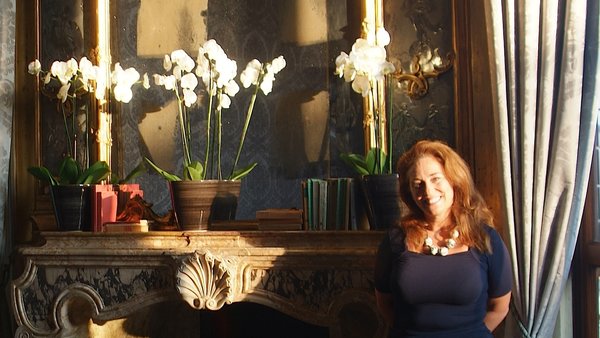 . . . Ms. Campagnol, 44, was commissioned by the society to write Forbidden Fashions after lecturing at its symposium in 2008. The book spans the period from the 15th century, when there were around 2,100 nuns living in the city’s 30 convents, to the mid-18th century, when, Ms. Campagnol said, “most of the convents were closed or repurposed by Napoleon, after the fall of the Republic in 1797.”
As for the fashionable nuns, they were “how Venice preserved its wealth” at a time when brides were expected to come with large dowries, the author explained. “If you had more than one daughter, one married and the rest went to convents.” . . .
The full article is available here»
Conference | Roma 1771–1819: I Giornali di Vincenzo Pacetti
From the conference programme:
Roma 1771–1819: I Giornali di Vincenzo Pacetti
Accademia Nazionale di San Luca – Università Sapienza, Rome, 28–30 November 2013
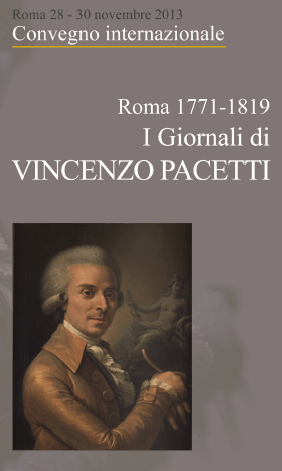 Il Convegno intende costituire un momento di riflessione critica a seguito della pubblicazione, avvenuta nel 2011, del volume Roma 1771–1819: I Giornali di Vincenzo Vincenzo Pacetti (1746–1820), che contiene la prima trascrizione integrale dei due diari dello scultore romano. A partire dalla testimonianza oggettiva contenuta negli appunti dell’artista, influente membro dell’Accademia di San Luca, restauratore, esperto e commerciante di antichità e dipinti nella Roma cosmopolita della seconda metà del XVIII secolo, l’incontro intende mettere a confronto specialisti di diverse discipline per indagare gli aspetti storico-culturali sollecitati dalla lettura dei Giornali.
G I O V E D Ì , 2 8 N O V E M B R E
I. Pacetti e l’Ambiente Artistico Contemporaneo
9.00 Saluti di apertura
9.30 Alvar Gonzales Palacios, Introduzione
10.00 Francesco Leone, Vincenzo Pacetti scultore d’invenzione
10.20 Angela Cipriani, Vincenzo Pacetti e l’Accademia di San Luca
10.40 Chiara Piva, “Una comunicazione di interessi e benefici
reciproci”. L’atelier di Vincenzo Pacetti e i suoi collaboratori
11.00 Nancy Hirschland Ramage, Pacetti at the Getty
11.20 Coffee break (more…)
New Book | At the King’s Table: Royal Dining through the Ages
While the eighteenth century doesn’t stand out in the book’s description (hard to compare with 48-day picnics), the Georgian period is covered, too. With feasting in mind for all of you celebrating this curious American holiday, all the best for a happy Thanksgiving. -CH
From the publisher:
Susanne Groom, At the King’s Table: Royal Dining through the Ages (London: Merrell, in association with Historic Royal Palaces, 2013), 208 pages, ISBN: 978-1858946139, $40.
 Here are the feasts that really are fit for a king – or queen. This delightful book explores the history of royal dining from the bustling kitchens of the Middle Ages to the informal dinner parties of today. Susanne Groom, a former curator at Historic Royal Palaces, considers the diets of monarchs from Richard II to Elizabeth II, revealing the exotic beasts served at medieval courts, the 48-day picnic prepared for Henry VIII and François I of France at the Field of Cloth of Gold, the romantic suppers made for Charles II and his mistresses, Queen Victoria’s love of nursery food, and the gluttonous appetite of Edward VII. We also learn about royal table manners, the earliest cookbooks, the hiring of flamboyant chefs and the intrigues of unscrupulous kitchen staff, the ever-changing health advice given to the sovereign, and the influence of royal diet on the average family fare. Full of lively anecdotes, colourful characters, rarely seen illustrations, and menus from state banquets, weddings, coronations and jubilees, At
the King’s Table is a treat for all culinary fans.
Susanne Groom is a consultant curator at Historic Royal
Palaces, London. She is the co-author of Kew Palace:
The Official Illustrated History (Merrell, 2006).
Reviewed | Crossing Borders: Hebrew Manuscripts
While the manuscripts included in this exhibition date from the Middle Ages, there is material pertinent to eighteenth-century collectors, as noted below. And to everyone celebrating Hanukkah (which, of course, most unusually coincides this year with the American Thanksgiving), a very happy holiday! -CH
From caa.reviews:
Piet van Boxel and Sabine Arndt, eds. Crossing Borders: Hebrew Manuscripts as a Meeting-place of Cultures, exhibition catalogue (Oxford: Bodleian Library, University of Oxford, 2010), 128 pages, ISBN: 978-1851243136, £25.
Exhibition schedule: Jewish Museum, New York, 14 September 2012 — 3 February 2013
Reviewed by Barbara Drake Boehm and Melanie Holcomb; posted 20 November 2013.
Illuminated manuscripts offer the best-surviving evidence of Jewish artistic production in the Middle Ages, bearing witness to the tastes of their Jewish patrons, the skills of Jewish scribes, and the aesthetic acuity of Jewish readers and viewers. Jews did not live in isolation, and the artists responsible for the decoration of their books—who were not necessarily Jewish but may have been—both drew from and contributed to the artistic conventions of the dominant culture. ‘Crossing Borders: Manuscripts from the Bodleian Libraries’, an exhibition held at the Jewish Museum in New York in 2012–13 and online via the Jewish museum website, provided an opportunity not only to see important, often beautiful examples of rarely shown Hebrew manuscripts, but also to explore the fascinating, complex intellectual and cultural relations between Jews and non-Jews of medieval Europe.
The full review is available here» (CAA membership required)
◊ ◊ ◊ ◊ ◊
From the exhibition website:
Jan Jiri Baltzer (1738–99), Posthumous Portrait of David Ben Abraham Oppenheimer, Chief Rabbi of Prague, 1773
Engraving after Johann Kleinhard, 7 3/4 x 4 3/8 in. (19.5 x 11.1 cm), The Jewish Museum, New York Gift of Dr. Harry G. Friedman, F 4143
 The collection of Rabbi David Oppenheimer (1664–1736) is his most significant legacy. His more than 780 manuscripts and 4,200 printed books in Hebrew, Yiddish, and Aramaic form perhaps the most important private Jewish library ever assembled. For most of his life he was unable to enjoy this treasure, keeping the works at his father-in-law’s home in Hanover to avoid the censorship imposed on Hebrew texts in Prague. After his death, the collection was inherited by a succession of relatives. It was appraised by the Jewish luminary Moses Mendelssohn and ultimately acquired by the Bodleian in 1829.
◊ ◊ ◊ ◊ ◊
A recently discovered Passover Haggadah commissioned in 1726 by one of David Oppenheimer’s relatives sold, incidentally, last week (22 November 2013) for £210,000.










 Enfilade
leave a comment