Lecture | Jill Lepore on Benjamin Franklin’s Sister’s Books
This year’s Lewis Walpole Library Lecture takes place on Friday:
The Ladies Library: Or, Benjamin Franklin’s Sister’s Books
Yale Center for British Art, New Haven, 8 November 2013
The Twentieth Annual Lewis Walpole Library Lecture, 5:30pm
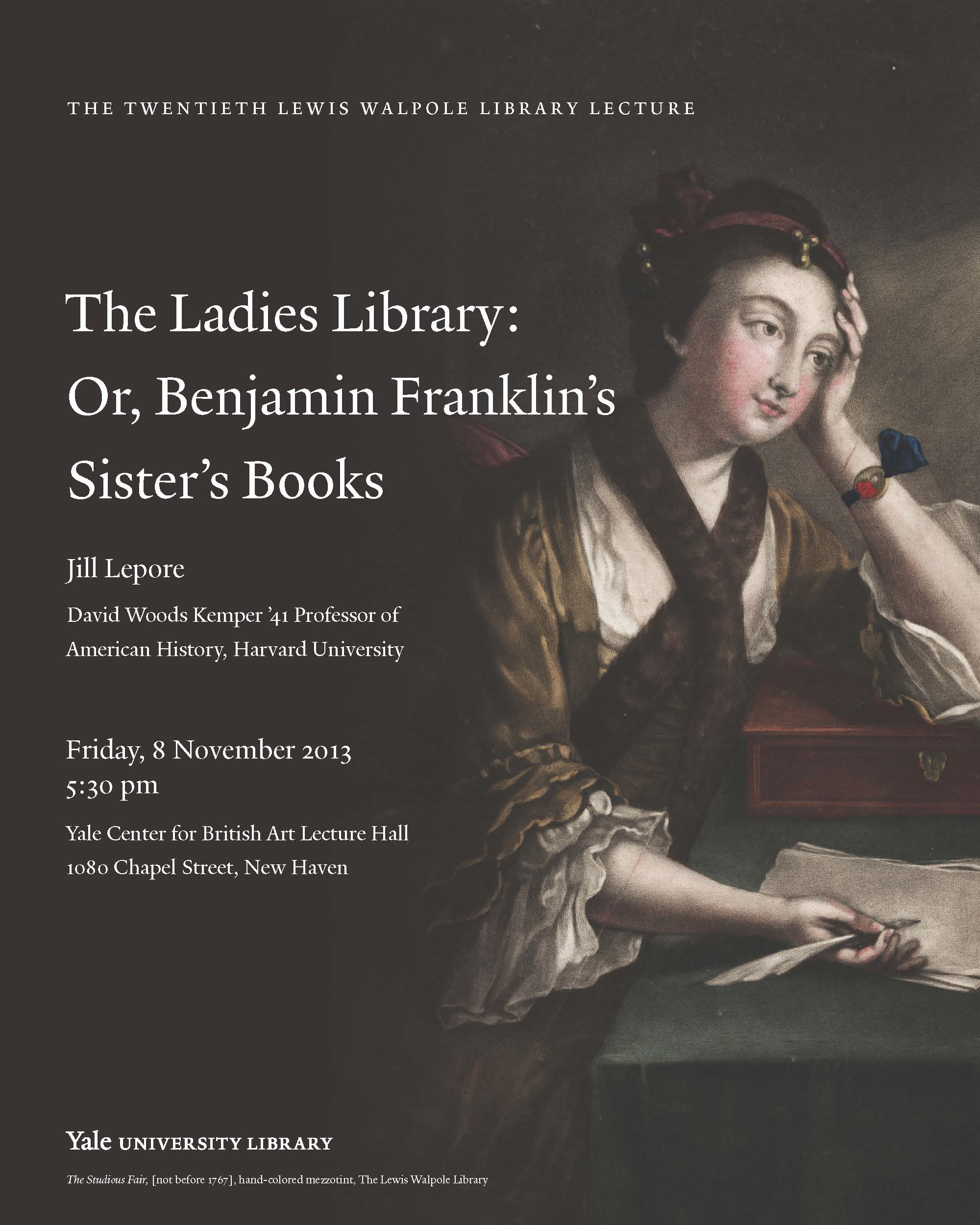 Professor Jill Lepore, National Book Award finalist and author of Book of Ages: The Life and Opinions of Jane Franklin, will discuss her work reconstituting the lost library of Benjamin Franklin’s sister Jane (1712–1794). Most of what Jane read, she borrowed, but she was an avid and discriminating reader, writing to her brother, “I Read as much as I Dare.”
Jill Lepore is the David Woods Kemper ’41 Professor of American History at Harvard University and a staff writer at The New Yorker. Her books include New York Burning, a finalist for the Pulitzer Prize; The Name of War, winner of the Bancroft Prize; The Mansion of Happiness, a finalist for the Carnegie Medal; The Whites of Their Eyes, a New York Times Book Review Editors’ Choice; and The Story of America. Her 2008 novel, Blindspot, written jointly with historian Jane Kamensky, was also a Times Book Review Editors’ Choice. In October 2013, Book of Ages, Lepore’s landmark biography of Benjamin Franklin’s youngest sister, was
published and nominated for the National Book Award.
The lecture is free and open to the public.
Jon Seydl Apointed New Director of Curatorial Affairs at WAM
Press release (29 October 2013) from the Worcester Art Museum:
The Worcester Art Museum (WAM) today announced the appointment of Jon Seydl as its new Director of Curatorial Affairs. In this position, he will direct the Curatorial department, as well as the Conservation, Registration, and Collections and Exhibition Services departments; he will also be the Museum’s curator of European art. Recognized for his specialty in 17th- to 19th-century Italian art, Seydl currently serves as the Paul J. and Edith Ingalls Vignos, Jr., Curator of European Paintings and Sculpture at the Cleveland Museum of Art. He will assume his new position in January 2014.
“We are excited for Jon to lead our talented, growing team of curators,” said WAM Director Matthias Waschek. “While his Old Master focus is in keeping with one of WAM’s traditional strengths, his proven track record of working innovatively outside his field of specialization will be crucial to us as we work to better engage audiences with our own collection. Cleveland’s impressive arms and armor collection will also inform his thinking and leadership role in our integration of the Higgins Collection into WAM’s encyclopedic holdings. Jon will provide an invaluable perspective as we continue toward our goal of accessibility for all audiences.”
Most recently coming from the Cleveland Museum of Art, Seydl’s previous positions include Program Specialist at the National Endowment for the Humanities Program, followed by Research Coordinator at the Philadelphia Museum of Art. He joined the J. Paul Getty Museum in 2002 as Assistant Curator of Paintings before becoming an Associate Curator of Paintings in 2006. He came to the Cleveland Museum of Art in 2007. Since then, he has reinstalled and thematically reinterpreted Cleveland’s entire collection of European Art as part of the Museum’s renovation and expansion project. Seydl’s acquisitions for the Cleveland Museum of Art include St Peter of Alcántara by Pedro de Mena and Julius Caesar by Mino da Fiesole, an Apollo Magazine 2009 Acquisition of the Year.
During his career, Seydl has curated and co-curated many major exhibitions, including Jacques-Louis David: Empire to Exile (2005), Tiepolo Oil Sketches (2005), From Caspar David Friedrich to Gerhard Richter: German Painting from Dresden (2006), Rembrandt in America (2011–12), and The Last Days of Pompeii: Decadence, Apocalypse, Resurrection (2012–13). Seydl wrote the catalogue for Tiepolo Oil Sketches (2005), which he curated at the Getty, and has co-edited two volumes of essays: Gerhard Richter: Early Work, 1951–1972 and Antiquity Recovered: The Legacy of Pompeii and Herculaneum. In 2013 the Association of Art Museum Curators awarded him the Outstanding Catalogue Essay prize for “The Last Days of Pompeii.”
Seydl completed his BA in art history at Yale University and received his MA and PhD in art history from the University of Pennsylvania. He specialized in 17th- and 18th-century Italian Art and wrote his dissertation on images of the Sacred Heart of Jesus in the 18th century.
“I am incredibly pleased to be joining the Worcester Art Museum,” Seydl said. “With the upcoming integration of the Higgins Armory and the recent reinstallation of the Museum’s European paintings in [remastered], this is an exciting time for the Museum. Matthias’ vision for the future is thoughtful and compelling, and I look forward to working with him and the rest of the WAM team on advancing the Museum’s goal of increased accessibility and engagement through the presentation and interpretation of a very great collection.”
Journées d’étude | La cuisine, une artification par les arts?
On at the Centre d’archives de BAnQ:
La Cuisine: Une artification par les arts ?
Montréal, Centre d’archives de BAnQ, 13–14 November 2013

◊ ◊ ◊ ◊ ◊
Journées d’études internationales organisées dans le cadre du programme L’Art de la cuisine : artification et patrimonialisation du culinaire dirigé par Julia Csergo (Université du Québec à Montréal / Université de Lyon 2) et Frédérique Desbuissons (Institut national d’histoire de l’art / HiCSA), avec le soutien du Laboratoire d’excellence Création, arts et patrimoine du Pôle de recherche et d’enseignement supérieur Hautes Études-Sorbonne-Arts et Métiers)
L’Art de la cuisine : artification et patrimonialisation du culinaire étudie le statut de la cuisine, entre savoir, science, tekhnè et art. Il aborde la dimension esthétique du culinaire à travers le statut du cuisinier et de sa création, l’art du service (art de découper, de présenter, de servir), par l’étude des objets de la table et des menus imprimés, de la médiatisation du spectacle culinaire, par l’iconographie et les représentations artistiques, par celle du jugement de goût – en particulier le rôle de la critique culinaire. D’un point de vue théorique, il s’interroge sur la manière dont la cuisine se situe par rapport aux autres arts, le statut et le rôle des sens, la spécificité des saveurs par rapport aux autres sens. D’un point de vue institutionnel et sociologique, il questionne le statut des cuisiniers, leur formation, leur starification contemporaine en tant qu’ “artiste”. Dans la perspective de l’anthropologie historique, il envisage la tekhnè du culinaire (lieux, gestes, recettes, outils, savoir-faire).
Poursuivant la réflexion engagée lors des journées d’études Le Cuisinier et l’art (Paris, Institut national d’histoire de l’art, 2 et 3 octobre 2012), qui interrogeaient le statut artistique de la cuisine, celle du cuisinier comme artiste et du plat comme création, ce second volet explore le rôle et la fonction des arts visuels et décoratifs, de la musique et des arts de la scène dans la construction des représentations de la cuisine comme art, et s’interroge sur les caractéristiques de cet éventuel « autre » art. Considérant que la cuisine a été jusqu’à présent peu étudiée dans ses relations avec les pratiques artistiques instituées, si ce n’est par métaphore, ces deux journées entendent continuer à élargir sa compréhension en l’inscrivant d’emblée au sein de l’histoire des arts et des pratiques
culturelles, et poursuivre ainsi cette ouverture d’un champ de recherche innovant fondé sur l’interdisciplinarité.
Ces deux journées sont présentées par l’Université du Québec à Montréal – ESG/DEUT, l’Institut national d’histoire de l’art, Paris et l’Université Paris I Panthéon-Sorbonne, en partenariat avec Bibliothèque et Archives nationales du Québec et avec le soutien du Labex CAP, de la Chaire de recherche du Canada en patrimoine urbain de l’ESG-UQAM et de l’Institut de tourisme et d’hôtellerie du Québec.
Exhibition | Antichità, Teatro, Magnificenza: Images of Rome
Press release (14 May 2013) from the Carlos Museum (with thanks to Hélène Bremer for noting it) . . .
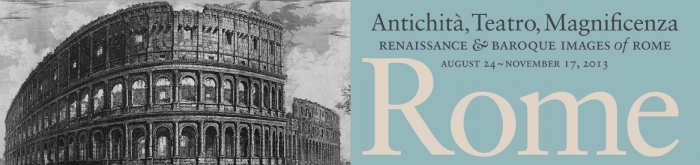
Antichità, Teatro, Magnificenza: Renaissance and Baroque Images of Rome
Michael C. Carlos Museum, Emory University, Atlanta, 24 August — 17 November 2013
Curated by Margaret Shufeldt and Sarah McPhee
◊ ◊ ◊ ◊ ◊
Antichità, Teatro, Magnificenza: Renaissance and Baroque Images of Rome will be on view at the Michael C. Carlos Museum of Emory University from August 24 through November 17, 2013. This spectacular temporary exhibition includes maps, views, and books on Rome from the sixteenth, seventeenth, and eighteenth centuries.
Over 130 works of art, many from the Carlos Museum’s permanent collection, representing ancient Rome will be showcased in three major sections—Antichita, Teatro, and Magnificenza. Antichita includes the Antiquae urbis imago, Pirro Ligorio’s 1561 reconstruction of the ancient city as the focal point of the antiquarian interests during the Italian Renaissance of the sixteenth century. Ligorio’s reconstruction will be surrounded by works by Hieronymous Cock, several others from the Speculum Romanae Magnificentiae, Mirror of the Magnificence of Rome, a Renaissance ‘coffee table book’ of prints of the sights of Rome produced by the French print seller and publisher Antonio Lafreri (1512–77), and images of the obelisks moved by Sixtus V—all from the Museum’s collection. This section also includes volumes from the rare book collections of the Emory Libraries such as De ludis circensibus by Onophrio Panvinio.
Antiquarians of the Renaissance were humanist scholars who sought to reconstruct, at least intellectually, Rome as it was in antiquity by studying coins, inscriptions, fragments, and the city’s ruins. The images show monuments that have been restored, healed of the ravages of time. Ligorio was one of the leading antiquarian scholars of his day. Cock on the other hand depicts the ruins just as they appeared in the sixteenth-century. The Colosseum is ravaged by time, with plants sprouting among the stones. This is the picturesque Rome that contemporary visitors to the city actually saw.

◊ ◊ ◊ ◊ ◊
The Teatro of the seventeenth century, the second section of the exhibition, is anchored by an impression of Giovanni Battista Falda’s 1676 Nuova pianta, lent by Chicago collector Vincent J. Buonanno. Also included are images from Falda’s depictions of the Giardini di Roma, as well as several books of the period. These works record the efforts of the seventeenth-century popes to refocus attention on the modern city through urban interventions known as ‘theaters’ or ‘teatri’. Piazzas were broadened and opened up to become stages where the life of the city took place and the power of the Church could be asserted. The most striking example is St. Peter’s Square. Falda’s many etchings show the theaters of the Baroque city.
The Magnificenza of the eighteenth century features Giovanni Battista Nolli’s Pianta grande and Giuseppe Vasi’s Prospetto dell’alma città di Roma. Also included are numerous views by Giovanni Battista Piranesi from the Museum’s collection and a copy of Jean Barbault’s Les plus beaux monuments de Rome ancienne among other items from Emory’s rare book collections. Also featured is a survey of Roman guidebooks through the centuries. In this section there are three different types of representations of the magnificence of the Eternal City by three different designers. Nolli’s map is an example of the rational, scientific thinking of the Enlightenment. Vasi follows in Falda’s footsteps making an encyclopedic collection of views of contemporary Rome. Piranesi takes an archaeological interest in the city and creates strikingly dramatic, imaginative views of the ancient monuments. Visitors to Rome on the Grand Tour purchased these prints as mementos of their sojourn and as evidence of their own learned interests.
Margaret Shufeldt, Carlos Museum Curator of Works on Paper, and Sarah McPhee, Emory’s Professor of Art History, are co-curators of the exhibition. Shufeldt notes, “This exhibition offers our visitors a chance to experience the Eternal City through the works of master printmakers across three centuries. One will be able to wander the city in detailed maps and marvel at imposing architecture in the diverse images of Rome.”
A Virtual Experience of Rome
In an exciting and innovative use of technology to bring the exhibition to life, the Carlos Museum is collaborating with Sarah McPhee and Jordan Williams and Erik Lewitt of plexus r + d to develop Virtual Rome. The virtual experience is grounded in the celebrated bird’s-eye view map of Giovanni Battista Falda, published in 1676, which subsumes the fine detail of over 300 etched views of the city made by the young artist. The composite image shows the urban fabric in exquisite visual detail, allowing the patient viewer to stroll the streets, count the windows in facades, and distinguish deciduous trees from evergreens.
Falda’s two-dimensional map will be transformed into a virtual, walkable Rome using the gaming platform known as NVis360. A team of educators, architects, and IT experts are documenting Falda’s Rome in maps and views, checking Falda’s data against Rome today, the surveyed map of 1748 by Giambattista Nolli, and the seventeenth-century ichnographic and surveyed maps that survive in the Roman archives. Through Virtual Rome, museum visitors will be able to journey back in time to experience the Eternal City of the seventeenth century. Virtual Rome is possible because of the generosity of Vincent J. Buonanno, who has made his extraordinary collection of Falda maps and views available in actual and digital form. McPhee notes, “The gaming platform allows us to follow the invitation of Falda’s prints to stroll the city with our eyes: to navigate lost streets and squares, take in vanished prospects, experience seventeenth-century Roman teatri in the round. This is the first time a gaming platform has been used at Emory University to recover urban history through an immersive and interactive reconstruction. We look forward to sharing the exciting results.
This exhibition has been made possible through the generous support of the Lamar Mixson Foundation, the Emory Libraries and the Manuscript and Rare Book Library (MARBL), and Mr. Vincent J. Buonanno.
Call for Papers | British Material Cultures in Global Contexts
Objects, Families, Homes: British Material Cultures in Global Contexts
University College London, 11–12 July 2014
Proposals due by 15 December 2013
Proposals are invited for 20-minute papers for Objects, Families, Homes: British Material Cultures in Global Contexts, an end-of-project conference organized by UCL History’s Leverhulme Trust-funded East India Company at Home team. Confirmed keynote speakers include Deborah Cohen, Professor of Modern British and European History at Northwestern University and author of Household Gods: The British and their Possessions (2006) and Family Secrets (2013), in dialogue with Marietta Crichton-Stuart, a descendant of the Marquess of Bute, who has researched how Margaret Bruce designed and furnished Falkland House in Fife in the 1830s and 1840s.
Since 2011, The East India Company at Home project has focused on country houses—and the families and objects that inhabited them—to explore how British material culture developed in a global context during the eighteenth and nineteenth century. The project’s goals have been twofold. First, we have sought to illuminate the broad-ranging ways in which the activities of the English East India Company shaped elite material cultures in Britain—and by doing so, shaped British identities in the Georgian and Victorian periods, and beyond. Second, we have sought to develop new ways of connecting diverse communities of historical researchers (archivists, curators, family historians, freelance historians, local historians, stately home volunteers and university-based historians) and in so doing have weaved otherwise dispersed studies into a transnational material narrative. At the same time, by disseminating research findings through our website we have made them available on an open-access basis.
For the end of project conference we welcome papers from all researchers engaged in investigating the themes and methodologies compatible with the core subjects of The East India Company at Home. These include:
· Distance, longing and return in the imperial family
· Race, gender, class and age: negotiating identities across imperial spaces
· Narratives of empire: colonial collecting, arrangement and display
· Meaningful objects: the role of Asian goods in British material culture
· Making histories: collaboration and engagement across historical research communities
· Building homes and houses in global contexts: research, interpretation and display
Individual papers or whole panel proposals are invited. Please send a 200-word abstract and a brief biographical note (for each paper) to EICathome@ucl.ac.uk by 15 December 2013. Please note in your email whether your paper is part of a panel or an individual submission: if proposing a full panel, indicate in 1–3 sentences its title and overarching theme (in addition to providing abstracts of each paper). The selection committee will notify applicants on its decisions by 31 January 2014. Further details about the conference can be found at http://www.blogs.ucl.ac.uk/eicah. Any queries about the call for papers or conference please email EICathome@ucl.ac.uk. It is hoped that a small number of bursaries will be available for the students and the unwaged.
A New Frame for The Blue Boy
Catherine Hess, the chief curator of European art at The Huntington, offers this posting at The Huntington’s blog Verso:
Catherine Hess, “How Do You Frame a Masterpiece?” Verso (24 October 2013).

This digital rendering shows the new frame as it will appear on The Blue Boy after installation in late November 2013.
In 1921, Henry and Arabella Huntington purchased what would become the most famous work of art in their collection: The Blue Boy (1770) by Thomas Gainsborough. Its celebrity rests on many factors, not least of which is the superb quality of the painting, with its brilliant brushwork and the frank earnestness of the boy’s gaze. Its price—at roughly $725,000—was the highest ever paid for a work of art up to that time. The scandal provoked by its departure from Britain also increased its notoriety. The fact that it was exhibited at the National Gallery, London, after the art dealer Joseph Duveen sold it to the Huntingtons further expanded its fame.
So The Blue Boy is a big deal. But what’s the story behind the famous painting’s frame?
When the painting arrived in San Marino, The Blue Boy’s frame was likely the same one in which it was displayed by the previous owner, Hugh Grosvenor, 2nd Duke of Westminster. By 1938, the Huntington’s curator of art collections, Maurice Block, was ready to respond to complaints about the painting’s “bulky 19th-century frame.” According to a memo written on May 6 of that year, “We have cut down one of our old frames to put the Blue Boy into it.”
The replacement frame appears to have been an extra supplied by Duveen and probably had been in storage for some time in the Huntington Art Gallery basement. This frame is of the so-called Carlo Maratta type, widely used in England from 1750 through the turn of the 20th century. . .
The Huntington recently began exploring ways to reframe The Blue Boy. We first approached Michael Gregory, frame specialist at Arnold Wiggins & Sons in London, a workshop specializing in the adaption and reproduction of antique frames. It supplies frames to the Royal Household and London’s National Portrait Gallery. . .
The full posting is available here»
Exhibition | Junípero Serra and the Legacies of the California Missions
Press release from The Huntington:
Junípero Serra and the Legacies of the California Missions
The Huntington Library, Art Collections, and Botanical Gardens, San Marino, 17 August 2013 — 6 January 2014
Curated by Catherine Gudis and Steven Hackel

◊ ◊ ◊ ◊ ◊
The life of Junípero Serra (1713–1784)—and his impact on Indian life and California culture through his founding of missions—is the subject of an unprecedented, comprehensive, international loan exhibition opening August 17, 2013, and remaining on view through January 6, 2014, exclusively at The Huntington Library, Art Collections, and Botanical Gardens. Junípero Serra and the Legacies of the California Missions coincides with the 300th anniversary of Serra’s birth and includes about 250 objects from The Huntington’s collections and those of 61 lenders in the United States, Mexico, and Spain. The exhibition examines Serra’s early life and career in Mallorca, Spain; his mission work in Mexico and California; the diversity and complexity of California Indian cultures; and the experiences of the missionaries and Indians who lived in the missions.
Junípero Serra also delves into the preservation and reconstruction of the missions as physical structures; the persistence of Indian culture from before the mission period to the present; the missions’ enduring place in California culture today; and a wide variety of perspectives—some of them irreconcilable—on Serra and the meaning of his life.
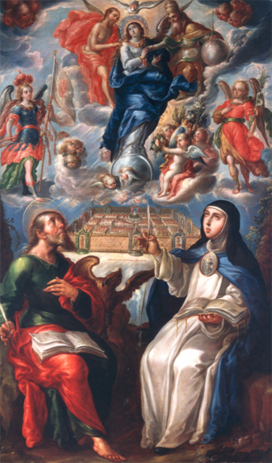
Cristóbal de Villalpando, La Mística Ciudad de Dios (The Mystical City of God), 1706. Museo regional de Gaudalupe/CONACULTA– INAH, Guadalupe, Zacatecas Nacional del Virreinato, Mexico.
“It’s a rich, complex, and multi-faceted story, and one that has not been told before in an exhibition of this magnitude,” said Steven Hackel, co-curator of the exhibition, professor of history at the University of California, Riverside, and Serra biographer (Junípero Serra: California’s Founding Father, 2013). “Serra was 55 years old and had had a very full life by the time he came to California in 1769. In this show, we are working to move beyond the standard polemic that often surrounds Serra and the missions. We present a picture that is equally rich in its portrayal of not only Serra’s life but the meaning of the missions for a range of California Indians.” The general tendency is to think that Serra’s life work began with the California missions, Hackel added, and that Indian culture disappeared with the onset of those missions. “The exhibition challenges both of these assumptions.”
Contemporary art, including a video work created expressly for the exhibition by James Luna (Luiseño), and first-person narratives by descendants of the missions “defy any presumptions that Native Americans ‘vanished’ or that they hold a monolithic view about the mission past,” said Catherine Gudis, co-curator of the exhibition and professor of California and public history at the University of California, Riverside. “Rather, the show represents a range of responses—including resistance and resilience—as the result of a period of painful disruption and devastating change.”
Among key items in the exhibition are a host of rare paintings and illustrations documenting the history of the Spanish island of Mallorca, Serra’s life, 18th-century Catholic liturgical art, and New Spain, as well as several sketches and watercolors that are among the first visual representations of California and California Indians by Europeans. “These images are not only beautiful,” says Hackel, “but they are among the most important ethnographic representations of California Indian life at the onset of the missions and of Indian life in the missions.”
Also on view are Serra’s baptismal record from Mallorca, his Bible and lecture notes from Mallorca, and the diary he composed as he traveled from Baja California to San Diego in 1769. Notable and unique items documenting Indian culture in California include a textile fragment that is thousands of years old, woven by California Indians from seaweed and fiber, as well as beads, tools, baskets, and written documents from the colonial period. “Like the Spaniards, these were people who had a significant history and culture well before the Europeans showed up, and it was a history and culture that would persevere, although not without huge changes, in and after the missions,” said Gudis.
 Junípero Serra provides a sweeping examination of where Serra came from, including the history and culture of Mallorca well before his time and during his early life; where Serra traveled, including his early adult years performing missionary work from central Mexico to Baja; and finally, his work to establish a system of missions along the California coastline from south to north.
At the same time, it provides the backdrop against which the missions emerged: early California was populated by numerous and diverse groups of Indians. Culture and customs varied from village to village; more than 100 languages were spoken; and in the parts of California colonized by Spain, the Indians numbered nearly 70,000.
Serra, under the auspices of the Catholic Church and the Spanish flag, believed his mission was to convert them to Christianity. However, his dream of encouraging Indians to relocate to the missions ultimately led many to an early grave, as diseases killed thousands of Indians who lived there.
“The mission period was a defining one in California’s history—and Serra is the most visible symbol of that period,” said Hackel. “But in taking this story all the way through—from before Indians and Europeans made contact, through the construction and collapse of the mission system, and then to the present day—it is, in fact, a story of conflicting, blending, and overlapping cultures, of imperial expansion and human drama and loss, and then, finally, of the perseverance and survival of not only European institutions in California, but the California Indians who were the focus of Serra’s missions.”
E X H I B I T I O N F L O W (more…)
Call for Papers | Material Culture Symposium: Consuming Objects
From The Center for Material Culture Studies at the University of Delaware:
Consuming Objects: Negotiating Relationships with the Material World
Winterthur Museum, Garden & Library, 12 April 2014
Proposals due by 2 December 2013
The Center for Material Culture Studies at the University of Delaware invites submissions for papers to be given at the Twelfth Annual Material Culture Symposium for Emerging Scholars.
“Consuming” is a multivalent word, fraught with provocative denotations and connotations. Whether we buy them, sell them, use them, or eat them, we all consume objects through a variety of channels. We seek papers that highlight the intersection between people and their things within this broad framework of consumption. This conference will consider how material culture can act as an extension of ourselves, provide repositories for memory, help stabilize identity, interrupt our sense of scale and space, give permanence to relationships, function as a semiotic marker, and enable human activities. Papers may also address how objects mediate human sensory experience and create aesthetic meaning. We encourage papers that reflect upon and promote an interdisciplinary discussion on the state of material culture studies today.
This conference is not bound by any temporal or geographical limits. Disciplines represented at past symposia include American studies, anthropology, archaeology, consumer studies, English, gender studies, history, museum studies, and the histories of art, architecture, design, and technology. We welcome proposals from graduate students, postdoctoral scholars, and those beginning their teaching or professional careers.
The symposium will consist of nine presentations divided into three panels. Each presentation is limited to eighteen minutes, and each panel is followed by comments from established scholars in the field. There will be two morning sessions and one afternoon session, with breaks for discussion following each session and during lunch. Participants will also have the opportunity to tour Winterthur’s unparalleled collection of early American decorative arts and to engage in a roundtable discussion on Friday, April 11, 2014. Travel grants will be available for presenters.
Proposals should be no more than 300 words. Please indicate the focus of your object¬based research, the critical approach that you take toward that research, and the significance of your research beyond the academy. We encourage the inclusion of relevant images with your abstracts.
While the audience for the symposium consists mainly of university faculty and graduate students, we encourage broader participation. In evaluating proposals, we will give preference to those papers that keep a more diverse audience in mind. Programs and paper abstracts from past symposia are posted here.
Send your proposal, with a current c.v. of no more than two pages, to emerging.scholars@gmail.com. Proposals must be received by 5 p.m. on Monday, December 2, 2013. Speakers will be notified of the vetting committee’s decision in January 2014. Confirmed speakers will be asked to provide symposium organizers with digital images for use in publicity and are required to submit a final draft of their papers by March 11, 2014.
2014 Emerging Scholars Co¬Chairs
Anastasia Day (Hagley Program in the History of Industrialization) and Philippe Halbert (Winterthur Program in American Material Culture), University of Delaware
Forthcoming Issues of ‘Eighteenth-Century Studies’
From Joseph Roach’s introduction to the ASECS News Circular (Fall 2013). . .
. . . In addition to encouraging individual submissions of articles for consideration, Steve Pincus [editor of Eighteenth-Century Studies] has introduced a process for the regular creation of special issues on topics of current interest and future promise. The Lewis Walpole Library and the Beinecke Rare Book and Manuscript Library have agreed to alternate in sponsoring Workshops in a particular interdisciplinary subfield. Scholars prominent in that field are invited to Farmington or the Yale campus to spend a day sharing their expertise and identifying potential contributors to a special issue. Workshops in three topics have been held so far: “The Eighteenth Century: East and West”; “The Maritime Eighteenth Century”; and “Performance in the Eighteenth Century.”
On February 23, 2013, the Walpole Library hosted a panel consisting of Felicity Nussbaum (English, UCLA), Robert K. Batchelor (History, Georgia Southern University), David Porter (English and Comparative Literature, University of Michigan), and Peter Perdue (History, Yale University). They identified key issues and trends, profiled new work in the field by both well established and emerging scholars, and made recommendations. After a process of further vetting, solicitation, and review, the East-West special issue (forthcoming) will be introduced by Chi-ming Yang (English, University of Pennsylvania) and contain the following articles: Danna Agmon (History, Virginia Tech), “The Currency of Kinship: Trading Families and Trading on Family in Colonial French India”; Srinivas Aravamudan (English, Duke), “East-West Fiction as World Literature: The Hayy Problem Reconfigured”; Kristina Kleutghen (Art History, Washington University in St. Louis), “Ocean Goods and Occidenterie: The Art of Eighteenth-Century Chinese Fascination with the West”; Suzanne Marchand (History, Louisiana State University) Herder’s “Oldest Document of Mankind” and the Problem of Near Eastern Chronology”; Nabil Matar (English, University of Minnesota), “Christians in Arabic Writings of the Eighteenth-Century Levant”; and Matthew Mosca (History, William and Mary), “The Qing State and Its Awareness of Eurasian Interconnections, 1789–1805.”
On May 23, 2013, the Beinecke Library hosted a panel on “The Maritime Eighteenth Century” consisting of Joseph C. Miller (History, University of Virginia), Neil Rennie (English, University College London), Felicia Gottmann (French, University of Warwick), Ellie Hughes (Art History, Yale Center for British Art), and Gagan Sood (History, Yale University). Plans for the special issue on “The Maritime Eighteenth Century” are pending.
On October 17, 2013, the Lewis Walpole Library hosted a panel on “Performance in the Eighteenth Century” consisting of Misty Anderson (English and Theatre, University of Tennessee Knoxville), Jeffrey Leichman (French, Louisiana State University); Kathleen Wilson (History and Cultural Studies, Stony Brook University), John Cooper (Clare-Mellon Fellow in the History of Art, Yale University) and Will Fleming (East Asian Languages and Literature and Theater Studies, Yale University). Virginia Johnson (Sociology, University of Michigan) was unable to attend, but she is communicating her views in writing. Plans for the “Performance” special issue are in the early stages.
With the cooperation with Carolyn C. Guile, ECS Review Editor, special issues will include reviews of pertinent new work on the featured topics. Members are encouraged to propose ideas for future special issues, including nominations for Workshop panelists and potential contributors. The Editor and Managing Editor held a session for interested scholars at the recent NEASECS Conference in New Haven, and a dynamic critical conversation ensued. More will be welcome, live or electronic. . .
Exhibition | America: Painting a Nation
The exhibition, organized by several American institutions including the Terra Foundation for American Art, debuted as Art Across America at the National Museum of Korea, in Seoul, and then traveled to Korea’s Daejeon Museum of Art. From the press materials of the Art Gallery of New South Wales:
America: Painting a Nation
Art Gallery of New South Wales, Sydney, 8 November 2013 — 9 February 2014

Portrait of a Black Sailor (Paul Cuffe?), ca. 1800 (LACMA)
This exhibition is a voyage through American history, across the American landscape and into the minds of the American people. It begins in the 18th century, among pious farmers and republican merchants. It traverses the continent, alongside Native Americans and frontiersman. It explores the great cities, and the lives of workers and bohemian artists. Answering the question, ‘What makes Americans American?’ is complex, but these paintings are a guide, revealing the self-reliance and communal beliefs, optimism and anxieties, that makes America tick.
Chris McAuliffe, Curatorial consultant
America: Painting a Nation is the most expansive survey of American painting ever presented in Australia. It is part of the Sydney International Art Series which brings the world’s outstanding exhibitions to Australia, exclusive to Sydney, and has been made possible with the support of the NSW Government through Destination NSW. Over 80 works, ranging from 1750 to 1966, cover more than 200 years of American art, history and experience. The exhibition sets a course from New England to the Western frontier, from the Grand Canyon to the burlesque theatres of New York, from the aristocratic elegance of colonial society to the gritty realism of the modern metropolis. This exhibition will reveal the breadth of American history, the hardy morality of the frontier, the intimacy of family life, the intensity of the 20th-century city, the epic scale of its landscape and the diversity of its people. The works being presented – many by American masters – are the works Americans love and works that represent the stories they have grown up with.
◊ ◊ ◊ ◊ ◊
From the Art Gallery of NSW:
Angela Miller and Chris McAuliffe, America: Painting a Nation (Sydney: Art Gallery of New South Wales, 2013), 264 pages, ISBN 978-1741741018, $45.
Spectacular landscapes, epic stories and diverse peoples feature in this expansive historical survey of American painting. The 89 artworks by some 74 artists traverse over 200 years of rich history, from the colonial era to the mid 20th century. Readers will encounter the sublime poetry and drama of the land, the ambition and optimism of the country’s pioneers, the challenges of the frontier, the intimacy of family life and the intensity of the modern city. The roots of the American character and nation will be revealed through images ranging from the Grand Canyon to the Brooklyn Bridge, from classic portraits to modern abstraction.
America: Painting a Nation includes works by artists such as Mary Cassatt, Winslow Homer, Edward Hopper, Georgia O’Keeffe, Jackson Pollock, Mark Rothko, John Singer Sargent and James McNeill Whistler from the collections of some of the finest art museums in the USA: The Terra Foundation, Chicago; the Philadelphia Museum of Art; the Museum of Fine Arts, Houston; the Los Angeles County Museum of Art; and The Virginia Museum of Fine Arts.
Essays by Angela Miller and Chris McAuliffe, combined with entries on each of the artworks and biographies on each artist, illuminate this fascinating survey of American painting from 1750 to 1967.










 Enfilade
4 comments