Xavier Salomon Appointed Chief Curator of The Frick Collection
Press release (4 November 2013) from The Frick:
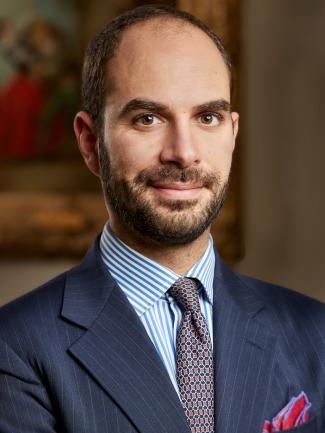 Xavier F. Salomon has been appointed to the position of Peter Jay Sharp Chief Curator of The Frick Collection, taking up the post in January of 2014. Dr. Salomon―who has organized exhibitions and published most particularly in the areas of Italian and Spanish art of the sixteenth through eighteenth century―comes to The Frick Collection from The Metropolitan Museum of Art, where he is a curator of in the Department of European Paintings. Previously, he was the Arturo and Holly Melosi Chief Curator of Dulwich Picture Gallery, London. Salomon’s two overall fields of expertise are the painter Paolo Veronese (1528–1588) and the collecting and patronage of cardinals in Rome during the early seventeenth century. Born in Rome, and raised in Italy and the United Kingdom, Salomon received his Ph.D. from the Courtauld Institute of Art, University of London. A widely published author, essayist, and reviewer, Salomon sits on the Consultative Committee of The Burlington Magazine and is a member of the International Scientific Committee of Storia dell’Arte.
Comments Frick Director Ian Wardropper, “We are thrilled to welcome Salomon to the post of Peter Jay Sharp Chief Curator. He is a remarkable scholar of great breadth and vitality, evidenced by his résumé, on which you will find names as far ranging as Veronese, Titian, Carracci, Guido Reni, Van Dyck, Claude Lorrain, Poussin, Tiepolo, Lucian Freud, Cy Twombly, and David Hockney. At the same time, he brings to us significant depth in the schools of painting at the core of our Old Master holdings, and he will complement superbly the esteemed members of our curatorial team. Salomon has experience as a department head, and he has curated marvelous shows, among them a mutually rewarding collaboration with the Frick. He was a highly productive and inspiring participant in the Frick’s Andrew W. Mellon Curatorial Fellowship program, leaving his mark already on the institution through an acclaimed Veronese exhibition as well as various other projects of distinction. In Salomon’s work, collecting has remained a critical line of art historical inquiry since the defense of his dissertation on the patronage of Cardinal Pietro Aldobrandini [1571–1621]. This focus resonates beautifully with us, as the institution is widely known for the interpretation of our history, holdings, exhibitions, publications, programs, and the innovative activities of the Frick Art Reference Library’s Center for the History of Collecting.”
Xavier Salomon adds, “It is a great honor for me to be appointed the Peter Jay Sharp Chief Curator of The Frick Collection. I organized my first exhibition at the Frick as an Andrew W. Mellon Curatorial Fellow. It is therefore a huge pleasure for me to return to an institution to which I feel deeply indebted and that I greatly admire. The Frick has a unique collection of outstanding masterpieces, and its holdings in the fields of painting, sculpture, decorative arts, and drawings are of stupendous quality. It will be a pleasure to work with the staff of noted colleagues in the fields of curatorial, conservation, and education, all of whom are leading authorities in their areas of expertise. Over the years and under the guidance of my predecessors, Edgar Munhall and Colin B. Bailey, the Frick has led the way with inspirational programming and groundbreaking exhibitions. I look forward to working on the institution’s upcoming projects, sharing, as I do, the Frick’s belief in the fundamental importance of museum research as well as in presenting wide-ranging, vibrant, and engaging offerings to the broad public and scholarly community alike.”
A Superb Résumé of Acclaimed Exhibitions
Salomon’s recent exhibitions have focused on areas of the fine arts well represented at the Frick: Spanish, Italian, and Flemish sixteenth- through eighteenth-century painting. A sought-after Veronese scholar, he is curator of a forthcoming monographic exhibition on this artist at The National Gallery, London (2014). At The Metropolitan Museum of Art, he organized Velázquez’s Portrait of Duke Francesco I d’Este: A Masterpiece from the Galleria Estense, Modena (2013). At Dulwich, he curated Van Dyck in Sicily, 1624–25: Painting and the Plague (2012) and collaborated with Nicholas Cullinan on Twombly and Poussin: Arcadian Painters (2011). He co-curated, with Helen Langdon and Caterina Volpi, Salvator Rosa (1615–1673): Bandits, Wilderness, and Magic (which went to Dulwich and the Kimbell Art Museum, Fort Worth, Texas, 2010–11). Salomon and his predecessor at the Frick, Colin B. Bailey (since June, the Director of the Fine Arts Museums of San Francisco), organized Masterpieces of European Painting from Dulwich Picture Gallery, which was shown to critical acclaim at the Frick in 2010. His exhibition Paolo Veronese: The Petrobelli Altarpiece was shown at Dulwich, the National Gallery of Canada, Ottawa, and the Blanton Museum of Art, Austin, Texas (2009–10). Best of British. The Story of the British Collection at Dulwich Picture Gallery (2009) was preceded by The Agony and the Ecstasy: Guido Reni’s Saint Sebastians (co-curated with Piero Boccardo and featured first at the Musei di Strada Nuova, Palazzo Rosso, Genoa, followed by Dulwich, 2007–08). As the Frick’s Andrew W. Mellon Curatorial Fellow, he was praised for his exhibition Veronese’s Allegories: Virtue, Love, and Exploration in Renaissance Venice (2006). He also contributed to Masterpieces of European Painting from The Cleveland Museum of Art (2006–7), From Callot to Greuze: French Drawings from Weimar (2005), Gardens of Eternal Spring: Two Newly Conserved Mughal Carpets (2005), and Raphael’s Fornarina (2004–5).
A Prolific Scholar and Speaker
Much in demand as a writer, Salomon has contributed myriad essays and entries to publications produced by institutions internationally, including the Kunsthistorisches Museum, Vienna; Palazzo Venezia, Rome; and the Royal Academy of Arts, London. Among the journals that have published his research are The Metropolitan Museum of Art Journal, Apollo, The Burlington Magazine, Master Drawings, The Medal, The Art Newspaper, and the Journal of the History of Collections. He is a frequent reviewer in The Burlington Magazine, with up to seven appearing annually. Salomon has delivered conference papers and lectures at the Musée du Louvre; The Metropolitan Museum of Art; The Frick Collection; the Morgan Library & Museum; the universities of Rome and Padua; the Musei di Strada Nuova, Genoa; Cambridge University; Dulwich Picture Gallery, and the National Gallery, London, among other institutions.
Call for Article Proposals | Arts of Display in the Netherlands
From CODART:
Arts of Display
Netherlands Yearbook for History of Art / Nederlands Kunsthistorisch Jaarboek 65
Proposals due by 1 January 2014
Works of art and their display have always been closely connected. Most art was and is created for exhibition in one form or another, and the history of the display of an art object often forms a meaningful part of its story. Exhibiting art involves strategies, techniques and devices that have much in common with other fields of presentation: theatre, advertising, interior design, book design, the display of goods in shops and shop windows. These display strategies use techniques that are partly culturally determined, and partly rooted in a biological determination of human perception, as Gombrich, among others, made clear. How we perceive patterns, prefer symmetry and note differences of scale between an object and its surroundings all have a direct bearing on the way art was and is shown. Moreover, changing modes of display and viewing conditions can create new narratives and can even lead to active or performative relationships between the displayed object and the viewer, resulting in playful (or sometimes aggressive) interactions. Finally, rules of decorum and rhetoric often play an important role in the art of display. (more…)
Restoration of Schloss Mirow
The December 2013 issue of Architectural Digest teasingly includes this news in the column “AD Hears. . .”
that architecture aficionados are agape at the flamboyant plasterwork concealed behind the modest façade of Germany’s Schloss Mirow—the birthplace of Charlotte of Mecklenburg-Strelitz, wife of England’s King George III—currently under renovation (48).
With a small amount of online searching, I found only a little more about the project; readers should feel free to chime in with more information. Presumably, we’ll hear more in the coming months. -CH
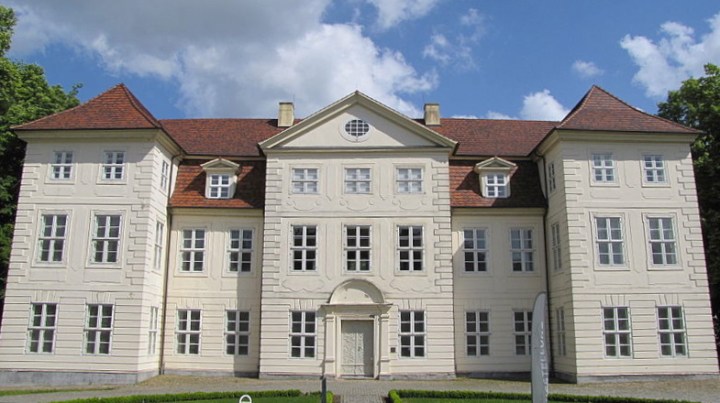
Schloss Mirow, Wikimedia Commons, 2011
◊ ◊ ◊ ◊ ◊
From the Mecklenburg website:
Das Mirower Schloss befindet sich in der Endphase seiner hochkarätigen Restaurierungsarbeiten. Höchst komplex sind die zahlreichen Methoden, die am Schloss zum Einsatz kommen. Die hohe Qualität und die Besonderheit der Restaurierungsarbeiten in Mirow haben das Schloss nun zum “Hot Spot” werden lassen. Die für den Dreh beauftrage Produktionsfirma Spiegel TV begleitete und interviewte einen Tag lang verschiedene Experten bei ihrer Arbeit – sie gehören zu den absoluten Spezialisten des Landes.
Das Fimteam traf in Mirow auf ganz unterschiedliche Gewerke: Bauhistoriker Dr. Tilo Schöfbeck verschaffte einen reizvollen Eindruck von den Techniken zur Altersbestimmung von Gebäudeelementen, während Diana von Stietencron einen spannenden Einblick in die geheimen Rezepturwelten von Vergoldern und Fassmalern des 18. Jahrhunderts gab. Bildhauer Bernhard Lankers wusste davon zu berichten mit welcher Genialität die Schnitzer im Rokoko gearbeitet haben. Einzigartig ist auch das Rekonstruktionsprojekt, bei dem eine handgestickte Tapete vom Atelier Twist in Berlin wieder zum Leben erweckt wird. . . .
Call for Papers | Reshaping Sacred Space
Reshaping Sacred Space: Liturgy, Patronage and Design in Church Interiors
University of St. Andrews, 14 June 2014
Proposals due by 31 December 2013
The conference seeks to present original ideas relating to the design and construction of churches in Catholic Europe between 1500 and 1750. New religious demands, arising out of the Counter-Reformation, led to innovations in both the form and function of the interior space of churches. This conference will provide a forum for presentations on these changes, and for discussion among scholars engaged in similar research. We will consider proposals that may include but are not limited to:
· an art-historical or architectural analysis of the interior of a church built or renovated during this period, in both public and private contexts
· a study of church furnishings (e.g. altarpieces, pulpits, monuments, choir stalls), and their location and function within the church
· an investigation of patronage, both religious and secular; how the patron or donor may have influenced the construction of the church or parts of its interior.
Our plenary speaker will be Dr Martin Gaier, University of Basel, Switzerland. Representatives from the ‘Open-Access and Online Journal System’ of the University of St Andrews Library and the Scholarly Communications team at the University of Edinburgh will give brief presentations on the constantly changing state of online and open-access publishing. This will be followed by a workshop discussion of the implications of open-access for post-graduate scholarship. All students and staff are welcome.
The proceedings of this conference will be published in a special edition of North Street Review: Arts and Visual Culture, the postgraduate art history journal of the University of St Andrews. Submissions will follow the formatting and image copyright guidelines set by the North Street Review, as detailed here. We will also explore the possibility of forming a session, with presenters from our conference, to participate in the 2015 annual meeting of the Renaissance Society of America in Berlin. (Submissions for the 2015 RSA conference will not be open until spring 2014, so we cannot confirm this until then.)
Papers will be 20-minutes long, with 10 minutes for discussion afterwards. To submit a proposal, send an abstract of your paper (ca. 300 words) and a CV by 31 December 2013 to: rssconf@st-andrews.ac.uk
Meredith Crosbie and Emanuela Vai,
Conference Organisers and PhD Candidates at the University of St Andrews
Symposium | Allan Ramsay: A Reputation Re-Defined
From the symposium programme (a full list of related events is available here) . . .
Allan Ramsay: A Reputation Re-Defined
University of Glasgow, The Hunterian Art Gallery, 5–6 December 2013
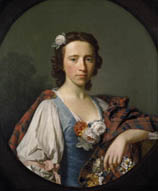 This symposium accompanies the exhibition Allan Ramsay: Portraits of the Enlightenment, which marks 300 years since the birth of Allan Ramsay (1713–1784). It centres on a selection of portraits from across Ramsay’s 30 years as a painter and also features drawings, watercolours, books, pamphlets, and other materials which demonstrate Ramsay’s fascinating place in the intellectual and cultural life of Edinburgh, London, Paris and Rome in the mid 18th century.
Registration fee: £40 Concession: £20. Booking requested by the 1st of December. Fees cover exhibition admission, the evening reception on the 5th of December, tea/coffee, lunch, and performance with a glass of wine on the 6th of December. Payment to be made by cheque (to ‘University of Glasgow’) or by cash on the day. For booking and further information please contact Mila Athayde (mila_athayde@yahoo.com.br); alternatively please visit The Hunterian website or contact the main reception on 00 44 (0)141 330 5431.
◊ ◊ ◊ ◊ ◊
T H U R S D A Y , 5 D E C E M B E R
17.45 Duncan Macmillan, Allan Ramsay and Portraiture in Enlightenment Scotland
F R I D A Y , 6 D E C E M B E R
9.30 Registration / Tea and coffee
10.00 Murray Pittock, ‘Jacobite Artists’ Connections in Scotland and Italy
10.40 Morning Session
Chair: Nigel Leask / Panel with Rhonda Brown and Melanie Buntin
• Chris Whatley (University of Dundee), A Hotbed for Genius: Allan Ramsay’s Scotland
• Elizabeth Eger (King’s College London), ‘A Harmony of Minds’: Allan Ramsay, Elizabeth Montagu and the Scottish Enlightenment
• Cristina Martinez (University of Carleton), Allan Ramsay: ‘A Dilettante in Law and Politics’
12.40 Lunch
14.15 Afternoon Session
Chair: John Bonehill / Panel with Anne Dulau, Rica Jones
• Rica Jones (conservator and historian of paintings), The Significance of Ramsay’s Technique in Context and Perspective
• Guillaume Farroult (Musée du Louvre), Ramsay’s Response to Mid Eighteenth-Century French Portraiture and Aesthetic Values
15.30 Tea and coffee
16.00 Panel discussion
17.00 Performance | Kirsten McCue, ‘Allan Ramsay’s Scots Songs’: The First Musick Book
Call for Papers | American Association for Italian Studies, 2014
From the Italian Art Society:
2014 American Association for Italian Studies Conference
University of Zürich, 23–25 May 2014
Proposals due by 5 December 2013
For the first time, the American Association for Italian Studies (AAIS) will hold its annual conference outside of North America and Italy. Switzerland is an ideal location: it is the only country, outside of the peninsula, where Italian is the national language. The Italian Art Society is glad to sponsor three sessions: two sessions treating photography and one treating early modern architecture. We welcome your paper abstracts.
◊ ◊ ◊ ◊ ◊
Maestri ticinesi, magistri grigioni: Swiss-Italian Architects and Craftsmen in Early Modern Europe
Organizer: Susan Klaiber (Winterthur, Switzerland)
The Italian-speaking regions of early modern Switzerland exported significant expertise in the building trades throughout Europe. These émigré architects, builders, and craftsmen such as stuccatori worked for courts, monasteries, and other patrons in present-day Germany, Austria, Italy, Poland, Czech Republic and elsewhere. While often well-studied by scholars in both Switzerland and the respective regions of migration, international awareness of such careers generally remains low, with notable exceptions such as Francesco Borromini. Taken
collectively, though, Swiss-Italian architects and craftsmen played important roles as agents of cultural transfer with their itinerant careers in early modern Europe. These figures include Domenico Fontana, Carlo Maderno, and Carlo Fontana in Rome; Enrico Zuccalli and Giovanni Antonio Viscardi in Bavaria; and Giovanni Battista Quadro in Poland.
The scholarly literature on such men is as rich yet dispersed as the architectural culture they embody. Representative publications include, in Italian, the exhibition catalogue Il giovane Borromini (1999), and books by Tommaso Manfredi (2008) and Marcello Fagiolo (ed., 2008); works in German by Sabine Heym (1984), Max Pfister (1991), and Michael Kühlenthal (ed., 1997); or several publications in Polish and Italian by Mariusz Karpowicz. Many of these studies are only available regionally. This session aims to break down these geographic and linguistic barriers and move toward a comprehensive view of the work of the ‘maestri ticinesi’ and ‘magistri grigioni’ with a comparative transnational approach. The session welcomes papers on any aspect of Swiss-Italian involvement in the building trades anywhere in Europe, ca. 1400-1800. Preference will be given to papers highlighting ties of workers (dynasties, networks), designs, techniques, or materials to Switzerland. Please send a 300-word abstract and a short bio to Susan Klaiber, sklaiber@bluewin.ch, by December 5, 2013.
Exhibition | The Golden Age of the Fan
Thanks to Pierre-Henri Biger for noting this upcoming exhibition of seventy fans at the Cognacq-Jay:
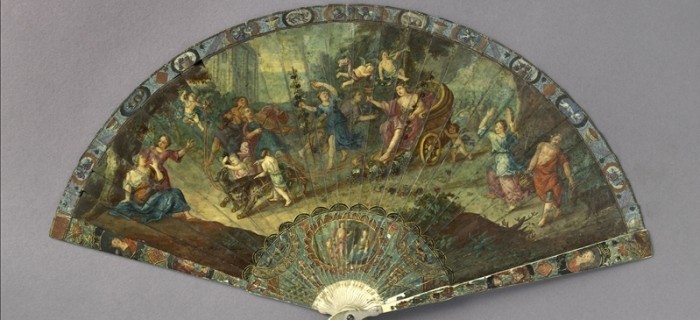
Le siècle d’or de l’éventail: Du Roi-Soleil à Marie-Antoinette
Musée Cognacq-Jay, Paris, 14 November 2013 — 2 March 2014
Curated by José de Los Llanos and Georgina Letourmy-Bordier
◊ ◊ ◊ ◊ ◊
Cette exposition rendra hommage à l’excellence du savoir-faire des éventaillistes français et montrera aussi l’extraordinaire inventivité dont témoignent ces objets fragiles et discrets que sont les éventails.
L’éventail est à la fois familier et méconnu. Accessoire de mode et objet d’art, il allie le savoir-faire d’artisans à la création artistique. Soumis à la fugacité des modes, il se renouvelle sans cesse. Importé d’Asie à la Renaissance, au milieu des cargaisons d’épices et de soies, l’éventail est adopté en France sous le règne de Louis XIV. Une corporation spécifique, celle des éventaillistes, créée en 1676, assure rapidement la domination des artisans français en Europe. Au cours du XVIIIe siècle, Paris devient ainsi la capitale de l’éventail. Le choix des décors suit alors la production des peintres à la mode et participe à la diffusion de l’art français en Europe, tout en montrant une singulière diversité. Tout peut être représenté sur un éventail : la mythologie, l’histoire antique comme l’histoire religieuse côtoient des scènes galantes. Ce sont aussi des décors empruntés à la vie quotidienne de la cour ou du peuple de Paris, ou encore des faits d’actualité, naissances et mariages royaux ou victoires militaires, célébrés par des fêtes publiques.
Avec soixante-dix oeuvres empruntées à des collections publiques et privées, en France et à l’Étranger, l’exposition du musée Cognacq-Jay, hommage à l’excellence du savoir-faire des éventaillistes français, essentiellement parisiens, montrera aussi l’extraordinaire inventivité dont témoignent ces objets fragiles et discrets.
Scottish NPG Acquires Portrait of the Fiddler Patie Birnie
From the museum press release (1 November 2013) . . .

William Aikman, Portrait of Patie Birnie, the Fiddler of Kinghorn, ca. 1718 (Scottish National Portrait Gallery)
A rare, early portrait of a Scottish folk musician, the celebrated eighteenth-century fiddler Patie (or Peter) Birnie, has recently been acquired by the Scottish National Portrait Gallery in Edinburgh and is on public display for the first time.
This charming portrait by the Scot William Aikman (1682–1731), who portrayed many of the leading political and literary figures of his day, was probably painted in the period between 1715 and 1720. A memorable and welcome addition to the Gallery’s collection, it is a significant example of a portrait by a prominent Scottish artist in which the sitter, who is clearly identified, comes from the lower ranks of society, rather than the ruling élite. It complements other renowned portraits of musicians in the collection, such Sir Henry Raeburn’s portrayal of the fiddler Niel Gow, painted in 1787, and also provides a compelling contrast with the Gallery’s other portraits by Aikman, which are primarily of aristocratic subjects.
In the striking and unusual composition the famous musician is shown laughing, and is identified not only by the fiddle he holds, but also by a painted inscription which describes him as “The Facetious Peter Birnie / Fidler in Kinghorn.” Although the word facetious is generally used in a derogatory sense today, in the eighteenth century it meant “gay; chearful [sic]; lively; merry; witty” (Samuel Johnson’s Dictionary). Most of our information about Birnie comes from Allan Ramsay the Elder’s Elegy, published, presumably shortly after Birnie’s death, in 1721, which states that Birnie was present at the Battle of Bothwell Bridge in 1679. The Elegy was later used by the Rev. James Granger in his Biographical History (1769):
“Patie Birnie resided at Kinghorn, on the sea coast, about nine miles north of Edinburgh, where he supported himself by his consummate impudence. Not by honest labour, but by intruding upon every person who came to the public house… He then fell into the utmost familiarity… his… exploits [involved] showing a very particular comicalness in his looks and gestures; laughing and groaning at the same time. He played, sung, and broke in with some queer tale twice or thrice e’er he got through the tune; and his beard was no small addition to the diversion.”
In addition to performing in such a memorable manner, Birnie is reputed to be among the earliest composers of strathspeys (a type of dance in 4/4 time). His fame was such that a number of engravings after Aikman’s painting were made, an example of which is in the Gallery’s collection. The painting was formerly in the collection of the Earls of Rothes, at Leslie House, Fife (where it was recorded in 1839) and was acquired by the Gallery from the London dealer Philip Mould.
Speaking of the acquisition, Christopher Baker, Director of the Scottish National Portrait Gallery, said: “This is an especially attractive and endearing addition to our eighteenth-century collection: Birnie was a man renowned for his music and vivacious performances and Aikman commemorated him in a wonderfully appropriate, informal and engaging manner.”
Call for Papers | The English Urban Renaissance Revisited
From the Call for Papers:
The English Urban Renaissance Revisited
A Centre for Urban History, University of Leicester, 18 July 2014
Proposals due by 1 February 2014
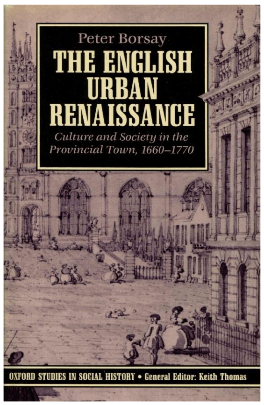 In 1989 OUP published Peter Borsay’s The English Urban Renaissance: Culture and Society in the Provincial Town 1600–1770. 2014 will therefore mark the 25th anniversary of this seminal text in urban cultural history. It inspired a new generation of researchers and developed some of the key themes that have since dominated the historiography of the ‘long’ eighteenth century:
• importance of provincial towns in the long eighteenth century as hubs of economic, cultural and political activity
• the strength and vitality of urban culture beyond the metropolis
• the transformation of the provincial urban townscape
This symposium is an opportunity to celebrate the anniversary and to:
• reflect on how eighteenth-century urban and cultural history has developed since 1989
• consider ‘urban renaissances’ in other European countries
• discuss new directions and possible collaborations
Papers (of 20 minutes’ duration) are invited on topics relevant to these themes. Please email proposals (300 words max) plus a brief biographical statement (60 words max) to John Hinks jh241@le.ac.uk and Roey Sweet rhs4@le.ac.uk by 1 February 2014.
New Book | Magnificent Entertainments
From Yale UP:
Melanie Doderer-Winkler, Magnificent Entertainments: Temporary Architecture for Georgian Festivals (London: The Paul Mellon Centre for Studies in British Art, 2013), 270 pages, ISBN: 978-0300186420, $75.
 A thoroughly original study of ephemeral architecture and design, Magnificent Entertainments examines the spectacular displays created for large-scale public celebrations in the Georgian period. The book focuses on a number of specific events—including royal weddings, coronations, battle victories, and birthday fêtes—that employed elaborate decorative measures to outshine the typical festivities of the day. Some of these elements, ranging from floral displays and scenery to music and light shows, transformed existing venues into unfamiliar marvels; other times, completely new settings were devised for short-lived occasions.
Drawing on primary sources such as commemorative prints, newspaper accounts, and diary entries, the book investigates just how essential these fanciful designs were in creating events with lasting impact and popular appeal. The author also delves into the various materials used for construction and embellishment: applications of sugar, sand, marble dust, or chalk lent luster and color to surfaces, while stand-alone firework temples and temporary reception rooms were often crafted of little more than wood, canvas, paint, and paste.
Melanie Doderer-Winkler is an art historian and former furniture specialist at Christie’s, London. She writes and lectures about the splendour and pageantry of eighteenth-century entertaining.










 Enfilade
leave a comment