Seminar on the History of Libraries, London, 2013–14
Information on the full 2013–14 seminar series on the History of Libraries is available from the Institute of English Studies:
John Goldfinch: The Survival of the Old Royal Library Collections, 1660–1760
British Library, London, 3 December 2013
A series of research seminars on the history of libraries, freely open for anyone to attend, has been organized by the Institute of English Studies, School of Advanced Study, University of London. They are jointly sponsored by the Institute of English Studies, the Institute of Historical Research, and the Library & Information History Group of CILIP. The December 3rd session is to be held in the Board Room of the British Library, Euston Rd., St. Pancras. Everyone attending is asked to meet at 5.20 at the British Library’s reception desk on the ground floor. As the Library needs to know numbers in advance, if you are intending to attend, please send a message to Jon Millington, john.millington@sas.sc.uk.
Exhibition | Making It in America
From the exhibition press release:
Making It in America
RISD Museum, Rhode Island School of Design, Providence, 11 October 2013 — 9 February 2014
Curated by Maureen O’Brien and Elizabeth Williams; designed by Thomas Jayne
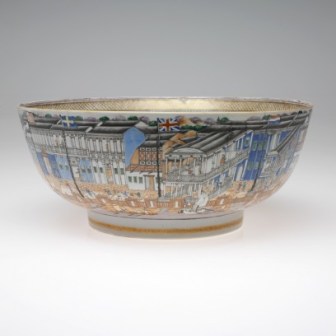

Punch Bowl, 1785–1800, Porcelain with enamel (RISD Museum). The bowl depicts warehouses along the waterfront of the city of Canton, the only port open to foreign merchants, whom the Chinese government confined to the waterfront areas. The western proprietor of each warehouse (hong) was identified by his national flag; Denmark, Spain, France, America, Sweden, England, and Holland are pictured.
◊ ◊ ◊ ◊ ◊
More than 100 outstanding works of painting, sculpture, and decorative arts from the RISD Museum’s collection illuminate connections between American ambitions and the making of art in Making It in America. The exhibition is on view through Sunday, February 9, 2014.
“American art has played a central role at the RISD Museum since its earliest days, and we celebrate this legacy with Making It in America,” says Museum director John W. Smith. “Drawn exclusively from our phenomenal permanent collection, this show is our first in-depth exploration of this subject in many years.”
Making It in America liberates artworks from the Museum’s galleries, storage vaults, and the historic period rooms of its Pendleton House wing, repositioning them within the broader context of American styles. These exceptional pieces, created between the early 1700s and early 1900s, are presented as examples of both artistic processes and aspirations. Just as individual accounts of American life revolve around searches for freedom, fulfillment, and identity, these stories are also embedded in objects that comprise the history of American art.
“The title is a double entendre that asks our viewers to think about art making and about how American art demonstrates American ideas about success,” explain exhibition co-curators Maureen O’Brien, curator of painting and sculpture, and Elizabeth Williams, curator of decorative arts and design. John Singleton Copley’s grand manner portrait of Moses Gill, for instance, illustrates the escalating wealth, social standing, and political capital of the 30-year-old merchant and future Massachusetts lieutenant governor. The land of opportunity is seen in painter Thomas Cole’s striking depictions of the American wilderness unspoiled nature ripe with promise. Closer to home, finely designed furniture with hand-carved motifs from Newport’s Townsend and Goddard workshops rivaled European examples in the 18th century, while the glorious excess of monumental silver works by Providence’s Gorham Manufacturing Company represented the city’s ambitions into the 19th and 20th centuries.
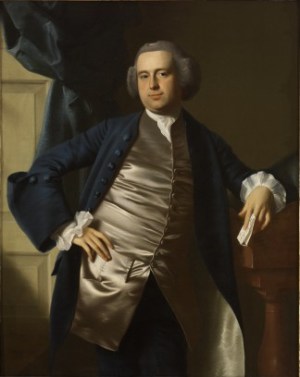
John Singleton Copley, Portrait of the Honorable Moses Gill, Esq., 1764, oil on canvas (RISD Museum)
Making It in America also touches on a theme for which the Rhode Island School of Design (RISD) is best known: the process of making art, a subtext of the show which provides a loose timeline of what happened in American art making and when. The exhibition’s intertwined threads of making art and representing achievement are woven into RISD and the RISD Museum’s own history. Inspired by the international display of art and commerce at the 1876 Centennial Exhibition, the College and Museum were established in 1877 with the mission to train American designers and publicly promote American art. The Museum’s earliest ‘contemporary’ purchase, in 1901, was Winslow Homer’s thundering seascape On a Lee Shore (1900), soon followed by the acquisition of important colonial portraits and American landscape paintings. In 1906, the RISD Museum built Pendleton House, the country’s first museum wing devoted to the display of American decorative arts, thus elevating the importance of native craftsmanship in the study of material culture.
The co-curators note that this exhibition provides exciting opportunities for visitors to explore the Museum’s rich holdings, closely examining objects that may have been behind ropes in period rooms or held in storage. Williams, who joined the RISD Museum in January and has spent much of her first year exploring the diverse decorative arts collection, looks forward to presenting 60 pieces of silver, furniture, glass, ceramics, and jewelry—more than half of which haven’t been on view in decades.
“Although many of the works in Making It in America have been on view in galleries throughout the Museum, visitors who see discrete selections rarely get a sense of the scope and quality of our collections,” says O’Brien.
Exhibition designer Thomas Jayne is a renowned decorator, decorative arts historian, and principal of Jayne Design Studio—specializing in interior decoration and product development. Jayne, who trained in the Winterthur Museum’s graduate program for American material culture, incorporates historic—and unexpected—patterns and colors to create a stunning installation that highlights the evolution of color and pattern in American design. Jayne’s previous clients include Winterthur; Edith Wharton’s country home, The Mount; the Brick House at the Shelburne Museum; and private collectors. Jayne was recently honored with the 2013 Arthur Ross Award for Interior Decoration from the Institute of Classical Architecture & Art. Drawing upon the past, he seeks details that deepen and enliven a room, exquisitely connecting history and place.
Launch of the Centre for Enlightenment Studies at King’s College
Please forgive the short notice, but news of the event is a useful marker of the launch of the Centre for Enlightenment Studies at King’s College London in partnership with the British Museum (stay-tuned for the Centre’s website). –CH
Enlightenment Bodies – from Apollo to Automata
King’s College London, The Strand, London, 15 October 2013
◊ ◊ ◊ ◊ ◊
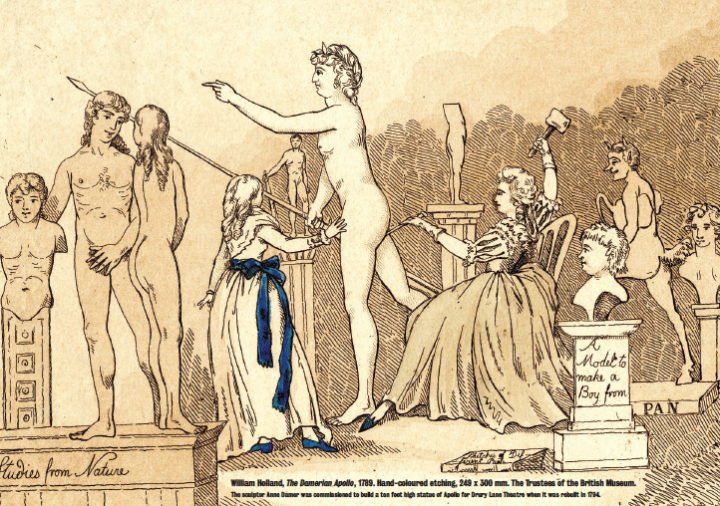
The Centre for Enlightenment Studies at King’s in partnership with the British Museum, presents Enlightenment Bodies – from Apollo to Automata, on Tuesday, 15 October 2013, 19.30–20.30 at the Edmond J Safra Lecture Theatre, Strand Campus, King’s College London.
Both the aesthetics and the workings of the human body were key themes of the eighteenth-century European Enlightenment. This is, therefore, an ideal topic with which to launch King’s College’s new interdisciplinary research centre, which will bring together our expertise in this area across a wide range of departments, and will build on our close relationship with the Enlightenment Gallery curatorial team at the British Museum. Join us for an exploration of the importance of the human body to Enlightenment life and thought with a panel of experts:
Athena Leoussi, University of Reading, Co-director of European Studies, University of Reading and author of
Nationalism and Classicism: The Classical Body as National Symbol in Nineteenth-Century England and France (1998);
Anna Maerker, Senior Lecturer in History of Medicine, King’s College London, author of Model Experts: Wax Anatomies and Enlightenment in Florence and Vienna, 1775–1815 (2011);
Simon Schaffer, Professor of History of Science, University of Cambridge and TV presenter of Mechanical Marvels and Clockwork Dreams, a recent programme for BBC 4.
The panel discussion will be followed by a drinks reception. The event is free, though booking is required.
Exhibition | Naples’s Treasure: The Museum of Saint Januarius
Press release from the Museo Fondazione:
Naples’s Treasure: Masterpieces of the Museum of Saint Januarius
Il Tesoro Di Napoli: I Capolavori del Museo di San Gennaro
Museo Fondazione, Palazzo Sciarra, Rome, 30 October 2013 — 16 February 2014
Musée Maillol, Paris, 19 March — 20 July 2014
Curated by Paolo Jorio and Ciro Paolillo

Michele Dato, Necklace of Saint Januarius, gold, silver,
and precious stones, 1679, with additions made in the
eighteenth, nineteenth, and twentieth centuries.
◊ ◊ ◊ ◊ ◊
Never before have such masterpieces from the most important collection of goldsmith art in the world, together with original documents, paintings, drawings, vestments and church plate, been exhibited beyond the walls of Naples. This exhibition offers an opportunity to investigate the inestimable artistic and cultural value of the treasure of Saint Januarius from a scientific point of view.
The exhibition, curated by Paolo Jorio, Director of the Museo del Tesoro di San Gennaro, and Ciro Paolillo, a professional gemmologist and professor of history, economics and the production of jewellery in the Sapienza University of Rome, with the advice of Franco Recanatesi, will be an event of great historic and artistic importance: over seventy works belonging to one of the most important collections of goldsmith’s art will be displayed for the first time beyond the walls of the Parthenopean city, beside original documents, paintings, drawings, vestments and church plate. The exhibition will offer an opportunity to investigate the inestimable artistic and cultural worth of the treasure of Saint Januarius from a scientific point of view, in order to rediscover, pass down and re-experience Naples on a journey through time and to protect its name, history, artists and, above all, this priceless heritage that has been collected over seven centuries.
 With twenty-five million devotees scattered throughout the globe, Januarius is the most famous Roman Catholic Saint in the world. Amidst devotion and prejudice, faith and disbelief, his long history is closely connected to Naples, the citizens of which – periodically threatened by natural catastrophes and historical events – even closely identify themselves with their patron saint. The exhibition to be held in Palazzo Sciarra will have both a scientific and an emotional approach, in order to explain the evolution of the cult of Saint Januarius in Naples, why the Treasure belongs to a secular institution and how Parthenopean goldsmithery was perfected over the centuries, thus creating most of the masterpieces on show.
In order to understand the impact of this event, suffice it to say that the historical value of the Treasure of Saint Januarius, formed throughout seven centuries of donations from Popes, Emperors, Kings and popular ex-votos, is higher than that of the Crown Jewels of the United Kingdom and those of the Tsar of Russia, as found during a research project conducted by a team of gemmologists led by Professor Ciro Paolillo, curator of the exhibition, the results of which were published in 2010. The team investigated several precious jewels donated to the Saint, which will be exhibited in Rome, for three years. Moreover, unlike other dynastic and ecclesiastical heritages, the Treasure has remained in tact ever since it was formed and has never endured spoliation, nor have the jewels ever been sold to fund wars. It has constantly been increased by means of acquisitions and accessions.

Matteo Treglia, Mitre in gilded silver, 3326 diamonds, 164 rubies, 198 emeralds and 2 garnets, 1714.
Professor Emmanuele F. M. Emanuele, Chair of the Fondazione Roma, says, “I believe it is essential to spread knowledge of this priceless heritage belonging to our country, the preservation and enhancement of which constitutes a strategic asset for the culture market. It is precisely due to its commitment in this field that the Fondazione Roma, by means of the activities performed by Fondazione Roma-Arte-Musei, has, in time, become a point of reference for the balance of the demand and supply of culture in the Eternal City. The exhibition devoted to Saint Januarius fully qualifies to be included in the cultural project promoted by our institution, which aims to spread all forms of art as an element of social development. The attention we pay to the relationship between culture and the community constitutes the link between the activities performed by the Foundation and those of the Museo di San Gennaro, which has led to the accomplishment of this important exhibition that will allow the public to admire, for the first time, works which, due to their preciousness and strong connotations of identity, have never been shown beyond the walls of Naples.”
 Paolo Jorio says that, “Each work of art belonging to the Treasure of Saint Januarius expresses its intrinsic artistic wealth, fruit of the unequaled craftsmanship of sculptors, silversmiths, chasers, welders and ‘put togetherers’ (as the assemblers were called in those days) who were capable of creating masterpieces of rare beauty using their technical know-how and creativity, and also tells the extraordinary story of a people and its ancient civilization. An account that places the Neapolitan people and European monarchs on the same level, since they all paid homage to Saint Januarius in a secular way and donated priceless masterpieces to the city of Naples.”
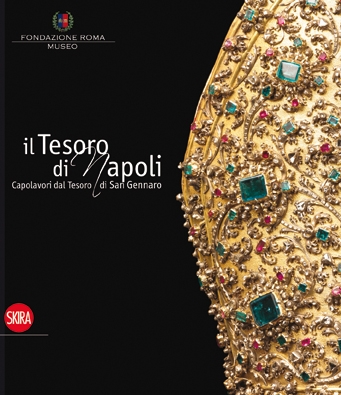
The exhibition will revolve around the two most extraordinary masterpieces of the Treasure: the Necklace of Saint Januarius, in gold, silver and precious stones created by Michele Dato in 1679, and the Mitre, in gilded silver, 3326 diamonds, 164 rubies, 198 emeralds and 2 garnets, created by Matteo Treglia in 1714, the
Tricentennial of which is celebrated this year.
The Necklace of Saint Januarius is one of the most precious jewels in the world and its history inextricably interweaves with the trail of constant devotion the city and monarchs have paid to this saint over the centuries. In 1679, the Members of the Deputation decided to use several jewels (crosses studded with sapphires and emeralds hanging from thirteen large solid gold links) in order to create a magnificent ornament for the bust, appointing Michele Dato, with the aid of other craftsmen, to enable the execution of such an exacting piece of work in only five months. The necklace is now comprised of other jewels of illustrious provenance created by various craftsmen at different times: a cross donated by Charles de Bourbon in 1734, a cross offered by Maria Amalia of Saxony, a three piece clasp with diamonds and emeralds, a cross with diamonds and sapphires dated 1775 bestowed by Maria Carolina of Austria, a crescent shaped broach dated 1799 donated by the Duchess of Casacalenga, a cross and a broach with diamonds and chrysolite offered by Victor Emmanuel II of Italy and other artefacts. Interestingly, Queen Marie Josè, consort of Umberto II of Italy, was attending a private visit to the Chapel of San Gennaro in 1933 and having nothing to donate, she removed the ring she was wearing and offered it to the saint. This regal gift is now to be found on the necklace.
When landing in Naples, even Napoleon, who plundered everywhere, not only refrained from stealing but, for once in his life, actually donated. In fact, when entering Naples in 1806 Joseph Bonaparte donated, as advised by his brother, a cross of diamonds and emeralds of rare beauty which the Deputation then included amongst the jewels bestowed by sovereigns that compose the priceless Necklace of Saint Januarius. Napoleon’s brother-in-law, Joachim Murat, who married beautiful Caroline Bonaparte, also paid heed to the advice of the French Emperor and donated a monstrance in gold and silver with precious stones in 1808. Both masterpieces will be exhibited in Rome. The arrival of the French in Naples is witnessed in only one known artwork: a painting by the French artist, Hoffman, depicted in 1800 and retrieved in Paris by the Deputation, in which the high altar in the Dome may be distinguished. The armed and threatening French troops, commanded by Championnet and Macdonald, stand on the altar ‘demanding’ Saint Januarius to perform the miracle of the liquefaction of his blood in front of the people. This painting will also be exhibited in Rome, as likewise the canvas of Saint Januarius depicted in 1707 by Solimena, the most famous authentic chromatic masterpiece in the world since, as from that year, all the holy pictures of the patron saint of Naples have been inspired by this painting.
The Mitre, the Tricentennial of which is celebrated this year, was commissioned by the Deputation in order to be placed on the bust during the festive procession held in April 1713. It was created in the Antico Borgo Orefici, established by the Anjou monarchs, which was an authentic mine of talents including the author, the maestro goldsmith, Matteo Treglia. The Mitre has an enormous material and symbolic value. The Mitre is adorned with 3964 precious stones including diamonds, rubies and emeralds, according to the traditional construction of ecclesiastical items in relation to the symbolic meaning of the gems: emeralds represented the union between the sanctity of the Saint and the emblem of eternity and power; rubies the blood of martyrs and diamonds an irreprehensible faith. The gemstones also reveal another fascinating affair. Several gems have been found to come from the ancient quarries in Latin America. Ciro Paolillo affirms that “thanks to Treglia’s devotion, today we are looking at one of the world’s most beautiful collections of emeralds belonging to the ancient people of South America; consequently, these gems are valuable both for their preciousness and history.” (more…)
Call for Papers | The Production of Ornament: Reassessing the Decorative
From H-ArtHist:
The Production of Ornament: Reassessing the Decorative in History and Practice
University of Leeds, 21–22 March 2014
Proposals due by 13 December 2013
Keynote speakers
· Susanne Kuechler, Professor of Material Culture in the Department of Anthropology, UCL
· Alina Payne, Professor of the History of Art and Architecture, Harvard
The descriptive terms ‘decorative’ and ‘ornamental’ are in many ways synonymous with superfluity and excess; they refer to things or modalities that are ‘supplementary’ or ‘marginal’ by their very nature. In the West, such qualitative associations in made objects intersect with long-standing and inter-related philosophical oppositions between ‘form’ and ‘matter’, ‘body’ and ‘surface’, the ‘proper’ and the ‘cosmetic’. Accordingly, this has weighed both on determinations of value in artistic media, and on the inflexions of related histories – particularly histories of ‘non-Western’ art, design and culture, where a wide range of decorative traditions are deemed unworthy of critical attention.
Yet such frameworks are no more historically stable than they are culturally universal. To take one very clear and ‘central’ counter-example, decoration in some strands of Renaissance architectural theory (Filarete, Alberti) emerged as a rigorous codification of meaning, as an essentially functional (political) language. In many ways the history of ornament may itself be seen as a process of marginalisation of such ways of thinking, and the separation of ornament from any form of social practice.
This two-day conference seeks to explore the various ways in which ornament might be regarded as itself productive of its objects and sites. How might the technologies, techniques, and materials of ornament be related to the conception and transformation of modes of object-making? How might ornament be understood to inform its objects, disrupting the spatial categories of ‘surface’ and ‘structure’, and the temporal models in which ornament ‘follows’ making? What are the relations between ornament and representation, and what is at stake in the conventional oppositions between these categories? What are the roles of ornament in larger dynamics of copying, hybridisation and appropriation between things? In what ways have practices and thinking on ornament staged cultural encounters, and engendered larger epistemological and social models?
The conference will explore the production of ornament across a broad range of historical and geographical contexts. We invite proposals from researchers and postgraduates working in any discipline, as well as practitioners, conservators and curators. Proposals of no more than 300 words, along with a CV, should be sent to Dr Richard Checketts and Dr Lara Eggleton at production.of.ornament@gmail.com by Friday the 13th of December 2013.
New Book | The Decoration of a Palace in Genoa
Anne Perrin Khelissa, Gênes au xviiie siècle. Le décor d’un palais (Paris: INHA/CTHS, Collection L’art et l’essai, 2013), 400 pages, ISBN : 978-2735508013, 33€.
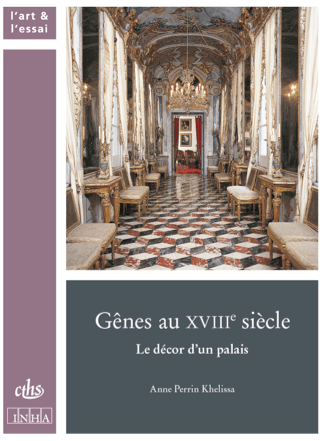 Au xviiie siècle, au cœur d’évènements qui mettent à mal la souveraineté et le prestige de Gênes, l’aristocratie parvient à maintenir sa place économique et politique. Les palais que les familles de la noblesse de l’époque meublent et donnent à voir au public en sont la preuve incontestable : le décor installé dans ces demeures répond au décorum et à une stratégie qui vise à consolider l’établissement des familles par le moyen de l’héritage.
Le palais Spinola à Pellicceria est paradigmatique de ces stratégies. Cet ouvrage éclaire les usages que l’aristocratie fait du décor, en analysant les meubles et les objets qui le composent, sous un angle à la fois social, juridique et esthétique. Il met aussi en évidence la cohérence des collections, enjeu majeur pour les familles, contraintes potentielles pour les artistes et artisans auxquels elles passent commande.
Anne Perrin Khelissa est maître de conférences en histoire de l’art moderne à l’Université Toulouse II – Le Mirail.
◊ ◊ ◊ ◊ ◊
S O M M A I R E
Remerciements
Préface de Peter Fuhring
Introduction
Première Partie: Hériter, transmettre
I. Le palais Spinola à Pellicceria et ses propriétaires
II. Pérennité des valeurs du clan
III. La sauvegarde du patrimoine
Deuxième Partie: Dépenser, commander
I. L’élaboration du décor
II. L’organisation du chantier
III. Aux origines de la commande : le mariage du fils aîné
IV. Les changements opérés par les héritiers
Troisième Partie: Habiter, séjourner
I. La distribution des intérieurs
II. Permanence et changements dans l’ameublement
III. Un parangon des styles européens
IV. Échapper au décorum de la résidence urbaine
Conclusion
Annexes
Les passages de propriété du palais à Pellicceria
Lexique
Sources manuscrites
Bibliographie
Index
Call for Papers | Colonial Spaces: Female Responses to Empire
From the Call for Papers:
Visualising and Materialising Colonial Spaces: Female Responses to Empire
University of Warwick, 11 January 2014
Proposals due by 31 October 2013
Proposals are invited for 20-minute papers for Visualising and Materialising Colonial Spaces: Female Responses to Empire, a conference organized by Dr. Rosie Dias (Art History, University of Warwick) and Dr. Kate Smith (History, University College London) and funded by The Paul Mellon Centre for Studies in British Art. Confirmed keynote speakers include David Arnold, Emeritus Professor, Department of History, University of Warwick and Caroline Jordan, Honorary Associate in the Humanities and Social Sciences, La Trobe University Melbourne.
In recent years scholars working in the field of British art history have increasingly broadened their approach to include transnational and imperial topics. Despite such interest, however, little attention has been paid to the gendered nature of such artistic productions. The majority of research on Anglo-Indian visual culture for example, has focused upon work created by men and as yet little research has considered the role of women in the creation and dissemination of visual and material culture. Visualising and Materialising Colonial Spaces: Female Responses to Empire demonstrates the significance of women’s cultural productions upon ideas of empire at home and abroad by examining the rich visual and archival sources created by British women in imperial spaces. It examines the paintings, sketches, writings, collections, and objects that women created to capture and record their experiences of empire. In doing so it questions the role women played in constructing particular understandings of and narratives about imperial experiences in the eighteenth, nineteenth and twentieth centuries.
Please send a 250-word abstract and a brief biographical note to visualisingcolonialspaces@gmail.com by October 31, 2013.
Exhibition | Rome in Your Pocket: Sketchbooks and Artistic Learning
From the Prado:
Rome in Your Pocket: Sketchbooks and Artistic Learning in the Eighteenth Century
Roma en el bolsillo: Cuadernos de dibujo y aprendizaje artístico en el siglo XVIII
Museo Nacional del Prado, Madrid, 15 October 2013 — 19 January 2014

José del Castillo, Allegory of the Arts, Italian sketchbook I, p. 3, 1762
(Madrid, Museo Nacional del Prado)
Curated by José Manuel Matilla, Head of the Department of Prints and Drawings at the Museo del Prado, Studying Rome focuses on a group of artists’ sketchbooks that the Museum has acquired over the past few decades, produced by a series of Spanish artists including Goya and José del Castillo during their formative years in Rome in the last quarter of the 18th century. These sketchbooks allow for a study of the type of training experienced by young Spanish artists in Italy as they used them to set down their artistic interests. On occasions they also include later works directly inspired by the motifs that they studied.
The exhibition includes 6 of the small sketchbooks that accompanied these artists in Rome and 23 more from various Spanish and international institutions, in addition to 22 independent drawings that offer a complete overview of the artistic practice that was common to European culture at this period. As such, this material provides a source of first-hand information for understanding the artistic and personal context of the period.
The exhibition also provides a unique opportunity for seeing the complete contents of the sketchbooks belonging to the Prado through electronic screens sponsored by Samsung, which visitors can consult in the exhibition space.
Forthcoming Book | Painting in Latin America, 1550–1820
Available in December from Yale UP:
Luisa Elena Alcala and Jonathan Brown, ed., Painting in Latin America, 1550–1820: From Conquest to Independence (New Haven: Yale University Press, 2013), 480 pages, ISBN: 978-0300191011, $75.
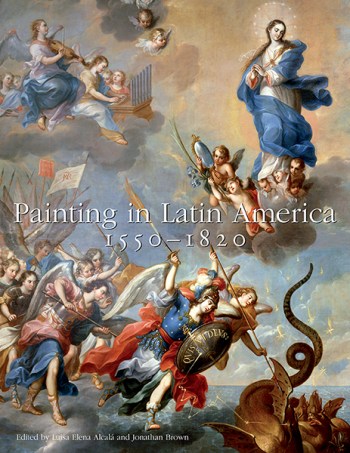 Painting in Latin America, 1550–1820: From Conquest to Independence surveys the diverse styles, subjects, and iconography of painting in Latin America between the 16th and 19th centuries. While European art forms were widely disseminated, copied, and adapted throughout Latin America, colonial painting is not a derivative extension of Europe. The ongoing debate over what to call it—mestizo, hybrid, creole, indo-hispanic, tequitqui—testifies to a fundamental yet unresolved question of identity.
Comparing and contrasting the Viceroyalties of New Spain, with its center in modern-day Mexico, and Peru, the authors explore the very different ways the two regions responded to the influence of the Europeans and their art. A wide range of art and artists are considered, some for the first time. Rich with new photography and primary research, this book delivers a wealth of new insight into the history of images and the history of art.
Luisa Elena Alcala is a professor titular at the department of history and theory of art, Universidad Autónoma of Madrid. Jonathan Brown is Carroll and Milton Petrie Professor of Fine Arts at New York University.
Call for Papers | AAH 2014
In April of 2014 the Royal College of Art in London will host the 40th annual meeting of the Association of Art Historians (AAH). Panels will address a wide variety of themes. Here’s one example, the Museums & Exhibitions Group Annual Session (a full list is available here).
AAH Annual Conference | Challenging Conventions: Exploring Hierarchies
within the Historiography of the Fine and Decorative Arts
Royal College of Art, London, 10–12 April 2014
Proposals due by 11 November 2013
 This session explores hierarchies within the discipline of art history, tracing the separation of the ‘fine’ and ‘decorative/applied’ arts and examining the impact of this division on the research, display and use of art objects within academic and museum contexts. Even before Kant subdivided the arts into ‘mechanical’ and ‘aesthetic’ groupings, the ‘decorative’ arts were somehow deemed lesser due to their inherent functionality, allied to base manual labour and divorced from the purity and higher appeal/role of the ‘fine’ arts. This approach was perpetuated throughout the 18th and 19th centuries, and continues to influence modes
of practice to the present day.
Within this session questions may include, but are not limited to, exploring how these historiographies affect perceptions within the study of art history and the presentation of objects within museums. Have they actively shaped the way we research, collect and display objects? Have these exclusions/inclusions limited or facilitated ways of working within the discipline generally, or affected the way specific fields have been shaped more particularly? And what impact has this legacy had on contemporary practice, in modes of working, forms of display or the evolution of funding streams?
The Museums & Exhibitions Group represents a wide range of practitioners, including art historians, curators and artists/makers, from all eras and cultures, and invites a similarly wide range of responses. Papers may examine specific areas within this topic, examples of interdisciplinarity or case studies within museum/gallery or academic contexts.
Please send proposals (maximum 250 words) to the session convenors Dr Marika Leino, Oxford Brookes University mleino@brookes.ac.uk and Marie-Therese Mayne, Laing Art Gallery, Tyne & Wear Archives & Museums marie-therese.mayne@twmuseums.org.uk by 11th November 2013.










 Enfilade
leave a comment