New Book | The Beau Monde: Fashionable Society in Georgian London
From Oxford University Press:
Hannah Greig, The Beau Monde: Fashionable Society in Georgian London (Oxford: Oxford University Press, 2013), 352 pages, ISBN: 978-0199659005, $35.
 Caricatured for extravagance, vanity, glamorous celebrity and, all too often, embroiled in scandal and gossip, 18th-century London’s fashionable society had a well-deserved reputation for frivolity. But to be fashionable in 1700s London meant more than simply being well dressed. Fashion denoted membership of a new type of society – the beau monde, a world where status was no longer determined by coronets and countryseats alone but by the more nebulous qualification of metropolitan ‘fashion’. Conspicuous consumption and display were crucial; the right address, the right dinner guests, the right possessions, the right jewels, the right seat at the opera.
The Beau Monde leads us on a tour of this exciting new world, from court and parliament to London’s parks, pleasure grounds, and private homes. From brash displays of diamond jewelry to the subtle complexities of political intrigue, we see how membership of the new elite was won, maintained – and sometimes lost. On the way, we meet a rich and colorful cast of characters, from the newly ennobled peer learning the ropes and the imposter trying to gain entry by means of clever fakery, to the exile banned for sexual indiscretion.
Above all, as the story unfolds, we learn that being a Fashionable was about far more than simply being ‘modish’. By the end of the century, it had become nothing less than the key to power and exclusivity in a changed world.
Hannah Greig is a lecturer in eighteenth-century British history at the University of York. Prior to joining York she held posts at Balliol College, Oxford, and the Royal College of Art. Alongside her academic work, Dr Greig works as a historical adviser for film, television and theatre. Recent credits include the feature film The Duchess (Pathe/BBC films 2008, directed by Saul Dibb) and Jamie Lloyd’s production of The School for Scandal (at the Theatre Royal in Bath).
Exhibition | Georgians Revealed
Press release from the British Library:
Georgians Revealed: Life, Style and the Making of Modern Britain
British Library, London, 8 November 2013 — 11 March 2014
Curated by Moira Goff

A view of the first Bridge at Paddington, and the
Accommodation Barge going down the Grand Junction
Canal to Uxbridge © The British Library Board
◊ ◊ ◊ ◊ ◊
Exploring the changing lives of the middle classes, from homes and gardens to entertainment and celebrity, Georgians Revealed will explore the myriad ways in which the Georgians influenced modern Britain between 1714 and 1830 and marks 300 years since the period began. Through over 200 fascinating and rare Georgian artefacts from the Library’s rich collections and other UK cultural institutions, the exhibition will reveal the roots of today’s popular culture as we know it, from theatre-going and a fascination with fashion, to celebrity scandals and gambling.
Curated by specialists from the History and Classics team at the British Library, the exhibition will feature iconic artworks and artefacts from the Georgian period, such as Jeremy Bentham’s violin and Joseph van Aken’s ‘An English Family at Tea’, alongside never before seen rare books, magazines and everyday objects, from the first fashion magazines to exquisite illustrations and designs of British landmarks and buildings still standing today, including the Brighton Pavilion and Sir John Soane’s house in Lincoln’s Inn Fields.
Moira Goff, lead curator of the exhibition, says: “We’re excited to uncover these objects that shed light on daily life in such an exciting time for cultural development. The parallels we can draw between Georgian Britain and today are astonishing and we’re delighted to be able to share these with a wider audience.”
The exhibition will be accompanied by an eclectic range of events celebrating the legacy of the Georgian period, including talks by celebrated chef Heston Blumenthal and historian and author Lucy Inglis.
The 300th anniversary of the accession of George I will be celebrated throughout the UK during 2014 with displays at Kensington Palace, the Handel House Museum and the Foundling Museum among other cultural institutions.
◊ ◊ ◊ ◊ ◊
E V E N T S
Historic Heston Blumenthal
Friday 8 November, 18.30-20.00, £10/£8 concessions
Heston Blumenthal, whose name is synonymous with cutting-edge cuisine, nonetheless finds one of his greatest sources of inspiration from the original and creative recipes from Britain’s rich culinary past. Join Heston for an evening exploring the lasting impact made during the Georgian era on the culinary history of Britain and to discover their influence on some of his creations.
The Josephine Hart Poetry Hour: The Romantics
Tuesday 12 November, 18.30-20.00, £7.50/£5 concessions
Josephine Hart’s passion for poetry and commitment to having it read live electrified the evenings she hosted at the British Library. The events continue on an occasional basis, with no less capacity to move and inspire. Tonight’s programme will be devoted to the great Romantic poets: Keats, Byron and Shelley.
Georgian Londoners: Into the Streets
Sunday 17 November, 14.00 – 15.15, £7.50/ £5 concessions
In 2009 historian Lucy Inglis began her award-winning blog on the lesser-known aspects of London during the eighteenth century. Monarchs, politicians and aristocrats grab the historical limelight, but Lucy’s Georgian Londoners are the men and women who rode the dawn coach to work, opened shops bleary-eyed and hung-over, fell in love, had risky sex in side streets, realized the children had head lice again, paid parking fines, cashed in winning lottery tickets, fought for good causes and committed terrible crimes. In this talk based on her new book, Lucy takes a journey back to a time that through fantastic highs and desperate lows, changed expectations of what life could be.
LATE at the Library: Vice and Virtue
Friday 6 December, 19.30 – 23.00, £12.50
An evening of decadent pleasure and entertainment awaits. Celebrate the legacy of the Georgian era with guest DJ sets, live performance, circus, installations, bar and food and a late night opening of the exhibition. Join the rogues and gents, vamps and ladies for a night of splendour and spectacle.
In association with Georgian Townhouse Parties and Circus Space
Call for Essays | Terra Foundation for American Art Essay Prize
Terra Foundation for American Art International Essay Prize
Submissions due by 15 January 2014
The Terra Foundation for American Art International Essay Prize recognizes excellent scholarship by a non-U.S. scholar in the field of historical American art. Manuscripts should advance understanding of American art, demonstrating new findings and original perspectives. The prize-winning essay will be translated and published in American Art, the Smithsonian American Art Museum’s scholarly journal. The winner will receive a $1,000 cash award and a $3,000 travel stipend to give a presentation in Washington, D.C., and meet with museum staff and fellows. This prize is supported by funding from the Terra Foundation for American Art.
The aim of the award is to stimulate and actively support non-U.S. scholars working on American art topics, foster the international exchange of new ideas, and create a broad, culturally comparative dialogue on American art. Ph.D. candidates and above (or equivalent) are eligible to participate in the competition. Essays may focus on any aspect of historical (pre-1980) American art and visual culture; however, architecture and film studies are not eligible. Preference will be given to studies that address American art within a cross-cultural context and offer new ways of thinking about the material. A strong emphasis on visual analysis is encouraged. Manuscripts previously published in a foreign language are eligible if released within the last two years (please state the date and venue of the previous publication). Essays that have been published in English will not be considered. Authors are invited to submit their own work for consideration. We also urge scholars who know of eligible articles written by others to inform those authors of the prize.
The length of the essay (including endnotes) should be between 7,000 and 8,500 words and should include approximately 12 to 14 illustrations with figure references in the text. The essay should be submitted by e-mail as a Word file, accompanied by a PDF file containing all of the illustrations, along with captions that provide each object’s title, artist, date, medium, dimensions, and current location. All manuscripts should be accompanied by an abstract of 500 to 1,000 words written in English that: 1) clearly states the author’s thesis and the essay’s contribution to the field of American art, and 2) outlines the essay’s basic structure and methodology. A curriculum vitae should be included.
Submissions must be sent to TerraEssayPrize@si.edu by January 15, 2014. Questions or comments may be addressed to the same address.
◊ ◊ ◊ ◊ ◊
Note (added 20 June 2014) — The Smithsonian American Art Museum is pleased to announce that John Fagg, a lecturer in the school of English, drama, and American & Canadian studies at the University of Birmingham in England, is the winner of the 2014 Terra Foundation for American Art International Essay Prize. Fagg’s award-winning essay, “Bedpans and Gibson Girls: Clutter and Matter in John Sloan’s Graphic Art,” will appear in the 2015 volume of American Art (volume 29).
Exhibition | The Enchanted World of German Romantic Prints
Though primarily a nineteenth-century show, this exhibition at the Philadelphia Museum of Art will appeal to many readers; it comes on the heels of Landscape, Heroes, and Folktales: German Romanticism at The British Museum last year. From the press release:
The Enchanted World of German Romantic Prints
Philadelphia Museum of Art, 21 September — 29 December 2013
Curated by John W. Ittmann

Carl Wilhelm Kolbe the Elder, Large Oak Tree Enclosed by a Plank Fence, ca. 1802–4, etching with masked plate tone, 13 x 17 inches, in the manner of the Dutch artist Anthonie Waterloo, 1609–1690 (Philadelphia Museum of Art)
In the late eighteenth and early nineteenth centuries, prints became widely available to growing and increasingly enthusiastic audiences throughout Europe and the United States. The Enchanted World of German Romantic Prints tells an important chapter in this story. This exhibition, comprising 125 etchings, lithographs, and woodcuts, will explore prints by artists from Germany, Austria, and Switzerland from 1770 to 1850, and how printmaking reflected the profound cultural changes that swept across the German-speaking regions of Central Europe during this period. The works in the exhibition represent the many artistic enthusiasms of the age: the Romantic fascination with wild, untamed landscapes teeming with life; the intimate pleasures of family scenes and friendship portraits; the rediscovery of ancient Nordic sagas and traditional fairy tales; and the synthesis of visual art, poetry, and music. The Museum’s encyclopedic collection of prints from this period is the finest in the country and includes rare prints unseen even in the finest European collections.
German Romantic Prints will feature major prints by important artists of the German Romantic era such Caspar David Friedrich, Carl Wilhelm Kolbe the Elder, and Philipp Otto Runge. The revival of interest in regional folk culture and fairy tales provided a rich source of material for artists of the time, including Ludwig Emil Grimm, the younger brother of the famous Brothers Grimm, Jacob and Wilhelm. His print The Boy Turned into a Fawn, Comforted by His Sister and Watched over by an Angel (1819) was used as the frontispiece of an early edition of his brothers’ famous tales. By the 1830s advances in technology allowed for the printing of large editions, and local art societies began to issue annual prints for members. Two large and elaborate etchings by Eugen Napoleon Neureuther illustrate the tales of Sleeping Beauty (1836) and Cinderella (1847) and attest to the continuing popularity of these stories throughout the era.
Caspar David Friedrich, one of the most important German artists of his generation, made only a handful of prints in his career. German Romantic Prints will include his rare woodcut, Woman Seated under a Spider’s Web (1803–4), a quintessential image of the Romantic era: a young woman seated between a pair of barren trees in dense undergrowth, seemingly lost in melancholy meditation on the brevity of life.
In the early 1800s, German artists and art lovers flocked to Dresden to admire Raphael’s Sistine Madonna, a painting represented in this exhibition by an engraving that was once as widely admired as the painting itself. The Sistine Madonna provided the inspiration for Runge’s visionary masterpiece, The Times of Day (Morning, Day, Evening, Night) (1805). This ambitious allegorical series depicting the cycle of life was originally conceived of as a set of mural-sized painted panels, but was realized only in the form of four large etchings, a rare first edition of which will be displayed. These large prints are bordered by delicate ornamental arabesques composed of intricate plant forms, music-playing infants, and cherubs.
An overview of a vital chapter in the history of European printmaking, German Romantic Prints illuminates one of the richest yet least known areas of the Museum’s collection. A selection of prints presented in display cases will permit enjoyment of the more finely detailed prints up close.
Review | A Selection of Digital Humanities Projects
The current issue of Renaissance Quarterly includes Michael Ullyot’s assessment of five digital resources, several of which are relevant to eighteenth-century studies:
Michael Ullyot, “Review Essay: Digital Humanities Projects,” Renaissance Quarterly 66 (Fall 2013): 937–47.
 “Are databases the defining genre of the twenty-first century? This question was at the core of a debate in 2007 over the nature of the Walt Whitman Archive in PMLA (Publications of the Modern Language Association of America). With digital resources now firmly established as an essential scholarly research tool, the question remains: what status do we afford databases relative to other forms of publication, like editions or monographs? The question is pertinent not just to tenure and promotion decisions, as the MLA Committee on Information Technology recently advocated, but more fundamentally to the circulation and provocation of ideas.1 If databases help us to interact with texts and cultural objects differently, enabling us to interpret them in ways we
could not otherwise do, how do they differ from monographs or journal articles? . . .” (937)
1. “Guidelines for Evaluating Work in Digital Humanities and Digital Media.” http://www.mla.org/guidelines_evaluation_digital; accessed 17 January 2013.
◊ ◊ ◊ ◊ ◊
· Mapping the Republic of Letters, which draws on the University of Oxford’s Electronic Enlightenment data, a collection containing over 50,000 letters.
· The Map of Early Modern London, a digital atlas of sixteenth- and seventeenth-century London (Ullyot references, in passing, Locating London’s Past, which is based on John Rocque’s 1746 map).
· 1641 Depositions Project, which collects 8,000 manuscript accounts of the 1641 Irish rebellion of Catholic gentry against Protestant settlers from England and Scotland.
· The Medici Archive Project, which aims to catalog the Medici Archival Collection (Mediceo del Principato), a collection of over four million letters written between 1537 and 1743. To date, approximately 10 percent of the archive is included within the database, though Ullyot explains a number of new, “promising” features aimed at making the platform more efficient and more interactive.
· Early English Books Online, a collection of texts published between 1473 and 1700. “What makes EEBO truly innovative and interesting is the Text Creation Partnership (TCP), under which the University of Michigan and Oxford University began in 1999 to convert these PDFs [created from microfilm copies of the books] into fully searchable texts. The TCP has focused on transcribing all 70,000 of the unique monographs in EEBO’s collection. These transcriptions are cross-linked to the page images they are taken from, so they are fully integrated into EEBO. At present, only members of the TCP consortium of libraries are able to access this resource, but it will ultimately pass into the public domain [starting in 2015 and finishing up in 2020]” (945).
Drawings at The Morgan Library to Be Digitized
From the press release (20 September 2013) . . .

Antoine Watteau, Two Studies of the Head and Shoulders of a Little Girl, ca. 1717, Red, black, and white chalk on buff paper; drawn over black chalk sketch of legs (New York: The Morgan Library & Museum)
The Morgan Library & Museum announced today that it will begin the digitization of its collection of master drawings, considered to be one of the greatest in the world. The initiative will result in a digital library of more than 10,000 images, representing drawings spanning the fourteenth to twenty-first centuries, available free of charge on the Morgan’s website. The project will begin in October and is expected to be completed within one year, contributing significantly to the Morgan’s commitment to advancing drawings scholarship.
The images will be accessible in two formats: one for general identification and another for detailed study with enhanced resolution. Scholarly information about each drawing will be linked to a corresponding Morgan catalogue record. Importantly, the project includes approximately 2,000 images of versos (reverse sides) of drawings that contain rarely seen sketches or inscriptions by the artist. The digital library will be available on an open-access basis, and can be downloaded for non-commercial uses such as classroom presentations, dissertations, and educational websites devoted to the fine arts.
“The Morgan’s drawing collection is indisputably one of the finest in the world, however, images of only a small part of our holdings have been available in digital form,” said William M. Griswold, director of the museum. “This project will provide access to the full range of the collection and is critical to our institutional goal of promoting drawings scholarship and reaching out to an ever larger audience.”
Future plans for the project involve digitization of the department’s print collection, including its celebrated group of Rembrandt prints, as well as artists’ sketchbooks, and expanded scholarly catalogue records. For nearly a century the Morgan has played a leading role in the collecting, scholarship, and exhibition of master drawings. All the major European schools are represented in the collection, with particular strengths in the field of Italian drawings, including works by Raphael and Michelangelo, Annibale Carracci, and Giambattista and Domenico Tiepolo; French drawings, especially of the eighteenth and nineteenth centuries; British drawings, with an exceptional concentration of works by William Blake; and Dutch, Flemish, and German drawings, including numerous sheets by Dürer, Rubens, Rembrandt, and Friedrich, among many others. The collection also includes a growing number of modern and contemporary works on paper as well as drawings by American artists. The Morgan’s collection is thus unusual in that it represents, in increasing depth, continuity as well as innovation throughout the entire history of drawing.
Jennifer Tonkovich, Curator in the Department of Drawings and Prints, and Marilyn Palmeri, Imaging and Rights Manager, will lead the project team. This project is generously underwritten by the Joseph F. McCrindle Foundation and by the Samuel H. Kress Foundation.
Call for Proposals | ISECS Seminar for Early Career Scholars
From the call for proposals (which includes the French text, too) . . .
2014 ISECS International Seminar for Early Career Eighteenth-Century Scholars
Arts of Communication: In Manuscript, in Print, in the Arts, and in Person
Manchester, 8-12 September 2014
Proposals due by 14 March 2014
The International Society for Eighteenth-Century Studies (ISECS) invites applications from scholars in all fields of eighteenth-century studies within the context of a one-week International Seminar for Early Career Eighteenth-Century Scholars.
This annual event now has an established reputation for promoting intellectual and social engagement between scholars from many countries. In 2014, the meeting will take place in Manchester, UK, and will be co-sponsored by the British Society for Eighteenth-Century Studies (BSECS) and the University of Manchester with its John Rylands Library, a Victorian masterpiece which will provide the Seminar venue. Other scholarly bodies in Manchester which may provide support include the People’s History Museum; the Museum of Science & Industry; Chetham’s Library; the Portico Library; and the Whitworth Art Gallery. The programme will include a reception, a dinner, a guided tour of Manchester and a visit to Quarry Bank Mill, ‘one of Britain’s greatest industrial heritage sites’.
The International Seminar will be held from Monday 8 September to Friday 12 September 2014 in Manchester, UK, directed by Prof. Jeremy Gregory (President BSECS: University of Manchester) and Prof. Penelope J. Corfield (Vice-President ISECS: Royal Holloway, University of London). This year, the theme of the International Seminar will be: C18 Arts of Communication: in manuscript, in print, in the arts, and in person.
◊ ◊ ◊ ◊ ◊
Dear Sir, If you think the word ‘Sir’ at present necessary, then I cannot object to it … – but it appears cold and & seems to place one at an uncomfortable distance. [letter to tradesman father from medical student son, Edinburgh, Sept. 1781]
It has long been known that the formal advice manuals and etiquette books published in such numbers in the eighteenth century were not taken literally by all readers. Instead, a dynamic and fluid art of inter-personal communication was evolving. Literacy levels were rising and access to all forms of media were spreading (just as today new social media are dramatically extending and changing forms of participation). The result was a simmering tension between formal/ informal styles; between public/ private modes; and, as a result, scope for innovation.
This International Seminar will address questions relating to the evolution of the art of communication, both following conventions and yet also breaking them. The focus falls especially upon contemporary awareness and innovations in the style and purpose of communication in different media – and the shared role of recipients, whether reading letters and books, viewing art, hearing music, or greeting/ talking in person. Was there a clear trend for change? If so, how should scholars characterise it? It is not enough to refer loosely to the advent of ‘Modernity’ (a slippery term with too many meanings). But if not that, then what?
1. Manuscript communication, including letters: Discussions here can draw upon recent studies of the spread of intimate letter-writing among all classes of society. In literature, there are also famous novels narrated via the medium of epistolary communication. Among European scientists/intellectuals, letters formed a key means of establishing informal networks, fostering a context favourable to scientific and technical innovation. In all these contexts, changing styles of greeting (as in the quotation above) offer one relevant theme to consider as well as other authorial choices in modes of communication.
2. Printed communication, in newspapers, broadsheets, books: In recent years, there has been a huge growth of scholarly interest in the history of book-publishing and book-selling. With that, there is scope for more focus upon new styles in print communication, such as specialisation for different markets (eg. the recently-studied children’s literature). Readers’ responses are relevant here, as shown in the history of reading newspapers; as are authorial appeals to implied readers, demonstrated in the history of literary erotica.
3. Communication by sound and sight in the arts: Tensions between traditional formulas and innovation, which often recur in the arts, merit fresh attention in the C18 context. In music, there was a gamut of evolving styles from formal compositions to popular songs (and the overlap between them). In the visual arts, there was a similar range from ‘high art’ to casual sketches and to illustrated manuscripts, as evidenced by William Blake.
4. Communication in person, including the arts of greeting: Alongside formal encounters, there was a negotiated intimacy, seen in this period by, for example, the rise of the egalitarian handshake. Themes of interpersonal communication have relevance for C21 film and TV representations of eighteenth-century social encounters – which tend to reproduce courtly manners, underestimating more casual semi-public/domestic styles.
Submission of proposals. The seminar is limited to 15 participants. The proposals (approx. 1.5 pages long, single-spaced) should be based on an original research project (e.g. a doctoral dissertation or post-doctoral project) that deals with one of the aspects mentioned above. The format of the seminar gives each participant a solo-session, with a 40-minute presentation followed by a further 20 minutes of questions/discussion directed at the paper.
Preference will be given to scholars who are at the beginning of their academic career (PhD or equivalent in or after 2009). The official languages are French and English.
Applications should include the following information:
* short curriculum vitae with date of PhD (or equivalent)
* list of principal publications and scholarly presentations
* brief description of the proposed paper (approx. 1.5 pages long, single-spaced)
* ONE letter of recommendation
Lodging and travel: Accommodation will be provided free on site, with free breakfast, lunch, and evening meals, including Conference dinner. Travel costs will also be met, if participants are unable to obtain travel funding from their home institutions. PLEASE NOTE: The organisers will book both travel tickets and accommodation.
Publication: The Seminar papers are usually published by Honoré Champion Éditeur (Paris) in the series ‘Lumières internationales’. In addition, any later studies based upon the John Rylands Library Special Collections can be considered for publication in Bulletin of the John Rylands Library: for full information see http://www.library.manchester.ac.uk/rylands/.
Deadlines: The deadline for submission of proposals is Friday 14 March 2014. Applications should be sent preferably by email, with details in file attachments, or by post (if email unavailable) to Prof. Jeremy Gregory, for consideration by himself and Prof. Corfield:
Prof. Jeremy GREGORY, Head of Arts, Languages & Cultures, University of Manchester, Manchester, M13 9PL. Tel: [44] 0161 306 1242. Email : jeremy.gregory@manchester.ac.uk.
Exhibition | Behind Closed Doors: Art in the Spanish American Home
Now on view at the Brooklyn Museum:
Behind Closed Doors: Art in the Spanish American Home, 1492–1898
Brooklyn Museum, New York, 10 September 2013 — 12 January 2014
Albuquerque Museum of Art and History, New Mexico, 16 February — 18 May 2014
New Orleans Museum of Art, 20 June — 21 September 2014
The John and Mable Ringling Museum of Art, Sarasota, Florida, 17 October 2014 — 11 January 2015
Curated by Richard Aste
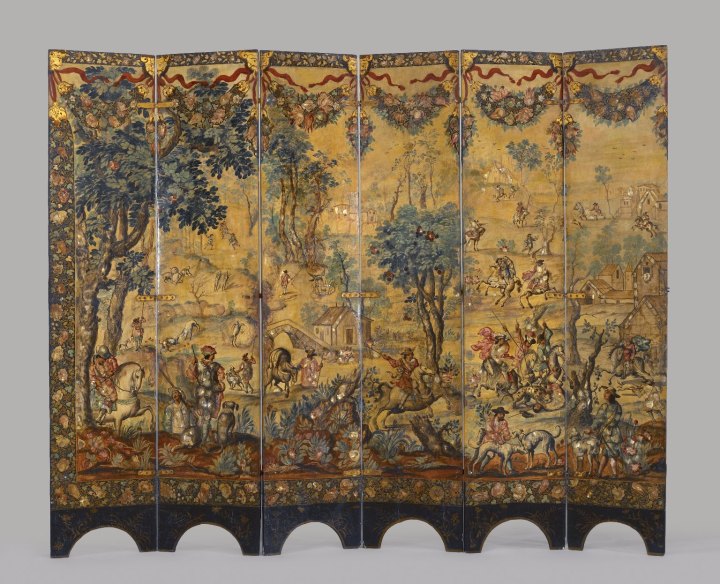
Screen with the Siege of Belgrade (front) and Hunting Scene (reverse,
as shown above). Mexico, ca. 1697–1701. Oil on wood, inlaid
with mother-of-pearl, 90 x 108 inches (Brooklyn Museum)
◊ ◊ ◊ ◊ ◊
The first major exhibition in the United States to explore the private lives, power struggles, and collecting practices of Spain’s New World elite brings together approximately 160 exceptional works in a wide range of media that illuminate conspicuous consumption and domestic display in the colonial era. Behind Closed Doors: Art in the Spanish American Home, 1492–1898 debuted at the Brooklyn Museum, where it will be on view through January 12, 2014, before traveling to three additional venues.
Included are paintings, manuscripts, prints, sculpture, decorative-arts objects, and textiles. The material demonstrates how colonial Spanish America’s new moneyed classes—including Spaniards, Creoles (Spaniards born in the New World), individuals of mixed race, and indigenous people—secured their social status through the spectacular private display of luxury goods from all over the world. The exhibition invites the visitor into an elite Spanish colonial home, beginning with more public reception rooms, hung with elaborately costumed family portraits and filled with fine imported and locally produced luxury goods, and ending with more private rooms, displaying objects that also spoke to the racial and social identity of their owners.
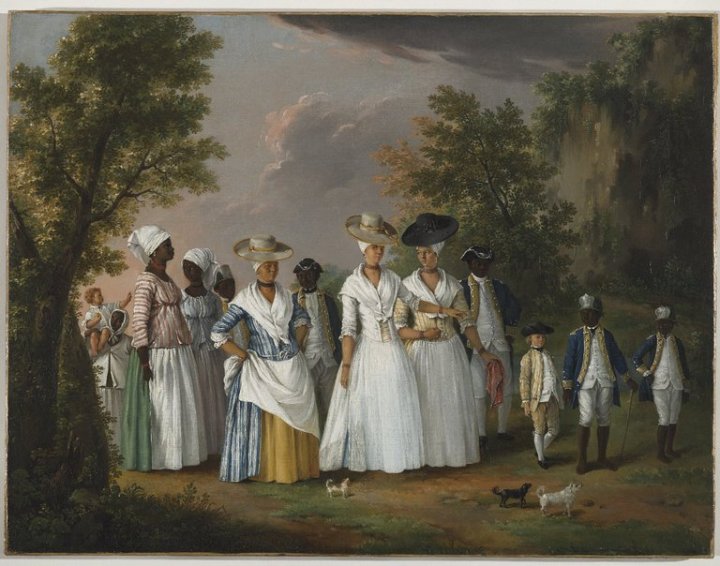
Agostino Brunias, Free Women of Color with Their Children
and Servants in a Landscape, ca. 1770–96. Oil on canvas,
20 x 26 inches (Brooklyn Museum)
◊ ◊ ◊ ◊ ◊
When the Spanish empire first expanded its borders into the Americas, the early conquistadors brought with them a rich artistic tradition, along with a monotheistic religion and an obsession with racial purity. Within a hundred years, fabulous fortunes had been amassed in the New World, thanks to the region’s abundant natural resources and robust market economy. Although Spanish America’s newly privileged class consisted of some of the wealthiest people in the world, the crown consistently favored those born in Spain for prominent local government and church positions, and political reforms in the eighteenth century further limited Creole power. In defiance, American-born elites responded by acquiring and ostentatiously displaying luxury goods from around the world in their dress and in their homes as pointed reminders of the crown’s reliance on New World resources. Their collections became more eclectic, including works by local artists and indigenous craftsmen as well as European masters.
Most of the objects in the exhibition are drawn from the Brooklyn Museum’s superb Spanish colonial holdings, supplemented by additional selections from the American, European, Asian, and Islamic collections as well as loans from public and private collections. For the first time in an exhibition in this country, Spanish colonial objects destined for the home will be paired with British American counterparts for purposes of comparison. The exhibition, which encompasses all of the New World under Spanish domination, calls attention to the Caribbean’s pivotal but, surprisingly, often overlooked role in Spanish American history.

José Joaquín Bermejo, Doña Mariana Belsunse y Salasar, ca. 1780 (Brooklyn Museum)
Among the exhibition highlights is a group of luxury objects from the viceroyalty of New Spain, which comprised present-day Mexico and Central America. One is a shell-inlaid and painted folding screen, or biombo enconchado, commissioned expressly for Mexico City’s viceregal palace about 1700 by Viceroy José Sarmiento de Valladares. This extremely rare, massive six-panel screen will be a focal point of the exhibition, along with a newly discovered late eighteenth-century neoclassical portrait by the mixed-race Puerto Rican painter José Campeche. Depicting twenty-one-year-old Doña Maria de los Dolores Gutiérrez del Mazo y Pérez, the painting commemorated her marriage to the future viceroy of New Granada.
Other objects in the exhibition include a pair of painted leather Peruvian chests from about 1690 decorated with allegories of the four elements, symbols of the zodiac, and a scene of a merry company dining outdoors; eighteenth-century Chinese export porcelain bearing the coat of arms of one of colonial Mexico’s leading families; an early sixteenth-century medallion Ushak carpet from Turkey of the type recorded in South American women’s sitting rooms; a late eighteenth-century polychromed wood portable tabernacle, adorned with the Virgin Mary and mirrors to reflect candlelight; Free Women of Color with Their Children and Servants in a Landscape, a portrait from about 1764–96 of members of the mixed-race elite in the British colony of Dominica by Italian painter Agostino Brunias; and Francisco de Goya’s monumental portrait of Peruvian-born Don Tadeo Bravo de Rivero, painted in Madrid in 1806.
The Brooklyn Museum began acquiring domestic Spanish colonial art in earnest in 1941 when Herbert J. Spinden, Curator of American Indian Art and Primitive Cultures, purchased approximately fourteen hundred art works from eight Latin American countries. The collection, which now ranks among the country’s finest, has been augmented with important recent acquisitions that are included in the exhibition.
◊ ◊ ◊ ◊ ◊
Programming at the Brooklyn Museum includes an afternoon roundtable:
Roundtable Discussion: Behind Closed Doors
Brooklyn Museum, Saturday, 16 November 2013, 11:30 a.m.–4 p.m.

Water Heater (Pava). Bolivia, 18th century, silver (Brooklyn Museum)
Join us for a day-long, bilingual roundtable discussion about calculated collecting practices in the colonial Americas, in celebration of the exhibition Behind Closed Doors: Art in the Spanish American Home, 1492–1898. The program begins with a morning session, in Spanish, on collecting for the home, moderated by Jorge F. Rivas Pérez, Curator of Colonial Art at the Colección Patricia Phelps de Cisneros. The afternoon session, in English, explores adorning the colonial body and will be moderated by Richard Aste, Curator of European Art at the Brooklyn Museum.
Collecting and signaling status through dress also connect with our fall exhibition The Fashion World of Jean Paul Gaultier: From the Sidewalk to the Catwalk.
Speakers include:
· Gustavo Curiel, Research Fellow, Instituto de Investigaciones Estéticas, Universidad Nacional Autónoma de México
· Maria Del Pilar Lopez Perez de Bejarano, Associate Professor, Instituto de Investigaciones Estéticas, Universidad Nacional de Colombia
· Barbara E. Mundy, Associate Professor of Art History, Fordham University
· Linda Rodríguez, Postdoctoral Fellow, Art History Department, New York University
· Caroline Weber, Associate Professor of French, Barnard College
· Luis Eduardo Wuffarden, independent Lima scholar and curator
This event is co-sponsored by the Brooklyn Museum and the Colección Patricia Phelps de Cisneros. Additional support provided by PAMAR’s eighth annual Latin American Cultural Week.
A box lunch will be available on the day of the event for $15. Museum Members receive free admission; call the Membership Hotline at (718) 501-6326 or email us for reservations.
◊ ◊ ◊ ◊ ◊
From Monacelli Press:
Richard Aste, ed., Behind Closed Doors: Art in the Spanish American Home, 1492–1898 (Monacelli Press, 2013), 224 pages, ISBN: 978-1580933650, $50.
 A critical contribution to the burgeoning field of Spanish colonial art, Behind Closed Doors reveals how art and luxury goods together signaled the identity and status of Spanish Americans struggling to claim their place in a fluid New World hierarchy.
By the early sixteenth century, the Spanish practice of defining status through conspicuous consumption and domestic display was established in the Americas by Spaniards who had made the transatlantic crossing in search of their fortunes. Within a hundred years, Spanish Americans of all heritages had amassed great wealth and had acquired luxury goods from around the globe. Nevertheless, the Spanish crown denied the region’s new moneyed class the same political and economic opportunities as their European-born counterparts. New World elites responded by asserting their social status through the display of spectacular objects at home as pointed reminders of the empire’s
dependence on silver and other New World resources.
The private residences of elite Spaniards, Creoles (American-born white Spaniards), mestizos, and indigenous people rivaled churches as principal repositories for the fine and decorative arts. Drawing principally on the Brooklyn Museum’s renowned colonial holdings, among the country’s finest, this book presents magnificent domestic works in a broad New World (Spanish and British) context. In the essays within, the authors lead the reader through the elite Spanish American home, illuminating along the way a dazzling array of both imported and domestic household goods. There, visitors would encounter European-inspired portraiture, religious paintings used for private devotion and also as signifiers of status, and objects that spoke to the owner’s social and racial identity.
◊ ◊ ◊ ◊ ◊
Karen Rosenberg reviewed the exhibition for The New York Times (19 September 2013)
New Book | The Museum of French Monuments 1795–1816
From Ashgate:
Alexandra Stara, The Museum of French Monuments 1795–1816: ‘Killing art to make history’ (Aldershot: Ashgate, 2013), 198 pages, ISBN: 978-1409437994, $100.
 The first volume in two centuries on Alexandre Lenoir’s Museum of French Monuments in Paris, this study presents a comprehensive picture of a seminal project of French Revolutionary cultural policy, one crucial to the development of the modern museum institution. The book offers a new critical perspective of the Museum’s importance and continuing relevance to the history of material culture and collecting, through juxtaposition with its main opponent, the respected connoisseur and theorist Quatremère de Quincy. This innovative approach highlights the cultural and intellectual context of the debate, situating it in the dilemmas of emerging modernity, the idea of nationhood, and changing attitudes to art and its histories.
Open only from 1795 to 1816, the Museum of French Monuments was at once popular and controversial. The salvaged sculptures and architectural fragments that formed its collection presented the first chronological panorama of French art, which drew the public; it also drew the ire of critics, who saw the Museum as an offense against the monuments’ artistic integrity. Underlying this localized conflict were emerging ideas about the nature of art and its relationship to history, which still define our understanding of notions of heritage, monument, and the museum.
Alexandra Stara is Reader in the History and Theory of Architecture at Kingston University, London.
Fellowships | The Society of the Cincinnati Fellowships for 2014
The Society of the Cincinnati Research Fellowships for 2014
Applications due by 8 November 2013
 The Society of the Cincinnati is offering four research fellowships for 2014: The Tyree-Lamb Fellowship, two Massachusetts Society of the Cincinnati Fellowships and, new this year, the Society of Colonial Wars in the State of Maryland Fellowship (the latter specifically for a scholar whose work is focused in the American colonial period, 1607–1775). Each fellowship provides $1,000 to support the cost of travel, housing, and per diem expenses for a scholar wishing to use the Society’s library for a period of at least five days. The fellowships are open to graduate students and other scholars who are conducting research that may benefit from the library’s holdings.
The Society of the Cincinnati library collections include contemporary books, manuscripts, maps, and works of art on paper which support the in-depth study of 18th-century naval and military history and the art of war in the age of the American Revolution. The library also houses books and archives related to the formation and history of the Society of the Cincinnati, as well as materials related to the life of Larz and Isabel Anderson, whose Gilded Age home now serves as a museum, and the headquarters of the Society.
Recipients will be required to fulfill their fellowship research in the library within a period of one year from the date of the award. Further, the recipient will be required to submit a two-to-three-page written report and summary of research findings, which may be published in the Society’s journal, Cincinnati Fourteen. In addition, the library requests a single copy of any subsequent publication (article, thesis, dissertation, or book) that may result.
The recipients of each of the three research fellowships will be chosen from a single round of applications. Applicants should submit the following:
• A curriculum vitae, including educational background, publications and professional experience
• A brief outline of the research proposed (not to exceed 2 pages)
• (For current graduate students only) Two confidential, sealed letters of recommendation from faculty or colleagues familiar with the applicant and his or her research project. Note: If letters are to be mailed independently, please include the names of recommenders when submitting the application.
Applications for the 2014 fellowships must be received by November 8, 2013. Applicants will be notified by January 15, 2014.
Applications should be mailed to:
Ellen McCallister Clark, Library Director
The Society of the Cincinnati
2118 Massachusetts Ave, N.W.
Washington, D.C. 20008
◊ ◊ ◊ ◊ ◊
The Society of the Cincinnati is the oldest patriotic organization in the United States, founded in 1783 by officers of the Continental Army and their French counterparts who served together in the American Revolution. Its mission is to promote knowledge and appreciation of the achievement of American independence and to foster fellowship among its members. Now a nonprofit educational organization devoted to the principles and ideals of its founders, the modern Society maintains its headquarters, library, and museum at Anderson House in Washington, D.C. Members of the Society are qualified male descendants of officers of the Continental Army and Navy and their French counterparts during the Revolutionary War.










 Enfilade
leave a comment