Exhibition | Surveying George Washington
From Crystal Bridges:
Surveying George Washington
Crystal Bridges Museum of American Art, Bentonville, Arkansas, 29 June — 30 September 2013
◊ ◊ ◊ ◊ ◊
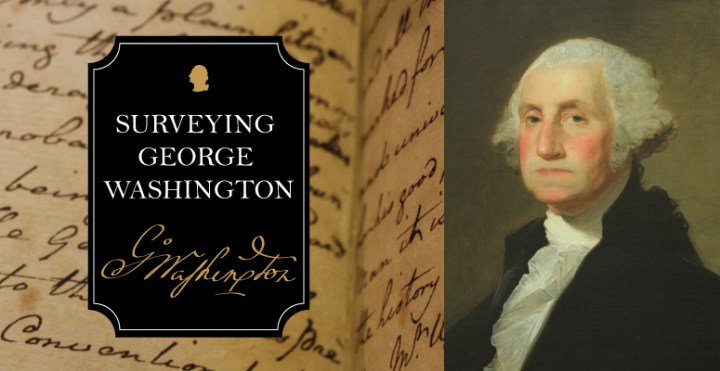
This summer, Crystal Bridges will mount the second of an ongoing series of exhibitions featuring historical documents pertaining to the Museum’s mission and collection. This year’s exhibition focuses on George Washington, and features an assortment of documents written by Washington himself, or by contemporaries who knew him, on loan from the Harlan Crow Library in Dallas, TX. The aim is to provide a look at Washington that provides insight into his life as a real person, not just a historical figure.
The exhibition will feature documents spanning the breadth of Washington’s life, including, among others, a land survey prepared by Washington at age 19; a copy of the broadside recruiting poster mustering troops for what would become a regiment under Washington’s command during the French & Indian War; a hand-written letter to General John Cadwalader of the Pennsylvania militia, appealing to him for troops to continue the push against British outposts in New Jersey during the War for Independence; and a hand-written letter by Washington’s private secretary Tobias Lear, announcing Washington’s death in 1799. Also included is a first edition of George Washington’s Last Will and Testament, printed from the record of the County Court of Fairfax, 1800.
Call for Papers | The Art of Science in New England, 1700–1920
The Art of Science in New England, 1700–1920
Wellesley College, Wellesley, Massachusetts, 15 March 2014
Proposals due by 30 September 2013
A one-day symposium sponsored by the Grace Slack McNeil Program for Studies in American Art at Wellesley College and the Office of Academic Programs at Historic Deerfield
This symposium will explore visual representations of scientific inquiry produced, collected, distributed or otherwise circulating in New England from the start of the 18th century to the first decades of the 20th century. Beginning with the scientific discoveries of the Enlightenment and extending through the 19th and into the 20th centuries, New Englanders sought to understand and explain scientific paradigms through two and three-dimensional representations. Botanical drawings, geological maps and charts, anatomical models, waxworks, and dioramas are just a few of the methods through which professionals and amateurs employed artistic methods and techniques in pursuit of scientific research and pedagogy. How did these representations shape scientific understanding? How did scientific ideas produce particular types of objects? What was the nature of collaboration between scientist and artist? How was the art of science put to pedagogical use in a variety of educational institutions from classrooms to lecture halls and museums?
Papers should be theoretical or analytical in nature rather than descriptive and should be approximately 20 minutes long. Please submit 250-word proposals and a two-page c.v. via electronic mail to Martha McNamara, mmcnamar@wellesley.edu and Barbara Matthews, bmathews@historic-deerfield.org. Proposals should include the title of the paper and the presenter’s name. The deadline for submissions is September 30th, 2013.
New Book | Men from the Ministry: How Britain Saved Its Heritage
Available in August from Yale UP:
Simon Thurley, Men from the Ministry: How Britain Saved Its Heritage (New Haven: Yale University Press, 2013), 224 pages, ISBN: 978-0300195729, $45.
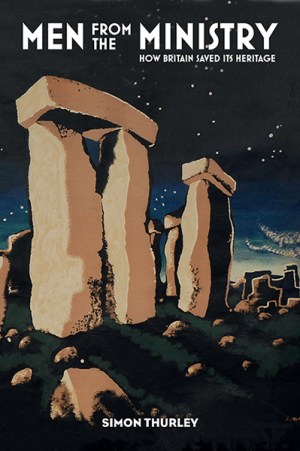 Between 1900 and 1950 the British state amassed a huge collection of over 800 historic buildings, monuments, and sites and opened them to the public. This engaging book explains why the extraordinary collecting frenzy took place, locating it in the fragile and nostalgic atmosphere of the interwar years, dominated by neo-romanticism and cultural protectionism. The government’s activities were mirrored by the establishment of dozens of voluntary bodies, including the Council for the Protection of Rural England, the Society for the Protection of Ancient Buildings, and the National Trust. Men from the Ministry sets all this activity, for the first time, in its political, economic and cultural contexts, painting a picture of a country traumatized by war, fearful of losing what was left of its history, and a government that actively set out to protect them. It dissects a government program that established a modern state on deep historical and rural roots.
Simon Thurley is the Chief Executive of English Heritage. He was formerly the Director of the Museum of London, and the Curator of Historic Royal Palaces.
English Heritage to Become a Charitable Trust

From English Heritage (26 June 2013) . . .
The Government has announced that it will work with English Heritage to consult on establishing a charity to care for the historic properties in the National Heritage Collection on a self-financing basis, supported by Government investment of £80 million. English Heritage will be awarded this one-off lump sum to invest in the National Heritage Collection of 420 historic sites, monuments and collections in its care. This will support its plan to transfer management of the Collection to a charity, licensed by English Heritage’s governing body, The Commission. This investment in historic properties across the entire country will create jobs and boost local economies.
The National Heritage Collection, which includes Stonehenge, Kenwood, Audley End, Dover Castle and Charles Darwin’s home Down House in Kent, will remain in public ownership. However, the new charity will have more freedom to generate greater commercial and philanthropic income to safeguard and present to the public what is arguably England’s most vulnerable and important collection of cultural treasures.
Under current plans, the new charity will be set up by March 2015. It will retain the name English Heritage and in due course, will be completely self-financing and no longer need tax-payer support. (more…)
Campaigning to Save the Chapel at Bretton Hall Park
Press release (20 May 2013) . . .
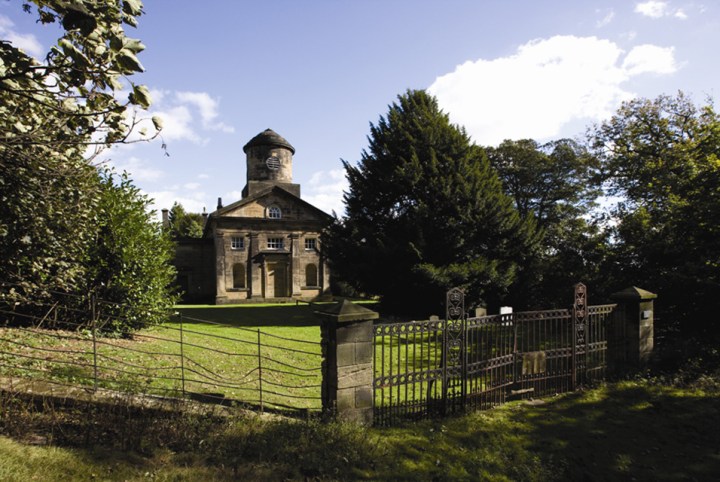
Sir William Wentworth, Chapel of Bretton Hall Park, 1744
Yorkshire Sculpture Park, Wakefield, West Yorkshire
◊ ◊ ◊ ◊ ◊
Yorkshire Sculpture Park (YSP) is campaigning to save one of the oldest surviving buildings on the Bretton Estate and transform it into a gallery space. The 270-year-old YSP Chapel is in an urgent state of repair and must be restored soon, in order to keep it open to the public. The Park’s fundraisers have secured financial support from English Heritage, Country Houses Foundation, The Wolfson Foundation and The Pilgrim Trust but are £100,000 short of the £500,000 needed to complete the full restoration plan. They are now asking visitors and supporters to give whatever they can to help reach the total.
Andy Carver, Director of Development at YSP said: “At a time when public funding is becoming increasingly scarce, we depend on the people and organisations that love YSP to give us their financial support. Restoring the chapel is an important and exciting project for us; it will mean that we can keep this historic building open for future generations to enjoy and allow us to programme new exhibitions of sculpture in the beautiful, tranquil space. At the moment, the conditions in the chapel aren’t suitable for some types of art works and structurally it is deteriorating quite badly. The restoration will bring the building back to its former glory and give us a unique and versatile space for exhibitions and events.”
Built in 1744 by Sir William Wentworth, the Georgian sandstone chapel is a historically important part of the Bretton Estate. Nestled within the YSP Country Park, the Grade II* listed building was at the heart of life on the estate during the 18th and 19th centuries. Renovation plans include replacing the roof, making extensive structural repairs and installing heating. An improved path from YSP Centre and disabled access to the building is also in the pipeline. (more…)
Exhibition | Princely Treasures from the House of Liechtenstein
From the National Museum of Singapore:
Princely Treasures from the House of Liechtenstein
National Museum of Singapore, 27 June — 29 September 2013
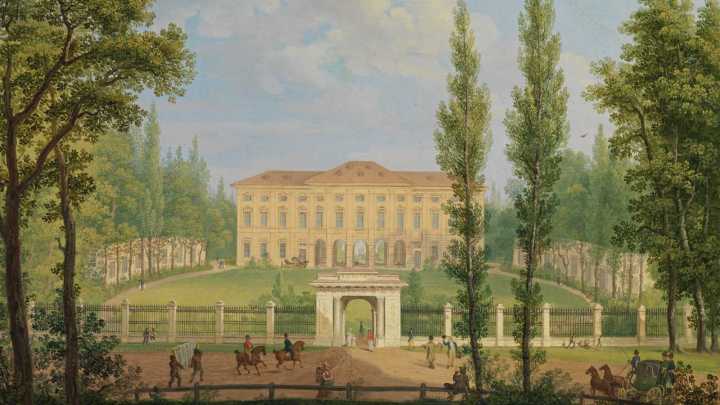
Copy after Ferdinand Runk (1764–1834), The Liechtenstein
Summer Palace in the Rossau Quarter, © Liechtenstein,
The Princely Collections, Vaduz–Vienna
◊ ◊ ◊ ◊ ◊
Collected over 500 years, over 90 masterpieces from the exquisite art collection of the Prince of Liechtenstein will be travelling to Singapore for the first time. This exhibition is exemplary of the highly cultivated choice in art, with artworks ranging from paintings, prints, tapestries, sculptures to rare decorative art objects. Significant works by important Flemish artists like Rubens and Anthony van Dyck, as well as those by other renowned European masters such as Raphael and Lucas Cranach the Elder, will be showcased to celebrate the High Renaissance, Baroque, Neo-classical and Biedermeier that span from the late 15th century to the mid 19th century, all of which characterise the European way of articulating authority, power and wealth of the ruling houses.
In addition, a selection of 16 oil paintings from the National Collection will be displayed to draw links to the art of portraiture in Singapore’s historical context, exploring how it was an important representational mode between the late 19th and mid 20th century.
◊ ◊ ◊ ◊ ◊
From one of the sponsors, LGT Prviate Banking:
 With a history dating back to its inception in 1887, the National Museum is Singapore’s oldest museum with a progressive mind. It is custodian of the 12 National Treasures, and its Singapore History and Living Galleries adopt cutting-edge and multi-perspective ways of presenting history and culture to redefine conventional museum experience.
A cultural and architectural landmark in Singapore, the Museum hosts innovative festivals and events all year round – the dynamic Night Festival, visually arresting art installations, as well as amazing performances and film screenings – in addition to presenting thought-provoking exhibitions involving critically important collections of artefacts. The National Museum of Singapore celebrated its 125th anniversary in 2012.
Additional information about the exhibition is available here»
Ghislain d’Humières to Direct The Speed Art Museum
Press release (25 June 2013) from The Speed Art Museum in Louisville:
 The Board of Trustees of The Speed Art Museum announced today that Ghislain d’Humières has been appointed as the new Director of the Museum. d’Humières, who is currently serving as the Director of the Fred Jones Jr. Museum of Art at the University of Oklahoma, succeeds Charles Venable, who served as Director from 2007 to 2012. d’Humières will assume his role at the Speed on September 3, 2013.
A native of France, Ghislain d’Humieres studied at the Sorbonne in Paris, where he received his DEA in History and License of Art History. He became a specialist in 18th-century furniture for Sotheby’s London, and later transferred to Sotheby’s in New York. To further his education, he studied at the Gemological Institute of America, and became the Director of the jewelry department at Christie’s of Los Angeles, overseeing the West Coast and South America. During his employment, he gained extensive business knowledge, expanded his expertise, and traveled extensively around the World. In 2001, he transferred to Christie’s in Geneva and was in charge of international clients from Europe and South America.
A compassionate leader, d’Humières took an eighteen-month sabbatical in Guatemala, during which time he worked with street children involved in drugs and prostitution. After his sabbatical, he founded the Alix Donation Fund (ADF) for underprivileged children in Guatemala.
Shortly thereafter, he was hired by the Fine Arts Museum of San Francisco as Assistant Director in charge of the opening of the new de Young Museum, located in San Francisco’s Golden Gate Park.
In 2007, Ghislain joined the University of Oklahoma as the Bill and Wylodean Saxon Director of the Fred Jones Jr. Museum of Art. During his six-year tenure at the Fred Jones Jr. Museum of Art, d’Humières has doubled attendance, led a successful $15 million capital campaign, and spearheaded the development and management of the Museum’s new 20,000 square-foot Stuart wing, which doubled the Museum’s exhibition space.
D’Humièresalso created a privately funded program to implement new educational and outreach initiatives which included underprivileged visitors. He supervised more than 40 exhibitions and oversaw the production of numerous exhibition catalogs and museum publications while also expanding the Museum’s educational programs and collaborations with other museums, communities and national and international organizations.
New Book | Speaking Ruins: Piranesi, Architects, and Antiquity
From the University of Michigan Press:
John A. Pinto, Speaking Ruins: Piranesi, Architects, and Antiquity in Eighteenth-Century Rome (Ann Arbor: University of Michigan Press, 2012), 352 pages, ISBN: 978-0472118212, $65.
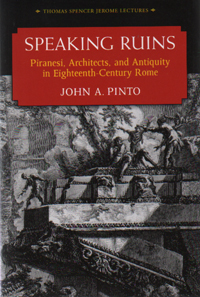 As they had during the Renaissance, ruins in the eighteenth century continued to serve as places of exchange between antiquity and modern times and between one architect and another. Rome functioned as a cultural entrepôt, drawing to it architects of the caliber of Filippo Juvarra, Robert Adam, Charles-Louis Clérisseau, and Giovanni Battista Piranesi. Through their collaboration, on-site exchanges, publications, and polemics, architects contributed notably to fashioning a more critical and sophisticated view of the material heritage of classical antiquity, one that we associate with the Enlightenment and the origins of modern archaeology. In this lavishly illustrated volume stemming from his Thomas Spencer Jerome Lectures at the University of Michigan and the American Academy in Rome, distinguished architectural historian John A. Pinto traces an extraordinary path through the development of European architecture. This period saw the transformation of history and archaeology. Texts were treated more skeptically as scholars placed greater reliance on artifacts as sources of information, and architects such as Giovanni Battista Piranesi increasingly played a crucial role in the recording and visual presentation of ancient art and architecture.
Piranesi and other eighteenth-century architects active in Rome explored the full creative potential of ancient architecture, its dual metaphorical function as both palimpsest and template. Their responses to the ruins of Rome, as well as other parts of the classical world, created a significant body of historical knowledge, but also propelled them to create new and dazzling designs, such as the Trevi Fountain, Santa Maria del Priorato, and Syon House. Their elaborate study and accurate renderings of ancient sites enriched contemporary understanding of the material heritage of classical antiquity; their informed conjectures and flights of fancy gave it wings. Their encounters on sites such as Hadrian’s Villa and Pompeii, where the ruins spoke with great eloquence, greatly enriched the architectural discourse of the Enlightenment. Speaking Ruins emphasizes the close relationship between the intensifying archaeological explorations in this period especially in Rome and vicinity, but also in Greece and the Levant, and the development of post-Baroque styles in architecture, shading gradually into romanticism and neoclassicism.
Speaking Ruins is an investigation of the legacy of classical antiquity. As a study of the classical tradition, it should be of particular interest to classicists and archaeologists, while its argument that eighteenth-century Rome provided a crucible for the developing disciplines of archaeology and art history will engage the interest of a wide range of humanistic scholars. Speaking Ruins tells a fascinating story, with Piranesi and his works centrally involved.
Jacket image: G. B. Piranesi, Fragments of the Temple of the Sun on the Quirinal, from Campus Martius (1762), courtesy of the Department of Rare Books and Special Collections, Princeton University Library.
Lecture | Connecting the East India Company and the Caribbean
Chris Jeppesen is the AHRC cultural engagement fellow working on a project entitled “East Meets West: Caribbean and Asian Colonial Cultures in British Domestic Contexts” with The East India Company at Home team, The Legacies of British Slavery team, and the British Library. From the British Library:
Chris Jeppesen | Uncovering Connections between the East India Company and the Caribbean
British Library, London, 3 July 2013
 Chris Jeppesen, Research Associate at the UCL Department of History, talks about his recent work on the Library’s collections tracing links between the East India Company and the Caribbean through the movement and correspondence of families.
Historians have tended to draw a binary between British involvement in India and the Caribbean. Rarely, do they acknowledge the intricate connections between the Atlantic and Indian Ocean worlds that facilitated the transfer of people, capital and goods during the late eighteenth/early nineteenth centuries. Chris’s ongoing research project based between UCL and the Library, has sought to uncover some of the connections between the East India Company and the Caribbean and to suggest ways that other interested researchers can expand our understanding of these links.
Crucial to many exchanges were family networks that spanned India, Britain and the Caribbean, allowing members access to opportunities that promised wealth and prestige. This talk will seek to demonstrate how by following one family – the Martins of Antigua – through the Library’s collections, one can start to uncover the all too often ignored links between India and the Caribbean.
Organised with support from the Eccles Centre for American Studies. This talk is part of the Summer Scholar’s programme. To book a space please email: summer-scholars@bl.uk
Wednesday, 3 July 2013, 12.30-14.00, Foyle Suite, Centre for Conservation, The British Library. Free, booking essential.
Exhibition | Secrets of the Royal Bedchamber
Press release for the exhibition at Hampton Court:
Secrets of the Royal Bedchamber
Hampton Court Palace, 27 March — 3 November 2013
Curated by Sebastian Edwards
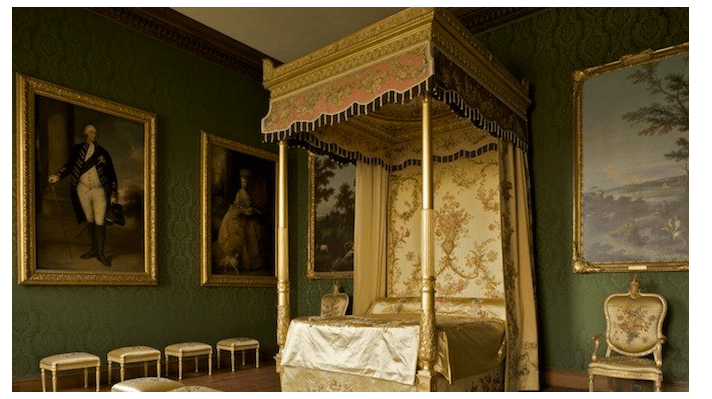
Queen Charlotte’s embroidered state bed, displayed in the
Prince of Wales’s Bedchamber at Hampton Court Palace
◊ ◊ ◊ ◊ ◊
This spring independent charity, Historic Royal Palaces, has transformed Hampton Court’s Baroque Palace with a special exhibition full of intrigue, drama and surprise. At its heart are six magnificent, royal beds. For the first time the world’s largest and rarest collection of early state beds are presented in one dramatic display, telling the story of how and why the bedchamber became the most public and important destination in the Palace. The exhibition also offers a chance to view architect John Vanbrugh’s Prince of Wales’s Apartments, opened for the first time in 20 years.
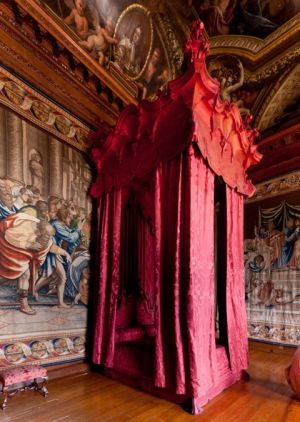
Bed of George and Caroline, Prince and Princess of Wales, ca. 1715, displayed in the Queen’s State Bedchamber at Hampton Court Palace
Through the stories of their royal owners and servants, visitors are able to explore the elaborate, sometimes bizarre bedchamber rituals and unusual sleeping arrangements. Discover what took place where heirs were born, marriages consummated, monarchs were struck down and died – all while important affairs of state were conducted in this most personal of rooms. Most strange of all, these events took place before an audience of courtiers, politicians and family members, who turned everyday life for the monarch into a grand performance.
Inspired by the French fashion of the levée, the monarch would meet courtiers and ministers during an elaborate morning ceremony, during which the most privileged of his servants, woke, washed and dressed the king. Courtiers would fight for the illustrious and intimate positions of ‘groom of the stool’ or the ‘necessary woman’ to get close to the monarch. For an extraordinary century, the state bedchamber became the most sought after room in the palace for the rich and the powerful, where privileged access brought honour or the king’s favour. At its heart was the great, state bed, from where the monarch could conduct affairs of state.
These remarkable state beds have undergone extensive conservation and restoration over some fifty years. Each bed has a dramatic, and often poignant, tale to tell. For the first time the tragic story behind Queen Anne’s magnificent velvet state bed is revealed. Ordered by a dying queen in her final year, childless after many sad losses, she faced the prospect of her dynasty ending with her death; left unused and forgotten, it was described by the thrifty George III as a ‘venerable old relic’. Another splendid bed featured is the infamous ‘Warming Pan Bed’, the state bed of James II’s Queen, Mary of Modena, and the scene of the royal birth that sparked the quiet revolution that led to the end of the Stuart line.
An exceptional but modest survivor is the unique ‘travelling bed’ of George II which comes apart into 54 pieces, a testament to a time when the king and his court were often on the move. King Georg took his bed as far afield as his second home in Hanover and even to the battlefields of Europe. Each state bed reveals the intense competition between monarchs, and their courtiers, who expressed their taste and magnificence through their beds — the largest and most expensive objects in their homes. These beds could cost the price of a London townhouse and yet, incredibly, might never have been slept in!
This new exhibition, supported by Savoir Beds, creates an experience which takes a contemporary twist on the distinctive Baroque style of the palace. Through new research and interpretation, visitors are plunged into an immersive, interactive world of the Stuart Court, showcasing rarely displayed and amazing objects from the Royal Collection and other important lenders, all within the backdrop of the beautiful architecture of the State Apartments.
Historic Royal Palaces’ exhibition curator, Sebastian Edwards, said, “Visitors to the exhibition will discover that, far from being restful places of privacy, the state bedchamber was the seat of power – the equivalent of the modern day boardroom, from which the business of the Kingdom was conducted. Events which took place in and around these beds had enormous consequences for society, politics and history. Courtiers were knighted, wars were brokered, marriages consummated and mistresses wooed all in the shadow of the royal bed. These are extraordinary beds – but not as we know them today.”










 Enfilade
leave a comment