Exhibition | Junípero Serra and the Legacies of the California Missions
Press release from The Huntington:
Junípero Serra and the Legacies of the California Missions
The Huntington Library, Art Collections, and Botanical Gardens, San Marino, 17 August 2013 — 6 January 2014
Curated by Catherine Gudis and Steven Hackel

◊ ◊ ◊ ◊ ◊
The life of Junípero Serra (1713–1784)—and his impact on Indian life and California culture through his founding of missions—is the subject of an unprecedented, comprehensive, international loan exhibition opening August 17, 2013, and remaining on view through January 6, 2014, exclusively at The Huntington Library, Art Collections, and Botanical Gardens. Junípero Serra and the Legacies of the California Missions coincides with the 300th anniversary of Serra’s birth and includes about 250 objects from The Huntington’s collections and those of 61 lenders in the United States, Mexico, and Spain. The exhibition examines Serra’s early life and career in Mallorca, Spain; his mission work in Mexico and California; the diversity and complexity of California Indian cultures; and the experiences of the missionaries and Indians who lived in the missions.
Junípero Serra also delves into the preservation and reconstruction of the missions as physical structures; the persistence of Indian culture from before the mission period to the present; the missions’ enduring place in California culture today; and a wide variety of perspectives—some of them irreconcilable—on Serra and the meaning of his life.
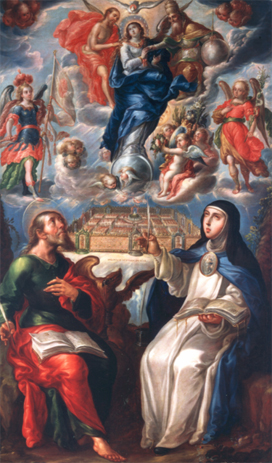
Cristóbal de Villalpando, La Mística Ciudad de Dios (The Mystical City of God), 1706. Museo regional de Gaudalupe/CONACULTA– INAH, Guadalupe, Zacatecas Nacional del Virreinato, Mexico.
“It’s a rich, complex, and multi-faceted story, and one that has not been told before in an exhibition of this magnitude,” said Steven Hackel, co-curator of the exhibition, professor of history at the University of California, Riverside, and Serra biographer (Junípero Serra: California’s Founding Father, 2013). “Serra was 55 years old and had had a very full life by the time he came to California in 1769. In this show, we are working to move beyond the standard polemic that often surrounds Serra and the missions. We present a picture that is equally rich in its portrayal of not only Serra’s life but the meaning of the missions for a range of California Indians.” The general tendency is to think that Serra’s life work began with the California missions, Hackel added, and that Indian culture disappeared with the onset of those missions. “The exhibition challenges both of these assumptions.”
Contemporary art, including a video work created expressly for the exhibition by James Luna (Luiseño), and first-person narratives by descendants of the missions “defy any presumptions that Native Americans ‘vanished’ or that they hold a monolithic view about the mission past,” said Catherine Gudis, co-curator of the exhibition and professor of California and public history at the University of California, Riverside. “Rather, the show represents a range of responses—including resistance and resilience—as the result of a period of painful disruption and devastating change.”
Among key items in the exhibition are a host of rare paintings and illustrations documenting the history of the Spanish island of Mallorca, Serra’s life, 18th-century Catholic liturgical art, and New Spain, as well as several sketches and watercolors that are among the first visual representations of California and California Indians by Europeans. “These images are not only beautiful,” says Hackel, “but they are among the most important ethnographic representations of California Indian life at the onset of the missions and of Indian life in the missions.”
Also on view are Serra’s baptismal record from Mallorca, his Bible and lecture notes from Mallorca, and the diary he composed as he traveled from Baja California to San Diego in 1769. Notable and unique items documenting Indian culture in California include a textile fragment that is thousands of years old, woven by California Indians from seaweed and fiber, as well as beads, tools, baskets, and written documents from the colonial period. “Like the Spaniards, these were people who had a significant history and culture well before the Europeans showed up, and it was a history and culture that would persevere, although not without huge changes, in and after the missions,” said Gudis.
 Junípero Serra provides a sweeping examination of where Serra came from, including the history and culture of Mallorca well before his time and during his early life; where Serra traveled, including his early adult years performing missionary work from central Mexico to Baja; and finally, his work to establish a system of missions along the California coastline from south to north.
At the same time, it provides the backdrop against which the missions emerged: early California was populated by numerous and diverse groups of Indians. Culture and customs varied from village to village; more than 100 languages were spoken; and in the parts of California colonized by Spain, the Indians numbered nearly 70,000.
Serra, under the auspices of the Catholic Church and the Spanish flag, believed his mission was to convert them to Christianity. However, his dream of encouraging Indians to relocate to the missions ultimately led many to an early grave, as diseases killed thousands of Indians who lived there.
“The mission period was a defining one in California’s history—and Serra is the most visible symbol of that period,” said Hackel. “But in taking this story all the way through—from before Indians and Europeans made contact, through the construction and collapse of the mission system, and then to the present day—it is, in fact, a story of conflicting, blending, and overlapping cultures, of imperial expansion and human drama and loss, and then, finally, of the perseverance and survival of not only European institutions in California, but the California Indians who were the focus of Serra’s missions.”
E X H I B I T I O N F L O W (more…)
Call for Papers | Material Culture Symposium: Consuming Objects
From The Center for Material Culture Studies at the University of Delaware:
Consuming Objects: Negotiating Relationships with the Material World
Winterthur Museum, Garden & Library, 12 April 2014
Proposals due by 2 December 2013
The Center for Material Culture Studies at the University of Delaware invites submissions for papers to be given at the Twelfth Annual Material Culture Symposium for Emerging Scholars.
“Consuming” is a multivalent word, fraught with provocative denotations and connotations. Whether we buy them, sell them, use them, or eat them, we all consume objects through a variety of channels. We seek papers that highlight the intersection between people and their things within this broad framework of consumption. This conference will consider how material culture can act as an extension of ourselves, provide repositories for memory, help stabilize identity, interrupt our sense of scale and space, give permanence to relationships, function as a semiotic marker, and enable human activities. Papers may also address how objects mediate human sensory experience and create aesthetic meaning. We encourage papers that reflect upon and promote an interdisciplinary discussion on the state of material culture studies today.
This conference is not bound by any temporal or geographical limits. Disciplines represented at past symposia include American studies, anthropology, archaeology, consumer studies, English, gender studies, history, museum studies, and the histories of art, architecture, design, and technology. We welcome proposals from graduate students, postdoctoral scholars, and those beginning their teaching or professional careers.
The symposium will consist of nine presentations divided into three panels. Each presentation is limited to eighteen minutes, and each panel is followed by comments from established scholars in the field. There will be two morning sessions and one afternoon session, with breaks for discussion following each session and during lunch. Participants will also have the opportunity to tour Winterthur’s unparalleled collection of early American decorative arts and to engage in a roundtable discussion on Friday, April 11, 2014. Travel grants will be available for presenters.
Proposals should be no more than 300 words. Please indicate the focus of your object¬based research, the critical approach that you take toward that research, and the significance of your research beyond the academy. We encourage the inclusion of relevant images with your abstracts.
While the audience for the symposium consists mainly of university faculty and graduate students, we encourage broader participation. In evaluating proposals, we will give preference to those papers that keep a more diverse audience in mind. Programs and paper abstracts from past symposia are posted here.
Send your proposal, with a current c.v. of no more than two pages, to emerging.scholars@gmail.com. Proposals must be received by 5 p.m. on Monday, December 2, 2013. Speakers will be notified of the vetting committee’s decision in January 2014. Confirmed speakers will be asked to provide symposium organizers with digital images for use in publicity and are required to submit a final draft of their papers by March 11, 2014.
2014 Emerging Scholars Co¬Chairs
Anastasia Day (Hagley Program in the History of Industrialization) and Philippe Halbert (Winterthur Program in American Material Culture), University of Delaware
Forthcoming Issues of ‘Eighteenth-Century Studies’
From Joseph Roach’s introduction to the ASECS News Circular (Fall 2013). . .
. . . In addition to encouraging individual submissions of articles for consideration, Steve Pincus [editor of Eighteenth-Century Studies] has introduced a process for the regular creation of special issues on topics of current interest and future promise. The Lewis Walpole Library and the Beinecke Rare Book and Manuscript Library have agreed to alternate in sponsoring Workshops in a particular interdisciplinary subfield. Scholars prominent in that field are invited to Farmington or the Yale campus to spend a day sharing their expertise and identifying potential contributors to a special issue. Workshops in three topics have been held so far: “The Eighteenth Century: East and West”; “The Maritime Eighteenth Century”; and “Performance in the Eighteenth Century.”
On February 23, 2013, the Walpole Library hosted a panel consisting of Felicity Nussbaum (English, UCLA), Robert K. Batchelor (History, Georgia Southern University), David Porter (English and Comparative Literature, University of Michigan), and Peter Perdue (History, Yale University). They identified key issues and trends, profiled new work in the field by both well established and emerging scholars, and made recommendations. After a process of further vetting, solicitation, and review, the East-West special issue (forthcoming) will be introduced by Chi-ming Yang (English, University of Pennsylvania) and contain the following articles: Danna Agmon (History, Virginia Tech), “The Currency of Kinship: Trading Families and Trading on Family in Colonial French India”; Srinivas Aravamudan (English, Duke), “East-West Fiction as World Literature: The Hayy Problem Reconfigured”; Kristina Kleutghen (Art History, Washington University in St. Louis), “Ocean Goods and Occidenterie: The Art of Eighteenth-Century Chinese Fascination with the West”; Suzanne Marchand (History, Louisiana State University) Herder’s “Oldest Document of Mankind” and the Problem of Near Eastern Chronology”; Nabil Matar (English, University of Minnesota), “Christians in Arabic Writings of the Eighteenth-Century Levant”; and Matthew Mosca (History, William and Mary), “The Qing State and Its Awareness of Eurasian Interconnections, 1789–1805.”
On May 23, 2013, the Beinecke Library hosted a panel on “The Maritime Eighteenth Century” consisting of Joseph C. Miller (History, University of Virginia), Neil Rennie (English, University College London), Felicia Gottmann (French, University of Warwick), Ellie Hughes (Art History, Yale Center for British Art), and Gagan Sood (History, Yale University). Plans for the special issue on “The Maritime Eighteenth Century” are pending.
On October 17, 2013, the Lewis Walpole Library hosted a panel on “Performance in the Eighteenth Century” consisting of Misty Anderson (English and Theatre, University of Tennessee Knoxville), Jeffrey Leichman (French, Louisiana State University); Kathleen Wilson (History and Cultural Studies, Stony Brook University), John Cooper (Clare-Mellon Fellow in the History of Art, Yale University) and Will Fleming (East Asian Languages and Literature and Theater Studies, Yale University). Virginia Johnson (Sociology, University of Michigan) was unable to attend, but she is communicating her views in writing. Plans for the “Performance” special issue are in the early stages.
With the cooperation with Carolyn C. Guile, ECS Review Editor, special issues will include reviews of pertinent new work on the featured topics. Members are encouraged to propose ideas for future special issues, including nominations for Workshop panelists and potential contributors. The Editor and Managing Editor held a session for interested scholars at the recent NEASECS Conference in New Haven, and a dynamic critical conversation ensued. More will be welcome, live or electronic. . .
Exhibition | America: Painting a Nation
The exhibition, organized by several American institutions including the Terra Foundation for American Art, debuted as Art Across America at the National Museum of Korea, in Seoul, and then traveled to Korea’s Daejeon Museum of Art. From the press materials of the Art Gallery of New South Wales:
America: Painting a Nation
Art Gallery of New South Wales, Sydney, 8 November 2013 — 9 February 2014

Portrait of a Black Sailor (Paul Cuffe?), ca. 1800 (LACMA)
This exhibition is a voyage through American history, across the American landscape and into the minds of the American people. It begins in the 18th century, among pious farmers and republican merchants. It traverses the continent, alongside Native Americans and frontiersman. It explores the great cities, and the lives of workers and bohemian artists. Answering the question, ‘What makes Americans American?’ is complex, but these paintings are a guide, revealing the self-reliance and communal beliefs, optimism and anxieties, that makes America tick.
Chris McAuliffe, Curatorial consultant
America: Painting a Nation is the most expansive survey of American painting ever presented in Australia. It is part of the Sydney International Art Series which brings the world’s outstanding exhibitions to Australia, exclusive to Sydney, and has been made possible with the support of the NSW Government through Destination NSW. Over 80 works, ranging from 1750 to 1966, cover more than 200 years of American art, history and experience. The exhibition sets a course from New England to the Western frontier, from the Grand Canyon to the burlesque theatres of New York, from the aristocratic elegance of colonial society to the gritty realism of the modern metropolis. This exhibition will reveal the breadth of American history, the hardy morality of the frontier, the intimacy of family life, the intensity of the 20th-century city, the epic scale of its landscape and the diversity of its people. The works being presented – many by American masters – are the works Americans love and works that represent the stories they have grown up with.
◊ ◊ ◊ ◊ ◊
From the Art Gallery of NSW:
Angela Miller and Chris McAuliffe, America: Painting a Nation (Sydney: Art Gallery of New South Wales, 2013), 264 pages, ISBN 978-1741741018, $45.
Spectacular landscapes, epic stories and diverse peoples feature in this expansive historical survey of American painting. The 89 artworks by some 74 artists traverse over 200 years of rich history, from the colonial era to the mid 20th century. Readers will encounter the sublime poetry and drama of the land, the ambition and optimism of the country’s pioneers, the challenges of the frontier, the intimacy of family life and the intensity of the modern city. The roots of the American character and nation will be revealed through images ranging from the Grand Canyon to the Brooklyn Bridge, from classic portraits to modern abstraction.
America: Painting a Nation includes works by artists such as Mary Cassatt, Winslow Homer, Edward Hopper, Georgia O’Keeffe, Jackson Pollock, Mark Rothko, John Singer Sargent and James McNeill Whistler from the collections of some of the finest art museums in the USA: The Terra Foundation, Chicago; the Philadelphia Museum of Art; the Museum of Fine Arts, Houston; the Los Angeles County Museum of Art; and The Virginia Museum of Fine Arts.
Essays by Angela Miller and Chris McAuliffe, combined with entries on each of the artworks and biographies on each artist, illuminate this fascinating survey of American painting from 1750 to 1967.
Symposium | Revolutionary Ideas: The Building of an American Nation
In connection with the exhibition America: Painting a Nation, the Art Gallery of New South Wales is hosting a symposium on the visual arts and American ideas of nationhood:
Revolutionary Ideas: Perspectives on the Building of an American Nation
Art Gallery of New South Wales, Sydney, 16 November 2013
Presented in conjunction with the Sydney Intellectual History Network at the University of Sydney
This symposium considers the role of the visual arts and other forms of cultural expression in building an idea of nationhood in America from its foundation as a colony through the beginning of the 20th century. It addresses the aims of portraiture, the meanings of landscape, the rise of genre subjects and the significance of garden projects in the contexts of relationships with Britain, claims of independence, pivotal wars, and moments of dramatic social change.
P R O G R A M
10.30 Registration and morning tea, Domain Theatre foyer
11:00 Welcome, Michael Brand, director, Art Gallery of NSW and Jennifer Milam, Sydney Intellectual History Network, University of Sydney
11:15 Laura Auricchio, What Makes ‘American art’ American?
‘American art’ has always been created in a context of international exchange. In the 18th and 19th centuries, much of the art that we now consider American was made by artists who spent many years living and studying in Europe, and whose work was steeped in European traditions. Yet other US-born artists working in the same period set out to develop a distinctly national idiom, forging styles and focusing on subjects that, in their view, expressed the unique character of their native land. Is one of these groups more American than the other? Or do they represent two different but related understandings of what it means to be American? Looking closely at a selection of paintings by artists ranging from the European-inspired John Singleton Copley, Mary Cassatt and F Childe Hassam to the self-consciously American Edward Hicks and Frederic Remington, this presentation proposes a variety of answers to the central question: what makes ‘American art’ American.
12:00 Kate Fullagar, Native Americans before and after the Revolution: Resistance, Representation, Removal
This paper traces both the broad history and the European representation of Native Americans through the 18th and 19th centuries. Specifically it looks at the rise and fall of two key ‘revolutionary ideas’ in this period. The first is that, far from a tale of destruction or neglect, Europeans in 18th-century North America in fact accommodated indigenous people more often than not. This engagement, however, narrowed after the American War of Independence when several key circumstantial factors changed for indigenous people. The second is that European representations of Native Americans during the early 18th century can be seen to stand for a critique of European activity just as often as they could for a confirmation, whereas into the 19th century their ‘savage’ attributes began to signify less and less with a European viewing public. Even while Native Americans began to shake off some initial stereotypes, their graphic representation became increasingly elegiac.
12:45 Exhibition viewing and lunch
2:00 Jennifer Milam, American Landscapes: Painting and Planting Democratic Ideals
In a 4th of July letter written in 1805 to his granddaughter, Thomas Jefferson defined gardening as a fine art, ‘not horticulture, but the art of embellishing grounds by fancy…it is nearly allied to landscape painting’. This talk looks at the relationship between landscape painting and garden design in 19th-century America. It considers how nature was perceived as an expression of democratic ideals in the formation of American identity following the Revolution of 1789. Although drawing on pastoral conventions established in Europe, American artists and garden designers were nevertheless keenly aware that the landscape presented elements for the creation of a novel visual language, full of promise for the future. The American landscape – extending further westward and the object of exploration – became a source of inspiration for forging a new nation.
2:45 Shane White, African Americans and American Art
Nearly 70 years ago now the great novelist Ralph Ellison asked: ‘Can a people live and develop for over 300 years simply by reacting?’ He went on: ‘Are American Negroes simply the creation of white men, or have they at least helped to create themselves out of what they found around them?’ Bearing this admonition in mind, White will talk about slavery, and the way white painters have depicted the so-called ‘Peculiar Institution’. Slavery was central to American development in both the 18th and 19th centuries and its legacy still helps shape the United States to this day. Then the talk jumps to the 20th century to look at the Great Migration and examine those who, in search of what Richard Wright called ‘the warmth of other suns’, moved to Harlem. In the 1920s, Harlem became the Negro Mecca, the Black Metropolis, the black capital of the world. It was a place of wonder that inspired the Harlem Renaissance. As the then recently coined Negro adage put it: ‘I’d rather be a lamppost in Harlem than Governor of Georgia’.
3:30 Drinks
S P E A K E R S
Laura Auricchio is Associate Professor of Art History and Dean of the School of Undergraduate Studies at The New School in New York. She has published widely on French and American visual culture in the Age of Revolution and on topics in 20th-century American art. Her next book, The Marquis, a visually informed biography of the Marquis de Lafayette, French hero of the American Revolution, will be published by Alfred A. Knopf in 2014.
Kate Fullagar is a senior lecturer in modern history at Macquarie University. Her most recent books include The savage visit: New World Peoples and Popular Imperial Culture in Britain, 1710–1795 (2012) and, as editor, The Atlantic World in the Antipodes: Effects and Transformations since the 18th Century (2012). She has also published articles on New World travellers, Joshua Reynolds, and Pacific historiography. She was assistant editor of The Oxford Companion to the Romantic Age: British Culture, 1776–1832 (1999).
Jennifer Milam is Professor of Art History and 18th-century Studies at the University of Sydney. Her books include The Historical Dictionary of Rococo Art (2011), Fragonard’s Playful Paintings: Visual Games in Rococo Art (2006), and Women, Art and the Politics of Identity in 18th-Century Europe (2003). She has taught American art at Princeton University, published on the 19th-century still-life artist William Michael Harnett, and written articles on American and European drawings, painting, and gardens.
Shane White is the Challis Professor of History and an Australian Professorial Fellow in the History Department at the University of Sydney. He has written, or co-written, five books including Stylin’: African American Expressive Culture from Its Beginnings to the Zoot Suit (1999), The Sounds of Slavery (which won the Queensland Premier’s History Prize in 2006) and, most recently, Playing the Numbers (which won the NSW Premier’s General History Prize in 2011). As well, he and his collaborators have created a prizewinning website called Digital Harlem. Currently, White is completing a book about Jeremiah G Hamilton, Wall Street’s first black millionaire.
Lecture | Laura Auricchio on Lafayette’s Legacies
From the Sydney Intellectual History Network (SIHN) at the University of Sydney:
Laura Auricchio | Hero and Villain: Lafayette’s Legacies
University of Sydney, 12 November 2013
Tuesday, 12 November 2013, 6:00 pm, New Law School Foyer
 Americans have long hailed the Marquis de Lafayette (1757–1834) as an extraordinarily admirable figure—a wealthy French nobleman who, at the age of 19, volunteered to fight in the War of Independence and prodded his king to support the rebel cause. But in France, Lafayette is seen by partisans on both the left and the right as an opportunist, a misguided dreamer, even a traitor. In her talk, Auricchio will consider how Lafayette, a man who lived by a principle that he called “moderation,” could have garnered such disparate reputations. While part of the answer lies in the very different roles that he played and decisions that he made in the French and American revolutions, this talk focuses on the importance of visual, material, and print cultures in shaping and sustaining Lafayette’s divided legacies.
Laura Auricchio is Associate Professor of Art History and Dean of the School of Undergraduate Studies at The New School in New York. She has published widely on French and American visual culture in the Age of Revolution and on topics in twentieth-century American art. Her next book, The Marquis, a visually informed biography of the Marquis de Lafayette, French hero of the American Revolution, will be published by Alfred A. Knopf in 2014.
This event is co-sponsored by Sydney Ideas and the Sydney Intellectual History Network (SIHN@Sydney). For further information about SIHN@Sydney, please contact Jennifer Milam, Professor of Art History and Eighteenth-Century Studies (jennifer.milam@sydney.edu.au).
Conference | The Enlightenment and Philosophical Anthropology
From the Sydney Intellectual History Network at the University of Sydney:
The Enlightenment and the Development of Philosophical Anthropology
University of Sydney, 4–6 November 2013
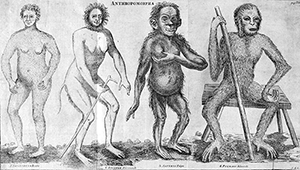 The conference focuses on the development of various forms of anthropology in the second half of the eighteenth century, with a special focus on philosophical anthropology, as a distinct discipline that competed with metaphysics, both in scope and aim.
The birth of philosophical anthropology in the mid-eighteenth century and its development well into the nineteenth signaled a fundamental shift – not only did it emphasise the historical character of thought, but it also sought to understand the human being in context, whether biological, cultural-historical, literary or psychological. For this reason, Odo Marquard has termed it one of the “three great epochal shifts” (alongside aesthetics and the philosophy of history) in the history of modern Europe.
The main focus will be on the way in which various forms of anthropology, philosophical (Germany) but also medical (France) both contributed to and challenged the notion of “Enlightenment” in Europe. That the European Enlightenment was a contested ground is well known; however, the fact that anthropology played a fundamental role in its orientation remains an understudied topic.
Many of the papers will focus on the role that Johann Gottfried Herder played in the development of philosophical anthropology, and in examining the debate between him and his former teacher, Immanuel Kant, this conference will be one of the first to address the ways in which philosophical anthropology developed in relation to the larger project of Enlightenment in Europe.
◊ ◊ ◊ ◊ ◊
P R O G R A M
Monday, 4 November
Peter Anstey (Sydney), The Enlightenment natural history of man
Charles Wolfe (Ghent), ‘Whoever takes man as an object of study must expect to have man as an enemy’: The tension between naturalism and anthropocentrism in La Mettrie and Diderot
Jennifer Milam (Sydney), Doggie Style: Rococo Representations of Interspecies Sensuality and the Pursuit of Volupté
Stephen Gaukroger (Sydney), The demise of anthropological medicine: the challenges of experimental medicine and Mesmerism
Ofer Gal (Sydney), Anthropology vs. metaphysics: Hobbes and Spinoza on the passions
Tuesday, 5 November
Daniela Helbig (Sydney), Self-positing: experimental subjects in Kant’s thought and in scientific practice
Nigel DeSouza (Ottawa), Between Leibniz and Kant: the philosophical foundations of Herder’s anthropology
Anik Waldow (Sydney), Natural history and the formation of the human being: Kant and Herder on active forces
Dalia Nassar (Sydney), Kant and Herder on analogy
Stefanie Buchenau (Paris), Herder: From comparative anatomy to philosophical anthropology
Wednesday, 6 November
John Zammito (Rice), The Animal-Human Boundary and Anthropology: Herder between Reimarus and Tetens
Kristin Gjesdal (Temple), Hermeneutics and Anthropology in Herder’s Early Thought
Gabriel Watts (Sydney), Herder’s theological anthropology
Marion Heinz (Siegen), Cultural theory in Kant and Herder
Michael Forster (Bonn), Herder’s anthropology and human rights
Conference Report | HECAA Session at UAAC
Christina Smylitopoulos (University of Guelph) reports that the first Canadian HECAA panel at UAAC last weekend in Banff went splendidly. Five speakers presented exceptional papers, and the discussions were rich and exciting—all framed by sublime mountains!
◊ ◊ ◊ ◊ ◊
Paul Holmquist, “Tying the Seductive Powers of Art to the Innate Rights of Man: The Architect as Legislator in the Ideal City of Chaux”
This paper examines the correlation between the Architect of Claude-Nicolas Ledoux’s ideal city of Chaux as set out in his L’Architecture…(1804) and the enigmatic figure of the Legislator in Jean-Jacques Rousseau’s On the Social Contract (1762). I argue that Ledoux’s Architect acts analogously to the Legislator in aspiring to shape the moeurs or customary views, practices and ways of life of a people by adapting them to natural law in new institutions and architectural programs. The Architect, like the Legislator, must also rely upon persuasion rather than coercion for the efficacy of his new institutions, and make the good of the ‘legislation’ publicly appear in the expressive program of architecture parlante. This analysis will show that as such Ledoux’s architectural theory and vision for Chaux addressed key philosophical questions posed by Rousseau concerning the foundation of society in terms of nature, reason, sentiment, and the imagination.
Alena Robin, “Being a Painter in Mexico City in 1735: Voices from the Archives”
In February 1735, Felipe Chacón, master painter and guilder in Mexico City, addressed the Royal Mint to recover his dues for the work he had been doing in different parts of the building. The document preserved in the National Archives in Mexico City is rich in descriptions of the now lost building. What could have been a simple monetary transaction did not, however, end there. The officers of the Mint contracted José de Ibarra and Nicolás Enríquez, also master painters, to evaluate Felipe Chacón’s work. Not satisfied with the first evaluation, the officers requested a second one. José de Ibarra and Nicolás Enríquez are painters that hold a significant place in the historiography of New Spanish painting. The name of Felipe Chacón is however unknown to this pictorial tradition. It is worth examining these documents to pause on what could mean being a painter in Mexico City in the eighteenth century.
Elizabeth Ranieri, “Trionfo della Fede sull’Eresia ad Opera dei Domenicani (1709) by Francesco Solimena: The Baroque Fresco as Medium for Epideictic Discourse”
Francesco Solimena’s sacristy fresco Trionfo della Fede sull’Eresia ad Opera dei Domenicani (1709) in the Neapolitan Church of San Domenico Maggiore follows the classical model of epideictic discourse by praising the virtues and the achievements of its Dominican patrons and audience. Solimena’s fresco is about the efforts of the Dominican order to educate the common people in order to eliminate heretical thought and behavior. The work was commissioned by the Dominican order for a Dominican audience; the patron-viewers of the fresco all have the same sex, educational level, religious affiliation, interests, and values. The virtues that are depicted in the fresco are Faith, Obedience, Poverty, Chastity, and Wisdom, all of which are valued by the Dominican order. The primary purpose of the fresco is to celebrate the virtues and achievements of the Dominicans, particularly the order’s historical and figurative triumph over heresy through the use of “faith” and “works.”
Diana Cheng, “Lord Chesterfield’s Boudoir: A Room without the Sulks”
The boudoir, as the early eighteenth-century writer Laurent Bordelon opined, was an apt description of the room where a married woman indulged in her dark, unreasonable moods. While the original intent of the nomenclature was to denigrate the undutiful wife, the boudoir was, on the contrary, a place without the sulks from the perspective of the inhabitant. Philip Dormer Stanhope, the 4th Earl of Chesterfield (1694–1773), for one, considered his gilded arabesque boudoir at Chesterfield House the gayest room in England. The paper is a case study of this English aristocrat’s boudoir, highlighting its functional and decorative similarities and differences from a lady’s boudoir. It argues that the meaning and usage of the eighteenth-century boudoir, while seemingly varied depending on gender and class, was rooted in the desire of its inhabitant to re-stake the boundaries of social inter-dependencies and duties.
Ji Eun You, “Bringing the Revolution Home: Printed Fabric during the French Revolution, 1789–1795”
Between 1789 and 1795, the manufactories at Jouy-en-Josas and Nantes produced a small group of cotton fabrics printed with narrative and allegorical scenes of the French Revolution for interior furnishing. This paper explores the interpretive possibilities of these designs, with attention to the highly variable viewing experience that was contingent upon tactile interaction with the material through cutting, draping, and display. Simultaneously embracing and evading contemporary politics, the multiple viewings offered by the printed fabrics represent the period when radical political discourse compelled luxury decorative arts to renegotiate their places in French visual culture. My visual analysis of printed fabrics is joined to an investigation into the discursive and material context for luxury interior furnishings during the French Revolution. In doing so, I propose a way of rethinking the aesthetic experience of the French Revolution through decorative arts.
The Wellcome Library Open Access Fund
With the move toward open access gaining more momentum, even as questions regarding who funds the access remain, this is a particularly interesting example from the Wellcome Library:
◊ ◊ ◊ ◊ ◊
The Wellcome Library is a free resource and is open to anyone who wants to use our collections. We know that lots of our users publish the outcome of their Library research. We want to encourage and support this research, and to ensure that it can be read and enjoyed by as many people as possible.
The Wellcome Trust has a long-standing commitment to Open Access, and provides funding to grant-holders to help them make their research accessible. We’re extending this principle to users of the Wellcome Library in a new scheme aimed at independent scholars, as well as students and university-based researchers who don’t have funding to cover the costs of open-access publishing.
The new Wellcome Library Open Access Fund is (and will always be) entirely voluntary – it’s up to library users whether they want to take advantage of it. We will pay the costs associated with open-access publishing for peer-reviewed journal articles, scholarly monographs or book chapters aimed at academic audiences. To qualify, you’ll need to have made substantial use of our collections; to have had your research accepted for publication; and to be ineligible for open-access funding from any other source.
In the Fall 2013 Issue of ‘Konsthistorisk Tidskrift’
Konsthistorisk Tidskrift / Journal of Art History 82 (Fall 2013)
A special issue of Konsthistorisk Tidskrift / Journal of Art History, guest edited by Peter McNeil (Faculty of Design, Architecture and Building University of Technology Sydney, Australia and Centre for Fashion Studies, Stockholm University) and Patrik Steorn (Centre for Fashion Studies, Stockholm University), addresses the theme of “Fashion and Print Culture: Translation and Transformation.”
From the editorial:
Print itself is both a materiality as well as a vehicle of representation. How did the meaning of various forms of fashion-related prints change as they were circulated in new contexts? What was the relationship of ‘fashion words’ and images? What were the mechanisms through which print – as newsprint, almanac, trade-card, respectful or satirical image – supported or undermined the spread of fashions, from ‘head-piece’ to ‘borders’? A pluralistic perspective is needed to better understand the transmission of ideas about fashion in print as well as in practice – and their interrelationship for the new readers and viewers of the period from the renaissance to the eighteenth century. This theme issue of Konsthistorisk tidskrift publishes some of the findings related to the Humanities in the European Research Area (HERA)/European Science Foundation funded project ‘Fashioning the Early Modern: Innovation and Creativity in Europe, 1500–1800’ (FEM) and the portfolio ‘Print Culture and Fashion Products’ managed therein by Peter McNeil and Patrik Steorn. HERA FEM was a three-year major funded project conducted from 2010 to 2013.
C O N T E N T S
· Peter McNeil and Patrik Steorn, The Medium of Print and the Rise of Fashion in the West, pp. 135–56.
· Chia-hua Yeh, From Classical to Chic: Reconsidering the Prints from Varie acconciature di teste usate da nobilissime dame in diverse città d’Italia by Giovanni Guerra, c. 1589, pp. 157–68.
· Lena Dahrén, Printed Pattern Books for Early Modern Bobbin-made Borders and Edgings, pp. 169–90.
· Cecilia Candréus, The Use of Printed Designs in Seventeenth-Century Embroidery: Layers of Transfer and Interpretation, pp. 191–204.
· Mark de Vitis, Sartorial Transgression as Socio-political Collaboration: Madame and the Hunt, pp. 205–18.
· Patrik Steorn, Migrating Motifs and Productive Instabilities: Images of Fashion in Eighteenth-Century Swedish Print Culture, pp. 219–34.
· Carolina Brown, Portraits en savoyarde and the Shepherdess of the Alps: Portraits, Prints, Literature, and Fashion in Eighteenth-Century Sweden, pp. 235–51.
· Arlene Leis, Displaying Art and Fashion: Ladies’ Pocket-Book Imagery in the Paper Collections of Sarah Sophia Banks, pp. 252–71.
· Audrey Millet, Dessiner La Mode En Régime De Fabrique: L’imitation Au Cœur Du Processus Créatif, pp. 272–86.










leave a comment