Call for Papers | Persistent Spaces: 18th- and 19th-Century Cities
Persistent Spaces: Politics, Aesthetics, and Topography in the 18th- and 19th-Century City
Université Paris Diderot, 12-13 December 2013
Proposals due by 13 October 2013
Keynote Speakers: Lynda Nead (Birkbeck College) and Stéphane Van Damme (Sciences Po Paris)
The aim of this two-day conference is to bring together young researchers to explore the city and its ideologies from a fully interdisciplinary perspective. We would like to combine approaches from the fields of literature and the arts, sociology, philosophy, law, science and engineering in order to create a dialogue between disciplines and methodologies. This conference would also establish a dialogue between the eighteenth and nineteenth centuries. We will seek to highlight the individual specificities of these two periods, but also to understand the echoes, continuities and breaks between them.
From the Enlightenment to the late nineteenth century and before urbanism was fully established as a discipline, the city was constantly being configured and reconfigured by the joint influences of architects, civil engineers, political organizations, associations and the informal ‘practices’ of inhabitants. Writers and artists also play a major part in this process, both picking up on these developments and changing them through the aesthetics they deploy. The conference will shed light on the city as a topography of struggle, a site of conflicting and interpenetrating layers, changing yet also persisting through time and space, and continually shaped by tensions between authority and resistance.
Topics may include, but are by no means limited to:
• Authority, ideology, urban planning and everyday ‘practices’
• Coherence or fragmentation of the urban space (home and workplace, centre and slums, etc.)
• Geographical juxtapositions / temporal superimpositions of spaces
• Population, mobility and living conditions
• Technological developments and urban networks
• 18th/19th-century continuity and breaks
• 18th-century ideas persisting and materializing in the 19th century
• Comparisons between / specificity of London and Paris
Papers will last for 20 minutes and will be followed by 15-minute discussions. Abstracts no longer than 300 words should be sent to Clemence Follea (clemence.follea@gmail.com) or Clement Martin (clemm.martin@gmail.com) by October 13th, 2013, along with a brief biographical note, which should not exceed 50 words. The scientific committee examining the papers is composed of doctoral students from Paris Diderot University: Claire Deligny; Clémence Follea; Clément Martin; Roisin Quinn-Lautrefin; Estelle Murail; and Marie Ruiz.
The conference will take place at Paris Diderot University (Paris, 13e arrondissement), on the 12th-13th December 2013. This event is supported by the Laboratoire de Recherches sur les Cultures Anglophones (Université Paris Diderot).
Exhibition | Anton Graff: Faces of an Era
The exhibition opened last weekend on the two-hundredth anniversary of the artist’s death (22 June 1813). From the Museum Oskar Reinhart:
Anton Graff: Gesichter einer Epoche
Museum Oskar Reinhart, Winterthur, 22 June — 29 September 2013
National Gallery in Berlin, 25 October 2013 — 23 February 2014
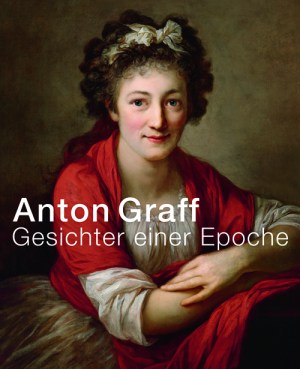 Anton Graff, who was born in Winterthur, was the most important portrait painter in the German-speaking world around 1800. He influenced the image of the bourgeoisie and nobility and the image of poets and thinkers on the brink of Modernism like no other. When he died in 1813, he left behind around 1800 portraits depicting a panorama of transitioning European society.
In celebration of the 200th anniversary of his death, the Museum Oskar Reinhart in Winterthur and the National Gallery in Berlin are honouring the work of Anton Graff in a comprehensive exhibition for the first time in 50 years. After a first stop at the Museum Oskar Reinhart from 22 June to 29 September 2013, the exhibition will be able to be seen in the National Gallery in Berlin between 25 October 2013 and 23 February 2014. The exhibition and the richly illustrated catalogue, which will be published by the Munich-based Hirmer Publishers, came about thanks to the cooperation of both institutions.
Marc Fehlmann and Birgit Verwiebe, eds., Anton Graff: Gesichter einer Epoche (Munich: Hirmer Publishers, 2013), 336 pages, ISBN: 978-3777420509, 40€.
◊ ◊ ◊ ◊ ◊
From Berlin’s Alte Nationalgalerie:
Bis in das Innere der Seele“ zu schauen, darin bestand, den Worten des Philosophen Johann Georg Sulzer zufolge, die Meisterschaft des großen Porträtisten Anton Graff. Der überaus produktive Künstler zählt zu den herausragenden Bildnismalern des späten 18. und frühen 19. Jahrhunderts. Sein größtes Verdienst war, die Berühmtheiten seiner Epoche zu porträtieren. Ihm ist das Panorama des deutschen Geistes zu danken, das die Bildnisse der bedeutendsten Dichter und Denker umfasst, wie etwa Lessing, Nicolai, Mendelssohn, Sulzer, Wieland, Gellert, Herder und Schiller.
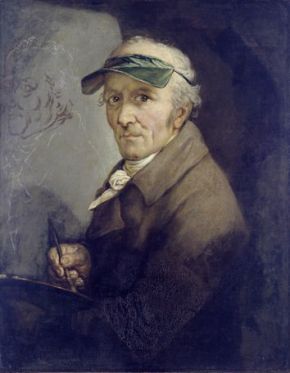
Anton Graff, Self-portrait with the Green Eye-shade, 1813 (Staatliche Museen zu Berlin, Nationalgalerie)
Graff wurde 1736 in Winterthur geboren und nahm dort seinen ersten Kunstunterricht. In Augsburg, Ansbach und Regensburg bildete er sich weiter. 1766 – 30jährig – wurde er in Dresden kurfürstlich-sächsischer Hofmaler und Mitglied der Akademie. Regelmäßig führten ihn Reisen nach Berlin, Leipzig und in die Schweiz. Gegen Ende seines Lebens wurde Graff gleichsam zu einer Symbolfigur für den Kreis junger Romantiker in Dresden. 1813, mit 76 Jahren, starb der Maler.
Graff hat seine Zeitgenossen nicht im Gestus der Repräsentation festgehalten. Vielmehr lag ihm daran, das Wesen des Einzelnen auszuloten, seine Individualität zu entdecken, seine seelischen und geistigen Qualitäten wiederzugeben. Auch heute noch spricht die innere Gestimmtheit der aufgeklärten geistigen Elite in Deutschland unmittelbar aus Graffs meisterhaften Werken. Mit Bildnissen von Königen und Fürsten, vom aufstrebenden Bürgertum, von Staatsmännern, Gelehrten, Künstlern, Kaufleuten, Geistlichen schuf er eine Galerie der deutschen Gesellschaft an der Schwelle zur Moderne.
Ein halbes Jahrhundert hat es keine Ausstellung zum Werk Graffs gegeben. Nun, anlässlich des 200. Todestages, wird sein Werk wieder umfassend präsentiert.
Die Retrospektive „Anton Graff. Gesichter einer Epoche“ entstand in Kooperation mit dem Museum Oskar Reinhart, Winterthur. Dort sind rund 80 Werke vom 22. Juni bis 29. September 2013 zu sehen. In der Alten Nationalgalerie Berlin wird die Ausstellung anschließend in erweiterter Form mit rund 140 Werken vom 25. Oktober 2013 bis 23. Februar 2014 gezeigt.
2012 Dissertation Listings
From caa.reviews:
Dissertation Listings
PhD dissertation authors and titles in art history and visual studies from US and Canadian institutions are published each year in caa.reviews. Titles can be browsed by subject category or year.
Titles are submitted once a year by each institution granting the PhD in art history and/or visual studies. Submissions are not accepted from individuals, who should contact their department chair or secretary for more information. Department chairs: please consult our dissertation submission guidelines for instructions. The annual deadline is January 15 for titles from the preceding year.
In 2003, CAA revised the subject area categories of art history and visual studies used for all our listings, including dissertations. These categories are listed in the Dissertation Submission Guidelines.
◊ ◊ ◊ ◊ ◊
The index for 2012 lists nine eighteenth-century dissertations completed, including:
• Currie, Christopher, “Art, Illusion, and Social Mobility in Eighteenth-Century France: Hyacinthe Rigaud and the Making of the Marquis de Gueidan” (UNC Chapel Hill, M. Sheriff)
• Ferng, Jennifer, “Nature’s Objects: Geology, Aesthetics, and the Understanding of Materiality in Eighteenth-Century Britain and France” (MIT, M. Jarzombek)
• Fripp, Jessica, “Portraits of Artists and the Social Commerce of Friendship in Eighteenth-Century France” (Michigan, S. Siegfried)
• Medakovich, Molly A., “Between Friends: Representations of Female Sociability in French Genre Painting, 1770–1830” (UNC Chapel Hill, M. Sheriff)
• Riggs, Marion, “Architectural Translations: Giuseppe Barberi (1746–1809) between Rome and Paris” (Princeton, J. Pinto)
and forty dissertations in progress, including:
• Beachdel, Thomas, “Landscape Aesthetics and the Sublime in France, 1750–1815” (CUNY, P. Mainardi)
• Bell, Andrea, “French Artist in Rome: An Examination of Eighteenth-Century Drawing Albums” (IFA/NYU, T. Crow)
• Chadwick, Esther, “The Radical Print: Experiments in Liberty, 1760–1830” (Yale, T. Barringer)
• Charuhas, Christina, “Constructing Eighteenth-Century Bermuda: Utopia in the Transatlantic Imagination” (Columbia, E. Hutchinson)
• Contogouris, Ersy, “Of Marble and Flesh: The Attitudes and Representations of Emma Hamilton” (Université de Montréal, T. Porterfield)
• Cox, Alison, “Images of Mourning and Melancholia in France, 1780–1830” (UNC Chapel Hill, M. Sheriff)
• Crawford, Katelyn D., “Transient Painters, Traveling Canvases: Portraiture and Mobility in the British Atlantic, 1750–1780” (Virginia, M. McInnis)
• Fox, Abram, “The Great House of Benjamin West: Family, Workshop, and National Identity in Late Georgian England” (Maryland, College Park, W. Pressly)
• Girard, Catherine, “Hallali! Hunting and the Violence of French Rococo Art, 1699–1755” (Harvard, E. Lajer-Burcharth)
• Gohmann, Joanna M., “Living Together: People and Their Animals in Eighteenth-Century French Art, 1700–1789” (UNC Chapel Hill, M. Sheriff)
• Knowles, Marika, “Pierrot’s Costume: Theater, Curiosity, and the Subject of Art in France, 1665–1860” (Yale, C. Armstrong)
• Laux, Barbara M., “Claude III Audran, Modern Ornemaniste of the Rococo Style” (CUNY, J. Sund)
• Lenhard, Danielle, “Reading with One Hand: Suggestive Folds and Subversive Consumption in Jean-Honore Fragonard’s ‘The Bolt’” (Stony Brook University, J. Monteyne)
• Logie, Rose, “The Self-Conscious Artist: The Strange Formality of Watteau’s Oeuvre” (Toronto, P. Sohm)
• Oliver, Elizabeth Lee, “Mercantile Aesthetics: Art, Science, and Diplomacy in French India (1664–1757)” (Northwestern, S. H. Clayson)
• Sezer, Yavuz, “The Eighteenth-Century Ottoman Library Movement: Architecture, Reading, and the Politics of Knowledge” (MIT, N. Rabbat)
• Smith, Hilary Coe, “The Role of the Auction Catalogue in the Growth of the Parisian Art Market, 1675–1789” (Duke, H. Van Miegroet)
• You, Ji Eun: “The Afterlife of Luxury: the Material Culture of Interior Furnishing during the French Revolution 1789-1795” (UNC Chapel Hill, M. Sheriff) [not included in the 2012 list at caa.reviews, this entry serves as a useful reminder that the list should not be understood to be comprehensive]
• Veen, Kasie, “The Spectacle of New Ruins in Britain and France, 1760–1840: Landscape Gardens and the Diorama” (UT Austin, M. Charlesworth)
• Viggiani, Daniela, “L’édition de L’Abecedario Pittorico de Pietro Maria Guarienti (1678–1753), une source pour l’histoire de l’art portugais” (Université de Montréal, L. De Moura Sobral)
• Wile, Aaron, “Charles de La Fosse and His Generation: Painting, Authority, and Experience at the Twilight of the Grand Siècle, 1680–1715” (Harvard, E. Lajer-Burcharth, H. Zerner)
Exhibition | Candida Höfer at the Borghese Gallery
As noted at Art Daily (23 June 2013) . . .
Candida Höfer per La Galleria Borghese
Villa Borghese, Rome, 20 June — 15 September 2013
Curated by Mario Codognato, Anna Coliva, and Marina Minozzi
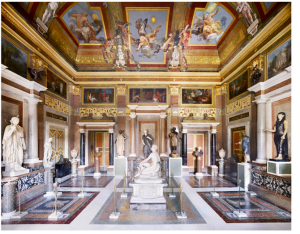
Candida Höfer, Villa Borghese Roma I, 2012. C-print. Print size: 71 x 86 inches (180 x 217.2 cm). © Candida Höfer/VG Bild-Kunst, Bonn© Candida Höfer by SIAE 2013.
The famous Galleria del Lanfranco hosts seven works by the artist Candida Höfer portraying the original reconstruction of the Borghese collection, recently restored for the I Borghese e lʼAntico exhibition (December 2011 – April 2012, curated by Anna Coliva and Marina Minozzi for Galleria Borghese and by Jean-Luc Martinez and Marie Lou Fabréga-Dubert for the Louvre) which brought back to the Gallery the most important ancient masterpieces that once belonged to the collection, mostly collected by Cardinal Scipione Borghese at the beginning of the seventeenth century and currently making up the core of the Paris Louvre Museum antiques collection, following the sale imposed by Emperor Napoleon Bonaparte on his brother-in-law Camillo Borghese in 1807. Candida Höferʼs work therefore represents the only existing evidence of the collection in its original setup, which will never be replicated again: some kind of miracle that will never repeat itself.
The underlying concept of the exhibition is that out of the reconstruction of an art masterpiece such as the Galleria Borghese collection in its original makeup, another work of art was created. In that occasion Candida Höfer – known for her incomparable way of perceiving places and reproducing them through her camera – had therefore documented the mounting of the exhibition halls through the photos that are now in display in their original location, the Galleria itself. The exhibition curated by Mario Codognato, Anna Coliva and Marina Minozzi is a unique event, enabling visitors to virtually walk through the halls of “the most beautiful villa in the world” — Antonio Canovaʼs definition — and experience the fascinating atmosphere generated by the exceptional return to their place of origin of the masterpieces of one of the most distinguished and prestigious archaeological collection of all times.
Candida Höfer features among the most relevant artists of German contemporary photography. She was born in Eberswalde, Germany, in 1944 and is a leading exponent of ‘the School of Dusseldorf’. She started her artistic career in 1975 taking part in several international exhibitions, such as Documenta in Kassel in 2002 and Biennale in Venice in 2003, where she exhibited her work in the German Pavillion. Her works feature in the collections of many international museums, such as Centre Pompidou in Paris, Centro de Arte Reina Sofia in Madrid, Kunsthalle in Hamburg, Museum of Modern Art in New York, Kunthalle in Basel. Höfer is renowned for her shots of public spaces, such as museums, libraries, archives, theatres, offices, banks, waiting rooms, underground stations and other culturally and socially crowded places which however stand out due to the total absence of human presence. As a matter of fact, it is a ‘non-presence’ rather than an absence: the portrayed locations seem to be suspended, waiting, ready to welcome the human being, the real protagonist, enjoying those museums and frequenting those libraries. In her pictures Candida Höfer exclusively uses natural light. This peculiarity turns the picture of a place from a mere documentation to a true portrait by personifying it, interpreting its surfaces as if they were a live element, devoid of any human presence and captured in a single moment that will survive forever thanks to her work.
The seven large-size photos – roughly 180 x 200 centimeters – exhibited in the Lanfranco Hall, portray the Villa and reproduce the setting of the seventeenth and eighteenth century when sculptures belonging to the celebrated Borghese archaeological collection were still displayed in the Museum halls. Masterpieces such as The Three Graces and The Sleeping Hermaphroditus feature in Höfer’s photos alongside modern masterpieces such as the The Rape of Proserpina by Gian Lorenzo Bernini and the famous Pauline Bonaparte as Venus Victrix by Antonio Canova. However, the true protagonists of these pictures are not only these extraordinary sculptures but also the Galleria as a whole: its history, its furniture, its works: all these elements make Candida Höferʼs photographs unique and the exhibition a one-off opportunity. Hoferʼs photos stir emotions thanks to their historical background, their perspective and the brightness of the place itself, defining its original aspects and raising the images to an eternal, absolute dimension.
◊ ◊ ◊ ◊ ◊
Ian Wardropper Honored as a Chevalier of the Order of Arts and Letters
Press release (11 June 2013) from The Frick Collection:
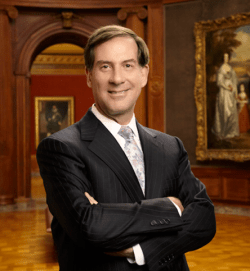 On Monday, June 10, Ian Wardropper, Director of The Frick Collection, received the insignia of Chevalier of the Order of Arts and Letters in a private ceremony held during a reception at the museum. Antonin Baudry, Cultural Counselor of the French Embassy, officiated at the ceremony. The Ordre des Arts et des Lettres (Order of Arts and Letters) was created in 1957 to recognize eminent artists and writers, as well as individuals who have contributed significantly to furthering the arts in France and throughout the world. The Order is given out twice annually to only a few hundred people worldwide. Among the Americans who have received this award in the past are Paul Auster, Ornette Coleman, Agnes Gund, Marilyn Horne, Judith Jamison, Jim Jarmusch, Richard Meier, Robert Paxton, Robert Redford, Meryl Streep, and Uma Thurman.
A specialist in European sculpture, decorative arts, and twentieth-century design and decorative arts, Ian Wardropper held key positions first at the Art Institute of Chicago and then at The Metropolitan Museum of Art before being named Director of The Frick Collection in 2011. At The Frick Collection, Wardropper co-curated last year’s Gold, Jasper, and Carnelian: Johann Cristian Neuber at the Saxon Court, the first exhibition on the work of a remarkable eighteenth-century court goldsmith. On view now at the Frick is an exhibition featuring drawing and prints from French masters spanning the entire second half of the nineteenth century: The Impressionist Line from Degas to Toulouse-Lautrec: Drawings and Prints from the Clark. These works represent the diverse interests of Realist, Impressionist, and Post-Impressionist artists in a rapidly changing world. (more…)
Christopher Gibbs and a Remarkable Georgian Sofa
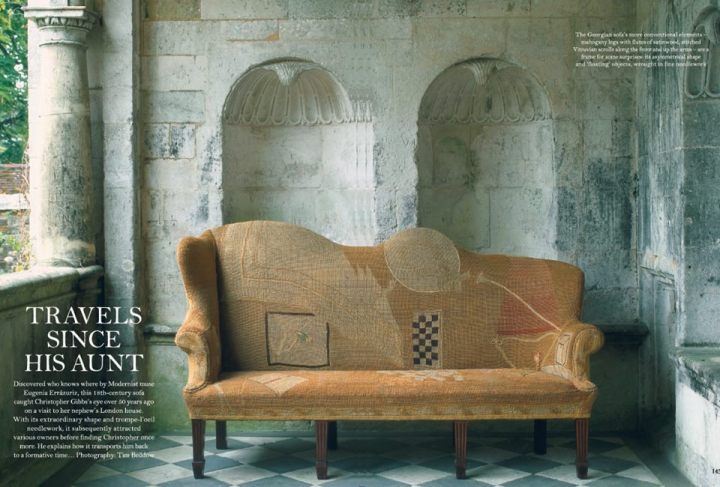
With its trompe-l’oeil needlework, this sofa is extraordinary (items depicted include a gameboard and cards, a box, a basket of yarn, a bird on a branch, and a bag). The one-page essay in The World of Interiors by the antiques dealer Christopher Gibbs, accompanied by stunning photographs, underscores just how compelling an object can be as a subject. -CH
◊ ◊ ◊ ◊ ◊
Christopher Gibbs, “Travels Since His Aunt,” The World of Interiors (June 2013): 144-49.
Discovered who knows where by Modernist muse Eugenia Errázuriz, this 18th-century sofa caught Christopher Gibbs’ eye over 50 years ago on a visit to her London home. With its extraordinary shape and trompe-l’oeil needlework, it subsequently attracted various owners before finding Christopher once more [via the antique dealer Edward Hurst]. Gibbs explains how it transports him back to a formative time, in the June issue of The World of Interiors. Photography: Tim Beddow.
Fellowship | Culture, Art, and Society in the Times of Juvarra
From the call for applications:
Fondazione 1563 Fellowship | Culture, Art, and Society in the Times of Juvarra
Applications due by 31 July 2013
 Fondazione 1563 per l’Arte e la Cultura, an Operating Body of Compagnia di San Paolo, pursues among its statutory objectives “the implementation of research and advanced education activities in humanities.” The Foundation is entrusted with the management and the promotion of the Historical Archives of Compagnia di San Paolo and the development of studies on the Age and the Culture of Baroque, in order to encourage research in humanities and to facilitate the access of young scholars to
academic and cultural institutions.
The fellowships intend to promote studies on Baroque literary, philosophical, musical, theater, artistic and architectural culture and on the political, social, and technical-scientific history of the Age of Baroque, also from a comparative international perspective. Research proposals for the 2013-14 call will need to pertain to the following theme: “Culture, art and society in the times of Juvarra.”
The career of Filippo Juvarra (1678-1736) is marked by two cultural experiences that he contributed to in terms of shapes, images, suggestions and models. On the one hand was Rome in the early 18th century and the inner circle of Cardinal Ottoboni, who was open to the reforms put forward by the Academy of Arcadia and who promoted the renewed primacy of the artist championed by the “Accademia di San Luca” in line with a reflection on the complexity of Baroque tradition. On the other hand there was Vittorio Amedeo II and his request to Juvarra to be part of a plan to create and consolidate a modern State, a project that would reflect in contemporary politics and society, as well as literature, philosophy, music, theater, architecture and the visual arts.
The call is open to researchers born on or after 1st January 1975 holding a University or master’s degree from an Italian University or equivalent from foreign Universities. Priority will be given to applicants holding a Ph.D. or equivalent from Italian or foreign universities. The fellowship will refer to the following fields of study: social history, political history, economic history, history of science and technology, history of literature, history of philosophy, history of music, history of theater, art history, history of architecture. . .
More information is available here»
New Book | Funerary Sculpture in St Patrick’s Cathedral, Armagh
From the author’s website:
James Stevens Curl, Funerary Monuments and Memorials in St Patrick’s Cathedral, Armagh (Whitstable: Historical Publications, 2013), 164 pages, ISBN: 978-1905286492, £40 (hardcover) / ISBN: 978-1905286485, £20 (softcover) — ordering information is available here»
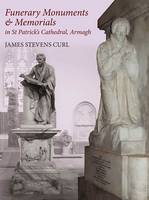 The funerary monuments and memorials in the Church of Ireland (Anglican) Cathedral Church of St Patrick, Armagh, include fine works by celebrated sculptors including Bacon, Chantrey, Farrell, Marochetti, Nollekens, Roubiliac, Rysbrack, and others, yet are not widely known.
Professor Stevens Curl’s comprehensively illustrated book describes and shows all of them, as well as giving details of the artists and their subjects, thereby filling an unaccountable gap in the literature. It is published in two versions; a hardback, limited edition of only 250 numbered signed copies with dust-jacket at £40, and a softback edition at £20 per copy.
James Stevens Curl has held Chairs in Architectural History at two Universities. He is Professor of Architecture at the School of Architecture and Design, University of Ulster. He read for his Doctorate at University College London, and in 1991-2 and 2002 was Visiting Fellow at Peterhouse, University of Cambridge.
New Book | Les Biscuits de Porcelaine de Paris
Available from Artbooks.com:
Régine de Plinval de Guillebon, Les Biscuits de porcelaine de Paris : XVIIIe-XIXe siècles (Dijon: Faton, 2012), 331 pages, ISBN: 978-2878441628, 68€ / $125.
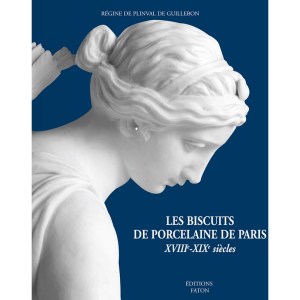 Aux biscuits de porcelaine de Paris sont souvent associés de grands noms de porcelainiers, tels Guérhard, Dihl, Gille jeune, Desprez et Nast. Pendules spectaculaires, statues gigantesques, ou bustes à taille humaine, ces figures ou groupes en porcelaine non émaillée sont pourtant assez méconnus ; on les imagine blancs, mais ils peuvent être bleus, noirs, polychromes ou dorés. Le biscuit parisien est de tout son temps très prisé par des amateurs aussi prestigieux que George Washington et le prince-régent d’Angleterre.
Après une présentation des origines de la porcelaine et des techniques de fabrication, Régine de Plinval de Guillebon nous entraîne au cœur de la vie mouvementée de 31 manufactures des XVIIIe et XIXe siècles, s’intéressant de près au travail des ouvriers, des artistes et des investisseurs, ainsi qu’au contexte économique général. Une analyse approfondie des formes, des couleurs, ainsi que de l’association du biscuit avec le bronze, l’orfèvrerie et le cristal, permet d’envisager l’évolution du style des biscuits, dont deux cents illustrent cet ouvrage. Un catalogue raisonné des manufactures parisiennes vient compléter cette remarquable étude.
Exhibition | Master Drawings
From The Ashmolean:
Master Drawings
The Ashmolean Museum, Oxford, 25 May — 18 August 2013
Curated by Christopher Brown, Jon Whiteley, and Catherine Whistler

Thomas Gainsborough, Study of a Woman, seen from the back, chalk and stump on paper, 1760-70 (Oxford: Ashmolean Museum)
The Ashmolean announces one of its major summer exhibitions, Master Drawings, as part of the celebrations to mark the founding of the Museum in 1683. The exhibition, drawn from one of the world’s greatest collections of works on paper, will display a selection of the Ashmolean’s treasures of western art including works by Michelangelo and Raphael; Dürer and the artists of the Northern Renaissance; through the centuries to Rubens and Rembrandt; Turner, Degas and Pissarro; up to Gwen John and David Hockney.
Master Drawings will survey seventy-two drawings of all types: figure studies, composition sketches, landscapes and portraits. Many are working drawings; others were made as works of art in their own right. Michelangelo will be represented by a study for the Sistine ceiling, drawn with the robust energy of youth, along with two profoundly poetic works drawn for friends, and a late, contemplative image of the Virgin and the risen Christ. Raphael will be represented by a series of studies ranging from one of his earliest works – a figure of the kneeling Magdalen delicately outlined in silverpoint – to one his last studies, the powerful and famous image of the hands and the heads of two apostles, drawn shortly before his death in 1520.
The history of landscape drawing will be explored from its beginnings with Dürer’s View of the Cembra Valley made in 1494; to watercolour sketches made by JMW Turner from opposite ends of his career. The seventeenth century will be represented in drawings by Rembrandt and Rubens; Guercino; and Claude Lorrain. The story will continue through the following centuries with studies by several of Europe’s greatest draughtsmen: Watteau, Boucher, Fragonard, Tiepolo, Goya, Ingres, Degas and Cézanne.
A full list of artists included is available here»
◊ ◊ ◊ ◊ ◊
From ACC Distribution:
Jon Whiteley and Catherine Whistler, Master Drawings: Michelangelo to Moore (Oxford: Ashmolean Museum, 2013), 160 pages, ISBN: 978-1854442789, £20.
 The collection of drawings in the Ashmolean is one of the greatest treasures of the University of Oxford. It began spectacularly in 1843 when a group of drawings by Raphael and Michelangelo that had previously belonged to the portrait painter, Sir Thomas Lawrence, was bought by subscription. Lawrence’s collection was one of the greatest collections of Old Master drawings ever assembled and its dispersal was much regretted. The Raphaels and Michelangelos, however, were the jewels in its crown. Following their arrival in Oxford, their fame attracted a number of gifts and bequests of drawings and watercolours by Dürer, Claude Lorraine, Brueghel, J. M. W Turner, Henry Moore and many others.
This is a story not only of Old Masters but of benefactors – Francis Douce, Chambers Hall, John Ruskin and their successors – whose different tastes account for the variety of the drawings in the modern Print Room. It is a story also of the curators who bought them. In particular, it is the story of Sir Karl Parker who arrived at the museum in 1934 and left a collection when he retired in 1962 that comprehensively covered the history of the art of drawing in Europe from its origins to the present day. The exhibition, Master Drawings: Michelangelo to Moore, celebrates this history. It includes many of the finest drawings in Oxford, representing the work of many different artists: Raphael and Michelangelo; Dürer and the artists of the Northern Renaissance; Guercino and Rubens; Boucher and Tiepolo; German Romantics; J. M. W. Turner; Degas and Pissarro; the artists of the Ballets Russes; British twentieth-century artists from Gwen John to Hockney; and much else.
Jon Whiteley is a Senior Assistant Keeper in the Department of Western Art, specialising in paintings, drawings and musical instruments.
Catherine Whistler is a Senior Assistant Keeper in the Department of Western Art, specialising in Italian and Spanish paintings and drawings.










 Enfilade
leave a comment