Christopher Brown Announces Retirement Plans
Press release (June 2013) from the Ashmolean:
 The Ashmolean has announced that Professor Brown will retire from his post as Director of the Ashmolean on 30 September 2014 after serving in that position for sixteen years. Following a sabbatical year, he will take up a position as a Research Professor in the University for three years until 2018. His work will be on Van Dyck and Rembrandt with the latter to be the focus of an exhibition in the Ashmolean in 2016. He took up the post of Director of the Ashmolean Museum in 1998 and the years of his Directorship have transformed the museum. Visitor figures have risen from 100,000 to over a million during these years. The museum will launch a campaign to create The Professor Christopher Brown Fund which will be used to establish curatorial fellowships at the Ashmolean. The process of finding Professor Brown’s successor will now begin so that his successor will be available to take up the position when he steps down.
Bernard Taylor, Chairman of the Visitors of the Ashmolean has said: “Christopher’s tenure as Director has involved huge positive development for the Ashmolean and he has overseen change on a grand scale with the implementation of architect the late Rick Mather’s wonderful design to transform the museum’s building. Visitor numbers have increased four fold since the opening of the remodelled building, the museum’s scholarly programme has been reemphasised and an ambitious temporary exhibition programme launched. Christopher has been tireless in successfully seeking financial support for the Ashmolean on an international scale. I am delighted that following his retirement, he will remain in Oxford doing his research.” (more…)
Conference | The Eighteenth-Century Gothick
From the symposium website:
Eighteenth-Century Gothick Symposium
University of Oxford, 7 August 2013
 The Gothick Revival in eighteenth-century Britain is a multi-faceted phenomenon, simultaneously liminal and mainstream, historical and modern, whimsical and serious. This international and interdisciplinary symposium is supported by the Georgian Group and the University of Oxford, and comes thirty years after the landmark Gothick conference held by the Georgian Group at the Victoria and Albert Museum, London. It will bring together current high-quality research by scholars and students on the revival and explore its many dimensions.
Conference registration is now open. Further details can be found on the symposium’s website.
◊ ◊ ◊ ◊ ◊
Oleksandr Golozubov, Laughter and Evil in the English Pre-Romanticism
Alice Labourg, The Pictorial Gothic in Ann Radcliffe’s Novels: From Decorative Details to Picturesque Tableaux
Jenny McAuley, English Literature and the Eighteenth-Century Gothic Revival: The Example of Ann Radcliffe
Thomas Willette, Horace Walpole’s Gothick Cellini
Cathryn Spence, King Alfred’s Hall, Cirencester
Oliver Cox, Back in the Summer of ’69 — Alfred’s Castle and Alfred’s Tower
Ruth Musielak, Gothic and Classical: Gothic Ornaments at Marino, Co Dublin
Peter N. Lindfield, Dicky Bateman, Shobdon Church and Kentian Gothic: The Great Mystery
Jonathan Kewley, Eighteenth-Century Gothick in the Regency: The Career of Thomas Brine
Jean-Marie Guillouët, Pursuing Historiographical Myths during the Eighteenth Century: English and Irish Art Historians and the Late Gothic Architecture in the Iberian Peninsula
Dustin Frazier, Samuel Pegge: A Reassessment
James Marsden, Thomas Leland, Gothic Novelist, Gothic Historian and Classical Educator
Philip Aspin, Enlightened Reactionaries? Gothic Revival thought in late Georgian England
Art Market | The Age of Elegance at Ely House
From Mallett:
The Age of Elegance: Treasures from the Eighteenth-Century Town House
Mallett, Ely House, London, 18 June — 20 July 2013
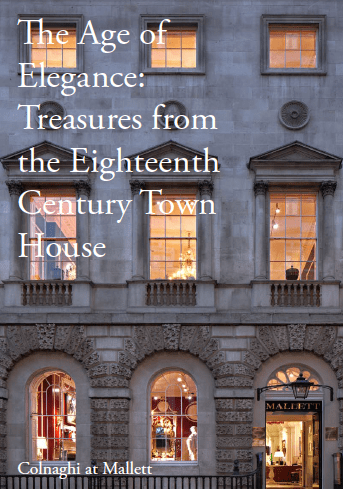 We are delighted to announce a special collaboration between Mallett and the world-renowned Old Masters dealer, Colnaghi. The exhibition will show the importance of the 18th-century town house as a site of display for the finest paintings and furniture. Set in the London showrooms of Mallett, the magnificent former palace of the Bishop of Ely built in 1770 to the designs of Sir Robert Taylor, this special event will show a series of rooms hung and decorated to recreate the splendours of a bygone era.
In the 18th century, the first in the hierarchy of rooms would have been the Saloon, containing the finest gilt furniture and hung with what Lord Chesterfield termed “capital pictures.” Among the works to be displayed in the Saloon of Ely House are Giovanni Antonio Pellegrini’s Sophinsba and Susannah and the Elders, which relate to an important series painted for nearby Burlington House. Still lifes will be featured in the dining room, while the Cabinet will be hung with smaller-scale pictures from the Northern Schools. The entrance hall will be dominated by an equestrian portrait by Louis Rolland Trinquesse, painted for presentation by the sitter Charles Grant to his
kinsman Sir James Grant.

Attributed to Sefferin Nelson (1739-97), after designs by Henry Holland, Giltwood Trophy, ca. 1795
Mallett will present a number of important pieces, including a pair of magnificent commodes, made by Mayhew and Ince for the home of Robert Birch in Donabate, Co. Dublin, and impaled with his coat of arms. Amongst other highlights will be a magnificent pair of giltwood settees in the manner of Thomas Chippendale, a set of twelve armchairs made by François Hervé and supplied to George John 2nd Earl Spencer in 1791, and a giltwood wall trophy attributed to Sefferin Nelson (1739-97) after designs by Henry Holland. This trophy was one of a series made for Carlton House, the former residence of George IV when Prince of Wales.
Carlton House will also be the subject of a special lecture given to accompany the exhibition by Desmond Shawe-Taylor, Surveyor of the Queen’s Pictures, on Sunday 30th June (please contact us for details).
The exhibition brochure is available here»
Enfilade Turns Four! Buy an Art Book!
To celebrate Enfilade’s fourth birthday (22 June), I’m encouraging readers to participate in the second annual Buy-an-Art-Book Day! This year I’m happy to announce a special, one-day discount from Ashgate. Many thanks for the kind support. — Craig Hanson

 At Ashgate or Lund Humphries, use the promotion code 287Y for a 20% discount on Saturday, June 22. The offer should work internationally, though please bear in mind U.S. timezones.
New Book | Architecture and Statecraft: Charles of Bourbon’s Naples
From Penn State University Press:
Robin L. Thomas, Architecture and Statecraft: Charles of Bourbon’s Naples, 1734–1759 (University Park: Penn State University Press, 2013), 248 pages, ISBN: 978-0271056395, $90.
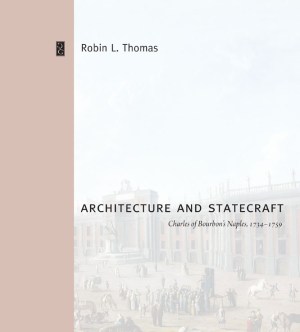 The eighteenth century was a golden age of public building. Governments constructed theaters, museums, hospices, asylums, and marketplaces to forge a new type of city, one that is recognizably modern. Yet the dawn of this urban development remains obscure. In Architecture and Statecraft, Robin Thomas seeks to explain the origins of the modern capital by examining one of the earliest of these transformed cities. In 1737 King Charles Bourbon of Spain embarked upon the most extensive architectural and urban program of the entire century. A comprehensive study of these Neapolitan buildings does not exist, and thus Caroline contributions to this new type of city remain undervalued. This book fills an important gap in the scholarship and connects Charles’s urban improvements to his consolidation of the monarchy. By intertwining architecture and sovereignty, Thomas provides a framework for understanding
how politics created the eighteenth-century capital.
Robin L. Thomas is Assistant Professor of Art History at The
Pennsylvania State University. (more…)
Reviewed | Extravagant Inventions
Recently added to caa.reviews:
Wolfram Koeppe, Extravagant Inventions: The Princely Furniture of the Roentgens (New York: Metropolitan Museum of Art, 2012), 304 pages, ISBN: 978-0300185027, $75.
Reviewed by Michael Yonan; Department of Art History & Archaeology, University of Missouri; posted 6 June 2013.
Once in a while an exhibition comes along that achieves many things. It illuminates past and present, and does so by creating a viewing experience both beautiful and instructive. All the better when such an exhibition also brightens up a blind spot in the history of art. The exhibition at the Metropolitan Museum of Art entitled ‘Extravagant Inventions: The Princely Furniture of the Roentgens’ achieved this. Curated by Wolfram Koeppe, Maria Kellen French Curator of European Decorative Arts, the show was a monographic investigation of father-and-son furniture makers Abraham (1711–1793) and David Roentgen (1743–1807), whose workshop in the German town of Neuwied produced furniture for the European elite between 1743 and 1800. By my estimation this was the decorative arts show of the decade, an educationally illuminating and utterly enjoyable museum experience whose rewards far
exceeded, in the words of a colleague of mine, the
opportunity to look at ‘old desks’. . . .
The full review is available here» (CAA membership required)
Exhibition and Book | The Art of Living, Augsburg ca. 1780
The June 2013 issue of The World of Interiors features a remarkable album from the 1780s, believed to the the work of Balthasar Cornelius Koch. It was the subject of a 2010-11 exhibition in Augsburg; the catalogue is available in German.
◊ ◊ ◊ ◊ ◊
Michael Huey, “A Cabinet Curiosity,” The World of Interiors (June 2013): 150-57. The stuff of life, c1780, is laid bare in a handmade album documenting the décor and possessions of a prosperous goldsmith, and his family of servants, in 18th-century Augsburg. From watercolour to scraps of fabric, the enchanting tour, from pantry to salon, literally opens the doors on inner courtyards and armouries. The June issue of The World of Interiors uncovers shoes, nightcaps and lace — but no skeletons — in the closets.
. . . Part pen/ink and watercolour, part découpage (it incorporates copperplate engravings), part scrapbook (it also uses real historical fabrics and papers) and, in a sense, part diary, it records the everyday functions of the rooms of the house in full colour and significant detail. Included are a dining room; five salons (chose from green, white, ladies’, music and tea); five bedrooms (including those for the maids, the maternity room and one for a child); and five public or service spaces (halls, kitchen, pantry), with all their particular floorings, textiles, furnishings and other accoutrements. . . (156).

◊ ◊ ◊ ◊ ◊
From the museum’s website:
Die Kunst zu Wohnen: Ein Augsburger Klebealbum des 18. Jahrhunderts
Deutsche Barockgalerie im Schaezlerpalais, Augsburg, 24 November 2010 — 20 February 2011
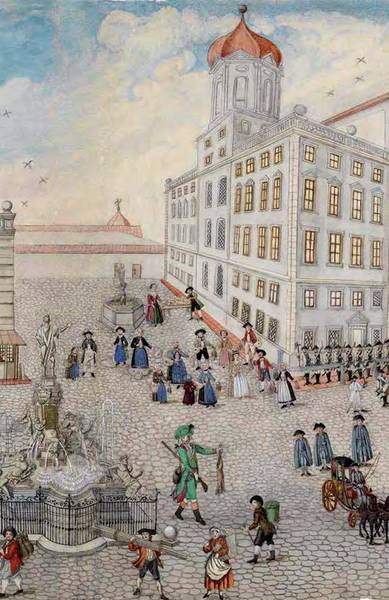 Augsburg war seit dem 16. Jahrhundert nicht nur eine Hochburg für den Buchdruck und die grafischeProduktion, hier entstanden ebenfalls sogenannte “Klebealben”. Diese wurden angelegt, um Kindern und Heranwachsenden aus bürgerlichen Familien die Welt zu erklären.
Die Jugendlichen schnitten aus eigens zu diesem Zweck herausgegebenen Bögen historische oder biblische Figuren, Tiere oderberühmte Bauwerke aus und klebten sie in gedruckte Vorlagen ein. Auch andere Druckgrafiken, Buntpapiere oder sogar Stoffe wurden zerschnitten und in die Klebealben eingefügt.
Das hier ausgestellte Klebealbum wurde nach 1780 für die Juwelierstochter Regina Barbara Waltherangelegt. Teile des Albums wie gezeichnete und kolorierte Figuren und Raumsituationen wurdenvermutlich bei dem Zimmerpolier Balthasar Cornelius Koch in Auftrag gegeben. Auf den Seiten blieb aber genügend Platz, so dass Regina Barbara selbst Figuren ausschneiden und einkleben konnte. Das Album stellt “die Kunst zu Wohnen” vor und verschafft den Betrachtern so bis heute einen Einblick in das Leben des Augsburger Bürgertums im
18. Jahrhundert. . .
More from the museum’s website»
◊ ◊ ◊ ◊ ◊
From the publisher:
Georg Haindl, Die Kunst zu Wohnen: Ein Augsburger Klebealbum des 18. Jahrhunderts (Berlin: Deutscher Kunstverlag, 2010), 240 pages, ISBN: 978-3422070400, 40€.
 Als beliebte Alternativen zu den Puppenhäusern wurden in Augsburg als wichtiger Verlagsstadt des 18. Jahrhunderts so genannte „Klebealben” von liebenden Eltern für ihre Kinder angelegt. Sie zeigen neben zentralen Plätzen Augsburgs auch die Räume idealtypischer Bürgerhäuser, in die ausgeschnittene Darstellungen von Figuren, Möbeln oder Geschirren eingeklebt werden konnten. Als Ressource hierfür dienten nicht nur die Augsburger „Ausschneidebögen”, wie sie von den Verlagen Johann Martin Wills oder Martin Engelbrechts extra für diesen Zweck herausgegeben wurden, sondern auch Modejournale, Buntpapiere, Textilien oder alte Bücher, die zerschnitten wurden.
In der Publikation widmen sich mehrere Autoren einem besonders qualitätsvollen und gut erhaltenen Album, bei dem nicht Kinder, sondern Heranwachsende die Adressaten waren, um ihnen einen perfekt funktionierenden Haushalt vor Augen zu führen. Das Album wurde in den 1780er Jahren vermutlich von dem Zimmerpolier Balthasar Kornelius Koch gefertigt und zeigt durch seine additive Darstellungsweise wichtige Aspekte des bürgerlichen Lebens dieser Zeit in Augsburg – eine unschätzbare kulturhistorische Quelle.
New Book | Gainsborough’s Cottage Doors
From Paul Holberton:
Hugh Belsey, Gainsborough’s Cottage Doors: An Insight into the Artist’s Last Decade (London: Paul Holberton, 2013), 120 pages, ISBN: 978-1907372506, £25 / $40.
 The work of Thomas Gainsborough is characterized by a series of subjects that preoccupied him, which with time he was able to hone and define more clearly. Inspired by the recent identification of a third autograph version of his masterpiece The Cottage Door, this book examines the significance of the multiple versions of designs that the artist produced during the 1780s. It demonstrates that without the pressure of exhibiting his work annually at the Academy and without a string of sitters waiting for their finished portraits, Gainsborough’s work became more personal, more thoughtful and searching.
A study of his unconventional background, training and early development as an artist provides some clues as to why Gainsborough came to use painting in this very personal way. It was not until the 1780s, however, that his creative energies really changed in this direction. He had never been happy with the constraints of the Royal Academy and he was at odds with the dictatorial opinions promoted by its president, Sir Joshua Reynolds. In removing himself from the Academy he cast off the shackles of producing paintings, competitive in their design and colouring, which inhibited the artist’s natural goals of likeness, subtlety and balanced tonality. He could now be choosey about the commissions he accepted, paint for his own pleasure and satisfy his own curiosity. He began to turn to portrait compositions that he had developed and refined over a number of years. With subtle alterations they could be made suitable for a variety of sitters. The margin between ‘fancy’ pictures and portraits became blurred and the categorization of some of these paintings changed while they were on the easel. Always finding composition difficult, rather than begin something new he often revisited earlier designs that had pleased him. He would paint them again and make slight changes of tone and emphasis that would radically change the concept and intention of the design.
Richly illustrated with beautiful new photography, this study of the last phase of the artist’s work is a totally fresh interpretation of not only the Cottage Door theme, which Gainsborough revisited over nearly 20 years, but other key late works such as Mrs Sheridan and Diana and Acteon. The subject matter in some of these late work veers towards the autobiographical and provides an invaluable insight into the artist’s personality and his very worrying concerns.
Hugh Belsey is currently Senior Research Fellow at the Paul Mellon Centre for Studies in British Art with the task of writing the definitive catalogue of portraits by Thomas Gainsborough.
Exhibition | Revisiting The Cottage Door: Gainsborough’s Masterpiece
From The Huntington:
Revisiting The Cottage Door: Gainsborough’s Masterpiece in Focus
The Huntington Library, San Marino, 1 June — 2 December 2013
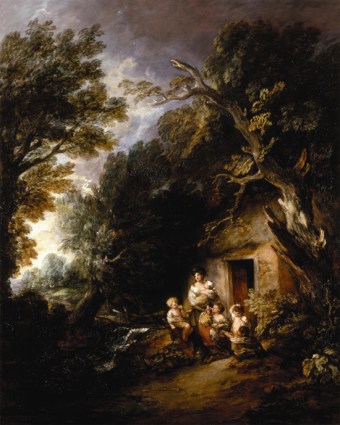
Thomas Gainsborough, The Cottage Door, ca. 1780
(San Marino: The Huntington)
The Cottage Door (ca. 1780), one of the treasures of The Huntington’s collections, is among Thomas Gainsborough’s most famous paintings. The idealized scene of rustic country life was exhibited at the Royal Academy in 1780, but both the subject and the composition continued to haunt the artist, and he repeated the design twice during the course of the decade. All three paintings are shown together for the first time in this special display, providing a unique opportunity to compare the subtle differences among them. Both of the later versions, on loan from private collections, are less finished than The Huntington’s canvas, and there are variations in tone and detail that give each a particular mood and a different emphasis.
A new book by Gainsborough specialist Hugh Belsey, Gainsborough’s Cottage Doors: An Insight into the Artist’s Last Decade, complements the installation. Inspired by the recent attribution of the third version, it examines how Gainsborough freed himself from the constraints of the Royal Academy and was able to make radical changes to his work during the last years of his
life.
Call for Articles | Collecting Italian Art North of the Alps
From RIHA Journal:
RIHA Journal Special Issue: Collecting Italian Art North of the Alps 1600–1800
Submissions due by 1 December 2013
The Italian schools occupied central positions in early modern art collections, a tradition that continued through the 19th and 20th centuries. The primacy of Italian art became a cornerstone for museum practice as well as a founding principle for the nascent art history discipline. This issue takes a closer look at the beginning of this tradition in the 17th and 18th century. Since the 1960s (and before), scholars have taken an interest in the Grand Tours of princes, aristocrats and connoisseurs. More recent research has added to the picture by discussing the collecting activities of artists, architects, diplomats, dealers and scholars, and of women collectors and travellers. Further advances in the last few years have included investigations of the Italian art market(s), early modes of display, legal and illegal ways of export and curatorial strategies in the early princely collections and private museums. Although pictures and sculptures have been most in focus, scholars are also bringing these questions with a new interest to collections of the applied arts, prints and drawings (including architectural and decorative drawings).
The issue could include (but does not have to be restricted to) studies of individual collectors and collectors, primary and secondary art markets, the history and theory of display, the export and physical transportation of art, auctions, bequests, the supply of and demand for particular schools, changing attitudes to individual artists, the rise of the interest in the “primitivi,” looting, copying, and the political and nation-building dimensions of collecting.
Suitable submissions will be sent to two expert peer reviewers for blind review. Articles should be no longer than 50,000 characters (including spaces) or 8,000 word, both measures including footnotes and captions. Up to 10 illustrations will be accepted. Contributions in English, French, Italian or German are welcome. Please follow the RIHA Journal Style Guide. Please send your contributions, including a 250-word abstract, to the editors at linda.hinners@nationalmuseum.se by 1 December 2013.
Kind regards,
Martin Olin, Assistant Director, Swedish Institute in Rome. Guest Editor of “Collecting Italian Art North of the Alps”
Magdalena Gram, RIHA Journal Local Editor
Linda Hinners, Assistant Local Editor, Nationalmuseum, Stockholm










 Enfilade
leave a comment