Symposium | Textile Translations
From the conference website:
Textile Translations: Intermedia Processes of Textile Transfer in the Arts
University of Zurich, 6-7 June 2013
Organised by Anika Reineke and Anne Röhl (ERC-Project “Textile – An Iconology of the Textile in Art and Architecture,” University of Zurich)
Processes of transfer and translation are crucial to the production and fashioning of textile materials: In the production of textiles, images taken from other media are submitted to the structure of warp and weft or translated into loops, stitches and knots. Thus, every textile technique requires translations and alterations of the original draft, even if the relation of the transferred subject or pattern to the media varies according to the technique: In the case of a woven image or a textile print, image and support are inseparable, though an embroidered motif, however, can be clearly distinguished from its backdrop. Translations into the textile and vice versa inevitably entail variation, mutation and adaptation. In this way translation processes leave traces inscribed in the particular object.
Because of the variety of manufacturing processes and their flexibility and malleability as material, technique, medium and metaphor, textiles provide a number of starting points for future research on processes of transfer. The symposium Textile Translations seeks to investigate these. In doing so, it is not the intent to focus on the alleged hierarchy of the original and the copy – or a comparison of before and after – but rather on the process of translation and its effects and implications. In this regard, textiles can be positioned at the beginning and end of such processes, or even due to their flexibility and adaptability, embody transitory conversion. Focusing on the process as the ‘inbetween’, the interactions of textiles and other media are the main concern of the symposium.
◊ ◊ ◊ ◊ ◊
T H U R S D A Y , 6 J U N E
14:00 Anika Reineke and Anne Röhl (University of Zurich), Welcome and Introduction
I. Appropriation of Textile Crafts
Chair: Merel van Tilburg (University of Geneva)
14:15 Leena Crasemann (Freie Universität Berlin), Sewing. Unravelling. Cutting. Of Sewn Everyday Things and Textile Art Objects
14:45 Sara Martinetti (EHESS/INHA, Paris), The Fabricated Image. Pictorial and Textile Situations in the Work of
Robert Gober
15:15 Discussion
15:30 Caroline Schopp (University of Chicago) “…draw him from behind”. The Roth-Wiener Tapestry Collaboration,
1974–1998
16:00 Discussion
16:15 Coffee
II. Textile Transfer
Chair: Anne Röhl (University of Zurich)
16:45 Kathrin Fehringer (University of Erfurt), Textile Handarbeit als Raumkonstitutiv: Das Bild des ‚hortus conclusus’ in Flauberts Madame Bovary
17:15 Johanna Függer (University of Vienna), Hanna(h) Höchs Stickerei der Avantgarde
17:45 Discussion
F R I D A Y , 7 J U N E
9:30 Coffee and Welcome
III. Translations of Motifs, Patterns, and Objects
Chair: Anika Reineke, Tristan Weddigen (University of Zurich)
9:45 Vera-Simone Schulz (KHI, Florenz), Text(ile)s Translated. Woven Words in 14th-Century Italian Painting
10:15 Ariane Koller (University of Berne), Gewirkte Wissenschaft – Kartographierte Geschichte. Intermediale
Transferprozesse zwischen Tapisserien und Karten
10:45 Discussion
11:00 Coffee
11:15 Liza Oliver (Northwestern University, Chicago), Don Quixote in 18th-Century India. Translation and Migration of Indian ‘Kalamkari’ Textile Designs for France
11:45 Karin Westphal-Erikson (University of Copenhagen), Porous ‘Paintings’ – Asger Jorn’s Textile Art in between Painting and Architecture
12:15 Discussion
13:00 Closing remarks
Exhibition | Revisiting the Picture Gallery of Frederick the Great
From the Prussian Palaces and Gardens Foundation (SPSG):
The Most Beautiful Gallery: Revisiting the Picture Gallery of Frederick the Great
Sanssouci, Picture Gallery, Potsdam, 9 May — 31 October 2013
As for the gallery, after St. Peter’s in Rome, it is undisputedly the most beautiful thing there is in the world. –Marquis d’Argens to Frederick the Great, 1761
 The Picture Gallery in Sanssouci Park ranks among the first and most magnificent buildings in Europe to be erected specifically for an art collection. Together with the paintings and sculptures selected by Frederick the Great, the building, adorned with portrayals of the arts and precious materials, constitutes a unique overall work of art. As a fitting expression of connoisseurship and education, at the same time it pointed to the importance of the Kingdom of Prussia. 250 years after it was first opened, visitors are now being invited to view through the eyes of Frederick this ‘queen’ of all gallery beauties.
The Picture Gallery was finished in 1763, and the cabinet was hung with paintings in 1764. Many of the masterpieces – for example, by Peter Paul Rubens and Carlo Maratta as well as by sculptors such as Jean-Baptiste Lemoyne and Louis-Claude Vassé – still hang here today. The collection of more than 180 paintings and sculptures has undergone powerful changes since its founding, however. The Prussian Palaces and Gardens Foundation Berlin-Brandenburg is now re-introducing the Gallery in a way that corresponds to the original furnishing concept of its royal builder.
 For the first time since 1830, antique sculptures, on loan from the Collection of Antiquities and the Sculpture Collection at the Staatliche Museen zu Berlin as well as the Muzeum Narodowe in Poznan, are coming to Sanssouci, where they may be admired in the Gallery once again. Among the pieces is the famous statuette of the Girl Playing Knucklebones. The Frederician manner of hanging paintings has been visualized in a photograph presentation. Particularly distinctive is the new hanging of the paintings in the small cabinet: With the return of works in 2010 that were long thought to be war losses, a closer approximation to the historical wall-to-wall hanging has been achieved. Thus, it is now possible to experience the overwhelming gallery rooms in a completely new manner as architecture, painting, and sculpture engage with one another in a unique dialogue.
Catalogue: Die Schönste der Welt: Eine Wiederbegegnung mit der Bildergalerie Friedrichs des Großen (Berlin: Deutscher Kunstverlag, 2013), 144 pages, ISBN 978-342207184, €15.
Additional information is available at ArtDaily»
Forthcoming Book | The Museum of the Horse
From Prestel:
Philip Jodidio, ed., The Museum of the Horse (London: Prestel, 2013), 176 pages, ISBN: 978-3791352985, £30 / $50.
 One of France’s most visited monuments, the Château de Chantilly features gardens by André Le Nôtre, a world-renowned art collection and impressive stables, which were the center of eighteenth-century French equestrian culture and transformed into a captivating museum in 1982. Now, under the auspices of the Aga Khan and the Foundation for the Safeguarding and Development of the Domain of Chantilly, the Museum of the Horse has undergone an extensive renovation. In addition to detailing the contents of the museum’s galleries, this beautifully illustrated volume explores the important role that Chantilly has played in horse racing and hunting. It takes readers on a tour of the historic stables and surrounding grounds and, in personal essays, looks at the close ties between horse and rider through the centuries.
Philip Jodidio is the author of more than 75 books on architecture.
Exhibition | Raynal: Un regard vers l’Amérique
From the Bibliothèque Mazarine:
Raynal: Un regard vers l’Amérique
Bibliothèque Mazarine, Paris, 13 June – 15 September 2013
Curated by Gilles Bancarel and Patrick Latour
 Le nom de Guillaume-Thomas Raynal reste attaché à son œuvre majeure, l’Histoire philosophique et politique des établissements et du commerce des Européens dans les deux Indes. Cette compilation à visée encyclopédique, l’un des grands succès de librairie de la fin du XVIIIe siècle, suscita autant de critiques que d’éloges de la part de ses contemporains. Elle apparaît comme pleinement représentative d’un paysage éditorial marqué par l’évolution du simple récit de voyage vers la réflexion philosophique sur le rôle de l’Europe dans le monde, particulièrement sur le continent américain.
Le tricentenaire de la naissance de l’abbé Raynal (1713-1796) est l’occasion de mettre en valeur la singularité du regard porté par un homme des Lumières sur l’Amérique, regard plongé dans l’actualité du moment – la guerre d’Indépendance dont il se fait le chroniqueur – mais aussi annonciateur des profondes transformations politiques et sociales qu’engagera la Révolution française, notamment l’abolition de l’esclavage. Ce regard est aussi le reflet des lectures multiples dont s’est nourri un auteur qui n’a lui-même jamais
traversé l’Atlantique.
Autour de différentes éditions de l’Histoire philosophique des deux Indes, l’exposition présente les ouvrages emblématiques de la riche production livresque consacrée, du XVIe au XVIIIe siècle, au Nouveau Monde : récits de la découverte et des premiers établissements, relations de colons ou observations de voyageurs. La guerre d’Indépendance, la condition des esclaves dans les colonies européennes, la diffusion et la réception des thèses de Raynal y sont appréhendées par les témoignages, manuscrits ou imprimés, des penseurs des Lumières. Livres rares, journaux, documents d’archives ou simples brochures illustrent ainsi la place éminente occupée depuis 1492 par l’Amérique dans le débat d’idée européen et l’imaginaire collectif.
The Historical Journal, March 2013
From The Historical Journal:
David Gilks, “Attitudes to the Displacement of Cultural Property in the Wars of the French Revolution and Napoleon,” The Historical Journal 56 (March 2013): 113-43.
 Abstract: The French state expropriated an enormous quantity of cultural property from across Europe during the Wars of the Revolution and Napoleon, but much was returned in 1815 after the fall of the Empire. This article examines contemporary attitudes to the displacement of works of art, antiquities, scientific specimens, and rare books. The seizures were controversial: since they occurred at a time when plundering the vanquished was already considered questionable behaviour, they attracted opposition and needed to be justified. The article identifies the resulting repertoire of attitudes, arguing that this repertoire evolved with changing circumstances and was more varied than hitherto maintained. By situating this repertoire in a larger historical context, the article also reassesses the extent to which attitudes were derivative and innovative. It contends that the disputation as a whole did not amount to a decisive rupture in the treatment of foreign cultural property during wartime, but that it was nevertheless remarkable in two respects: concepts from hitherto unrelated subjects were applied to considerations about cultural property; and the perceived conditions under which cultural property could be legitimately transferred were revised.
Exhibition | Home, Land, and Sea: Art in the Netherlands
From the Manchester Art Gallery:
Home, Land, and Sea: Art in the Netherlands, 1600-1800
Manchester Art Gallery, 24 May 2013 — 23 May 2014
Curated by Henrietta Ward

Aelbert Cuyp, River Scene with a View of Dordrecht, oil on panel (Manchester Art Gallery)
Home, Land, and Sea: Art in the Netherlands, 1600-1800 is a new exhibition which brings together over 50 paintings from Manchester City Galleries’ exceptional 17th- and 18th-century Dutch and Flemish collection, one of the most important in the country. It includes exquisite paintings of everyday life, portraiture, landscapes, seascapes, and still lifes by Pieter de Hooch, Gerard ter Borch, Jacob van Ruisdael and many more. Some of these paintings have not been on display for tens of years, while others have benefited from recent conservation treatment.
For the first time these paintings will be juxtaposed with works by major contemporary artists such as Mat Collishaw’s Last Meal on Death Row, Texas series, sculptures of gnawed apples by Gavin Turk, and Rob and Nick Carter’s homage to Ambrosius Bosschaert: Transforming Still Life Painting. Alongside the seascapes will be Bachelor Machines Part I, a film by 2013 Northern Art Prize nominee Rosalind Nashashibi that focuses on the lives of an all-male crew on board the Gran Bretagna, a modern-day cargo vessel. This exhibition has been curated by Henrietta Ward, The National Gallery Curatorial Trainee supported by the Art Fund.
◊ ◊ ◊ ◊ ◊
From Hettie Ward’s blog for the exhibition, Manchester’s Dutch and Flemish Collection:
February’s Painting of the Month — Innocent Nostalgia or Outright Fraud?
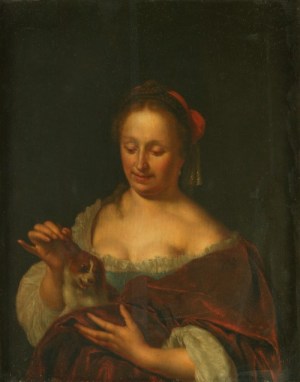
Willem van Mieris, Woman Pulling on a Dog’s Ear,
16 x 12.5 cm (Manchester City Galleries)
This month’s painting is an extension of my previous post which looked at the fineness that can be found in Dutch paintings, particularly the fijnschilders, such as Willem van Mieris (1662-1747). We have 2 works by Willem van Mieris in the collection: Interior with a Cavalier and Lady and the Painting of the Month: Woman Pulling on a Dog’s Ear, which both came to the Gallery through the Assheton Bennett bequest. Woman Pulling on a Dog’s Ear is miniscule and only measures 16 x 12.5 cm (27 x 23.4cm framed) and is so intricately painted that you can’t make out a single brushstoke.
The painting is a portrait of the artist’s mother, Cunera van der Cock, but it is actually a copy of a painting by his father, Frans van Mieris (1635-1681). The original is in the collection of Worcester Art Museum, USA, along with its companion piece A Soldier Smoking a Pipe, or self-portrait of the artist. The Worcester pair dates to 1662 and both measure 14 x 11cm. You can see them here. Willem van Mieris also made a copy of the companion piece, now in a private collection.
Willem’s painting is an incredibly good copy, and whilst the initial reaction is to dismiss Manchester’s version as being just that, there is actually a lot more to it which touches on elements of fraud — to a certain extent — and brings into question the whole value of a fake. It is with great thanks to the recent research of the art historian and academic Junko Aono that this painting can be reassessed and valued in terms of the 18th-century revival of the Dutch Golden Age, and turns it from being an interesting copy to a fascinating bit of history. Much of what I have learnt about this painting has come from her article ‘Reproducing the Golden Age: Copies after Seventeenth-Century Dutch Genre Painting in the First Half of the Eighteenth Century’ in Oud Holland Vol. 121, 2008, no. 1, and I urge you to read it yourselves if you can get hold of a copy. . . .
Read Ward’s full posting here»
Glidden and The Cleveland Museum of Art
Last month’s ASECS meeting in Cleveland delivered all sorts of intellectual stimulation, including a lovely reception at The Cleveland Museum of Art, where The Last Days of Pompeii is on show until May 19. We can add the museum to the list of institutions making the most of sponsorship opportunities to include installation wall paint, in this case from Glidden. Given that Glidden’s headquarters have been in the Cleveland area since the company’s founding in 1875, the relationship makes sense. Copies of the following card were available at the exhibition, though interestingly not online (at least, I was unable to find it and thus the less than ideal colors and clarity from my scan). -CH

New Book | Women and Gender in Early Modern Europe
From Ashgate:
Allyson Poska, Jane Couchman, and Katherine McIver, The Ashgate Research Companion to Women and Gender in Early Modern Europe (Aldershot: Ashgate, 2013), 572 pages, ISBN: 978-1409418177, $150.
 Over the past three decades scholars have transformed the study of women and gender in early modern Europe. This Ashgate Research Companion presents an authoritative review of the current research on women and gender in early modern Europe from a multi-disciplinary perspective. The authors examine women’s lives, ideologies of gender, and the differences between ideology and reality through the recent research across many disciplines, including history, literary studies, art history, musicology, history of science and medicine, and religious studies. The book is intended as a resource for scholars and students of Europe in the early modern period, for those who are just beginning to explore these issues and this time period, as well as for scholars learning about aspects of the field in which they are not yet an expert. The companion offers not only a comprehensive examination of the current research on women in early modern Europe, but will act as a spark for new research in the field.
Allyson M. Poska is Professor of History at the University of Mary Washington, USA and co-editor of Ashgate’s ‘Women and Gender in the Early Modern World’ book series. Jane Couchman is Professor Emerita of French Studies, Women’s Studies and Humanities at Glendon College, York University, Toronto. Katherine A. McIver is Professor Emerita of Art History at the University of Alabama at Birmingham.
◊ ◊ ◊ ◊ ◊
C O N T E N T S
Introduction, Allyson M. Poska, Jane Couchman and Katherine A. McIver
Part I | Religion
The permeable cloister, Elizabeth A. Lehfeldt
Literature by women religious in early modern Catholic Europe and the New World, Alison Weber
Convent creativity, Marilynn Dunn
Convent music: an examination, Kimberlyn Montford
Lay patronage and religious art, Catherine E. King
Female religious communities beyond the convent, Susan E. Dinan
Protestant movements, Merry Wiesner-Hanks
Protestant women’s voices, Jane Couchman
Part II | Embodied Lives
Maternity, Lianne McTavish
Upending patriarchy: rethinking marriage and family in early modern Europe, Allyson M. Poska
The economics and politics of marriage, Jutta Gisela Sperling
Before the law, Lyndan Warner
Permanent impermanence: continuity and rupture in early modern sexuality studies, Katherine Crawford
Women and work, Janine M. Lanza
Old women in early modern Europe: age as an analytical category, Lynn Botelho
Women on the margins, Elizabeth S. Cohen
Women and political power in early modern Europe, Carole Levin and Alicia Meyer
Part III | Cultural Production
The Querelle des femmes, Julie D. Campbell
Intellectual women in early modern Europe, Diana Robin
Women in science and medicine, 1400-1800, Alisha Rankin
Early modern women artists, Sheila ffolliott
Beyond Isabella and beyond: secular women patrons of art in early modern Europe, Sheryl E. Reiss
Material culture: consumption, collecting and domestic goods, Katherine A. McIver
Images of women, Andrea Pearson
Women, gender, and music, Linda Phyllis Austern
2012-13 Clifford Prize | Messbarger on the Florentine Anatomical Venus
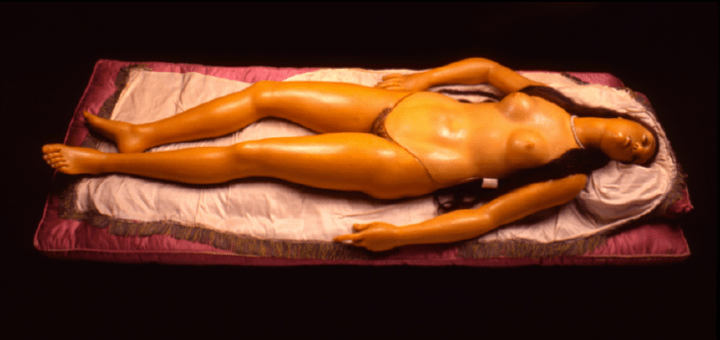
Anatomical Venus, ca. 1780, wax, Museum of Natural History in Florence
(Photo: Saulo Bambi)
◊ ◊ ◊ ◊ ◊
ASECS recently announced that the 2012-13 James L. Clifford Prize was awarded to Rebecca Messbarger for her article “The Re-Birth of Venus in Florence’s Royal Museum of Physics and Natural History” published by the Journal of the History of Collections (May 2012): 1-21.
Messbarger is the author of The Lady Anatomist: The Life and Work of Anna Morandi Manzolini (Chicago: University of Chicago Press, 2010).
Study Day | Le sens du métier: identité et organisation
From Entre art et industrie:
Le sens du métier : identité et organisation dans les métiers
d’art et d’industrie en France (XVIIe-XXe siècles)
Université Paris, 31 May 2013
 L’historiographie a longtemps fait de l’organisation corporative le pilier institutionnel du monde des métiers sous l’Ancien Régime, s’enfermant ainsi dans un débat opposant « corporatisme » et « libéralisme », et faisant des lois de 1791 l’aboutissement d’un long combat des libéraux contre le supposé archaïsme des communautés d’arts et métiers. Depuis une vingtaine d’années, cette vision ancienne a été complètement révisée : il importe de distinguer entre l’exercice d’une profession et l’appartenance à une corporation ; toutes les professions ne sont pas uniformément « instituées » en métiers corporés ; les réalités professionnelles sont bien plus diverses ; enfin, la dissolution des corporations en 1791 n’a pas supprimé tous les besoins organisationnels ou réglementaires, pas plus que les représentations identitaires des différentes professions artisanales. Ainsi, d’une part, la conscience d’une appartenance professionnelle a existé sous l’Ancien Régime en dehors de la forme corporative, et d’autre part, les identités de métier ont continué d’exister après l’abolition des corporations.
Cette journée d’études est consacrée au cas des professions d’art, qui oscillent entre « art » et « industrie » dans les représentations communes, et se situent précisément bien souvent en dehors du système corporatif : comment penser alors l’identité de métier, quand le savoir-faire ne s’incarne pas dans une forme instituée susceptible de cristalliser et manifester à la fois une appartenance collective, de découper un « eux » et un « nous » ? Quel sens, en somme, peut avoir le métier sans corporation ?
◊ ◊ ◊ ◊ ◊
9.45 Accueil, café/thé
10.00 Introduction : Philippe Minard, Audrey Millet (IDHE-Paris 8)
10:15
• Lesley Miller (Victoria and Albert Museum, Londres), Un pied dans la Grande Fabrique. Les dessinateurs de la soierie lyonnaise au XVIIIe siècle
• Audrey Millet (Université Paris 8, IDHE), Dessiner des indiennes de Pondichéry à New-York : une organisation en réseaux (XVIIe-XIXe siècles)
11.15 Discussion : Corine Maitte (Université Paris-Est-Marne-la-Vallée)
12.00 Repas sur place
13.45
• Elodie Voillot (Université Paris Ouest – INHA), Unir, promouvoir et protéger : la Réunion des fabricants de bronzes (1818-1870)
• Eugénie Briot (Université Paris-Est-Marne-la-Vallée), Inspiration vs oxydoréductions : le métier de parfumeur au XIXe siècle, entre chimie et alchimie
• Jérémie Cerman (Université Paris-Sorbonne), L’atelier de dessin industriel de Robert Ruepp, une entreprise prédominante de la Belle Époque
15.15 Discussion : Patrick Verley (Université de Genève)










 Enfilade
leave a comment