Online Talk | Vanessa Sigalas on Meissen Figures
As noted at Events in the Field:
Vanessa Sigalas | All Walks of Life: Meissen Porcelain Figures of the 18th Century
Online, Connecticut Ceramics Circle, 9 December 2024, 2pm (EST)
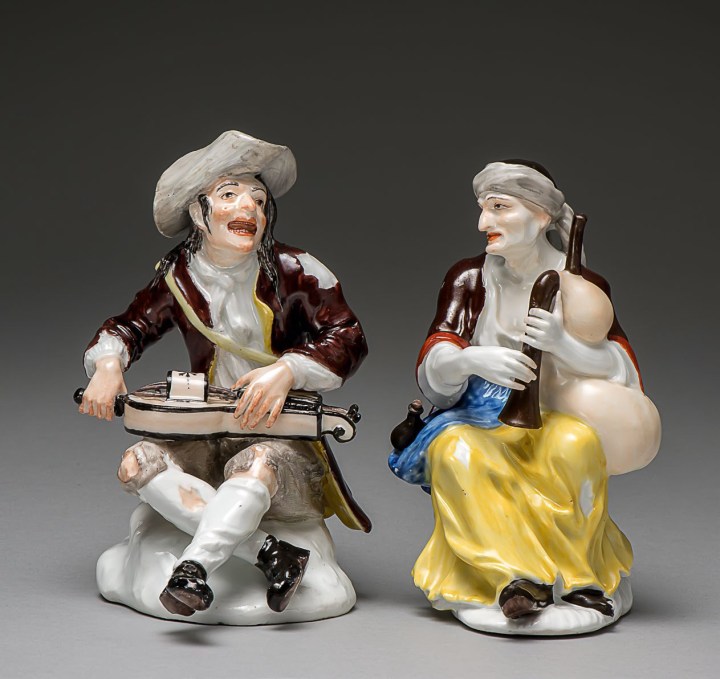
Pair of Figures of Beggar Musicians, German, Meissen Porcelain Manufactory, models by Johann Joachim Kaendler (1706–1775). Original year of modelling: ca. 1736; beggar-woman reworked later. Date of porcelain paste: both ca. 1730–65; date of decoration: both 18th century. Hard-paste porcelain. Man: Blue crossed swords mark on base; woman: no marks. Heights: man 13.4 cm; woman 13 cm. Model no. man: 918; woman: 915. Shimmerman Collection nos. MPBP_16 & 17.
Dr. Vanessa Sigalas will guide the audience through a captivating exploration of 18th-century life in Saxony, Paris, London, and St. Petersburg, using Meissen porcelain sculptures from the Alan Shimmerman Collection in Toronto, Canada, as well as the Wadsworth Atheneum’s collection in Hartford, Connecticut. Renowned master modeler Johann Joachim Kaendler, in collaboration with his fellow modelers at Meissen, portrayed glimpses of daily existence, meticulously capturing even the minutest details. From the carefully arranged trinkets of a street vendor to the intimate script of a love letter and the culinary tools of a cook preparing a hare, Kaendler’s work unveils the richness of ‘All Walks of Life’.
The Alan Shimmerman Collection, with its emphasis on groups of criers (street sellers) and artisans, offers a fresh perspective on the inception, production, and dissemination of Meissen porcelain. Dr. Sigalas’s lecture is based on her recently published collection catalogue bearing the same title, providing an immersive journey into the intricate world of 18th-century European society as depicted through these masterfully crafted sculptures.
Vanessa Sigalas holds a Dr. phil. in Art History from the Eberhard-Karls-Universität Tübingen, Germany. She joined the Wadsworth Atheneum in 2011, As an art historian, Sigalas specializes in European art from the 17th to the first half of the 20th centuries, especially 18th- and 19th-century German porcelain. One of her research interests is the connection between ivory and porcelain, particularly at the Dresden Court of Augustus the Strong (1670–1733). At the Wadsworth, she works with American and European decorative arts and sculpture from the ancient to the modern worlds, but also explores the collections of non-Western art. Despite her deep love for books and archives, Sigalas has always enjoyed the hands-on work with objects. In 2013, she assisted with the Storage Renovation and Relocation Project, and in 2015 she was part of the team to reinstall the European art collections, where she assisted the curatorial team and led the installation team of decorative arts.
She has published in a variety of journals, exhibition catalogues, and books. Her latest book, All Walks of Life: A Journey with the Alan Shimmerman Collection (2022), focuses on Meissen porcelain figures from the 18th century. She has taken on the role of editor for several publications, with her most recent work being Morgan—The Collector: Essays in Honor of Linda Roth’s 40th Anniversary at the Wadsworth Atheneum Museum of Art, co-edited with Jennifer Tonkovich. Additionally, she served as the managing editor of the American Ceramic Circle Journal from 2015 to 2023. Sigalas has curated exhibitions in Germany and the US. Her most recent exhibitions at the Wadsworth include, in conjunction with director Matthew Hargraves, Between Life & Death: Art and the Afterlife (Fall 2023), as well as the community-focused and staff-curated exhibition, Styling Identities: Hair’s Tangled Histories, which was on view until August 2024.
The Burlington Magazine, November 2024
The long 18th century in the November issue of The Burlington:
The Burlington Magazine 166 (November 2024)
e d i t o r i a l
 “The Life Cycle of Art History,” p. 1099.
Art history is withering. Art history is flourishing. Which of these statements is true? Very mixed impressions can be gathered from across the United Kingdom, where the future health and reach of the academic discipline is far from clear. Amid all this uncertainty, however, there are some inspiring developments that should be applauded.
a r t i c l e s
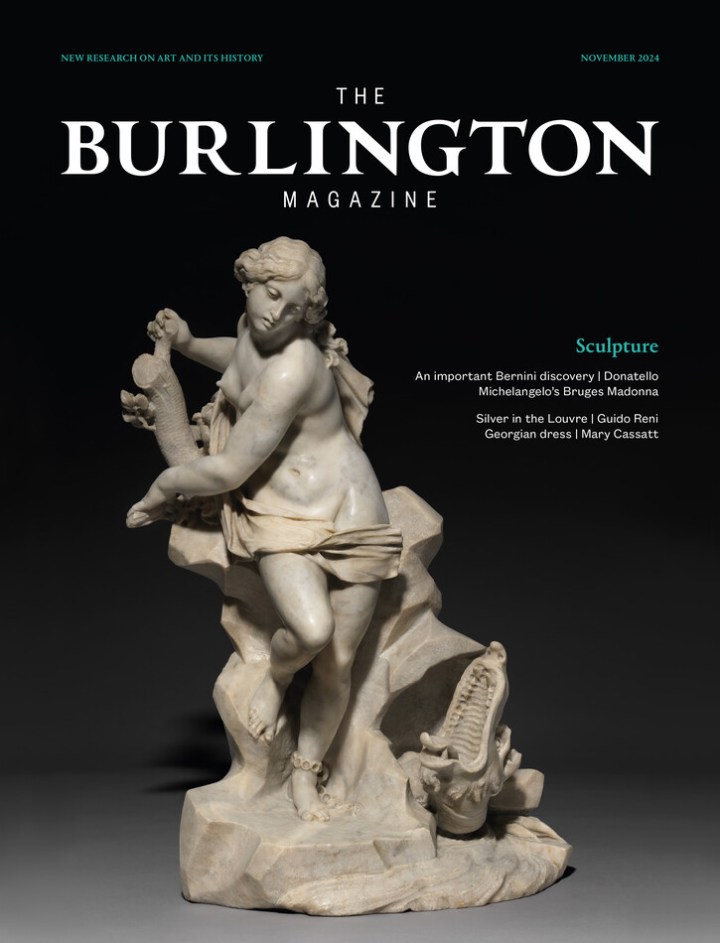
• Maichol Clemente, “‘Une pièce fort singulière’: The Rediscovery of Gian Lorenzo Bernini’s Andromeda and the Sea Monster,” pp. 1100–22.
An important early sculpture by Gian Lorenzo Bernini, Andromeda and the Sea Monster, is here attributed to him and published for the first time. It displays all the finesse and invention that characterises the work of his youth and is also notable for having been offered to Jean-Baptiste Colbert, First Minister of Louis XIV, before forming part of the collection of the Prince of Soubise [in the eighteenth century.]
r e v i e w s
• William Barcham, Review of the exhibition catalogue, Les Tiepolo: Invention et Virtuosité à Venise, edited by Hélène Gasnault with Giulia Longo and a contribution by Catherine Loisel (Beaux-Arts de Paris, 2024), pp. 1176–78.
• Erin Griffey, Review of the exhibition catalogue, Style & Society: Dressing the Georgians, by Anna Reynolds (Royal Collection Trust, 2023), pp. 1178–80.
• Philippa Glanville, Review of the catalogue of the Louvre’s silverware, Orfèvrerie de la Renaissance et des temps modernes: XVIe, XVIIe et XVIIIe siècles: La Collection du Musée du Louvre, by Michèle Bimbenet-Privat, Florian Doux, and Catherine Gougeon, with Philippe Palasi, 3 volumes (Éditions Faton, 2022), pp. 1186–87.
• Giulio Dalvit, Review of the catalogue, Galleria Borghese: Catalogo Generale I: Scultura Moderna, edited by Anna Coliva with Vittoria Brunetti (Officina Libraria, 2022), pp. 1192–93.
• Gauvin Alexander Bailey, Collective Creativity and Artistic Agency in Colonial Latin America, edited by Maya Stanfield-Mazzi and Margarita Vargas-Betancourt (University of Florida Press, 2023), pp. 1193–94.
• Charles Avery, Review of Die Bronzen des Massimiliano Soldani Benzi (1656–1740): Representationsstrategien des europäischen Adels um 1700, by Carina Weißmann (De Gruyter, 2022), p. 1195.
• Pierre Rosenberg, Review of the catalogue, French Paintings 1500–1900: National Galleries of Scotland, by Michael Clarke and Frances Fowle, 2 volumes (National Galleries of Scotland, 2023), pp. 1196–97.
Exhibition | The Art of French Wallpaper Design

Installation view of the exhibition The Art of French Wallpaper Design at the RISD Museum, November 2024.
◊ ◊ ◊ ◊ ◊
The exhibition is accompanied by an online publication:
The Art of French Wallpaper Design
RISD Museum, Providence, 16 November 2024 — 11 May 2025
The Art of French Wallpaper Design explores the vibrant, surprising designs that adorned walls in the 1700s and 1800s. Featuring more than 100 rare samples of salvaged wallpapers, borders, fragments, and design drawings, this exhibition reveals the creative process and showcases the extraordinary technical skills involved in producing these works, presenting an invaluable resource for artists and enthusiasts alike. This exhibition celebrates the vision and generosity of collectors Charles and Frances Wilson Huard, whose remarkable collection, assembled in the 1920s and ’30s, is now in the care of the RISD Museum. Accompanied by a comprehensive digital publication, The Art of French Wallpaper Design invites you to explore the remarkable innovation and craftsmanship of these historic pieces.
◊ ◊ ◊ ◊ ◊
Lyra Smith, ed., with contributions by Emily Banas, Brianna Turner, and Andrew Raftery, The Art of French Wallpaper Design (Providence: Rhode Island School of Design Museum, 2024), available online»
The vibrant designs of French papier peint (literally meaning painted paper) that adorned walls in the 1700s and 1800s were collected and donated to the museum by French artist Charles Huard and his wife, American writer Frances Wilson Huard. The Huard Collection is a rare resource due to the fragile and ephemeral nature of wallpapers. This free online publication explains the preservation methods used to take care of the wallpapers along with components made in the process, such as design drawings and woodblocks. The attentive care taken to preserve the materials made during each phase of the design process make the Huard Collection an ideal teaching collection.
Essays
• Introduction to French Wallpaper — Emily Banas
• About the Huard Collection — Emily Banas
• Conservation and the Huard Collection: Preserving the Processes of Making — Brianna Turner
• Printing Matters: Wallpaper in the Context of Printmaking — Andrew Raftery
The Collection
The RISD Museum contains one of the most significant collections of French 18th- and 19th-century wallpapers in the United States with approximately 500 wallpaper panels, borders, fragments, and design drawings. Here, you can browse the wallpapers by their collections, colors, motifs, or time periods.
The Making of Wallpaper
This video provides a guided, in-depth look at seven different wallpapers in the Huard Collection. Watch, listen, and learn about the hidden stories these wallpapers can tell us about their design, making, and use.
New Book | Quatremère de Quincy: Art and Politics
From Oxford UP:
David Gilks, Quatremère de Quincy: Art and Politics during the French Revolution (Oxford: Oxford University Press, 2024), 288 pages, ISBN: 978-0198745563, £90.
 Antoine-Chrysosthôme Quatremère de Quincy (1755–1849) was the most distinguished writer on art and architecture at the end of the enlightenment. However, as David Gilks shows, he was never simply an esoteric antiquarian and theoretician; he was also a zealous functionary and skilled publicist whose writings on the arts often served political purposes.
Quatremère de Quincy: Art and Politics during the French Revolution demonstrates how Quatremère’s early writings on art and antiquity formed the foundation for a politics grounded in faith, authority, and hierarchy that favoured gradual social and political evolution over destruction and experimentation. Gilks then traces how Quatremère set aside his antiquarian research and became a royalist politician and publicist during the revolutionary decade. Quatremère feared that the Revolution would destroy the cosmopolitan republic of letters that had flourished when states across Europe supported the papacy’s rediscovery of the past, restoration of taste and, revival of learning. Yet Gilks reveals that Quatremère was also a resourceful and an opportunistic political actor who deployed his opponents’ language for strategic reasons. Gilks therefore reinterprets Quatremère’s interventions by situating them in their polemical contexts and treating them as contributions to debates and quarrels, by locating his sources and reconstructing his social and political networks. The resulting study revises our understanding of Quatremère’s famous reflections on the Academy of Painting and Sculpture, the Panthéon, art plunder, and museums, but it also discovers and sheds light on previously ignored writings. Although the study focuses on the period between 1789 and 1799, it examines the second half of Quatremère’s life to substantiate his commitment to crown and altar and show how he fought against the Revolution’s legacy of godless materialism and calculation that was inimical to the arts.
This is a thoroughly researched and richly detailed contextual study of the most eventful period in Quatremère’s life, offering an original and unfamiliar history of the French Revolution. Gilks integrates the study of political power with the history of ideas and art history and provides a window into institutional and legal reforms and debates about cultural patronage and education.
David Gilks was educated at Trinity College, Cambridge, and then won a Henry Fellowship to Harvard. After returning to Cambridge for his doctoral thesis, he was a Junior Research Fellow at Christ Church, Oxford, and a Leverhulme Early Career Fellow at Queen Mary University London. He is currently Lecturer in Modern European History at the University of East Anglia. His research has been published in The Historical Journal, French Historical Studies, and Urban History. He is the first English-language translator of Quatremère de Quincy’s Letters on the Plan to Abduct Monuments of Art from Italy.
c o n t e n t s
Abbreviations
Note on Names and and Language
Biographical and Political Chronology
Introduction: An Unconventional History of the Revolution
1 The Making of a Missionary of Antiquity, 1755–85
2 The Friend of the Arts, 1785–89
3 Art in a Regenerated Nation, 1789–91
4 The Nation’s Temple, 1791
5 Devoted to the King, 1791–92
6 Republicanising the Pantheon, 1792–94
7 Standing for the Counter-Revolution, 1794–96
8 Justice to the Papacy, 1796
9 The Mask of Constitutionalism, 1796–99
Conclusion
Maps
Bibliography
Index
Call for Papers | Publics of the First Public Museums, Part 3
From the Call for Papers:
Publics of the First Public Museums: Visual Sources, 18th–19th Centuries
Los públicos de los primeros museos públicos: Fuentes visuales, siglos XVIII y XIX
Madrid, Museo Nacional del Prado, 5–6 June 2025
Organized by Carla Mazzarelli and David García Cueto
Proposals due by 20 January 2025
This conference is an integral part of the research project Visibility Reclaimed: Experiencing Rome’s First Public Museums, 1733–1870, An Analysis of Public Audiences in a Transnational Perspective (FNS 100016_212922) directed by Carla Mazzarelli. Marking the third of three encounters (building upon Institutional Sources and Literary Discourses), this workshop delves into the examination of visual sources, vital to understanding the forms of representation of early museums and their publics. We intend to investigate a vast range of visual sources, from views of internal and external spaces to architectural and display projects, from caricatures to illustrations published in catalogues, guidebooks, voyages pittoresques up to the (self)representation of publics, museum staff (directors, custodians, ciceroni), and artists within the museum.
Visual sources have long represented a privileged source for investigating the origins of the first public museums and the impact on their publics. However, in the light of recent studies aimed at deepening the material history of the museum and the encounter of the public with the institutions, these sources deserve closer scrutiny in both methodological and critical terms. As museums sought to define and engage their publics, visual sources often became both a mirror and a mould; they reflect and shape institutional and societal perceptions, contributing to build up the idea of museum but also to give a depiction of practices of access to public and private collections in Europe and in the world more widely.
The Museo Nacional del Prado welcomes this initiative as it has been involved since its foundation in 1819 in the process that the conference analyzes. The well known paintings that represent the spaces of Museo Nacional del Prado since its opening, such as those of Fernando Brambilla, are an important starting and comparison point for the theme at the center of the conference discussion. On the other hand, paintings depicting ‘quadrerie’ have been a codified genre since at least the 17th century. Such artworks have been read as sources for the study of the evolution of the display during the early modern age, but they also represent reference models for artists on how to represent the interiors of museum spaces, their publics, and staff.
The Prado conference aims, therefore, to answer the following questions:
• In what terms can visual sources be used as a starting point for a broader reflection on the definition and progressive evolution of the way of looking and experiencing the spaces of collecting and museums, increasingly opened to a general public from the late 18th century?
• What kind of visual representations of the publics in museums are privileged by institutions at the origins of their foundation?
• When and how can we recognize forms of self-representation and/or visual promotion of museum, its spaces and its staff?
• What can the images depicting the spaces of collecting and the first public museums tell us about the evolution of visitor’s gaze and of their encounter with the institutions?
We welcome papers offering new insights on the following topics and materials:
• The role of artists and architects specialized in the genre of the ‘museum’ view (paintings and prints). In particular, we will appreciate specific insights not only into the backgrounds and careers of specific, lesser-known personalities, but also into the methods they developed to ‘portray’ the museum and their audiences and any relationships they had with institutions.
• Architectural plans/sketches/drawings as a vehicle for the study of museography in relation to publics. From the drawing of ideal museums to the design of first public museums, we are interested in exploring how, through the study of published and unpublished graphic materials, we can reconstruct a history of museography for the public, at its origins.
• Facing each other: artists vs general publics. We are interested in investigating how the publics are represented in the first images depicting the museums, focusing in particular on the theme of the “encounter of the audiences” and the interrogatives that may emerge regarding gender, identity and culture issues within the early museums. In this context we are also interested in the role of satire and caricatures and what they can tell about social reception of museums, their staff and audiences.
• The role of illustration in periodicals, guides, catalogues, novels and literature in general dedicated to the museum and the related topic of “Museums at Hand” (maps, postcards, souvenirs, “portable museums”). We are interested in how visual narratives of the museum have been constructed to make it more accessible to the public. In particular, we encourage proposals on the relationship between visual and written narratives.
• The role of early photographs in/of the museum. We are also interested in exploring how photography contributes to disseminating the image of the museum to a wider public, as well as the material history aspects of its use in the museum.
With a spotlight on interdisciplinary and transnational approaches, the conference calls for a deeper probe into the visual and material realms of museums, emphasizing the interplay between visual sources, literary discourses, and artworks, collections, display, space, staff and audiences ‘narrated’ or ‘observed’ in the museum of the 18th and 19th centuries. We aim to broaden the horizon by drawing parallels with analogous visual documentation from other cultural spaces that the project seeks to study in comparative terms. This includes libraries, academies, galleries, private collections, villas, both ancient and modern monuments, archaeological sites, places of worship, theatres, ateliers, and more.
Key points to consider
• To foster dialogue around the most recent research endeavors on the topic, we especially encourage submissions from doctoral candidates and early-career researchers, who are currently delving into original themes and sources resonant with the workshop’s objectives.
• Preference will be given to applications showcasing interdisciplinary research approaches. This encompasses the melding of art and architectural history with material history, literature, intermedial studies, tourism studies, geography, and beyond.
• Submissions emphasizing digital humanities are highly regarded. This includes, but is not limited to, cataloguing projects, databases concerning in particular to visual sources, the visiting experiences and audiences of the first public museum in comparisons with other institutions and places (e.g., libraries, academies, galleries, villas, ancient and modern monuments).
• We highly value case studies adopting transnational and/or transregional perspectives. Proposals exploring underrepresented geographies within the sphere of museum studies are particularly encouraged.
• The primary focus of this conference is on the 18th and 19th centuries. However, topics on the 17th and the early 20th century are also welcome, provided they maintain a strong engagement with or connection to these two centuries.
Contributors are invited to submit an abstract (max. 2000 characters, including spaces) accompanied by a brief CV (max. 1500 characters, including spaces) and a minimum of three keywords to: visibilityreclaimed@gmail.com. Application will be evaluated and communicated by the conference directors. Accepted languages are English, French, Italian, and Spanish. Please note that for the selected contributors there is no registration fee, though reimbursement for travel and accommodation is not included.
Contact
visibilityreclaimed@gmail.com
congreso.visibily@museodelprado.es
Direction
Carla Mazzarelli (Università della Svizzera italiana, Accademia di Architettura, Istituto di storia e teoria dell’arte e dell’architettura)
David García Cueto (Madrid, Museo Nacional del Prado)
Co-organisation
Centro de Estudios del Prado (MNP)
Accademia di Architettura, Istituto di storia e teoria dell’arte e dell’architettura (USI)
Secretary
Gaetano Cascino and Luca Piccoli (Università della Svizzera italiana)
Itziar Arana Cobos (Centro de Estudios, Museo Nacional del Prado)
Deadline for abstract submission: 20 January 2025
Notification of acceptance: 3 February 2025
New Book | British Portrait Miniatures from the Thomson Collection
From Ad Ilissvm, an imprint of Paul Hoberton Publishing and also distributed by The University of Chicago Press (the Thomson Collection is now part of the Art Gallery of Ontario in Toronto):
Susan Sloman, British Portrait Miniatures from the Thomson Collection (London: Ad Ilissvm, 2024), 320 pages, ISBN: 978-1915401120, £80 / $100.
 Portrait miniatures were highly prized in Europe for nearly four hundred years; and, unusually, artists based in Britain were the acknowledged masters of this specialised field. Many of the best painters are represented in this remarkable but relatively little-known collection. As is illustrated and described in this book, miniatures were frequently made as tokens of love or memorials of loved ones; part-likeness, part-reliquary and part-jewel, they might be wearable in a locket, on a bracelet, or even on a finger ring, but their portability also made them desirable as gifts.
Styles, techniques, and modes of presentation naturally evolved between 1560 (the date of the first miniature in the catalogue) and around 1900. Some changes happened rapidly; in England, for example, the foundation of exhibiting societies in 1760s created a demand for larger miniatures that could hang on the wall alongside full-sized portraits. The Thomson collection includes fine examples of the work of Nicholas Hilliard (from the Elizabethan period) and John Smart (from the eighteenth century) as well as notable portraits by less familiar names such as Jacob Van Doordt and James Scouler. It is apparent from the scope and character of his acquisitions that Ken Thomson never planned an encyclopaedic collection. Reacting to miniatures that spoke most eloquently to him when held in the hand, or examined under a glass, he developed over time a fondness for particular artists and had no qualms about omitting others altogether.
Using this collection housed at the Art Gallery of Ontario as a case study, the catalogue discusses the function of miniatures, their material presence, the circumstances in which they were made, and aspects of their later history. The homes and studios of the most successful painters, as sumptuous as those occupied by oil painters, often passed from one generation to another: here, one key property in Covent Garden is described and illustrated. In this book, for the first time, a number of specialist artists’ suppliers are identified, showing where ivory could be obtained and enamel plates prepared and fired. The links between enamelling for clock and watch faces and enamelling for miniatures are demonstrated. The illicit practice within the late nineteenth and early twentieth century art trade of duplicating old miniatures, a topic generally avoided in the literature, is addressed here. Miniatures are difficult to display in museums, but recently-developed photographic methods of identifying pigments are also proving to be a way of introducing a new audience to this multi-layered subject. Eighteen years after Ken Thomson’s death, there could not be a more opportune moment to highlight his collection.
Susan Sloman has written extensively on British art, her most recent book being Gainsborough in London (2021). She has a longstanding interest in studio practice and artists’ premises and a record of unearthing fresh documentation on the lives of artists.
Call for Essays | Miniature Painting and Recipes, 1500–1800
From ArtHist.net:
Miniature Painting and Its Recipes in the Early Modern Period, 1500–1800: The Transmission of Technical Knowledge in the East and West
Volume edited by Mandana Barkeshli and Matthieu Lett
Proposals due by 15 January 2025; completed essays due by 15 November 2025
Peer-reviewed volume edited by Mandana Barkeshli (UCSI University) and Matthieu Lett (Université de Bourgogne/LIR3S, Institut Universitaire de France), to be published in Brill’s book series Studies in Art & Materiality (Editor-in-Chief: Ann-Sophie Lehmann).
In art history, the practice of miniature painting raises unique challenges in terms of definition. This is partly due to its material hybridity—both in terms of supports and pictorial layers (pigments, binders)—but also because of its size and the variety of objects it encompasses. The term miniature covers a wide range of techniques, including painting on paper, vellum, or ivory, as well as enamel and illumination.
In both the East and the West, the early modern period marked a pivotal moment of technical experimentation, coinciding with the development of both professional and amateur practices of miniature painting. During this time, miniature painting was practiced by professionals but also by high-ranking figures such as Shah Tahmasp I and the Spanish queen Marie Louise d’Orléans. The distinctive properties of miniature paints—such as the lack of staining or odor, unlike oil paints—along with the ease of copying compositions, may have encouraged its adoption in courtly settings.
The simultaneous emergence of practical treatises in both the East and West—notably the Qanun us-Suvar by Sadiqi Bek (ca. 1570–1600) and A Treatise Concerning the Arte of Limning by Nicholas Hilliard (ca. 1600)—reflects this phenomenon. These treatises provided recipes for mixing colors, advice on representing certain motifs, and instructions for preparing various supports. They signaled a major shift in how the knowledge and techniques of miniature painting were transmitted. While these texts could not entirely replace the traditional master-apprentice model, some manuscripts and books enabled students to grasp the basics independently. Independent learning was especially encouraged for women, who increasingly pursued miniature painting in Europe from the second half of the 17th century onward. Similarly, Persian women artists made notable, though less documented, contributions to miniature painting during the Safavid and Qajar periods. However, professional training primarily took place within workshops, where the secrets of the craft were closely guarded.
This volume, building on discussions initiated during the 36th CIHA Congress (Lyon, 23–28 June 2024), seeks to study the technical recipes and transmission methods of miniature painting in the East and West from a comparative perspective. By doing so, it aims to illuminate the material hybridity of miniature painting and provide new insights into the conditions of its production.
We invite contributions from academics, museum and library professionals responsible for Eastern or Western miniature collections, and conservation scientists specializing in materials analysis. Topics of interest include, but are not limited to:
1 Materials used in miniature painting (supports, paper colors, sizing, dyes, pigments, inks, binding mediums).
2 Rediscovery of technical knowledge and practices based on historical recipes and/or scientific analysis.
3 The conditions of transmission through oral traditions or written sources, especially recipes.
4 The social (workshops, courts) and/or gendered contexts of transmission.
5 Terminology in historical manuals and recipes, including challenges in translation and understanding the historical context of recipes through modern chemistry.
Comparative approaches are especially encouraged.
The selected contributions will be published in Brill’s Studies in Art & Materiality, a peer-reviewed series dedicated to innovative scholarship on the intersections of art, materials, and making (Editor-in-Chief: Ann-Sophie Lehmann). Authors will be required to submit a full manuscript of up to 50,000 characters (including spaces and references) by 15 November 2025. Each article may include up to 12 images, which should be provided as JPG or TIFF files at 300 DPI resolution. All submissions will undergo a double-blind peer review.
To submit a proposal, please email Mandana Barkeshli (mandana@ucsiuniversity.edu.my) and Matthieu Lett (matthieu.lett@u-bourgogne.fr) by 15 January 2025 with the following documents:
• Title of the proposed paper (concise and reflective of the paper’s content)
• Abstract (350–500 words in English), including 4–6 keywords and a brief bibliography
• Short Curriculum Vitae
Online Talks | Pets and Portraiture / Art and the Portuguese Court
The final seminar of the series takes place on Wednesday:
Luba Kozak and Diogo Lemos | Pets, Portraiture, and Identity
Online, Material and Visual Culture Research Cluster, Edinburgh, 4 December 2024
 Each week we hear from two speakers, sharing their research on, and approaches to, the study of seventeenth- and eighteenth-century material and visual culture. We aim to make a space in which these rich histories can be explored from varied disciplines to enhance our research practices. We meet on Wednesdays, 5–6pm GMT, online using Zoom; registration closes 1 hour before seminar start time.
Luba Kozak | Pet Animals as Connectors: Exploring the Role of Pet Animals in Shaping British Identity and Colonial Encounters in 18th-Century British Portraiture
This paper explores the role of pet animals in shaping British identity and colonial encounters as portrayed in eighteenth-century British portraiture. Through an analysis of John Eccardt’s Portrait of Lady Grace Carteret, Countess of Dysart with a Child, Black Servant, Cockatoo, and Spaniel (1740) and Johann Zoffany’s Colonel Blair and his Family with an Indian Ayah (1786) as case studies, I investigate how pet animals reveal power structures and hierarchies within the domestic sphere, exposing deeper tropes of colonisation and race (Braddock; Bocquillon). Ultimately, I propose that pet animals act as critical contact points between the British aristocracy and enslaved individuals in these artworks, bridging cultural, racial, and species divides.
Recognising the need to address the material presence of animals in art and their marginalisation in the field of art history, I analyse these paintings through more inclusive theoretical frameworks including ecocriticism and post-colonialism. Building on the scholarship of Ingrid Tague and Erin Parker, who discuss the domestication of animals within British households, I examine how these animals negotiated status and place within elite homes as depicted in visual culture. This approach repositions non-human figures as active subjects rather than pictorial accessories. Adopting an interdisciplinary perspective, this paper is at the intersection of art history, animal studies, philosophy, and ethics. Amidst growing concern for animal ethics and the Anthropocene, this timely research offers a broader understanding of the complexities of human-animal relations, relevant in historical and contemporary.
Luba Kozak is a third-year Ph.D. student at the University of Regina, Saskatchewan (Canada).
◊ ◊ ◊ ◊ ◊
Diogo Lemos | Spreading the Icon: Visual Culture and Royal Patronage under the Reign of John V, King of Portugal
During his reign (1707–1750), John V recognized the importance of emulation and identifying the most renowned masterpieces of his time. By so, he instructed his diplomats to collect copies of certain artworks from various courts. The most iconic among them served as vital iconographic sources for artworks commissioned by the king, executed by artists trained in Europe’s leading apprenticeship circuits, who later disseminated these same iconographic references in other courts. This talk aims to highlight a set of artworks produced within European courts which played a pivotal role in shaping the image of the Portuguese court.
The primary goal is to decipher the mechanisms of ‘promotion’ of these artworks; to grasp the processes and means (ex. the press but also espionage) used to transform them into true icons. Relating this context with the Portuguese court, documentation will also reveal the mechanisms—and circles of influences—used by John V to know and acquire them. Furthermore, the project seeks to intersect these artworks (primarily portraits) with the material culture of both the Portuguese and European courts in which France plays an important role. Nevertheless, rather than solely emphasizing France as the primary influencer, the intention is to accentuate the nuances and distinctiveness of the artistic and material cultures within these courts, moreover, highlighted by Portuguese court itself. In short, focusing on the iconology of the Catholic Kings, this proposal aims to unveil and decode a curated collection of artworks commissioned by King John V, providing new insights into the cultural (and political) milieu of the era and demonstrating how certain iconic masterpieces (yet often underestimated) not only reflected cultural exchanges between nations during the reign of John V but also shaped European visual culture during this period.
Diogo Lemos is a researcher at the Centre for the History of Society and Culture of the University of Coimbra, where he is developing an art history PhD project in the Faculty of Arts and Humanities for which he was awarded a fellowship by the Portuguese Foundation for Science and Technology.
PMC Book Night | Esther Chadwick, Ian Dudley, and Mark Laird

Coming up at the Mellon Centre:
Book Night with Esther Chadwick, Ian Dudley, Mark Laird
Paul Mellon Centre, London, 11 December 2024
Please join us for Book Night at the Paul Mellon Centre, where we will celebrate some of our latest publications by asking authors to discuss their research and answer questions about their books. Each author will give a short talk discussing the research behind their book. Afterwards, there will be drinks, canapes, and a chance to meet the authors.
• Esther Chadwick, The Radical Print: Arts and Politics in Late Eighteenth-Centry Britain
• Ian Dudley, Aubrey Williams: Art, Histories, Futures
• Mark Laird, The Dominion of Flowers: Botanical Art & Global Plant Relations (remoting in)
Book tickets here»
Esther Chadwick is a lecturer in art history at the Courtauld, where she specialises in eighteenth-century British art. She studied art history at the University of Cambridge and completed her doctorate at Yale University in 2016. Before joining the Courtauld, she was a curator in the Department of Prints and Drawings at the British Museum. Esther’s research addresses the materiality and agency of printed images, the role of art in the age of revolutions and the visual culture of the circum-Atlantic world. She is working on a book that examines the formative role of printmaking in the work of British artists of the late eighteenth century. Exhibition projects have included Figures of Empire: Slavery and Portraiture in Eighteenth-Century Atlantic Britain (Yale Center for British Art, 2014) and A Revolutionary Legacy: Haiti and Toussaint Louverture (British Museum, 2018).
Ian Dudley is a Visiting Fellow in Art History at the University of Essex. His research focuses on relationships between histories of art and empire from the early modern period to the present. Recent work includes a study of Olmec colossal heads in the paintings of Aubrey Williams, published in Art History, and an examination of slavery visualisation in the sculpture of Stanley Greaves, published in Third Text. His 2017 doctoral thesis investigated Edward Goodall’s Sketches in British Guiana within the context of colonial geography and anthropology during the 1830–40s. He also curated the exhibition Southern Press: Prints from Brazil, Paraguay and Chile with the Essex Collection of Art from Latin America (ESCALA) at Firstsite gallery, Colchester.
Mark Laird is professor emeritus at the University of Toronto and former faculty member at Harvard University. He is the author of The Flowering of the Landscape Garden and A Natural History of English Gardening—recipient of an Elisabeth Blair MacDougall Award. He has been historic planting consultant to Painshill Park Trust, English Heritage and Strawberry Hill Trust.
Call for Papers | Interspecies Interactions in the Visual Arts, 1550–1914
From ArtHist.net:
Interspecies Interactions in the Visual Arts, 1550–1914: Collaborations, Experimentations, Oppositions
Lyon, 21–23 May 2025
Organized by Oriane Poret, Clara Langer, and Laurent Baridon
Proposals due by 10 January 2025
While representations of animals abound in Western art, often invoked by iconography to support symbolic interpretations of works, they are, however, rarely considered for their own sake by academic research, despite numerous calls to “look at animals” (Berger, 1980). Over the last forty years, the role of animals has attracted increasing interest from historians and art historians, particularly in the Anglophone world, and is gradually gaining ground in other regions, notably in French research. This renewed attention is part of a broader movement to reconsider the relationships between humans and other-than-humans, illuminating the multiple ways in which animals have been represented, perceived, and involved throughout history. While Éric Baratay reconstructs animal lives (Baratay, 2017) and Katie Hornstein investigates the reasons behind the disappearance of felines from 19th-century art (Hornstein, 2024), Sean Kheraj and Jennifer Bonnell (Kheraj & Bonnell, 2022) undertake the challenging task of reading animal traces in archives. A similar trend can be observed in museums. For instance, the curators of the exhibition Les Animaux du Roi at the Château de Versailles (2021) endeavoured to reconstruct a royal menagerie through artworks. In 2023, the British Library highlighted its sound archives of the animal kingdom in the exhibition Animals: Art, Science and Sound. Inspired by various natural habitats, the exhibition documented the lives of species while preserving their voices. Broader research projects are also being conducted by research institutions, such as the Moving Animals project led by Raf de Bont at Maastricht University since 2019. Others have focused on specific families of animals and their long-term history, including the New History of Fishes project conducted by the LUCAS centre at Leiden University between 2015 and 2019 (Smith & Egmond, 2024).
The proposed symposium aligns with this dynamic and aims to analyse the interspecies interactions between humans and other animals visible in the visual arts. It spans the era commonly known as the ‘scientific revolution’ to the industrial/industrious revolution, covering a period from the mid-16th century to the early 20th century. The second half of the 16th century witnessed a renewal of thought regarding animals: this was expressed, on the one hand, in the field of natural history, which moved away from the ancient writings that had served as models until then, revised by authors such as Pierre Belon and Ulysse Aldrovandi; and on the other hand, in the renewed reflection on the human-animal relationship, brought to the forefront by figures such as Michel de Montaigne and Pierre Gassendi, or, in opposition, René Descartes. These evolving ideas are perceptible in art, which renders this new philosophy of the human-animal relationship tangible (Cohen in Enenkel/Smith, 2007), and embeds these representations within the process of scientific development. The long 19th century marks a turning point in the understanding and exploitation of animals. As animal protection movements institutionalised at the beginning of the century, with the establishment of societies dedicated to animal welfare and the introduction of the first laws against cruelty, a new perspective emerged, focusing on the animal-machine concept. This notion, already present in Descartes’ modern thought, was exacerbated by the development of mechanisation and mass production, embodied by the advent of assembly lines, notably in slaughterhouses. From then on, the animal was perceived not only as a cog in an economic system but also as a participant in the modern war machine (Baratay, 2014).
This symposium proposes to study how artists have not only observed animals and, in some cases, lived alongside them, but have also sometimes attributed agency to them. The idea of an active relationship between the artist and the animal raises fundamental questions about the role of animals in artistic production. Are they merely objects of study, partners in creation, or autonomous agents in a larger process? How does the making of artworks define or blur boundaries between humans and other-than-humans? The analysis of artistic practices allows for questioning the nature of the bond between humans and other animals, and examining how, in certain works, the animal can be perceived as a protagonist capable of resisting attempts at reification. Rather than being a mere reflection of power relations between humans and animals, artistic creation thus becomes a site of negotiation, even contestation, of these relationships.
The ambition of this symposium is to offer a transversal and innovative reflection on artistic modes of appropriation of animals, without limiting itself to domesticated animals and mammals. It is also to transcend traditional frameworks of art history by examining the relationship between Western artists and animals, perceived both as companions in life, partners in creation, and as social and cultural actors. By focusing on the restricted cultural area of the West, it will allow for the exploration of particular modes of relations with animals, situating them in relation to other ontologies (Descola, 2021), and recontextualising them within broader discussions on issues of circulation and domination. In doing so, it will seek to examine how artists have echoed, or not, the profound changes in the relationships between humans and animals.
The symposium seeks interdisciplinary approaches as well as contributions from different disciplines. In the hope to encourage those various attitudes, four main sections can be considered. Proposals for presentations may align with one or more of these sections, as they are indicative and not exclusive, aiming to provoke diverse reflections on the place of animals in art and in the humanities/social sciences. The committee will also appreciate proposals that include reflections on the methodologies of art history in addressing animal-related questions.
Section 1 | (Re)viewing and (Re)reading Animal Behaviours
Animals are inherently active, animated, and mobile beings with their own will. While this understanding is accepted today (Harchi, 2024), a portion of modern authors, particularly those within Cartesian thought, has questioned this capacity. The perception of animal behaviours is fluctuating, prompting an inquiry into how artists represent these behaviours across different historical periods. To what extent do these representations reflect contemporary veterinary, naturalistic, or zootechnical discourses? Are certain animals endowed with human traits, or are they depicted as autonomous entities with their own behaviours? What of representations that reify animals, transforming the entirety of the creature or its substance? With the ‘scientific revolution’, modes of representation and appropriation of fauna have evolved, coinciding with the proliferation of menageries. Surpassing mere symbolism or decorative accessory, animals have become subjects in visual culture. Iconographic codes borrowed from scientific literature have been integrated into visual arts by figures such as Paulus Potter or George Stubbs, progressively individualising animals into genuine ‘portraits’. Does the portrait then reflect actual relationships with the animal? This section aims, first, to examine how artists translate discoveries regarding animal behaviour into their works and how these evocations fit within successive scientific debates. It will then explore potential interspecies affinities detectable in visual or textual archives.
Section 2 | Animal Experience, Between Beliefs and Sciences
Experience is understood here in a deliberately multifaceted sense: the experience by the animal, the experience of the animal, and the experience on the animal. The animal’s body is the field for experiments, both scientific and more esoteric, exploiting the animal’s substance. This is evidenced from the 16th century by nature casts from the German artists Wenzel Jamnitzer and Bernard Palissy, followed in the 18th century by paintings such as An Experiment on a Bird in the Air Pump by Joseph Wright of Derby (1768). For a long time, animals were associated with belief systems and superstitions, embodying supernatural forces or polysemous symbols. Alchemy gave them pride of place, echoing other beliefs with pagan origins. Scientific and industrial developments changed these paradigms, turning the animal body into a source of knowledge and production. What are the material traces of experiments and experiences conducted with/on the animal body in works of art and artistic objects? How do artists position themselves in relation to the experiments of their contemporaries?
Section 3 | From Extraction to Artistic Exploitation
From the dawn of sedentarisation, animals have been integrated into human economic systems, playing a central role in exploitation through farming, hunting, transportation, and the trade of so-called ‘exotic’ species. This extractivist dimension (Pouillard, 2019)—which encompasses capture, forced domestication, and mass movements of animals—is often overlooked by art history, despite its profound impact on artistic representations. This section seeks to interrogate the strategies employed to benefit from animal resources and the networks available to artists. Artists were actors in circuits of appropriation and transmission of animals akin to amateur collectors. Who were then the intermediaries (merchants, caretakers, transporters, etc.) between animals and artists? How did the forced circulation of animals, their commodification, and practices of domestication influence their treatment in visual representations? This section proposes to expand the reflection to include animals that have been reified post-mortem through taxidermy and used as artistic models. Extractivist practices invite a reconsideration of the forms of governance exerted by humans over animals (Piazzesi, 2023). In this sense, can artistic work be seen as a form of domination or collaboration? What is the extent of the violence present in the imagery?
Section 4 | Resistances, Negotiations, and Oppositions
In light of the affinities between artists and animals, this last section offers an opportunity to explore forms of ‘animal resistances’ visible in works of art, discernible in historical testimonies, or perceptible in the material evolutions of objects. Given the diversity of discussions on this issue and the risk of anthropomorphism, this section seeks to reclaim the term ‘resistances’ to encompass more subtle forms that imply “a conscious and intentional decision to oppose” (Pearson, 2015) authority and oppression. Beyond escape attempts, flights, or bites that defy constraints, how can we identify signs of boredom or weariness within the works? What non-human communications are detectable in the sources? What do animal reactions teach us about their exploitation as models? What do textual and visual archives (notably photography) reveal about the reality of the treatment of animals? Many researchers, for instance, interpret the cracking of ivory objects as manifestations of the animal material’s memory of its exploitation or reification. Thus, this section, as well as the previous one, also encourages papers looking at animals as art materials.
Numerous academic works invite the humanities and social sciences to question their methods and underscore the necessity of a paradigm shift. This call aspires to foster a convergence between sciences and to summon knowledge from various research fields and plural horizons, conditions deemed essential today to comprehend animal existence (Baratay, 2010) and interspecies issues in images. By gathering knowledge and expertise, the symposium aims to deliberately open the perspectives of art history to collaborations with other scientific fields.
Proposals
We invite scholars in art history and animal history, as well as those from the fields of animal sciences and ethology, to submit proposals that address these questions and open new avenues of reflection on the relationship between animals and artistic creation. Proposals, whether individual or collaborative, are welcome for case studies, comparative approaches, and ongoing research. Aware of the structural challenges in working with both visual and textual archives to recover animal traces, the scientific committee will pay particular attention to methodologies and to innovative proposals.
Proposals (around 300 words), accompanied by a short bio-bibliography, should be sent by 10 January 2025 to clara.langer2@univ-lyon2.fr and riane.poret@univ-lyon2.fr. Notification should follow by 21 February.
Presentations, lasting 15 to 20 minutes, will be followed by discussions with the audience. Travel costs for speakers to Lyon may be covered by the organization, subject to available funding (doctoral students and speakers with no affiliation as a priority). The symposium may be the subject of a publication, the form of which remains to be defined. For any questions or additional information, please contact: clara.langer2@univ-lyon2.fr and oriane.poret@univ-lyon2.fr.
Organising Committee
Oriane Poret, Université Lyon 2 / LARHRA
Clara Langer, Université Lyon 2 – Universität Konstanz / LARHRA
Laurent Baridon, Université Lyon 2 / LARHRA
Scientific Committee
Prof. Dr. Guillaume Cassegrain, Université Grenoble-Alpes / LARHRA
Dr. Kate Nichols, The Barber Institute of Fine Arts, University of Birmingham
Dr. Amandine Péquignot, Muséum national d’histoire naturelle / PALOC
Dr. Violette Pouillard, CNRS / LARHRA
Prof. Dr. Maurice Saß, Alanus Hochschule für Kunst und Gesellschaft, Alfter
Dr. Silvia Sebastiani, EHESS / CRH-GEHM










 Enfilade
leave a comment