Attingham Courses in 2025

Daniel Zuloaga y Bonetta, El Salón Gasparini del Palacio Real de Madrid, 1875, oil on canvas, 58 × 72cm
(Madrid: Museo Nacional del Prado, P006884)
◊ ◊ ◊ ◊ ◊
Attingham offerings for 2025:
London House Course
Led by David Adshead, 1–7 April 2025
Applications due by 17 January 2025
This seven-day non-residential course studies the development of the London house from the Renaissance to the present. It combines numerous visits to houses, many of them private, with a series of lectures by leading authorities. Progressing broadly chronologically and exploring all over London, the course takes members inside grand aristocratic buildings, smaller domestic houses, artists’ studios, and the garden suburb.
◊ ◊ ◊ ◊ ◊
The 72nd Summer School
Led by Tessa Wild and David Adshead, 28 June — 13 July 2025
Applications due by 31 January 2025
This intensive 16-day residential course will include visits to country houses in Sussex, Oxfordshire, Derbyshire, Northamptonshire, and Lincolnshire. Accompanied by specialist tutors and lecturers, the Summer School will examine the country house in terms of architectural and social history, focus on the collections of fine and decorative arts with close-up in-depth study, and encourage discussion on topical issues of conservation and interpretation.
◊ ◊ ◊ ◊ ◊
Royal Collections Studies
Led by Helen Jacobsen, 31 August — 9 September 2025
Applications due by 14 February 2025
Run on behalf of The Royal Collection Trust, this ten-day residential course offers participants the opportunity to study the magnificent holdings of paintings, decorative art, jewelry, books, and arms and armor in the Royal Collection and to examine the architecture and interiors of the palaces that house them. Based near Windsor, the course will also examine the history of the collection and the key roles played by monarchs and their consorts over the centuries.
◊ ◊ ◊ ◊ ◊
New Perspectives in Country House Studies
Led by Elizabeth Jamieson, 21–25 September 2025
Applications due by 14 February 2025
Based in Yorkshire, this intensive five-day themed, residential course will focus on a series of fresh perspectives that are currently informing country house studies, including the global and colonial contexts of objects; craftspeople, and makers, both then and now; women as patrons, as collectors and as instigators of change in the country house; how the buildings were lived and worked in, and how they reflect both the lives of their occupants and wider social change.
N.B. This short course is intended for anyone who has a professional or academic interest in the arts and heritage. The Attingham Trust welcomes all applications, including those at the early stages of their career, in the process of completing their academic studies, and from backgrounds under-represented in these fields.
◊ ◊ ◊ ◊ ◊
The Study Programme: From Granada to Madrid
Led by Annabel Westman and Helen Jacobsen, 12–18 October 2025
Applications due by 14 February 2025
This intensive seven-day residential course to Spain will begin at the Alhambra palace complex in Granada, renowned for its architectural and decorative beauty. The programme will continue to Madrid, where a mix of architecture, interiors, and works of art will be studied, with a focus on the exceptional decorative arts in Spanish royal and aristocratic collections. Visits are planned to palaces, private houses, and gardens and—as with all Attingham courses—the course will be supported by local curators and experts and will include visits with privileged access.
New Book | Blenheim: 300 Years of Life in a Palace
From Rizzoli:
Henrietta Spencer-Churchill, with photography by Hugo Rittson-Thomas, Blenheim: 300 Years of Life in a Palace (New York: Rizzoli, 2024), 360 pages, ISBN: 978-0847833504, $75.
 The most important, most visited, and most renowned of all of Britain’s stately homes, Blenheim has been home to the Churchill family for more than 300 years.
Regarded as perhaps the greatest of the stately homes and the finest example of baroque architecture in Great Britain, Blenheim is a treasure of English heritage. In this stunning volume, Lady Henrietta Spencer-Churchill, the twelfth generation of the family, takes us on a privileged tour of the palace.
Designed by John Vanbrugh and Nicholas Hawksmoor (a protégé of Christopher Wren) in the early 1700s; with stonework, furniture, and tapestries crafted by the best talents of the age; and art and statuary by such notable artists as John Singer Sargent and Joshua Reynolds, Blenheim is filled with artistic commissions that provide a window into the history of England. In addition to the gilded staterooms and acres of landscaped gardens, Spencer-Churchill shows us the family’s private apartments, with their secret corridors and history of illustrious guests, as well as the ‘downstairs’ staff area with its iconic bell system. With beautiful photography of the magnificent interiors and priceless collections, and Spencer-Churchill’s fascinating text, this volume illuminates Blenheim as it’s never been seen before.
Lady Henrietta Spencer-Churchill is an interior designer, founder of Woodstock Designs, and author of multiple Rizzoli books on design and historic styles, including The Life of the House, Blenheim and the Churchill Family, and Classic English Interiors. She lectures widely on design and design history in the US and the UK.
Hugo Rittson-Thomas is a portrait photographer of many high-profile subjects, including the British royal family. His work has been published in Romantics and Classics, Secret Gardens of the Cotswolds, and Great Gardens of London.
New Book | The English Landscape Garden: Dreaming of Arcadia
From Frances Lincoln:
Tim Richardson, with photographs by Clive Boursnell, The English Landscape Garden: Dreaming of Arcadia (London: Frances Lincoln, 2024), 320 pages, ISBN: 978-0711290921, £40 / $60.

Smooth lawns, glassy pools, cool garden temples, mysterious woodland glades, evocative statuary … the 18th-century English landscape garden offers a transcendent vision of Arcadia, a world of rich escapism peopled by gods and goddesses, young lovers and dairymaids, poets and philosophers.
This sumptuous, beautifully photographed volume celebrates this quintessentially British creation, arguably its greatest artform, taking you on a tour of 20 of the finest surviving gardens, including:
• Studley Royal (Yorkshire), a dreamy valley garden which culminates with a view down and across the ruins of a Cistercian abbey
• Stowe (Buckinghamshire), the great politically motivated garden of its day, boasting the ensemble masterpiece that is William Kent’s Elysian Fields
• Chiswick House (London), Lord Burlington’s experiment in neoclassical architecture
• Petworth (Sussex) of ‘Capability’ Brown, who eschewed the symbolism of earlier generations but created instead his own powerful vision of pastoral Arcadia
• Hawkstone Park (Shropshire), designed to elicit a thrill of fear in visitors as they traverse rocky precipices and encounter live hermits
Tim Richardson is a writer who specializes in garden and landscape design and history. He has been gardens editor at Country Life and landscape editor at Wallpaper* magazine, and was founding editor of both the award-winning gardens magazine New Eden and Country Life Gardens. He contributes to The Daily Telegraph, House and Garden, Gardens Illustrated, and Country Life. He is the author of Phaidon’s The Garden Book, Vanguard Landscapes Gardens of Martha Schwartz, English Gardens of the 20th Century, and Arcadian Friends: The Makers of the English Landscape Garden. He is also the author of The New English Garden (Frances Lincoln).
New Book | The English Garden
First published in 2010, The English Garden has been reissued by Haus Publishing, with distribution by The University of Chicago Press:
Hans von Trotha, The English Garden, translated by John Brownjohn (London: Haus Publishing, 2024), 104 pages, ISBN: 978-1914982095, £10 / $17.
 Garden design in England was entirely reinvented during the eighteenth century. The strictly symmetrical gardens of the French Baroque were replaced by artificial landscapes almost indistinguishable from natural scenery. What continues to govern our notions of a beautiful landscape, even today, is the ideal image of nature conceived by eighteenth-century English landscape gardeners. Hans von Trotha’s journey through the history of the English garden introduces us to twelve of the most important, original, and beautiful parks in Britain, all of which can be visited today. On the way, we learn how the new landscape garden was born of the spirit of political opposition. We also learn the significance of imitation Greek temples and Gothic ruins. The foreword presents a historical outline of the origins of the English garden.
Hans von Trotha studied literature in Heidelberg and Berlin, completing his PhD in eighteenth-century gardens. He became a radio journalist and later a university lecturer. He spent ten years as the editorial director at Nicolai Verlag in Berlin and is the author of a novel, Pollak’s Arm (2019).
John Brownjohn is an experienced and versatile literary translator with almost 200 books to his credit. His work has won him critical acclaim and numerous awards on both sides of the Atlantic, including the Schlegel-Tieck Prize (three times), the US PEN, and the Helen and Kurt Wolff Prize for Marcel Beyer’s The Karnau Tapes and Thomas Brussig’s Heroes Like Us.
Exhibition and Book | Lost Gardens of London
Now on view at London’s Garden Museum:
Lost Gardens of London
Garden Museum, London, 23 October 2024 — 2 March 2025
Curated by Todd Longstaffe-Gowan
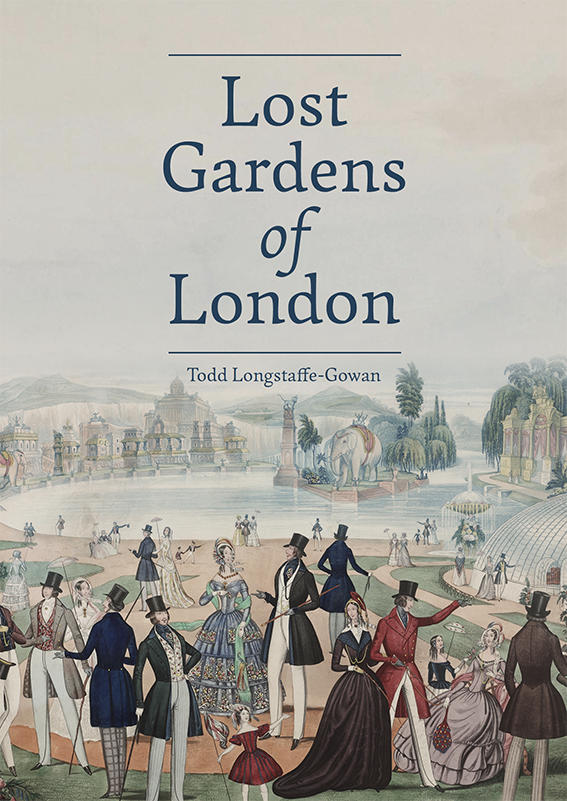 Did you know that Southwark once had a zoo? That for a short spell Britain’s first ecological park was built within a stone’s throw of Tower Bridge? Or that one of the capital’s most celebrated botanical gardens now lies beneath the platforms of Waterloo station? The exhibition Lost Gardens of London reveals the secret history of some of London’s most beguiling forgotten gardens.
Thousands of gardens have vanished across London over the past five hundred years—ranging from princely pleasure grounds and private botanical gardens, to humble allotments and defunct squares, artists’ gardens, eccentric private menageries, and the ecological parks of the twentieth century. Guest curated by landscape architect and historian Dr Todd Longstaffe-Gowan, Lost Gardens of London will explore this legacy and reveal tantalising glimpses of some of the rich and varied gardens that once embellished the metropolis. Paintings, prints, drawings, photographs, and maps bring these lost gardens to life, depicting changing trends and fashions in garden design while exploring London’s enduring love affair with nature, and how green spaces have always been a vital part of life in the capital.
In every borough, parks, gardens, and green open spaces have succumbed to new roads, street-widenings, railway encroachments and new buildings, or have simply been swallowed up by suburbia. Accompanying public programmes will explore how the remaining green spaces that may be taken for granted in London today have survived thanks to protests, community action, and legal protections being put in place. The exhibition is a timely reminder of the vulnerability of urban gardens and access to nature.
Lost Gardens of London coincides with a new book by Longstaffe-Gowan of the same name, published by the Modern Art Press (and distributed by Yale University Press).
Todd Longstaffe-Gowan, Lost Gardens of London (London: Modern Art Press, 2024), 272 pages, ISBN: 978-1738487806, £25 / $35.
New Book | Taste and the Antique
From Brepols:
Adriano Aymonino, Eloisa Dodero, Nicholas Penny, and Francis Haskell, Taste and the Antique: The Lure of Classical Sculpture, 1500–1900, revised and amplified edition (Turnhout: Harvey Miller / Brepols, 2024), 3 volumes, approximately 1684 pages, ISBN: 978-1909400252, €395.
 Indispensable for historians of taste and for art historians concerned with the debt owed by artists from the Renaissance onwards to the art of ancient Greece and Rome, as well as for students and collectors of the many surviving copies of the sculptures discussed.
For several hundred years, until about 1900, a limited number of antique sculptures were as much admired as are the Mona Lisa, Botticelli’s Birth of Venus or Michelangelo’s David today. They were reproduced in marble, bronze, and lead, as plaster casts in academies and art schools, as porcelain figurines for chimneypieces and as cameos for bracelets and snuffboxes. They were celebrated by poets from Du Bellay and Marino to Byron and D’Annunzio, and memorably evoked by novelists as diverse as Marcel Proust and Nathaniel Hawthorne, George Eliot and Charles Dickens. Copies of some of these statues can be seen at Pavlosk and Madrid, at Stourhead, Charlottenburg, Malibu and Versailles, and in countless gardens, houses, and museums throughout the world.
How and when did these particular sculptures achieve such a special status? Who were the collectors, restorers, dealers, artists, dilettanti, scholars and archaeologists who created their reputations? Under what names (often wildly fanciful) did they first become famous? How were they interpreted, and how and when and why did their glamour begin to wane? These are some of the problems that are confronted in Taste and the Antique.
 Taste and the Antique has become a classic of art history since its original publication in 1981. Now expanded into three volumes, this revised and amplified edition significantly updates the information based on new research undertaken in the last several decades, as well as expanding examples of the reception and influence of these works by artists and collectors from the Renaissance through to contemporary art.
When Taste and the Antique was published in 1981, Francis Haskell (1928–2000) was established as one of the most influential historians of art, not only in the English-speaking world but throughout Europe, chiefly on account of his first book, Patrons and Painters (1963), a highly original account of Baroque art in Italy. Since his appointment as professor of art history in Oxford in 1967, he had turned his attention from Italy in the seventeenth and eighteenth centuries to France in the eighteenth and nineteenth, and had begun his investigations of collecting, historiography, and the role of the museum and of the art critic, eventually published as Rediscoveries in Art (1976) and Past and Present in Art and Taste (1987). Taste and the Antique identified the models for art education and criticism during the four centuries with which Haskell was chiefly preoccupied, providing a series of individual case studies for the works upon which orthodox taste was founded. The book had a central place in his oeuvre, prompting preoccupations which persist in the last book that he published in his lifetime, History and Its Images (1993), as well as in The Emphemeral Museum, published posthumously in 2000.
 When he began to work with Francis Haskell on Taste and the Antique, Nicholas Penny was teaching art history at the University of Manchester. His first book, Church Monuments in Romantic England (1977), had attracted Haskell’s attention and subsequently they discovered and developed many mutual interests. Penny went on to occupy curational positions in the Ashmolean Museum in Oxford, the National Gallery in London, and the National Gallery of Art in Washington, D.C. From 2008 to 2015 he was director of the National Gallery. He is now a visiting professor at the National Academy of Fine Art in Hangzhou. Among his other books are Raphael (1983), written with the late Roger Jones, and The Materials of Sculpture (1993), as well as catalogues of the sculpture in the Ashmolean Museum (3 volumes, 1992) and of the sixteenth-century Italian paintings in the National Gallery (2004, 2008, 2016). He is currently cataloguing the Italian paintings in the Norton Simon Museum in Pasadena, of which one volume was published in 2021 and the other, written with Imogen Tedbury, is approaching completion.
Adriano Aymonino is the director of the MA in Art Market, Provenance and History of Collecting at the University of Buckingham. He is the author of Paper Palaces (2013); Drawn from the Antique: Artists and the Classical Ideal (with Anne Varick Lauder, 2015); and, most recently, Enlightened Eclecticism. The Grand Design of the 1st Duke and Duchess of Northumberland (2021), winner of the 2022 William MB Berger Prize.
Eloisa Dodero is archaeological curator at the Capitoline Museums in Rome. She is the author of Il Tesoro di Antichità. Winckelmann e il Museo Capitolino nella Roma del Settecento (with Claudio Parisi Presicce, 2017); Ancient Marbles in Naples in the Eighteenth Century (2019); and co-author, with Amanda Claridge, of The Paper Museum of Cassiano dal Pozzo. Sarcophagi and other Reliefs (four volumes, 2022) and, within the same series, of Statues and Busts (2023).
c o n t e n t s
Volume I | Text
A revised and amplified version of the 1981 edition. Fifteen chapters trace in narrative form, with the support of a wide variety of plates, the rise and decline of this highly important episode in the history of taste. These chapters are followed by catalogue entries for 95 of the most celebrated sculptures, all of them illustrated, which provide information on when and where they were discovered, changes of ownership and nomenclature, as well as a record of varying critical fortunes designed to complement the more general discussion in the earlier chapters.
Preface to the Revised and Amplified Edition
An Updated Note on the Presentation of the Essay and Catalogue
Introduction
1 ‘A New Rome’
2 The Public and Private Collections of Rome
3 Plaster Casts and Prints
4 Control and Codification
5 Casts and Copies in Seventeenth-Century Courts
6 ‘Tout ce qu’il y a de beau en Italie’
7 Erudite Interests
8 Florence: The Impact of the Tribuna
9 Museums in Eighteenth-Century Rome
10 The New Importance of Naples
11 The Proliferation of Casts and Copies
12 New Fashions in the Copying of Antiquities
13 Reinterpretations of Antiquity
14 The Last Dispersals
15 Epilogue
Notes to the Text
Updated Bibliography
Catalogue
Appendix
Bibliography
Index
Volume II | Originals
Contains especially commissioned new photography of over 90 statues catalogued in Volume I.
Volume III |Replicas and Adaptations
Devoted to a visual survey of the full range of replicas and adaptations of the works catalogued and illustrated in the previous volumes.
Study Day | The Face in Public Sculpture
From ArtHist.net:
L’intime face au public: Le visage dans la sculpture publique des XVIIIe et XIXe siècle en France et dans la sphère germanique
INHA Paris, 25–26 November 2024
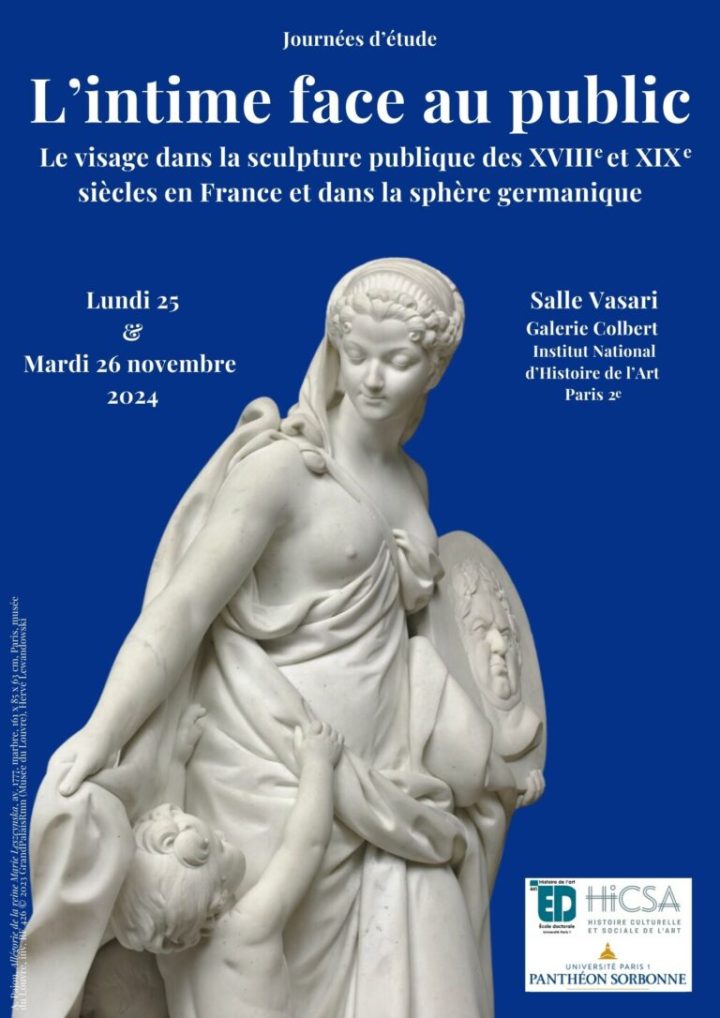 Cette journée d’étude dédiée à la sculpture souhaite s’intéresser à un élément en particulier : le visage. Partie essentielle de la figure sculptée, le visage a ce double rôle de permettre l’identification et l’expression. Cette double responsabilité est davantage mise en évidence au cours des XVIIIe et XIXe siècles, avec l’essor des portraits et de l’intérêt porté à l’intériorité, et plus largement à l’intime. Cette manifestation souhaite mettre en parallèle cette notion d’intimité avec celle du public, qui lui est souvent opposée. La sculpture étant l’art par excellence de l’espace public, l’objectif est de confronter le visage qui relève de l’intime, avec les impératifs liés à la sculpture publique. Ce sujet est d’autant plus pertinent que les statues présentes dans l’espace public ont été sujettes à un décorum en constante évolution tout au long du XIXe siècle.
Le type statuaire de prédilection était et reste le portrait, en buste ou bien en pied. Honneur pour une personne, outil de propagande, image officielle, le visage sculptural compte de nombreuses fonctions qui se dessinent au XVIIIe siècle et se précisent au XIXe siècle, avec le déplacement d’une fonction religieuse et royale de la sculpture à une fonction civique. Oscillant entre idéalisation et ressemblance, la figuration du visage dans le médium sculptural est un concept questionnable dans les XVIIIe et XIXe siècles franco-allemands. Outre les similitudes dans leurs ascendants artistiques et textuels, ces deux étendues géographiques nous permettront d’interroger les circulations artistiques qui ont eu lieu, et surtout d’analyser comment les évolutions politiques, qui ont touchées tant la France que la sphère germanique, ont conduit à une affirmation nationale qui s’incarne dans la sculpture publique. Cette journée d’étude vise ainsi à questionner la représentation du visage dans la statuaire publique franco-germanique du XVIIIe et XIXe siècle, à analyser ses théories, ses pratiques, ses techniques, ses possibles typologies et la perception qu’en a le spectateur.
l u n d i , 2 5 n o v e m b r e
14.00 Accueil des participants
14.30 Introduction générale — Justine Cardoletti, Sarah Touboul-Oppenheimer, Émilie Ginestet
14.45 Conférence d’ouverture / Opening Lecture
• Animated Features: Making Public Faces Private — Malcolm Baker (Distinguished professor of the History of Art, University of California, Riverside)
15.30 Session 1 | Visage du vivant, visage du mort / The Face of the Living, the Face of the Dead
Chair: Guilhem Scherf (Conservateur général du patrimoine au département des Sculptures, musée du Louvre)
• La statuaire publique franco-germanique : Objet de transmission de l’intime et Sujet altruiste ou quand le visage inerte devient une table de conversion des affects qui Comptent pour les siècles et les siècles — Bruno Bouchard (Professeur, Université du Québec à Rimouski)
• Jean-Baptiste Carpeaux : un instantané en pierre — Francis Mickus (Doctorant en Histoire, Université Paris 1 Panthéon-Sorbonne)
• Le visage du mort : portrait intime, portrait public — Eric Sergent (Maître de conférences en histoire de l’art et du patrimoine, Université de Haute-Alsace)
• L’intime et l’obscène. Moulages anthropologiques et masques mortuaires au XIXe siècle — Martial Guédron (Professeur d’Histoire de l’art moderne, Université de Strasbourg)
m a r d i , 2 6 n o v e m b e r
9.00 Accueil des participants / Greeting participants
9.30 Session 2 | Le visage d’un statut : l’illustre et le populaire / The Face of a Status: The Illustrious and the Popular
Présidence : Émilie Ginestet (Doctorante en Histoire de l’art moderne, Université Toulouse –Jean Jaurès), Sarah Touboul-Oppenheimer (Doctorante en Histoire de l’art, Université Paris 1 Panthéon-Sorbonne)
• Intimes fragments : la fonte du Louis XV de Bouchardon, gestation et reliques d’un monument parisien —Ulysse Jardat (Conservateur du patrimoine, responsable du département Décors, mobilier et arts décoratifs, Musée Carnavalet-Histoire de Paris)
• Goethe par David d’Angers. Production collective d’une persona — Gregor Wedekind (Professeur d’Histoire de l’art moderne et contemporain, Johannes Gutenberg-Universität Mainz)
• Christian Daniel Rauch à Halle : début, puissance d’action et vulnérabilité du monument — Wiebke Windorf (Professeur d’Histoire de l’art moderne, Martin-Luther-Universität Halle-Wittenberg)
• Visages du quotidien : la sculpture de genre dans les monuments publics au XIXe siècle — Michaël Vottero (Docteur en histoire de l’art habilité à diriger des recherches et Conservateur en chef du patrimoine, conservateur des monuments historiques, DRAC Bourgogne-Franche-Comté)
14.00 Session 3 | Expression du visage, expression du monument / Facial Expression, Expression of the Monument
Présidence : Émilie Roffidal (chargée de recherche HDR CNRS Framespa-UMR 5136)
• From the Fontaine de Grenelle to the Laiterie at Rambouillet: The Theme of the Distracted Head in Mid-to-Late 18th-Century French Sculpture — Tomas Macsotay (Professeur d’Histoire de l’art moderne, Universitat Pompeu Fabra)
• De face ou de profil ? L’orientation de la tête dans les monuments publics aux rois de France à l’époque moderne — Étienne Jollet (Professeur d’Histoire de l’art moderne, Université Paris 1 Panthéon-Sorbonne)
• Élever une figure chartraine au XIXe siècle — Maéva Bouderlique (Doctorante en Histoire de l’art contemporain, Nantes Université)
• Le Gavarni de Denys Puech : le monument comme image-récit biographique — Marie-Lise Poirier (Doctorante en Histoire de l’art, Université du Québec à Montréal)
16.30 Session 4 | Du privé au public : enjeux du Beau et de l’identification dans le buste / From Private to Public: Issues of the Beautiful and Identification in Busts
Présidence : Justine Cardoletti (Doctorante en Histoire de l’art moderne, Université Paris 1 Panthéon-Sorbonne)
• La figure antique et la notion du Beau au XVIIIe siècle : évolution et transformation du goût dans l’espace nobiliaire — Hector Chapron (Doctorant en Histoire de l’art moderne, Sorbonne Université)
• Gaetano Merchi (1747–1823). Itinéraires européens du portrait sculpté entre pratique publique et privée — Gaia Mazzacane (Doctorante en Histoire de l’art, École Normale Supérieure de Pise)
17.15 Conclusion des journées — Justine Cardoletti, Émilie Ginestet, Sarah Touboul-Oppenheimer
17.30 Cocktail de clôture
Exhibition | Sculpture and Colour in the Spanish Golden Age

Luisa Roldán, known as La Roldana, The First Steps of Jesus, ca. 1692–1706, polychrome terracota
(Museo de Guadalajara)
◊ ◊ ◊ ◊ ◊
From the press release for the exhibition:
Hand in Hand: Sculpture and Colour in the Spanish Golden Age
Darse la mano: Escultura y color en el Siglo de Oro
Museo Nacional del Prado, Madrid, 19 November — 2 March 2025
Curated by Manuel Arias Martínez
When praising the wood sculpture of Christ of Forgiveness, carved by Manuel Pereira and polychromed by Francisco Camilo, the writer on art Antonio Palomino (1655–1726) concluded with the following opinion: “Thus painting and sculpture, hand in hand, create a prodigious spectacle.” The unique importance achieved by the synthesis of volume and colour in sculpture of the early modern period can be explained only by the role it played as an instrument of persuasion.
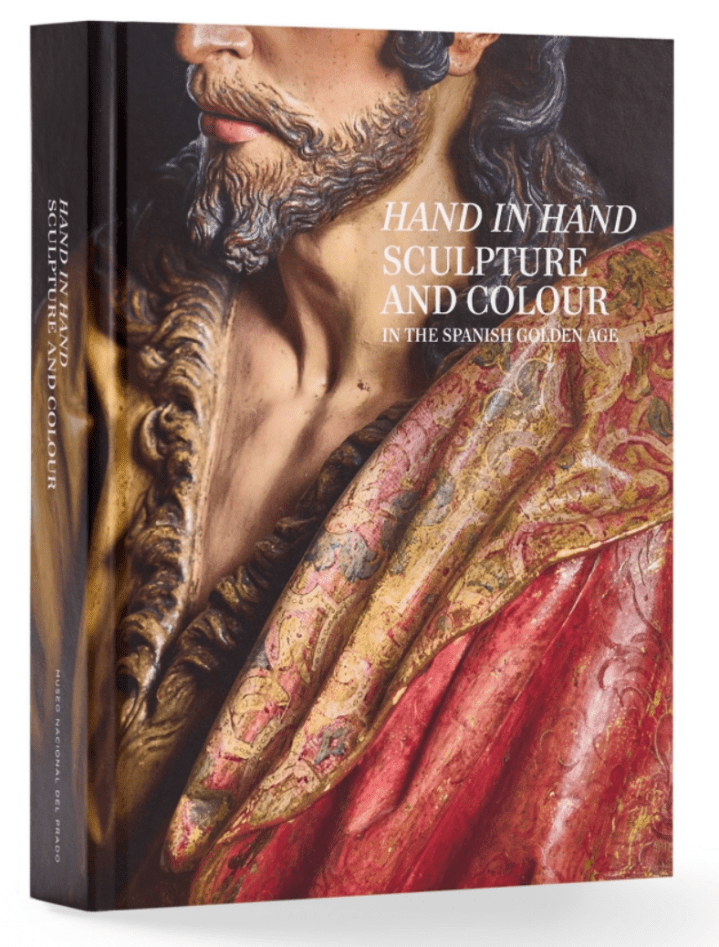 From the Graeco-Roman world onwards, sculptural representation was seen as a necessity. Divinity was present through its corporeal, protective, and healing image, which became more lifelike when covered with colour, an essential attribute of life in contrast to the inanimate pallor of death. In the words of the Benedictine monk Gregorio de Argaiz in 1677: “Each figure, no matter how perfect it may be in sculpture, is a corpse; what gives it life, soul, and spirit is the brush, which represents the affections of the soul. Sculpture forms the tangible and palpable man […], but painting gives him life.”
Religious sculpture existed in a context of supernatural connotations from the time of its execution. It was thus associated with miracles and divine interventions, with angelic workshops, and with craftsmen who had to be in a morally acceptable state in order to undertake a task that went beyond a mere artistic exercise, given that what was created was ultimately an imitation of the divine.
The exhibition now presented at the Museo Nacional del Prado offers an analysis of the phenomenon and success of polychrome sculpture, which filled churches and convents in the 17th century and played a key role as a support for preaching. The close and ideal collaboration between sculptors and painters is revealing with regard to the esteem in which colour was held, not merely as a superficial finish to the work but rather an essential element without which it could not be considered finished. Colour also made a decisive contribution to emphasising the dramatic values of these sculptures, both those made for altarpieces and for processional images. Theatrical gesturalism, together with the sumptuous nature of the clothing—whether sculpted, glued fabric, or real textiles—transformed these sculptures into dramatic objects filled with meaning.
Finally, the exhibition looks at other examples of the interrelationship between the arts in relation to polychrome sculpture, from the prints that helped disseminate the most popular devotional images to the Veils of the Passion [painted altarcloths of devotional images] which simulated altarpieces, and paintings that made use of striking illusionism to faithfully reproduce the sculptural images on their respective altars.
More information is available here»
Manuel Arias Martínez, Hand in Hand: Sculpture and Colour in the Spanish Golden Age (Madrid: Museo Nacional del Prado, 2024), 424 pages, ISBN: 978-8484806288 (English edition) / ISBN: 978-848480-6271 (Spanish edition) €37.
Call for Papers | French Sacred Sculpture, 1700–1850
From ArtHist.net, which includes the German version:
Productive Crisis: French Sacred Sculpture on the Threshold of Modernity, 1700–1850
Produktive Krise: Französische Sakralskulptur an der Schwelle zur Moderne, 1700–1850
Martin-Luther-Universität Halle-Wittenberg, Halle, 27–29 November 2025
Organized by Julie Laval and Angelika Marinovic
Proposals due by 31 January 2025
With the start of the 18th century, Parisian churches emerged as a testing ground for new sculptural concepts. Critical discourses on religion, institutions, and art—increasingly conducted in public forums such as Salons, literary magazines, and other editorial formats—demanded updated artistic approaches. There is no doubt that the French Revolution, with its tendencies toward secularisation, marked a significant turning point with regard to the modernisation programmes within the church. Nevertheless, sculptural concepts in the first half of the 19th century up to the end of French monarchy continued to be characterised by the search of convincing and authentic solutions in response to the crisis of the sacred space, while still considering the political and institutional continuity of royal and ecclesiastical patrons.
As part of the DFG-funded project Sculpture and the Sacred: Sculptural Reconceptions of Religious Spaces of Visuality in Paris during the Transition to the Modern Period (1700 to circa 1850), this conference will be held at the IZEA in Halle (Saale) from November 27 to 29, 2025. It focuses on innovations in previously underrated French religious sculpture from the Siècle des Lumières to the end of the French monarchy. The focus is on religious spaces of visuality fundamentally shaped by sculpture, not only in Paris but also beyond. In addition to French religious sculpture—with a particular emphasis on its liturgical and architectural context—this conference will also consider possible correlations with secular sculpture and comparable themes in sculptural production in neighbouring European countries.
Proposals may consider, but are not limited to, the topics suggested below. Submissions offering further perspectives are explicitly encouraged.
• Significance of social and cultural upheavals arising throughout the Siècle des Lumières—especially during the French Revolution and the July Revolution of 1830—as well as the reconsolidation measures of the Restoration for (French) religious sculpture
• Political intentionality in the conception of religious sculptural ensembles, e.g. as an expression of continuity and in response to social change
• Reassessment of the relationship between religious sculpture and an increasingly ‘enlightened’ and self-aware audience, e.g. new didactic expectations regarding religious sculpture as well as a re-evaluation of sculptural illusion as reflected in contemporary magazines and other publications
• Post-Tridentine liturgical reforms during the Siècle des Lumières and the debate on the renewal of Christian art and architecture as articulated by, among others, François-René de Chateaubriand and Charles de Montalembert as impetus for sculptural invention
• Relevance of aesthetic demands shaped by Neoclassical ideals and formulated in art theoretical writings and Salon critiques (such as the ‘beau idéal’ coined by Quatremère de Quincy or the rejection of realistic detail) for religious sculpture
• Influence of the redefinition of religious sculpture on secular sculptural practices
• Artistic innovation in religious sculpture in neighbouring European countries
The conference languages are German, English, and French. Travel and accommodation expenses will be fully covered by the German Research Foundation (DFG). A conference volume is planned for 2026. Please submit an abstract (up to 500 words) for a 20-minute presentation along with a brief biographical note by 31 January 2025, to sakralskulptur@kunstgesch.uni-halle.de. Question are also welcome.
Head of the DFG-funded project Productive Crisis: French Sacred Sculpture on the Threshold of Modernity, 1700–1850: Prof. Dr. Wiebke Windorf (Martin-Luther-Universität Halle-Wittenberg).
Conference development and coordination:
Julie Laval M.A. (Martin-Luther-Universität Halle-Wittenberg)
Dr. Angelika Marinovic (Martin-Luther-Universität Halle-Wittenberg)
Conference | The Secularization of Religious Assets
From ArtHist.net and the Centre André-Chastel:
The Secularization of Religious Assets in Enlightenment Europe: Urban Development, Architecture, and Art Works
La sécularisation des établissements religieux dans l’Europe des lumières: Ville, architecture et œuvres d’art
Institut National d’Histoire de l’Art, Paris, 27 November 2024
Organized by Ronan Bouttier, Gernot Mayer, and Raluca Muresan
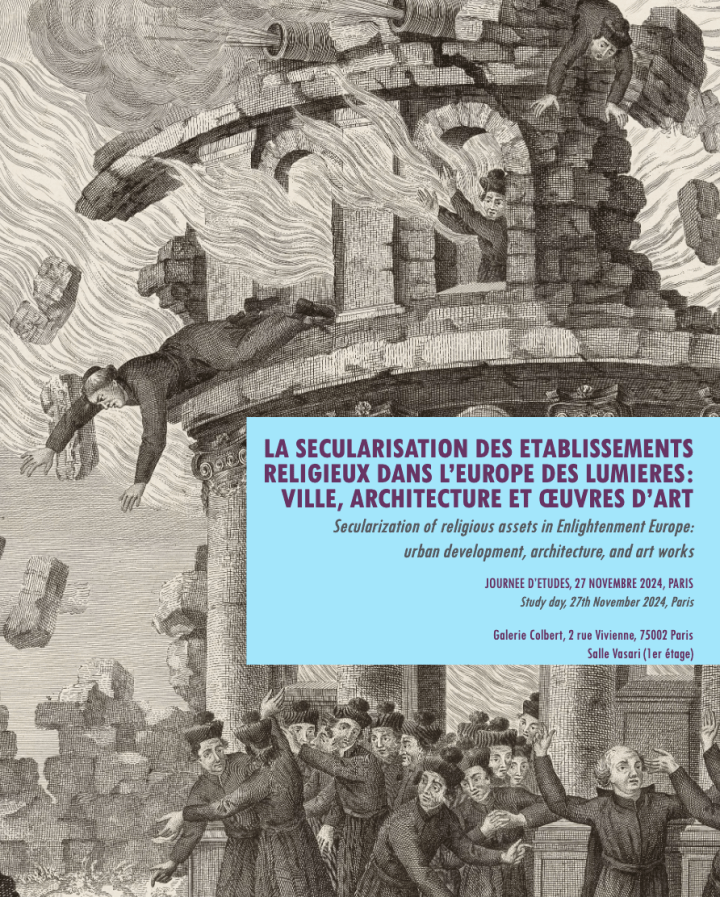 The suppression of the Society of Jesus in 1773 marks the last step of the Order’s progressive dissolution initiated fifteen years earlier, in Europe and in its colonies. This act of suppression was the culmination of a broader secularisation movement concerning religious congregations across Europe, from the 1760s to the French Revolution. In most cases, the State intended to take over the management of properties belonging to religious congregations described as useless for the common interest. Whether driven by reformatory or by economic interests, all acts of suppression and secularisation had the same consequences: a large number of movable assets and real property, estates and art works were either reallocated to other religious congregations or put on sale, when not confiscated altogether.
p r o g r a m m e
9.00 Welcome of participants
9.15 Welcoming address
9.30 Introduction by the organizers
10.00 Confiscation Procedures
Chair: Raluca Muresan (Sorbonne Université, Paris)
• Paola Benussi (Archivio di Stato, Venise), La sécularisation des patrimoines ecclésiastiques dans les régions « d‘outre-mer » de la République de Venise
• Raffaele Marronne (Scuola Normale Superiore, Pise), ‘Volle entrare per tutte le sagrestie’: The Dispersion of the Artistic Heritage of the Lay Confraternities of Siena following the Leopoldine Suppressions (1785)
• Etienne Couriol (LARHRA, Université Lyon 3), Ce que dit la presse périodique lyonnaise et bordelaise de la vente des biens des Jésuites
11.30 Pause
12.00 Sécularisation et développement urbain / Secularization and Urban Development
Chair: Ronan Bouttier (Université Paris 1 Panthéon-Sorbonne)
• Richard Biegel (Université Charles, Prague), Les transformations des édifices sacrés de Prague au siècle des Lumières et leurs conséquences urbaines
• Pierre Coffy (Univ. Paris 1 Panthéon-Sorbonne/Univ. Statale di Milano), Préparer le terrain pour l’essor de la «ville moderne»: Suppression et réemploi des biens religieux dans le Milan des Habsbourg d’Autriche
13.00 Lunch break
14.30 Sécularisations, remplois et dispersions / Secularization, Reuse, and Dispersal
Chair: Gernot Mayer (Université de Vienne)
• Alberto Garin (Universidad Francisco Marroquín, Guatemala), Le couvent des Jésuites de la Antigua Guatemala
• Katia Martignago (Università degli Studi di Napoli Federico II, Naples), The Venetian Jesuits’ Convent after 1773
• Sylvia Stegbauer (Belvedere Research Center, Vienne), Architectural Properties of the Marian Congregations in Transition
• Márta Velladics (Université Eötvös Loránd, Budapest), Success or Failure? The Utilisation of the Abolished Monasteries in Hungary between 1782 and 1802
17.00 Final Discussion
• Emilie d‘Orgeix (Ecole Pratique des Hautes Etudes, Paris)
• Jean-Philippe Garric (Université Paris 1 Panthéon-Sorbonne)
• Olga Medvedkova (CNRS, Centre André Chastel, Paris)
18.00 Thanks from the organizers
Organizers
• Ronan Bouttier, Université Paris 1 Panthéon-Sorbonne
• Gernot Mayer, Universität Wien, Vienne
• Raluca Muresan, Sorbonne Université, Paris
Scientific Committee
• Jean-Philippe Garric, Université Paris 1 Panthéon-Sorbonne
• Richard Kurdiovsky, Österreichische Akademie der Wissenschaften, Vienne
• Olga Medvedkova, CNRS, Centre André Chastel, Paris
• Émilie d’Orgeix, Ecole Pratique des Hautes Etudes, Paris
Image: Extinction de la Société des Jésuites, detail, 1773, engraving, 58 × 39 cm (Wien Museum, Inv. 21288).










 Enfilade
leave a comment