New Book | Every Valley
From Penguin Random House:
Charles King, Every Valley: The Desperate Lives and Troubled Times That Made Handel’s Messiah (New York: Doubledy, 2024), 352 pages, ISBN: 978-0385548267, $32.
 George Frideric Handel’s Messiah is arguably the greatest piece of participatory art ever created. Adored by millions, it is performed each year by renowned choirs and orchestras, as well as by audiences singing along with the words on their cell phones. But this work of triumphant joy was born in a worried age. Britain in the early Enlightenment was a place of astonishing creativity but also the seat of an empire mired in war, enslavement, and conflicts over everything from the legitimacy of government to the meaning of truth. Against this turbulent background, prize-winning author Charles King has crafted a cinematic drama of the troubled lives that shaped a masterpiece of hope. Every Valley presents a depressive dissenter stirred to action by an ancient prophecy; an actress plagued by an abusive husband and public scorn; an Atlantic sea captain and penniless philanthropist; and an African Muslim man held captive in the American colonies and hatching a dangerous plan for getting back home. At center stage is Handel himself, composer to kings but, at midlife, in ill health and straining to keep an audience’s attention. Set amid royal intrigue, theater scandals, and political conspiracy, Every Valley is entertaining, inspiring, unforgettable.
Charles King is the author of eight books, most recently Gods of the Upper Air, a New York Times bestseller, a finalist for the National Book Critics Circle award, and winner of the Francis Parkman Prize. His Odessa won a National Jewish Book Award. He is a professor of international affairs and government at Georgetown University.
Call for Papers | Disabilities and American Art Histories
From the Call for Papers:
Disabilities and American Art Histories
Commentaries for American Art, 2026
Organized by Laurel Daen and Jennifer Van Horn
Manuscripts (1500–2000 words) due by 1 April 2025
American Art, the peer-reviewed journal co-published by the Smithsonian American Art Museum and the University of Chicago Press, seeks to publish papers that explore the intersections of disability studies and the histories of American art, architecture, and design. What perspectives, insights, and forms of redress does disability studies bring to American art history? Where does disability surface in American art and visual culture, and where do absences persist? How has art enacted ableism, spurred practices that challenge and move beyond exclusion and oppression, or combined divergent tendencies in complicated and generative ways? What are the responsibilities of art historians to advance disability justice in their scholarship, teaching, and museum practice? How do the histories of American art change when new ways of making or experiencing art are included?
We invite essays that center disability in American art history in compelling and innovative ways. We encourage authors to foreground critical disability studies methodologies and conceptualize disability broadly, recognizing that the meanings and terminologies of disability can vary across disciplines, experiences, identities, and histories. We welcome essays about how disability has been represented, conceptualized, and constructed via visual and material practices; how individual artists as well as communities, including those that reject the identity of disability, have defined themselves alongside and beyond changing understandings of abled-ness. We encourage authors to approach disability intersectionally and to center the histories of understudied peoples. We also invite reflection on how the discipline of American art and practices of extractive looking have perpetuated ableism.
Collectively these commentaries aim to reveal the centrality of disability and disability studies to our understanding of American art history, considering how such approaches can advance multiple fields and contribute to anti-ableist future practices. Please submit manuscripts of 1,500 to 2,000 words (including notes) with 3–5 images, to AmericanArtJournal@si.edu by 1 April 2025. We invite submissions from authors in and beyond art history, including crip studies, Deaf studies, design history, disability history, disability studies, Mad studies, material culture studies, the history of the body, the history of the senses, the history of technology, medical humanities, and visual culture/practices of looking.
The journal’s guidelines on originality, quality, and submission format apply; visit journals.uchicago.edu/journals/amart/instruct for details. Pre-submission inquiries may be directed to organizers Laurel Daen, University of Notre Dame, and Jennifer Van Horn, University of Delaware, at ldaen@nd.edu and jvanhorn@udel.edu. American Art will facilitate fully anonymized peer reviews and final decisions. Accepted manuscripts will be workshopped, rigorously edited, and published in American Art in 2026.
Exhibition | Sketching Splendor: American Natural History, 1750–1850
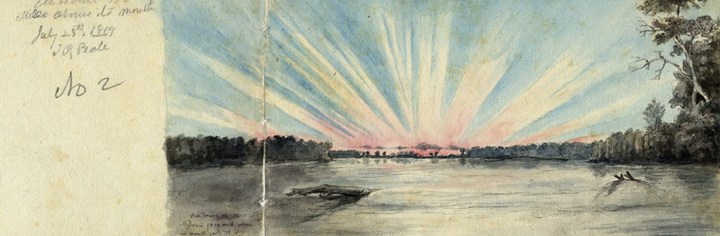
Titian Ramsay Peale, Sunset on Missouri, July 1819
(Philadelphia: American Philosophical Society, NH121 TRP, MSS.B.P31.15d)
◊ ◊ ◊ ◊ ◊
Now on view at the American Philosophical Society Museum:
Sketching Splendor: American Natural History, 1750–1850
American Philosophical Society Museum, Philadelphia, 12 April — 29 December 2024
Sketching Splendor: American Natural History, 1750–1850 explores how William Bartram, Titian Ramsay Peale, and John James Audubon made sense of nature’s complexities through their writings, drawings, and watercolors. It highlights their approaches to capturing the natural world during a time of rapid intellectual, social, and political change.
 Bartram, Peale, and Audubon relied on natural knowledge established by European, Euro-American, and Native American experts while balancing changing ideas of how reason and emotion impacted science. As both artists and naturalists, they freely expressed their ideas using science, art, and literature. Through a potent mix of scientific ideas, shifting worldviews, and professional freedom, their works embodied both experimentation and certainty. However, their interpretation of the natural world has also raised questions of national importance. Their world was not just one of intellectual excitement, but one of systematic injustice and a complex national history become visible as we peel back the layers. Sketching Splendor draws on the APS’s extensive holdings. Highlights of the exhibition include William Bartram’s map of the Alachua Savanna, Benjamin Henry Latrobe’s Rattlesnake Skeleton, Titian Ramsay Peale’s watercolors from the Long Expedition, and one volume of John James Audubon’s original Birds of America.
Anna Majeski and Michelle Craig McDonald, Sketching Splendor: American Natural History, 1750–1850 (Philadelphia: University of Pennsylvania Press, 2024), 112 pages, ISBN: 978-1606180402, $30.
Anna Majeski received a PhD in art history from the Institute of Fine Arts, New York University in 2022, where she completed a doctoral dissertation on a remarkable series of astrological fresco cycles completed in Padua between 1300 and 1440. Her research focuses on the intersections of art and science, image and knowledge in the early modern world, and has been supported by pre- and postdoctoral fellowships from the American Academy in Rome and the Harvard Center for Renaissance Studies, Villa I Tatti. She joined the American Philosophical Society, Library & Museum, as Mellon Foundation Postdoctoral Natural History Exhibition Research Fellow in October 2022.
Michelle Craig McDonald is the Librarian/Director of the Library and Museum at the American Philosophical Society, founded in 1743 and the oldest learned society in North America. The APS has more than 14 million pages of manuscripts and 300,000 printed volumes, with particular strengths in early American history, the history of science, and Native American and Indigenous cultures. McDonald earned her PhD in history from the University of Michigan where she focused on business relationships and consumer behavior between North America and the Caribbean during the 18th and 19th centuries. She is the co-author of Public Drinking in the Early Modern World: Voices from the Tavern (Pickering & Chatto/Routledge Press, 2011), and her current monograph, Coffee Nation: How One Commodity Transformed the Early United States, will be published by the University of Pennsylvania Press in spring 2025.
IDEAL Internship Grants from Decorative Arts Trust

Family Room at Filoli, Woodside California
(Photo by Jeff Bartee)
◊ ◊ ◊ ◊ ◊
From the press release (28 October 2024) . . .
The Decorative Arts Trust is pleased to announce the six institutions that received IDEAL Internship Grants for 2025: the Asheville Art Museum in Asheville, North Carolina; Bard Graduate Center in New York City; The Clay Studio in Philadelphia; Filoli in Woodside, California; the High Museum of Art in Atlanta; and the Liberty Hall Historic Site in Frankfort, Kentucky.
The IDEAL Internship Grants program was established in 2020 to create opportunities for undergraduate students of color through collaborations that create meaningful introductions to the museum field and introduce new perspectives and voices to curatorial practice. Since its founding, the program has supported 16 interns.
Once the Asheville Art Museum reopens following the damage brought by Hurricane Helene, the curatorial department will host two undergraduate interns to assist with the development and educational programming for two upcoming exhibitions.
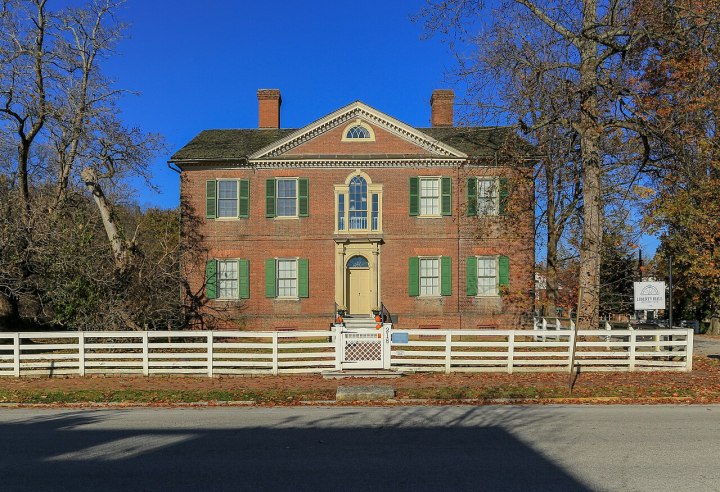
Liberty Hall, Frankfort, Kentucky, built in 1796 (Photo by Christopher Riley, Wikimedia Commons, November 2018).
Bard Graduate Center will create an internship within their Marketing, Communications, and Design department, specifically for Pratt Institute’s Undergraduate Communications Design program. The intern will work closely with staff on exhibition design, catalog production, and institutional branding.
The Clay Studio, in Philadelphia, will hire an intern who will gain valuable experience working with both physical and digital archival systems, the documentation of artworks, and exhibition planning and implementation.
Filoli, a Georgian Revival estate turned museum in Woodside, California, will host a Collections Intern to gain tangible and meaningful experience in preservation, cataloging, photography, and database management.
As the High Museum of Art in Atlanta approaches its centennial anniversary in 2026, the curatorial team will welcome an intern to assist with the reinstallation of American art galleries and conduct research on objects in the permanent collection.
Liberty Hall Historic Site in Frankfort, Kentucky, will host an intern to study the Black experience at two houses owned by the prominent Brown family, specifically regarding the buildings’ construction, urban enslavement, emancipation, and Reconstruction.
For updates about applying for these internship opportunities, visit the institutions’ websites and follow them on social media. The IDEAL Internship Program is part of the Decorative Arts Trust’s Emerging Scholars Program. For upcoming grant application deadlines, visit decorativeartstrust.org or email thetrust@decorativeartstrust.org.
Exhibition | Buckland and Palladio: A Legacy of Design

Hammond-Harwood House in Annapolis, Maryland, designed by William Buckland in 1774. Buckland was inspired by Palladio’s Villa Pisani, Montagnana, as published in The Four Books of Architecture.
◊ ◊ ◊ ◊ ◊
Now on view:
Buckland and Palladio: A Legacy of Design
Hammond-Harwood House Museum, Annapolis, Maryland, 1 April — 30 December 2024
When William Buckland designed the Hammond-Harwood House in 1774, he was inspired by the designs of 16th-century Italian architect Andrea Palladio. The Hammond-Harwood House celebrates its 250th anniversary with an exhibition of early documents, paintings, and artifacts that provide context for Matthias Hammond’s house—including Buckland’s indenture papers and a drawing by Thomas Jefferson.
When the Hammond-Harwood House was designed for Matthias Hammond in 1774, Annapolis was in its Golden Age. There were 14 major houses either already built or underway for the politically active leaders of the Revolution: John Brice, Charles Carroll of Carrollton, William Paca, John Ridout, and Upton Scott. Hammond, a wealthy 25-year-old tobacco planter and delegate to the Maryland General Assembly, had a handsome inheritance and a keen business sense to purchase four acres in Annapolis to build his own “town house.”
Hammond hired the joiner, carpenter, and architect William Buckland to design his city home. Buckland had been indentured to George Mason since his arrival in Virginia in 1755 to complete Mason’s plantation home, Gunston Hall. Buckland left Mason with high recommendations and bought a farm in Virginia, set up a workshop, and worked on other estates, including Mount Airy, the Tayloe family plantation.
Buckland moved to Annapolis most likely at the urging of Tayloe’s son-in-law Edward Lloyd. Lloyd, a wealthy merchant and planter, had purchased a half-finished brick house in Annapolis begun by Samuel Chase, now known as the Chase-Lloyd House. Buckland agreed to complete its construction and devise the impressive interior that showcased his skill inspired by the designs of the 16th-century Italian architect Andrea Palladio (1508–1580).
Palladio was an Italian Renaissance architect who was influenced by Greek and Roman architecture and is considered to be, even today, one of the most influential figures in the history of architecture. His treatise, I quattro libri dell’architettura (The Four Books of Architecture), was first printed in Italian in 1570, followed by several reprints and a full English version published in London by Giacomo Leoni in 1715–1720.
In Buckland’s design for Hammond’s city house, he adapted the plans of the Villa Pisani at Montagnana from Palladio’s Four Books. The five-part plan house, composed of a central block with wings on each side and connected by a passage, was well-suited to the tastes and climates of the southern colonies. By 1760, the manor houses of the Chesapeake and Tidewater plantation owners were primarily of the five-part Palladian plan—essentially a Palladian country villa.
Although Buckland is thought to have designed many interiors in Virginia and Maryland, including Tulip Hill, Whitehall, and Ringgold House, little documentation exists. The Hammond-Harwood House is the only known commission for a full building design and attests to Buckland’s knowledge of English Palladianism and the current fashion in decoration.
New Book | The Gardens of Venice
From Marsilio Arte:
Toto Bergamo Rossi and Marco Bay, with photographs by Marco Valmarana, The Gardens of Venice (Venice: Marsilio Arte, 2024), 296 pages, ISBN: 979-1254631973, €65 / $70.
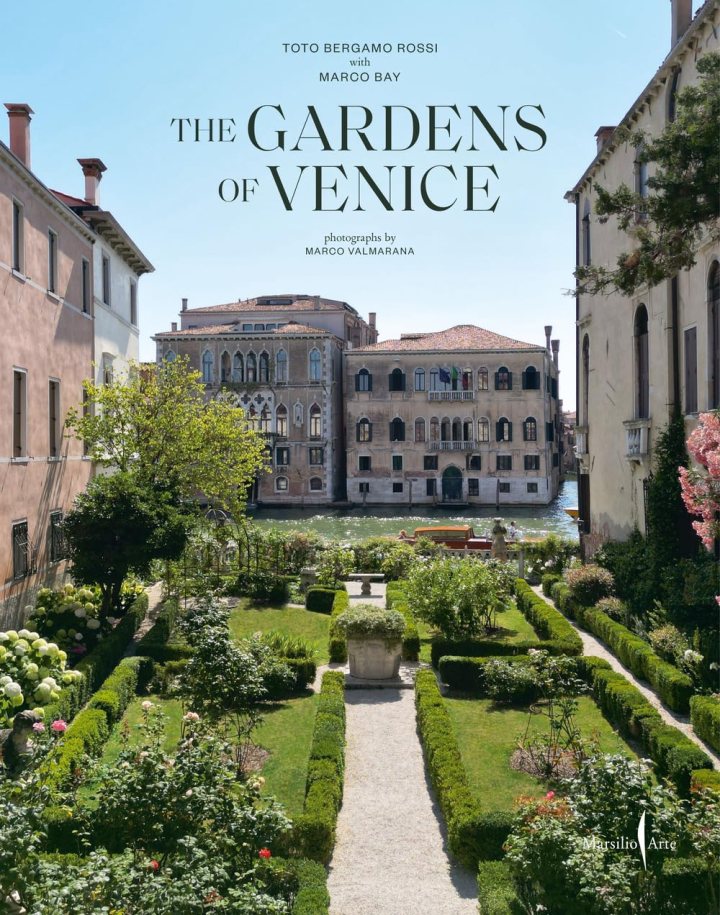
A lush look into Venice’s verdant gardens, photographed in every season of the year.
Turquoise lagoons and crystalline canals, criss-crossed by romantic bridges and traversed by singing gondoliers on their gondolas: water is considered by many to be Venice’s most enchanting feature. Yet on the little land that constitutes this ancient city, secret and sumptuous gardens lie waiting to cast their captivating spell. This lushly illustrated volume takes readers inside Venice’s most undiscovered and most exclusive green spaces across the city. The gardens of the palazzi that overlook the Grand Canal, along with the more vernacular ones of the lagoon islands, are captured throughout the seasons: the flowering in spring, the opulence of summer, the colors of fall and the frost of winter. Photographer Marco Valmarana’s exquisite images evoke a sense of wanderlust enough to inspire even the most jaded traveler. To walk the reader through the legacy of these special spaces, author Toto Bergamo Rossi recounts the evolution and history of the Venetian garden alongside a glossary of commonly used plants. The Gardens of Venice also includes a special foreword by designer Diane von Furstenberg.
Toto Bergamo Rossi, formerly a specialist in the conservation of stone materials, has restored a number of important monuments in Italy. Since 2010 he has served as the director of Venetian Heritage. He is the author of Inside Venice (Rizzoli, 2016) and Venice and Its Doges (Rizzoli, 2023).
New Book | Blue Guide: Venice, 10th Edition
The tenth edition for Venice appeared last year. While I’ve always thought of Blue Guides as reliably informative, this updated edition is also engaging, fun to read, and handsomely designed. If you’ve not tried a Blue Guide recently, it’s worth another look. –CH
Alta Macadam, Blue Guide Venice: Tenth Edition (London: Somerset Books, 2024), 495 pages, ISBN: 978-1905131945, $25.
 Full color throughout, with photographs, diagrams, site plans, and detailed maps.
The 10th edition of this accessible, detailed guide to Venice is an essential handbook for any traveler who wants to fully understand the existence and future challenges of this unique and extraordinary city, as well as its history, art, architecture, cuisine, and culture.
Completely updated, this new edition is in full colour, with photographs, plans, and illustrations, as well as detailed and accurate maps of the labyrinthine streets and canals. There is also a section of practical tips, ideas on food and wine, and how to navigate the transportation system. The depth of information and quality of research make this book the very best guide for the independent cultural traveler, as well as for all students of art history, architecture, and Italian culture. Ideal as an on-site guide or as a desk resource.
Art historian Alta Macadam lives in Fiesole, on the hillside above Florence.
New Book | The Venetian Façade
From ORO Editions:
Michael Dennis, The Venetian Façade (South Bend: Notre Dame School of Architecture / ORO Editions, 2024), 160 pages, ISBN: 978-1961856356, $40.

There are no books that focus on the unique artistic characteristics of the Venetian facade and its potential relevance to contemporary architectural and urban issues, as this book intends.
This book is about architecture. It is not about history, although a bit of history is necessary to set the context. It is not about theory, although, again, a bit is necessary to connect the facade with urbanism. It is also not about structure and technology. And, most definitely, it is not about the plan. All of these topics are well-covered elsewhere. This book is about the facade. It explores the art and typology of the Venetian facade, not only as a high point of architectural literacy and achievement, but as a potentially useful contemporary stimulant.
Michael Dennis is the principal of Michael Dennis & Associates in Boston, and Professor of Architecture Emeritus at MIT. 1986 Thomas Jefferson Professor of Architecture, University of Virginia; 1988 Eero Saarinen Professor of Architecture, Yale University; 2006 Charles Moore Professor of Architecture, University of Michigan.
New Book | Canaletto and Guardi: Views of Venice
Published by Scala and distributed by Rizzoli:
Lelia Packer and Charles Beddington, Canaletto and Guardi: Views of Venice at the Wallace Collection (Milan: Scala, 2024), 192 pages, ISBN: 978-1785513206, £25 / $30.

A celebration of the beauty of Venice that Wallace Collection’s paintings convey and an enjoyable and informative complement to viewing the paintings in the flesh. Among the renowned Old Master paintings at the Wallace Collection in London is an important group of 27 eighteenth-century views of Venice, known as vedute, by Canaletto and his followers, including Francesco Guardi. They hang together in a dedicated gallery known as the Canaletto Room, but the majority had not been cleaned since the nineteenth century and their original beauty was obscured by multiple layers of discoloured varnish.
The paintings have now been restored, following a recent multi-year conservation and research project, and this book presents them in their renewed splendour. It features essays and commentaries by Charles Beddington, the global expert on vedute, and by Wallace Collection curator Lelia Packer, which provide fresh insights into the artists’ creative processes, the dating of pictures and their authorship. Canaletto and Guardi is a gorgeous celebration of the beauty of Venice that these paintings convey.
Lelia Packer is the curator of Dutch, Italian, Spanish, German, and pre-1600 paintings at the Wallace Collection.
Charles Beddington is an independent scholar and art dealer based in London.
◊ ◊ ◊ ◊ ◊
More information on the conservation and research project is available here»
New Book | Women Artists and Artisans in Venice
From Amsterdam UP:
Tracy Cooper, ed., Women Artists and Artisans in Venice and the Veneto, 1400–1750: Uncovering the Female Presence (Amsterdam: Amsterdam University Press, 2024), 292 pages, ISBN: 978-9048559718, €141.
 This book of essays highlights the lives, careers, and works of art of women artists and artisans in Venice and its territories from the fourteenth to the eighteenth centuries. The collection represents the first fruits of an ongoing research program launched by Save Venice, Inc., Women Artists of Venice, directed by Professor Tracy Cooper of Temple University, in conjunction with a conservation program, led by Melissa Conn, Director of Save Venice, Inc. Inspired by a growing body of research that has resurrected female artists and artisans in Florence and Bologna during the last decade, the Save Venice project seeks to recover the history of women artists and artisans born or active in the Venetian republic in the early modern period. Topics include their contemporary reception—or historical silence—and current scholarship positioning them as individuals and as an underrepresented category in the history of art and cultural heritage.
Tracy E. Cooper is Professor of Art History at Temple University and on the Board of Directors of Save Venice, Inc., where she is director of the Women Artists in Venice research program. She is best known for Palladio’s Venice: Architecture and Society in a Renaissance Republic (Yale, 2006), winner of the Phyllis Goodhart Gordan Prize from the Renaissance Society of America.
c o n t e n t s
List of Illustrations
Introduction — Tracy Cooper, Temple University
1 La Serenissima in Context: Women Artists in Venice and Beyond — Babette Bohn, Texas Christian University
2 The Taiapiera in Fourteenth-Century Venice: What’s in a Name? — Louise Bourdua, University of Warwick
3 In Search of Marietta Tintoretta — Robert Echols, Independent Scholar, and Frederick Ilchman, Museum of Fine Arts Boston
4 The ‘Vite’ of Women Artists in Venice (Sixteenth to Eighteeth Century) — Antonis Digalakis, University of Crete
5 Artists and Artisans in the Account Books of Marino Grimani, Patrician and Doge of Venice (Late Sixteenth–Early Seventeenth Centuries) — Maria Adank, Università degli Studi di Verona
6 Chiara Varotari (1584/1585–after 1663) — Diana Gisolfi, Pratt Institute
7 Artemisia Gentileschi in Venice: Facts and Suppositions — Davide Gasparotto, J Paul Getty Museum
8 Giovanna Garzoni and Venetian Witchcraft: Still Lifes as Natural Enchantments — Sheila Barker, Medici Archive Project and University of Pennsylvania
9 Caterina Tarabotti Unveiled — Georgios Markou, University of Cambridge
10 Shining a Light on Giulia Lama’s Painting Practice in the San Marziale Four Evangelists — Cleo Nisse, Columbia University
11 Rosalba Carriera Unframed — Xavier Salomon, The Frick Collection
General Bibliography
Archival Abbreviations
Works Cited
Index










 Enfilade
leave a comment