Netherlands Yearbook for History of Art | Women, 1500–1950
The latest issue of NKJ:
Elizabeth Alice Honig, Judith Noorman, and Thijs Weststeijn, eds., Women: Female Roles in Art and Society of the Netherlands, 1500–1950, Netherlands Yearbook for History of Art / Nederlands Kunsthistorisch Jaarboek 74 (2024), ISBN: 978-9004710740, $162.
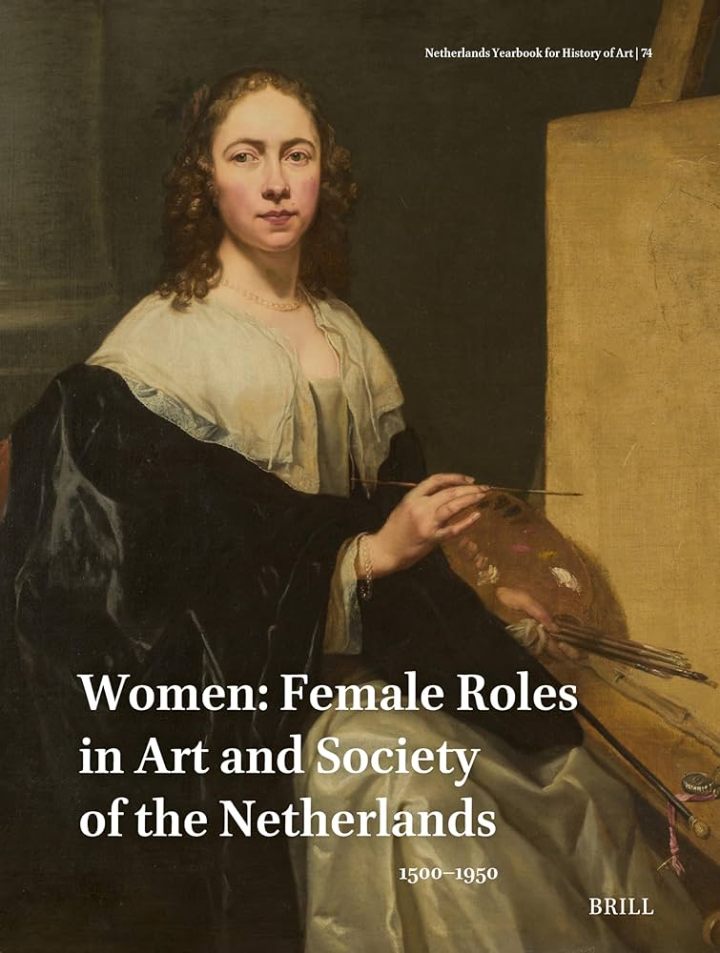 Long overdue in the history of the Netherlands Yearbook for History of Art, this volume foregrounds women as creators, patrons, buyers, and agents of change in the arts of the Low Countries. Venturing beyond the participation of ‘exceptional’ individuals, chapters investigate how women produced paintings, sculptures, scientific illustrations, and tapestries as well as their role in architectural patronage and personalized art collections. Teasing out a variety of socio-economic, legal, institutional, and art-theoretical dimensions of female agency, the volume highlights the role of visual culture in women’s lived experience and self-representation, asking to what extent women challenged, subverted, or confirmed societal norms in the Netherlands.
Elizabeth Alice Honig is Professor of Northern European Art at the University of Maryland, and Professor Emerita at the University of California, Berkeley. She works on Dutch, Flemish, and British art.
Judith Noorman is Associate Professor in Early Modern Art History at the University of Amsterdam. From 2021 to 2026, she is Principal Investigator of The Female Impact, a research project funded by the Dutch Research Council (NWO).
Thijs Weststeijn is Professor of Art History before 1800 at Utrecht University, where he chairs the research project The Dutch Global Age (2023–2028).
c o n t e n t s
• Introduction
• Dynamic Partnership: The Work of Married Women in Dutch Seventeenth-Century Artists’ Households — Marleen Puyenbroek
• The Sculptor and the Sculptress: Gendering Sculpture Production in the Early Modern Low Countries —Elizabeth Rice Mattison
• The Images and the Interventions of Adriana Perez in the Rockox Collection — Kendra Grimmett
• Household Heroines: Maria van Nesse’s Memory-Book and the Interplay between the Art Market and Household Consumption — Judith Noorman
• Weaving a Business: Clara de Hont’s (1664–1751) Tapestry Workshop in Amsterdam — Rudy Jos Beerens
• Situational Awareness and Practices of Exchange in the Art of Johanna Helena Herolt and Alida Withoos — Catherine Powell-Warren
• Cultivating a Female Presence in the Early Eighteenth-Century Learned Community: The Printed Portraits of Maria de Wilde (1682–1729) — Lieke van Deinsen
• Unmarried, Married, Widowed, and Dead: Female Patrons of Architecture in Amsterdam (1680–1800) —Pieter Vlaardingerbroek
• Caretaker of a Collection: The Case of Jo van Bilderbeek-Lamaison — Bert-Jaap Koops
• We Could Hardly Refuse Them: Alida Pott and the Women of De Ploeg, 1918–1931 — Anneke de Vries
New Book | Campaspe Talks Back
From Brepols:
Lieke van Deinsen, Bert Schepers, Marjan Sterckx, Hans Vlieghe, and Bert Watteeuw, eds., Campaspe Talks Back: Women Who Made a Difference in Early Modern Art (Turnhout: Brepols: 2024), 436 pages, ISBN: 978-2503613055, €125.
 With forty-three contributions this book pays homage to Katlijne Van der Stighelen, who has shown exceptional range in her own contributions to the history of art in the Southern Netherlands and beyond. With monographs on Peter Paul Rubens and Anthony van Dyck, she has considerably expanded scholarship on canonical artists. Yet early on, a catalogue raisonné of the portraits of the lesser-known Cornelis de Vos revealed that Van der Stighelen was not one to preserve the status quo but to challenge it. Mindful of protagonists and their historiographical pull, she has consistently rehabilitated artists relegated to the background, in some cases by single-handedly saving them from total oblivion and—remarkable feat—having them added to the canon.
Portraiture, supposedly a sijd-wegh der consten, was paved into a central avenue of inquiry in Van der Stighelen’s work. Her approach to the genre made it into a pathway for the introduction of women artists. What was a sijd-wegh became a zij-weg. From seminal publications on Anna-Maria van Schurman to revelatory exhibitions on Michaelina Wautier, Van der Stighelen’s particular brand of feminism has impacted scholarship as deeply as it has touched the museum-going public.
Women and portraiture are the core themes of the essays assembled in this book. The resulting group portrait is crowded and rambunctious and reflects the varied subject matter that has attracted Van der Stighelen’s professional attention. It also paints a partial portrait of the community of scholars that she has so generously fostered. In trying to summarize the motivations of authors to contribute to this volume or the gratitude of generations of art historians trained by her, it is best to quote the title of the first exhibition on women artists in Belgium and The Netherlands, which Van der Stighelen curated in 1999: Elck zijn waerom.
Lieke van Deinsen is assistant research professor Dutch literature at KU Leuven.
Bert Schepers is senior editor of the Corpus Rubenianum Ludwig Burchard.
Marjan Sterckx is associate professor in the histories of art and interior design 1750–1950 at Ghent University.
Hans Vlieghe is emeritus professor history of early modern art at Leuven University.
Bert Watteeuw is director of the Antwerp Rubenshuis.
c o n t e n t s
Introduction
Campaspe, Apelles, and Alexander the Great
• Hans Vlieghe — Katlijne: Portrait of an Art Historian
I | Sitters & Subjects
• Barbara Baert — Cutting the Gaze: Salome in Andrea Solario’s Oeuvre, c. 1465–1524
• Nils Büttner — Rubens, the Capaio Ladies, and Their Niece
• Hans Cools — Why Margaret of Parma Should Make It to the Next Version of the Flemish Canon
• Liesbeth De Belie — Concerning Orbs and the Value of a Destroyed Portrait
• Guy Delmarcel — The Virtuous Women of the Bible: A Series of Baroque Tapestries from Bruges and Their Mysteries
• Gerlinde Gruber — Brave (if Brazen) Women: Spartans, not Amazons, by Otto van Veen (1556–1629)
• Karen Hearn — Portrait of a Poisoner? An Early Seventeenth-Century British Female Portrait Reconsidered
• Fiona Healy — Sacred History Imitating Real Life: How a Curious Portrayal of the Birth of the Virgin Reflects Childbirth Practices in the Early Modern Period
• Koenraad Jonckheere — Rubens’s Verwe: Head Studies and Complexion
• Elizabeth McGrath — The Girls in Rubens’s Allegory of Peace
• Hubert Meeus — Judith’s Maid
• Bert Schepers — Lifting the Veil on Justus van Egmont (1602–1674): On Cleopatra Approaching Alexandria and Some Other Newly Identified Designs for Tapestries
• Lieke van Deinsen — The Voiceless Virgin and the Speaking Likeness: Anna Maria van Schurman’s Portrait as a Labadist
• Hans Vlieghe — Portrait of a Young Woman in Triplicate: On a ‘Rubensian’ Head Study
II | Artists & Artisans
• Rudy Jos Beerens — Unravelling the Story of Jannetje Laurensd. Wouters (c. 1640–1722), Tapitsierster
• Ralph Dekoninck — Pausias and Glycera by Rubens and Beert: Amorous Emulation and/or Mimetic Rivalry
• Kirsten Derks — Leaving Her Mark: Michaelina Wautier’s Signing Practice
• Inez De Prekel — Female Artists and Artisans in the Antwerp Guild of St Luke, 1629–1719
• Ad Leerintveld — Constantijn Huygens and Louise Hollandine, Princess of the Palatinate, or How High a Highness Could Rise in the Arts
• Fred G. Meijer — All in the Family: A Previously Unrecorded Landscape Painter: Catrina Tieling, 1670-?
• Judith Noorman — ‘Elck heeft sijn eijgen pop’: Dollmaker Drawings by Leonart Bramer and Dolls as Indicators of Class and Identity
• Anna Orlando — Sofonisba and van Dyck: A Matter of Style
• Marjan Sterckx — Talent and Sentiment: A Portrait of the Artist Marie-Anne Collot (1748–1821) as a Young Woman
• Jan Van der Stock — Women Who Stood Their Ground in the Guild of St Luke at the Beginning of Antwerp’s ‘Golden Age’, 1453–1552
• Francisca van Vloten — From ‘Russian Rembrandt’ to ‘Baronin’ and ‘Nonna’: Marianne von Werefkin (1860–1938), Evolution and Appreciation
• Wendy Wiertz — Craft, Gender, and Humanitarian Aid: The Representation of Belgian Lacemakers in the Era of World War I
• Beatrijs Wolters van der Wey — Catharina Pepyn, Rising Star
III | Partners & Patrons
• Rudi Ekkart and Claire van den Donk — In the Lead: Another Look at the Role of Women in Seventeenth-Century Family Portraits
• Valerie Herremans — Arte et Marte: Countess Maria-Anna Mulert-van den Tympel and Ian-Christiaen Hansche’s Pioneering Stucco Ceilings in Horst Castle (1655)
• Corina Kleinert — Hidden in the Footnotes: The Collection of Anna-Isabella van den Berghe, 1677–1754
Hannelore Magnus, ‘Periculum in Mora’: Frans Langhemans the Younger (1661–c.1720) and the Scandalous Elopement of Maria Cecilia de Wille
• Volker Manuth and Marieke de Winkel — The Marital Misfortunes and Messy Divorce of a Mennonite Woman: Catharina Hoogsaet
• Sarah Joan Moran — Court Beguinage Mistresses as Art Curators
• Erik Muls — Isabella and Catharina Ondermarck: Spiritual Daughters on a Mission
• Eric Jan Sluijter — Rembrandt’s Saskia Laughing (1633): The Affect and Effect of Reciprocal Love
• Bert Timmermans — Art Patronage in an Unequal Playing Field: Women’s Convents during the Building Boom of the Antwerp ‘Invasion Conventuelle’
• Ben van Beneden — A Flemish Shepherd for Amalia? Some Thoughts on a Newly Discovered Painting by Thomas Willeboirts Bosschaert
• Carla van de Puttelaar — Marriage in Painting: Painterly Collaborations between Juriaan Pool and Rachel Ruysch and a Newly Discovered Portrait of a Girl
• Martine van Elk — ‘The Name Gives Lustre’: Anna Maria van Schurman’s Glass Engravings
• Bert Watteeuw and Klara Alen —Dealing with Helena
• Jeremy Wood — In the Shadow of the ‘Proud Duke’? Elizabeth Percy, Duchess of Somerset (1667–1722), as Patron
• Lara Yeager-Crasselt — Painting Margherita: Louis Cousin and Flemish Portraiture in Seventeenth-Century Italy
• Leen Huet — Epilogue: Reading between the Lines, Reading between the Brushstrokes – Two letters
Bibliography of Katlijne Van der Stighelen — Compiled by Lies De Strooper and Koen Brosens
Research Lunch | Jessie Park and Catherine Roach, Naming Rights
Later this month at the Mellon Centre:
Jessie Park and Catherine Roach | Naming Rights: Sir Joshua Reynolds, Sitters of Colour, and the Limits of Knowledge
Paul Mellon Centre, London, 29 November 2024, 1pm
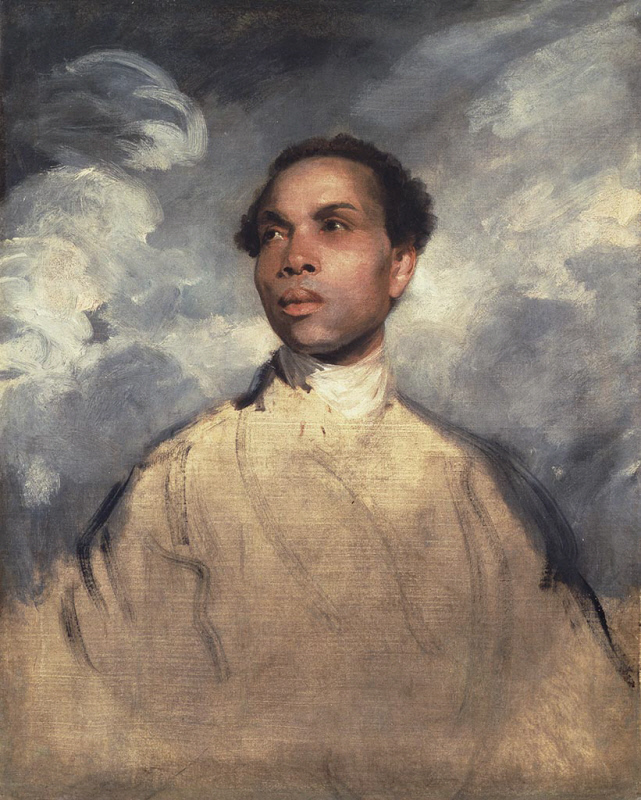
Joshua Reynolds, Portrait of a Man, perhaps Francis Barber, ca. 1770, oil on canvas, 79 × 64 cm (Private Collection).
Recent interest in recovering historical images of people of colour by Europeans raises important methodological questions. How can we address the potentials and limits of the traditional art historical toolkit in investigating this type of work? And how can we acknowledge that which may never be known?
This paper focuses on two pictures by Sir Joshua Reynolds that made their public debut together, hanging as pendants in the Reynolds retrospective at the British Institution in 1813. Each poses a different type of scholarly quandary: one subject has no name; the other, too many. One canvas represents an unidentified Black Briton. In the absence of secure historical data, the subject has been variously attributed: a servant of the artist; Francis Barber, heir to the writer Samuel Johnson; or even George Washington’s cook. Recent discoveries by researchers at the London Metropolitan Archives raise the tantalising possibility that Reynolds’s servant was named John Shropshire. But it remains an object in search of a name, a subject in search of a biography. In contrast, the second canvas represents a securely identified subject, the Polynesian traveller now known as Mai, who bore many names over his lifetime. He came to fame in Britain as ‘Omai’ or ‘Omiah’, a British misunderstanding of a Tahitian honorific that he reportedly bestowed on himself. Rather than presenting definitive answers, this paper explores how to navigate the limits of historical knowledge in the quest to name pictures and their subjects correctly.
Book tickets here»
Jessie Park is the Nina and Lee Griggs Assistant Curator of European Art at the Yale University Art Gallery. She specialises in early modern Netherlandish art, with a secondary area of expertise in the visual and material culture of global exchange from the late sixteenth to the early nineteenth century. She served as the Rousseau Curatorial Fellow in European Art at the Harvard Art Museums and held curatorial positions at the J. Paul Getty Museum in Los Angeles and the Huntington in San Marino, California. Her scholarship has appeared in The Art Bulletin and in an edited volume, Charles V, Prince Philip and the Politics of Succession: Festivities in Mons and Hainault, 1549.
Catherine Roach is an associate professor of art history at Virginia Commonwealth University, specialising in the art and exhibitions of eighteenth- and nineteenth-century Britain. Her scholarship has appeared in Art History, British Art Studies, and the American Art Journal, among others. She has been awarded fellowships by the Huntington Library and the National Humanities Center to support work on her second book, The Shadow Museum: A History of the British Institution, 1805–1867.
At Christie’s | Largillièrre’s Portrait of a Woman
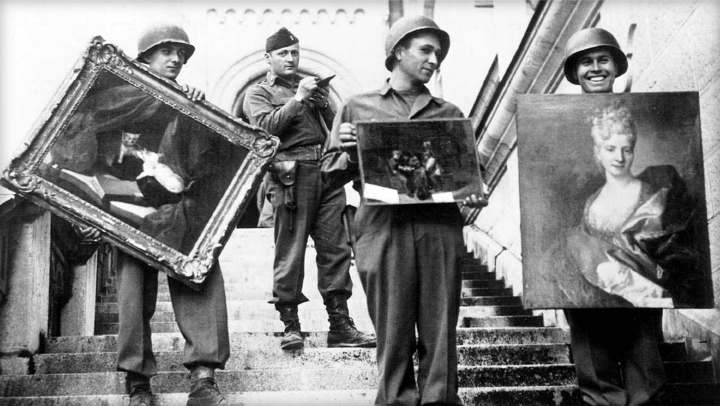
The leader of the Monuments Men, Capt. James Rorimer, and three soldiers after the rescue of artworks from Neuschwanstein Castle.
◊ ◊ ◊ ◊ ◊
As noted last month by Nina Siegal in The New York Times:
Nina Siegal, “For Sale: A Painting the Monuments Men Rescued from the Nazis,” The New York Times (25 October 2024). The portrait by a French court painter is one of three displayed in a photo that came to depict the efforts of a U.S. Army unit that tracked legions of looted art.
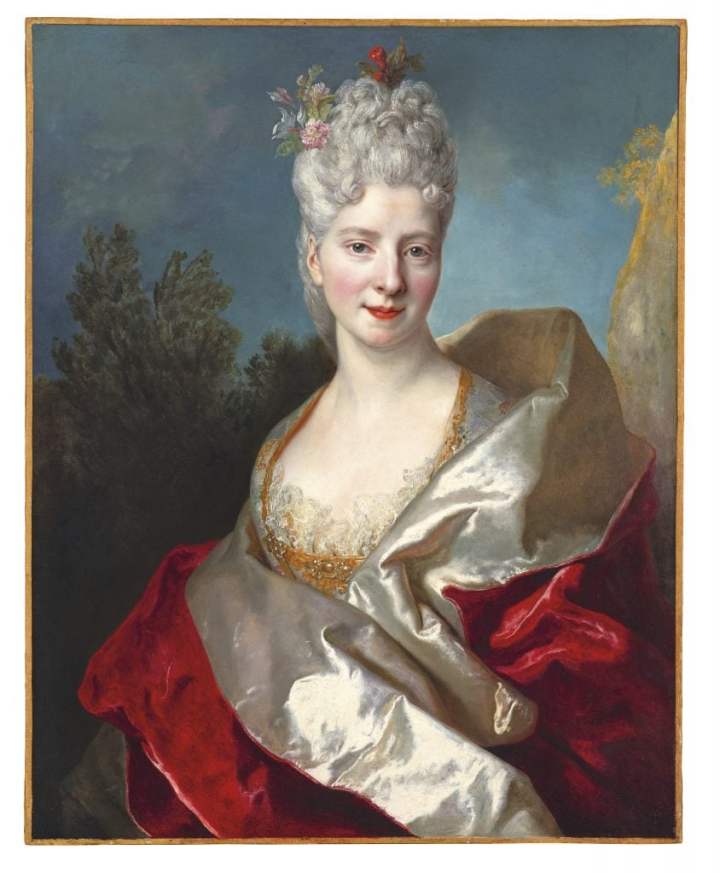
Nicolas de Largillièrre (1656-1746), Portrait of a Woman Half-Length, oil on canvas, 81 × 65 cm. To be sold at Christie’s Paris, 21 November 2024 (Sale #23018, Lot 27), estimate: €50,000–80,000.
It appears, memorably, in a snapshot taken in May 1945 of American soldiers on the steps of Neuschwanstein Castle in Bavaria—a painted portrait of a woman in a shimmering gown with porcelain skin and curly silver hair. The portrait and two other old master paintings are held by American soldiers in combat fatigues who have just liberated them from a Nazi storehouse of looted art.
The G.I.s were helping the Monuments Men, a special U.S. Army unit that tracked down millions of works of art stolen by the Germans during World War II. The image became a resonant depiction of the unit’s role in undoing Nazi evil and restoring part of European heritage to its rightful place.
Now the portrait, by the French court painter Nicolas de Largillièrre from the era of Louis XIV, is to be auctioned next month at Christie’s. . .
The full article is available here»
Note (added 22 November 2024) — The portrait sold for €529,200 (ten times more than its low estimate).
Symposium | Portraiture in a Trans-Asian Context
From ArtHist.net:
Making the Subject of Portraiture in a Trans-Asian Context, ca. 1000–Present Day
SOAS University of London, 5–7 December 2024
Registration due by 22 November 2024
Portraits have commonly been understood as naturalistic likenesses of human beings, centred on the face. The work of scholars such as Jean Borgatti, Richard Brilliant (1990), and Joanna Woodall (1997) opened the field in conceptualising portraiture as a truly multi-local genre, foregrounding the relational and performative processes of portraiture. This conference addresses the performative function of portraiture in constructing subjectivities in Asian contexts, in order to reveal important cultural, social, religious, and philosophical ideas key to understanding particular societies and cultures within Asia and its diasporas.
The symposium focuses on the portraiture of Asia with two specific purposes in mind. First, to decentre studies of Asian portraiture from Eurocentric conceptions of subjecthood and thus to expand the field of portraiture studies; second, to foreground the connections, transfers and tensions articulated by portraiture within trans-Asian contexts. The focus on Asia should not be read as exclusionary, but rather as the intent to initiate a dialogue with existing research on the portraiture of other regions such as Africa and Europe. Thirty-five years after Borgatti, Brilliant and Woodall’s contributions to the field of portraiture studies, the symposium Making the Subject of Portraiture in a Trans-Asian Context ca. 1000-Present Day proposes to take stock of a changing field by contributing the scholarship of art, cultural and literary history in the trans-Asian context.
Registration links are at the event page (participants will need to register individually for each day). Please direct inquiries to Conan Cheong (656531@soas.ac.uk) and Mariana Zegianini (mz15@soas.ac.uk) of the Department of the History of Art and Archaeology, at SOAS University of London.
t h u r s d a y , 5 d e c e m b e r
17.15 Doors open at Wolfson Lecture Theatre, Senate House
17.30 Welcome by Charlotte Horlyck (Head of the School of Arts, SOAS University of London)
17.45 Let’s Change the Subject: Joanna Woodall (The Courtauld Institute of Art)
18.00 Panel 1 | Portraiture and Technology
Chair: Ashley Thompson (SOAS University of London
• Margaret Hillenbrand (University of Oxford) — Read Your Mind: Facial Recognition Technology and Contemporary Chinese Portraiture
• Xinrui Zhang (The Courtauld Institute of Art) — Maskbook: Selfhood and Portraits of Chinese Artists and Environmental Activists
• Wiebke Leister (Royal College of Art and Ashley Thorpe, Royal Holloway) — A Hannya Manifesto: Performative Photographic Portraiture as Contemporary Demon Meta-Noh Play to Construct Feminist Frameworks for Interpretation
19.30 Evening Drinks
f r i d a y , 6 d e c e m b e r
13.15 Doors open at S312, Paul Webley Wing, Senate House
13.30 Panel 2 | Portraying Femininity
Chair: Henning von Mirbach (The Courtauld Institute of Art)
• Wen-chien Cheng, Royal Ontario Museum (Online) — Genre Crossing: The Fluidity of Female Portraits in Late Imperial China
• Doreen Mueller (Leiden University) — Becoming Ōtagaki Rengetsu: Misrepresenting a Buddhist Nun
• Amanda (Xiao) Ju (University College London) — From the Personal to the General: Xing Danwen’s Photographic Diaries
• Bahar Gürsel (Middle East Technical University, Online) — Studio Portraits of Female Domestic Workers in Late 19th- and Early 20th-Century Java and Singapore
15.15 Coffee Break
15.45 Panel 3 | The Diasporic / Displaced Subject
Chair: Marcus Gilroy-Ware (SOAS University of London)
• Nicole-Ann Lobo (Princeton University) — Self-Portraits of Francis Newton Souza in Bombay & London, 1949–61
• Jung Joon Lee (Rhode Island School of Design) — Surface Reading: Oksun Kim’s Berlin Portraits and the Aesthetics of Inscrutability
• Yingbai Fu (SOAS University of London) — Dressing Like a Princess: The Old-fashioned Horse-hoof Cuffs in the Portrait of Der Ling (c. 1885–1944) for American Eyes
• Haely Chang (Hood Museum of Art, Dartmouth College) — A Portrait of Public Self: Reading Na Hyesŏk’s Self-Portrait through Vernacular Photo Albums
17.30 Coffee Break
18.00 Panel 4 | Altered Masculinities
Chair: Richard Hylton (SOAS University of London)
• Giorgio Strafella (Palacký University Olomouc, Czech Republic) — The Experimental and Intellectual Roots of Shen Jingdong’s Hero and Hundred Family Names Portraits
• Amanda Wangwright (University of South Carolina, Online) — Seeing the Truth in Uncut Jade: Modernist Naturism, Traditional Ideals, and Timeless Truths in Portrait of Xu Langxi
• Michele Matteini (New York University, Online) — The Underbelly of Qing Portraiture: Flaccid Skin, Defective Bodies, and Old Age in the Qianlong Era
s a t u r d a y , 7 d e c e m b e r
9.15 Doors open at DLT Lecture Theatre, Ground Floor, Main Building
9.30 Panel 5 | Image-Text Relationships
Chair: Malcolm McNeill (SOAS University of London)
• Yiyang Gao (University of Oxford, Online) — Intertextual Subjectivity at the Qing Court: Portraiture in Wanguo laicho tu and Tributary Dramas Revisited
• Mengxuan Sui (Tsinghua University Art Museum, Online) — The Portraiture of Female Literati: A Study on Qu Bingyun (1767–1810) and Her Peers
• Nicholas L. Chan (The Chinese University of Hong Kong, Online) — A 1979 Calendar: Portraits of Figures from the Dream of the Red Chamber
11.00 Panel 6 | The Performing Subject
Chair: Natasha Morris (SOAS University of London)
• Junyao He (The Courtauld Institute of Art) — Emperor or Bodhisattva? The Qianlong Emperor as Bodhisattva Manjushri in the collection of the Potala Palace, Lhasa, Revisited
• Conan Cheong (SOAS University of London) — Memorialising Monastic Subjectivity: Photographs and Wax Figures of Buddhist Monks in Luang Prabang, Lao PDR
• Ziyi Shao (SOAS University of London) — The Origins and Image Translation of the Three Horizontal Paintings of Tsongkhapa’s Life Stories in Fanhualou
12.30 Lunch Break
13.30 Panel 7 | Testing the Boundaries
Chair: Stephen Whiteman (The Courtauld Institute of Art)
• Leslie V. Wallace (Coastal Carolina University) — White General and Other Portraits of Gyrfalcons at the Court of the Qianlong Emperor (r. 1795–1796)
• Natasha Morris (SOAS University of London) — ‘Opening the Face of Isfahan’: Portraiture in 17th-Century Persian Painting
• Chang Tan (Penn State University) — Living Matter: Portraiture in Zhuang Hui’s “Nature Photography”
15.00 Closing Remarks (Conan Cheong and Mariana Zegianini)
Symposium | Apprentices and Networks of Learning, 1650–1950
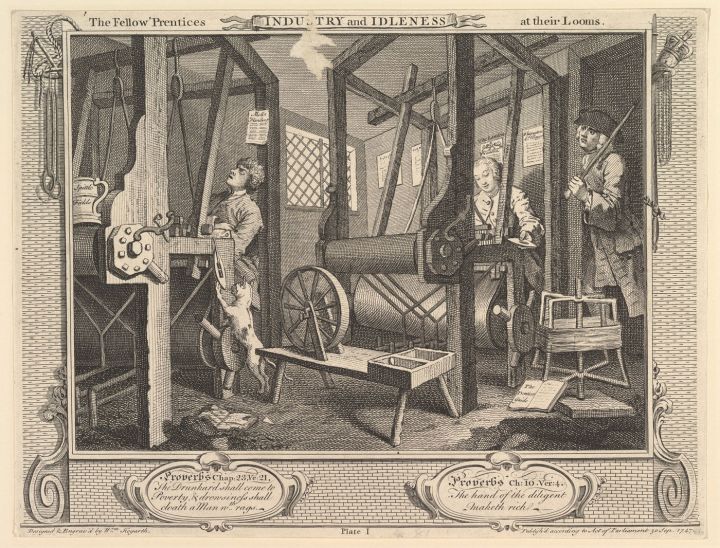
William Hogarth, Industry and Idleness, Plate I: The Fellow ‘Prentices at Their Looms, October 1747, etching and engraving
(Houston: Sarah Campbell Blaffer Foundation)
◊ ◊ ◊ ◊ ◊
This Saturday at the MFAH:
Skillful Hands: Apprentices and Networks of Learning, 1650–1950
Online and in-person, Museum of Fine Arts Houston, 9 November 2024
Established in 2014, the biennial Rienzi symposium focuses on topics inspired by the decorative arts, with papers presented by emerging scholars.
The 2024 symposium, Skillful Hands: Apprentices and Networks of Learning 1650–1950, explores the networks of learning available—and unavailable—to diverse groups of people, examining how access to training and materials through apprenticeships shaped craft traditions. Selected participants present their research on Saturday, 9 November 2024, on the MFAH main campus in Lynn Wyatt Theater, located in the Kinder Building. Entrance is included with Museum admission. The event is live streamed and can be accessed here.
Before the late 19th century, apprenticeships regulated by European craft guilds were the primary means of training in craft trades. These apprenticeships offered a valuable alternative to traditional education but often excluded women, immigrants, Indigenous and enslaved peoples, and children from low-income families. With the onset of the Industrial Revolution, informal apprenticeships emerged to adapt to new innovations and technologies. Outside traditional European models, skills were acquired through forced migration, local environments, and informal training in various colonial regions. These diverse experiences contributed to a network of skilled craftspeople, both anonymous and renowned.
p r o g r a m
11.15 Welcome — Christine Gervais (the Fredricka Crain Director, Rienzi)
11.20 Keynote
Making Time: Competition and Collaboration in Early Modern European Artisanal Networks — Lauren R. Cannady (Assistant Professor of Humanities, University of Houston–Clear Lake)
12:05 Session 1
• Tactile Nomenclature: Transgenerational Transmission of Silk Weaving Knowledge in Early Modern Iran —
Nader Sayadi (Visiting Assistant Professor, University of Rochester)
• Es Artisanes Du Roi: The Public Prohibition and Private Protection of Women’s Artisanal Knowledge in the Paris of Louis XIV, 1661–1715 — Jordan Hallmark (PhD student, Harvard University)
1.00 Lunch break
1.40 Session 2
• The Racial Afterlife of Revolutionary Goldsmithing and Absent Apprenticeships from Haiti to Bordeaux — Benet Ge (Williams College)
• ‘Perfect’ Imitations: Learning in The Spanish Colonial Philippines — Lalaine Little (Director, Pauly Friedman Art Gallery, Misericordia University)
2.35 Break
2.50 Session 3
• Haitian Cabinetmaking Community in New Orleans: The Apprentices of Jean Rouseau and Dutreuil Barjon — Lydia Blackmore (Decorative Arts Curator, Historic New Orleans Collection)
• Passing on Knowledge: Learning the Upholsterer’s Trade in the 19th Century — Justine Lécuyer (Sorbonne Université, Paris)
Call for Papers | Artists’ International Social Networks, 1750–1914
From ArtHist.net:
(Re)searching Connections: Artists’ International Social Networks, 1750–1914
Academia Belgica, Rome, 30 September — 1 October 2025
Proposals due by 15 February 2025
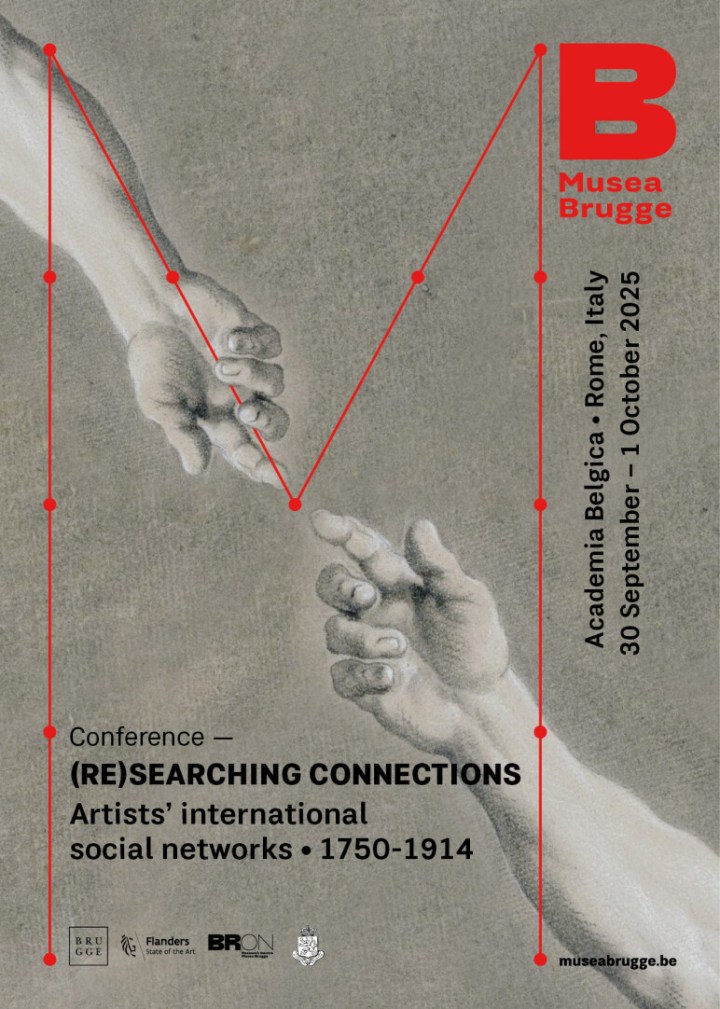 Musea Brugge and the Academia Belgica are pleased to announce the conference (Re)searching Connections: Artists’ International Social Networks, 1750–1914, to be held at the Academia Belgica in Rome on 30 September and 1 October 2025. This two-day conference will examine the formation and function of artists’ transnational social networks, while also exploring new research possibilities enabled by digital methodologies. Embracing a broad chronological and geographical scope, we invite insights spanning the long nineteenth century and various contexts worldwide. We are excited to confirm two esteemed keynote speakers: France Nerlich (Musée d’Orsay) and Giovanna Ceserani (Stanford University).
Possible topics for consideration include, but are not limited to:
• The impact of artists’ networks on educational and professional development, with a focus on artistic training abroad, intergenerational exchanges, mentorship, patronage, and/or the role of academies and other institutions.
• The complex interplay of identity and community in artists’ networks, which can encompass émigré artists, artist’s colonies, the influence of gender, social class and family ties, the physical spaces of sociability, and interpersonal dynamics such as collaboration, competition, emulation, and a sense of belonging.
• Processes of artistic exchange and adaptation in artist’s networks, whether influenced by cross-cultural interaction or by historical shifts and events such as the rise of nationalistic ideologies, regime change, warfare, and colonialism.
• The representation and documentation of artist’s networks, with attention to contemporary artworks, visual media, and written historical source material, as well as the digital approaches that enable the visualization and analysis of social networks today.
Please visit our website for the conference details, including the full Call for Papers and the submission form. We invite proposals for 20-minute papers in English or French. If presenting in French, please provide accompanying materials in English. Please fill out the submission form on our website by 15 February 2025 (notification of acceptance expected to arrive by the end of March 2025). Proposals should include a single PDF file with the following components:
• A 100-word biography of the author
• A 300-word abstract
• 1 or 2 relevant images (e.g. artworks, archival documents, data visualization)
Proposals will be evaluated based on relevance, clarity, novelty, and contribution to the field. We seek papers that reflect critically on the source material and methodologies employed. For more information, please contact Marie Vandeghinste at marie.vandeghinste@brugge.be.
Conference | The Art of Mourning, 1750–1850
From ArtHist.net:
The Art of Mourning: Emotion and Restraint in the Visual Arts, 1750–1850
Die Kunst des Trauerns. Gezügelte Gefühle in den Bildkünsten, 1750–1850
Martin von Wagner Museum der Universität Würzburg, 5–6 December 2024
 In a much-discussed essay of 1986, Yve-Alain Bois identified “The Task of Mourning” as a characteristic feature of painting in the advanced twentieth century. However, this emotionally charged purpose had already been ubiquitous in many forms of artistic expression in the decades around 1800, before being eclipsed by the more materialistic art movements from the middle of the nineteenth century. Prior to that, images of mourning occur with overriding frequency, to such an extent that they lend themselves for questioning the very polarity of neo-classicism and romanticism.
From ca. 1750, mournful motifs and sentiments are conspicuously present in virtually all genres within the visual arts. Art historical research has addressed this phenomenon mainly by asking for the impact of secularization and dissolving iconographic norms (e.g., Werner Busch, Das sentimentalische Bild, 1993). In fact, mourning as existential subject matter is isolated, sometimes devoid of moralistic or theological linkage, for the first time during the so-called ‘saddle period’. In tombs designed by Antonio Canova, old and new motifs of figural grief are constantly played through; John Flaxman fills one sheet after the other with sorrowful processions; within the paper architecture of Étienne-Louis Boullée, mourning and the sublime are connected through the void of cenotaphs; the school of David chooses, in a rather obsessive manner, scenes informed with teariness; large numbers of mourning figures populate the works of the Düsseldorf School. In painting as in sculpture, let alone the graphic arts, grief and sorrow are everywhere; military commanders, politicians, artists, popes are bemoaned, just as family members, suicides and persons sentenced to death. Lost honor or lost homeland, even the flow of time, are occasions of mourning.
These new ways of depicting grief feature a clear distinction from Baroque pathetic formula. The contrary stance compared to everything before is experienced in the most immediate manner—but how to grasp it conceptually? For sure, images of mourning are hallmarked by emotional control; thus we can understand them as an inversion of heightened expression and pathos. Why, then, is there a desire for pictures of painful yet patiently endured loss just in the age of enlightenment and its aftermath, i. e. in a period that is characterized by faith in progress like none before it? For what reason these pictures were considered particularly appropriate for transformations of Christian imagery? Is there a deeper connection between the new visual dimension of mourning and changed gender-specific attributions? Can we establish a causality between the withdrawal of mourners into themselves on one side, and neo-classicist reductionism on the other? What are the effects of the expanded canon of antiquities, operated by contemporary archaeology, on the iconography of mourning? How to define the share of human science—of new anthropological concepts, early forms of psychology, or research into human emotions in terms of physical and medical scholarship—in the visualization of mourning? How to relate, in a methodically sound fashion, the boom of mourning in the visual arts with social and political upheaval?
This conference seeks to explore, on a large scale, these and other questions around the historical theme of mourning. The Art of Mourning is the first edition of the Würzburg Wellhöfer-Colloquium. Every two years, it will investigate research topics from the history of art between 1750 and 1850 from an interdisciplinary perspective.
Organisation
Michael Thimann (Georg-August-Universität Göttingen/Deutsche Gesellschaft für die Erforschung des 19. Jahrhunderts) und Damian Dombrowski (Julius-Maximilians-Universität/Martin von Wagner Museum der Universität Würzburg)
Kontakt
Martin von Wagner Museum der Universität Würzburg, mvw-museum@uni-wuerzburg.de
d o n n e r s t a g , 5 d e z e m b e r
Michael Thimann, Damian Dombrowski — Begrüßung und Einführung / Welcome and Introduction
Impulsvortrag | Keynote Lecture
• Werner Busch, FU Berlin — Die Kunst des Trauerns: Gezügelte Emotionen in den Bildkünsten, 1750–1850
Sektion 1 | Sentimentalisierte Trauer / Sentimentalised Mourning
• Cordula Grewe, Indiana University Bloomington — Seelenmalerei, oder: Wie bewahrt man seine Fassung?
• Franca Buss, Universität Hamburg — Um die Wette weinen. Johann August Nahls Grabmal für Maria Magdalena Langhans und die Sentimentalisierung des Todes
• Lisa Hecht, Philipps-Universität Marburg — Trauer oder Langeweile? Die Eleganz des ‚Nichtstuns‘ in Damenbildnissen des englischen 18. Jahrhunderts
Sektion 2 | Trauer-Orte / Places of Mourning
• Daniela Roberts, Julius-Maximilians-Universität Würzburg — Die Tugend überdauert den Schmerz: Horace Walpoles Grabmal für seine Mutter in der Westminster Abbey
• Eric Sergent, Laboratoire de recherche historique Rhône-Alpes —Mourning and Grief in French Funerary Sculpture
• Martina Sitt, Kunsthochschule Kassel — Trauer-Plätze des Klassizismus: Vielschichtige Aspekte der Gestaltung von Licht und Raum
Sektion 3 | Entgöttlichte Trauer? / Grief without Deity?
• Noémi Duperron, Université de Genève — ‘Touch(ing) with Sentiment’: Gavin Hamilton’s Grievers and Smith’s Theory of Moral Sentiments
• Maria Schabel, Julius-Maximilians-Universität Würzburg — Erneuerung religiöser Bildsprache? Fallstudien biblischer Trauerikonographie um 1800 am Beispiel zweier Werke Johann Martin von Wagners
• Lorenzo Giammattei & Antonio Soldi, Sapienza Università di Roma — Comparing Perspectives of Eternity in the Elaboration of the Mourning Theme in Painting: From Death for a Religiously Connoted Afterlife to Death as an Opportunity to Create an Ethical and Virtuous Model for the Present Time
f r e i t a g , 6 d e z e m b e r
Sektion 4 | Trauern an der Epochenschwelle / Mourning in the Age of Transition
• Damian Dombrowski, Julius-Maximilians-Universität Würzburg — ‘l’ultimo soffio di felicità in Europa’? Tiepolo’s Sense of Loss
• Isabelle Le Pape, DRAC Normandie, Rouen — From Caspar David Friedrich to Courbet’s Enterrement à Ornans: The Image of Mourning in French and German Romantic Painting
• Susanne Adina Meyer, Università di Macerata — Morire con grazia: Bilder des Trauerns im Spiegel des römischen Kunstdiskurses
Sektion 5 | Antike als Trauer-Modell / Antiquity as a Model of Mourning
• Carolin Goll, Julius-Maximilians-Universität Würzburg — Trauern in der griechischen Tragödie: Martin von Wagners Zeichnungen nach Euripides
• Johannes Myssok, Kunstakademie Düsseldorf — Canova and the Art of Mourning
• Jochen Griesbach, Julius-Maximilians-Universität Würzburg — Niobe ist überall? Zur Antikenrezeption mütterlicher Trauer in Bildern des 18. und 19. Jahrhunderts
Sektion 6 | Politisches Trauern / Political Mourning
• Tobias Kämpf, Friedrich-Alexander-Universität Erlangen — Mourning at Missolonghi: Political Artworks as Compensations for Loss
• Cigdem Özel, Universität Wien — Trauern für die Monarchie am Beispiel von Miniaturporträts Eduard Ströhlings
• Philip Schinkel, Universität Hamburg — Grenzen überschreiten: Männertränen im belgischen Nationalmythos bei Louis Gallait
Call for Papers | On the Use and Abuse of Antiquity in 18th-C. Life
From the Call for Papers:
On the Use and Abuse of Antiquity in 18th-Century Life: Classical References and Their Subversion in the Age of Enlightenment
University of Chicago John W. Boyer Center in Paris, 22–23 May 2025
Proposals due by 15 December 2024

Ingres, The Apotheosis of Homer, 1827, oil on canvas, 386 cm × 512 cm (Paris: Musée du Louvre).
It is a well-established fact, frequently analysed by literary critics, that Greek and Roman Antiquity lies at the heart of 18th-century culture. The significance attributed to ancient authors in 18th-century collèges is often acknowledged, but references to classical figures in fact permeate all forms of the literary and visual arts, whether in the light-hearted forms of Baroque and Rococo or the austere severity of Neoclassicism. Scholars have often highlighted the idealisation of ancient socio-political models, which served as counterpoints to contemporary reflections and critiques, extending from the writings of philosophers to the proclamations and imagination of Revolutionary thinkers. The classical world was imbued with an exemplary value, conceived as an alternative framework through which to contemplate and categorise a frequently problematic present, or to advocate for political, social, and aesthetic reforms. Antiquity offered ideas and images that constituted a kind of second language through which the world of the Enlightenment could be reimagined.
However, any process of re-functionalisation and re-valorisation is inevitably accompanied by subversions, instrumentalization, and alterations. For a reference to be productive and applicable to a new and changing context, it must undergo modification that renders it relevant and exploitable, allowing it to bear meanings beyond the scope of its original formulation. In all cultural domains, ancient texts were either faithfully reproduced, critically commented upon, or openly reinterpreted according to the argumentative needs of writers, who, whether intentionally or not, projected their worldview and concerns onto these works. Precisely because Antiquity functioned as a ‘second language’, its words could only serve as instruments for the description and analysis of reality to the extent that they lost their original meaning and took on new ‘semantic’ valences, enabling them to convey content more attuned to the concerns of the time.
This colloquium aims to analyse and explore these deviations, shedding light on the highly productive dialectical play that takes place between an increasingly historicist and proto-scientific reception of the ancient world (with the emergence of disciplines such as archaeology, philology, etc.) and the still very free and fertile use of classical heritage, which was often employed with little constraint to support any and all ethical, political, or aesthetic arguments. Our goal is to identify the misunderstandings or ‘subverted’ reuses of classical texts, histories, and figures. Whether these fluctuations occur in the literal but reoriented reproduction of phrases, maxims, or passages from ancient texts, or more broadly in the reception of classical models in which new symbolic potentialities are detected, we wish to delve deeper into the qualities and purposes of these transformations of ancient material, analysing their pathways and dead ends, their distortions and their reconfigurations.
Why refer to Antiquity, and with what specific objectives or purposes? How were maxims, historical or philosophical texts, and the pantheon of ancient heroes and gods reinterpreted in the Age of Enlightenment, and how were they integrated into the contemporary cultural discourse? What demands for fidelity, and what modernising distortions were imposed upon Greek and Roman treatises and literature? How did any reappropriation of ancient discourse and its imagery ultimately prove suitable for the new expressive and ideological needs of the philosophes, and how could these same images also lead to their condemnation?
Presentations, in French or English, must not exceed 30 minutes. The conference organizers will cover travel and accommodation expenses for all invited speakers. A publication of the conference proceedings is planned.
Proposals for papers, in French or English, consisting of 250–300 words, accompanied by a brief bio-bibliography including institutional affiliations, should be submitted by 15 December 2024, to glenn.roe@sorbonne-universite.fr and dario.nicolosi.92@gmail.com. Acceptance decisions will be communicated to the authors by 15 January 2025.
The Burlington Magazine, October 2024
The long 18th century in the October issue of The Burlington:
The Burlington Magazine 166 (October 2024)
 e d i t o r i a l
• “Restoring the ‘belle époque’,” pp. 995–96.
The Musee Jacquemart-André is a treasure house that graces the Haussmann boulevards in Paris and is perhaps not nearly as well-known as it should be. The recent re-opening of the museum on 6th September, following a period of closure for conservation, therefore provides a welcome opportunity to draw fresh attention to this most romantic and beguiling of collections and the elegant building that houses it.
a r t i c l e s
• Jacob Willer, “Annibale Carracci and the Forgotten Magdalene,” pp. 1028–35.
A painting the collection of the National Trust at Kedleston Hall, Derbyshire, is published here as a work of Annibale Carracci’s maturity. Related to comparable compositions which derive from it, in collections in Rome and Cambridge, it was acquired in Florence in 1758 for the 1st Baron Scarsdale.
• Samantha Happé, “Portable Diplomacy: Louis XIV’s ‘boîtes à portrait’,” pp. 1036–43.
Louix XIV’s ambitious and carefully orchestrated diplomatic programme included gifts of jewelled miniature portraits known as ‘boîtes à portrait’. Using the ‘Présents du Roi’, the circumstances around the commissioning and creation of these precious objects can be explored and a possible recipient suggested for a well-preserved example now in the Musée du Louvre, Paris.
r e v i e w s
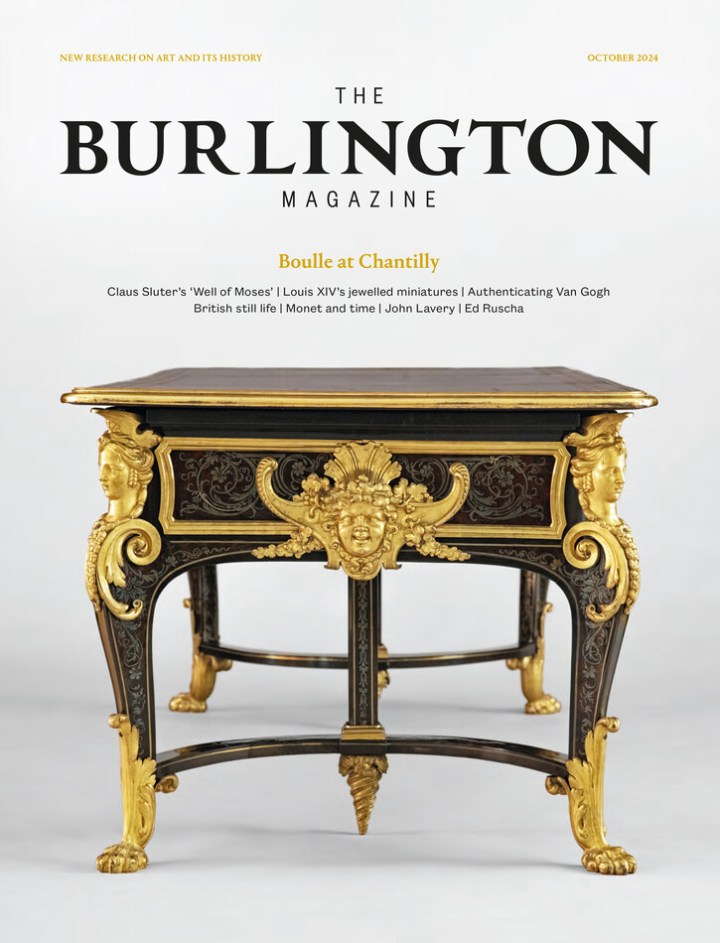
• Alexander Collins, Review of the exhibition André Charles Boulle (Musée Condé, Château de Chantilly, 2024), pp. 1056–59.
• Claudia Tobin, Review of the exhibition The Shape of Things: Still Life in Britain (Pallant House Gallery, 2024), pp. 1067–69.
Helen Hillyard, Review of of the recently renovated galleries of the Barber Institute of Fine Arts, Birmingham, pp. 1077–79.
• Colin Thom, Review of Steven Brindle, Architecture in Britain and Ireland, 1530–1830 (Paul Mellon Centre, 2024), pp. 1080–81.
• Christopher Baker, Review of Bruce Boucher, John Soane’s Cabinet of Curiosities: Reflections on an Architect and His Collection (Yale University Press, 2024), pp. 1087–88.
o b i t u a r y
• Christopher Rowell, Obituary for Alastair David Laing (1944–2024), pp. 1094–96.
Although renowned in particular for his expertise on the art of François Boucher, Alastair Laing had very wide-ranging art historical taste and knowledge, which he shared with great generosity of spirit. He curated some important exhibitions and brought scholarly rigour to his inspired custodianship of the art collections of the National Trust.










 Enfilade
leave a comment