Berlusconi’s Interventions Reversed
As reported by the Agence France-Presse (AFP):

AFP Photo by Andreas Solaro
An ancient statue of Mars has lost its fake penis and his counterpart Venus her hands, in the reversal of cosmetic changes ordered by Italy’s ex-prime minister Silvio Berlusconi, a newspaper reported Wednesday.
In 2010 Berlusconi decided the two marble statues adorning the official residence of the prime minister were ‘incomplete’ and ordered a swift intervention to remedy their shortcomings. In a move which horrified the art world, Mars was touched up with a fake penis, shield, hand and the point of his sword and Venus her two hands. The 70,000 euro ($90,000) cost of the changes also sparked ridicule and anger
from the opposition. . .
The full article is available here»
This Week in Cleveland
From the Editor
For those of you who will be in Cleveland this week for ASECS, these two items might be of interest: The Dunham Tavern Museum and Mitsuko Uchida’s performance of Mozart with the Cleveland Orchestra.
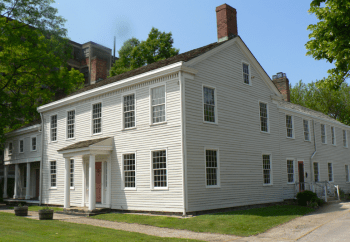
Dunham Tavern, Cleveland, Ohio (Photo: Wikimedia Commons)
Admittedly, I’m an easy sell for house museums. Built in 1824, the Dunham House is Cleveland’s oldest building. Rufus and Jane Pratt Dunham arrived in 1819 from Massachusetts, farming fourteen acres in the Western Reserve (previously known as ‘New Connecticut’, the region had been claimed by Connecticut as early as 1662 and finally turned over to the Connecticut Land Company only in 1800). Positioned on a stagecoach route, the house also functioned as a tavern during the middle decades of the nineteenth century. As for the history of the museum, it’s entirely typical of this sort of site: preservation plans and renovations took place in the 1930s; it became a Cleveland Landmark in 1973 and was added to the National Register of Historic Places in 1974. It seems to be open only Wednesday and Sunday afternoons.
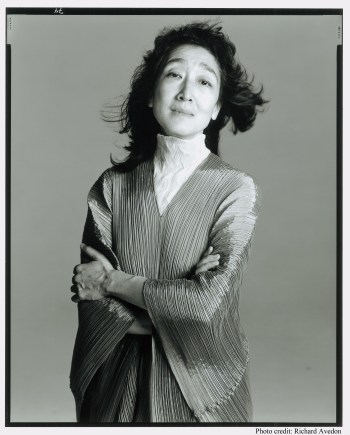
Richard Avedon, Mitsuko Uchida
British pianist and conductor Mitsuko Uchida has garnered an impressive array of critical recognition within the past few years: Dame Commander of the British Empire, an honorary doctorate from the University of Oxford, and a Grammy award. It’s especially fitting to hear her in Cleveland, for she served as artist-in-residence with the city’s Orchestra from 2002 to 2007, and her 2011 Grammy came in connection with her performance of Mozart also in Cleveland. She performs Mozart’s Piano Concerto No. 17 in G major, K453; Divertimento in B-flat major, K137; and Piano Concerto No. 25 in C major, K503 — April 4-6, Thursday, Friday, and Saturday evenings at 8:00.
Exhibition | Marquis de Marigny
I’m afraid this is another exhibition that slipped past me, but I include it here nonetheless. The catalogue is, at least, still available from Artbooks.com. -CH
◊ ◊ ◊ ◊ ◊
From the press release:
Le Naturel Exalté: Marigny, Ministre des Arts au Château de Menars
Expo 41, Loir-et-Cher, Blois, 30 June — 16 September 2012
 Ambitieux, fier, ombrageux : les qualificatifs ne manquent pas pour définir Abel-François Poisson de Vandières, marquis de Marigny et seigneur de Menars (1727-1781). Son destin, tracé à la plume de l’exception, en fait foi. Il eut la chance d’être le frère cadet de la maîtresse de Louis XV, titrée marquise de Pompadour, qui l’introduisit dès son adolescence à la cour du roi. À vingt-quatre ans, il est nommé directeur général des Bâtiments du roi, arts et manufactures. Un voyage en Italie en compagnie d’artistes et d’architectes engagés dans les débats esthétiques contemporains fut le déclic vers l’émancipation : Marigny commença alors à se constituer une collection d’exception. Sa galerie de statues était la 1ère de France après celle de Louis XV. Il dirigea surtout la politique des arts du royaume pendant 30 ans, laissant à l’humanité des chefs-d’oeuvre tels que la place de la Concorde, l’École Militaire, les jardins des ChampsÉlysées ou le Panthéon de Paris.
L’exposition Le naturel exalté. Marigny, ministre des arts au château de Menars, qui sera présentée à Expo 41, du 30 juin au 16 septembre 2012, est la 1ère rétrospective mondiale consacrée au frère de la Pompadour et ministre de Louis XV. Le visiteur découvrira le fonds exceptionnel des archives départementales de Loir-et-Cher, encore jamais dévoilé au public, constitué de centaines de dessins représentant l’aménagement des jardins du château de Menars en Loir-et-Cher, plusieurs tableaux majeurs en provenance du musée du Louvre ou du château de Versailles, ainsi que des oeuvres issues de la collection personnelle de Marigny. . .
◊ ◊ ◊ ◊ ◊
Christophe Morin, ed., Le Naturel Exalté: Marigny, Ministre des Arts au Château de Menars (Milan: Silvana, 2012), 192 pages, ISBN: 978-8836622658, €28 / $55.
 Abel-François Poisson (1727-1784), marquis de Vandières puis de Marigny est plus que le frère de la marquise de Pompadour. Directeur général des Bâtiments du roi à compter de 1751, il a rang de ministre et participe à la vie de cour autour de Louis XV. Courtisan zélé, il conserve ses fonctions au-delà même de la disparition de sa soeur, jusqu’en 1773. Il a toute la reconnaissance du roi qui lui offre un somptueux ” meuble ” pour décorer son hôtel de la rue Saint-Thomas-du-Louvre, ainsi que de nombreuses sculptures qui viendront embellir son château de Menars.
Le présent ouvrage rappelle, grâce aux contributions des meilleurs spécialistes de la question, la brillante carrière d’un grand commis de l’Etat au service de Louis XV. Pour la première fois, une exposition monographique sur le marquis de Marigny rassemble des oeuvres qui évoquent la carrière de l’homme public dont le rôle fut éminent dans la transformation radicale du goût au milieu du XVIIIe siècle.
L’autre versant de cette entreprise, tout aussi inédit, regarde le seigneur de Menars, ses collections et sa vie en Val de Loire. Ce ne sont pas moins de 90 dessins d’architecture qui sont présentés ici. Des oeuvres parfois majeures, parfois émouvantes, commandées par Marigny aux plus grands artistes du temps pour décorer le parc de sa maison de campagne. Grand seigneur sur ses terres, il aménage en effet le château de Menars, à sa mesure, réglant les moindres détails de son nouveau jardin anglo-chinois.
Symposium | Design and Mobility
From Parsons The New School for Design:
Design and Mobility: The 22nd Annual Parsons/Cooper-Hewitt Symposium
on the Decorative Arts and Design
Parsons The New School for Design, New York, 26-27 April 2013
A keynote address by Professor Edward Cooke of Yale University will be delivered and papers delivered by graduate students and faculty from universities around the US and UK. Free and open to the public.
This year’s theme is mobility which has become one of the defining traits of the age: new modes of living and transportation have created increasingly mobile lifestyles, aided by mobile communications networks, cultural products can move and spread across the globe with ease, and changing climate conditions are forcing relocations and rethinking of building patterns. On the individual scale, designers have worked with transformable and reusable products, or to help make individuals more mobile. The symposium will explore various aspects of mobility in the decorative arts and design — on macro and micro scales, from literal to metaphoric perspectives.
Sponsored by The MA Program in the History of Decorative Arts and Design, School of Art and Design History and Theory, Parsons The New School for Design in conjunction with: Cooper-Hewitt, National Design Museum, Smithsonian Institution with the additional support of: donations to the Catherine Hoover Voorsanger memorial fund.
◊ ◊ ◊ ◊ ◊
F R I D A Y , 2 6 A P R I L 2 0 1 3
5:30 The Catherine Hoover Voorsanger Keynote Address
Edward Cooke (Yale University), Design and Mobility
S A T U R D A Y , 2 7 A P R I L 2 0 1 3
11:00 Session I
• Iris Moon (Massachusetts Institute of Technology), The Cabinet de platine (1800-1804): Monumentality, Materiality, and the Mobile Interior at the End of the Enlightenment
• Penny Wolfson (Parsons The New School for Design/Cooper-Hewitt, National Design Museum), The Wheelchair in Post-Civil War America
• Rebecca Gross (Parsons The New School for Design/Cooper-Hewitt, National Design Museum), Holiday Magazine: Paving the Postwar American Dream Road with Patriotism
2:30 Session II
• Jonathan Patkowski (City University of New York Graduate Center), Transformation, Reproduction, Reuse: The Reception of Asian Silks in Late Medieval Italy
• Neil Malcolm Douglas Ewins (University of Sunderland), UK Ceramic Manufacturing Strategy, Marketing, and Design in Response to Globalization, ca. 1990-2010
• Elise Hodson (York University), ‘Born and Raised on Kickstarter’: The Near Immaculate Conception of a Smart Watch Named Pebble
The Burlington Magazine, March 2013
The eighteenth century in The Burlington:
The Burlington Magazine 155 (March 2013)
E D I T O R I A L
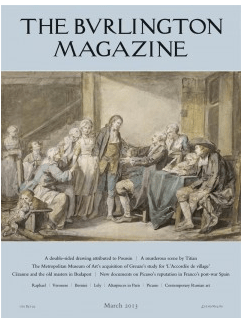 • “Mind Your Language,” p. 151. The incorrect and exaggerated use of language in the art press.
. . . A recent article in the Guardian [Andy Beckett, “A User’s Guide to Artspeak,” The Guardian (27 January 2013)] reported on a private initiative by two Americans, an artist and a critic/sociologist, who have investigated the language of contemporary art description, culled from wall labels and gallery press releases from 1999 onwards [David Levine and Alix Rule, “International Art English,” Triple Canopy 16 (July 2012)]. Their survey is analytic rather than satiric, and they trace the origins of what they call ‘International Art English’ to much French post- structuralist theory. They make excellent, deadpan fun of the commercial gallery press release which now goes well beyond its earlier professional constituency to reach a broad emailed audience. At the Burlington, where we receive thousands of such releases each year from many countries, we can testify to the universality of this artspeak obscurantism. But even in the more comprehensible releases, for exhibitions or books, the clichés mount up: the works are ‘brand new’; the exhibits are ‘iconic’; the paintings are ‘vibrant’ (and also, of course, ‘masterful’); the artist is never less than ‘award winning’; and the new book (invariably a ‘comprehensive overview’) is ‘groundbreaking’, ‘lavishly illustrated’ and ‘thought-provoking’. These all accumulate into a prose of deadly conformity. . . Keep reading here»
A R T I C L E S
• Perrin Stein, “Greuze’s L’Accordée de Village: A Rediscovered Première Pensée,” pp. 162-66. The rediscovery of a watercolour study (c.1761) of Jean-Baptiste Greuze’s L’Accordée de Village.
R E V I E W S
• Antony Griffiths, Review of Ad Stijnman, Engraving and Etching 1400–2000: A History of the Development of Manual Intaglio Printmaking Processes (London: Archetype Books, 2012), p. 177.
This monument book is the result of twenty-five years’ work on the part of the author who has produced a text far ahead of anything yet written on this aspect of printmaking. . . His conclusions have an authority that immediately makes this a standard work, and it can confidently be recommended to any reader. . .
• Claudia Nordhoff, Review of the exhibition Johann Christian Reinhart (1761–1847): Ein deutscher Landschaftsmaler in Rom,” pp. 199-200.
London Art Week 2013
Press release (January 2013) . . .
London Art Week
London, 28 June — 5 July 2013
 London Art Week is an exciting joint venture that unites Master Paintings Week and Master Drawings and Sculpture Week (formerly Master Drawings London). The new collaboration will provide a coherent platform, sharing advertising and creating a new online portal through which the individual websites can be accessed. London Art Week will also produce a map with the locations of all the participants making it easier for collectors to navigate the week. More than 50 specialist dealers across the fine art disciplines and the major London auction houses will take part in this new initiative.
“We welcome this initiative which strongly underlines the unique and unrivalled connoisseurship and expertise to be found in the art trade in London,” comments Johnny Van Haeften, co-founder of Master Paintings Week. “The old cliché of the fusty gallery is totally out of date and we want people to discover just how accessible we are and what treasures we hold.”
The strength of the format of London Art Week lies in its simplicity. By joining together to hold a series of coordinated exhibitions in galleries throughout the West End at the same time that the auction houses hold their major sales, specialist dealers in these disciplines are giving collectors, both private and institutional, the opportunity to view the full range of works available on the market. During the first weekend, all the participants’ doors will be open giving visitors the opportunity to look at works of art at their leisure.
London Art Week will serve to promote specialist dealers and their works in all three disciplines, while encouraging collectors and enthusiasts to visit exhibitions in the galleries. By displaying the objects in intimate gallery settings located in Mayfair and St James’s, the event will encourage the building of relationships between clients and dealers.
Exhibition | Colors of Seduction: Tiepolo and Veronese
This is, unfortunately, the last weekend for the exhibition, though it is slated to be reviewed by The Burlington.
I Colori della Seduzione: Giambattista Tiepolo & Paolo Veronese
Castello di Udine, 17 November 2012 — 1 April 2013
Curated by William Barcham, Linda Borean, and Caterina Furlan

◊ ◊ ◊ ◊ ◊
Un’occasione unica per vedere riunite, dopo quasi duecento anni, le due tele che compongono il Mosè salvato dalle acque di Giambattista Tiepolo. L’opera, tagliata negli anni ’20 dell’800, viene proposta nella sua composizione originaria, riaccostando il Mosè della Scottish National Gallery di Edimburgo con l’Alabardiere della collezione Agnelli di Torino, così come documentato da una copia coeva attribuita a Giandomenico Tiepolo della Staatsgalerie di Stoccarda. Le due parti della tela, che hanno avuto destini conservativi diversi, presentano oggi colori leggermente diversi.
Un sistema di illuminotecnica all’avanguardia renderà possibile vedere l’opera sia come è realmente, che secondo una colorazione uniforme. Ideale risulta l’accostamento al Mosè salvato dalle acque di Paolo Veronese del Musée des Beaux Arts di Digione, per rilevare le assonanze e la personale soluzione adottata da Tiepolo. Il confronto diretto tra le due opere vuole riportare l’attenzione sullo speciale rapporto intessuto da Tiepolo con uno dei più importanti esponenti della tradizione pittorica veneziana del Cinquecento. Tiepolo trovò infatti nell’arte di Veronese lo stimolo al superamento della “maniera scura” e il punto di partenza per la maturazione di un linguaggio che lo avrebbe trasformato in uno dei grandi protagonisti della pittura europea del Settecento.
A partire dagli affreschi del Palazzo arcivescovile di Udine, una sorta di prologo e punto di partenza della mostra, Tiepolo intraprende un percorso di ‘emulazione’ di Veronese. Il critico Francesco Algarotti definì l’amico Tiepolo ‘l’emulo di Paolo’. Guardare a Veronese significò per Tiepolo rivisitarne l’interpretazione di temi religiosi o di storia antica, mediante scenografiche impostazioni di natura teatrale, prospettive architettoniche e opulenza decorativa, ed appropriarsi di una tavolozza squillante di colori puri e ombre colorate.
La mostra è articolata in quattro sezioni nelle quali Tiepolo e Veronese vengono messi a confronto nella trattazione di alcuni temi religiosi, mitologici e della storia antica: il Mosè salvato dalle acque, il Ratto d’Europa, le Cene e i Banchetti e l’Adorazione dei Magi.
Il complesso terreno di confronto tra i due artisti è messo in luce anche dai bozzetti e dai disegni, che illustrano le varie modalità con cui Tiepolo ha riletto l’eredità figurativa di Veronese nei vari momenti del processo creativo. Oltre alle tele, la mostra vanta infatti un gruppo straordinario di fogli di Tiepolo e Veronese, prestati da musei nazionali e internazionali di primo piano (Galleria degli Uffizi, Victoria and Albert Museum di Londra, Ashmolean Museum di Oxford, Département des Arts Graphiques del Louvre, Schlossmuseum di Weimar e Städel Museum di Francoforte). Un dialogo visivo che vede, ad esempio, il disegno d’insieme approntato da Tiepolo per il Banchetto di Antonio e Cleopatra esposto insieme ai pensieri di Veronese sul tema dei banchetti, rappresentati dallo studio preparatorio per le Nozze di Cana e al modello a olio della National Gallery di Londra.
Call for Papers | Modern British History since 1750
From the Modern British History Network:
Conference on Modern British History: Society, Culture, Politics and Religion since 1750
University of Edinburgh, 10-11 June 2013
Proposals due by 6 May 2013
Following the success of the conferences held at Strathclyde (2007-2009), at St Andrews in 2010, at Dundee in 2011, and at Stirling in 2012, the Modern British History Network will host a seventh major Conference on Modern British History at New College, University of Edinburgh, on 10-11 June 2013. The event is particularly aimed at members of the Scottish universities and the northern English universities although all historians are very welcome. Previous conferences have attracted delegates from across the UK and from overseas.
Proposals for papers or registration to attend the event are now invited from researchers working on all aspects of modern British history. The conference aims to represent work covering the whole period since the late eighteenth century with topics in social, cultural, political and religious history. Proposals should be submitted by 6 May 2013 to Dr Juliette Pattinson (juliette.pattinson@strath.ac.uk). Over two days there will be three main papers from senior academics and short papers by other academics and postgraduates, who are equally welcome to speak. (more…)
Exhibition | Fans of History: Daily Life and Major Events
From Visit Paris Culture Guide (with thanks to Pierre-Henri Biger for noting it so early!) . . .
Feuilles d’histoires: Vie quotidienne et grands évènements
à travers l’éventail en France au XVIIIe siècle
Musée Cognacq-Jay, Paris, 14 November 2013 — 9 April 2014
Curated by José de Los Llanos and Georgina Letourmy-Bordier
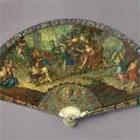 L’éventail est à la fois familier et méconnu. Accessoire de mode et objet d’art, il allie le savoir-faire d’artisans à la création artistique. Soumis à la fugacité des modes, il se renouvelle sans cesse. Importé d’Asie à la Renaissance, au milieu des cargaisons d’épices et de soies, l’éventail est adopté en France sous le règne de Louis XIV. Une corporation spécifique, celle des éventaillistes, assure la domination des artisans français.
Au cours du XVIIIe siècle, Paris devient la capitale de l’éventail. Le choix des décors suit alors la production des peintres à la mode et participe à la diffusion de l’art français en Europe, tout en montrant une singulière diversité. Avec soixante-dix œuvres empruntées à des collections publiques et privées, cette exposition, hommage à l’excellence du savoir-faire des éventaillistes français, essentiellement parisiens, montrera aussi l’extraordinaire inventivité dont témoignent ces objets fragiles et discrets.
New Title | Houghton Revisited: The Walpole Masterpieces
The catalogue for the Houghton Revisited exhibition should be available soon. From Artbooks.com:
Thierry Morel, Larissa Dukelskaya, John Harris, and Andrew Moore, Houghton Revisited: The Walpole Masterpieces from Catherine the Great’s Hermitage (London: Royal Academy of Arts, 2013), 256 pages, ISBN: 978-1907533501, £40 / $85.
 In 1779 the family of Sir Robert Walpole, Britain’s first prime minister, sold his remarkable art collection to Catherine the Great, Empress of Russia. More than two centuries later, these masterpieces, rarely seen outside Russia since that time, are returning to Houghton Hall, the great house built by Walpole. This handsome book illustrates these superlative works hanging once again in William Kents magnificent interiors. Thierry Morel uncovers the wonders of Walpole’s collection, which includes paintings by Van Dyck, Poussin, Rubens and Rembrandt, and traces its journey to the State Hermitage Museum in St Petersburg, to which most of the works now belong. Other essays explore Walpole’s artistic tastes and collecting habits, and his beautiful house, one of the finest Palladian buildings in England.










 Enfilade
leave a comment