Exhibition | Dalou, Regards sur le XVIIIe Siècle
Press release from the Cognac-Jay:
Dalou, Regards sur le XVIIIe Siècle
Musée Cognac-Jay, Paris, 18 April — 13 July 2013
Curated by Cécilie Champy-Vinas and Benjamin Couilleaux
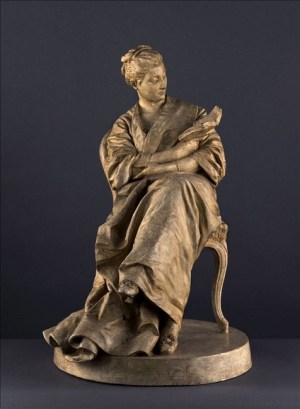
Aimé-Jules Dalou, La Liseuse (Paris: Petit Palais, Musée des Beaux-Arts de la Ville de Paris) © Petit Palais/ Roger-Viollet
À l’occasion de la publication du catalogue raisonné du fonds Dalou conservé au Petit Palais, le Musée Cognacq-Jay accueille une sélection d’œuvres de ce grand sculpteur du XIXe siècle, en les confrontant à ses propres collections du XVIIIe siècle.Trente-cinq terres cuites, plâtres et bronzes, issus des collections du Petit Palais et du musée Carnavalet, sont présentés parmi les collections permanentes. Cette manifestation montre comment un grand artiste républicain du XIXe siècle pouvait puiser son inspiration dans le siècle des Lumières, balançant entre l’exaltation des hauts faits de la Révolution et la nostalgie des grâces de l’art rocaille.
D’une famille parisienne modeste, « communard » en 1871, ce qui lui valut de s’exiler à Londres jusqu’en 1879, le sculpteur Aimé-Jules Dalou (1838-1902) commence sa carrière en France dans les années 1880. Artiste engagé, il eut à cœur de célébrer la République depuis ses origines, c’est-à-dire depuis la Révolution. Sa carrière est jalonnée de monuments ambitieux à la gloire des grands hommes de ce temps, de Mirabeau répondant à Dreux-Brézé le 23 juin 1789, un des épisodes fondateurs de la Révolution, en 1883, au Monument à
Hoche, dernière commande publique passée à l’artiste en 1900.
Pendant son exil à Londres et après son retour à Paris, Dalou a également réalisé de nombreuses œuvres intimistes. Pour celles-ci, il se tourne souvent vers un autre XVIIIe siècle, celui des grâces enfantines, des bacchanales et des intrigues d’alcôves. Ses portraits d’enfants, ses baigneuses et ses groupes mythologiques font écho aux créations de Boucher, Clodion ou Lemoyne.
En parallèle, le Petit Palais, musée des Beaux-arts de la Ville de Paris, présente du 18 avril au 13 juillet Dalou. Le sculpteur de la République, première exposition monographique consacrée à l’artiste. Près de trois cents œuvres seront présentées, en grande partie inédites, provenant de collections publiques et privées en France et à l’étranger.
Exhibition | Plain or Fancy?
Press release (25 February 2013) from The Met:
Plain or Fancy? Restraint and Exuberance in the Decorative Arts
The Metropolitan Museum of Art, New York, 26 February — 18 August 2013
Curated by Luke Syson and Ellenor Alcorn
 The tension in design between austerity and opulence—the simple and the ornate—is a long-standing one. Plain or Fancy? Restraint and Exuberance in the Decorative Arts, on view February 26 through August 18, 2013 at The Metropolitan Museum of Art, invites visitors to consider their own preferences and suggests some of the cultural meanings that have been associated with the two words. The challenge is not to identify quality, or to determine “good taste” versus “bad taste.” Rather the exhibition touches on some historical moments when austerity and flamboyance in design were actively debated. In a departure from a conventional chronological presentation, the show raises a question, encouraging visitors to explore their own reactions. The 40 works of art on view are drawn from the Museum’s holdings of European decorative arts, and include ceramics, metalwork, and works in glass ranging in date from the late 14th to the early 20th century.
The word “fancy” is a shortened form of “fantasy,” which suggests that imagination and exuberance might be seen as prized formal qualities, equally present in a rustic pot and a treasury piece. Fanciness has sometimes been linked to the notion of luxury, and with it, expensive indulgences. In ancient Greece and Rome, costly imported commodities were sometimes seen as a threat to the local economy, and in later centuries condemned as a symptom of an unwelcome social mobility that challenged the existing power structure. But grandeur also had its place in securing the social hierarchy, for example, at the court of Louis XIV. Plainness, by contrast, has tended to be associated with moral virtue and purity.
A century after the Austrian architect Adolf Loos delivered his polemic “Ornament and Crime,” the Modernist aesthetic, which married form with function, remains a dominant influence. But this was not the first time that the merits of ornament had been debated. Court culture in Spain in the 16th century was permeated with the somber gravitas of King Philip II. A contemporary treatise promoting restraint in dress, comportment, and decoration argued: “…a quiet manner is the inevitable mark of a grave and dignified man, ruled by reason rather than by appetite…” These values are expressed in the architecture and metalwork of the period, which is characterized by a distinctive geometric simplicity. Implicit in this taste, which is often referred to as the “Severe Style,” is a rejection of what was seen as the sensuous decadence of Mannerist design.

Coffee and tea service, Sèvres Manufactory. Designer: Hyacinthe Régnier, 1855–61 (New York: The Metropolitan Museum of Art).
Another moment of debate occurred in the 18th century, when the Rococo style was derided by advocates of Neoclassicism. The English artist William Hogarth campaigned for spontaneity and asymmetry, writing in 1753, “Simplicity, without variety, is wholly insipid…” But the same year, the whimsical fantasies of Rococo designers, which were rooted in nature’s capriciousness, were ridiculed as excessive and depraved. The taste for fanciful Chinese subjects was mocked as the “monstrous offspring of wild imagination, undirected by nature and truth.”
Plain or Fancy? points out that aesthetic responses are never neutral. Our judgments have roots in our culture, socioeconomic status, generational values, and aspirations. For some, “plain” is sophisticated, while for others “plain” is dull. The exhibition does not aspire to settle the debate but encourages visitors to consider their own responses to this issue as they experience works of art throughout the Museum. To ask now if people like art “plain” or “fancy” is to ask whether they are aristocrats or revolutionaries, Protestants or Catholics, forward-looking or nostalgic. In looking at works of art, people look at themselves.
The exhibition features an in-gallery and web-based interactive component that encourages visitors to explore, consider, and share their own sensibilities in the decorative arts. Displayed on iPads in the exhibition and as a presentation in MetMedia, it features six works from the installation whose character—whether plain or fancy—can be debated. After viewing the objects, visitors are invited to share their personal opinions in a 120-character tweet (@PlainOrFancy), deciding for themselves whether a work is “plain” or “fancy” and if it suits their personal style.
Plain or Fancy? Restraint and Exuberance in the Decorative Arts is organized by Luke Syson, Iris and B. Gerald Cantor Curator in Charge, and Ellenor Alcorn, Associate Curator, both of the Metropolitan Museum’s Department of European Sculpture and Decorative Arts. Installation design is by Michael Langley, Exhibition Design Manager; graphic design is by Mortimer Lebigre, Graphics Designer; and lighting is by Clint Ross Coller and Richard Lichte, Lighting Design Managers, all of the Metropolitan Museum’s Design Department.
Education programs include exhibition tours and a Friday evening program during which visitors will participate in a multi-sensory exploration of the question of “Plain or Fancy?” through several collection galleries.
◊ ◊ ◊ ◊ ◊
Plain or Fancy? Restraint and Exuberance: A Conversation about Taste
The Metropolitan Museum of Art, New York, 15 May 2013
Wayne Koestenbaum, author, The Queen’s Throat and Humiliation, and Luke Syson, Iris and Gerald B. Cantor Curator in Charge, Department of European Sculpture and Decorative Arts, MMA
The Metropolitan Museum of Art’s exhibition Plain or Fancy? Restraint and Exuberance in the Decorative Arts culls highlights from the Met’s permanent collections to contrast restrained—plain—works of art with richly ornamented—fancy—ones, focusing on those moments in history when pendulum shifts made a sharp swing in one direction or another. Wayne Koestenbaum (The Queen’s Throat, Humiliation), one of today’s most influential and controversial cultural critics, joins Luke Syson, Iris and B. Gerald Cantor Curator in Charge, European Sculpture and Decorative Arts, for a conversation exploring the ways in which stylistic choices may also be moral ones—and how our aesthetic responses are shaped by shame and judgment. Do you like your art “plain” or “fancy”? And what does taste mean, really?
Details for this ticketed event are available here»
New Book | Architecture & Tradition Académique au Temps des Lumières
Basile Baudez, Architecture & tradition académique au temps des Lumières (Presses Universitaires de Rennes, 2013), 390 pages, ISBN: 978-2753521223, 24€.
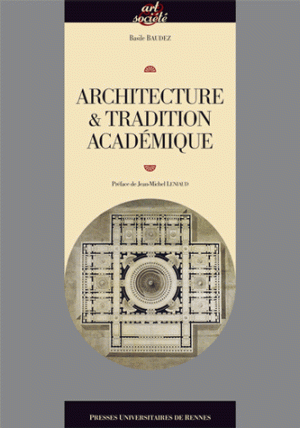 Dans le système des beaux-arts, l’architecture, en tant qu’art utile, a toujours occupé une place singulière. Issue des arts du dessin, elle côtoyait sur un pied d’égalité la peinture et la sculpture dans les premières académies fondées par les humanistes de la Renaissance. Ces institutions connurent leur âge d’or au siècle des Lumières dans le domaine des sciences, des lettres et des arts. Les académies artistiques d’Europe se définissaient comme des cercles professionnels, des organes de consultation pour le pouvoir politique et des écoles visant à transmettre un certain nombre de principes esthétiques.
Elles jouèrent un rôle crucial pour la structuration de la profession architecturale, l’établissement de normes théoriques et la diffusion de la pratique de l’expertise dans l’Europe classique. Cet ouvrage examine pour la première fois la manière dont ce modèle propre au monde occidental, si décrié à la fin du XIXe siècle, a donné naissance dans la seconde moitié du XVIIIe siècle à la profession moderne d’architecte et à une façon de concevoir l’art de bâtir qui est encore la nôtre.
Basile Baudez, archiviste paléographe, agrégé d’histoire, est maître de conférences en histoire du patrimoine moderne et contemporain à l’université Paris-Sorbonne. Ses recherches portent sur l’histoire de l’architecture européenne de l’époque classique.
A full description is available at Le Blog de L’ApAhAu.
The Nelson-Atkins Names Antonia Boström as Curatorial Director
Press release (27 February 2013) from the museum:
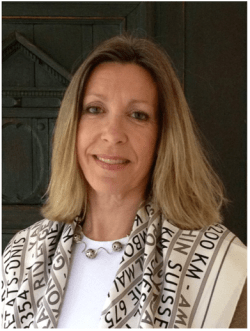 Following an international search, The Nelson-Atkins Museum of Art in Kansas City today announced the appointment of Antonia Boström as Director of Curatorial Affairs, a position that will lead the Nelson-Atkins’s dynamic curatorial team. Boström brings a wealth of experience from art museums in London and the United States, including her current leadership position at the J. Paul Getty Museum, Los Angeles. She will begin her new post at the Nelson-Atkins in May.
“Dr. Boström’s wealth of experience across continents and in institutions with world-class collections made her unequivocally the ideal candidate for this position,” said Julián Zugazagoitia, Director & CEO of the Nelson-Atkins. “She brings a depth of scholarship and invaluable skills that will advance the curatorial voice of the Nelson-Atkins toward even higher levels of excellence.”
Boström has pursued art throughout her life, and her scholarship and management skills have led her to the Getty Museum, the Detroit Institute of Arts, the Royal Academy of Art, London, and the Victoria and Albert Museum, London, among others. She is excited to come to Kansas City and work with the esteemed collection at the Nelson-Atkins.
“The museum is at a great moment of transition, with the exquisite new Bloch Building, a gem of architecture, and with the leadership of Julián Zugazagoitia,” Boström said. “I am interested in working with a collection that is so renowned, but that perhaps is not widely enough known, and in discovering what the museum means to Kansas City. I look forward to working with a talented group of curators as we strive to reach new audiences.”
Born and raised in London, the daughter of a paintings conservator, she received her B.A. (1979) in the History of Art from the Courtauld Institute of Art, London University, and obtained her PhD in 1996 from the same institution. She worked in London as museum assistant at the National Portrait Gallery (1980), in the National Art Library and as an assistant curator at the Victoria and Albert Museum (1980-1985), as a commissioning editor at the Grove Dictionary of Art for Macmillan Publishers (1985-1988), and as acting curator of the Permanent Collection of Paintings and Sculpture at the Royal Academy of Arts (1995-96).
Boström, fluent in five languages, spent important years at the Detroit Institute of Arts from 1996 to 2004, working with that institution’s rich collection as an assistant, then associate curator in the Department of European Sculpture and Decorative Arts. While there she was co-author of Catalogue of Italian Sculpture in the Detroit Institute of Arts, and she was an adjunct professor at Wayne State University.
Since 2004 she has been the Senior Curator and Department Head, Sculpture and Decorative Arts Department at the J. Paul Getty Museum. Boström led the installation of the Fran and Ray Stark Sculpture Garden and Terrace in collaboration with Richard Meier Architects & Olin Patnership, plus the reinstallation of several Sculpture and Decorative Arts galleries. Among the many she has been involved with are two recent exhibitions at the Getty Museum – Messerschmidt and Modernity and Cast in Bronze: French Sculpture from Renaissance to Revolution. (more…)
Exhibition | Journeys to New Worlds: Spanish and Portuguese Art
Now on at the Philadelphia Museum of Art:
Journeys to New Worlds: Spanish and Portuguese
Colonial Art from the Roberta and Richard Huber Collection
Philadelphia Museum of Art, 16 February — 19 May 2013
Curated by Mark A. Castro and Joseph J. Rishel
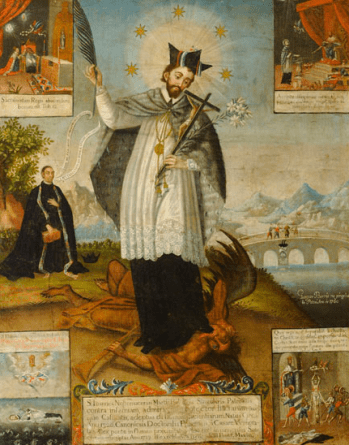
Gaspar Miguel de Berrío, Saint John of Nepomuk, 1760, oil on canvas, 40 x 32 inches (103 x 82 cm)
With a rare group of paintings, decorative arts, and sculptures from the collection of Roberta and Richard Huber, Journeys to New Worlds explores the artistic exchanges between Spain and Portugal and their colonies in the Americas and Asia during the seventeenth and eighteenth centuries. This unique combination of rich visual traditions offers viewers a glimpse into the fascinating history and global influence of Iberian colonial art.
The exhibition includes paintings by Melchor Pérez Holguín (c. 1665–after 1724) and Gaspar Miguel de Berrío (1706–after 1764), two prolific artists from the city of Potosí, Bolivia. Berrío’s Our Lady of Mount Carmel with Bishop Saints of 1764 displays the artist’s ability to present European imagery in a new regional style, emphasizing sumptuous textiles and lush colors. Other paintings on view feature objects of popular devotion, among them the anonymously painted Our Lady of Pomata, which depicts a dressed sculpture of the Virgin Mary housed in a sanctuary on the shores of Lake Titicaca, Peru.

Coquera (Coca Box), Bolivia, first half of the eighteenth century; silver, repoussé, chased and burnished, 9 x 11 x 10 inches (23 x 29 x 26 cm) Roberta and Richard Huber Collection
Potosí sits at the foot of the Cerro Rico (Rich Hill), known for its abundant silver mines, which funded the Spanish empire for many years. The mines also fueled a great metalworking tradition that produced decorative objects for church, public, and domestic use. Among the silver works included in this show are an eighteenth-century coquera (a box used for storing coca leaves) and an elaborately decorated altar plaque.
Sophisticated ivory sculptures created in the Iberian colonies in Asia (the Portuguese colonies of Goa, on the western shores of India, and Ceylon, the modern nation of Sri Lanka; as well as the Spanish-controlled Philippines) are another integral part of the Huber collection. These carved works depict Catholic themes, yet the refined, Asiatic features of the figures show the direct influence of native artistic traditions.
Roberta and Richard Huber began collecting in the 1970s, when the study of Iberian colonial art was in its infancy in the United States. They have purchased works over the years based on their own changing interests, enjoying the thrill of discovering new objects as much as the works themselves. Embodying the passionate interests of two individuals, their collection is one of a handful focused on this material in the country. Journeys to New Worlds celebrates their enthusiasm and reflects the Philadelphia Museum of Art’s continuing commitment to promoting the arts of Latin America.
The exhibition is generously supported by The Annenberg Foundation Fund for Exhibitions, the Arlin and Neysa Adams Endowment, Paul K. Kania, and Mr. and Mrs. Reinaldo Herrera. The catalogue is made possible by The Andrew W. Mellon Fund for Scholarly Publications at the Philadelphia Museum of Art and by Furthermore: a program of the J.M. Kaplan Fund.
Curated by Mark A. Castro, Exhibition Coordinator, and Joseph J. Rishel, The Gisela and Dennis Alter Senior Curator of European Painting before 1900, and Senior Curator of the John G. Johnson Collection and the Rodin Museum.
◊ ◊ ◊ ◊ ◊
From Yale UP:
Edited by Suzanne L. Stratton-Pruitt, with Mark A. Castro, Journeys to New Worlds: Spanish and Portuguese Colonial Art in the Roberta and Richard Huber Collection (New Haven: Yale University Press, 2013), 204 pages, ISBN: 978-0300191769, $60.
Contributions by Luisa Elena Alcalá, David L. Barquist, Mark A. Castro, Margarita M. Estella Marcos, Enrique Quispe Cueva, Joseph J. Rishel, Jorge F. Rivas P., and Suzanne L. Stratton-Pruitt
 This beautifully illustrated catalogue showcases 120 Spanish and Portuguese artworks from the seventeenth and eighteenth centuries, all highlights from the dazzling collection of Roberta and Richard Huber. Featuring works in a variety of mediums and from far-flung places, including paintings, silver, and furniture from South America and sculptures in ivory from the Spanish Philippines and from Portuguese territories in India. Distinguished experts shed light on these significant objects, many of which have not been previously published and which illustrate the unparalleled artistic exchanges between and within these colonial empires. The Andean painters Melchor Pérez Holguín and Gaspar Miguel de Berrío inventively interpreted European iconographies, while similar adaptations took place in Asia, where native craftsmen, carved Christian images in ivory. These works traveled along the trade routes connecting Europe to Asia and the Americas, thus influencing the development of a new visual culture.
Suzanne L. Stratton-Pruitt is an independent scholar specializing in Spanish and Spanish colonial art. Mark A. Castro is an Exhibition Coordinator at the Philadelphia Museum of Art.
Forthcoming | Rediscovering the Ancient World on the Bay of Naples
From Yale UP:
Carol C. Mattusch, ed., Rediscovering the Ancient World on the Bay of Naples, 1710-1890 (New Haven: Yale University Press, 2013), 292 pages, ISBN: 9780300189216, $70.
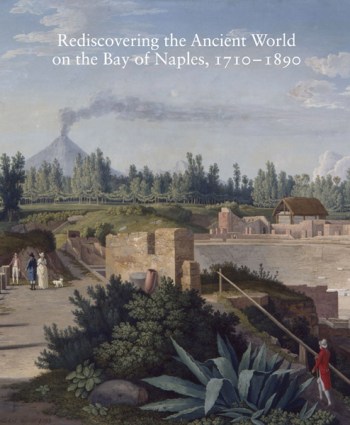 The ancient Roman cities of Pompeii and Herculaneum, buried by the eruption of Mount Vesuvius in 79 C.E., drew international attention when excavations commenced in the 1730s. As a result, the nearby city of Naples became a nexus of scholarship, cultural diplomacy, and tourism. This fascinating book examines responses to the excavations by 18th- and 19th-century monarchs, statesmen, scholars, and archaeologists, as well as by artists, architects, designers, writers, and tourists.
Essays by leading art historians and archaeologists chronicle the exploitation of the sites through excavation, publication, and museum display, and discuss the wider influence of the recovered objects and architectural remains on art and design in Italy, France, Germany, and Britain. Unlike other publications that focus on the archaeological artifacts and their documentation, this extensively illustrated book presents the discoveries from
the standpoint of how they were understood at the time.
Carol C. Mattusch is Mathy Professor of Art History in the Department of History and Art History at George Mason University.
◊ ◊ ◊ ◊ ◊
C O N T E N T S
Elizabeth Cropper, Preface
Carol C. Mattusch, Introduction
Alain Schnapp, The Antiquarian Culture of Eighteenth-Century Naples as a Laboratory of New Ideas
Jens Daehner, The Herculaneum Women in Eighteenth-Century Europe
Christopher Parslow, The Sacrarium of Isis in the Praedia of Julia Felix in Pompeii in Its Archaeological and Historical Contexts
Carlo Knight, Politics and Royal Patronage in the Neapolitan Regency: The Correspondence of Charles III and the Prince of San Nicandro, 1759–1767
John E. Moore, “To the Catholic King” and Others: Bernardo Tanucci’s Correspondence and the Herculaneum Project
Steffi Roettgen, German Painters in Naples and Their Contribution to the Revival of Antiquity, 1760–1799
Sophie Descamps-Lequime, The Ferdinand IV Donation to the First Consul and His Wife: Antiquities from the Bay of Naples at Malmaison
Nancy H. Ramage, Flying Maenads and Cupids: Pompeii, Herculaneum, and Eighteenth-Century Decorative Arts
Bruce Redford, Grecian Taste and Neapolitan Spirit: Grand Tour Portraits of the Society of Dilettanti
Eric M. Moormann, Literary Evocations of Herculaneum in the Nineteenth Century
Mary Beard, Taste and the Antique: Visiting Pompeii in the Nineteenth Century
John Pinto, “Speaking Ruins”: Piranesi and Desprez at Pompeii
Eugene J. Dwyer, Pompeii versus Herculaneum
Exhibition | The Path of Nature: French Paintings, 1785-1850
From The Met:
The Path of Nature: French Paintings from the Wheelock Whitney Collection, 1785–1850
The Metropolitan Museum of Art, New York, 22 January — 21 April 2013
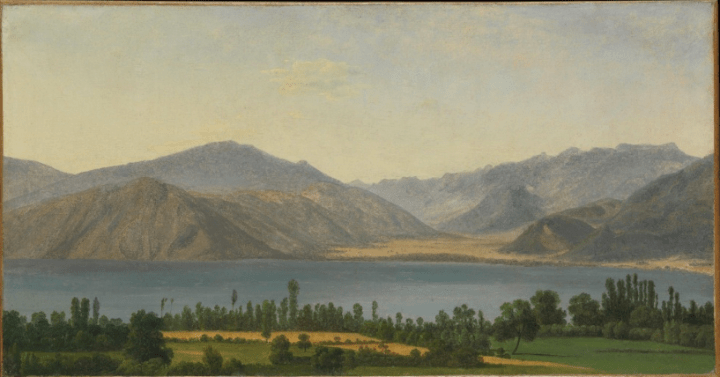
Joseph Bidauld, Lake Fucino and the Abruzzi
Mountains, 10 x 19 inches, ca. 1789 (NY: Met)
◊ ◊ ◊ ◊ ◊
In 2003 the Metropolitan Museum acquired a significant group of paintings spanning a key period in European history, beginning with the advent of the French Revolution and concluding with the reign of Louis-Philippe. Assembled by the New York connoisseur Wheelock Whitney between 1972 and 2000, this collection reveals a rich tradition of painting out of doors nearly a century before Impressionism, thus amplifying the role of the natural world as a source of inspiration to artists on the cusp of the modern epoch. This exhibition of fifty paintings is the first to be devoted entirely to the Whitney collection and includes examples by numerous painters who are thought to be represented in no other American museum.
 The Whitney collection is remarkable for its concentration of plein-air oil studies by artists ranging from Pierre-Henri de Valenciennes to Camille Corot. This is complemented by a strong representation of finished landscapes, history subjects, genre, and portraiture: in short, the full scope of painting that one could expect to find in a Parisian cabinet d’amateur, or private collection, in the first half of the nineteenth century. Crossing the boundaries of subject matter and lying at the heart of the collection is a group of paintings executed by northern artists drawn to Rome by its combination of antiquity and natural beauty. A number of these painters received from the Académie des Beaux-Arts, Paris, the Rome Prize to study painting in Italy, for example, François-Édouard Picot, Léon Pallière, Charles Rémond, and André Giroux. Others traveled there independently, such as Joseph Bidauld, Simon Denis, François-Marius Granet, and Théodore Caruelle Aligny. The exhibition also illuminates one of the most popular developments in French painting during the 1820s, the depiction of Italian peasants, brigands, and clerics, by such representative figures as Claude Bonnefond, Jean-François Montessuy, and Louis-Léopold Robert.
Call for Papers | Images of the Art Museum
Images of the Art Museum: Connecting Gaze and Discourse in the History of Museology
Kunsthistorisches Institut in Florenz – Max-Planck-Institut, 26-28 September 2013
Proposals due by 15 April 2013
Organized by the Max Planck Research Group Objects in the Contact Zone: The Cross-Cultural Lives of Things, directed by Eva-Maria Troelenberg.
Scholars normally consider the institution of the museum to have arisen in Europe. Historians have traced its origin back to the collections of the Renaissance princes and the ‘cabinets of curiosity’, the ‘Kunstkammern’ and ‘Wunderkammern’, literally art chambers and wonder chambers, of sixteenth and seventeenth-century Western Europe. From their initial establishment until today, museums have become increasingly elaborate institutions, the purpose of which is not simply to exhibit collections of beautiful artefacts, but also to become a social agency able to interact with a different kind of public. In particular, in recent years, it seems as though ‘the museum’ has become a geographically universal or ‘global’ institution. At the same time, museum discourses are almost inevitably entangled with political questions, implying definitions of cultural values and privileges of interpretation.
Since the early 1990s, the emerging field of museum studies has seen rapid expansion in the critical study of museums. New Museology started to question the institution and its functions. Anthropological approaches to the object, theories on the aesthetics of perception or ‘Bildakt’ have affected our ideas of the artwork. The current museum boom and the ensuing new wave of historiographical and theoretical writing on museums have on the one hand addressed notions of ‘the museum’ as a temple, a cultural storage or even a universal symbol of enlightenment. On the other hand, more pro-active postmodern approaches work with concepts of the museum as a forum, a place of participation, but also as a machine or even a brand. (more…)
Exhibition | Piranesi’s Paestum: Master Drawings Uncovered
Press release for the exhibition Piranesi’s Paestum, now on at the Soane Museum:
Piranesi’s Paestum: Master Drawings Uncovered
Sir John Soane’s Museum, London, 15 February — 18 May 2013
Tchoban Foundation, Museum for Architectural Drawing, Berlin, 1 June – 31 August 2013
The Morgan Library and Museum, New York, 23 January – 17 May 2015
Curated by Jerzy Kierkuć-Bieliński
 An exhibition of Giovanni Battista Piranesi’s last great graphic project, the highly finished Paestum drawings, is now on view at Sir John Soane’s Museum, London, deepening understanding of the graphic artist whose work has influenced designers from Escher to the makers of the Harry Potter films, and shedding new light on the considerable impact of his work on 18th-century architectural taste. For the very first time since Piranesi’s death, all seventeen drawings will be shown together, uniting the fifteen drawings from Sir John Soane’s Collection with those from the collections of the Bibliothèque nationale de France, Paris, and Amsterdam’s Rijksmuseum. The Paestum drawings were the preparatory work for Piranesi’s Différentes Vues de Pesto finished by his son Francesco and published posthumously in 1778. They depict views of the three great Doric temples in the former Greek colony of Poseidonia, colonised by the Romans and re-named Paestum.
Left abandoned, and later cut off by a malarial swamp, the ruins of the colony were rediscovered in 1746 during the construction of a new road. Its massive and well-preserved Doric temples dedicated to Poseidon, Hera and Athena sparked renewed interest among artists and architects including the celebrated Giovanni Battista Piranesi and inspired drawings, prints, paintings and models which revolutionised understanding of early Greek Classical architecture.
As well as exploring Piranesi’s complex perspectives, the Master Drawings Uncovered exhibition will examine Soane’s relationship with the artist, architect and antiquarian and the influence that visiting Paestum and experiencing Piranesi’s work had on his architecture and teaching. Those wishing to explore Piranesi’s techniques for themselves, will also be able to participate in an evening course and a range of Piranesi-inspired workshops, running alongside the exhibition.

The Paestum drawings are highly unusual in Piranesi’s portfolio. Although the artist usually made preparatory drawings for his famous etchings, much of the composition was often worked directly on to the copper plate at the engraving stage. These drawings contain a level of detail very close to the finished prints, and it is thought that perhaps, aware of his failing health, Piranesi included as much detail as possible for his son Francesco to finish the work he had begun. He uses the full repertoire of his draughtsmanship to create images that both accurately describe the architecture of the Paestum temples and bring out their evocative, rustic setting. Multi-layering of pencil, brown and grey washes and pen and ink, sometimes with the addition of red chalk or white chalk highlights, creates a layered effect which can be compared to the repeated bitings in the resulting etchings. The rough paper used by Piranesi is analogous with the travertine used to construct the temples – echoing its pitted and eroded texture. He also uses the scena per angolo – a feature of Ferdinando Bibiena’s theatrical scenery designs – to give a unique perspective to the drawings; replacing the traditional, central vanishing point with diagonal axes to heighten the three-dimensionality of the temples and add to their dramatic impact.
The Paestum drawings in the Soane collection were purchased by Sir John Soane at auction in March 1817 for £14.5.0, as part of a sale by antiquarian Charles Lambert. It is not known how they came to be in his collection. Dr Jerzy Kierkuć-Bieliński, curator of Master Drawings Uncovered, looks forward to welcoming visitors to a significant exhibition of Piranesi’s work: “We’re delighted to be able to present a focused exhibition which celebrates the impeccable quality and influence of a small selection of drawings. Although six of the Soane drawings have been exhibited in the Die Graber von Paestum exhibition (2007–08) in Hamburg and Berlin, they have never been viewed by the public un-framed, and no exhibition has ever been devoted to their display as a discrete grouping. The fifteen drawings in Soane’s collection have been displayed in the Picture Room of No.13 Lincoln’s Inn Fields, but their position, in Soane’s ingenious picture planes, has not allowed close scrutiny. We hope that the conservation and academic research resulting from the exposure of the drawings will throw considerable light on their history and the architectural legacy left by Giovanni Battista Piranesi.”
Images courtesy of the Trustees of Sir John Soane’s Museum
Top: Exterior of the Temple of Neptune from the North-East
Bottom: Interior of the Temple of Neptune from the West
◊ ◊ ◊ ◊ ◊
From the Soane Museum’s shop:
John Wilton-Ely, Piranesi, Paestum, & Soane (London: Prestel, 2013), 112 pages, ISBN: 978-3791348063, £25.
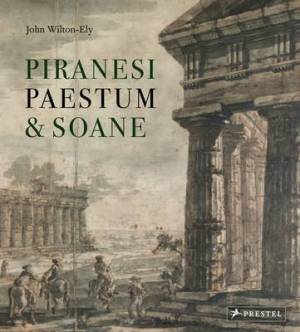 To celebrate the launch of our exhibition Piranesi’s Paestum: Master Drawings Uncovered, the Soane is proud to bring you the accompanying exhibition book, Piranesi Paestum & Soane, beautifully produced in hardback with full colour pictures and illustrations. This newly reprinted and updated book by John Wilton-Ely [the first edition of which appeared in 2002] examines Soane’s extensive collection of Piranesi’s work which Soane incorporated into his theatrical displays at his Lincoln’s Inn home, connecting Piranesi’s own dramatic visions of Paestum with his revivalist architectural practice.
Architect and printmaker, Giovanni Battista Piranesi was a lifelong champion of Rome, publishing more than 1000 etchings of the Eternal City and it’s ancient monuments. When Sir John Soane and Piranesi met they formed a profound and complex, creative and intellectual relationship that nurtured Soane’s later career. Among Soane’s greatest legacies are the preparatory drawings Piranesi developed for a publication on the Greek temples at Paestum.
Mantel on “Royal Bodies”
From the Editor
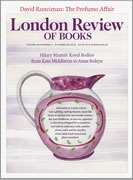 Hilary Mantel’s talk, “Undressing Anne Boleyn,” at the British Museum (4 February 2013), published as “Royal Bodies” in the London Review of Books (21 February 2013), has occasioned considerable discussion in the UK, thanks to the comments of the two-time Booker Prize recipient regarding the role of Kate Middleton, Duchess of Cambridge, and her body in British society. With no intentions of fanning the flames of the controversy, I thought it might nonetheless be of interest to Enfilade readers, particularly since Marie Antoinette serves as one source for the argument (whatever one makes of Mantel’s engagement with history, I’m repeatedly gobsmacked by her writing and the views offered into the past). From the LRB article:
Marie Antoinette was a woman eaten alive by her frocks. She was transfixed by appearances, stigmatised by her fashion choices. Politics were made personal in her. Her greed for self-gratification, her half-educated dabbling in public affairs, were adduced as a reason the French were bankrupt and miserable. It was ridiculous, of course. She was one individual with limited power and influence, who focused the rays of misogyny. She was a woman who couldn’t win. If she wore fine fabrics she was said to be extravagant. If she wore simple fabrics, she was accused of plotting to ruin the Lyon silk trade. . . .
 Mantel’s first novel, A Place of Greater Safety — finished in 1979 but not published until 1992 — addresses not Tudor England but Revolutionary France, imagining the lives of Georges-Jacques Danton, Maximilien Robespierre, and Camille Desmoulins. Larissa MacFarquhar brilliantly profiled Mantel in the fall in “The Dead Are Real,” for The New Yorker (15 October 2012). And in terms of the current controversy, Jenny Hendrix, writing for The Los Angeles Times Books (19 February 2013), offers a sampling of the response in the British media. Here, I give the last words to Mantel:
It may be that the whole phenomenon of monarchy is irrational, but that doesn’t mean that when we look at it we should behave like spectators at Bedlam. Cheerful curiosity can easily become cruelty. It can easily become fatal. We don’t cut off the heads of royal ladies these days, but we do sacrifice them, and we did memorably drive one to destruction a scant generation ago. History makes fools of us, makes puppets of us, often enough. But it doesn’t have to repeat itself. In the current case, much lies within our control. I’m not asking for censorship. I’m not asking for pious humbug and smarmy reverence. I’m asking us to back off and not be brutes. . .










 Enfilade
leave a comment