Call for Papers | Graduate Student Conference on Repitition
Repetition: Second Annual Art History Graduate Student Conference
University of California, Riverside, 18 May 2013
Proposals due by 15 March 2013
Repetition, as both logic and device, has played a significant role in the history of art. As logic, repetition underlies the very possibility of artworks as meaningful objects, as it is through repeated acquaintance with an object or form that it gains meaning in a prescribed context. And as stylistic device, the use of repetition has transcended historical periods and visual cultures. From prehistory to the present, the repetition of forms and objects has been used by practically all cultures as a way to define common identities, establish order, and inscribe sense and meaning into the world. The use of repeated forms stands at the center of, for instance, practices and objects as distinct as Inca tunic design, Buddhist and Hindu mandalas, Outsider art and 1960s Minimalism. Yet repetition was also part of painterly strategies in the Renaissance and Baroque periods and pervades the concepts of Early Modern print culture as well as sculptural practices. These various examples serve to highlight our expanded approach to the idea of repetition as an integral aspect of a series of diverse practices, including pattern design, seriality, doubling, mirroring, symmetry, recursion, copying and reproducibility. (more…)
New Book | Portraiture and British Gothic Fiction
From Johns Hopkins University Press:
Kamilla Elliott, Portraiture and British Gothic Fiction: The Rise of Picture Identification, 1764–1835 (Baltimore: Johns Hopkins University Press, 2012), 352 pages, ISBN: 978-1421407173, $60.
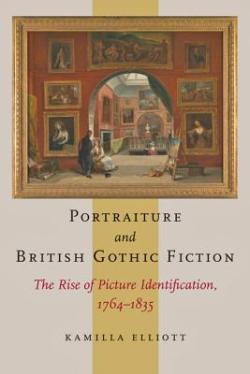 Traditionally, kings and rulers were featured on stamps and money,the titled and affluent commissioned busts and portraits, and criminals and missing persons appeared on wanted posters. British writers of the eighteenth and nineteenth centuries, however, reworked ideas about portraiture to promote the value and agendas of the ordinary middle classes. According to Kamilla Elliott, our current practices of “picture identification” (driver’s licenses, passports, and so on) are rooted in these late eighteenth- and early nineteenth-century debates.
Portraiture and British Gothic Fiction examines ways writers such as Horace Walpole, Ann Radcliffe, Mary Shelley, and C. R. Maturin as well as artists, historians, politicians, and periodical authors dealt with changes in how social identities were understood and valued in British culture—specifically, who was represented by portraits and how they were represented as they vied for social power.
Elliott investigates multiple aspects of picture identification: its politics, epistemologies, semiotics, and aesthetics, and the desires and phobias that it produces. Her extensive research not only covers Gothic literature’s best-known and most studied texts but also engages with more than 100 Gothic works in total, expanding knowledge of first-wave Gothic fiction as well as opening new windows into familiar work.
Kamilla Elliott is senior lecturer at Lancaster University and is author of Rethinking the Novel/Film Debate.
Call for Papers | CSECS 2013, Enlightenment Constellations
From CSECS:
Canadian Society for Eighteenth-Century Studies: Enlightenment Constellations
London, Ontario, 16-19 October 2013
Proposals due by 1 March 2013
 The Enlightenment has resurfaced as a vital site for the study of the long eighteenth century. As the ideological critique of humanism and universalism has subsided, a variety of projects have been undertaken, ranging from the digital mapping of the early modern republic of letters, to the “Re-Enlightenment” of knowledge formation for the twenty-first century, to studies of local, radical, religious, and many other enlightenments. Enlightenment Constellations explores this plurality of possibilities. We seek panels and papers on a range of eighteenth-century ideas, discourses, and practices that speak to the expansion and rejuvenation of enlightenment. In addition to traditional panel formats, we welcome proposals for roundtables, panels with digital or new media components, seminars, etc. Panel topics or paper topics may include: (more…)
Exhibition | Beauty and Revolution: Neoclassicism 1770-1820

Press release from the Städel Museum:
Beauty and Revolution: Neoclassicism 1770-1820
Städel Museum, Frankfurt, 20 February — 26 May 2013
Curated by Eva Mongi-Vollmer and Maraike Bücklingy
A comprehensive special exhibition presented by Frankfurt’s Städel Museum from 20 February to 26 May 2013 will highlight the art of Neoclassicism and the impulses it provided for Romanticism. Developed in collaboration with the Liebieghaus Skulpturensammlung, the show Beauty and Revolution will assemble about one hundred works of the period from 1770 to 1820 by such artists as Anton Raphael Mengs, Thomas Banks, Antonio Canova, Jacques-Louis David, Bertel Thorvaldsen, Johann Gottfried Schadow, and Jean-August-Dominique Ingres. The major survey, whose range also comprises a number of impressive examples of ‘Romantic Neoclassicism’, will be the first in Germany to convey an idea of the variety of the different and sometimes even contradictory facets of this style.
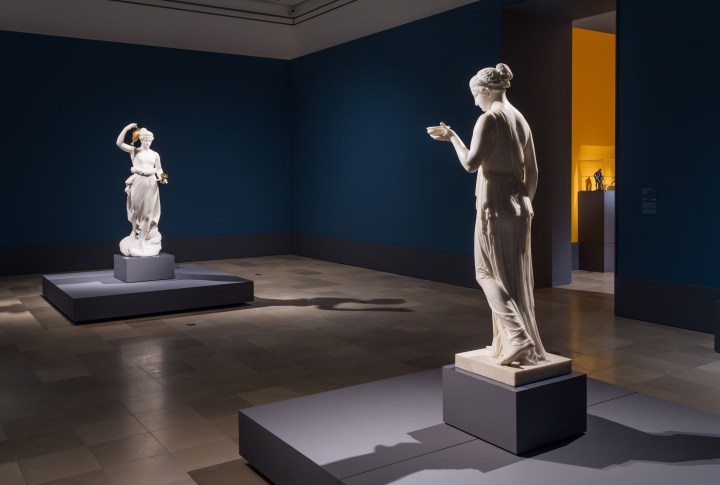 Based on significant sculptures, paintings, and prints from collections in many countries, the exhibition will explore the decisive influence of classical antiquity on the artists of the era. Struggling for a socially relevant art, the artists directed their attention to the aesthetics of Greek and Roman art as well as to their virtues and moral standards conveyed by history and mythology. It will become evident how the viewer could be addressed in many different ways. Two famous marble sculptures of the Greek goddess Hebe, for example, will be confronted with each other in Frankfurt for the first time: a variant by Antonio Canova (1796, The State Hermitage Museum, Saint Petersburg) and another by Bertel Thorvaldsen (designed in 1806, Thorvaldsens Museum, Copenhagen). The two masterpieces have again and again been compared and judged, yet never exhibited together since their creation.
Assembling a wide range of works from Gavin Hamilton’s and Henry Fuseli’s innovative solutions to central works by Antonio Canova and Jacques-Louis David as well as Bertel Thorvaldsen’s masterpieces of ‘Romantic Neoclassicism’, the Städel Museum’s major spring exhibition offers an extensive survey of Neoclassicist art and demonstrates the unexpected vitality of an era often classified as static.
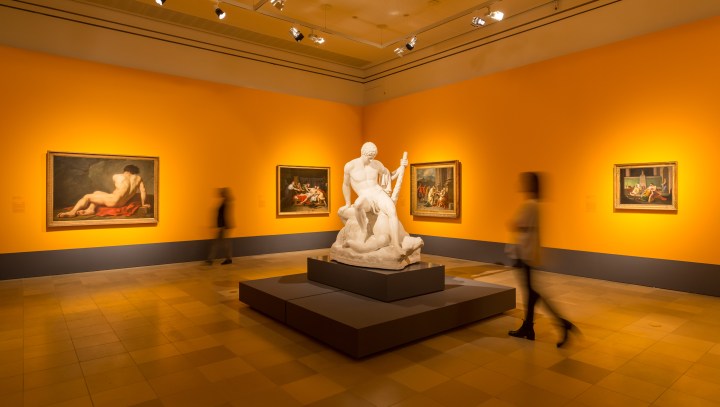 The various aspects of Neoclassicism will be explored along three lines in the Städel’s exhibition. Disregarding a few exceptions, the selection of numerous loans focuses on the production of art in the city of Rome that was considered the first address for studying the ancient world by many artists, writers, and theorists around 1800 and became a center of the art world of that time. The second emphasis of the show is on representations of historical and mythological scenes. In search of a model for moral standards of behavior, the artists fathomed the core of what features as human in the ancient world’s myths, which they read as poetry without religious implications. Jacques-Louis David’s painting The Oath of the Horatii, for example – of which an oil sketch from the holdings of the Louvre in Paris will be presented in the exhibition – upholds a timelessly valid moral code, yet also relates to current political events. The show exemplifies how contemporary motifs increasingly found their way into the range of themes dealt with by Neoclassicist art. The third chapter explores an issue connected with this development, namely how feelings and passions were depicted in Neoclassicist works of art. Artists like Canova or David rendered emotions and pathos in a way unfamiliar to their contemporaries, a way which manifested itself mainly in their figures’ body language. Contrary to the Baroque era, it was not the representation of affectations that artists were primarily concerned with any longer, but internalized emotions in which the viewer was to immerse himself. The artists also clearly detached themselves from the pathos of the ancient world in this way: Canova’s sculpture Theseus and the Minotaur (1783, Museo e Gipsoteca Antonio Canova, Possagno), for example, primarily deals with the aspect of reflection after Theseus’s victory and the hero’s moral consciousness.
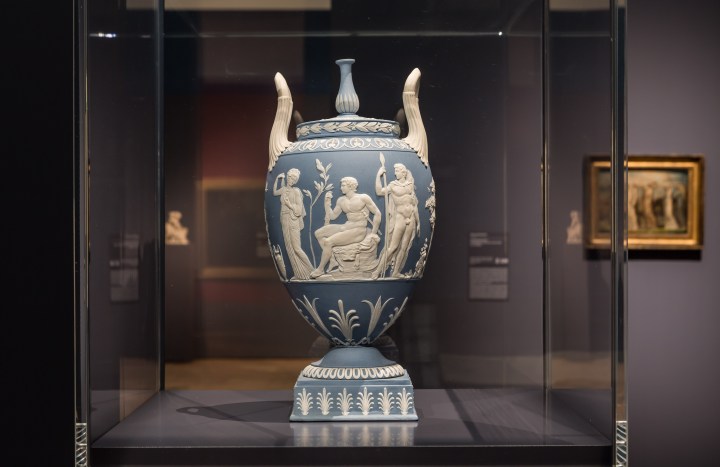
Extending across the Städel’s entire Exhibition House, the generously conceived special exhibition begins with the imposing confrontation of the two famous representations of the goddess Hebe by Antonio Canova (1800–05) and Bertel Thorvaldsen (1815–23) on the ground floor. The difference between Canova’s cupbearer hurrying near on a cloud and involved in what is going on and Thorvaldsen’s introverted musing female illustrates the whole stylistic range of Neoclassicist art at the very beginning. Picking up the thread of this confrontation, the presentation in the large ground floor hall impressively visualizes the turbulent development of Neoclassicism until about 1870. The tour starts with a selection of plaster cast and bronze reproductions of antique sculptures dating from the late eighteenth and early nineteenth centuries; these reproductions particularly illustrate the canon of classical antiquity emphasized by the archaeologist and art historian Johann Joachim Winckelmann (1717–68). Artists staying in Rome initially incorporated these famous reproductions into their works as directly as possible. In those years, the return to the ancient world frequently implied a criticism of contemporary systems of rule, especially of the courtly and ecclesiastical formal language of the Baroque age. Anton Raphael Mengs’s appropriation of classical antiquity was of such an extreme degree that the artist was even able to deceive Winckelmann who described Mengs’s fresco Jupiter Kissing Ganymede (1758–59, Galleria Nazionale d’Arte Antica, Palazzo Barberini, Rome) as an original of classical antiquity in one of his writings.
The following section comprises the rebellious works of a group of artists who also lived in Rome for some time, yet felt not inclined to follow Winckelmann’s credo of “noble simplicity and quiet grandeur” – though they too thoroughly studied the antique models. They aimed at capturing the viewer’s attention by dramatizing their subjects, even if this meant putting up with exaggeration and distortion. The English sculptor Thomas Banks (1735–1805) – see his The Falling Titan (1786, Royal Academy of Arts, London) – was one this group’s artists as was the Swiss-born Henry Fuseli (1741–1825), whose Achilles Sacrificing his Hair on the Funeral Pyre of Patroclus (1800–05) from the Kunsthaus in Zurich is included in the exhibition.
The shown works by Antonio Canova (1757–1822) and Jacques-Louis David (1748–1825) and his pupils then ushered in a definitely calmer approach to the motifs rendered. They are characterized by formal austerity and a deliberately pointed dramatic composition. However, both the sculptor Canova and the painter David relied on completely new pictorial and iconographic means for drawing on antique subjects and attitudes – means that were to inform subsequent generations of artists all over Europe.
The presentation on the second floor of the Exhibition House highlights how the new iconography developed not least in response to the political context of the time and particularly the French Revolution. Jacques-Louis David immortalized the dead Marat as the revolution’s first martyr, for example: the exhibition comprises a version by David and his workshop (Musée national des châteaux de Versailles et de Trianon, Versailles) as well as by Joseph Roques (1793, Musée des Augustins, Toulouse).
The works in the following room strikingly illustrate that the young art also held a revolutionary potential in terms of form: the sophisticatedly simplified scenes visualized by the sculptor John Flaxman (1755–1826) in his drawings and engravings, for example, are based on an astounding abstraction. Their reduction to mere contours was to create a furore all over Europe.
The adjacent room sheds light on the slow, yet far-reaching change in the artists’ attitude toward the ancient world that occurred around 1800. The unreachability of its ideal made itself felt with increasing weight. This implied a growing abandonment of its norms on the part of the artists, whereas the viewer was granted more leeway for interpretation. The protagonist’s internalization also came to play a more important role in what was going on in the picture. Consequently, masterpieces such as Bertel Thorvaldsen’s Ganymede (1819–21, Thorvaldsens Museum, Copenhagen) are categorized as works of ‘Romantic Neoclassicism’ today.
The various tendencies brought forth by Neoclassicism within the first decades after 1800 become increasingly clear in the last room of the exhibition. In spite of all discrepancies between the various artists’ decisions, they shared a common denominator in looking for new ways to leave Neoclassicism behind. The idea of the ancient world was regarded with increasing detachment, unconventionally transformed, and largely ignored by more and more nineteenth-century artists. All in all, the exhibition unfolds the age of Neoclassicism as a surprisingly manifold and lively stylistic epoch whose unconditional desire for renewal and improvement became a breeding ground for Romanticism in its return to classical antiquity.
Exhibition photos by Norbert Miguletz
◊ ◊ ◊ ◊ ◊

Maraike Bückling and Eva Mongi-Vollmer, eds., Schönheit & Revolution: Klassizismus 1770-1820 (Munich: Hirmer, 2013), 392 pages, ISBN: 978-3777470115, €40 / $85. — available from Artbooks.com.
A comprehensive catalogue edited by Maraike Bückling and Eva Mongi-Vollmer will be published by Hirmer to accompany the exhibition. It will include contributions by Sergej Androsov, David Bindman, Maraike Bückling, Werner Busch, Christian M. Geyer, Alexander Kaczmarczyk, Thomas Kirchner, Eva Mongi-Vollmer, Johannes Myssok, and Marjorie Trusted. German.
Forthcoming | European Painted Cloths, 1400-2000
While most of the papers from this June 2012 Courtauld conference addressed earlier material, there were some eighteenth-century offerings. The collection of essays is due out in June.
◊ ◊ ◊ ◊ ◊
From ACC Distribution:
Christina Young and Nicola Costaras, European Painted Cloths, 1400-2000: Pagentry, Ceremony, Theatre and Domestic (Archetype Publications, 2013), 196 pages, ISBN: 9781904982906, $140.
 The conference papers in this volume explore the use of painted cloths in religious ceremony, pageantry, domestic interiors and scenic art, focussing on their change of context and significance from the fourteenth to the twenty-first centuries and examining their different function, materials, and method of creation. The potential for large sizes, portability, and versatility for religious objects including banners, hangings, altarpieces, and palls was the impetus for the emergence of fabrics as a painting support in Western art in the Middle Ages. The functionality of the works explains the survival of relatively few examples. One of the most common forms of interior decoration for centuries, painted cloths have received less attention from art historians and historians than they deserve in part due to their poor survival. Scenic backcloths were once commissioned for court functions, part of an elaborate display of royal power and magnificence. The same methods and materials continued to be used for theatrical cloths.
New Book | The Cast Gallery of the Ashmolean Museum
Though the Ashmolean’s collection of plaster casts was assembled in the late nineteenth century, some pieces date to the eighteenth century. Anyone interested in the subject should also consult Donna Kurtz, The Reception of Classical Art in Britain: An Oxford Story of Plaster Casts from the Antique (British Archaeological Reports, 2000).
◊ ◊ ◊ ◊ ◊
From ACC Distribution:
R.R.R. Smith and Rune Frederiksen, The Cast Gallery of the Ashmolean Museum: Catalogue of Plaster Casts of Greek and Roman Sculpture (Oxford: Ashmolean Museum, 2013), 360 pages, ISBN: 9781854442666, $30.
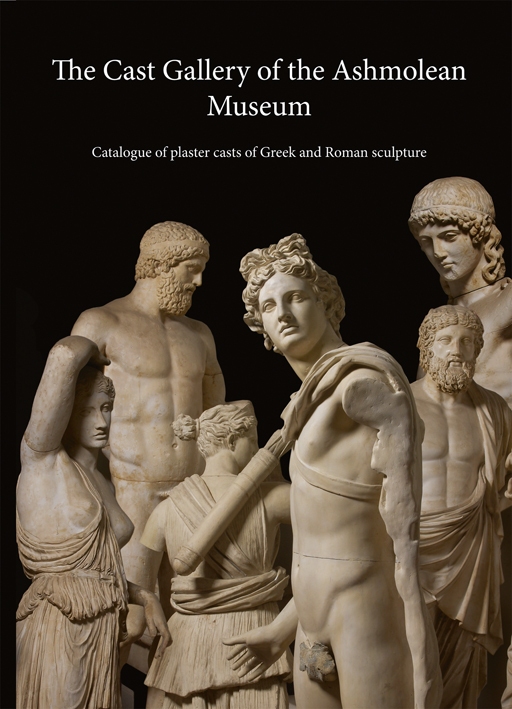 The Cast Gallery of the Ashmolean Museum contains the premier collection of plaster casts of Greek and Roman sculpture in the UK, formed over more than a century, from 1884 to the present. The collection has recently been re-displayed and integrated with the Museum, and this book is its first complete and illustrated catalogue. It presents 1,000 casts of monuments from all over the ancient world, from 600 BC to AD 500, from small bronzes to iconic monuments such as the Laokoon and the Augustus of Prima Porta.
Exhibition | Italian Soup Tureens
Notice of this exhibition at the Hotel Villa Zuccari slipped by me last year, but I see that the catalogue is available from artbooks.com. Eighteenth-century pieces are the minority, but February has me thinking about soup! -CH
◊ ◊ ◊ ◊ ◊
From Good Morning Umbria:
Le Zuppiere dal XVIII al XX Secolo: Collezione Paolo Zuccari
Villa Zuccari, San Luca di Montefalco (Perugia), 22 June — 30 September 2012
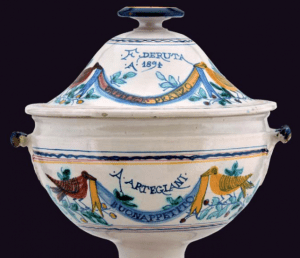 Negli ultimi anni il collezionismo privato ha avuto un notevole sviluppo e gioca un ruolo importante nella nostra cultura e società, in quanto consente di salvaguardare beni di valore artistico, storico e culturale. E’ proprio questo il caso della Collezione di zuppiere di Paolo Zuccari che annovera oltre 500 esemplari alcuni dei quali sono pezzi della fine del ‘700 ed altri –il nucleo principale- dell’800 e del ‘900 di provenienza tutta italiana, dalla Lombardia, all’Emilia Romagna, dalla Toscana all’Umbria alle Marche , agli Abruzzi, dalla Campania al Molise ed alla Puglia. Collezione questa molto originale se si pensa che il collezionista , dopo aver trasformato la sua residenza in un relais a quattro stelle, si è dedicato alla catalogazione di questa sua passione. “Tutti mi chiedono perché, come e quando ho iniziato a collezionare zuppiere.” afferma Paolo Zuccari. “La risposta è semplice, dopo aver vissuto per trenta anni in questa casa, ora Hotel Villa Zuccari, dopo aver sposato Daniela ed avere avuto la prima figlia Federica, ho deciso di andare a vivere a Spoleto dove è nata Lorenza. In occasione di tale trasferimento, per la verità un po’ sofferto, ho portato con me solo poche cose e pochi ricordi della mia casa natale, ma fra queste poche cose c’erano alcune zuppiere. Da queste prime zuppiere, forse per nostalgia, è iniziato il desiderio o la mania di comperarne altre e via via ho iniziato a collezionarle” . Ce ne sono di bellissime e di particolarissime, per esempio la zuppiera realizzata nel 1894 da Angelo Artegiani di Deruta, in cui si legge un cartiglio con l’iscrizione “Buon Appetito” , sicuramente eseguita per qualche ricorrenza speciale. (more…)
Nationalmuseum acquires Miniature Portrait by Adélaïde Labille-Guiard
Press release (February 2013) from the Nationalmuseum in Stockholm:

Adélaïde Labille-Guiard, Madame Lefranc Painting a Portrait of Her Husband Charles Lefranc, watercolour and gouache on ivory, 1779 (Stockholm: Nationalmuseum, NMB 2625) Photo: Bodil Karlsson
The Nationalmuseum has acquired a spectacular miniature by Adélaïde Labille-Guiard. One of the most important women artists in late 18th-century France, she was not previously represented in the museum’s collections. The work is interesting on account of the motif alone, depicting a woman, albeit an amateur, in the role of artist.
Miniature portraits by Adélaïde Labille-Guiard (1749–1803) are extraordinarily rare. Her depiction of Madame Lefranc Painting a Portrait of Her Husband Charles Lefranc was painted five years after she made her debut (1779). Like many other female artists, she realized early on that miniature portraits offered a steady source of income. She was a pupil of the Swiss enamellist François-Élie Vincent, a neighbour of her father’s fashion shop in Paris. Gradually Labille-Guiard also took up working with pastels. She frequently reproduced these works in a smaller format as miniatures. After her election to the French Royal Academy of Art in 1783, she switched over completely to large-scale oil portraits. By then, Labille-Guiard had acquired pupils such as Marie-Gabrielle Capet and Marie-Thérèse de Noireterre. It became their job to translate her portraits into miniature format to satisfy the ever-changing demands of customers.
The acquisition of this spectacular work by Adélaïde Labille-Guiard, made possible by a generous donation from the Hjalmar and Anna Wicander Foundation, has filled a major gap in Nationalmuseum’s world-renowned miniatures collection. Madame Lefranc Painting a Portrait of Her Husband Charles Lefranc also documents a time when women began to emerge as serious artists.
Exhibition | Antoine Watteau: The Music Lesson
From the exhibition press materials:
Antoine Watteau (1684–1721): The Music Lesson
BOZAR (Palais des Beaux-Arts), Brussels, 8 February — 12 May 2013
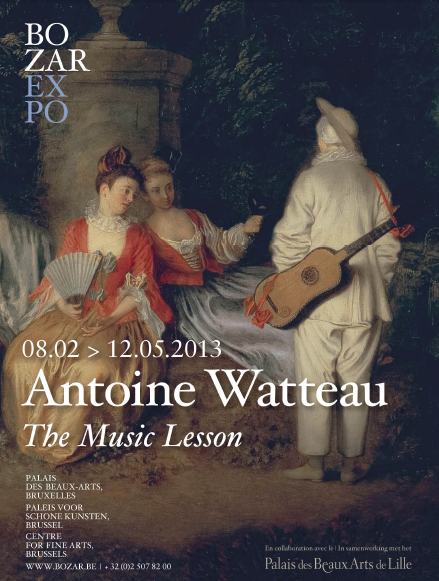 BOZAR EXPO presents, in cooperation with the Palais des Beaux-Arts de Lille, a major interdisciplinary project consisting of an ambitious exhibition, various concerts and debates, devoted to a great French master of the early 18th century, Antoine Watteau, with a particular focus on the musical scenes frequently depicted in the painter’s work. The exhibition’s general curator, the renowned orchestral conductor William Christie, is also at the heart of a cycle of eight concerts that will evoke the sensual atmosphere of Watteau’s canvases.
In the spring of 2013 BOZAR is presenting the first exhibition in Belgium to be devoted to Antoine Watteau (1684–1721). This not only offers an opportunity to see a number of his works; moreover, it sets his pictures to music; it also highlights the correspondence between the arts that was at the heart of his work as an artist. Almost a third of Watteau’s works feature musicians. Born to a humble family, he was a short-lived star of French 18th-century painting, dying at the early age of 37. Despite his short life and limited oeuvre, Watteau’s elegance and
genius left their mark on European art.
Antoine Watteau, father of the fêtes galantes
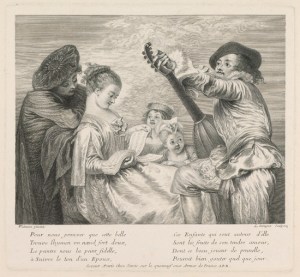
Louis Surugue after Antoine Watteau, The Music Lesson, etching. © Bibliothèque nationale de France
Little is known about his years of training in his native Valenciennes, a town that was open to both Flemish and French influences, as it only became attached to France in 1678. We can, however, be sure of the importance of his master, Claude Gillot (1673–1722). It was through him that Watteau, the “fils du Nord,” discovered Italian painting and the Commedia dell’Arte, which meant so much to him, even though he would never make the journey to Italy.
Watteau passed the bulk of his career in Paris, towards the end of the reign of the Sun King and during the Regency, a period in which the French capital experienced an aesthetic ferment and a renewed commercial enthusiasm for art. It was in that context that, in the 1720s, Watteau became a protégé of Pierre Crozat (1661–1740), one of his great patrons. Crozat helped to bring into being a musical circle in which both Italian and French music were acclaimed. His collection also helped Watteau to find himself as an artist, as he enthusiastically copied drawings it contained by Flemish and Venetian masters (Rubens, Van Dyck, Titian, and Campagnola). Their attention to colour, movement, and sensuality fascinated the young artist, who drew on those qualities to create a new style, less grandiloquent and less formal, imbued with a feigned lightness and an unprecedented elegance.
So there is nothing fortuitous about the presence of other disciplines – theatre, dance, and music, in particular – in Watteau’s paintings. They are very much present in the figures depicted in the fêtes galantes, whose language he invented: scenes of intimacy, conversation, and music set in an enclosed natural setting in which the human condition plays with appearances. Are we looking at aristocrats who have put on the costumes of actors or at theatrical scenes reconstructed in a bucolic setting? Watteau explores, as no one had done before him, a free combination of theatrical characters, whom he places away from the stage, somewhere between life and playing a role. Music is never far away in these fêtes galantes. The titles of works such as La Leçon de musique, Le Concert amoureux, and L’Accord parfait are highly evocative in this context.

Antoine Watteau, L’Enchanteur Huile sur cuivre (Troyes: Musée
des Beaux-Arts) © RMN-Grand Palais – © Jean Schormans
Antoine Watteau (1684–1721): The Music Lesson
The exhibition, which has a particular focus on the musical aspect of Watteau’s painting, brings together a unique selection of fifteen of the artist’s canvases and thirty of his drawings, some of which have not been seen by the European public for more than 50 years. It also presents fifty engravings by his contemporaries, including François Boucher, Benoît Audran II, and Charles-Nicolas Cochin, who produced the finest engravings of the 18th century and spread Watteau’s art throughout Europe. Thanks to them, we have reproductions of paintings of his that have since been lost and it is possible to offer an almost complete overview of his work. This unprecedented combination of original paintings, drawings, and engravings, as well as archival material, scores, and musical instruments of the same period, is a first. The exhibition itinerary is organised chronologically and thematically. The visitor first discovers the silent dimension of Watteau’s art and is thus better placed to appreciate its various musical tones later in the exhibition. The aesthetic experience is heightened as the visitor is immersed in the music of the time thanks to the audioguides and several listening points throughout the exhibition circuit. A special room is set aside for free concerts given by students of various Belgian and French conservatories on Thursday evenings. The intervention by Dirk Braeckman, leading Belgian photographer with an international reputation, establishes connections between Watteau’s work and contemporary art.
For additional information, including lenders, room texts, and programming details, see the 28-page press booklet (PDF).
◊ ◊ ◊ ◊ ◊
Note (added 20 March 2013): The catalogue is available through Artbooks.com:
Florence Raymond, ed., Antoine Watteau (1684-1721): La leçon de musique (Paris: Skira Flammarion, 2013), 272 pages, ISBN: 978-2081295834, $87.50.
Call for Papers | Money, Power, and Print, 1688-1776
Money, Power, and Print
The Leuven Institute for Ireland in Europe, Leuven, 12-14 June 2014
Proposals due by 15 June 2013
This colloquium, the sixth in a biennial series and the first to be held in Belgium, offers an opportunity for scholars from a variety of disciplines to enrich their mutual understanding of the intersections between public finance, politics and print during Britain’s ‘financial revolution’. The term ‘Britain’ is used loosely to refer to all constituent parts of the United Kingdom and also to Ireland and the colonies.
The organizers invite proposals for papers that will build on the three papers already contributed and the two contemporary publications they have chosen for discussion in an opening-day session. Ideally, submissions should develop ideas in, or comment upon issues raised by, one or more of the papers or readings already included in the program. Abstracts of the organizers’ three papers are printed below.
The contemporary publications to be discussed are:
1) Benjamin Franklin, A Modest Enquiry into the Nature and Necessity of a Paper-Currency. Philadelphia, 1729. Reprinted in Leonard W. Labaree, ed., The Papers of Benjamin Franklin, Vol. 1 (New Haven, CT: Yale University Press, 1959), vol. 1, pp. 139-157.
2) Dr. William Douglass, A Discourse Concerning the Currencies of the British Plantations in America. Boston, 1740. Reprinted in Andrew McFarland Davis, ed., Colonial Currency Reprints, 1682-1751, Vol. III (New York: Augustus M. Kelly, 1964), vol. 3, pp. 305-363.
Proposals are welcome in any of four general areas: (more…)










 Enfilade
leave a comment