New Book | Autour des Van Loo
From PURH:
Christine Rolland, ed., Autour des Van Loo: Peinture, commerce des tissus et espionnage en Europe (1250-1830), (Mont-Saint-Aignan: Publications des Universités de Rouen et du Havre, 2012), 402 pages, ISBN: 9782877755016, 49€/ $95.
 Puissante dynastie de peintres qui s’est constituée au cours des XVIIe et XVIIIe siècles, les Van Loo ont été au cœur des grands événements culturels de leur temps. Jacob Van Loo (1614-1670) a fréquenté Vermeer et Rembrandt, avant de s’enfuir vers la France et d’y devenir membre de l’Académie royale de peinture. On retrouve ses descendants dans toutes les cours et les académies de peinture d’Europe. Les Van Loo ne s’en tiennent cependant pas à la peinture. Louis-Michel Van Loo (1707-1771), premier peintre du roi d’Espagne, représentait en même temps l’une des grandes entreprises textiles lyonnaises : il avait pour clients la famille royale, des aristocrates, des ambassadeurs et des agents secrets. À partir de l’exemple de Louis-Michel, sont mis en lumière les liens entre les réseaux des artistes, des marchands, des diplomates et des espions, du Moyen Âge au début du XIXe siècle. Ce volume est surtout la première étude moderne portant sur l’ensemble de la dynastie des Van Loo, de 1617 à 1830, depuis Jacob, le pater familias, jusqu’à Jules-César-Denis, le « peintre des neiges ». Les principales œuvres de chacun des peintres y sont reproduites, souvent pour la première fois. On y trouve aussi un arbre généalogique complet de la famille, des notices biographiques sur chacun de ses membres et des documents issus des archives familiales, sans oublier des tissus et des costumes jamais vus du XVIIIe siècle.
Ont collaboré à ce volume : Cinzia Maria Sicca, Bruna Niccoli, David Mandrella, Christophe Henry, Lesley Ellis Miller, Serge Chassange, Gérard Gayot, Alain Becchia, Simonne Abraham-Thisse, Sjoukje Colenbrander, Corine Maitte, Jean-Paul Leclercq, Ulrich Leben, Fabienne Camus, Michel Van de Laar, Arie Wallert, Cyrille Sciama, Michelle Sapori, Françoise Thelamon.
The full list of contents is provided here»
Graduate Student Seminar | Coloring Color at YCBA
Summer seminar at the YCBA:
Coloring Color: The History, Science, and Materiality of Paint
Yale Center for British Art, New Haven, 17-21 June 2013
Applications due by 4 March 2013
In June 2013, the Yale Center for British Art (YCBA) will offer a week-long graduate student seminar, open to doctoral candidates interested in learning about color and its historical development, manufacture, and use in a range of art works in the eighteenth, nineteenth, and twentieth centuries. The seminar, which is organized by the YCBA’s Conservation Department, will concentrate on the physical materials of color. The long eighteenth century plays a central role in the history of color, as the scientific revolution and the development of chemistry were, in part, fueled by the urge to synthesize pigments and dyes. The seminar will examine color from historic and scientific perspectives, explore its physical definitions and biological responses, and create a familiarity with the language of color as it evolved historically. Studio demonstrations and some practice will be used to help inform art history students who may have had little or no experience in handling pigments and mediums in the studio. The aim of the seminar is to equip students with a fundamental understanding of the history and theory of color, and to develop an understanding of the appearance of color in paintings and works on paper.
Yale historically has been linked to color teaching. From 1950 until his death in 1976, Joseph Albers taught, studied, and painted in New Haven, and it was at the Yale School of Art that he developed his seminal theories and teachings on color. Yale’s superb collections and conservation facilities make the University an ideal setting for color immersion. Students will be able to correlate color theory with the wide range of paintings on view at the YCBA and the Yale University Art Gallery, as well as in the various library collections with extensive holdings of original manuscripts and color ephemera, such as the Faber Birren collection, one of Yale’s gems. Yale’s collections are rich with examples of artists who experimented with color, and many of these paintings present us with technical puzzles, as we consider artistic intention in relation to the aging of paintings.
The lead instructors of the seminar are Mark Aronson, Chief Conservator, and Jessica David, Assistant Paintings Conservator at the ycba. Other specialists, including curators, art historians, scientists, conservators, and artists, will be involved in teaching special sessions during the course. The seminar is open to current PhD students within the United States and internationally, whose doctoral research focuses on issues relating to painterly practice and the materiality of paintings and works on paper. Participants will be provided with economy airfare, ground transportation, meals, and accommodation at Yale. Students are expected to undertake reading assignments in advance of the seminar. A syllabus and details of assignments will be available in late spring 2013. The graduate student summer seminar is generously supported by the Andrew W. Mellon Foundation.
Applications must be submitted electronically. Please include a cv and a statement (no more than two pages) of how your research interests intersect with the focus of the seminar, and what you hope you to gain for your own work by participating. Applications should be emailed to: Marinella Vinci, Senior Administrative Assistant, Department of Research, marinella.vinci@yale.edu. Please also address any queries to Marinella Vinci. The deadline for receipt of
applications is Monday, March 4, 2013.
Exhibition | Eighteenth-Century Book Illustration in the Veneto
The exhibition presents 115 illustrated books and as many loose prints from the likes of Tiepolo, Piazzetta, Novelli, Fontebasso, and Balestra. From Padova Cultura:
Tiepolo, Piazzetta, Novelli: L’Incanto del Libro Illustrato nel Settecento Veneto
Musei Civici agli Eremitani and Palazzo Zuckermann, Padua, 24 November 2012 — 7 April 2013
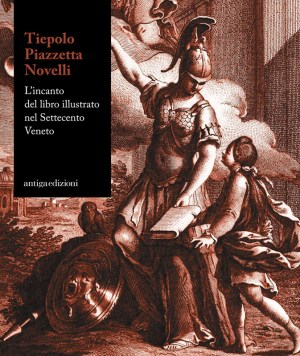 A Padova una meravigliosa galleria cartacea: 115 volumi illustrati del Settecento esposti accanto ad altrettanti fogli sciolti e incisioni, dipinti e disegni di grandi Maestri. Ecco la più completa mostra mai realizzata sul tema.
E’ dal connubio tra intelligenti editori come Giambattista Albrizzi e Antonio Zatta – per citarne solo alcuni – grandi e celeberrimi artisti come Tiepolo, Piazzetta, Novelli, Fontebasso o Balestra, e di abili incisori capaci di tradurre i segni e lo stile di questi in stampe di straordinaria complessità e varietà luministica, che nascono alcuni dei maggiori capolavori dell’editoria illustrata del Settecento. Un fenomeno ben sviluppato anche nel Seicento ma che nel XVIII secolo raggiunge nel Veneto vertici assoluti d’eleganza e raffinatezza, ammirati a livello internazionale.
Un fenomeno che, dal 24 novembre 2012 al 7 aprile 2013 a Padova, nelle sedi del Museo Civico agli Eremitani e di Palazzo Zuckermann, sarà esplorato e reso accessibile al grande pubblico in una mostra assolutamente unica per vastità e completezza di trattazione e certamente tra le più importanti esposizioni del genere mai realizzate in Italia: un viaggio affascinante e sorprendente, alla scoperta di quello che fu un aspetto fondamentale della vita culturale della Serenissima, ma anche di una produzione artistica spesso parallela a quella più appariscente della pittura da cavalletto o ad affresco, ma non meno suggestiva.
Oltre 115 volumi prodotti in Veneto o che hanno visto la collaborazione d’importanti artisti veneziani del Settecento – edizioni rare e preziose, arricchite da antiporte, incisioni, cornici, testatine, vignette o preziosi finalini – saranno dunque esposti accanto a quasi 120 tra stampe sciolte tratte dagli stessi volumi e incisioni autonome, in modo da favorire un’ampia documentazione della ricchezza illustrativa di questi volumi e dell’attività degli artisti ai quali si deve l’invenzione grafica delle opere. Maestri che saranno ricordati in mostra, ciascuno, anche attraverso uno dei loro significativi dipinti, a sottolineare e rimarcare la stretta connessione esistente tra la produzione artistica dei pittori coinvolti e i disegni da questi approntati per l’editoria: “una comune attitudine per il libero dispiegarsi della fantasia, applicata ora alle pagine di un libro invece che ai cieli dei soffitti affrescati o alle tele di grandi quadri di storia, una medesima audacia compositiva, un precoce interesse per forme di ornato rococò.”
Una mostra dunque ricchissima – realizzata grazie alle opere della Biblioteca Civica, dei Musei Civici agli Eremitani e della Biblioteca Universitaria, oltre a quelli di un’importante collezione privata e di alcuni selezionati istituti culturali del Veneto – che si sviluppa in 9 sezioni, adottando punti di vista diversificati e privilegiando, di volta in volta, un approccio cronologico, monografico e tematico.
The press release (a PDF file) is available here»
◊ ◊ ◊ ◊ ◊
The catalogue is available from ArtBooks.com»
Vincenza Cinzia Donvito and Denis Ton, Tiepolo, Piazzetta, Novelli: L’Incanto del Libro Illustrato nel Settecento Veneto (Crocetta del Montello: Antiga Edizioni, 2012), 480 pages, ISBN: 978-8888997940, $67.50.
Notes & Queries | Image of the British Museum
Yesterday, Arlene Leis posted a question to C18-L regarding this print. Since, however, the list (like most listservs) doesn’t allow for attachments, I thought it might be useful to include the query here. -CH
This small picture (10 x 12 cm) is from a lady’s pocket book, circa 1780. Tents are set-up around the garden wall, but in the middle are rows of tiny triangles. Does anyone know what these might be? Also, I would appreciate any information pertaining to the camp set up in the museum’s garden.
Thanks,
Arlene Leis
Please feel free to respond with comments below.
Exhibition | Salvaging the Past: Georges Hoentschel
From the BGC:
Salvaging the Past: Georges Hoentschel and French Decorative
Arts from The Metropolitan Museum of Art
Bard Graduate Center, New York, 4 April — 11 August 2013
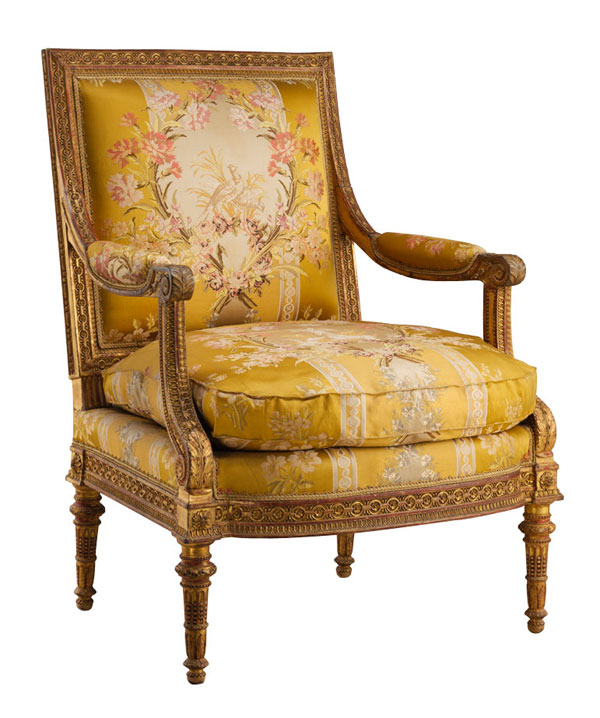
Georges Jacob; gilder: Louis–François Chatard. Armchair from Louis XVI’s Salon des Jeux, Château de Saint-Cloud, 1788. Carved and gilded walnut; gold brocaded silk (New York: The Metropolitan Museum of Art, Gift of J. Pierpont Morgan, 1906 — 07.225.107)
Focusing on a remarkable but little-known collection that entered the Metropolitan Museum as a gift of J. Pierpont Morgan in the early twentieth century, Salvaging the Past: Georges Hoentschel and French Decorative Arts from The Metropolitan Museum of Art features more than 200 objects of primarily medieval art and French eighteenth-century paneling, furniture, metalwork, textiles, paintings, and sculpture, as well as late nineteenth-century art pottery, most of which have rarely been viewed since the 1950s. The fourth in a series of collaborations between The Metropolitan Museum of Art and the BGC, the exhibition provides the first comprehensive examination of Georges Hoentschel—a significant figure in the history of collecting—and illuminates an understudied and critical chapter of the Metropolitan’s history.
Drawn primarily from the Metropolitan Museum’s holdings, with loans from other public and private collections in the United States and France, the exhibition tells the story of this unique collection in four sections. The first introduces Georges Hoentschel, who was an enterprising and successful decorator during the late nineteenth and early twentieth centuries, when France witnessed a great scientific, industrial, and social transformation and the newly moneyed bourgeoisie adopted a lifestyle based on an aristocratic model. As director of the Parisian decorating firm Maison Leys, Hoentschel catered to these affluent clients, creating for them interiors in historic French styles. In this section of the exhibition, ephemera, family papers, photographs, and a film presentation will outline his story within the context of Belle Époque Paris.
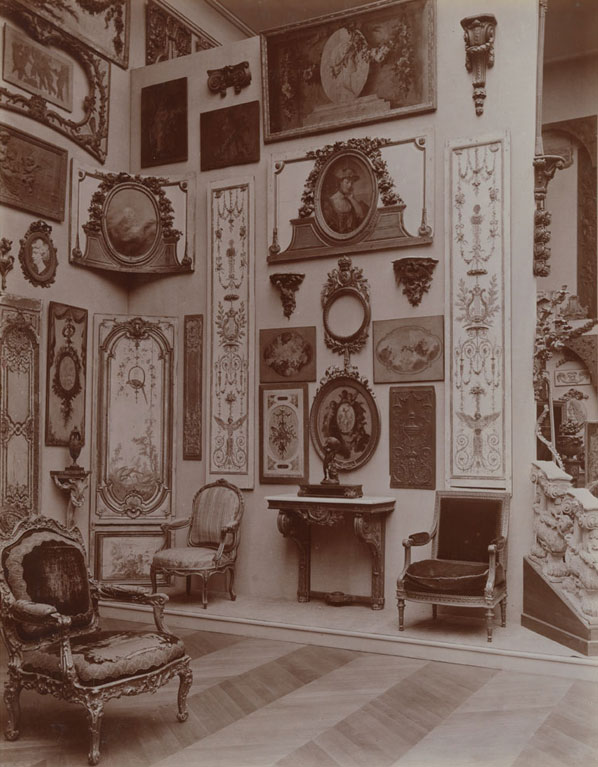
Section of the interior of 58 Boulevard Flandrin, Paris (ca. 1906) to be recreated in the Bard Graduate Center exhibition.
The second and largest section presents selections from the eighteenth-century holdings of the collection in installations inspired by historic photographs of Hoentschel’s densely arranged showroom-museum in Paris, where the objects served as models for his interior decorating business. Delicately carved woodwork, decorative paintings, and exquisitely chased gilt-bronze mounts are featured here. Highlights include a chair made for Louise-Élisabeth of Parma, daughter of Louis XV; an armchair made for Louis XVI; and a panel from shutters originally installed in a room outside the chapel at Versailles.
The third section displays medieval artworks, including sculpture, ivories, and metalwork, and includes one of the finest surviving examples of French Limoges enamelwork—a twelfth-century reliquary container, or chasse. Also shown here is Jean Barbet’s Ange du Lude, on loan from the Frick Collection, a rare bronze angel dated 1475, one of the most remarkable works from Hoentschel’s collection.
The final section presents examples of Hoentschel’s stoneware and those of his friend the sculptor and potter Jean-Joseph Carriès (1855–1894). Some of these ceramics were originally exhibited in the Union Centrale des Arts Décoratifs’ pavilion at the 1900 Exposition Universelle in Paris, for which Hoentschel created interiors in art nouveau style, unique in his oeuvre. A chair from this pavilion, loaned by the Musée des Arts décoratifs, Paris, is displayed, along with a selection of furnishing textiles used by Hoentschel in interior design commissions.
The exhibition is organized by the Bard Graduate Center: Decorative Arts, Design History, Material Culture and The Metropolitan Museum of Art.
◊ ◊ ◊ ◊ ◊
From Yale UP:
Daniëlle Kisluk-Grosheide, Deborah L. Krohn, and Ulrich Leben, eds., Salvaging the Past: Georges Hoentschel and French Decorative Arts from The Metropolitan Museum of Art (New Haven: Yale University Press, 2013), 320 pages, ISBN: 9780300190243, $85.
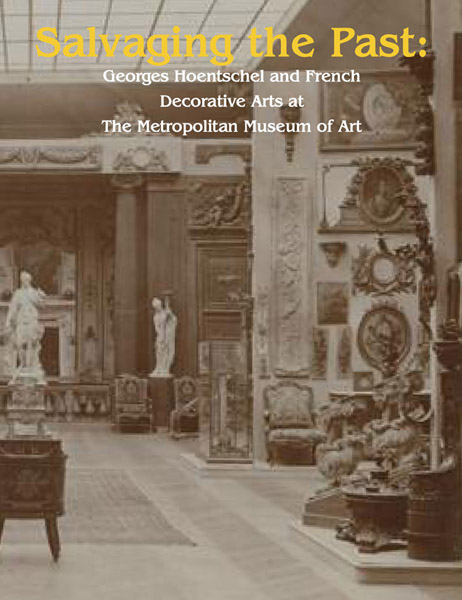 Georges Hoentschel (1855–1915) was a leading French interior designer in historic styles, head of a decorating firm, and ceramicist during the Belle Epoque. He found inspiration for his designs in medieval and 18th-century French art, which he avidly collected, amassing more than 4,000 pieces of furniture, woodwork, metalwork, sculpture, paintings, and textiles. After visiting Hoentschel in Paris, the American financier J. Pierpont Morgan acquired the collection and bequeathed it to the Metropolitan Museum of Art in 1906 and 1916–17. These works greatly enriched the museum’s medieval art department and became the nucleus of its decorative arts department, profoundly influencing American tastes in the early 20th century. Through texts, early documentary photographs, and images of newly conserved works, Salvaging the Past goes behind the scenes to explore the history and influence of this remarkable collection.
Daniëlle Kisluk-Grosheide is curator of European sculpture and decorative arts at The Metropolitan Museum of Art, New York. Deborah L. Krohn is associate professor of Italian Renaissance decorative arts at Bard Graduate Center. Ulrich Leben is a visiting professor and special exhibitions curator at Bard Graduate Center and associate curator for the furniture collection at Waddesdon Manor, Buckinghamshire.
Getty Research Institute Acquires a Rare Set of Chinese Battle Prints
Press release (17 January 2013) from The Getty:

Ping ding Kuoerke zhan tu, or Pictures of the Campaigns against the Gurkhas
(i.e., Nepalese), China, ca. 1793 (LA: The Getty Research Institute)
◊ ◊ ◊ ◊ ◊
The Getty Research Institute (GRI) has acquired an extraordinarily rare suite of battle prints from about 1793 that depict the Chinese Emperor Qianlong’s (reign era, 1736–1795) successful military campaign against invading armies from Nepal. These eight large-format copper engravings represent the complete set of prints commissioned by the Emperor to commemorate his 1792 victory. Printed in China, this set is one of seven so-called ‘Conquest’ suites.
“The rarity of these prints makes them an extraordinary addition to the GRI’s stellar collections depicting ‘China on Paper,’ highlighting cross-cultural relationships between Europeans and Chinese,” said Marcia Reed, Chief Curator at the Getty Research Institute. “Because the GRI holds strong collections of related works, it’s extremely beneficial to bring the collections already in place and these prints together for future research and publication.”
The scenes show dynamic landscapes of undulating mountains which seem to envelope the troops marching and fighting amidst their peaks and valleys. One plate depicts the victorious emperor being carried towards a yurt in front of a grand hall. The defeated soldiers of the enemy are grouped on the left, all on their knees. Each print includes a poem at the top of the engraved print; the poems were based on the Emperor’s own personal commentary on the scenes.
Prints such as these made their way into China from Europe in the 1700s and the emperor would have been given gifts of panoramic battle prints by visiting European dignitaries. In 1765 he ordered drawings to be made from monumental paintings commemorating his recent victories. These drawings, made by Jesuits employed by Qianlong’s court, were sent to Paris for engraving and printing. Created by Europeans for a Chinese audience, the prints were very European in appearance, with Chinese visual tropes incorporated in the drawings. When the prints were received at court, poetry was added to them—a very Chinese touch.
The Pictures of the Campaigns against the Gurkhas break away from this hybrid imagery. Though inspired by a European tradition and using French printing techniques, the drawings are notably Chinese in composition and style.
As part of the GRI’s special collection, these prints will now be available for scholarly research. The GRI’s vaults hold rare and unique collections in art history and visual culture from around the world, including more than 27,000 prints ranging from the Renaissance to the present.
◊ ◊ ◊ ◊ ◊
Additional information and illustrations are available at Amy Hood’s posting on the Getty’s blog, The Iris»
Call for Papers | The Art of Lying in the Eighteenth Century
From Hélène Bremer:
The Art of Lying in the Eighteenth Century
Amsterdam, 17-18 January 2014
Proposals due by 15 March 2013

Thomas Rowlandson, Transplanting Teeth, 1787
On Friday January 17 and Saturday January 18, 2014 the annual conference of the Werkgroep 18de Eeuw will be held in Amsterdam. The major theme of the conference is: The Art of Lying.
Lying and cheating were daily practice in the eighteenth century. That is, if we believe the many pamphlets, newspapers, comedies, criminal biographies and criminal records. Before one knew one had lost his money, goods, reputation or health. Despite the severe penalties on stealing and murdering and despite all Enlightenment ideals, trickery and deceit seem to have been rather mainstream. Historical criminologists have shown that it is a misconception to think that cheating only existed in the lower classes or in the margins of eighteenth century society. In each social class fraud and corruption were common. Persons like Casanova and Cagliostro were operating in the highest circles. Some of the wealthiest people were specialized in real estate fraud and illegal speculation, not to mention the corruption in politics and in the (para)medical sector. At the same time, an anti-movement started. Eighteenth-century ‘philosophes’ were fascinated by the truth and the late eighteenth-century revolutions could not have taken place without the desire to eradicate corruption.
The conference aims for an interdisciplinary and international approach to the phenomenon of fraud and corruption. Topics may include an international affair such as the South Sea Bubble, the corruption of regents, the medical malpractice of quacks or the vicissitudes of a local thief. We will also focus on the ways in which the criminal world was represented in the media. Possible key questions to be addressed are:
• What was the top 10 list of famous con men in the eighteenth century, nationally and internationally?
• What was the relationship between truth and lying in the eighteenth century?
• To what extent were corruption and fraud considered to be normal?
• Could one survive without lying?
• Can we consider the Enlightenment movement as a response or an antidote to this culture of lying?
• How were con men, thieves and murders punished and sentenced?
• How did the late eighteenth-century revolutions contributed to a transformation of a culture of lying into a more just society?
• Why became the genre of criminal biography so popular in the eighteenth century? And why in general do we find so many crooks, thieves and swindlers in eighteenth-century literature?
• In what sense did literature and the arts play an active part in combating fraud?
• Can we state that neither the Enlightenment nor the Judeo-Christian tradition – both considering lying as a sin – have been able to change human nature?
Historians, art historians, criminologists, philosophers, sociologists, economists, literary and medical historians, are all invited to give an inspiring lecture of approximately twenty minutes. We also welcome scholars who want to bridge the gap between past and present. Please submit proposals (approximately 300 words in Dutch or English) before March 15, 2013 by email to: devriesmarleen@hotmail.com. Contributors will be notified that their proposal has been accepted by April 1, 2013.
Note: On Friday, January 17, we will host one or more guest speakers from abroad. This day will therefore be in English, and all lectures should be conducted in English. The language for Saturday, January 18, will be Dutch.
New Book | The Pleasure Garden, from Vauxhall to Coney Island
Released in December from U of Pennsylvania Press:
Jonathan Conlin, ed., The Pleasure Garden, from Vauxhall to Coney Island (Philadelphia: University of Pennsylvania Press, 2012), 352 pages, cloth ISBN 978-0812244380 / ebook ISBN 978-0812207323, $70 / £46.
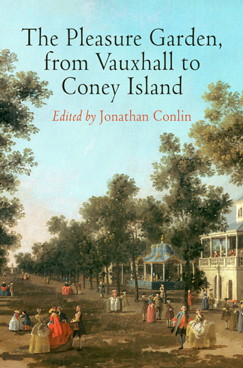 Summers at the Vauxhall pleasure garden in London brought diverse entertainments to a diverse public. Picturesque walks and arbors offered a pastoral retreat from the city, while at the same time the garden’s attractions indulged distinctly urban tastes for fashion, novelty, and sociability. High- and low-born alike were free to walk the paths; the proximity to strangers and the danger of dark walks were as thrilling to visitors as the fountains and fireworks. Vauxhall was the venue that made the careers of composers, inspired novelists, and showcased the work of artists. Scoundrels, sudden downpours, and extortionate ham prices notwithstanding, Vauxhall became a must-see destination for both Londoners and tourists. Before long, there were Vauxhalls across Britain and America, from York to New York, Norwich to New Orleans.
This edited volume provides the first book-length study of the attractions and interactions of the pleasure garden, from the opening of Vauxhall in the seventeenth century to the amusement parks of the early twentieth. Nine essays explore the mutual influences of human behavior and design: landscape, painting, sculpture, and even transient elements such as lighting and music tacitly informed visitors how to move within the space, what to wear, how to behave, and where they might transgress. The Pleasure Garden, from Vauxhall to Coney Island draws together the work of musicologists, art historians, and scholars of urban studies and landscape design to unfold a cultural history of pleasure gardens, from the entertainments they offered to the anxieties of social difference they provoked.
Jonathan Conlin is Senior Lecturer in Modern History at the University of Southampton and author of Civilisation and The Nation’s Mantelpiece: A History of the National Gallery.
◊ ◊ ◊ ◊ ◊
C O N T E N T S
Introduction
Jonathan Conlin 1
Chapter 1. Theaters of Hospitality: The Forms and Uses of Private Landscapes and Public Gardens
John Dixon Hunt 29
Chapter 2. Pleasure Gardens and Urban Culture in the Long Eighteenth Century
Peter Borsay 49
Chapter 3. Guns in the Gardens: Peter Monamy’s Paintings for Vauxhall
Eleanor Hughes 78
Chapter 4. Performance Alfresco: Music-Making in London’s Pleasure Gardens
Rachel Cowgill 100
Chapter 5. Pleasure Gardens of America: Anxieties of National Identity
Naomi Stubbs 127
Chapter 6. Pleasure Gardens in Nineteenth-Century New Orleans: ”Useful for All Classes of Society”
Lake Douglas 150
Chapter 7. Night and Day: Illusion and Carnivalesque at Vauxhall
Deborah Epstein Nord 177
Chapter 8. ”Strange Beauty in the Night”: Whistler’s Nocturnes of Cremorne Gardens
Anne Koval 195
Chapter 9. Edwardian Amusement Parks: The Pleasure Garden Reborn?
Josephine Kane 217
Notes 247
Select Bibliography 299
List of Contributors 303
Index 307
Acknowledgments 315
Fellowships | The Drawing Institute at The Morgan Library
Pre-Doctoral and Post-Doctoral Fellowships
The Drawing Institute, The Morgan Library & Museum, New York, 2013-14
Applications due by 15 February 2013
The Morgan Library & Museum invites applications for Pre-Doctoral and Post-Doctoral Fellowships at the Drawing Institute for the 2013-2014 term. Fellowships support independent research projects on subjects relating to the history, theory, collecting, function or interpretation of old master and/or modern drawings. For more information or to apply, please visit The Morgan Library’s website.
◊ ◊ ◊ ◊ ◊
Morgan-Menil Fellowship
The Drawing Institute, The Morgan Library & Museum, New York, 2013-14
Applications due by 15 February 2013
The Drawing Institute invites applications for the Morgan-Menil Fellowship for the 2013-2014 academic term. This fellowship, a collaboration between the Morgan Library & Museum and the Menil Collection, focuses on the history, production, use, and cultural meaning of drawing as a discipline, with an emphasis on the relationships between the old-master tradition and the practice of drawing in the modern and contemporary era. For more information, please visit The Morgan Library’s website.
Exhibition | In Search of Classical Greece: Travel Drawings
Press release from The British Museum:
In Search of Classical Greece: Travel Drawings of Edward Dodwell and Simone Pomardi, 1805–1806
The British Museum, London, 7 February – 28 April 2013
Curated by John Camp with Ian Jenkins and Kim Sloan

Edward Dodwell, Simone Pomardi, Panorama from the top of the Mousaion Hill, Athens, 1805.
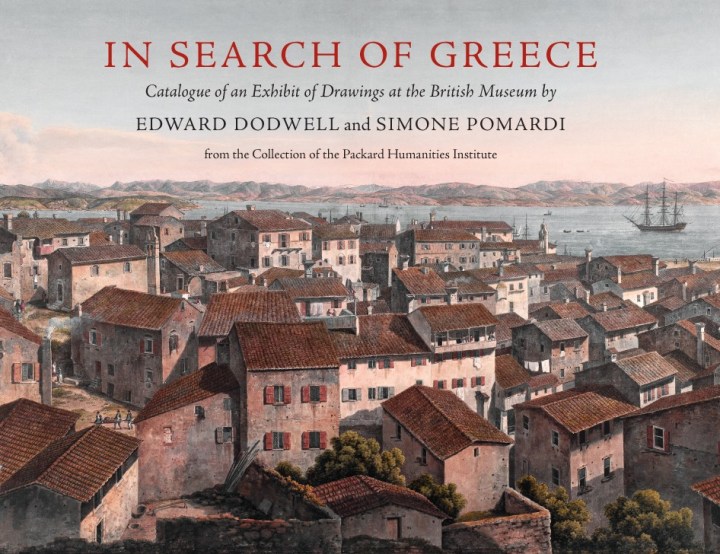
This exhibition will look at Greece through the eyes of the classical scholar Edward Dodwell (about 1777–1832) and his Italian artist, Simone Pomardi (1757–1830). During their travels in 1805–06, they recorded the country and its people in a series of fascinating and spectacular drawings and watercolours. Kindly lent by the Packard Humanities Institute, these works have never been seen in public before. They represent a unique record of an important chapter in the rediscovery of ancient Greece on the eve of the creation of the modern Greek state.
Their landscapes, often featuring the ruins of classical sites, are peopled with modern Greeks and Turks at a time when Greece was under Ottoman rule. Especially fascinating and impressive are five rare surviving panoramas, measuring up to four metres in length, and providing 360 degree views of Corfu harbour, the Acropolis and of Athens and its surrounding countryside.
Dodwell and Pomardi’s travels were part of a great surge of interest in Greece at a time when Napoleon’s military occupation of Rome in 1796 had brought the age of the European Grand Tour to a sudden end. This exhibition will set Dodwell and Pomardi in the tradition of travel in Greece in the age of Enlightenment, examining the motivation and circumstance of such travel as well as its cultural consequences. It will be accompanied by a related display of drawings from the British Museum’s permanent collection exploring the theme of travel in Greece in the Ottoman era and just after the War of Independence.
Throughout the eighteenth century, generations of young men from Europe’s leading families had gone to Italy to complete an education that had comprised, in large part, the learning of Latin and Greek. Rome, Florence and Venice were the cities most visited and for the intrepid traveller there was also Naples. This was the principal city of southern Italy and the stopping-off point for viewing the newly discovered towns of Pompeii and Herculaneum, buried in the eruption of Mt Vesuvius in AD 79. When the occupation of Italy prevented Grand Tourists from visiting Italy, Dodwell and Pomardi, like many travellers, chose to go beyond the established Mediterranean regions of the Grand Tour. The understanding these travellers brought to the archaeological remains of ancient Greece encouraged the taste among British Hellenists for Greek architecture. This gave new vigour to the Greek Revival, already begun in the middle of the 18th century by the expeditions of the Society of Dilettanti. Hellenism, the love of ancient Greece, was to promote a new movement of Philhellenism, a sympathy for modern Greek people and a desire to realise the dream, as Byron put it, ‘that Greece might still be free’.
The beauty of its landscape and romance of its classical ruins were the primary reasons for travel to Greece under Ottoman rule. By the first decade of the nineteenth century a sympathy for the Greek-speaking peoples inspired European travellers to call for independence from Ottoman rule. In the years following the Greek War of Independence, many of the monuments recorded by Dodwell and his companions would change considerably as the new nation swept away the accretions of the late Roman, Christian and Ottoman eras and attempted to restore the purity of the classical remains. With hindsight these removals are controversial and they feed into a larger on-going debate around the creation of and the competing identities of modern Greece.
Dodwell was a talented amateur who signed many of the watercolours and drawings, even though some of them he worked on with Pomardi; others were Pomardi’s own work. Many of them were engraved in Dodwell’s own published accounts of his travels in 1819 A Classical and Topographical Tour Through Greece, During the Years 1801, 1805, and 1806. A few drawings exist in other collections, but the majority, over 800 in total, remained in the possession of Dodwell’s Irish descendants until they were purchased in 2002 by David Packard for the Packard Humanities Institute in Los Altos, California. He was advised by the distinguished American archaeologist John Camp, who has carefully catalogued the collection and made a representative selection of 67 works for the display here. He is the guest curator of this exhibition and the principal author of the accompanying publication which contains additional essays by the British Museum curators Ian Jenkins and Kim Sloan, and by Fani-Maria Tsigakou, Curator of Paintings, Prints and Drawings at the Benaki Museum, Athens.
◊ ◊ ◊ ◊ ◊
◊ ◊ ◊ ◊ ◊
John McKesson Camp, with contributions by Ian Jenkins, Fani-Maria Tsigakou, and Kim Sloan, In Search of Greece: Catalogue of an Exhibit of Drawings at the British Museum by Edward Dodwell and Simone Pomardi from the Collection of the Packard Humanities Institute (Los Altos, CA: The Packard Humanities Institute, 2013), £25.
C H A P T E R S
• Introduction: The Road to Erudite Athens – Ian Jenkins
• Introduction to the Collection – John Camp
• Greece at the Eve of the Nineteenth Century: Poised between Myth and Reality – Fani-Maria Tsigakou
• Seen through a Glass Darkly: Dodwell and Pomardi’s Drawings and Watercolours of Greece – Kim Sloan
◊ ◊ ◊ ◊ ◊
John Camp — In Search of Classical Greece
The British Museum, London, 8 February 2013
Guest curator of the forthcoming Room 90 exhibition In Search of Classical Greece and Director of Athenian Agora Excavations, Professor John Camp, explores the reality of the Classical sites pre-independence, when well-to-do European travellers ‘re-discovered’ ancient Greece.
Friday 8 February, 18.30, BP Lecture Theatre (book early, as it’s expected to sell out)
Tickets £5 (Members/Concessions £3), book online here»
◊ ◊ ◊ ◊ ◊
Note (added 4 February 2013) — Additional information on programming for the exhibition is available (as a PDF) here»










 Enfilade
leave a comment