Exhibition | White Gold: Meissen Porcelain
I’m afraid this one almost slipped by without notice, though you still have two months to see it. From The Frick:
White Gold: Highlights from the Arnhold Collection of Meissen Porcelain
The Frick Collection, New York, 13 December 2011 — 6 January 2013

Teapot, Meissen porcelain, c.1729–31, The Arnhold Collection; photograph: Maggie Nimkin
New Portico Gallery Opens with Presentation of Sculpture and Selections from an Important Promised Gift of Meissen Porcelain from Henry H. Arnhold
Since December 13, visitors to The Frick Collection have been able to enjoy a new gallery — the first major addition to the museum’s display spaces in nearly thirty-five years. The inspiration for this initiative, which involves the enclosure of the portico in the Fifth Avenue Garden, comes from the intention of museum founder Henry Clay Frick (1849–1919) to build an addition to his 1914 mansion for his growing Collection of sculpture. The project was postponed in 1917 following the United States entry into World War I, and Mr. Frick died before it could be resumed. In recent years, the institution has placed greater focus on sculpture through critically acclaimed exhibitions and several key acquisitions, while also evaluating the effectiveness of the display and lighting of such objects. Another area of increased focus has been the decorative arts. When talks began with renowned porcelain collector Henry H. Arnhold about a promised gift, the idea to create a gallery both for sculpture and the decorative arts was revisited. The architecture firm Aedas developed a plan to integrate the outdoor garden portico into the fabric of the museum, and groundbreaking occurred last winter. Aedas, formerly known as Davis Brody Bond Aedas, is one of the leading practices in the United States engaged in a range of museum and landmark structure commissions.
The Portico Gallery for Decorative Arts and Sculpture opened in late December with an inaugural exhibition of works drawn from Henry Arnhold’s promised gift of 131 examples of Meissen porcelain from the early years of this Royal Manufactory’s production. . . White Gold: Highlights from the Arnhold Collection of Meissen Porcelain will feature approximately seventy of these objects, presented along with a group of eighteenth-century sculptures by Jean-Antoine Houdon (1740–1828). Among the latter works is the full-length terracotta Diana the Huntress, a signature work at the Frick that returns to view having been recently cleaned and treated. It finds a permanent home in the new portico gallery, while the ongoing display of other sculptures and ceramics will rotate periodically.
Fellowships | Residential Awards at the Yale Center for British Art
Visiting Scholar Awards, 2013-14
Yale Center for British Art, New Haven
Applications due by 4 January 2013
The Yale Center for British Art offers short-term residential awards to scholars undertaking research related to British art. The awards are intended to enable scholars working in any discipline, including history, the history of art, literature, and other fields related to British visual and material culture, to study the Center’s collections of paintings, sculptures, drawings, prints, rare books, and manuscripts, as well as primary and secondary reference materials.
Awards are offered at both postdoctoral (or equivalent) and pre-doctoral levels. Postdoctoral awards may be held between one to four months. While all applications are given equal consideration, we are encouraging of stays of two or more months. Pre-doctoral awards may be held from one to two months and are intended for graduate students writing dissertations in the field of British art. Applicants from North America must be ABD to qualify.
One award per annum is reserved for a member of the American Society for Eighteenth-Century Studies. In addition, scholars may apply to the Huntington Library, San Marino, California, and the Delaware Art Museum, Wilmington, Delaware, for awards in the same year; every effort will be made to offer consecutive dates.
The closing date for awards is January 4, 2013. Applicants should complete the online application and upload a cover letter, a curriculum vitae, and a statement of no more than 2,000 words (single-spaced) outlining the proposed research project and the preferred months of tenure. Applicants should provide a title for their research project and place their full name on each page of the application. Two confidential letters of recommendation should be emailed to Research (ycba.visitingscholars@yale.edu) under separate cover by the same deadline.
More information is available here»
◊ ◊ ◊ ◊ ◊
This fall’s visiting scholars:
Caroline Good
PhD Candidate, University of York and Tate Britain
Caroline Good’s research project is entitled, “Two Cultures: English Writers on Art and the Making of a National School, 1658–1719.” Good intends to provide an intensively researched and historically specific perspective on the theory and early historiography of British art between 1658 and 1719 through the written accounts of English art that were produced in these years. The Center’s collection contains the rare books and manuscripts that form the backbone of her thesis, from William Sanderson’s Graphice (1658) to Jonathan Richardson’s Two Discourses (1719).
Rivke Jaffe
Lecturer, Leiden University
Rivke Jaffe is researching the aesthetics of pollution in the context of Victorian-era sanitary reform in Kingston, Jamaica. Her project will explore how Victorian ideologies of cleanliness mapped onto the urban Caribbean, and how they articulated post-emancipation hopes and fears. Jaffe will use her time at the Center to access the historical and visual sources on pollution, disease, and sanitary reform in the British Empire, such as the Center’s extensive collection of illustrated periodicals, maps, prints, and drawings. Jaffe’s research will culminate in a chapter in the publication tentatively titled “Victorian Jamaica,” and a historical chapter in a larger monograph entiteld “Concrete Jungles: Environmentalism, Urban Space, and the Politics of Difference.”
Stephanie O’Rourke
PhD Candidate, Columbia University
Stephanie O’Rourke will spend her time at the Center researching for her project, “Impressed upon the Countenance: Fuseli and the Physiognomic Body.” Her project revisits the relationship between Henry Fuseli and Johann Lavater, who collaborated in the production of numerous French and English editions of Lavater’s seminal text on physiognomy, “Physiognomische Fragmente” in the 1780s. Through this project, O’Rourke seeks to contribute to contemporary scholarship and its compelling reevaluation of Fuseli’s work by revisiting the role of physiognomy in terms of the spectatorial body. O’Rourke’s work will involve a detailed examination of Lavater’s multivolume text as well as the Center’s materials on Henry Fuseli, Horace Walpole, physiognomy, and the display and reception of painting at the Royal Academy.
Morna O’Neill
Assistant Professor of Eighteenth and Nineteenth-Century European Art, Wake Forest University
Morna O’Neill’s project, “This Place: Attributing the Inscription of ‘English Landscape Scenery,’” seeks to re-examine John Constable’s collaboration with David Lucas known as “English Landscape Scenery” (1830–32) in light of her discovery of the source of the Latin verse included on the frontispiece. O’Neill’s attribution of the Latin inscription to Constable’s print series prompts a reconsideration of his goals for “English Landscape Scenery,” as well as for his larger project and formation of his artistic identity. O’Neill will research the specific and broader questions raised by the allusions to William Camden’s Britannia and Alexander Neckam’s poetry using the Center’s extensive collection of Constable-related material.
Celina Fox
Independent scholar and museums advisor
On the basis of previous research, Celina Fox conjectures that tours of northern Europe, which extended beyond the realms of improvement and amusement to serve professional ends, were more pragmatic in their core purpose than tours to Italy and the Mediterranean. Fox’s project will be to explore the material at the Center relating to the Northern Grand Tour—British travellers to the Low Countries, Germany, the Habsburg Empire, Switzerland, Poland, Russia, and Scandinavia—from the seventeenth to the nineteenth century. Fox will spend her time at the Center studying its collection of manuscript travel journals, watercolor albums, drawings, and prints of the tourists of Northern Europe who travelled from the seventeenth century to the nineteenth century. In addition, Fox will benefit from consulting resources at the Lewis Walpole Library and the Beinecke Rare Book and Manuscript Library.
Grace Brockington
Lecturer in History of Art, University of Bristol
Grace Brockington’s scholarship concerns Vanessa Bell (1876–1961), an artist of international stature who operated at the forefront of the British avant-garde. Historians have failed to give an adequate account of her critical, cosmopolitan practice, accepting at face value her portrayal as a Bloomsbury bohemian on the one hand, and as a withdrawn, even inarticulate artist on the other. Brockington’s study of Bell is based on a close examination of her work and its visual references; her work is a reaction against the prevailing biographical approach and a response to Bell’s own practice of talking about art in the gallery. As a visiting scholar at the Center, Brockington will examine the collection of works by Bell (including drawings, paintings, and manuscript letters) in relation to the larger holdings of British art. She will also study the work of associated modern artists such as Duncan Grant and Walter Sickert as well as the eighteenth-century Conversation Piece, a genre which Bell reinvented in her group portraits of 1912–13 (e.g., Conversation at Asheham House, 1912).
Matthew Craske
Reader in History of Art, Oxford Brookes University
Dr. Matthew Craske visits the Center as the Andrew W. Mellon Foundation Senior Visiting Scholar, to undertake research on the employment of images in churches in the English Protestant tradition, focusing on St. Margaret’s Church, Westminster. He will also work on his book-length project, Wright of Derby: The Art of Friendship, which is supported by a Senior Research Fellowship from the Paul Mellon Centre for Studies in British Art. Andrew W. Mellon Senior Visiting Scholars are invited to spend two months at the Center, pursuing their research and participating in the intellectual life of the Center and Yale University.
Kathleen Wilson
Professor of History and Cultural Analysis and Theory, State University of New York at Stony Brook
Kathleen Wilson will be working on a book project entitled “Strolling Players of Empire: Theatre, Culture and Modernity in the English Provinces, 1700-1820,” which considers the role of theater and performance of difference in provincial and colonial towns.
Cora Gilroy-Ware
PhD Candidate, University of Bristol and Tate Britain
Cora Gilroy-Ware will conduct research on a project entitled, “Thomas Stothard and Henry Howard: In Search of Grace and Elegance,” related to her doctoral dissertation, “The Classical Nude in Romantic Britiain.”
Molly Duggins
PhD Candidate, University of Sydney
Molly Duggins will explore the visual discourse on seaweed in the Center’s Rare Books and Manuscripts collections for a project entitled “From Scientific Specimen to Civilising Medium: Seaweed and the Art of Arrangement in Nineteenth-Century British Visual Culture.”
Exhibition | Coaches from Versailles on View at Arras
From the exhibition website:
Roulez Carrosses! Le Château de Versailles à Arras
Musée des Beaux-Arts, Arras, 17 March 2012 — 10 November 2013
Curated by Béatrix Saule, Jean-Louis Libourel, and Hélène Delalex
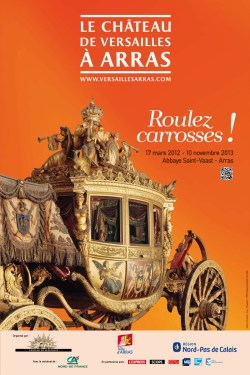 Roulez Carrosses!, the inaugural exhibition of the partnership signed in 2011 between the Château de Versailles, the City of Arras and the Nord-Pas-de-Calais Region, is a landmark event. It is the first French exhibition to be devoted to horse-drawn vehicles. Berlin coaches, royal and imperial carriages from the Versailles collection have all taken the road for Arras, to be admired here until November 2013. The Musée des Beaux-Arts is thus hosting paintings, sculptures, sledges, sedan chairs, horse harnesses and several outstanding carriages such as the coaches of Napoleon I’s marriage procession, Charles X’s coronation coach or the impressive funeral hearse of Louis XVIII. From Louis XIV to the Third Republic, these little-known vehicles will offer a journey through the History of France. Chronologically displayed over 1,000 m², these works are set against a backdrop of innovative scenography combining reconstructions, activities, immersion and multimedia. The exhibition provides an opportunity to discover Versailles and its collections whilst at the same time highlighting the historical links between Arras and the former residence of kings. It will also provide an insight into the operation
and evolution of horse-drawn vehicles.
Curatorship
Béatrix Saule, Director of the Musée National des châteaux de Versailles et de Trianon
Jean-Louis Libourel, Honorary Chief Curator of Heritage
Hélène Delalex, Heritage Conservation Manager at the Château de Versailles
◊ ◊ ◊ ◊ ◊
As Didier Rykner judges in his review for The Art Tribune (24 September 2012) . . .

Sedan Chair for the King’s House Versailles, Musée national des châteaux de Versailles et de Trianon Photo : RMNGP/G. Blot
Even if it is much longer than the usual three-month period, this is a true exhibition, not a lineup of works; it is accompanied by a beautiful scholarly catalogue on a subject which is not often studied; it does not replace the display of the permanent collections as the exhibition rooms occupy the space acquired at the Saint-Vast Abbey; it does not deprive visitors going to the lending museum from seeing major works there since the Musée des carrosses (a rather exaggerated term given the usual presentation conditions) is rarely open to the public; and, above all, it will result in enduring benefits for the coach collection as well as for the Musée des Beaux-Arts itself. . . .
The museum staging by Frédéric Beauclair is very well done. Paintings, sculptures and drawings round out the presentation of the carriages illustrating their use, the way they functioned and the context in which they were produced. Visitors will also discover some little-known works. . . .
The full review is available here»
◊ ◊ ◊ ◊ ◊
Eight short videos accompany the exhibition:
◊ ◊ ◊ ◊ ◊
From the Château de Versailles bookshop:
Béatrix Saule, ed., Roulez Carrosses! Le Château de Versailles à Arras (Paris: Skira Flammarion, 2012), 256 pages, ISBN: 9782081278172, 40€.
 Roulez carrosses! is the first exhibition in France devoted to horse-drawn coaches and carriages and, in this case, historical examples, all totally luxurious in every detail and all different: carriages for the outings of the children of Louis XVI, a sumptuous berline for the wedding of Napoleon I, the hearse of Louis XVIII, the coronation coach of Charles X, etc. Other outstanding masterpieces from the collections of Versailles accompany them: a series of paintings by Van der Meulen, major royal portraits, or unique vehicles like these fantasy sledges in which Louis XV and then Marie-Antoinette were pulled over the snow-covered walks of the park of Versailles. This book describes episodes from the political history of the palace, dynastic events and customs of the court, narrated and commented on here by eminent historians. Fans of handsome horse-drawn vehicles will discover the grand coaches for ceremonial occasions – from the “modern coach” invented in the reign of Louis XIV to the coaches for state ceremonies of the presidents of the Republic – along with their technical innovations, the refinement of their accessories and the extreme lavishness of their ornamentation, at a time when the art of French coach-building was at its apogee.
Call for Papers | Exotic Goods in France and the U.S., 1700-2000
In the spring at NYU’s Center for International Research in the Humanities and Social Sciences:
Objects From Abroad: The Life of Exotic Goods in France and the United States
New York University, 25 April 2013
Proposals due by 31 December 2012
The development of material studies and consumption studies, of anthropology of the material world and the material culture of art history shows growing interest for the material dimension of pictures and goods. This perspective calls attention to the physical and social life of things. In this sense, our conference looks to analyse the production of goods and their transformation, in connection with their various uses and contexts. A historiography focusing on the construction of international spaces and exchanges through the movements of things, goods, merchandises and artworks is currently on its way.
This conference would like to concentrate on the goods imported in France and the United States between the 18th and the 20th century, and their existence within their new environment: business or tourist trips, where the exotic objects were collected and gathered in private spaces; scientific expeditions, where “anthropological” artefacts were collected for Western museums. What kind of things and goods were brought back to New York City, Paris, and the other American and French cities – and through cities of many countries – between the 18th and the 20th century? How were they exhibited, put on display, but also converted and updated? We wish to interrogate the life and “career” of goods, their collection and their circulation, as well as the way in which goods acted upon reception societies. What was the impact of these objects on ways to consume, to live, to dress, to create? What about the processes of translation and interpretation that accompanies such uses and appropriation?
Exchanges between Europe and United States were heavy and significant but they are seldom analysed. Therefore they needs to be carefully examined. At the same time, paying attention to these goods is also a way to repopulate these worlds with different actors. Collectors, but also ethnographers, dealers, painters, soldiers: they were all inventing, marketing and consuming these singular things. From this angle, these goods become boundary objects that mobilized and gathered different communities – scientific, commercial, artistic, etc. Around the actors lie various spaces: we would like to observe the large scale movements but also micro-movements and circulations, and also how these goods were set up and displayed in museums as well as in houses. In this sense, this conference tries to link social practices and representations, visual and material cultures, private and public spaces.
Four directions, all connected, could be explored during this conference:
1. Uses and re-uses
Processes of decontextualisation and recontextualisation (collection, re-use, reparation) will focus our attention. How are the objects sold, exposed, reterritorialized? When bought, how are they used? And, when necessary, how are they repaired or redesigned? Rebuilt and recomposed? Through a series of case studies, it may be useful to follow certain objects from the merchant’s shop to the individual interiors, or from the private space to the museum, looking carefully at the hands and
gestures that welcome and transform the goods.
2. Witnesses and souvenirs
Some objects, such as travel souvenirs, have a special memorial function. What kind of memory do they keep? What are they witnessing? How do they tell us an emotion, a narrative, a story or a part of history? This reflection can also be extended to the issue of fake and authenticity, or of hyper-reality, by studying life-casts, prints, or, in some cases, photography.
3. Actors and markets
Objects are taken as part of a chain involving various actors and consumers that need to be identified. Who are the people involved in these exchanges and what are their roles in the invention of these objects? In their updating and marketing? What are the specific issues, circuits and contours of these markets? How do the different actors and consumers use these objects to develop various identities?
4. Fictions and identities
The fourth axis will focus on fiction, disguise, game, and more generally on fictional use. Joanna Sofaer has already shown how the use and representation of some exotic accessories build identities. How do dresses, dishes or accessories related to tobacco, for instance, work on the identity of their owner? How are these objects mobilized and used in the artworld, in private or public spaces, theater plays or paintings?
Paper abstracts (maximum 300 words) and a short bio (maximum 100 words) should be submitted to Noemie Etienne (noemie.etienne@unige.ch) and Manuel Charpy (manuel.charpy@wanadoo.fr) by December 31, 2012.
MetPublications
From MetPublications:

◊ ◊ ◊ ◊ ◊
About MetPublications
MetPublications is a portal to the Met’s comprehensive publishing program. Beginning with nearly 650 titles published from 1964 to the present, this resource will continue to expand and could eventually offer access to nearly all books, Bulletins, and Journals published by the Metropolitan Museum since the Met’s founding in 1870. It will also include online publications.
MetPublications includes a description and table of contents for almost every title, as well as information about the authors, reviews, awards, and links to related Met bibliographies by author, theme, or keyword. Current titles that are in-print may be previewed and fully searched online, with a link to purchase the book. The full contents of almost all other titles may be read online, searched, or downloaded as a PDF, at no cost. Books can be previewed or read and searched through the Google Books program. Many out-of-print books are available for purchase, when rights permit, through print-on-demand capabilities in association with Yale University Press.
Readers may also locate works of art from the Met’s collections that are included within each title and access the most recent information about these works in Collections. Readers are also directed to every title located in library catalogues on WATSONLINE and WorldCat. Please check back frequently for updates and new book titles. MetPublications is made possible by Hunt & Betsy Lawrence.
About the Met’s Publishing Program
From its founding in 1870, the Metropolitan Museum has published exhibition catalogues, collection catalogues, and guides to the collections. Today it is one of the leading museum publishers in the world, and its award-winning books consistently set the standard for scholarship, production values, and elegant design. Each year, the Met produces about thirty exhibition and collection catalogues and general-audience books, as well as informative periodicals such as the quarterly Metropolitan Museum of Art Bulletin and the annual Metropolitan Museum Journal.
Beginning in 2000, the Met developed two groundbreaking online publications: the Heilbrunn Timeline of Art History, with 300 chronologies, 900+ essays, and close to 7,000 works of art written by Museum specialists; and Connections, which offers personal perspectives on works in the collections.
The Met’s print and online publications program will continue to expand in scope in order to reach the broadest possible audience, thus fulfilling its mission to increase public awareness of and appreciation for art, presenting insightful scholarly discussions and diverse Museum voices on works of art, art history, and especially the Museum’s collections and exhibitions.
Art Market | Winter Art & Antiques Fair
Press release from the Winter Fine Art & Antiques Fair:
Winter Fine Art & Antiques Fair, Olympia
Olympia Exhibition Centre, London, 12-18 November 2012
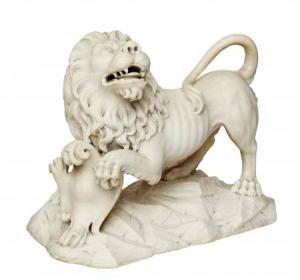
Armorial Lion, with his paw raised upon a cartouche and his tail curled across his back, ca. 1740 (Exhibitor: Hansord)
The Winter Fine Art & Antiques Fair at Olympia, now in its 22nd year, is considered one of the most important annual art and antiques events and is the only fair of its calibre between October and February. Highlights include artworks by Chagall, Miró and Braque, furniture by Trotter, glass by Lalique and even Bond-style accessories alongside silver, glass, jewellery, textiles and clocks for the collector and Christmas shopper. Attracting over 24,000 visitors, the Fair, which opens at 4pm on Monday, November 12, 2012 features around 130 exhibitors in an elegant setting.
Well positioned for buyers furnishing a home or shopping before Christmas, it has become an event in the annual social calendar. The buzzy preview night attracts over 3,000 keen buyers with queues down the road before opening and plenty of red dots and empty glasses at the end of the night. Attendees include Jemima Khan, Jools Holland, Jasper Conran, Bryan Ferry, Nicky Haslam, Sir Paul Smith, Sir David Tang and Sir Peter Blake. Furniture is an important element of the Winter Fair with a number of the UK’s top furniture dealers exhibiting. Wakelin and Linfield brings an early 18th-century English walnut bureau and Hansord will be showing a myriad of interesting objects such as a late 19th-century armchair constructed from timber from Nelsons ship The Foudroyant as well as a rare pair of early 19th century Dutch colonial burgermeisters chair with carved decoration and a fine George III period mahogany partners desk, with original brass swan neck handles and good veneers to the drawer fronts dating from 1775.
Fine Art makes up a good proportion of the fair with prices ranging from the hundreds to the hundreds of thousands. Print specialists Dinan & Chighine has two important sets of prints by Marc Chagall and Joan Miró while Court Gallery brings an oil on card laid on canvas, ‘l’aquarium au verre’, 1944 by Georges Braque. Held in the Vassar College Collection from 1956 until 2012, the work was the first of the artist’s fish bowl series and the motif was repeated many times by him in the 1940s and 50s.
Scottish-based, Victorian picture dealer, Campbell Wilson has an oil on canvas portrait of Isadora Duncan by Paul Swan (1883-1972) signed and dated. The most famous dancer of her time, Isadora is known as the ‘mother of modern dance’. It is for sale for £15,000. Nicholas Bagshawe’s Philip Alexius De Laszlo (1869-1937) portrait of Major Henry Frederick Elliott Lewin was painted during the First World War, and is a fine example of one of 38 portraits that the artist painted in 1915 of officers going to the front, as their families feared they might not return. Ironically after painting these patriotic and poignant portraits, Laszlo was imprisoned for two years in 1917 (at the hands of the very establishment he had been portraying so handsomely) and suffered a nervous breakdown.
For anyone inspired by the latest James Bond film, which will be released in late October, Hampton Antiques have several items that could leave you shaken and stirred. A very rare Art Deco ‘Smokers Companion, in the form of a stylised aeroplane, manufactured in Germany by J.A. Henckels in the late 1920s.This wonderfully rare smokers companion has a cigar box in the fuselage, a pair of removable cigarette cases in the wings, a set of four ashtrays housed in the cockpit, behind a match safe with removable cover and striker. A very simple but very stylish touch is provided by the propeller which is sprung and serves as a cigar cutter, the clippings drop into undercarriage. It has its original plated finish, with gilded interior to cigar receptacle, cigarette cases and ashtrays will be offered at £6,500. A chromium plated, 1960 Rolls-Royce decanter in the shape of a radiator with ‘Spirit of Ecstasy’ Silver Lady will be offered, while a chrome Bugatti Spirit Decanter with a super red enameled Bugatti badge and black grill, all incased around a single glass decanter has an asking price of £775.
Japanese specialist Laura Bordignon Antiques will be bringing a selection of Japanese ivories, bronzes and works of art from the Meiji Period. These include a Japanese silvered bronze okimono of an eagle, signed Seiya saku, dating from the Meiji period. The BADA (British Antique Dealers Association) are also holding a lecture titled, The Flamboyant Mr Chinnery: An Artist in India and China. At a time when the West’s eyes are looking towards China and India this lecture, given by Patrick Conner, reminds us of how 200 years ago one wayward genius, George Chinnery, interpreted through his brush the turbulent times of imperial expansion and the Opium Wars in the region.
The fair will have a strong section devoted to clocks and barometers, which in this current economic times can be a shrewd investment as they are seen as machines, so therefore exempt from Capital Gains Tax. Richard Price & Associates will be offering a Louis XVI white marble, bronze and ormolu mantel clock, dating from circa 1780, while Alan Walker Barometers will be displaying an impressive and very unusual aneroid barometer by Negretti & Zambra of London, dating from 1915. The barometer is in a mahogany case, made from timber removed from HMS Empress – a seaplane carrier during World War 1, having been refitted in 1914 from a cross-channel steamer.
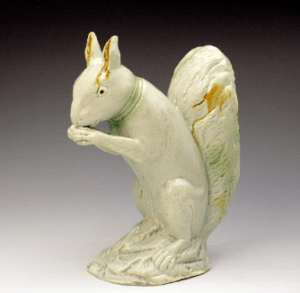
Staffordshire creamware model of a seated squirrel eating a nut, ca. 1775 (Exhibitor: John Howard)
Amongst the smaller objects such as silver, ceramics and glass; Paul Bennett will be exhibiting two exceptional pieces dating
from the 17th century. A continental silver-mounted carved coconut cup, dating from circa 1680 and inscribed by maker BA measures 10½inches tall, while a William and Mary flagon, made in 1694 in London by Frances Garthorne, weighs 51ounces and measures 12¾ inches high. Oxfordshire-based John Howard, who specialises in Early English ceramics, will be bringing a Staffordshire creamware model of a seated squirrel eating a nut. Measuring 8 inches high, the delightful squirrel dates from circa 1775 and will have an asking price in the region of £4,750. Meissen specialist, Alexandra Alfandary brings a Meissen vase, dating from circa 1880, and measuring 36cm high. It is a very unusual shape with ‘pâte-sur-pâte’ decoration to front showing a Centaur with a female on horseback.
For visitors searching for a one-of-a-kind Christmas present, many of the exhibitors will have interesting suggestions. Geoffrey Breeze Antique Canes has a cane inspired by Darwin’s Origin of the Species. Dating from 1870, the cane comprises a palm wood shaft with silver collar with a carved handle depicting an ape holding a human skull. There is a button on the handle, which makes the ape turn his head and open his mouth.
◊ ◊ ◊ ◊ ◊
From the Fair’s website:
Patrick Conner — The Flamboyant Mr Chinnery: An English Artist in India and China
Olympia Exhibition Centre, London, 15 November 2012
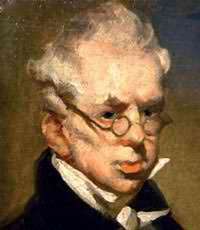 At a time when the West’s eyes are looking towards China and India, this year’s BADA Lecture, given by Patrick Conner, reminds us of how 200 years ago one wayward genius, George Chinnery (1774-1852), interpreted through his brush the turbulent times of imperial expansion and the Opium Wars in the region.
Chinnery enjoyed a double career in the Far East. Leaving wife and children behind in Ireland he sailed in 1802 to India where he rose to become the principal artist of the Raj. He had a successful studio, an Indian mistress and a huge appetite for curry. Then, hounded by creditors he fled to the China coast. Unable to make the voyage home, he lived on for another 27 years in Canton and Macau. Here he sketched and portrayed all those around him – the captains, the opium traders, the Chinese and the Westerners. Chinnery left a vivid pictorial legacy of
the key players at a time of immense change.
A former Keeper of Fine Art at the Royal Pavilion and Museums, Brighton, Patrick Conner is a Director of the Martyn Gregory Gallery, London, specialists in historical paintings related to the China Trade. A widely published author, his latest book is The Hongs of Canton. In his lecture Patrick will give a fascinating insight into the important historical period when Chinnery was active.
Lecture ticket price: £45 including lecture followed by a 2-course lunch with wine provided by Mosimann’s Winter Brasserie. To book for this event email Anne Green or call on +44 (0)20 7581 5259.
Art Institute of Chicago Unveils LaunchPad
AIC press release (29 October 2012) . . .
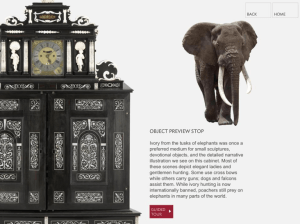 The Art Institute of Chicago’s Department of Digital Information and Access and the Department of European Decorative Arts are pleased to unveil a new gallery interactive that revolutionizes the museum experience while improving public access to art. LaunchPad is a specially developed platform for the iPad—containing engaging and interactive multimedia resources—that brings three-dimensional objects to life. With the new LaunchPads in the galleries, visitors have at their fingertips basic introductory facts about works of art enhanced by animations, brief video documentaries on techniques and use, and views of the works not possible in the galleries alone.
Drawers open, music plays, and objects are assembled and re-assembled right in front of visitors—lending great insight to the original contexts, uses, and construction of works of art from the 16th through the 19th centuries. The new technology and visualization tools will debut on October 28, 2012 with more than 50 objects featured on 25 iPads installed in the Eloise W. Martin Galleries of European Decorative Arts. LaunchPad will also be stationed at 16 kiosks throughout the new Jaharis Galleries of Ancient, Roman, and Byzantine Art when those galleries open to the public on November 11. With this effort, the Art Institute of Chicago becomes one of the first museums to offer such extensive scholarly and entertaining content—more than 1000 supporting images, 16 videos, and behind-the-scenes glimpses into context and conditions of production of works of art—on a custom platform rooted in the gallery experience.
 “The decorative arts in a museum have always presented something of a challenge,” said Douglas Druick, President and Eloise W. Martin Director of the Art Institute of Chicago. “These objects—chairs, cabinets, tableware—were originally designed to be used but must now be protected so they can be preserved. We are thrilled that we can present these intricate objects in a much richer context through the creative use of technology, thanks to the generosity of Melinda Martin Sullivan and the Eloise W. Martin Legacy Fund. And we are confident that the LaunchPad platform and the resources it contains will be a model not only
for other galleries here at the Art Institute but for other
museums as well.”
“LaunchPad has truly been a collaborative effort involving no fewer than 71 professionals across the museum and beyond,” said Sam Quigley, project leader for LaunchPad and vice president for collections management, imaging, and information technology. “Working so intimately with Ghenete Zelleke, Samuel and M. Patricia Grober Curator in the Department of European Decorative Arts, and her colleagues, along with videographers, editors, photographers, and researchers has been a monumental, and monumentally satisfying, effort. And our hope is that similar institutions may take up LaunchPad as a model; with our development partners at IMA Labs of the Indianapolis Museum of Art and Sandbox Studios, we have been committed to making this an open source platform so that others may benefit from, and build on, what we have developed.”
More than two and a half years in development, LaunchPad will offer visitors the chance to get up close to some of the centuries-old objects in the Art Institute’s collection and discover their hidden stories through several innovative technologies. Users will be able to virtually “handle” objects, turning them over to examine the exquisite artistry on each and every side, through advanced 360-degree imaging. And animated videos of works such as the magnificent multi-chambered Augsburg Cabinet will allow users to open doors and drawers and see the beautiful carvings in the interiors and the pharmaceutical tools and bottles that are stored inside.
For the LaunchPad platform, teams at the museum have additionally created more than a dozen videos that focus on the skilled craftsmanship that went into making the pieces, providing an intimate view into the actual processes and techniques behind these objects. One such film captures Patrick Edwards, one of very few Americans trained in traditional 18th-century French marquetry, or wood inlay, recreating sections of an intricate coffer by André Charles Boulle in his San Diego studio— without a power tool in sight. Another video records two artists, one from the School of the Art Institute’s ceramics department, fashioning a replica of an earthenware vase step by step, from throwing to painting to glazing.
With its host of unique resources—which even includes an 18th-century recipe for rabbit stew for the museum’s rabbit-shaped porcelain tureen—LaunchPad will enhance visitors’ experience and appreciation of the museum’s rich holdings of European decorative arts and offer a model for creating the most productive intersection possible between the technology of today and the creative expression of the past.
LaunchPad was designed and written by staff from numerous departments at the Art Institute of Chicago. Its open source software was developed by IMA Labs at the Indianapolis Museum of Art with project coordination and management by Sandbox Studios of Minneapolis, Minnesota. The software is based on the TAP project, which is a collection of free and open source tools supporting the creation and delivery of mobile tours.
LaunchPad was originally conceived for the galleries of European Decorative Arts by Melinda Martin Sullivan and was created with a grant from her late mother, Eloise W. Martin.
Call for Papers | Risk, Crisis, Speculation, 1500-1800
The upcoming Santa Barbara conference on Risk, Crisis, and Speculation is supported — at least for Santa Barbara graduate students — with an course on the subject from the English Department:
ENGL 231: Early Modern Risk (Fall 2012) (Graduate)
Inspired by the ‘Speculative Risk’ programming of last year, this course will pursue the topic of risk in early modern England. In most contemporary discussions of the topic, risk is correlated with modernity. In this course we will address the emergence of some modern conceptions of risk in early modern economic practice and political theory. We will also explore premodern cognates to the notion of risk in concepts like chance and hazard, contingency and calculation, uncertainty and exposure to loss. In our inquiry into early modern risk, we will read More’s Utopia, Bacon’s New Atlantis, book two of Spenser’s Faerie Queene, Marlowe’s Doctor Faustus, and Shakespeare’s Merchant of Venice and The Winter’s Tale. In the course of our conversation we will also touch on the thought of Aristotle, Augustine, Luther, Hobbes, Blumenberg, Derrida, and Butler as we discuss topics ranging from utopian desire and societal engineering to the rise of speculative capitalism and insurance, from the dangers of maritime trade and metaphors of shipwreck to moral philosophy and the technologies of the self, from the hazards of transformative reading and religious conversion to hospitality, affective calculation, and the madness of decision.
While the topic is framed with a grounding in the sixteenth and seventeenth centuries, the conference extends the theme into the eighteenth century, too.
◊ ◊ ◊ ◊ ◊
Risk, Crisis, Speculation, 1500-1800
Early Modern Center at the University of California, Santa Barbara, 9 February 2013
Proposals due by 2 December 2012
The Early Modern Center at the University of California, Santa Barbara is pleased to announce our twelfth annual conference, Risk, Crisis, Speculation, 1500-1800, which will take place in the McCune Conference Room, HSSB 6020, on Saturday, February 9, 2013. Our keynote speaker for this year’s conference is Professor Joseph Roach (Yale University). This year’s conference is being hosted in conjunction with a one-day UC multi-campus research group “(w/Shakespeare)” symposium on “Shakespeare & Risk,” which will take place on UCSB’s campus on Friday, February 8th, and feature keynote speaker Professor Richard Halpern (New York University). Conference attendees and presenters are cordially invited to attend both Friday’s and Saturday’s events.
Contemporary discussions of ‘risk’ or ‘speculation’ often identify these concepts as distinguishing features of modern or postmodern societies. In this conference, we seek to explore and investigate early modern English cognates, forebears, and analogues of ‘risk’ (including, but not limited to, ‘hazard’ and ‘venture’). We hope for a range of presentations investigating religious, economic, political, or environmental aspects of risk in early modern literature and history.
Possible topics include, but are not limited to: maritime trade and the rise of insurance; mathematics and the early history of probability; civic and political crises and governmental intervention; environmental and social crises (plague, famine, etc.) and their ‘management’; gambling, play, and games of chance; erotic and romantic exposure; religious reform and upheaval; conversion and the specter of apostasy; hermeneutics and reading; the stigma of print and publication; violence and the vulnerability of the body.
Please send abstracts, 250-500 words in length, to EMCconference@gmail.com by December 2, 2012. Feel free to contact Christopher Foley at EMCfellow@gmail.com with specific questions.
Museum News | Serena Urry and Esther Bell Move to Cincinnati
The Cincinnati Art Museum has just announced two appointments: Serena Urry as Chief Conservator and Esther Bell as Curator of European Painting, Sculpture and Drawings. Bell completed her Ph.D. at the Institute of Fine Arts, New York University, writing on “Charles-Antoine Coypel: Painting and Performance in Eighteenth-Century France,” under the direction of Mariët Westermann and Mark Ledbury. The press release as noted at ArtDaily (30 October 2012) . . .
◊ ◊ ◊ ◊ ◊
The Cincinnati Art Museum announced Serena Urry as Chief Conservator. Before coming to the Cincinnati Art Museum, Serena served as Senior Conservator of Paintings at the Barnes Foundation, preparing its Impressionist and Post-Impressionist collection for the historic move to downtown Philadelphia. Prior to that, Serena was Conservator of Paintings at the Detroit Institute of Arts where she conserved paintings ranging in date from the 14th to the 20th century. Among the exhibitions she worked on were American Beauty (2002-2004) and Masterpieces from the Detroit Institute of Arts at TEFAF in 2005.
Serena has a B.A. from Tufts University, and a M.A. in art history and a diploma in Conservation from the Institute of Fine Arts of New York University. She was awarded a residency by the Rockefeller Foundation in Bellagio in 1996, and a fellowship by Save Venice in Venice in 1999-2000. She has lectured and published about many of the conservation projects she has undertaken. “We are so excited to have somebody of Serena’s experience and insights joining the Art Museum. She will be able to build on the terrific work past Chief Conservators have done to make our art shine forth in all its beauty,” says Cincinnati Art Museum Director Aaron Betsky. Serena grew up in the Boston area and holds dual American and Italian citizenship. She has six nephews and nieces in an extended family that stretches from East cost to the West. Serena looks forward to exploring all that Cincinnati has to offer.
 The Cincinnati Art Museum also announced Esther Bell as Curator of European Painting, Sculpture and Drawings. Esther received her doctorate from the Institute of Fine Arts, New York University with a specialization in 17th- and 18th-century European art. She received a Masters in the history of art at Williams College and a bachelor of arts from the University of Virginia. With over ten years of experience in some of the nation’s finest museums, Dr. Bell has worked at the Sterling and Francine Clark Art Institute, Williamstown, MA; the Metropolitan Museum of Art, New York; and the Morgan Library & Museum, New York. At the Morgan, she recently organized exhibitions such as Ingres at the Morgan and Rembrandt’s World: Dutch Drawings from the Clement C. Moore Collection.
Dr. Bell lived extensively in Paris during her graduate work; she was a Fulbright Scholar with an affiliation at the Musée du Louvre, Paris and a Theodore Rousseau Fellow in Paris in association with the Metropolitan Museum of Art. She has delivered lectures in many distinguished international venues such as the University of St. Andrews, Scotland; the Musée des Beaux-Arts, Nantes; and the Metropolitan Museum of Art, New York, and she has published numerous articles and exhibition catalogues. “Esther brings an enthusiasm to her art history that is positively electrifying. She combines thorough knowledge and expertise with the desire to have everybody share her love of art, and we look forward to her contributions here,” says Cincinnati Art Museum Director Aaron Betsky. Esther is a self-proclaimed “foodie” and enjoys travel, reading fiction, and yoga. She will move to Cincinnati with her husband, Jason, and they look forward to exploring Blue Grass music, Graeter’s, and the local contemporary art scene.
Conference | Domes: Past, Present, and Future
From the Architecture, Space and Society Network:
Domes: Past, Present and Future
Cinema, Birkbeck School of Arts, London, 29 November 2012
A symposium exploring continuities and ruptures in the use and meanings of the dome across periods and media.
• Peter Draper, Visiting Professor of History of Architecture, Birkbeck
The Early Exploration of Domes: Typology, Symbolism and Decoration
• Caspar Pearson, Lecturer, Department of Art History and Theory, University of Essex
From Renaissance Urbanism to the Urban Renaissance: Domes and the Making of Cultural History
• Barry Curtis, Emeritus Professor of Visual Culture, Middlesex University, and London Consortium
Utopian Domes: Buckminster Fuller and ‘Spaceship Earth’
• Nick Lambert, Lecturer in Digital Art and Culture, Department of History of Art and Screen Media, Birkbeck
From the CAVE to Fulldome: Virtual Space Returns to its Roots
This event is free, but booking is required.










 Enfilade
leave a comment