New Title | Anatomy and the Organization of Knowledge
From Pickering & Chatto:
Matthew Landers and Brian Muñoz, eds., Anatomy and the Organization of Knowledge, 1500–1850 (London: Pickering & Chatto, 2012), 272 pages, ISBN: 978-1848933217, £60/$99.
 Across early modern Europe, the growing scientific practice of dissection prompted new and insightful ideas about the human body. This collection of essays explores the impact of anatomical knowledge on wider issues of learning and culture. The contributors argue that the study of anatomy directly influenced the way in which emerging disciplines of study were organized.
◊ ◊ ◊ ◊ ◊
C O N T E N T S
Introduction – Matthew Landers
Part I: The Body as a Map
1 Early Modern Dissection and a Physical Model of Organization – Matthew Landers
2 ‘Who Will Not Force a Mad Man to be Let Blood?’ Circulation and Trade in the Early Eighteenth Century – Amy Witherbee
3 Earth’s Intelligent Body: Subterranean Systems and the Circulation of Knowledge, or, The Radius Subtending Circumnavigation – Kevin L Cope
4 ‘After and Unwonted Manner’: Anatomy and Poetical Organization in Early Modern England – Mauro Spicci
5 Subtle Bodies: The Limits of Categories in Girolamo Cardano’s De subtilitate – Sarah Parker
Part II: The Collective Body
6 Mirroring, Anatomy, Transparency: The Collective Body and the Co-opted Individual in Spencer, Hobbes and Bunyan – Nick Davis
7 From Human to Political Body and Soul: Materialism and Mortalism in the Political Theory of Thomas Hobbes – Ionut Untea
8 Visualizing the Fibre-Woven Body: Nehemiah Grew’s Plant Anatomy and the Emergence of the Fibre Body – Hisao Ishizuka
9 Forms of Materialist Embodiment – Charles T Wolfe
Part III: Bodies Visualized
10 Visualizing Monsters: Anatomy as a Regulatory System – Touba Ghadessi
11 Anatomy, Newtonian Physiology and Learned Culture: The Myotomia Reformata and its Context within Georgian Scholarship – Craig Ashley Hanson
12 Art and Medicine: Creative Complicity between Artistic Representation and Research – Filippo Pierpaolo Marino
13 The Internal Environment: Claude Bernard’s Concept and its Representation in Fantastic Voyage – Jérôme Goffette and Jonathan Simon
Early Registration for CAA 2013 Now Open
The best rates — via Early Registration — for CAA in New York are available until December 14. Posted at CAA News (23 October 2012) . . .
◊ ◊ ◊ ◊ ◊
 This week CAA will begin mailing Conference Information and Registration, which provides important details, instructions, and deadlines for attending and participating in the 101st Annual Conference, to all individual and institutional CAA members. Nonmembers and those wanting a digital file now can download a PDF of the booklet. The conference will take place February 13–16, 2013, in New York.
Following sections on registration and CAA membership, Conference Information and Registration describes travel, lodging, and transportation options and explains the basic processes for candidates seeking jobs and employers placing classifieds and renting booths and tables in the Interview Hall. In addition, the publication lists topics for eleven Professional-Development Workshops. If you want to connect with former and current professors and students, consult the Reunions and Receptions page. The booklet includes paper forms for CAA membership, conference registration, workshops, special events, and mentoring enrollment.
The contents of Conference Information and Registration also appear on the conference website, which is being updated regularly between now and the February meeting. You may also choose to join CAA and register online.
The Burlington Magazine, November 2012
The eighteenth century in The Burlington:
The Burlington Magazine 154 (November 2012)
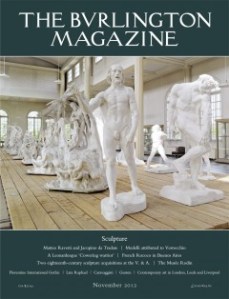 A R T I C L E S
• Marjorie Trusted, “Two Eighteenth-Century Sculpture Acquisitions for the Victoria and Albert Museum, London,” pp. 773-79. Two marble sculptures, a Crouching Venus by John Nost (1702) and a relief of Julius Caesar Invading Britain by John Deare (1796), have been acquired by the Victoria and Albert Museum, London.
• Gauvin Alexander Bailey, “French Rococo Prints and Eighteenth-Century Altarpieces in Buenos Aires,” pp. 780-85. French Rococo designs used in altarpiece decorations in eighteenth-century Buenos Aires.
R E V I E W S
• Philip Ward-Jackson, Review of Stefano Grandesso and Laila Skjøthaug, Bertel Thorvaldsen, 1770–1844 (Milan: Silvana, 2010), pp. 798-99.
• Mark Stocker, Review of Mary Ann Steggles and Richard Barnes, British Sculpture in India: New Views and Old Memories (Kirstead, Norfolk: Frontier Publishing, 2011), pp. 800-01.
• Christopher Baker, Review of the exhibition and catalogue The English Prize: The Capture of the Westmorland, an Episode of the Grand Tour (2012), pp. 817-18.
Conference | Furniture History Society Research Seminar
Furniture History Society Research Seminar
The Wallace Collection, London, 23 November 2012
The concept of this event is to present current studies of research on furniture history, design, construction, conservation and the history of interiors by MA and PhD students, and museum/heritage curators and professionals at an early stage of career development. The seminar will provide useful insights into current trends of research in the educational and museum world. Each talk will last 15 minutes with questions immediately after.
◊ ◊ ◊ ◊ ◊
10.00 Coffee
10.30 Adriana Turpin (Chairman of the Tom Ingram Memorial Fund Committee), Introduction
10.40 Mia Jackson (PhD student Queen Mary, University of London), André-Charles Boulle as a Collector of Prints and Drawings
11.00 Antonia Brodie (PhD student Queen Mary, University of London), A Room of One’s Own? Unlocking the Closet 1650-1730
11.20 Wolf Burchard (PhD student Courtauld Institute of Art/ Curatorial Assistant The Royal Collection), Charles Le Brun: Unity and Hierarchy in the ‘Visite du Roy aux Gobelins’
11.40 Naomi Luxford (post-doctoral research fellow University College London), Has it Changed? Is it Damaged? A Study of Veneer and Marquetry Surfaces
12.00 Elizabeth Bisley (MA, Assistant Curator Furniture Textiles & Fashion, V&A), Painted Decoration and the Cultures of Imitation: Study of an Eighteenth-Century Tyrolean Cupboard
12.20 Shari Kashani (MA, Christies Furniture Department London), Imitation/Presentation: Some Observations on Médalliers and Coquillers in Eighteenth-Century France
12.45 Lunch
2.00 Barbara Lasic (Assistant Curator, Europe: 1600-1800 gallery project, V&A), Salon Tales: A Set of Mid-Eighteenth-Century Panelling Depicting the Fables of Aesop in the Collections of the Victoria and Albert Museum
2.20 Peter Nelson Lindfield-Ott (PhD student University of St Andrews), Georgian Gothic Furniture: A New Pathway to Interpreting British Gothic Furniture, 1740-1840
2.40 David Oakey (MA, Assistant to the Surveyor of the Queen’s Works of Art), Henry Holland and Furniture
3.00 Diana Davis (PhD student the Wallace Collection& University of Buckingham), Wily Brocanteurs: Retailing Curiosity in the Regency
3.20 Christopher Maxwell (PhD student Glasgow University with the Virtual Hamilton Palace Trust), The Dispersal of the Furniture from the Hamilton Palace Collection
3.40 Myriam Tondeur (PhD student, University of Sorbonne), The Architects and Creators of Furniture in the Belgian Modernism Movement of the 1920s
4.00 Closing Remarks from the Chair, followed by tea and coffee
Any ticket booking queries should be addressed to Clarissa Ward, FHS Grants Secretary, 25 Wardo Avenue, London SW6 6RA, tel. 0207 384 4458, email grantsfhs@gmail.com.
Organised by the Tom Ingram Memorial Fund Committee with generous support of the Oliver Ford Trust.
Supporting HECAA: Dues and Contributions via PayPal
From the President
After some remarkable digital wrangling by our treasurer, Jennifer Germann, we are once again able to receive HECAA dues via PayPal! So, if you’re a regular reader, please consider making a contribution to the Historians of Eighteenth-Century Art & Architecture. The organization needs your financial support to pursue its mission, an important part of which includes modest grants for graduate students through the Vidal and Wiebenson Awards. For current members, now is a good time to send in your dues for 2013 (just $20/$5 for graduate students), and if you didn’t pay dues for 2012, please consider making an additional contribution (also easily done via PayPal). You may also pay by mailing Jennifer a check, as directed on the membership page.
Anyone interested in the eighteenth century is welcome as a HECAA member. So if you’re reading, consider joining!
— Michael Yonan
Display | 700th Anniversary of Edward III
While hardly an obvious inclusion for Enfilade, this small exhibition at Windsor includes several eighteenth-century sources. The coat of arms of Edward on display, for instance, comes from the sketchbook of Henry Emlyn (1729-1815), the architect and supervisor of George III’s restoration of the chapel (SGC M.172). John Anstis’s 1724 Black Book, or Register of the Order (SGC RBK DL.13 volume I) is also on view. These and similar items serve as reminders of the historiographical and antiquarian importance of the period. -CH
◊ ◊ ◊ ◊ ◊
From the College of St George:
King Edward III Anniversary
St George’s Chapel, Windsor, 19 June 2012 — 3 January 2013

St George’s Chapel, Windsor Castle
◊ ◊ ◊ ◊ ◊
2012 marks the 700th anniversary of the birth of Edward III at Windsor Castle. Born on 13 November 1312, the first son of Edward II and Isabella of France, Edward III became King of England at the age of fourteen, in January 1327, on the abdication of his father.
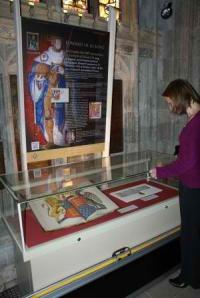 His reign, lasting fifty years, was dominated by war with Scotland and France, which has led to him being chiefly remembered as a warrior. However, it also saw great building projects, the evolution of the English parliament, the establishment of English as the official language and the longest period of domestic peace in Medieval England. Edward III had a long and close relationship with Windsor. Having been born in the Castle, he was baptised here on 16 November 1312, in St Edward’s Chapel, built by his ancestor Henry III in around 1240 and subsequently rededicated by Edward III to St Mary the Virgin, St George the Martyr and St Edward the Confessor. Several of his children were born at Windsor, and it was here that his Queen Consort, Philippa, died in 1369.
In commemoration of the 70oth anniversary of Edward III’s birth at Windsor, an exhibition of documents, rare books and artefacts from the St George’s Chapel Archives and Chapter Library will be on display in the South Quire Aisle of the
Chapel from 19 June 2012 to 3 January 2013.
The four exhibition cases and explanatory panels cover the following themes:
• Edward III as King
• Edward III and Windsor
• Edward III and St George’s Chapel
• Edward III and the Order of the Garter
Together they illustrate key aspects of the life of this great English king and explore his relationship with Windsor, which he was to make the spiritual home of his new chivalric order, the Order of the Garter, founded here in or shortly before 1348.
Exhibition | Almost Real Art: A Satirical Archaeology of the RA
From the Royal Academy:
Almost Real Art: A Satirical Archaeology of the RA Collections and Library
Royal Academy of Arts, London, 1 November 2012 — 17 February 2013

Mark Hampson, The Remarkably Talented Thomas Gainsborough, 2012, mixed media © Mark Hampson
Since 2010, artist Mark Hampson has been working ‘in residence’ at the Royal Academy and from his studio in Kent on a collaboration with the RA Collections, Library and Archives. Exploring the RA’s holdings during this two-year period, he has created a satirically inspired ‘archaeological’ response to its complexities of information and histories. The resulting work exploits and distorts the ‘official’ biography of the RA, corrupting the apparent facts to produce newly imagined narratives that are rooted in the lives and works of some of the great artists who have been connected with the Academy.
Hampson’s imaginings take concrete form in a series of mock-historical artworks combining image and text, made in collaboration with commercial sign-makers. Alongside these, the artist offers up alternative versions of art societies, unions and academies that encourage us to ask why places like the RA exist, how its history has shaped it, and how different it might have been had it been subjected to other influences and ideas. Registering the enormous impact that individual personalities have had on the institution, he explores the clichéd image of the Romantic artist as eccentric, obsessive and self-mythologising. Throughout, however, Hampson’s satire is balanced by a deep affection for the institution and those who have made it, a feeling which has only grown the deeper he has probed its history.
Bringing together high and folk art, the fairground and the museum, history and anachronism, fact and fakery, Hampson has produced what he describes with characteristic ambiguity as ‘almost real art’.
Artist’s Talks
Tuesday 4 December 2012
Tuesday 5 February 2013
Mark Hampson gives an informal introduction to his work.
Meet at 3:30 pm in the Tennant Gallery. Free with an exhibition ticket.
Call for Papers | American Association for Italian Studies Conference
The complete Call for Papers is available at the conference website:
American Association for Italian Studies
University of Oregon, Eugene, 11-14 April 2013
Proposals due by 15 November 2012
We are pleased to invite you to join the forthcoming 2013 AAIS Conference that will be hosted by the Department of Romance Languages at the University of Oregon in Eugene, OR on April 11–14, 2013. The AAIS (American Association of Italian Studies) gathers scholars and intellectuals who conduct research in Italian literature and more broadly contribute to the study of the different aspects of Italian society and artistic production, including its influence on other cultures.
We envision next year’s conference as an opportunity for a stimulating and fruitful exchange of ideas and expertise that will span not only the different periods of Italian literature, but also related areas of scholarship such as art, art history, history, philosophy, music, photography, etc. We look forward to seeing you next April. For more information on the American Association for Italian Studies, please visit the AAIS website.
Conference | National Trust Libraries: Mobility and Exchange
National Trust Libraries: Mobility and Exchange in Great House Collections
Gonville and Caius College, Cambridge, 1 February 2013
Hosted by the University of Cambridge Centre for Material Texts
This one-day event will take as its starting point the recent opening to wider research of a number of significant great house private libraries in the United Kingdom, thanks to the on-going cataloguing work being undertaken by the National Trust. Papers and discussion will treat themes including the migration of books and ideas in and out of libraries; communities of the library (how ‘private’ was a private library?); libraries as repositories of cultural history. Attendance is free, but registration is required. Please contact Dunstan Roberts (dcdr2@cam.ac.uk) or Abigail Brundin (asb17@cam.ac.uk) for more information.
◊ ◊ ◊ ◊ ◊
Some background from the Centre for Material Texts at Cambridge:
National Trust Libraries: Pilot Project at Belton House, Lincolnshire
The National Trust owns and manages over 150 properties in the UK that contain collections of books, the majority still housed in the buildings where they were assembled and read by their original owners. Between forty and fifty of the libraries in National Trust properties have been described as being of ‘major national significance’ (Purcell and Shenton, 2005), constituting an unparalleled resource for the study of the history of private book ownership in the United Kingdom. The process of cataloguing the major libraries is ongoing, and the results are being made available to researchers on the COPAC Catalogue as they become available. This pilot study showcases the research potential of these exciting collections, which form an important part of our national cultural heritage.
The study investigates the place of Italian books in an English great house, Belton House in Lincolnshire. Belton houses the Trust’s second largest library (over 11,000 titles), assembled by successive generations of the Brownlow family, and the collection has now been fully catalogued. 229 works are in Italian, published between 1500 and 1800, across a variety of genres and subjects. Analysis of the Italian holdings will form the basis for two themed workshops. The first, to be hosted by the CMT in Cambridge in the summer of 2012, will explore the curatorship of great house libraries, in discussion with the curators themselves. The second, to be held at Belton early in 2013, will explore the theme of cultural mobility in the early modern library, considering the social, cultural and intellectual histories of continental books in English collections. An exhibition of Italian books will be held at Belton, displaying the connections between book and place for a general audience.
The PI for this project is Abigail Brundin (Department of Italian). The RA is Dunstan Roberts.
Update (15 June 2012): The AHRC has just awarded us a Research Networking Grant in relation to this project… more information to follow.
Call for Papers | The Paris Fine Art Salon, 1791-1881
From the University of Exeter:
The Paris Fine Art Salon, 1791-1881
University of Exeter, 4-6 September 2013
Proposals due by 25 January 2013
Keynote speakers: Susan Siegfried (University of Michigan), Pierre Vaisse (University of Geneva), and Richard Wrigley (University of Nottingham)
The Paris Fine Art Salon dominated French artistic life throughout the nineteenth century. Organised by the State, and usually lasting between two and three months, the Salon was an annual or biennial showcase for the contemporary visual arts and a conspicuous manifestation of French artistic hegemony. It provided artists with the most important opportunity available to present their work to the public, attract a clientele, launch and sustain a career, and compete for state honours and prizes, and public and private buyers and commissions. For the public it was a huge social and cultural event, attracting hundreds of thousands of visitors from across Europe and beyond.
The conference will coincide with the completion of a three-year, AHRC–funded project, entitled Painting for the Salon? The French State, Artists and Academy, 1830-1852. The participants in the project, Professor James Kearns (Principal Investigator), Dr Alister Mill (Research Fellow) and Harriet Griffiths (doctoral candidate) will each present elements of their research at the beginning of the second day, which will be devoted to the period 1830-1852. The first day will be devoted to the period 1791-1830, the third to 1852-1881.
We invite proposals for papers which explore issues and ideas centred around the Paris Salon as an artistic and cultural event in the period 1791-1881. Areas that may be considered include the Salon’s importance for the careers of the exhibiting artists, its relationship to other exhibition spaces in Paris and the provinces, its management by the State, the shifting role of the Académie des Beaux-arts and/or the Salon jury, viewing conditions in the Salon, the impact of changes in Salon management on such issues as participation rates and stylistic innovation, and the exhibition’s significance as a social as well as artistic event. Please email James Kearns at J.Kearns@exeter.ac.uk with a title and 150-word abstract of your proposed 20/25-minute paper by 25 January 2013.
Conference papers to be delivered in either English or French.










 Enfilade
leave a comment