Call for Papers | Risk, Crisis, Speculation, 1500-1800
The upcoming Santa Barbara conference on Risk, Crisis, and Speculation is supported — at least for Santa Barbara graduate students — with an course on the subject from the English Department:
ENGL 231: Early Modern Risk (Fall 2012) (Graduate)
Inspired by the ‘Speculative Risk’ programming of last year, this course will pursue the topic of risk in early modern England. In most contemporary discussions of the topic, risk is correlated with modernity. In this course we will address the emergence of some modern conceptions of risk in early modern economic practice and political theory. We will also explore premodern cognates to the notion of risk in concepts like chance and hazard, contingency and calculation, uncertainty and exposure to loss. In our inquiry into early modern risk, we will read More’s Utopia, Bacon’s New Atlantis, book two of Spenser’s Faerie Queene, Marlowe’s Doctor Faustus, and Shakespeare’s Merchant of Venice and The Winter’s Tale. In the course of our conversation we will also touch on the thought of Aristotle, Augustine, Luther, Hobbes, Blumenberg, Derrida, and Butler as we discuss topics ranging from utopian desire and societal engineering to the rise of speculative capitalism and insurance, from the dangers of maritime trade and metaphors of shipwreck to moral philosophy and the technologies of the self, from the hazards of transformative reading and religious conversion to hospitality, affective calculation, and the madness of decision.
While the topic is framed with a grounding in the sixteenth and seventeenth centuries, the conference extends the theme into the eighteenth century, too.
◊ ◊ ◊ ◊ ◊
Risk, Crisis, Speculation, 1500-1800
Early Modern Center at the University of California, Santa Barbara, 9 February 2013
Proposals due by 2 December 2012
The Early Modern Center at the University of California, Santa Barbara is pleased to announce our twelfth annual conference, Risk, Crisis, Speculation, 1500-1800, which will take place in the McCune Conference Room, HSSB 6020, on Saturday, February 9, 2013. Our keynote speaker for this year’s conference is Professor Joseph Roach (Yale University). This year’s conference is being hosted in conjunction with a one-day UC multi-campus research group “(w/Shakespeare)” symposium on “Shakespeare & Risk,” which will take place on UCSB’s campus on Friday, February 8th, and feature keynote speaker Professor Richard Halpern (New York University). Conference attendees and presenters are cordially invited to attend both Friday’s and Saturday’s events.
Contemporary discussions of ‘risk’ or ‘speculation’ often identify these concepts as distinguishing features of modern or postmodern societies. In this conference, we seek to explore and investigate early modern English cognates, forebears, and analogues of ‘risk’ (including, but not limited to, ‘hazard’ and ‘venture’). We hope for a range of presentations investigating religious, economic, political, or environmental aspects of risk in early modern literature and history.
Possible topics include, but are not limited to: maritime trade and the rise of insurance; mathematics and the early history of probability; civic and political crises and governmental intervention; environmental and social crises (plague, famine, etc.) and their ‘management’; gambling, play, and games of chance; erotic and romantic exposure; religious reform and upheaval; conversion and the specter of apostasy; hermeneutics and reading; the stigma of print and publication; violence and the vulnerability of the body.
Please send abstracts, 250-500 words in length, to EMCconference@gmail.com by December 2, 2012. Feel free to contact Christopher Foley at EMCfellow@gmail.com with specific questions.
Museum News | Serena Urry and Esther Bell Move to Cincinnati
The Cincinnati Art Museum has just announced two appointments: Serena Urry as Chief Conservator and Esther Bell as Curator of European Painting, Sculpture and Drawings. Bell completed her Ph.D. at the Institute of Fine Arts, New York University, writing on “Charles-Antoine Coypel: Painting and Performance in Eighteenth-Century France,” under the direction of Mariët Westermann and Mark Ledbury. The press release as noted at ArtDaily (30 October 2012) . . .
◊ ◊ ◊ ◊ ◊
The Cincinnati Art Museum announced Serena Urry as Chief Conservator. Before coming to the Cincinnati Art Museum, Serena served as Senior Conservator of Paintings at the Barnes Foundation, preparing its Impressionist and Post-Impressionist collection for the historic move to downtown Philadelphia. Prior to that, Serena was Conservator of Paintings at the Detroit Institute of Arts where she conserved paintings ranging in date from the 14th to the 20th century. Among the exhibitions she worked on were American Beauty (2002-2004) and Masterpieces from the Detroit Institute of Arts at TEFAF in 2005.
Serena has a B.A. from Tufts University, and a M.A. in art history and a diploma in Conservation from the Institute of Fine Arts of New York University. She was awarded a residency by the Rockefeller Foundation in Bellagio in 1996, and a fellowship by Save Venice in Venice in 1999-2000. She has lectured and published about many of the conservation projects she has undertaken. “We are so excited to have somebody of Serena’s experience and insights joining the Art Museum. She will be able to build on the terrific work past Chief Conservators have done to make our art shine forth in all its beauty,” says Cincinnati Art Museum Director Aaron Betsky. Serena grew up in the Boston area and holds dual American and Italian citizenship. She has six nephews and nieces in an extended family that stretches from East cost to the West. Serena looks forward to exploring all that Cincinnati has to offer.
 The Cincinnati Art Museum also announced Esther Bell as Curator of European Painting, Sculpture and Drawings. Esther received her doctorate from the Institute of Fine Arts, New York University with a specialization in 17th- and 18th-century European art. She received a Masters in the history of art at Williams College and a bachelor of arts from the University of Virginia. With over ten years of experience in some of the nation’s finest museums, Dr. Bell has worked at the Sterling and Francine Clark Art Institute, Williamstown, MA; the Metropolitan Museum of Art, New York; and the Morgan Library & Museum, New York. At the Morgan, she recently organized exhibitions such as Ingres at the Morgan and Rembrandt’s World: Dutch Drawings from the Clement C. Moore Collection.
Dr. Bell lived extensively in Paris during her graduate work; she was a Fulbright Scholar with an affiliation at the Musée du Louvre, Paris and a Theodore Rousseau Fellow in Paris in association with the Metropolitan Museum of Art. She has delivered lectures in many distinguished international venues such as the University of St. Andrews, Scotland; the Musée des Beaux-Arts, Nantes; and the Metropolitan Museum of Art, New York, and she has published numerous articles and exhibition catalogues. “Esther brings an enthusiasm to her art history that is positively electrifying. She combines thorough knowledge and expertise with the desire to have everybody share her love of art, and we look forward to her contributions here,” says Cincinnati Art Museum Director Aaron Betsky. Esther is a self-proclaimed “foodie” and enjoys travel, reading fiction, and yoga. She will move to Cincinnati with her husband, Jason, and they look forward to exploring Blue Grass music, Graeter’s, and the local contemporary art scene.
Conference | Domes: Past, Present, and Future
From the Architecture, Space and Society Network:
Domes: Past, Present and Future
Cinema, Birkbeck School of Arts, London, 29 November 2012
A symposium exploring continuities and ruptures in the use and meanings of the dome across periods and media.
• Peter Draper, Visiting Professor of History of Architecture, Birkbeck
The Early Exploration of Domes: Typology, Symbolism and Decoration
• Caspar Pearson, Lecturer, Department of Art History and Theory, University of Essex
From Renaissance Urbanism to the Urban Renaissance: Domes and the Making of Cultural History
• Barry Curtis, Emeritus Professor of Visual Culture, Middlesex University, and London Consortium
Utopian Domes: Buckminster Fuller and ‘Spaceship Earth’
• Nick Lambert, Lecturer in Digital Art and Culture, Department of History of Art and Screen Media, Birkbeck
From the CAVE to Fulldome: Virtual Space Returns to its Roots
This event is free, but booking is required.
Call for Essays | The Modern French Interior and Mass Media
Plans for this edited volume grow out of a session from this year’s meeting of the Society for French Historical Studies (March 2012 in Los Angeles). As noted at the Society of Architectural Historians:
Edited Volume: The Modern French Interior and Mass Media
Co-editors: Anca I. Lasc, Georgina Downey, and Mark Taylor
Proposals due by 19 November 2012
We invite papers that focus on the relationship between mass media (broadly defined) and the modern French interior. Since the mid-18th century, a new interest in the modern and comfortable interior, removed from the world of power, staged a gradual dislocation of life away from the court at Versailles and into the city. New patrons and new living spaces inaugurated an unprecedented interest in new building techniques, fashionable tendencies in interior decorating, and new modes of social interaction. With the 19th century, techniques of representing the modern interior witnessed an extraordinary development, enhanced by advances in photography, techniques of color reproduction, and photo-mechanical printing processes. Architectural drawings were complemented by visual representations of the modern interior in prints, books, illustrated journals, private collections, department store catalogs, photographs, guidebooks, and even film. The variety of media employed in representing the modern interior blurred the boundaries between spectacle and privacy, collecting and decorating, the fine and the decorative arts, the domestic and the commercial spheres. Possible topics include, but are not limited to:
– The invention, display, and commercialization of the modern French interior
– The modern interior and technologies of reproduction
– Privacy and publicity in the modern interior
– Mass media – advice and consumption for the home
– Visual and textual narratives of the spectacular or the tasteful interior
– The gendering and politicization of private space as mediated through representational techniques
– Advertising and selling Empire, Art Nouveau, or Art Deco interiors
– The exhibition as a new mass medium for displaying the private interior
– New representational strategies for staging the modern French interior in fine and/or commercial art
– The modern French interior, the studio, and the performed self: artists, ateliers and apartments
– The modern French interior and sexuality: dandies and divas
Please submit a 500-600 words abstract and a short C.V. to Anca I. Lasc (alasc@ship.edu), Georgina Downey (georgina01@adam.com.au) and Mark Taylor (Mark.Taylor@newcastle.edu.au).
Call for Papers | The Substance of Sacred Place
From the Kunsthistorisches Institut in Florenz:
The Substance of Sacred Place: An Interdisciplinary Workshop on Locative Materiality
Kunsthistorisches Institut in Florenz – Max-Planck-Institut, Florence, 20-21 June 2013
Proposals due by 30 November 2012
Organised by Laura Veneskey and Annette Hoffmann
The study of holy places has long been a central concern of not only the humanities, but also the social sciences. Much of this body of scholarship has focused on pilgrimage and sacred centers, either as theoretical constructions or as concrete places, such as Jerusalem, Mecca or Benares. These subjects have been explored, on the one hand, through the study of ritual and liturgy, and on the other, through various modes of representation, be they architectural, cartographic, iconic, or textual. Complementary to these lines of inquiry, we invite papers that explore the material and tactile dimensions of locative sacrality across religious traditions. How is a sense of place communicable through physical means? What can a consideration of matter tell us about the often fraught relationship between the tangible world and its representation?
We seek analyses of all materials evocative of a particular sacred milieu, not only earth, dust, stone, but also wood, metal, pigments, oil, or water. Presentations exploring either the substances and places themselves or textual and iconic depictions thereof are equally welcome. We invite papers from all disciplines on any locale conceived of as sacred, whether scriptural, pilgrim, monastic, ascetic, or cultic, between antiquity and the early modern period. The workshop is aimed at young researchers, and is intended to bring together graduate students, postdoctoral scholars, and those in the early stages of their teaching or professional careers. Possible topics include, but are not limited to:
– Sacred landscapes (deserts, mountains, caves, etc.)
– The material dimensions of topographic representation (iconic or textual)
– Earthen, geographic, and locative relics
– Transportable versus site-specific sanctity
– The physicality of built environments and places of worship
Interested applicants should send a current c.v. and an abstract of no more than 250 words (for presentations of twenty minutes) to hoffmann@khi.fi.it and lv2308@columbia.edu). Proposals must be received by date 30th November 2012.
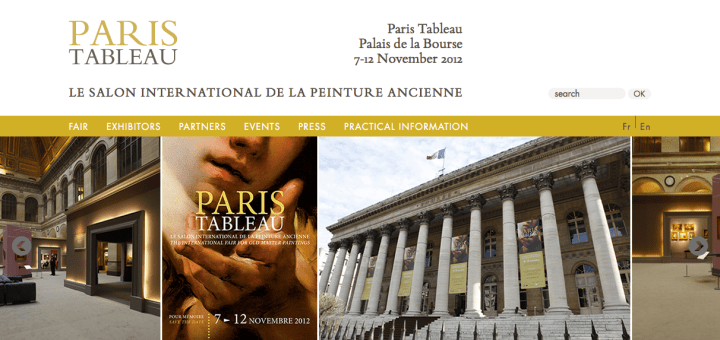
Art Fair | Paris Tableau 2012
Paris Tableau: The International Fair for Old Master Painting
Palais de la Bourse, Paris, 7-12 November 2012
◊ ◊ ◊ ◊ ◊
Building on the success of its first edition in 2011, Paris Tableau 2012 will again open its doors at the Palais de la Bourse from 7 to 12 November 2012. Paris Tableau attracted over 6,000 serious collectors and sold sixty major paintings within just five days in November last year, and the ten dealer/organisers look forward again to sharing their passion for Old Master Paintings with international connoisseurs and enthusiasts in 2012. The work on display at Paris Tableau ranges from the Middle Ages to the Second Empire.
The full press package is available as a PDF here»
Call for Papers | Mapping Discursive Geographies
Graduate Student Conference: Mapping Discursive Geographies
University of Arizona, Tucson, 1 February 2013
Proposals due by 20 November 2012
The Art History Graduate Student Association at the University of Arizona is pleased to announce its twenty-third annual symposium, Mapping Discursive Geographies, which will take place February 1, 2013 at the University of Arizona Student Union, Santa Rita Room. The keynote speaker for this year’s symposium is Dr. Stella Nair from the University of California, Los Angeles.
The goal of this symposium is to explore the relationship between geography and art, art history, and curatorial practices, within the context of recent scholarship on natural and artificial landscapes, landscape aesthetics, earth works, land preservation and degradation, hybridities of art and science, disputed and fraught boundaries, the distribution of resources, and immigration. This symposium hopes to provide a forum to address how geography is a cultural process which can be instrumental in the formation of identity.
Some ideas to consider are: how do national and social identities become inscribed in the terrain? How do visual representations of terrestrial and corporeal spatiality construct meaning? How have shifts in geographies changed the production, exhibition, and/or consumption of artistic, curatorial practices and art historical discourse? Paper topics may include, but are not limited to:
1. Site specificity, locality, and intervention
2. Construction of mythology and symbolism in the landscape
3. National/corporeal identities
4. Physical or intangible borders between nations/individuals and issues of ownership and sovereignty
5. Commercialization, consumerism, and tourism
6. Historic and contemporary cartographic or locational practices
Graduate students in art history and relating disciplines are invited to submit a 300-word abstract and curriculum vita to AHGSA.org@gmail.com by November 20, 2012. Applicants will receive notification via email of the committee’s decisions by December 12, 2012. To learn more about the Art History Graduate Student Association at the University of Arizona, please visit www.cfa.arizona.edu/ahgsa/.
New HGCEA Emerging Scholar Publication Prize
HGCEA Emerging Scholar Publication Prize
Nominations due by 14 December 2012
The Historians of German and Central European Art (HGCEA), an affiliated society of CAA, announces a new Emerging Scholar Publication Prize. The Prize will be awarded annually to a distinguished essay published the previous year by an emerging scholar. Submissions may be on any topic in the history of German or Central European art, architecture, design or visual culture. This year, essays published in 2011 and 2012 will be considered; submissions will be accepted from current PhD students and from those who earned a PhD in or after 2007. The recipient of the Prize, which will be announced at CAA and comes with an award of $500, must be a current member of HGCEA. Nominations and self-nominations are welcome; the deadline for submissions (the publication and a CV) by electronic attachment to the HGCEA president, Marsha Morton at mortonmarsha10@gmail.com, is December 14, 2012.
Exhibition | Nude Men in Vienna
With the advertising for this exhibition having been covered sensationally by the international press, the focus on contemporary work has obscured the late eighteenth-century offerings. Press release from the Leopold Museum:
◊ ◊ ◊ ◊ ◊
Nude Men from 1800 to the Present / Nackte Männer
Leopold Museum, Vienna, 19 October 2012 — 28 January 2013
Curated by Elisabeth Leopold and Tobias Natter
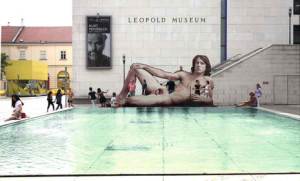
Ilse Haider, Mr. Big, installed at the Leopold Museum
The endless flood of images intrinsic to today’s lifestyle has given unprecedented public prominence to the depiction of male nudes. At the same time seemingly firmly established categories such as masculinity, body, and nakedness are apparently being redefined on a broad social basis, resulting in a new interpretation of male gender roles. These developments have prompted the Leopold Museum to embark on a topical as well as historical journey through the visual arts in search of the male nude, a quest leading predominantly from the longing for antiquity prevalent in art around 1800 to contemporary art. The exhibition Naked Men: Power & Powerlessness through the Ages also represents the fulfillment of the museum’s long-cherished ambition to present a counterpart to the highly successful 2006 exhibition Body – Face – Soul curated by Elisabeth Leopold, which explored the female image in art from the 16th century to the present. Thus, the current presentation constitutes a continuation of this theme, except that its focus is now on the opposite sex.
The exhibition Naked Men: Power & Powerlessness through the Ages is based on works by Egon Schiele, Richard Gerstl and Anton Kolig – three artists who are more comprehensively represented in the Leopold Museum than in any other institution and in whose oeuvre the depiction of the male nude features prominently. Schiele’s male nudes can be seen as unconditional explorations of the self, as expressions of inner emotions and as body images situated between vulnerability and provocation. Gerstl followed the tradition of Christian iconography with the first of his two life-sized self-portraits, while he elevated the fragmentation of form to a principal in the second with his wild brushstrokes. Kolig was captivated by the depiction of naked young men all his life and dedicated his drawings almost exclusively to this motif.
Based on eminent examples from its own collection and complemented by loaned works from all over Europe, the Leopold Museum’s exhibition will set out in two main directions, examining the depiction of the male nude in contemporary art, while also exploring the Old Masters’ approach to the subject from the Renaissance all the way back to antiquity. The exhibition unites examples of many different genres, including painting, sculpture, graphic arts, photography and new media, with special emphases on the following themes:
The Measure of All Things: The Male Body and Art Academies
Ever since the Renaissance, the naked male body was considered to be an important object of study and an indispensable part of the academies’ curriculum, which was one of the reasons that women were denied access to art academies for so long. The presentation affords insights into the life drawing rooms of European art academies from the Baroque period onwards and illustrates to what an extent all eyes were focused on the naked man, though he himself was the only one to remain naked.
Longing for Antiquity and the Male Ideal
For centuries, the depiction of the male nude was only legitimized by ancient art. These restrictions prompted the emergence of various artistic strategies that reinterpreted ancient ideals under the guise of antiquity. This is illustrated in the exhibition with examples from the period around 1800 up until the present.
The Naked Self
While Klimt still believed that nakedness and truth coincided in the Nuda Veritas, Schiele began to make his own body the object of his paintings. Expressionism brought with it a radical examination of the self, which saw the artists exposing themselves both physically and existentially and exploring the use of their own nudity as a sphere of political influence.
In the Sights of Women
The battle of female desire and male denial is not often addressed in the visual arts, but it has its historical sources both in the biblical story of Joseph and the Wife of Potiphar and in the ancient mythological traditions of Narcissus and Adonis. The emancipation of women as artists has brought with it a new basis for the depiction of such conflicts. Nowadays, female artists also have access to male nude models and are free to interpret and depict this motif at their will, currently often with a view to deconstructing gender and gender asymmetries.
Bathers — On the Beach
In the second half of the 19th century depictions of naked people in nature abounded. These renderings had their origin in a reassessment of man’s position in nature. Based on early depictions such as Dürer’s The Men’s Bath, the exhibition features many eminent examples of such encounters and get-togethers of naked men, from Cézanne to Mapplethorpe.
◊ ◊ ◊ ◊ ◊
In the United States, the English edition of the catalogue will be distributed by The University of Chicago Press:
Catalogue: Elisabeth Leopold and Tobias Natter, eds., Nude Men from 1800 to the Present (Vienna: Hirmer, 2013) ISBN: 9783777458519, $50.
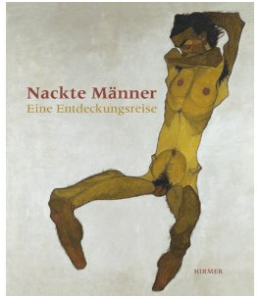 Rodin’s Thinker. Da Vinci’s Vitruvian Man. Pigalle’s controversial portrayal of the philosopher Voltaire. From its earliest days, art history is rife with representations of nude men. But while there is no shortage of studies of art celebrating the female form, the male nude has suffered from relative neglect. This book seeks to correct this imbalance with a collection of paintings, sculptures, and photographs that challenge conceptions of the body and masculinity, many of which continue to have considerable cultural resonance today.
Beginning with a look at art completed in life-drawing classes popular across European academies, the book moves on to representations of masculinity throughout the French Revolution, including works by Johann Heinrich Füssli and Antonio Canova; provocative Sturm und Drang paintings by Edvard Munch and contemporaries; and late impressionist works. The unsettling self-portraits of Austrian artists Egon Schiele and Richard Gerstl exemplify an extreme candor that characterized the early twentieth century. Other twentieth-century artists whose work is included in this book are Jean Cocteau, David Hockney, Andy Warhol, Nan Goldin, and Louise Bourgeois.
With nearly four hundred full-color illustrations, the book also includes insightful essays examining topics like male identity, depictions of desire in modern art, and the use of nude men in advertising.
◊ ◊ ◊ ◊ ◊
Note (added 2 February 2013) — The sensational coverage is likely to continue. As reported by the AFP, viewers are invited to step out of their own clothes for a special viewing on February 18, “Our museum will be a clothes-free zone for one evening. . . Nudists, naturists are welcome!”
Call for Papers | Material Culture Studies in Three Dimensions
From The Center for Material Culture Studies at the University of Delaware:
Embodied Objects: Material Culture Studies in Three Dimensions
Winterthur Museum, Garden & Library, 20 April 2013
Proposals due by 30 November 2012
 The Center for Material Culture Studies at the University of Delaware invites submissions for papers to be given at the Eleventh Annual Material Culture Symposium for Emerging Scholars.
The objects we create, manipulate, and consume mediate our experience with the world. We seek a broad range of papers that highlight the intersection between objects and humans, things and people. We’re interested in how three-dimensional objects act as extensions of ourselves, provide repositories for memory, help stabilize identity, interrupt our sense of scale and space, give permanence to relationships, and mirror human forms. Papers may also address how objects mediate human sensory experience and create aesthetic meaning. We encourage papers that reflect upon and promote an interdisciplinary discussion on the state of material culture studies today.
Disciplines represented at past symposia include American studies, anthropology, archaeology, consumer studies, English, gender studies, history, museum studies, and the histories of art, architecture, design, and technology. We welcome proposals from graduate students, postdoctoral scholars, and those just beginning their teaching or professional careers.
Format
The symposium will consist of nine presentations divided into three panels. Each presentation is strictly limited to eighteen minutes, and each panel is followed by comments from established scholars in the field. There will be two morning sessions and one afternoon session, with breaks for discussion following each session and during lunch. Participants will also have the opportunity to tour Winterthur’s unparalleled collection of early American decorative arts and to engage in a roundtable discussion on Friday, April 19. Travel grants of up to $300 will be available for presenters.
Submissions
The proposal should be no more than 300 words and should clearly indicate the focus of your object-based research, the critical approach you take toward that research, and the significance of your research beyond the academy. While the audience for the symposium consists mainly of university and college faculty and graduate students, we encourage broader participation. In evaluating proposals, we will give preference to those papers that keep a more diverse audience in mind.
Send your proposal, with a current c.v. of no more than two pages, to emerging.scholars@gmail.com. Proposals must be received by 5 p.m. on November 30, 2012. Speakers will be notified of the vetting committee’s decision in January 2013. Confirmed speakers will be asked to provide symposium organizers with digital images for use in publicity and are required to submit a final draft of their papers by March 11, 2013.
Conference Co-Chairs: Liz Jones and Amy Torbert










 Enfilade
leave a comment