Call for Papers | Visual Culture of Gastronomy, 16th–20th Century
From the full Call for Papers, which includes the French Appel à communication) . . .
Visual Culture of Gastronomy, 16th–20th Century
La culture visuelle de la gastronomie, XVIe–XXe siècles
Galerie Colbert, Paris, 18–19 December 2025
Organized by Frédérique Desbuissons and Ryan Whyte
Proposals due by 1 June 2025
This international conference addresses the visual dimension of gastronomy, whose study surpasses traditional disciplinary limits for historical research (Allen Weiss, Déborah L. Krohn, Marcia Reed). In contrast to the logocentric definition that prevails in most of the work on gastronomy of the last century (Jean-Louis Flandrin, Pascal Ory, Priscilla Ferguson, Jean-Robert Pitte), we propose to consider gastronony as a qualitative relationship to food (Julia Csergo) constituted not least by images in their sensory and material manifestation. Whether as visual perception or material representation in the visual arts, printed matter, consumer goods such as games and toys, or popular and mass culture more broadly, images have played an active role in the construction and experience of the “art of eating well” [art de bien-manger] (Brillat-Savarin). Due to their quantity and ubiquity, such images, whether traditional or more often “popular,” are as essential to gastronomy as those of the fine arts, usually more difficult to access due to their socially restricted sites, relative rarity, and elite visual language. Visual culture, far from being subordinated to or dependant on text as mere illustration, commentary or archival record, immediately and directly defines “eating well.” D’abord l’à bord [first of all the on (the) bo(a)rd(er)], in the formula of Jacques Derrida, the very immediacy of gastronomic images defines the perimeters of gastronomy, thereby to furnish foundational models of experience and desire. In this way images, inseparable from other forms of signification, testify to the composite nature of gastronomy.
In the early modern period, the culture of the table began to free itself from both the rules of dietetics and the religious morality stigmatizing sensual pleasures that Louis de Jaucourt, in the Encyclopédie, evoked in defining cuisine as “lust for good food” [cette luxure de bonne chere dont on fait tant de cas], perpetuating its denigration by Michel de Montaigne as the “science of the gullet” [science de gueule] two centuries earlier. Meanwhile, banquets abandoned the ostentatious symbolism that prevailed before the Renaissance. Cuisine became a product of intellectual exchange in which images played a key role, including frontispieces and other images for cookbooks, reference books and other works relating to domestic economy. In urban spaces, images of consumer products were disseminated in the form of shopsigns, window displays, and trade cards. In France, on the eve of the Revolution, “eating well” no longer necessarily meant eating to maintain physical and moral health according to the precepts of medicine and religion, but also eating good things, with the right table setting, in an appropriate environment, and in good company. All these dimensions of table culture are described, not without irony, in the poem of Joseph de Berchoux, “Gastronomy: Or the Rural Philosopher Dines” [La gastronomie, ou l’homme des champs à table] (1801), whose title would furnish the term for the “art of good cheer” finally accepted by the Académie française in its Dictionary of 1835.
Like the various prints published in successive editions of Berchoux’s poem, images participated in the diffusion of the knowledge, practice, and social imaginary of gastronomy well beyond the narrow social and geographic limits of the table culture of the Old Regime. The multiplication of images and print technologies in the nineteenth century emancipated gastronomy from the houses and restaurants accessible only to those capable of employing the services of great chefs, consuming luxury products, and frequenting good tables. In addition to the fine grocery stores, caterers, and restaurants emblematic of the urban spectacularization of food from the nineteenth century, representations disseminated in books, journals, and posters revealed the labour, implements, stagings, uses, and forms of conviviality once inaccessible to most people.
If images established a new visual regime of gastronomy, they also fixed and standardized norms transcending local and regional variations and facilitating their broader recontextualization. This is why this conference will focus on developments in Europe in the early modern period and following the French Revolution, as well as on other gastronomic cultures and geographies, whether in themselves or operating in the context of colonial empires and other forms of globalization of food products, standards, and practices. How, in particular, may one describe and conceptualize qualitative relationships to food in non-European cultures using emic images and terms rather than the etic discourses of European gastronomy? And how can subaltern communities create visual cultures as vectors of resistance and emancipation, as in the exemplary case of Soul Food? We invite proposals from all disciplines on the visual dimensions of gastronomy, whether international or local, elite or popular. Possible themes include, but are not limited to:
Physiology, psychology
• Food synesthesias
• Ephemeral consumption and visual memory
Presentation, representation, conservation
• Representing taste
• Staging the table
• Gastronomical exhibitions (displays, markets, shop windows, museums and galleries …)
• Museums and heritage
Media and technologies
• Print culture and gastronomy: almanacs, newspapers, magazines, posters, pamphlets, etc.
• Design, packaging, labels
• Food and image technologies
Geographies, spaces, sites
• Perimeters and geographies of the gastronomic image
• Sites of production and consumption: kitchen, pantry, dining room, restaurant
• Empire and gastronomy
Values, customs, ideologies
• Images, egos, personifications: eaters, chefs, critics, gastronomes, servants, merchants
• Moralities of food
• Political and gastronomic economies
• Gastronomic laughter: satire, burlesque, comedy
Please submit proposals in French or English, including an abstract of maximum 700 words and a brief curriculum vitae by 1 June 2025 to frederique.desbuissons@univ-reims.fr and rwhyte@ocadu.ca.
Université Paris 1 Panthéon-Sorbonne / OCAD University, Toronto) / Bibliothèque des Arts Décoratifs
Frédérique Desbuissons (université de Reims) & Ryan Whyte (OCAD University, Toronto)
Scientific Committee
James Benn, McMaster University, Hamilton
Valérie Boudier, université de Lille
Gwenhael Cavanna-Kernemp, Les Arts Décoratifs, Paris
Julia Csergo, Université du Québec à Montréal
Michael Garval, North Carolina State University
Jérémie Koering, Université de Fribourg
Camille Paulhan, École nationale supérieure des Beaux-Arts de Lyon
Bibliographie indicative / Preliminary Bibliography
L’Art de manger. Rites et traditions en Afrique, Insulinde et Océanie, exh. cat. Paris, musée Dapper, 2014–2015.
L’Art gourmand, exh. cat. Bruxelles, Galerie du Crédit communal, 1996–1997.
Atelier + Küche = Labore der Sinne, cat. exp. Hertford, Marta Herford, 2012.
Victoria Avery (ed.), Feast & Fast: The Art of Food in Europe, 1500–1800, exh. cat. Cambridge, Fitzwilliam Museum, 2019
Sylvette Babin (ed.), Eating the Universe : vom Essen in der Kunst, exh. cat. Kunsthalle Düsseldorf, 2009–2011
Kate Baldwin, The Racial Imaginary of the Cold War Kitchen: From Sokol’niki Park to Chicago’s South Side, Chicago, Dartmouth College Press, 2015
Judith A. Barter (ed.), Art and Appetite: American Painting, Culture, and Cuisine, exh. cat. Chicago, Art Institute, 2013–2014.
Daniel Bender (ed.), Food Mobilities: Making World Cuisines, Toronto, University of Toronto Press, 2024
Diane Bodart and Valérie Boudier (ed.), Le banquet de la Renaissance : images et usages, Prédella. Journal of Visual Arts, n° 33, 2013.
Nicolas Bourriaud (ed.), Cookbook. Quand l’art passe à table, exh. cat. Paris, Palais des Beaux-Arts, 2013–2014.
Susan Bright, Feast for the eye. The Story of Food in Photography, New York, Aperture, 2017.
Germano Celant (ed.), Arts & Foods. Rituali da 1851, exh. cat. Milano, Triennale di Milano, 2015.
Germano Celant (ed.), Cucine & Ultracorpi, exh. cat. Milano, Triennale design Museum, 2015.
Julia Csergo, La gastronomie est-elle une marchandise culturelle comme une autre ?, Chartres, Menu fretin, 2016.
Julia Csergo and Frédérique Desbuissons (eds), Le cuisinier et l’art. Art du cuisinier et cuisine d’artiste (XVIe-XXIe siècle), Chartes, Menu Fretin ; Paris, Institut national d’histoire de l’art, 2018.
Jörg Dürrschmidt and York Kautt (eds.), Globalized Eating Cultures: Mediation and Mediatization, Cham (Switzerland), Palgrave Macmillan, 2019.
Zilkia Janer, The Coloniality of Modern Taste: A Critique of Gastronomic Thought, London, Routledge, 2023.
Shana Klein, The Fruits of Empire: Art, Food, and the Politics of Race in the Age of American Expansion, Oakland, University of California Press, 2020.
Jonatan Leer and Karen Klitgaard Povlsen (eds), Food and Media: Practices, Distinctions, and Heterotopias, London, Routledge, 2016.
Nina Levent and Irina D. Mihalache (eds), Food and Museums, London [etc.], Bloomsbury, 2017.
Deborah Lupton and Zeena Feldman (eds) Digital Food Cultures, New York, Routledge, 2020.
Simeon Magliveras (ed.), Odysseys of Plates and Palates: Food, Society, and Sociability, Oxford, Inter-Disciplinary Press, 2015
Marcia Reed (ed.), The Edible Monument: The Art of Food for Festivals, exh. cat.. Los Angeles, The Getty Research Institute, 2015.
Jérémie Koering, Les iconophages, une histoire de l’ingestion des images, Arles, Actes Sud, 2021.
Deborah L. Krohn, Food and Knowledge in Renaissance Italy: Bartolomeo Scappi’s Paper Kitchens, London and New York, Ashgate Publishing, 2015.
Linda Roodenburg, Food is fictie verhalen over voedsel en vormgevin / Food is fiction. Stories about food and design, Rotterdam, nai010 Publisher, 2018.
Nancy K. Stalker (ed.), Devouring Japan: Global Perspectives on Japanese Culinary Identity, New York, Oxford University Press, 2018.
Nelleke Steughels and Peter Scholliers (eds), A Taste of Progress: Food at International and World Exhibitions in the Nineteenth and Twentieth Centuries, London, Ashgate, 2017.
John Varriano, Tastes and Temptations: Food and Art in Renaissance Italy, Oakland, University of California Press, 2009.
Kim M. Williams and Warwick Frost, Gastronomy, Tourism, and the Media, Bristol, Channel View Publications, 2016.
Call for Papers | SAVAH 2025: Practices of Entanglement
From ArtHist.net and the Call for Papers:
Practices of Entanglement
38th Annual Conference of the South African Visual Arts Historians
University of KwaZulu-Natal, Pietermaritzburg, 25–27 September 2025
Proposals due by 11 April 2025
The term entanglement has been widely used in academic discourse across multiple disciplines—postcolonial studies, anthropology, philosophy, art history, physics and beyond. It often refers to the complexity of relationships between histories, cultures, and identities, with Karen Barad extending these ideas to apply to what she calls agential realism, where concepts of entanglement (or intra-action) describe how entities emerge through relationships with other entities, challenging traditional distinctions between subject/object, human/nonhuman.
Nicolas Bourriaud applies entanglement to contemporary art, arguing that artists navigate and intertwine multiple cultural and historical references, making art a process of relational engagement rather than fixed meaning. Achille Mbembe, on the other hand, applies notions of entanglement to postcolonial and decolonial thought, as a means to demonstrate how Africa’s colonial past and present are inextricably linked, producing complex subjectivities and overlapping temporalities. Conceptualisations such as these challenge linear narratives of history and explore how colonial and postcolonial conditions are mutually constitutive.
The concept of entanglement has gained traction in art history, especially in relation to postcolonial theory, global art histories, material culture, and the decolonial turn. Okwui Enwezor’s curatorial work, such as Documenta 11 (2002), foregrounded the idea of art as a site of entangled histories, where space and meaning are in constant negotiation. Mieke Bal proposes that the interplay between visuality and textuality is a fundamental aspect of interdisciplinarity, and this dualism is also central to the discipline of art history, which at its core involves writing about visual things. The tension produced through the entanglement of verbal and visual languages has also been foregrounded since the Practice Turn insisted on the ability of creative practice to produce original knowledge.
The 2025 SAVAH conference aims to pull at these entangled threads and connections in order to begin an untangling that might reveal the richness of the layers in between. In the spirit of creative curiosity, we ask that submissions focus on the many possible questions rather than the conclusions. We welcome provisional research in progress and hope that the conference will be a platform for knowledge sharing and exchange. We also, therefore, welcome submissions that think through some of these webs across disciplines, and are interested in novel research of any kind that extends beyond the themes outlined below.
Abstract submissions could focus on (but are not limited to) the following topics:
• Visual and verbal entanglements: language, image, and knowledge production
• Postcolonial and decolonial art histories
• Materiality and entangled objects
• Entangled histories and temporalities
• Materiality and the making of tntanglements
• Entangled objects, archives, and memory
• Decolonial entanglements and the politics of space
• Curatorial entanglements: exhibitions, practice, and knowledge sharing
• Entangled performances of self and society
• Other novel research and experimental approaches to entanglement
We invite papers and visual presentations from scholars, researchers, and post‐graduate students. Practice-led research is particularly welcome. We also invite contributions from SAVAH members on current research that engages topics not included in this call for papers. Please submit an abstract of 300–400 words via the savah.org.za website by 11 April 2025. Successful applicants will be notified by 30 April 2025. For any queries, please contact conference@savah.org.za.
Graduate Student Seminar | Caricature and the Grotesque
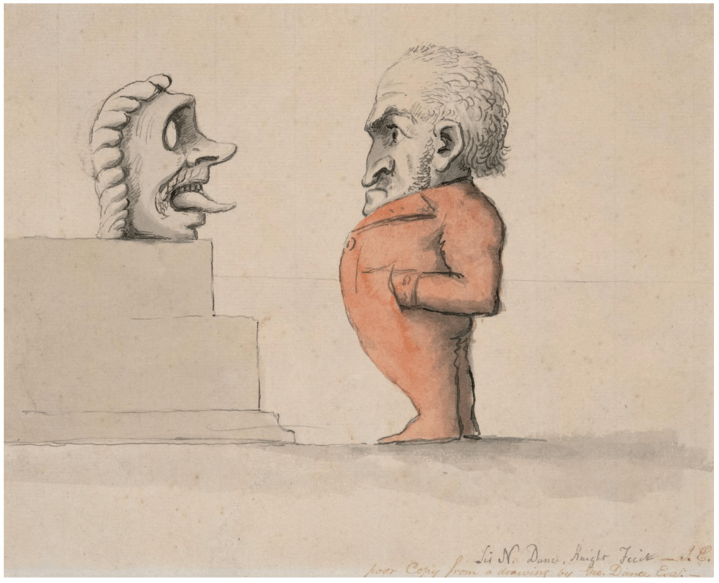
Nathaniel Dance, The Antiquarian, ca.1800, pen, ink, and watercolor.
◊ ◊ ◊ ◊ ◊
The application form is available here:
Caricature and the Grotesque: Early Modern Prints and Politics
Graduate Student Seminar led by Peter Parshall, with Cynthia Roman and Freyda Spira
The Lewis Walpole Library and Yale University Art Gallery, 21–22 May 2025
Applications accepted until 12 May 2025 (with rolling acceptance)
Distortion takes many different forms and plays a role in all artistic traditions. In one sense or another the pictorial response to the world has always shown an inclination to turn things inside out. Our task in this two-day graduate seminar will be to consider this phenomenon as it evolves in the graphic arts from the Renaissance into the early nineteenth century. In this admittedly broad setting we shall concentrate specifically on the use of distortion in political and social contexts, especially in printmaking where the wide and efficient distribution of texts and pictures first became possible. How does the use of caricature, satire, and the grotesque inflect the message of an image? What lies behind its preference for the artist and its appeal to the viewer? Does a potentially ‘popular’ medium like printing inevitably lead to the embrace of the grotesque and a conscious degradation of pictorial rhetoric?
We shall approach these questions through a discussion of original works of art, primarily works available in the Yale University Art Gallery and the Lewis Walpole Library. The main areas of study will be: Renaissance prints and the transformation of the grotesque; the invention of modern caricature with particular attention to anti-Semitism; the flourishing of British caricature in the eighteenth century; William Hogarth and social satire as political argument; and last, Francisco Goya and the relation between realism and fantasy. There will be short readings for each of four sessions held over two consecutive days. The emphasis will be on group discussion conducted as an open forum and inviting all manner of inquiry pertinent to the questions being addressed and the objects at hand.
With space limited to 10 participants, this program is open by application. Applications will be reviewed and successful applicants notified on a rolling basis until 12 May 2025, or until enrollment is filled. This seminar is sponsored by the Lewis Walpole Library, Yale University. Please contact cynthia.roman@yale.edu with questions.
• Peter Parshall, former Jane Neuberger Goodsell Professor of Art and Humanities at Reed College and Curator of Old Master Prints at the National Gallery of Art
• Cynthia Roman, Curator of Prints, Drawings, and Paintings, the Lewis Walpole Library, Yale University
• Freyda Spira, Robert L. Solley Curator of Prints and Drawings, Yale University Art Gallery
Peter Parshall has written and lectured widely on early modern art with special emphasis on the history of prints, the history and the organization of collecting, and Renaissance art theory. He co-authored with David Landau The Renaissance Print (1994), recipient of the Mitchell Prize. Among exhibitions curated are: The Unfinished Print (2001); Origins of European Printmaking (2005) with Rainer Schoch; and The Darker Side of Light: Arts of Privacy, 1850–1900 (2008). Since formal retirement he has pursued several topics of current interest and is presently writing a book on art and politics.
Call for Panels | CAA in Chicago, 2026
From CAA:
114th Annual Conference of the College Art Association
Hilton Chicago, 18–21 February 2026
Panel Proposals due by 25 April 2025
The CAA Annual Conference is the largest convening of art historians, artists, designers, curators, and visual arts professionals. Each year we offer sessions submitted by our members, committees, and affiliated societies that deliver a wide range of program content. The 114th Annual Conference will take place at the Hilton Chicago, 18–21 February 2026. The conference will be held in person with a selection of hybrid sessions and events. CAA leadership, in collaboration with the Annual Conference Committee, is reviewing participant and attendee feedback from the 113th Annual Conference to determine any format adjustments needed for the 2026 program. Please check back regularly for updates and see this page for important information.
t i m e l i n e
March 15: Call for Proposals period begins; submission forms open
April 25: Deadline for CAA114 session, workshop, and presentation submissions
Mid-July: Submitters notified of acceptance or rejection
July: Affiliated Society Business Meeting & Reunion or Reception request forms open
Late July: Call for Participation (CFP) opens
Late August: Deadline for CFP submissions
Mid September: Deadline for chairs of sessions soliciting contributors to make decisions and add to session entry
Early October: Registration opens and conference schedule is announced
December 5: Access accommodation requests for in-person and/or remote participants due to CAA.
February 18–21: Annual Conference
New Book | Jewish Country Houses
From Brandeis UP:
Juliet Carey and Abigail Green, eds., with photography by Hélène Binet, Jewish Country Houses (Waltham, MA: Brandeis University Press, 2024), 300 pages, ISBN: 978-1684582204, $60. Part of the Tauber Institute Series for the Study of European Jewry.
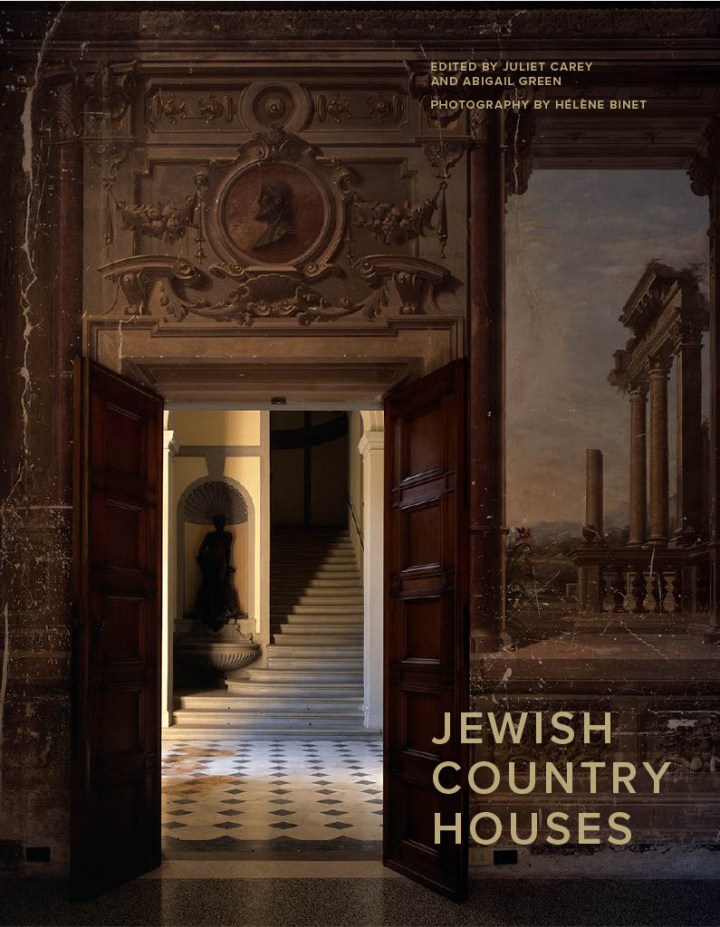 Country houses are powerful symbols of national identity, evoking the glamorous world of the landowning aristocracy. Jewish country houses—properties that were owned, built, or renewed by Jews—tell a more complex story of prejudice and integration, difference and connection. Many had spectacular art collections and gardens. Some were stages for lavish entertaining, while others inspired the European avant-garde. A few are now museums of international importance, many more are hidden treasures, and all were beloved homes that bear witness to the remarkable achievements of newly emancipated Jews across Europe—and to a dream of belonging that mostly came to a brutal end with the Holocaust. Lavishly illustrated with historical images and a new body of work by the celebrated photographer Hélène Binet, this book is the first to tell their story, from the playful historicism of the National Trust’s Waddesdon Manor in Buckinghamshire to the modernist masterpiece that is the Villa Tugendhat in the Czech city of Brno—and across the pond to the United States, where American Jews infused the European country house tradition with their own distinctive concerns and experiences. This book emerges from a four-year research project funded by the UK Arts and Humanities Research Council that aims to establish Jewish country houses as a focus for research, a site of European memory, and a significant aspect of European Jewish heritage and material culture.
Juliet Carey is senior curator at Waddesdon Manor. Abigail Green is an Oxford historian and author of the award-winning Moses Montefiore: Jewish Liberator, Imperial Hero.
◊ ◊ ◊ ◊ ◊
A conversation with the authors will take place at Yale on Monday:
Juliet Carey and Abigail Green | Jewish Country Houses
Yale University, New Haven, 24 March 2025, 4pm
Juliet Carey and Abigail Green will discuss their new book, Jewish Country Houses, which explores these remarkable houses, their architecture and collections, and the lives of the extraordinary men and women who created and transformed them. Moderated by Laurel O. Peterson, Assistant Curator of Prints and Drawings, Yale Center for British Art; the event is cosponsored by the Yale Center for British Art and Yale Jewish Studies Program.
Symposium | Turner Today

J.M.W. Turner, Inverary Pier, Loch Fyne: Morning, detail, ca. 1845, oil on canvas
(New Haven: Yale Center for British Art, Paul Mellon Collection)
◊ ◊ ◊ ◊ ◊
Upcoming at YCBA:
Turner Today
Online and in-person, Yale Center for British Art, New Haven, 9 May 2025
The dramatic landscapes of J. M. W. Turner continue to enthrall audiences across the globe, more than two centuries after the artist’s birth. Organized in conjunction with the Yale Center for British Art’s exhibition J. M. W. Turner: Romance and Reality, this symposium invites scholars and curators from Canada, the United States, and the United Kingdom to explore the multiple ways that Turner’s oeuvre speaks to our present moment, from its relationship to contemporary visual art to its role in framing conversations about climate change and resource extraction. What exciting and new possibilities exist for interpreting and sharing Turner’s work in 2025?
The symposium is free and open to the public. It will be held in the Lecture Hall at the Yale Center for British Art and will be livestreamed. Registration is recommended but not required for this event.
s c h e d u l e
10.15 Welcome and opening remarks by Martina Droth (Paul Mellon Director, YCBA)
10.30 Panel One | Transatlantic Turner: Reputation and Reception
Moderator: Tim Barringer (Paul Mellon Professor of the History of Art, Yale University)
Turner established a significant reputation in North America in his lifetime and still draws considerable attention from American museums. This panel brings together curators from the Frick Collection, J. Paul Getty Museum, and Metropolitan Museum of Art to explore Turner’s transatlantic appeal in the past and present. How has Turner been introduced to, and understood by, American audiences? What factors cemented Turner’s reputation in the United States and how does his storied reputation affect the way we present and represent his work today?
• Julian Brooks (Senior Curator and Head of the Department of Drawings, J. Paul Getty Museum)
• Alison Hokanson (Curator, Metropolitan Museum of Art)
• Aimee Ng (John Updike Curator, Frick Collection)
11.30 Break
11.45 Panel Two | Turner’s Atmospheric Topography
Chair: Lucinda Lax (Curator of Paintings and Sculpture, YCBA)
How are Turner’s paintings being reinterpreted amid current ecological crises? This panel situates Turner’s interest in particular locations, and the specifics of place, within the broader sociopolitical and environmental context of industrialization and natural resource extraction. Curators based in the United States and United Kingdom will discuss how exhibitions of Turner’s work can address contemporary environmental issues and consider how museums can put contemporary works with environmental themes in dialogue with Turner’s paintings.
• John Chu (Senior Curator of Pictures and Sculpture / Senior Curator for Midlands, National Trust)
• Lizzie Jacklin (Keeper of Art, Tyne and Wear Archives and Museums)
• Jennifer Tonkovich (Eugene and Clare Thaw Curator of Drawings and Prints, Morgan Library and Museum)
12.45 Lunch
2.00 Panel Three | Turner, Tradition, and Modern Painting
Chair: Martin Myrone (Head of Research Support and Pathways, Paul Mellon Centre for Studies in British Art, and Convenor, British Art Network)
This panel considers a paradox: Turner is often portrayed as a harbinger of late nineteenth- and early twentieth-century Impressionism and abstraction, yet he made constant and overt reference in his art to major artists of the past. How is Turner being embraced and interpreted as an artist who both self-consciously worked within a longstanding tradition and broke radically with traditional painting practices? How are curators engaging with Turner’s elusive relationship to modernity and tradition? What is Turner’s relevance to contemporary artistic practice?
• Amy Concannon (Manton Senior Curator of Historic British Art, Tate)
• Anni Pullagura (Margaret and Terry Stent Associate Curator of American Art, High Museum of Art)
• Nicholas Bell (President and CEO, Glenbow)
3.00 Closing Remarks and Reflections on J. M. W. Turner: Romance and Reality
• Lucinda Lax (Curator of Paintings and Sculpture, YCBA)
• Tim Barringer (Paul Mellon Professor of the History of Art, Yale University)
Symposium | Art, Museum, Nation
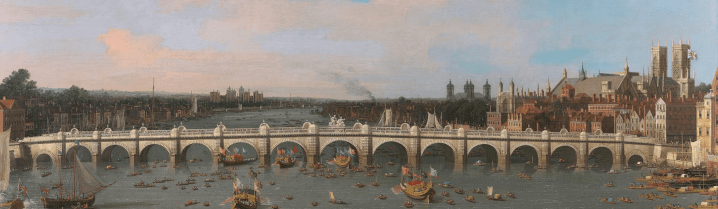
Canaletto, Westminster Bridge, with the Lord Mayor’s Procession on the Thames, 1747, oil on canvas
(New Haven: Yale Center for British Art, Paul Mellon Collection).
◊ ◊ ◊ ◊ ◊
From YCBA:
Art, Museum, Nation
Online and in-person, Yale Center for British Art, New Haven, 25 April 2025
What does it mean to display art through the lens of national identity and history? To mark its reopening, the Yale Center for British Art convenes Art, Museum, Nation, a symposium to critically interrogate the concept of nationhood in contemporary practices of art exhibition, interpretation, and acquisition. In roundtable discussions, leading art historians, curators, and directors from the Art Gallery of Ontario, Metropolitan Museum of Art, and National Gallery, London, among others, will explore how art museums can revise, think beyond, and reinvigorate national frameworks. Among many questions, the symposium will ask: How have expressions of national identity influenced the civic and public role of art museums in both explicit and implicit ways? How might art museums contend with the fluidity of borders and foreground ideas of migration and diaspora? What can art museums do to better acknowledge the traces of colonialism and empire embedded in national collections?
The symposium is free and open to the public. It will be held in the Lecture Hall at the Yale Center for British Art and will be livestreamed. Registration is recommended but not required for this event.
The Yale Center for British Art is pleased to offer a travel stipend for curators and museum professionals who wish to attend this symposium in person and are traveling from within the Boston–New York rail corridor or an equivalent driving distance (approximately 125 miles). If you are facing particular financial barriers to participating and wish to take advantage of this funding, please email your name, position, and travel details to ycba.research@yale.edu before Monday, April 21. Funding is limited and applications will be reviewed on a rolling basis, so apply early!
s c h e d u l e
9.30 Welcome — Rachel Chatalbash (Deputy Director for Academic Affairs, Education, and Research, YCBA)
9.35 Introduction: Reopening the Yale Center for British Art — Martina Droth (Paul Mellon Director, YCBA)
9.45 Keynote Conversation | Art, Museum, Nation: Building Collections Today
Moderator: Lucinda Lax (Curator of Paintings and Sculpture, YCBA)
How can museums serve the needs of both local and international constituents? What does it mean to present a global collection in a national context? Conversely, what should the mission of a national museum be in a globalized world? YCBA curator Lucinda Lax leads a discussion on building and stewarding heritage art collections in the twenty-first century.
• Andrea Bayer (Deputy Director for Collections and Administration at the Metropolitan Museum of Art)
• Christine Riding (Director of Collections and Research at the National Gallery, London)
10.45 Break
11.00 Session 1 | Art, Museum, Nation in Exhibitions and Display
Moderator: Tim Barringer (Paul Mellon Professor of the History of Art, Yale University)
Curators based in Canada, the United Kingdom, and the United States reflect on the potential of exhibitions to advance inclusive and critical definitions of national artistic canons. How are curators using museum display to alter or challenge established ideas of Canadian, British, and American art?
• Patricia Allerston (Deputy Director and Chief Curator, National Galleries of Scotland)
• Horace Ballard (Theodore E. Stebbins, Jr., Curator of American Art, Harvard Art Museums)
• Julie Crooks, Curator (Arts of Global Africa and the Diaspora, Art Gallery of Ontario)
12.00 Lunch Break
1.30 Session 2 | Art, Museum, Nation in the History of Art and Museums
Moderator: Sria Chatterjee (Head of Research Initiatives, Paul Mellon Centre for Studies in British Art)
This conversation looks to the past, addressing how Enlightenment-era ideas of progress and race shaped the construction of public museums in North America and Europe. Discussants will consider the impact of imperialism and scientific racism on modern museum practice and ask what institutions can do to acknowledge and combat these forces.
• Nana Adusei-Poku (Assistant Professor of History of Art and African American Studies, Yale University)
• Andrew McClellan (Professor of History of Art and Architecture, Tufts University)
• Marina Tyquiengco (Ellyn McColgan Associate Curator of Native American Art, Museum of Fine Arts, Boston)
2.30 Break
2.45 Session 3 | Art, Museum, Nation: New Futures
Moderator: Anni Pullagura (Margaret and Terry Stent Associate Curator of American Art, High Museum of Art)
Building on the previous session, the symposium’s closing discussion looks to the future of ‘the nation’ in the art museum. How can the lenses of national identity and history be mobilized toward new and productive ends? What other interpretive frameworks can museums use to complement and complicate ideas of nationality and nationhood?
• Mark Mitchell (Holcombe T. Green Curator of American Paintings and Sculpture, Yale University Art Gallery)
• Stephanie Sparling Williams (Andrew W. Mellon Curator of American Art, Brooklyn Museum)
• Linsey Young (Independent Curator and PhD Candidate, Royal College of Art)
3.45 Closing Remarks — Kishwar Rizvi (Robert Lehman Professor in the History of Art, Islamic Art and Architecture, Yale University)
4.00 Reception
Exhibition | The Declaration’s Journey

Looking to this fall, from the March 11 press release for the exhibition:
The Declaration’s Journey
Museum of the American Revolution, Philadelphia, 18 October 2025 — 3 January 2027
The Museum of the American Revolution today announces new details of its loan acquisitions for The Declaration’s Journey—a special exhibition commemorating the 250th anniversary of the adoption of the Declaration of Independence—related to female activists and suffragists in the 18th and 19th centuries who both touted the Declaration’s progressive ideals and pushed the United States to apply the its promise of equality to women.
On the night of July 4,1776, the first copies of the Declaration of Independence were published at John Dunlap’s printing office, near Second and Market Streets in Philadelphia. The news of independence spread quickly and widely both in the United States and abroad. Though women were not mentioned in the declaration issued by the Continental Congress, they contributed to its proliferation and success. Beginning with Dunlap, printers created broadsides of the Declaration, and they published the text in their newspapers. In July 1776, Mary Katharine Goddard of Baltimore was the only woman running a newspaper under her own name in the newly declared United States. She first published the Declaration in her newspaper, the Maryland Journal, and later also printed broadside copies of the Declaration, the first version to bear the names of the men who signed the revolutionary document. The Declaration’s Journey will feature a rare surviving broadside of the Declaration of Independence printed by Goddard in January 1777, on loan from Brian and Barbara Hendelson.
Throughout the 19th and early 20th centuries, activists fought for women’s rights and cited the words of the Declaration of Independence to advocate for education, temperance, abolition, and especially suffrage. In Seneca Falls, New York, in 1848, 100 men and women signed a Declaration of Sentiments that looked very similar to the Declaration of Independence, with a key difference—it affirmed that “all men and women are created equal.” At the time, women in the United States had few legal, social, and political rights compared to men. Women were not allowed to vote. Only a few state laws allowed them to own property if they got married. They had limited rights in the court system and could not serve in government positions.
Elizabeth Cady Stanton, a skilled writer and orator for the suffrage movement, wrote the Declaration of Sentiments, borrowing its title from the American Anti-Slavery Society while retaining the structure and much of the language from the United States’ Declaration. Of the 68 women who signed the Declaration of Sentiments, only one, Rhoda Palmer, lived long enough to legally vote after nationwide women’s suffrage was achieved in 1918.
The Declaration’s Journey will feature Elizabeth Cady Stanton’s desk used in her house in Tenafly, New Jersey, where she lived from 1868 until 1887. Alongside coauthors Matilda Joslyn Gage, Ida Husted Harper, and Susan B. Anthony, Stanton likely used this desk during the writing process for their History of Woman Suffrage book, which they began working on following the suffragists’ appearance at the Centennial International Exhibition in Philadelphia in 1876. At that appearance, a small group of suffragists including Stanton famously interrupted the proceedings of the Fourth of July celebration at Independence Hall to present their Declaration of Rights of the Women of the United States to Vice President Thomas Ferry. History of Woman Suffrage was later published in 1881.
Coline Jenkins, the great-great-granddaughter of Stanton, will lend the desk to the Museum for the full run of The Declaration’s Journey. Just as Stanton and her fellow activists took advantage of the attention surrounding the Centennial celebration to travel to Philadelphia and champion their cause, Jenkins said she is thrilled to have her ancestor represented through the Museum’s special exhibition celebrating the Semiquincentennial.
“The Declaration’s Journey will be the focus of the nation in 2026,” Jenkins said. “It means a lot to me and to my family to contribute this artifact at such a key time to such a key institution. It was never my family’s interest to have it stored away from the American people. Now, by its inclusion in this special exhibition, the desk can be a tool for Americans to understand where they came from and how to move forward.”
Displayed near Stanton’s desk in The Declaration’s Journey will be the earliest known printing of the Declaration of Sentiments, on loan from the Historical Society of Pennsylvania. The exhibition will also include a ballot box made from blueberry crates that was used in 1868 in a protest organized by Vineland, New Jersey, resident Portia Gage. One hundred and seventy-two local white and Black women cast illegal votes in the ballot box, which will be on loan from the Vineland Historical and Antiquarian Society.
“American women have helped to shape the legacy of the Declaration of Independence over the past 250 years,” said Matthew Skic, Senior Curator at the Museum of the American Revolution. “Stories of revolutionary women such as Mary Katherine Goddard, Elizabeth Cady Stanton, and Portia Gage remind us of the long-standing and continuing struggle to strengthen the American nation’s commitment to equality stated back in 1776.”
Structure of the exhibition:
First Travels, 1776–1783
The exhibition begins with the story of Jonas Phillips, a Jewish merchant in Philadelphia who sent a letter, written in Judeo-German to keep its contents secret, and a Dunlap broadside of the Declaration of Independence to Amsterdam in July 1776. That copy never arrived, as the ship carrying it was captured by a British warship. The letter and Dunlap broadside will be on view along with Phillips’ notes referencing the Declaration’s promise of freedom of conscience—an early example of the emerging meanings credited to the Declaration. Other objects and documents in this introductory section convey how a July 1776 reading of the Declaration led the Mi’kmac and Maliseet communities of New Brunswick and Maine to enter into the first treaty to recognize the U.S. as an independent nation; how the French celebrated the Declaration and helped to announce the U.S. as a nation of the world, available for diplomacy and alliance; and how a small minority, all abolitionists, pioneered the use of the Declaration as an egalitarian document.
A Worldwide Journey, 1780–1830
The story moves abroad to examine how international interpretations of the Declaration of Independence pressured Americans to clarify their own understanding of the founding document, especially its language about equality. The Marquis de Lafayette borrowed language of the Declaration in his “Declaration of the Rights of Man and Citizen” (1789) but clarified language about equality. The Haitian Declaration of 1804, as well as the declarations adopted in Mexico and Chile, pushed and pressured Americans into conversation and conflict over the tensions within their own Declaration’s promise.
A Divided Declaration, 1831–1898
The narrative returns to the United States, exploring the Declaration’s appropriation by abolitionists, suffragists, and Confederate secessionists. Items may include Frederick Douglass’s typescript oration from 1852, best known for the line “What to the American Slave, is your Fourth of July?” and a printing of the Seneca Falls Convention’s Declaration of Sentiments, which launched the modern women’s suffrage movement with the addition of the phrase “and women” to the Declaration’s statement that “all men” are created equal.
Examples of Native American Declarations of Sovereignty and Independence, including Mashpee and Cherokee, show ways that the Declaration’s language was re-fashioned in the 1800s by people described in the original document as “savage.”
The Declaration’s Journey, 1898–Present
In this final section, visitors will see more and more people claim the legacy of the Declaration. At the end of WWI, Czechoslovakia, Korea and six other nations adopted their versions of a declaration of independence and by the mid-1900s, the Declaration was increasingly understood as a fundamental statement of human rights and equality. Martin Luther King Jr.’s 1963 “I Have a Dream,” speech is perhaps the best-known example of this understanding of the Declaration as a far-reaching promise. Visitors will leave the exhibition with an understanding of our Declaration as part of an ongoing revolution, a continuing effort to secure fair government and individual rights for people in the United States and around the world.
The Museum is poised to play a leadership role in the upcoming 250th anniversary of the nation’s founding in 2026. As we continue to transform the nation’s relationship with its Revolutionary past by increasing awareness of the many ordinary, diverse, and little-known people who created the American nation. Through this special exhibit, digital initiatives, and educational programs, we aim to facilitate widespread conversation about the meaning of the American Declaration of Independence and its ongoing legacy.
Journal18, Fall 2024 — Craft
The latest issue of J18 (I’m sorry to be slow with this one! –CH) . . .
Journal18, Issue #18 (Fall 2024) — Craft
Issue edited by Jennifer Chuong and Sarah Grandin
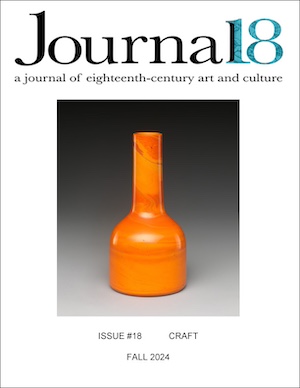 When, where, and why does craft matter? Craft, by definition, is any activity involving manual skill. But in the modern western world, the term typically implies specific kinds of activities that produce specific kinds of objects: things like baskets, lace, and lacquerware. In a culture that has historically privileged rationality and innovation, craft’s commitment to tradition, reliance on haptic knowledge, and association with marginalized subjects have rendered it the minor counterpart to more ‘serious’ forms of material production. As a subsidiary to art and industry, craft has often occupied a circumscribed role in accounts of modern art and modernity’s origins in the eighteenth century. Recently, however, craft—as a more capacious category of material production—has become a crucial term in efforts to expand and diversify the study of eighteenth-century art.
This special issue builds on recent investigations while considering how craft’s ancillary role within the Anglo-European tradition has limited its capacity to transform the field. Drawing inspiration from the absence of an art/craft divide in many cultures, we are interested in exploring craft’s potential to radically reframe, reconceptualize, and globalize the history of art.
a r t i c l e s
Elizabeth Eager — Labor, Leisure, and Lost Time in Eighteenth-Century Women’s Embroidery
Yve Chavez — Eighteenth-Century Loom and Basket Weaving at the California Missions
Hampton Smith — Insurgent Tooling and the Collective Making of Slave Revolts
Natalie E. Wright and Glenn Adamson — Encyclopædia Materia: Material Intelligence and Common Knowledge
Julie Bellemare, N. Astrid R. van Giffen, and Robert Schaut — Hot Tempered: Recreating a Lost Glass Recipe
Caroline Wigginton — Reading with Indigenous Form: Lucy Tantaquidgeon Tecomwas’s Moccasins (ca. 1767)
Ellen Siebel-Achenbach — Bookbinding in Eighteenth-Century Nuremberg: Reconstructing an Edge Plough from the Hausbücher der Nürnberger Zwölfbrüderstiftungen
All articles are available for free here, along with recent notes & queries:
r e c e n t n o t e s a n d q u e r i e s
Lytle Shaw — A Pirate Primer? Review of Stan Douglas: The Enemy of All Mankind
Sofya Dmitrieva — The Art Collection of the French Royal Academy of Painting and Sculpture: Notes on the Database
Jennifer Laffick — Lethière in Williamstown and Paris: A Transatlantic Exhibition Review
Kristina Kleutghen — Beijing to Dresden via St. Petersburg: An Early Qing Enameled Snuff Bottle in the Collection of Augustus II the Strong
Geoff Quilley — Lubaina Himid’s Naming the Money at the Entangled Pasts, 1768-now Exhibition, Royal Academy, London
Print Quarterly, March 2025
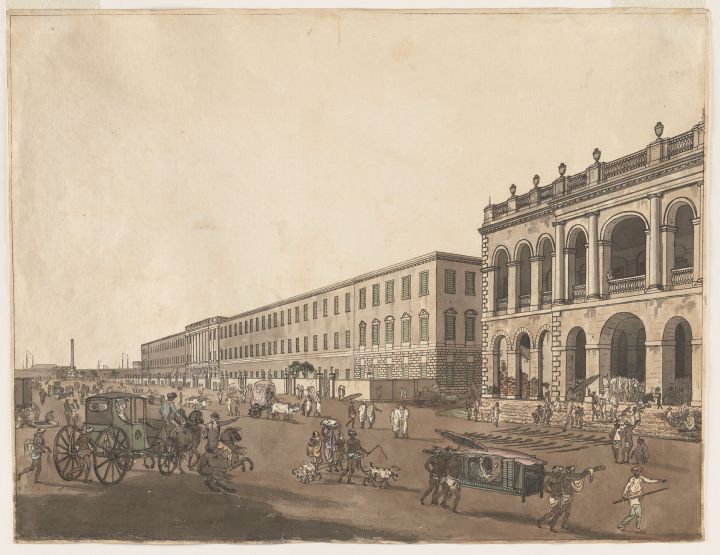
Thomas Daniell, The Old Court House and Writers’ Building, 1786, hand-coloured etching, 403 × 524 mm
(Philadelphia Museum of Art; image Thomas Primeau).
◊ ◊ ◊ ◊ ◊
The long eighteenth century in the latest issue of Print Quarterly:
Print Quarterly 42.1 (March 2025)
a r t i c l e s
• Jalen Chang, “‘Bengalee Work’ before Aquatint: Thomas Daniell’s Views of Calcutta”, pp. 20–30.
This article reevaluates eleven hand-coloured etchings by Thomas Daniell (1749–1840) held by the Philadelphia Museum of Art, previously presumed to be published states of his 1786–88 print series Views of Calcutta, often cited as the earliest aquatints made outside of Europe. Devoid of the rudimentary aquatinting and hand-coloured skies which characterize other extant examples, the relatively bare objects document a distinct stage of Daniell’s artistic process and are unprecedented in their survival. The article suggests that these prints were trial proofs never intended for publication or sale, meant instead to serve as colour tests for Daniell and his team of Indian copyists. Furthermore, the article considers early imperial printmaking and its ideological functions in British India.
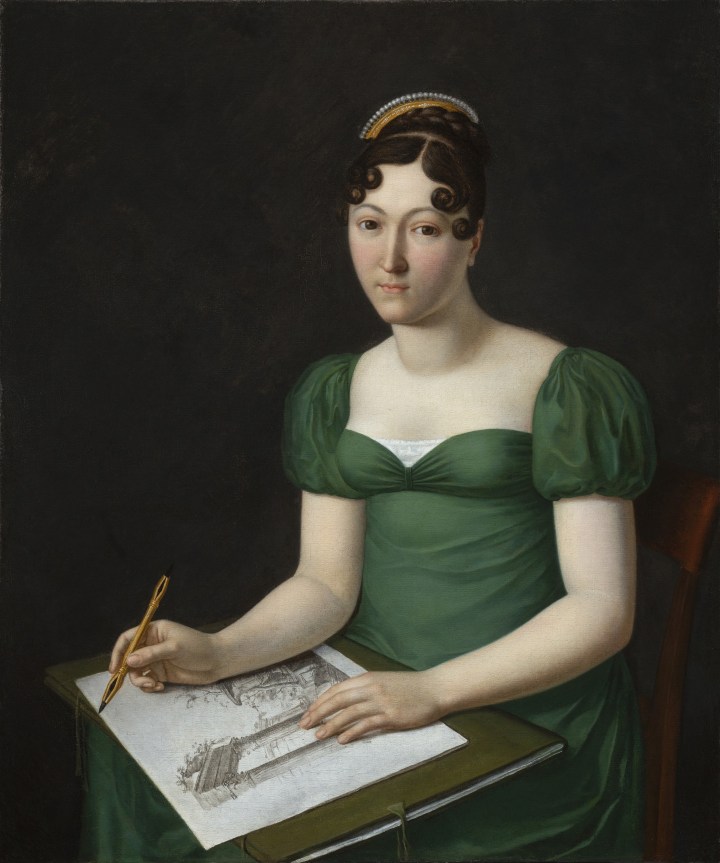
Charlotte Bonaparte, Self-Portrait, ca. 1824–26, oil on canvas, 885 × 730 mm (Princeton University Art Museum).
• Thomas Busciglio-Ritter, “From Brussels to Point Breeze: Charlotte Bonaparte’s Lithographic Landscapes, 1821–25”, pp. 31–43.
This article discusses a series of twelve lithographs by Charlotte Bonaparte (1802–1839), niece to Napoleon I, of North American views known as the Vues pittoresques de l’Amérique dessinées par la Comtesse Charlotte de Survillier (printed 1824), which she completed and disseminated on her return to Europe. The series, published in Brussels, became the first lithographic scenic views of the United States to circulate among western European audiences. The article situates Bonaparte’s landscape views within the context of transatlantic print culture of the early nineteenth century, touching on the role of women as producers of landscape images and the introduction of lithography as a new medium for American audiences.
n o t e s a n d r e v i e w s
• Bernard Aikema, Review of the exhibition catalogue Connecting Worlds: Artists and Travel, ed. by Anita Viola Sganzerla and Stephanie Buck (Paul Holberton Publishing, 2023), pp. 64–66.
• Catherine Jenkins, Review of the exhibition catalogue Trésors en noir et blanc. Estampes du Petit Palais, de Dürer à Toulouse-Lautrec, by Anne-Charlotte Cathelineau, Joëlle Raineau-Lehuédé, and Clara Roca (Paris Musées, 2023), pp. 74–76.
• Ellis Tinios, Review of Hokusai’s Fuji, ed. by Kyoko Wada (Thames and Hudson, 2023), pp. 76–77.
• Victoria Sancho Lobis, Review of Aaron Hyman, Rubens in Repeat: The Logic of the Copy in Colonial Latin America (Getty Research Institute, 2021), pp. 99–105.










leave a comment