Exhibition Celebrates Ferguson Gang’s Secretive Preservation Efforts
From the UK’s National Trust:
Taming the Tentacles
Shalford Mill, Surrey — 19, 23, 26, 30 September 2012

Shalford Mill, Surrey
Wearing masks and chanting Latin verse, the Ferguson Gang collected money to preserve buildings at risk of demolition. By the time the Gang’s activities wound down in 1946 they had preserved Shalford Mill, in Surrey, Newtown Old Town Hall on the Isle of Wight, Priory Cottages in Oxfordshire and donated some of the most beautiful stretches of the Cornish coastline to the National Trust. The exhibition is built on their essential strategy for life.
◊ ◊ ◊ ◊ ◊
The following account is excerpted from an August 2011 article from Surrey Life magazine:
Shalford Mill has been in the National Trust’s care since the early 1930s when it was bought for the organisation by an intriguing group of preservationists, called the Ferguson Gang. This group of mainly well-educated young women got together in the 1920s to raise money for philanthropic projects, which included saving Shalford Mill from demolition in 1932.
The members of the gang guarded their anonymity fiercely; giving each other various nicknames such as ‘Erb the Smasher’, ‘Bill Stickers’, ‘Red Biddy’ and ‘See Mee Run’. When it came to handing over the funds to the National Trust to purchase Shalford Mill, they did so secretly, wearing cloaks to deliver the money to the National Trust’s headquarters at Queen Anne’s Gate in London, and carrying bulging sacks packed with Victorian coins.
Having safeguarded its future, the gang went on to use Shalford Mill to hold their clandestine meetings. In fact, membership was limited to the number of people that could fit inside the mill. Here, they discussed future fund-raising tactics in private, while sitting around the drum of the millstones and enjoying picnics delivered from Fortnum and Mason.
Having eaten, the eccentric group would have a collection of all the coins they had managed to find. They would then wander round the mill in the small hours, searching for what they called ‘the four colours of the dawn’ (to this day, no one really knows what that meant), wrapped in veils and cloaks. . . .
The full article is available here»
Call for Essays | Spaces of Work and Knowledge
Spaces of Work and Knowledge in The Long Eighteenth Century
Proposals due by 15 September 2012
Abstracts are invited for proposed submissions for publication in a forthcoming collection of essays based on the proceedings of the Spaces of Work 1770-1830 conference held at the University of Warwick April 2012. The publication will follow the broad themes of the conference, but is expanded to include articles focusing on any time within the Long Eighteenth Century, and beyond being focused on Britain to include all geographical locations. Further, the overall headings of ‘space’ and ‘work’ are to be examined in relation to forms of knowledge, broadly conceived.
We are particularly interested in interrogating under-analyzed types of work and space. For example, we hope to develop the theorization of types of work that critics have not conventionally understood as ‘work’ (the performance of music as practical activity, for instance). We also aim to bring attention to under-analysed spaces. For example, due to Romanticism’s traditionally rural focus, literary critics of this period have only recently begun to interrogate urban spaces; interdisciplinary discussion of urbanism in this period would therefore be particularly valuable.
In terms of knowledge, we are particularly interested in forms of knowledge often essentialized and therefore not understood as knowledge as such. The traditionally male knowledge of utilising a commanding voice and demeanour to assert a seemingly innate authority, for example; or the traditionally female knowledge of being able to correctly ascertain the freshness of produce. We aim to elucidate the complex nuances of the interfacing of work, space, and knowledge as three factors that fundamentally shape everyday life in order to gain a greater understanding of material life in the period.
Possible questions which articles might tackle could include:
· How do workers and their work uniquely shape space?
· How does space facilitate or hinder workers and their work?
· How is knowledge acquired, employed, or altered by types of work and working locations?
· How do the social relationships between workers and their supervisors/masters alter according to the work they are doing and the spaces in which they perform it? How does the knowledge encoded in levels of expertise affect the dynamic between supervisors and workers?
· How is knowledge encoded in gender, race, and/or class across working space?
Possible approaches could include, but are not limited to: genteel work and the city; the work of acquiring the necessary knowledge for genteel status; work in spaces of ‘leisure’ and the forms of knowledge encoded therein; work, knowledge, and (sub)urban domestic spaces; gendered working knowledge in the home; space and female accomplishment and the forms of knowledge encoded; working knowledge in relation to emergent manufacturing/industrial spaces.
Pickering & Chatto have expressed an interest in publishing the collection. The exact word length may change, but we expect articles will be approximately 8000 words in length. Abstracts for proposed articles should be 500 words in length, and be submitted no later than 15 September 2012. Please send abstracts to spacesofwork@gmail.com
Conference | Castles and Manor Houses in the Baltic Sea Region
From the Verband Deutscher Kunsthistoriker:
Castles and Manor Houses in the Baltic Sea Region: Components of a European Cultural Heritage
Greifswald, 3-6 October 2012
The post-medieval castles and manors, up to the present, are a central piece of the cultural landscape of the Baltic Sea region. They are spread over altogether 10 countries: Germany, Poland, Russian region Kaliningrad, Lithuania, Latvia, Estonia, Finland, Sweden, Norway and Denmark. The central theme of the symposium (Schlösser und Gutshäuser in der Ostseeregion: Bausteine einer Europäischen Kulturlandschaft) will be the characteristic architecture of castles and manor houses in the Baltic Sea region from the early modern period to the present. Furthermore the symposium will focus on history and cultural history. The functional, sociological and political differences and similarities of the manors of the landed gentry in the different countries will be analysed as well as the cooperation of architects and other artists. It will be examined if there is a transcultural history of art of castles and manor houses in the Baltic Sea region and, finally, how the reception and adoption of castles and manors in the different countries is proceeding.
◊ ◊ ◊ ◊ ◊
W E D N E S D A Y , 3 O C T O B E R 2 0 1 2
16.00 Begrüßung
16.15 Führung durch Herrenhaus und Gutskapelle
17.30 Abendvortrag: Göran Ulväng (Uppsala), Manor House Building and Economic Growth in Sweden in the 18th and 19th Centuries
19.00 Empfang
T H U R S D A Y , 4 O C T O B E R 2 0 1 2
Typologien und Perioden
9.00 Dorota Piramidowicz (Warschau), Seats of a Lithuanian Magnate in the First Half of the 17th Century
9.30 Carsten Porskrog Rasmussen (Aarhus), Epochen der Gutsbauten in Dänemark und ihr gesellschaftlicher Hintergrund
10.00 Diskussion
10.30 Pause
10.45 Ulrich Lange (Göteborg), Aspects on Closed and Open Forms in the Nordic Manors Renaissance and Neo-Renaissance Period
11.15 Diskussion
Das ‘internationale’ 18. Jahrhundert
11.30 Ants Hein (Tallin), From War Destruction to the Golden Era: The Development of the Architecture of Estonian Manor Houses in the Beginning and in the Middle of the 18th Century
12.00 Diskussion
12.15 Mittagspause
14.00 Anna Oleska (Warschau), Maisons de plaisance in 18th-Century Poland: Fashionable Architecture, New Social Mode
14.30 Sigrid Puntigam (Schwerin), Ludwigslust – Schlossbau in der Spätphase des Ancien Régime
15.00 Diskussion
15.30 Pause
Verspätungen – Traditionalismen – Anachronismen
15.45 Vytautas Volungevicius (Vilnius), Das 16. Jahrhundert und die Entstehung der Adelsburg im Großfürstentum Litauen: soziopolitische Umstände und ‚verspätetes‘ Phänomen
16.15 Malgorzata Buchholz-Todoroska (Sopot), The Pomeranian Manors at the Turn of 19th and 20th Centuries: Living a Peaceful Life in the Picturesque Landscape
16.45 Michael Lissok (Greifswald), Letzte Vertreter einer anachronistischen Baugattung: Beispiele für die Landschloss- und Herrenhausarchitektur der 1920er und 1930er Jahre in Brandenburg und Pommern
17.15 Diskussion
F R I D A Y , 5 O C T O B E R 2 0 1 2
Transkulturalitäten im Ostseeraum?
9.00 Carsten Neumann (Schwerin), Das Herrenhaus Bothmer in Klütz – Ein englisch-holländischer Landsitz in Mecklenburg
9.30 Cynthia Osiecki (Apeldoorn), A Cultural History of the Baltic Area: The Sixteenth-Century Migration of Dutch Sculptors into the Baltic Area
10.00 Diskussion
10.30 Pause
10.45 Ojars Sparitis (Riga), Beziehungen zwischen der Familie von Behr und dem Hof von Rudolph II. und deren Auswirkung auf die Kultur Kurlands
11.15 Rafal Makala und Monika Frankowska-Makala (Stettin), Das Residenzschloss der Herzöge von Pommern in Stettin als Kunstwerk und Ort von Kunstsammlungen
11.45 Diskussion
12.15 Mittagspause
Funktionswandel in der Moderne: Umnutzungen und Aneignungen
14.00 Dorota Sikora (Warschau), Historic Residences of the Puck (Putzig) Region and the Wejherowo (Neustadt) Region: Their Present Condition, Function and Surroundings
14.30 Herle Forbrich (Hamburg), Herrenhäuser ohne Herren. Ostelbische Geschichtsorte im 20. Jahrhundert
15.00 Diskussion
15.30 Pause
Erberezeption – Erbediskussion
15.45 Michael Paarmann (Kiel), Historische Gutsanlagen in Schleswig-Holstein – Ein ausgeschlagenes Erbe oder Chance für die Zukunft?
16.15 Salvijus Kuleviiius (Vilnius), Cultural Memory and Reconstruction of Castles in Lithuanian in the Second Half of the 20th and 21st Centuries
16.45 Diskussion
18.00 Führung durch Herrenhaus (in zwei Gruppen)
19.00 Abendvortrag: Sabine Bock (Schwerin), Haben Häuser einen Stammbaum? Wie sich der Bautyp ‚Herrenhaus’ entwickelt hat Kleiner Empfang
S A T U R D A Y , 6 O C T O B E R 2 0 1 2
9.30 Malgorzata Rozbicka (Warschau), Manor Houses of the Lower Landed Gentry in Village Inventory Albums from the Collection of the Department of Polish Architecture, Warsaw University of Technology
10.00 Kilian Heck (Greifswald), Von der Ordensburg zum Barockschloss. Steinort/Sztynort in Masuren
10.30 Oliver B. Hauck und Piotr Kuroczynski (Frankfurt am Main), Virtuelle Rekonstruktion des kulturellen Erbes – Ein räumliches Informationssystem
11.00 Abschlussdiskussion
12.30 Exkursion auf die Insel Rügen — Geplant sind Besichtigungen unter anderem folgender Häuser: Boldevitz, Kartzitz, Spyker, Venz
Call for Papers | Eastern Resonances 2: India and the Far East
From the conference website:
Eastern Resonances 2: India and the Far East, 16th-18th Centuries
University of Paris Diderot (Paris 7), 5-7 December 2013
Proposals due by 31 October 2012
Contrary to the echo or the trace, which both imply an enduring, but fading prolongation of a presence, resonance suggests not only a continuation, but a reinforcement of a sound or image, provoked by a reflection on another surface. Taking from Stephen Greenblatt’s definition of resonance as the power of the object displayed to reach out beyond its formal boundaries to a larger world, to evoke in the viewer the complex, dynamic cultural forces from which it has emerged (“Resonance and Wonder,” in Learning to Curse, p. 170), this conference aims at studying the moves, shifts, transformations and translations through which the idea of the East resonated in Europe in general, and Britain in particular, from the early modern period to the romantic age.
Calling into question the adversarial nature of Orientalism as defined by Edward Said, our conference will address the deterritorializations and reterritorializations (to borrow the concepts developed by Deleuze and Guattari in Anti-Oedipus) through which the East reshaped itself in the West through its many reflections and reverberations. Our focus will not just be on what was lost and what was gained along the routes of such recuperations, but we also wish to chart in greater detail the routes themselves, the people who crossed them and the motivations underpinning these attempts at reaching, understanding and picturing the East.
The first of our series of two conferences on Eastern Resonances, to be held at the University of Montpellier 3 (30 May-1 June 2013), will focus on the Ottoman Empire and Persia. We are now welcoming proposals for the second conference, on India and the Far East, to be held at the University of Paris Diderot, Paris 7 (5-7 December 2013). Suggested areas of reflection for this conference could include:
1) Texts and their circulation/translation: What were the Sanskrit, Chinese and other texts that resonated in the West in this period? Through what channels did manuscripts and books travel? Why and how did they reach Britain in adapted or translated forms?
2) Places and their memories: What did travellers look back to in historical and cultural terms as they embarked on their journeys to the East? What images did they bring back with them from their eastern encounters? How did these reverberate as literary and artistic artefacts at the receiving end of the journey?
3) Actors and intermediaries: Who went East or West, and why did they? Who were their interlocutors or mediators there? Why and how were contact zones created? On what terms was trust granted and collaborative research carried on?
For Eastern Resonances 2: India and the Far East, short proposals in English (250 words) and a brief biographical statement are to be sent by October 31, 2012 to the conference organisers:
-Dr Claire Gallien, University of Montpellier 3 claire.gallien@univ-montp3.fr
-Pr Jean-Marie Fournier, University of Paris 7 jean-marie.fournier@univ-paris-diderot.fr
-Pr Ladan Niayesh, University of Paris 7 niayesh@univ-paris-diderot.fr
Papers should be 30 minutes in length and may be presented either in French or in English. We intend to publish a selected number of papers from the two conferences in a volume of essays on the topic of Eastern Resonances.
Universite Paul Valery – Montpellier III
IRCL (UMR5186)
Site Saint-Charles
Rue Henri Serre
34000 Montpellier
Email: claire.gallien@univ-montp3.fr
Visit the website at http://easternresonances.jimdo.com/
At Auction | American Furniture at Christie’s, 24 September 2012
Press release from Christie’s:
Important American Furniture, Folk Art, and Decorative Arts (Sale #2584)
Christie’s, New York, 24 September 2012
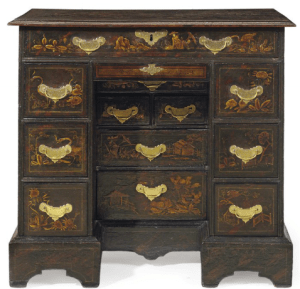
Queen Anne Japanned Maple Bureau Table, ornament attributed to Robert Davis (d. 1739), ca. 1735.
On September 24, Christie’s presents the sale of Important American Furniture, Folk Art & Decorative Arts (Sale #2584). This sale features over 100 diverse examples of American art and craftsmanship from the 18th and 19th centuries. Highlights include furniture from the Wunsch Americana Foundation, the Philadelphia Museum of Art, as well as a selection of American folk art and maritime paintings.
Leading the sale is a Chippendale Carved Mahogany Easy Chair, Philadelphia, 1760-65 (estimate: $600,000-900,000). One of the most successful creations of the renowned ‘Garvan’ carver, this easy chair is a triumph of Philadelphia design and artistry. Unidentified and known solely through his body of work spanning from the early 1750s to the mid-1760s, this craftsman was the city’s most accomplished and influential carver of his day and this easy chair, made during the his mature style, reflects the culmination of this remarkable carver’s talents. Similarly, the chair’s frame, expertly crafted with a number of distinctive features, can be linked to a larger body of work and placed within the oeuvre of a known, but also unidentified, cabinetmaking shop. Long hailed as a Philadelphia masterpiece, the Philadelphia Museum of Art purchased the chair in 1925, and is now deaccessioning it to provide funds for acquisitions.
Resplendent and extraordinarily rare, another sale highlight is a Queen Anne Japanned Maple Bureau Table, Boston, circa 1735, which is one of about forty known examples of japanned furniture from colonial America, most of which are in public collections today (estimate: $60,000-90,000). The only bureau table known to exist, this piece stands as a survival of the form with distinctive chinoiserie ornament. The japanned ornament is attributed to Robert Davis, a prominent craftsman in colonial Boston. The table’s decoration remains largely intact and reveals the full beauty of the sparking gem-like appearance intended by its eighteenth-century creator.
The sale also features a selection of property from the Wunsch Americana Foundation, including a Pair of Federal Eagle-Inlaid Mahogany Side Chairs, Attributed to William Singleton (w. 1789-1803, d. 1803), Baltimore, 1790-1800 (estimate: $60,000-90,000). This pair of chairs was lent to the Diplomatic Reception Rooms at the Department of State in 1968 and remained in the Monroe Reception Room as part of a larger set of four related chairs until they were returned to the Wunsch Americana Foundation. Until now, the location of this pair has been unknown. . .
Call for Papers | Art History and Sound
From The Courtauld:
Art History and Sound – Workshop Series: ‘The Listening Art Historian’
The Courtauld Institute of Art, London, 6 December 2012, 14 March and 30 May 2013
Proposals due by 28 September 2012
Organised by Irene Noy and Michaela Zöschg with Katie Scott
Art historians constantly encounter traces of sound. These can take the form of notes in an illuminated manuscript, a textual echo of past noise and lost voices, or depictions of instruments, singers and dancers, captured on panel, canvas, paper, film or in wood, marble and bronze or spaces that have been specifically designed and built to embrace and amplify sound: pulpits, choir stalls, opera houses, the floor of the stock exchange. The aural is continuously intertwined with visual arts as content or context. In the 20th and 21st centuries especially artists have variously incorporated sounds, live and recorded, in their performances, happenings and multi-media installations putting into question the silence and fixity of visual art.
As a result of the collapse in the Enlightenment of the Renaissance notion of the unity of the arts and the substitution of a modern division of temporal from spatial art forms, art historians have generally limited their research and interpretation exclusively to the visual aspects of art and have disregarded the existence, never mind the significance, of the aural. Despite the recent broadening of art history’s disciplinary boundaries to include ‘non-traditional’ media as well as related fields, art historians are primarily trained to analyse and explain the non-ephemeral dimensions of art. When the visual approaches the transient qualities of the aural it raises problems of methodology and terminology.
This workshop series aims to explore both historical and contemporary instances of sound in art history, as well as some of the theoretical and methodological questions arising from this preoccupation. It is designed to provide an open platform for all art historians concerned with collecting, analysing, interpreting and describing sound(s) to meet and discuss ways of hearing visual art. Topics for discussion may include, but are not limited to:
• In what kind of media do art historians encounter notions of sound such as music, voice or noise and with what methods do they explore these traces of the aural?
• How do art historians, with their specific background in the analysis of visual arts, collect, listen to, ‘process’ and write about sound?
• In regards to aurality, can research fields such as soundscape, Klangkunst, acousmatic voice, developed by neighbouring disciplines, be fruitfully used in and adapted for art history?
• How does our preoccupation with the aural inform or perhaps change our understanding of the visual, and vice versa?
This workshop series will be hosted at the The Courtauld Institute of Art on three different occasions throughout the academic year 2012/13. Each workshop will consist of four papers that will function as catalysts for a subsequent round table discussion, and each workshop will address the dynamics existing between aurality and art historical material, tools and methods from a different angle, generated around the proposals we receive. We welcome proposals of 20 minutes long papers in all periods, media and regions that deal either with case studies or broader methodological questions. Please send your abstracts of 250–300 words and a short biography to irene.noy@courtauld.ac.uk and michaela.zoschg@courtauld.ac.uk by 28 September 2012. For organisational purposes, we also kindly ask you to indicate on which of the dates (indicated above) you would like to present and whether you will be able to attend all three workshops. We cannot offer travel subsidies for speakers, and therefore students from outside London are encouraged to apply to their institutions for funding to attend the workshops.
Lecture | Dining in 18th-Century France
This fall at The Getty:
Charissa Bremer-David — Of Cauliflower and Crayfish:
The High Art of Dining in 18th-Century France
Getty Center, Los Angeles, 25 October 2012

Lidded Tureen (detail), Thomas Germain, 1744–50 (Los Angeles: The J. Paul Getty Museum)
In mid-18th-century France, decorative sculptural elements on many luxurious serving vessels and tablewares actually portrayed, quite naturalistically, ingredients of the food contained within. Identifiable representations of vegetables, fish, and game can be compared to the recipes from period cookbooks.
Charissa Bremer-David, curator of Sculpture and Decorative Arts at the Getty Museum, discusses the naturalism of these miniature sculptures and how they reflected the broader interests of the Enlightenment as well as the latest culinary developments. Discover how these visualizations were meant to awaken and enhance the palate. This talk, part of the Tracey Albainy Lecture Series, commemorates the life and career of Tracey Albainy, a specialist of European silver and ceramics.
◊ ◊ ◊ ◊ ◊
Tracey Albainy, a senior curator at Boston’s Museum of Fine Arts, died in 2007 at the age of 45. More information is available here»
William Morris Gallery Reopens after Renovation
Yes, I realize William Morris stretches the long eighteenth century to the breaking point. I note the reopening of the museum because of the building itself, which dates to around 1744. The official ceremony marking the completion of the renovation took place on 2 August 2012. The following is an excerpt from Alastair’s Sooke’s response for The Telegraph. -CH
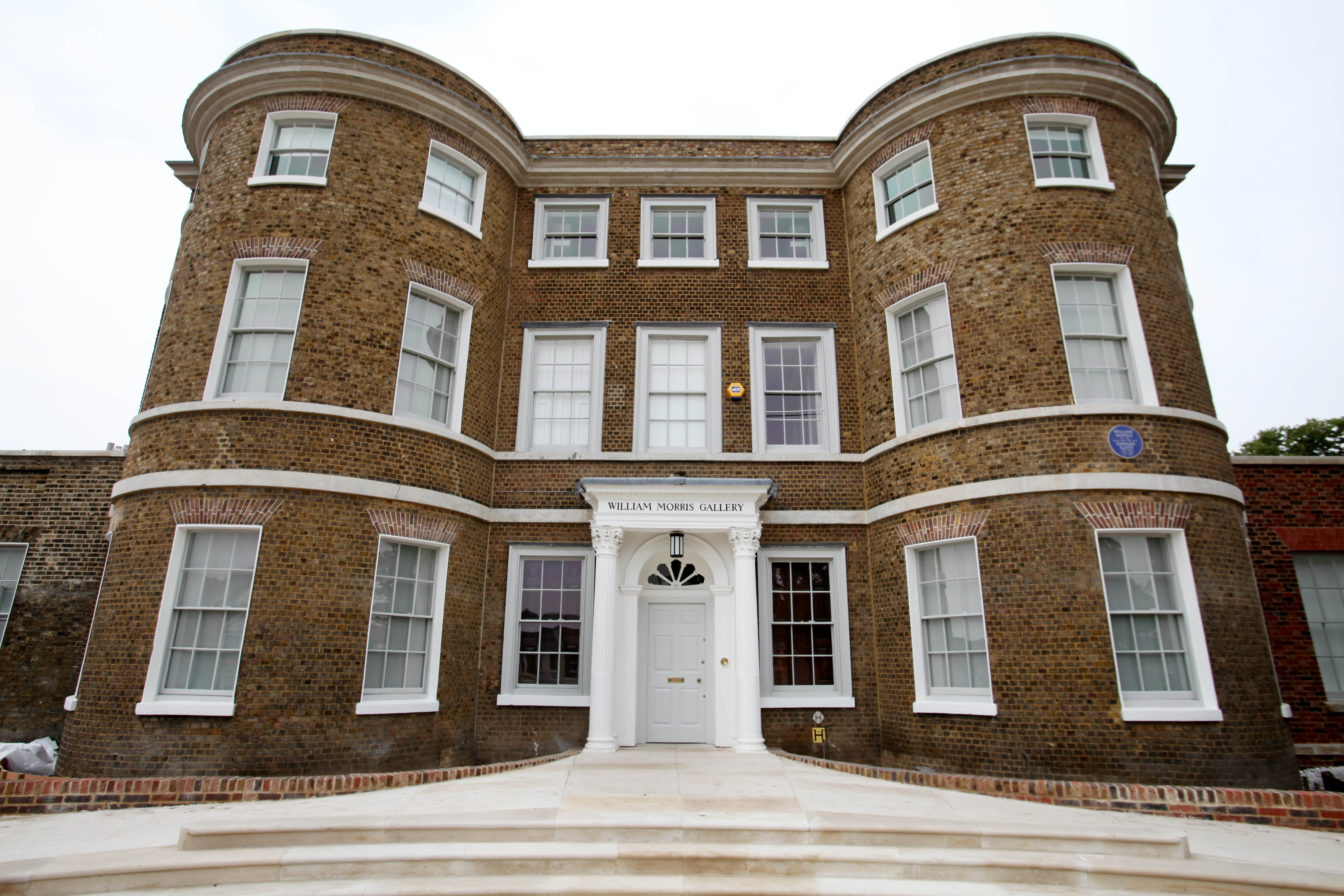
William Morris Gallery, Walthamstow, London © Oliver Dixon / Imagewise — The building dates to ca. 1744
. . . Making sense of the personality, achievements and legacy of such a visionary polymath is a complicated task. Yet that is what the new-look William Morris Gallery, which reopens this week following a year-long £5 million refurbishment, manages to do. The gallery occupies a magnificent Grade II-listed Georgian villa, with a front boasting full-height semicircular bays and a white-painted timber porch with Corinthian columns. Situated in Lloyd Park in Walthamstow in northeast London, like a beacon of beauty amid the local asphalt-benighted urban sprawl, the three-storey building was home to the Morris family between 1848 and 1856, when William was at Marlborough College and then Oxford University, where he met his lifelong friend and collaborator, the painter Edward Burne-Jones, as well as Jane Burden, whom he married in 1859. . .
The full review is available here»
Small Exhibition | Gems of European Lace, ca. 1600–1920
Press release (20 July 2012) for this exhibition now on at The Met:
Gems of European Lace, ca. 1600–1920
The Metropolitan Museum of Art, New York, 24 July 2012 — 13 January 2013
Oorganized by Devon Thein and Gunnel Teitel
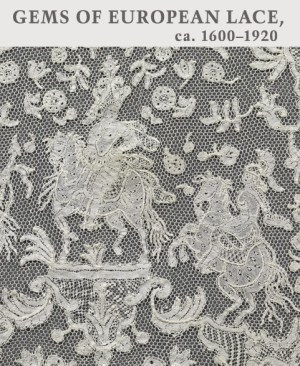
Cravat End or Rabat (det.), mid-18th century, Flemish, Linen, bobbin lace (point d’Angleterre). The quality of workmanship in this cravat end is consistent with its presumed exalted provenance. It is said to have been made for the Austrian empress Maria Theresa; given to her daughter the French queen Marie Antoinette; and then passed to the marquis de Chabert, a French admiral and astronomer, after which it descended in his family. The possibility of this association is supported by the crown at center resembling the Austrian archducal crown, though no further proof of the connection has been discovered. . . click on the image for more
A selection of 13 exceptional examples of handmade lace from the collection of The Metropolitan Museum of Art—one of the finest such collections in the United States—will be featured in the exhibition Gems of European Lace, ca. 1600–1920, opening July 24 in the Museum’s Antonio Ratti Textile Center. These delicate luxury textiles, created between 100 and 400 years ago, represent techniques and styles associated with some of the preeminent lacemaking centers of Europe.
Included in the installation are examples of the two major lacemaking techniques: needle lace (built up from a single thread that is worked in a variety of looping, or buttonhole, stitches) and bobbin lace (woven—or braided—together from multiple threads organized on individual bobbins). Beyond the two basic technical categories, lace is also often described with the name of the town or region where a particular style was first made.
The exhibition will include outstanding examples of Venetian (needle) lace, Brussels (bobbin) lace, and Devon (bobbin) lace. Of particular interest is a 19th-century handkerchief associated with King Leopold II and Queen Marie-Henriette of Belgium. The queen was a patron of the local lace industry. The best-quality lace was extremely expensive, due to the time-consuming and painstaking process of transforming fine linen thread into such intricate openwork structures. Rather surprisingly, the 17th-century English clergyman Thomas Fuller defended the wearing of lace and the nascent English lacemaking industry, writing that it cost “nothing save a little thread descanted on by art and industry,” and “saveth some thousands of pounds yearly, formerly sent over to fetch lace from Flanders.”
In the late 19th century, American women began to recycle antique lace for use in fashion. The American socialite and style setter Rita de Acosta Lydig, for example, often wore garments with insertions of antique lace. On view will be one of her dresses from 1920, completely made of lace in a horse-and-rider motif. As a result, many women began to collect and study lace, taking an interest not only in its artistry and complexity of construction but also in the historical and cultural contexts in which it was made and used. In large part, the collection of the Metropolitan Museum reflects the interest of these women who became serious collectors and who graciously donated their collections to the Museum.
The installation was organized by Devon Thein and Gunnel Teitel, volunteers in the Department of European Sculpture and Decorative Arts, under the supervision of Melinda Watt, Associate Curator, European Sculpture and Decorative Arts, and Supervising Curator, Antonio Ratti Textile Center. Established in 1995, the Antonio Ratti Textile Center at the Metropolitan Museum is one of the largest, most technically advanced, and well-equipped centers for the study, storage, and conservation of textiles in any art museum. Objects from the Metropolitan Museum’s collection of textiles are featured, on a rotating basis, in a small gallery at the entrance of the center.
Call for Papers | ASECS Proposals Due Next Week
2013 American Society for Eighteenth-Century Studies Conference
Cleveland, 4-7 April 2013
Proposals due by 15 September 2012 — Next Saturday!
The 2013 ASECS conference takes place in Cleveland, at the Renaissance Cleveland Hotel, 4-7 April. Along with our annual luncheon and business meeting, HECAA will be represented by two panels chaired by Christopher Johns and Heather McPherson. In addition to these, a wide selection of sessions that might be relevant for HECAA members are also included below. A full list of panels is available here.
◊ ◊ ◊ ◊ ◊
Anne Schroder New Scholar’s Session (Historians of Eighteenth-Century Art and Architecture)
Christopher M.S. Johns, 1112 Wildwind Ct., Nashville, TN 37209; Tel: (615) 516 9337; Christopher.Johns@vanderbilt.edu
Named in honor of the late Anne Schroder, this seminar will feature outstanding new research by emerging scholars.
◊ ◊ ◊ ◊ ◊
Interiors as Space and Image (Historians of Eighteenth-Century Art and Architecture)
Heather McPherson, Dept. of Art and Art History, 113 HUM , 900 13th St. South, U. of Alabama at Birmingham, Birmingham, AL 35294; Tel: (205) 934-4942, Fax: (205)-996-6986; hmcphers@uab.edu
In recent years scholars have reconsidered the significance of the eighteenth-century interior as a complex site of social interaction and nexus of display associated with daily life, exhibition practices, and conspicuous consumption. This session invites papers on eighteenth-century interiors as actual spaces experienced in multiple ways (socially, aesthetically, temporally, etc.) OR as represented in paintings, prints, or other art forms. Topics might include functions of different types of interior spaces, furnishings, decorative arts, display of artworks or other objects, etc. in any geographical area during the long eighteenth century.
◊ ◊ ◊ ◊ ◊
There are numerous other panels that should prove interesting for art and architectural historians. A full list of panels is available at the ASECS website, but a couple of dozen are included here»










 Enfilade
leave a comment