September 2012 Issue of ‘The Art Bulletin’
In the current issue of The Art Bulletin, the “Notes from the Field” feature addresses the theme of contingency. Making a strong case for the proposition that it is possible to say something worthwhile in less than two pages, many of the essays are insightful and stimulating. The following two particularly address the eighteenth century. -CH
Gloria Kury, “On Contingency,” The Art Bulletin 94 (September 2012): 352-54.
Invoking Charles Le Brun, Emma and William Hamilton (“the first spell-binding teacher of art history was . . . a husband-wife duo”), and Dr. James Graham (famous for his sexual prescriptions involving the Celestial Bed at his Temple of Health and Hymen), Kury urges “scholars to start giving due heed to the significance of the spellbinding lecturer and / or master of the slide show, from the Hamiltons through Leo Steinberg and T. J. Clark, in the establishment and vitality of their discipline” . . . (354).
Mark Ledbury, “On Contingency,” The Art Bulletin 94 (September 2012): 354-55.
Addressing the “brilliant, but infuriating essay,” Charles Baudelaire’s “The Painter of Modern Life,” Ledbury draws readers’ attention to the critic’s coupling of “the contingent” with “the other half of art . . . the eternal and the immovable,” arguing that, in fact, modernity “has no monopoly over the contingent: wherever specialists look, the eternal and the immutable are thin on the ground” (354). Turning his attention then to eighteenth-century France (with reference to Richard Rorty’s Contingency, Irony, and Solidarity), Ledbury contends “that compelling history is always aware of the gravitational forces of contingency tugging it from its lofty heights. . . . Certainly, in my own scholarship, to even begin to chart the fortunes of the Neoclassical generation is to appreciate both the force and unpredictability of contingency in the making of lives, works, and careers” . . . (355).
Bard Graduate Center’s 2012-2013 Seminar Series
The following list offers a sample of events at the Bard Graduate Center during the 2012-13 academic year that might be of interest to Enfilade readers. A flyer listing all events is available as a PDF file here.
◊ ◊ ◊ ◊ ◊
Bard Graduate Center’s Seminar Series
Bard Graduate Center, New York City, 2012-2013
 All events take place in the Lecture Hall at 38 West 86th Street, between Columbus Avenue and Central Park West, in New York City. Seminars begin at 6pm. RSVP is required. For general information or to reserve your place, please visit the BGC website.
September 27-29
Symposium — Beyond Representation: an Interdisciplinary Approach to the Nature of Things
October 15
Symposium — Circus and the City: New York, 1793–2010
November 14
Steven Pincus (History, Yale University) — Spanish American Trade, Patriot Politics and the Shaping of the British Empire
November 27
Laura Auricchio (Art History/Humanities, The New School) — Hero and Villain: Lafayette’s Legacies
February 12
Tobias Locker (Art History, Saint Louis University-Madrid) — Paris / Potsdam / Paris: Gilt Bronzes ‘à la française’ in Prussia and the Circulation of Knowledge
February 13
Christopher Brown (Director, Ashmolean Museum of Art and Archaeology, University of Oxford) — The New Ashmolean
February 20
Béla Kapossy (History, University of Lausanne, Switzerland) — Rousseau’s, and Other Relics: Material Memories in Later Eighteenth-Century Switzerland
Display | Jean-Henri Riesener (1734–1806)
Based on press releases from VisitParis and Art Media Agency:
Jean-Henri Riesener (1734–1806)
Biennale des Antiquaires, Grand Palais, Paris, 14-23 September 2012
Organized by Kraemer & Cie
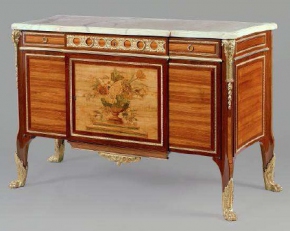 The Maison Kraemer, a Parisian gallery specialising in pieces from the 17th and 18th centuries, is organising the first ever exhibition to be entirely dedicated to the cabinet-maker Jean-Henri Riesener (1734-1806). It will run from the 14 to the 23 of September at stall 32 during the 26th Biennale des Antiquares. The solo exhibition is then to go on tour.
Introduced to the art of cabinetmaking by Jean-Francois Oeben, Riesener became a master in 1768, and was designated ‘carpenter to the King’ in 1774. He also supplied Queen Marie-Antoinette with furniture, creating for the Court and the Royal Family a collection of stunningly beautiful pieces of furniture, characterized the remarkable finesse in his use of gilt bronzes and precious inlay decorations. Riesener is one of the most commonly displayed cabinet-makers in museums throughout the world. Examples include the Louvre museum, the Château de Versailles, the Nassim de Camondo museum, the New York Metropolitan Museum and the Getty Museum in Los Angeles. At auction, his pieces regularly sell for remarkable prices:
• In 1999 a chest of drawers was sold by Christie’s for £7,041,500 or €8.5 million (with fees)
• In 2007 a chest of drawers was sold by Sotheby’s for €3,952,250 (with fees)
• In 2000, a desk was sold by Christie’s for £1,214,750 or €1.5 million (with fees)
• Recently, a chest of draws put up for sale by the auction house Sotheby’s in October 2011, estimated to be worth between €20-30 million, was sold for only €24,750.
Also see the article by Susan Moore for Apollo Magazine (September 2012) and the coverage (in French) at Artistik Rezo.
Art Fair | 2012 Biennale des Antiquaires in Paris
2012 Biennale des Antiquaires
Grand Palais, Paris, 14-23 September 2012
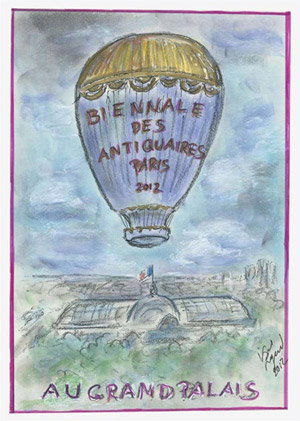
In the September 2012 issue of Apollo Magazine, Susan Moore previews the upcoming Biennale des Antiquaires, which thanks to the design work of Karl Lagerfeld is sure to garner plenty of press coverage in the coming weeks (he’s briefly profiled with a tease for the event in the current issue of Elle Decor). While the art fair will present a wide range of offerings (in keeping with the general trends of similar recent events), the established dealers of French decorative arts are to be well represented. As Moore writes:
 Kraemer & Cie, for instance, arguably the grandest of them all, is presenting the first ever exhibition devoted to the great French cabinetmaker Jean-Henri Riesener (1734–1806; see Collectors’ Focus, pp. 94–95). Trained by Jean-François Oeben, Riesener became a maitre ébéniste in 1768 and was appointed ébéniste du roi to Louis XVI in 1774. He was also Marie-Antoinette’s preferred supplier. ‘While a lot of cabinet-makers at the time may seem similar,’ explains Laurent Kraemer, ‘Riesener’s work is immediately identifiable by the perfection of proportion and execution – whether [he was] producing extremely rich marquetry for the court or very simple mahogany pieces with no or few gilt-bronze mounts.’ Some 20 pieces will be presented in a simple museum-style display, including a transitional Louis XV–Louis XVI commode with a central panel comprising a polychrome marquetry vase of flowers, as well as a Louis XVI mahogany and mahogany veneered writing desk and cartonnier ornamented with chased and gilt-bronze mounts. Riesener’s only known pair of cabinets is also on display, along with two tables from Versailles. According to M. Kraemer, the last three years have seen a rise in the number of international collectors buying at the very top level. Prices here range from €50,000 to ‘many hundred thousands’. After the fair, the exhibition will transfer to the gallery on the rue de Monceau.
Other exhibitors represent 18th-century objets d’art, their wares displayed in a traditional setting. François Léage specialises in outstanding pieces of the period, and has installed the panelling from the Grand Salon of the Paris home of Le Normand de Mézières. It provides the perfect mise en scène for a handsome pair of ormolu and serpentine oval covered vases – a similar pair adorn the Queen’s private apartments at Versailles.
The full article is available here»
Call for Papers | Gothic: Culture, Subculture, Counterculture
From St Mary’s University College:
Gothic: Culture, Subculture, Counterculture
Strawberry Hill House, 8-9 March 2013
Proposals due by 30 October 2012

Horace Walpole’s Strawberry Hill, Twickenham, London,
built between 1749 and 1776; restoration completed in 2010
◊ ◊ ◊ ◊ ◊
This conference, held in the Gothic mansion at Strawberry Hill, west London, will interrogate the many and varied cultures of the Gothic that were largely set in train by the owner of this mansion, Horace Walpole, in the mid-eighteenth century. As Walpole’s projects well exemplify – an aesthetic rebellion against a classical orthodoxy, which nonetheless looked implicitly to the restoration of some former social order – Gothic’s cultural poetics have always been difficult to place politically.
To what degree have Gothic tendencies in literature, art, architecture and screen media been participants in, adjuncts to, contesters of, or alternatives to cultural and political mainstreams, and how might such relationships be assessed by historians and critics? If Gothic was the Enlightenment’s naughty, child, to what extent is its rebelliousness mental or political, and is it ultimately co-opted by the order that it appears to resist?
This is a multi-disciplinary conference, and proposals for papers are invited in response to such questions in the fields, amongst others, of literature, screen media, art, architecture and popular culture. Participants will be offered the chance to see Horace Walpole’s Gothic mansion, now resplendent in its recently-renovated state, and to dine there during the conference. Preference will be given to papers that are suitable for an enthusiastic amateur audience, as well as specialists in the appropriate field. A bursary will be offered to cover conference fees for the best proposal by a postgraduate student.
200-word proposals for papers of 20-25 minutes, should be sent, by 30 October 2012 to:
Ms Jessica Jeske
St Mary’s University College
Waldegrave Road
Strawberry Hill
London TW1 4SX
jessica.jeske@smuc.ac.uk
Confirmed Speakers
• Michael Snodin (The Victoria and Albert Museum)
• John Bowen (University of York)
• Avril Horner (Kingston University)
• Allan Simmons (St Mary’s University College, London)
Display | Dead Standing Things at Tate Britain
I was fortunate enough to visit this terrific display earlier in the summer, but for anyone who hasn’t seen it, impressive points of access are available online, offering a fine model for extending an exhibition’s usefulness well beyond the physical site of the museum. A page from the University of York provides an online record, and the first-rate publication edited by Tim Batchelor with contributions by Caroline Good, Claudine van Hensbergen, Peter Moore, and Debra Pring is available free of charge as a PDF file. -CH
◊ ◊ ◊ ◊ ◊
From Tate Britain:
Dead Standing Things: Still Life 1660-1740
Tate Britain, London, 21 May — 16 September 2012
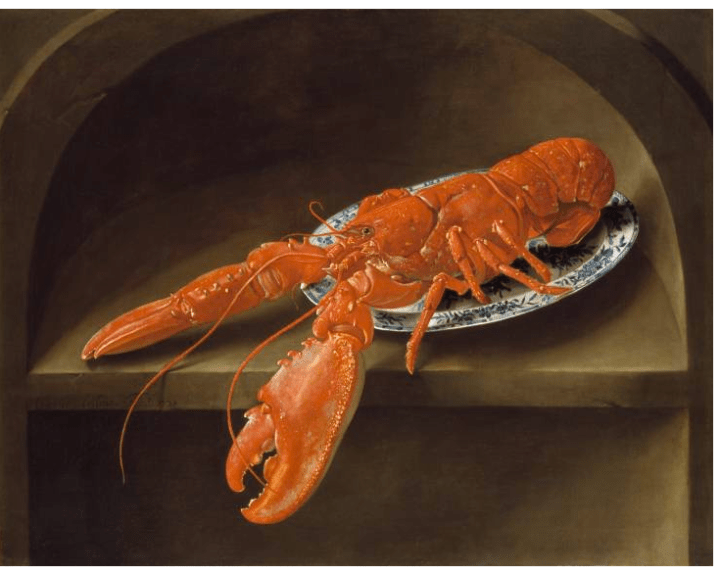
Charles Collins, Lobster on a Delft Dish
oil on canvas, 1738 (London: Tate)
◊ ◊ ◊ ◊ ◊
A familiar genre today, still life painting became established in Britain in the late seventeenth century. Writing in the 1650s, the author William Sanderson referred to such paintings as ‘dead-standing-things’, the term ‘still life’ (from the Dutch ‘stilleven’) only appearing in the following decades. Characterised as the detailed depiction of inanimate objects, the genre had been established in the Netherlands early in the seventeenth century and its introduction into Britain was through the work and influence of Dutch incomer artists. Pieter van Roestraten arrived in London from Amsterdam in the mid-1660s and became known for his ‘portraits’ of objects, particularly silver; another Dutchman known by the anglicised name of Edward Collier was active in London from the 1690s.
This period saw a shift in the way artists sold their works. The old system of artistic patronage by and commissions from the wealthy elite was, from the later 1680s, augmented by newly-emerging auctions. Sales at taverns, coffee houses and commercial exchanges provided artists with new opportunities. It also meant the ‘middling’ class of professionals and merchants could purchase art to furnish their homes and satisfy their social ambitions, with affordable and easily available still lifes a popular choice.
This is the second of two displays at Tate Britain organised as part of Court, Country, City: British Art, 1660-1735, a major research project run by the University of York and Tate Britain, and funded by the Arts and Humanities Research Council. This display has been devised by curator Tim Batchelor.
Call for Papers | 2013 BSECS Conference
From the British Society for Eighteenth-Century Studies:
2013 BSECS Conference — Credit, Money and the Market
St Hugh’s College, Oxford, 3-5 January 2013
Proposals due by 30 September 2012
The annual meeting of the British Society for Eighteenth-Century Studies is Europe’s largest and most prestigious annual conference dealing with all aspects of the history, literature, and culture of the long eighteenth century. We invite proposals for papers and sessions dealing with any aspect of the long eighteenth century, not only in Britain, but also throughout Europe, North America, and the wider world. Proposals are invited for fully comprised panels of three or four papers, for roundtable sessions of up to five speakers, for individual papers, and for ‘alternative format’ sessions of your devising.
While proposals on all and any eighteenth-century topics are very welcome, this year the conference theme will be Credit, Money and the Market. We would thus particularly welcome proposals for panels and papers that address eighteenth-century understandings of Credit, Money and the Market, and their workings and effects, broadly conceived, throughout the long eighteenth century, at all levels of society, and in any part of the world. These might include, but will not be confined to: the meanings and significance given to Credit, Money and the Market in all fields from history, politics and religion, to the arts, literature, and philosophy; the way money is represented in the theatre, literature, philosophy and the arts; credit and reputation; debt and debtors; ‘capitalism’; ‘speculation’; financial ‘bubbles’; trade and business; ‘new money’; banks and financiers; ‘The Exchange’; investment; ‘moral economy’; and ‘the black economy’.
All enquiries regarding the academic programme of the conference should be addressed to the academic programme co-ordinator, Dr Corinna Wagner academic@bsecs.org.uk. To submit a proposal, please click here.
Keynote Speakers
Robert D. Hume — The Value of Money: Prices, Incomes, and Buying Power in Eighteenth-Century England
Julian Hopitt — Scottish Oeconomy and English Debts
Reviewed | Orientialism in Louis XIV’s France
 Appearing some time ago, Nicholas Dew’s Orientialism in Louis XIV’s France is reviewed in the current issue of French History (by way of reminder of the upcoming ASECS deadline, it’s worth noting that at least three proposed panels at the 2013 conference relate to the theme of Europe’s engagement with Asia). As Julia Landweber notes in her review of Dew’s book for H-France Review 10 (July 2010): 437-40, readers should also consult Ina McCabe’s Orientalism in Early Modern France (Berg, 2008). Landweber writes: “McCabe aimed for an almost encyclopedic gathering of information, bringing in figures great and small alike for brief cameos,whereas Dew chose to focus his research on the deep analysis of a much narrower set of individuals. By happy fortune, Dew’s subjects barely overlap with McCabe’s; in consequence, the two works complement each other nicely. Read together, their theses essentially reinforce one another, and indicate that a consensus has been reached in terms of a new post-Saidian interpretation of ‘baroque Orientalism'” (439). -CH
◊ ◊ ◊ ◊ ◊
French History 26 (September 2012): 403-04.
Review of Nicholas Dew, Orientalism in Louis XIV’s France (Oxford: Oxford University Press, 2009), 301 pages, ISBN: 9780199234844. $120.
Reviewed by Diane C. Margolf; posted online 28 July 2012
Historians of Europe’s Republic of Letters during the late seventeenth and early eighteenth centuries will welcome this book as a valuable addition to the field. Focusing on what he calls ‘baroque Orientalism’, Nicholas Dew explores the ways in which a small group of French scholars produced knowledge about China, India, and the Ottoman Empire before the Enlightenment of the later eighteenth century and the European empires of the modern era. Although the scholars’ research and publication efforts were often unsuccessful and always fraught with delays and complications, Dew’s analysis of the process they followed further enriches our understanding of intellectual and cultural activity in France under Louis XIV. . .
The full review is available here» (subscription required)
Applying for a Clark Fellowship
From the Clark:
Clark Fellowships
Applications due by 15 October 2012
 The Sterling and Francine Clark Art Institute combines a public art museum with a complex of research and academic programs, including a major art history library. The Clark is an international center for discussion on the nature of art and its history.
The Clark offers between fifteen and twenty Clark Fellowships each year, ranging in duration from six weeks to ten months. National and international scholars, critics, and museum professionals are welcome to propose projects that extend and enhance the understanding of the visual arts and their role in culture. Stipends are dependent on salary and sabbatical replacement needs. Housing in the Institute’s Scholars’ Residence, located across the street from the Clark, is also provided. Fellows are furnished with offices in the library, which contains a collection of 200,000 books and 700 periodicals. The Institute’s collections, its library, visual resources collection, and the Fellows’ program are housed together with the Williams College Graduate Program in the History of Art. The Clark is within walking distance of Williams College, its libraries, and its art museum. The Massachusetts Museum of Contemporary Art (MASS MoCA) is a ten-minute drive away.
Candidates must already have a Ph.D. or equivalent professional experience. The Clark does not award pre-doctoral fellowships, and given the intense competition for fellowships, we do not normally make awards to those who have received their Ph.D. within the last four years.
A number of special fellowships are also offered, as seen here»
Ethan Lasser Announced as New Curator of American Art at Harvard
Ethan Lasser, the new curator of American Art at the Harvard Art Museums, completed his dissertation at Yale in 2007, writing on “Figures in the Grain: The Enlightenment of Anglo-American Furniture, 1660-1800.” Press release (dated 15 August 2012) . . .
◊ ◊ ◊ ◊ ◊
 The Harvard Art Museums are pleased to announce the appointment of Ethan Lasser as Margaret S. Winthrop Associate Curator of American Art, effective September 18, 2012. Lasser will join the Art Museums’ Division of European and American Art.
Lasser’s innovative work as a curator and academic experience align well with the Art Museums’ teaching and research mission. From 2007 to the present, Lasser has been curator of the Chipstone Foundation in Milwaukee, Wisconsin, a research institute committed to advancing progressive scholarship in American art through exhibitions, publications, teaching, and public programming. In 2008, he reinstalled the foundation’s permanent galleries at the Milwaukee Art Museum, a 13,000-square-foot exhibition space for American paintings and decorative arts. He has also served as adjunct professor in the Department of Art History at the University of Wisconsin–Madison, where he initiated the Object Lab, a summer program for undergraduates focused on teaching American art and craft history through hands-on research with artifacts. Lasser is currently developing two new exhibitions—The Practice and Poetics of Repair and Makers: Craft and Industry in American Art—both of which explore his interest in art-making processes and materiality. Lasser, who graduated magna cum laude from Williams College, has a PhD in art history from Yale University. (more…)










 Enfilade
leave a comment