Exhibition | The Epic and the Intimate: French Drawings
Press release (19 June 2012) from the Georgia Museum of Art:
The Epic and the Intimate: French Drawings from the
John D. Reilly Collection at the Snite Museum of Art
Flint Institute of Arts, Flint, Michigan, 5 May — 29 July 2012
Georgia Museum of Art, Athens, 18 August — 3 November 2012
Crocker Art Museum, Sacramento, California, 30 June — 29 September 2013
Curated by Cheryl Snay and Lynn Boland
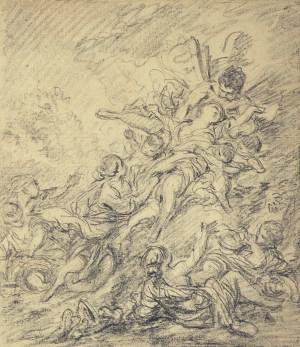
François Boucher, Boreas and Oreithyia, ca. 1749 or ca. 1769, black chalk (Snite Museum of Art, University of Notre Dame)
The Georgia Museum of Art (GMOA) at the University of Georgia will present the exhibition The Epic and the Intimate: French Drawings from the John D. Reilly Collection at the Snite Museum of Art from August 18 to November 3, 2012. Organized by Cheryl K. Snay at the Snite Museum of Art at the University of Notre Dame, this exhibition illustrates the history of French drawing from before the foundation of the Royal Academy of Painting and Sculpture in 1648 through the French Revolution of 1789 and its subsequent reforms of the 1800s. It includes works by Simon Vouet, Antoine Watteau, François Boucher, Jean-Honoré Fragonard and Jacques-Louis David.
“Each of these drawings is exquisite in its own right, and as a collection, they offer a compelling overview of the French Academy,” said Lynn Boland, GMOA’s Pierre Daura Curator of European Art and the in-house curator of the exhibition.
The drawings on display offer an opportunity to see a range of media, including chalk, colored chalks, ink and crayon; a variety of favored subjects, such as narrative compositions, portraits, landscapes and genre scenes; and types of drawings from figure and drapery studies to quick sketches of initial ideas to complex, multifigured, highly developed compositional works. From the grand “machines” that narrate epic history, such as Michael Dorigny’s Sacrifice to Juno or Anne-Louis Girodet de Roussy-Trioson’s Christ Led from Pilate, to the celebrations of singular, intimate moments, such as Watteau’s seated figure or Honoré Daumier’s observation of a woman putting bread in an oven, The Epic and the Intimate demonstrates an extensive range of both subject and medium. Later artists, including Pierre-Paul Prud’hon, Théodore Rousseau and Edgar Degas signal the transition into the modern era that glorified the individual and the local.
Snay explains, “Before drawing gained its autonomy from painting, sculpture and architecture in the 20th century, it was regarded as a means of ordering reality. It was understood to be the fundamental basis of all creative activity.” Many of the artists whose works appear in the exhibition belonged to the Académie royale de peinture et de sculpture (Royal Academy of Painting and Sculpture) in Paris, founded by the French government in 1648. Snay continues, “By holding government-sponsored exhibitions and commissioning large-scale projects, the Royal Academy monopolized the art market and became a model for many other academies in Europe and North America, ensuring France’s influence on material culture into the early 1900s.”
New Title | Inganno – The Art of Deception
To judge from the table of contents, I think this is really a collection of essays on the sixteenth century, though it does conclude with an eighteenth-century piece by Kristin Campbell, “‘Such is Picture Dealing’: Noel Joseph Desenfans (1745-1807) and the Perils of Purchasing in 18th-Century London.” -CH
◊ ◊ ◊ ◊ ◊
From Ashgate:
Sharon Gregory and Sally Anne Hickson, eds., Inganno – The Art of Deception: Imitation, Reception, and Deceit in Early Modern Art (Aldershot: Ashgate, 2012), 216 pages, 9781409431497, $105.
 The essays contained in this volume address issues surrounding the use, dissemination, and reception of copies and even deliberate forgeries within the history of art, focusing on paintings, prints and sculptures created and sold from the sixteenth century to the eighteenth century. The essays also probe contemporary sensibilities about the art of inganno, or deception, sometimes even viewed as pleasurable deception, in the making and viewing of copies among artists and their audiences.
Through specific case studies, the contributors explore the fine line between imitations and fakes, distinctions between the practice of copying as a discipline within the workshop and the willful misrepresentation of such copies on the part of artists, agents and experts in the evolving art market. They attempt to address the notion of when a copy becomes a fake and when thoughtful repetition of a model, emulation through imitation, becomes deliberate fraud. The essays also document developing taxonomies of professionals within the growth of the “business of art” from the workshops of the Renaissance to the salons and galleries of eighteenth-century London. As a whole, this volume opens up a new branch of art historical research concerned with the history and purpose of the copy.
Philadelphia Museum of Art Acquires ‘Fox and the Grapes’ Table
Thanks to Courtney Barnes for passing along this press release from the Philadelphia Museum of Art (dated 3 August 2012) . . .
 The Philadelphia Museum of Art has agreed to purchase the exceptional mahogany dressing table that has been on loan to the Museum for 36 years. Made in Philadelphia in the late 1760s or early 1770s, the table is the mate to the Museum’s monumental high chest, which was donated in 1957 by Amy Howe Steel Greenough. The dynamic carved decoration on both the high chest and the dressing table depicts a scene from Aesop’s fable of “The Fox and the Grapes” on their central drawers. The impressive proportions of these remarkable examples of 18th-century craftsmanship echo the architectural framework of the bedchamber for which they were made. Together, they epitomize the elegance and sophistication that distinguish Philadelphia furniture as the finest produced in British colonial North America.
“The Museum has now realized its cherished dream of keeping ‘The Fox and the Grapes’ dressing table together with its companion high chest,” said Timothy Rub, the Museum’s George D. Widener Director and Chief Executive Officer. “The two anchor our galleries of early American art; and now that their future together is secure, we can continue to display and interpret them as superlative artistic achievements.”
The high chest was known to Museum curators early in the 20th century when it was borrowed from Mary Fell Howe for the 1924 exhibition Philadelphia Chippendale. Lauded for its stately presence, highly figured mahogany, abundant carved ornament, and the rare depiction of a narrative from one of Aesop’s fables, the high chest also generated curiosity about whether or not its companion piece—the dressing table—was still in existence. “The Fox and the Grapes” dressing table was soon discovered and made its debut in William MacPherson Hornor, Jr.’s 1935 publication The Blue Book of Philadelphia Furniture: William Penn to George Washington. Joseph Kindig, Jr., the preeminent York, Pennsylvania, furniture and gun dealer, purchased the dressing table from Miss Eliza Davids in the late 1930s. Though Kindig was an antiques dealer, the dressing table was not offered for sale. Instead, it remained in the Kindig’s private home. Mr. Kindig died in 1971, and soon thereafter a friend of the Museum alerted curators to the whereabouts of the coveted “Fox and Grapes” dressing table. The Kindigs agreed to lend the dressing table so it could be displayed next to its high chest in 1976 for Philadelphia: Three Centuries of American Art, the great survey celebrating American art exhibited at the Museum during the bicentennial year. The two looked superb together—each had found its accompaniment—and after the exhibition closed, the dressing table remained on loan to the Museum. (more…)
ARIAH Prize for Online Publishing
From the Association of Research Institutes in Art History (ARIAH) . . .
ARIAH Prize for Online Publishing
Nomination due by 1 September 2012
 ARIAH looks for new initiatives to promote art historical research throughout the world, and invites nominations and self-nominations for the ARIAH Prize for Online Publishing. This award, which carries a $1,000 prize, seeks to encourage and promote high scholarly standards in online publishing in all fields of art history. The prize will be awarded annually to the author(s) of a distinguished article or essay published online in the past three years in the form of an e-journal or other short-form e-publication which advances the study of art history and visual culture. The article should either appear exclusively online, or should be substantially distinct from any print version, creatively capitalizing on the potential of digital publishing.
The competition is open to anyone, with the exception of delegates to ARIAH. Entries may be submitted by the author(s), or by others nominating authors for the prize, including publishers. Entries must be accompanied by the ARIAH Prize Entry Form.
Online publications must have appeared within three years of the submission date. All languages will be considered, but non-English submissions must also provide an English translation. Closing date for entries: September 1, 2012. Prize-winners will be notified by December 1, 2012. Please direct any questions to ARIAHprize@ariah.info
Articles and projects should contain substantial original scholarship and research, and enrich our understanding of art history and visual culture. Submissions will be considered that contribute new ideas and innovative approaches to the online presentation of information, and which exploit the potential offered by digital technology. Entries will be judged by a committee of ARIAH members.
Roundtable Discussion for New Book on Court Funerals
As noted at L’ApAhAu, in Paris on Thursday, 20 September 2012, at 6pm, the Fondation Maison des Sciences de l’Homme, in conjunction with the Centre de Recherche du Château de Versailles, will host a roundtable discussion with the authors of this new book on the role of court funerals in early modern Europe. The invitation (as a PDF) is available here»
◊ ◊ ◊ ◊ ◊
Juliusz A. Chrościcki, Mark Hengerer, Gérard Sabatier, Les funérailles princières en Europe, XVIe-XVIIIe siècle — Volume I : Le grand théâtre de la mort (Paris: Éditions de la Maison des sciences de l’homme, 2012), ISBN: 9782735114269, 47€. [Publication issue du colloque international des 14-16 octobre 2007 à Cracovie]
 Depuis une trentaine d’années, les historiens ont exploré la problématique de la « genèse de l’État moderne » en Europe entre le XVIe et le XVIIIe siècle, et son corollaire, la place centrale tenue par les cours princières dans le processus. L’objectif de ce livre est de s’interroger sur la part qu’ont pu y prendre les stratégies funéraires des familles souveraines. Ce livre propose une approche différente des travaux consacrés jusqu’à présent aux rituels funéraires princiers où l’histoire de l’art y est prépondérante. Les funérailles princières sont étudiées en terme de stratégies de la part des monarchies, comme rituel interne de transmission du pouvoir, mais aussi dans le cadre de leurs relations entre dynasties, et de leurs rapports tant avec leurs opinions publiques propres qu’avec une opinion européenne en formation.
Premier des trois volumes consacrés aux funérailles princières, l’ouvrage s’intéresse au déroulement des cérémonies en relation avec les institutions propres, la conjoncture, les traditions particulières, les rapports de force internes, l’insertion dans le jeu politique européen.
On Site | Kladruby Abbey Church, Czech Republic
Eighteenth-Century Encounters: Kladruby Abbey Church, Czech Republic
By Michael Yonan

Jan Blažej Santini-Aichl, Abbey Church of Kladruby,
near Stříbro, completed in 1726 (Photo by Michael Yonan)
◊ ◊ ◊ ◊ ◊
For most eighteenth-century specialists, the phenomenon of the period’s Gothic revival architecture is principally understood as an English one. Less well known is existence of another eighteenth-century Gothic, this one Central European. I’m speaking of the series of so-called Czech ‘Gothic Baroque’ churches by the Prague-born architect Jan Blažej Santini-Aichl (1677–1723). This summer I traveled to western Bohemia and, generously stewarded by art historian Dr. Martin Mádl, was able to visit one of the more distinctive of Santini-Aichl’s buildings: the abbey church of Kladruby, part of a complex of ecclesiastical buildings that make up a Benedictine cloister, located not far from the town of Stříbro.1
 From a distance, the church doesn’t immediately reveal its eighteenth-century origins. Its height, the pinnacled columns, exterior buttresses, and of course ogive arches all suggest a medieval vintage. That is until one notices the centralized cupola, an element whose arrangement and form is not typically Gothic. Dislocations of style and date increase as one enters the church. As with many Gothic buildings, Kladruby has a basilican plan and employs architectural forms like pointed arches and ribbed vaulting. But few, if any, Gothic churches look quite like this. The ribbed vaults zigzag into stylized lilies, the coat-of-arms of the local abbots. The interior’s pink and pistachio green tonalities, its original hues, are more reminiscent of the rococo than of medieval churches. And the illusionistically painted dome, replete with saints tumbling through the heavens and an oculus representing the Holy Spirit, recalls seventeenth-century Roman predecessors more than Chartres or Ulm. Kladruby reveals itself to be a surprising synthesis of late baroque and medieval architectural styles.
What could possibly explain this? As an American art historian trained to see eighteenth-century art through specific narratives, I’ll confess that this building floored me. To understand it, it helps to know the monastery’s history and the unique culture of Czech religious communities. A church was first consecrated here in 1233, not long after the abbey’s formation. In subsequent centuries the community’s fortunes waxed and waned; it fell into disarray in the sixteenth century and was conquered and plundered during the Thirty Years’ War. Repairs to its buildings began in 1653, but in 1712 the presiding abbot, Maurus Fintzguth, commissioned Santini-Aichl to build an entirely new church, the one we see today, which was completed in 1726.
‘New’ is not quite the right term, however. Most of what one encounters at Kladruby dates, in fact, from the eighteenth century, but scholars have speculated that somewhere within the walls are fragments of the original church. In constructing this new building out of and on top of its predecessor, Santini-Aichl described his architectural process as one of renovation. He did more than simply reconstruct an old church or build a new one on its site, but rather constructed something that simultaneously evokes its predecessor, incorporates it, and improves upon it. In this respect, Santini-Aichl’s building maintains and visualizes the monastery’s medieval history, which Fintzguth viewed as a Golden Age, even as it celebrates its modern resilience.
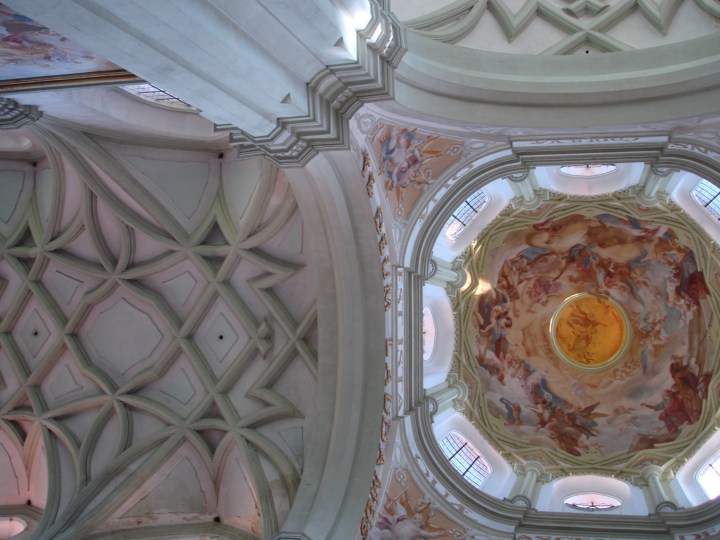
Some scholars have suggested that Kladruby is essentially an eighteenth-century building wrapped in Gothic skin, and indeed given what we know about the eighteenth-century love of surfaces, architectural and otherwise, this would seem to fit. But a recent article by the Czech art historian Pavel Kalina claims that the situation is actually more complicated.2 The interior ribbed vaulting is not used in a manner true to Gothic structural techniques, for sure, but neither is it entirely decorative. It’s somewhere in between, partially structural and partially ornamental, and in achieving this balance it combines medieval and eighteenth-century architectural knowledge. In this synthesis of old and new, Kalina argues, lie traces of dialogues between learned abbots and skilled artisans, as well as existential tensions between the abbey’s past and its present.
Kladruby isn’t an isolated example of such a synthesis. Santini-Aichl constructed a similar Gothic-baroque church at Sedlec, a village near the city of Kutná Hora, and he designed particularly daring synthesis of classical and Gothic architectural forms for the Pilgrimage Chapel of St. John Nepomuk at Žďár nad Sazavou. All are easily reachable as day trips from Prague.
◊ ◊ ◊ ◊ ◊
Notes
1. Three different 360-degree views of the church and its surroundings are available at 360globe.net. Martin Mádl’s wife, Claire Mádl, is editor and co-founder of the journal Cornova, the ‘Eighteenth-Century Studies’ of the Czech Republic.
2. Pavel Kalina, “In opere gotico unicus: The Hybrid Architecture of Jan Blažej Santini-Aichl and Patterns of Memory in Post-Reformation Bohemia,” Umění 58 (2010): 42–56.
◊ ◊ ◊ ◊ ◊
President of HECAA, Michael Yonan is Associate Professor of Art History at the University of Missouri-Columbia. His book, Empress Maria Theresa and the Politics of Habsburg Imperial Art, appeared in 2011 from Penn State University Press.
Colloquium | We Need to Talk about ‘Things’
From the CRASSH website:
We Need to Talk about ‘Things’: Concluding Colloquium
CRASSH, University of Cambridge, 27-28 September 2012
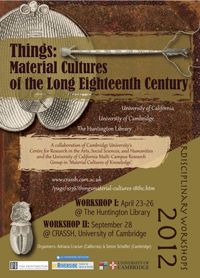 This year CRASSH has hosted a Graduate Research Group concerned with ‘Things: Material Cultures of the Long Eighteenth Century’. Our speakers have considered specific eighteenth-century objects ranging from coins to ships, porcelain to plants, from different disciplinary perspectives. We have discussed how these objects allow us to tell complex. inter-disciplinary stories about consumption, production and display in this period. This colloquium pulls together the speakers and themes that have defined the series. The day will consist of several papers with invited responses, as well as space for discussion. The colloquium is preceded by a keynote lecture by Professor Ludmilla Jordanova on Thursday evening, Talking about Things.
Both keynote lecture and colloquium talks on Friday 28 September are open to everyone. The lecture is free to attend and no registration is required. However, registration is required for the colloquium. The fee is £20 (including lunch and refreshments at the colloquium) with a reduced £10 charge for students. For information about the event and the graduate research group please contact Katy Barrett or Sophie Waring.
◊ ◊ ◊ ◊ ◊
P R O G R A M M E
Thursday, 27 September
18.00 Keynote Lecture, Ludmilla Jordanova (King’s College London) — Talking about Things
19.00 Drinks reception at CRASSH
Friday, 28 September
9.00 Registration and coffee
9.30 Welcome and Introduction — Sophie Waring (University of Cambridge) and Katy Barrett (University of Cambridge)
9.45 Session 1: W R I T T E N T H I N G S — Chair: Dr Luisa Calè (Birkbeck College, London)
• Sarah Kareem (University of California, Los Angeles) — Romantic Bubbles, Fictional Worlds
• Leanna McLaughlin (University of California, Riverside) — “A Lampoon Put on his Door”: Poetry and Politics, 1678-1689
11.15 Coffee break
11.45 Session 2: F A M I L I A R T H I N G S — Chair: Dr Melissa Calaresu (University of Cambridge)
• Sara Pennell (University of Roehampton) — Familiarity Breeds Contempt? ‘Everyday’ Objects and ‘Small Things Forgotten’ in the early modern English Household
• Melanie Keene (University of Cambridge) — Title tbc
13.15 Lunch
14.15 Session 3: G E N D E R E D T H I N G S — Chair: Dr Elizabeth Eger (Kings College London)
• Catherine Eagleton (British Museum) — Sarah Sophia Banks: Money, Medals and a ‘Collection of Scraps’
• Mary Brooks (University of Durham) — Curiosities from Female Hands
15.45 Tea Break
16.15 Session 4: T R A V E L L I N G T H I N G S
• Mary Terrall (University of California, Los Angeles) — The Dynamics of Natural History: Collecting and Collections in the Eighteenth Century
• Jonathan Eacott (University of California, Riverside) — Few Constitutions Can Stand Against East Indian Luxury: Tropical Lifestyles and the Health of Britain’s Global Power
Forthcoming | From Books to Bezoars: Sloane and His Collections
Due in November from the University of Chicago Press:
Michael Hunter, Alison Walker, and Arthur MacGregor, eds., From Books to Bezoars: Sir Hans Sloane and His Collections (Chicago: University of Chicago Press, 2012), 296 pages, ISBN: 9780712358804, $60.
 This well-illustrated volume offers fresh perspectives on the great eighteenth-century physician, naturalist, and collector Sir Hans Sloane (1660–1753), whose extensive holdings formed the basis of the British Museum and its offspring, the Natural History Museum and the British Library. The colonial milieu within which Sloane operated gets prominence here, particularly the time he spent in Jamaica. Attention is paid to his enormous network of acquaintances and correspondents throughout the world as well as to the way his collecting activities permeated every aspect of his life. Other essays consider the museum specimens accumulated by Sloane—both natural and man-made—shedding new light on his aims for acquiring and organizing them. A fascinating look at the man behind three of the United Kingdom’s most famous museums, From Books to Bezoars will appeal to students and scholars of eighteenth century studies, early modern science, and the history of the book.
Conference | Histories of British Art, 1660-1735
From the University of York:
Histories of British Art, 1660-1735
King’s Manor, University of York, 20-22 September 2012
Organized by Claudine Van Hensbergen
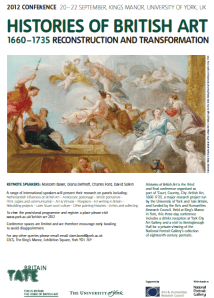 Histories of British Art is the third and final conference organised as part of Court, Country, City: British Art 1660-1735, a major research project run by the University of York and Tate Britain, and funded by the Arts and Humanities Research Council. Held at the King’s Manor in York, this three-day conference includes a drinks reception at York City Art Gallery and a visit to Beningbrough Hall (built 1716) for a private viewing of the National Portrait Gallery’s collection of over a hundred artworks from the period.
Keynote speakers: Malcolm Baker, Diana Dethloff, Charles Ford, and David Solkin
Conference spaces are limited and we therefore encourage early booking to avoid disappointment. For any other queries please email email clare.bond@york.ac.uk
◊ ◊ ◊ ◊ ◊
P R O G R A M M E (more…)
Exhibition | Dutch Country Houses
As noted at Art Daily:
Fresh Air!: City Dwellers and Their Country Houses
Naar Buiten! – Stedelingen en hun Buitenplaatsen
Geelvinck Hinlopen House, Amsterdam, 11 July 2012 — 4 February 2013

Jan van der Heyden, Elswout House and Gardens , ca. 1660 (Haarlem: Frans Hals Museum)
Since the Dutch Golden Age of the 17th century, those, who could afford it, fled the malodour of the city during the summer months. In a time span of three centuries, over 6000 summer residences appeared all over the country and especially around Amsterdam. Today, some 10% of these historic houses for the summer still survive. This exhibition tells the story of these houses, why they came into existence, how the city dwellers spend their time during summer and how the once spectacular gardens and parks of these houses are maintained and reconstructed today.
The leading theme of the exhibition concerns the rich and influential bourgeoisie families who once lived in the city palace Geelvinck Hinlopen Huis. Their palatial country houses were exemplary. Many still exist and often the gardens can be visited. Important exhibits, such as a painting of the country house and gardens of Elswout by Jan van der Heyden (1637-1712) on loan from the Frans Hals Museum, a huge painting of a city garden The Courtyard of the Proveniershuis (1735) by Vincent Laurensz van der Vinne II (1686-1742) on loan from the Rijksmuseum Twente and a large reverse glass painting of the country house of Soelen by Jonas Zeuner (1727-1814) on loan from the Amsterdam Museum, are on view. Connected to the exhibition is a new website, which stimulates visiting the gardens and parks of the country houses around Amsterdam, which are open for the public. . .
The full article is available here»










 Enfilade
leave a comment