Exhibition | Renaissance to Goya: Prints and Drawings in Spain
From The British Museum:
Renaissance to Goya: Prints and Drawings Made in Spain
The British Museum, London, 20 September 2012 — 5 January 2013
The Art Gallery of New South Wales, Sydney, 31 August — 24 November 2013
New Mexico Museum of Art, Santa Fe, 14 December — 9 March 2014
Curated by Mark McDonald
Spanish prints and drawings is a subject that is little known outside Spain. It is generally assumed these were marginal arts practiced only by a few well-known artists, including José de Ribera, Bartolomé Murillo and Francisco de Goya. The aim of this project is to explore the largely unchartered territory of the origins, form and function of prints and drawings in Spain. It will present for the first time a coherent study, largely based on the collections of the British Museum, that looks at their history from around 1400 through to and including Goya (died 1828). It will also present new research on the subject of the graphic arts in Spain. The material will be published in a monograph to accompany an exhibition at the British Museum in late 2012.
It is the first time prints and drawings made in Spain have been studied together. A critical aspect of the project will be to consider the presence of foreign artists working in Spain and how they contributed to the artistic landscape. Particular attention will be given to the different types of prints and drawings and their many functions to convey the role they played in artistic practice and visual culture in Spain (architectural prints and drawings, reproductive prints, landscape, religious subjects, prints made for commemorative purposes, fans, playing cards and more).
◊ ◊ ◊ ◊ ◊
Due out in October from Ashgate:
Catalogue: Mark McDonald, Renaissance to Goya: Prints and Drawings Made in Spain (Aldershot: Lund Humphries, 2012), 320 pages, ISBN: 9781848221185.
 The rich tradition of printmaking and drawing in Spain has rarely been examined, in part because of the misapprehension that Spanish artists did not draw and few turned their hand to printmaking. This spectacular study of prints and drawings will for the first time examine the history of graphic practice in Spain, providing an overview of more than 400 years of artistic production.
The story begins in the late 15th century with convergence of foreign artists in Spain who introduced new techniques and ideas. The most significant changes were brought about through the building of Philip II’s monastery of the Escorial near Madrid. Large numbers of foreign artists arrived to decorate the monastery. They included the Italians Pellegrino Tibaldi and Federico Zuccaro and the Flemish printmaker Pedro Perret, whose engravings of the Escorial are among the most remarkable architectural prints of the period. At the Escorial the international influences formed the basis of artistic practice and contributed to the distinctive appearance of art produced in Spain.
The ‘Golden Age’ — a dramatic flourishing of artistic and literary endeavour in Spain during the 17th century — is celebrated through discussion of key works by the most important visual artists of the period: Alonso Berruguete; the Carducho brothers; Murillo; Ribera; Zurbarán and the extraordinary drawings of Velázquez, about which very little is known. Each region of Spain is explored separately as independent centres of artistic activity during this time with prints and drawings examined together to demonstrate how their production was closely linked.
The book concludes with the Enlightenment and the 18th century, with a study of remarkable prints and drawings by Francisco de Goya. Goya’s important Spanish contemporaries are examined alongside the works of foreign artists who continued to come to Spain, such as the Tiepolo family who worked in Madrid.
Contents
Introduction
1. Prints and Drawings in Spain: Attitudes and Evidence
2. Drawings and Prints before 1500 and Early Collecting in Spain
3. Importing Graphic Practices: Castile 1550–1600
4. Madrid as Artistic Capital 1600–1700
5. Andalusia 1500–1700
6. Valencia 1500–1700 and Ribera in Naples
7. The Eighteenth-Century Reinvention of the Graphic Arts
8. Francisco de Goya
Appendix by Clara de la Peña McTigue, Spanish Paper and Papermaking
Bibliography
Mark McDonald is curator of Old Master prints and Spanish drawings at the British Museum. He has published widely on the subject of Old Master prints from the 15th to the 18th centuries, with special interest in the Renaissance period. He is the author of The Print Collection of Ferdinand Columbus (1488–1539): A Renaissance Collector in Seville (winner of the Mitchell Prize 2005).
◊ ◊ ◊ ◊ ◊
Note (added 1 September 2013) — The original posting did not include the Sydney venue; more information is available here»
Note (added 21 December 2013) — Earlier versions did not include Santa Fe venue; more information is available here».
The Art Market and the Pursuit of Superlatives
At Enfilade we’ve noted a number of the events described in this article from the WSJ — including Masterpiece London, Treasures, Prince Taste at Sotheby’s, and the Exceptional Sale at Christie’s. Emma Cricthton-Miller here addresses the trend toward singularity and the strength of the high end of the market for art and luxury goods.
◊ ◊ ◊ ◊ ◊
From The Wall Street Journal:
Emma Crichton-Miller, “Redefining ‘Masterpiece’: How a Shift in Collectors’ Focus Is Changing the Art World,” The Wall Street Journal (28 June 2012).
Once, London’s Grosvenor House Art and Antiques Fair was as integral a part of the English summer season as Henley or Ascot. This year, its successor, Masterpiece, whose third edition runs through July 4, reaffirms its claim to Wimbledon fortnight. In between the big auctions at Sotheby’s, Christie’s and Bonhams, and running in tandem with Master Paintings Week (until July 6), the fair looks to attract a young international audience usually more inclined to spend its money on great wine, fine jewelry or fast cars, to the alternative pleasures of Old Master paintings, contemporary ceramics, antique sculptures or Georgian furniture.
The key to the event is its name. It is under the “masterpiece” rubric . . . This approach has come to dominate fairs and sale rooms around the globe, as collectors focus on outstanding individual examples across categories rather than box-ticking must-haves within a single category. For critics, it aligns art directly with luxury, suggesting that what ultimately unites these objects is their availability only to the very wealthy. But more broadly, it reflects a shift within the market that is changing how we look at objects, understand collections and live with art.
As newspaper headlines indicate, the top end of the market has emerged largely unscathed from the world financial crisis. Records continue to be broken, most recently with the $119.9 million May sale of Munch’s pastel The Scream (1895), now the most expensive work of art ever sold at auction. The middle of the market, however, has become more difficult, as auction houses struggle to sell pieces from less well-known artists and periods. . .
The full article is available here»
Dissertations
From caa.reviews:
Dissertation Listings
PhD dissertation authors and titles in art history and visual studies from US and Canadian institutions are published each year in caa.reviews. Titles can be browsed by subject category or year.
Titles are submitted once a year by each institution granting the PhD in art history and/or visual studies. Submissions are not accepted from individuals, who should contact their department chair or secretary for more information. Department chairs: please consult our dissertation submission guidelines for instructions. The annual deadline is January 15 for titles from the preceding year.
In 2003, CAA revised the subject area categories of art history and visual studies used for all our listings, including dissertations. These categories are listed in the Dissertation Submission Guidelines
◊ ◊ ◊ ◊ ◊
The index for 2011 lists eight eighteenth-century dissertations completed, including:
• Frederique Baumgartner, “Transformation of the Cultural Experience: The Art of Hubert Robert during the French Revolution” (Harvard, E. Lajer-Burcharth)
• Christina Ferando, “Staging Canova: Sculpture, Connoisseurship, and Display, 1780–1822” (Columbia, J. Crary, A. Higonnet)
• Katie Hanson, “A Neoclassical Conundrum: Painting Greek Mythology in France, 1780–1825” (CUNY, P. Mainardi)
• Amanda Lahikainen, “Unchecked Ideas: Humor and the French Revolution in Late Eighteen-Century British Political Graphic Satire” (Brown, K. D. Kriz)
and forty-one dissertations in progress, including:
• Katherine Arpen, “Pleasure and the Body: Representations of Bathing in Eighteenth-Century French Art” (UNC Chapel Hill, M. Sheriff)
• Julie Boivin, “Horrid Beauty: Rococo Ornament and Contemporary Visual Culture” (Toronto, M. Cheetham)
• Elizabeth Berler Brand, “Representing Natural History in Philadelphia, 1770–1820” (UT Austin, S. Rather, M. Cohen)
• Lauren Cannady, “Owing to Nature and Art: The Garden Landscape and Decorative Painting in Eighteenth-Century French Pavillons de Plaisance” (IFA/NYU, T. Crow)
• Zirwat Chowdhury, “‘Imperceptible Transitions’: The Anglo-Indianization of British Architecture, 1768–1820” (Northwestern, S. H. Clayson)
• Katelyn D. Crawford, “Itinerant Portraitists in the Late Eighteenth-Century British Atlantic World” (Virginia, M. McInnis)
• Lindsay Dunn, “A Revolutionary Empress: Figuring Dynastic Power and National Identity in Representations of Marie-Louise, House of Habsburg-Lorraine (1791–1847)” (UNC Chapel Hill, M. Sheriff)
• Emily Everhart, “The Power of Friendship: Madame de Pompadour, Catherine the Great, and Representations of Friendship in Eighteenth-Century Art” (Georgia, A. Luxenberg, A. Kirin)
• Jessica Fripp, “Portraiture as Social Practice: The Creation, Collection, and Exchange of Portraits of Artists in Eighteenth-Century France” (Michigan, S. Siegfried)
• Daniel Fulco, “Palace Frescoes as an Expression of Princely Power in Early Modern Germany: Five Representative Examples” (Illinois at Urbana–Champaign, D. O’Brien)
• Meredith Gamer, “Criminal and Martyr: Art and Religion in Britain’s Early Modern Eighteenth Century” (Yale, T. Barringer)
• Victoria Sears Goldman, “‘The most beautiful Punchinelli in the world’: A Comprehensive Study of the Punchinello Drawings of Giovanni Battista Tiepolo” (Princeton, T. DaCosta Kaufmann)
• Jennifer Jones, “A Discourse on Drawings: P. J. Mariette and the Graphic Arts in Early Eighteenth-Century Paris” (Columbia, D. Rosand)
• Jason LaFountain, “The Puritan Art World” (Harvard, J. Roberts)
• David Pullins, “Cut and Paste: The Mobile Image from Watteau to Pillement” (Harvard, E. Lajer-Burcharth)
• Brian Repetto, “Impressing the Patriot: Visual Culture and Revolution in the Eighteenth-Century Netherlands” (Brown, J. Muller)
• Ünver Rüstem, “Architecture for a New Age: Imperial Ottoman Mosques in Eighteenth-Century Istanbul” (Harvard, G. Necipoğlu)
• Susan Wager, “Boucher’s Bijoux: Luxury Reproductions in the Age of Enlightenment” (Columbia, A. Higonnet)
• Diane Woodin, “Embodied Constellations: Representations of Science, Gender, and Social Allegiance in the Eighteenth Century” (UNC Chapel Hill, M. Sheriff)
Display | The King’s Artists: George III’s Academy
Now on view at the Royal Academy, as noted at British Art Research:
The King’s Artists: George III’s Academy
The Royal Academy of Arts, London, 25 May — 21 October 2012

Joshua Reynolds, Portrait of King George III, 1779. Oil on canvas, 2774 x 1855 mm. Photo: John Hammond. © Royal Academy of Arts, London
Part of a series of displays to celebrate The Queen’s Diamond Jubilee, The King’s Artists explores the influence that George III had on the early shaping and history of the Royal Academy of Arts and how his support contributed to its success.
Dominating the exhibition are the imposing portraits of George III and Queen Charlotte, painted by Sir Joshua Reynolds to hang in the Academy’s council chamber. These served as physical reminders of the Academy’s great patrons, presiding over the institution in its resplendent, purpose-built, new apartments in Somerset House.
A newly attributed chalk study by Reynolds for his grand portrait of the monarch, on loan from a private collection, will be shown for the first time alongside the finished oil painting. Hurriedly taken in the brief sittings that the King allowed, this drawing is a poignant reminder of how George and Joshua were obliged to put aside mutual antipathy for the sake of their Academy as it was about to move to Somerset House. Sculpture, drawings, prints and archival materials exploring the Academy’s royal connections are also on view.
George Washington’s Constitution Sells for Record Price
With the Constitution of the United States as ideologically charged as ever, it’s hardly a surprise that George Washington’s own annotated copy would sell for a record price — almost $10 million. While I’m glad to know that it’s going back to Mount Vernon, my hunch is that this hardly marks the end of the politicization of this crucial historical document. -CH
◊ ◊ ◊ ◊ ◊
As Patrick Hruby reports for The Washington Times (22 June 2012) . . .
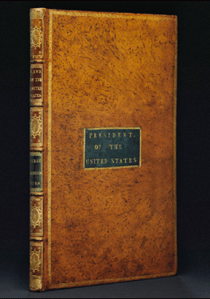 Having set a world record, George Washington’s personal copy of the Constitution is heading home. A book containing Washington’s annotated Constitution and a draft of the Bill of Rights was purchased for almost $10 million by the Mount Vernon Ladies’ Association in an auction Friday [22 June 2012] at Christie’s in New York.
Printed and bound in 1789, the book featuring Washington’s signature on the title page sold for a winning bid of $9,826,500 — an amount the venerable auction house said was a world auction record for an American book or historical document.
Part of Washington’s original private library at Mount Vernon, the book will once again be housed at the historic Virginia estate as part of the collection at the Fred W. Smith National Library for the Study of George Washington, currently under construction and set to open next fall. . .
The full article is available here»
◊ ◊ ◊ ◊ ◊
The Mount Vernon website provides an overview of the National Library for the Study of George Washington, including the following:
The 45,000-square-foot library will occupy a 15-acre site to the west of George Washington’s historic home on the banks of the Potomac River. A drive winding through a woodland of native trees and plantings will lead to the building’s entrance court and visitor parking area. A 6,000-square-foot Scholars’ Residence adjacent to the library will provide living quarters for up to eight resident scholars. . .
Display | The Atlantic World at Tate Britain
From Tate Britain:
Atlantic Britain
Tate Britain, London, 5 December 2011 – 4 November 2012
Curated by Martin Myrone

James Barry, William Pitt, Earl of Chatham, Etching, line-engraving and aquatint on paper (London: Tate Britain)
The history of British art has often been told as an ‘island story’, as if the visual arts were directly shaped by the immediate social and physical environment. The modesty and naturalism of British art has been explained with reference to a mythic ‘national character’. However, all the paintings displayed here illuminate a different history – that of the ‘Atlantic world’ which connected Africa, Europe and the Americas.
British investments and colonial settlement in North America and the West Indies expanded enormously in the eighteenth century. Military successes during the Seven Years War (1756-63) resulted in Britain becoming the dominant European force in the American colonies. Even after the declaration of political independence by the North Americans in 1776, Britain remained tied to an Atlantic economy. The circulation around the Atlantic of money, goods, ideas and people (not least in the form of enslaved Africans) underpinned economic and cultural development well into the
nineteenth century.
Britain’s imperial and economic relationships were rarely addressed directly by artists in the period. But underlying these apparently unrelated works are stories which reveal how even the most parochial-looking of British paintings may be connected to a larger history of trade, war and imperial exploitation.
An illustrated checklist of all works included in the display is available here»
Announcement | Steven Pincus Appointed Editor of ECS
Many of you will have seen this announcement (2 July 2012) regarding Eighteenth-Century Studies (I’ve inserted the links). -CH
◊ ◊ ◊ ◊ ◊
It is a pleasure to inform you that the Executive Board of the American Society for Eighteenth-Century Studies has appointed Steven Pincus, Yale University, as Editor of Eighteenth-Century Studies for a five-year term effective 1 July 2012. We want to thank the Yale University community for their willingness to assume this important responsibility and to provide support for this flag-ship journal.
Finally, the officers and Executive Board of ASECS wish to thank Julia Simon for her outstanding service as editor of ECS, and wish her the best of luck on her retirement from the journal.
Byron R. Wells
Executive Director, ASECS
Online Resource | Le Comte de Caylus
A cooperative project involving the Bibliothèque nationale de France (BnF), the Institut National d’Histoire de l’Art (INHA), and the Centre d’Anthropologie et d’Histoire des Mondes Anciens (Centre ANHIMA), this online resource provides a wealth of information on Caylus (biographical and bibliographical) as well as digital access to the seven volumes of the Recueil d’Antiquités. There is also a searchable catalogue of the collection of objects. Thanks to Hélène Bremer for noting such an important resource.

◊ ◊ ◊ ◊ ◊
From the website:
Le comte de Caylus (1692-1765) a été un personnage clé du XVIIIe siècle, à la fois homme de lettres aux talents multiples, dramaturge, romancier fin observateur des mœurs de son temps, conteur, traducteur, mais aussi antiquaire érudit, collectionneur, mécène, graveur, membre de l’Académie de peinture et de sculpture en 1731, de l’Académie des Inscriptions et Belles Lettres en 1742, de l’Académie de France à Rome, ardent défenseur de la grande peinture et du goût à l’antique.
Ce site explore une de ces multiples facettes, son rôle de pionnier de l’archéologie, par l’édition numérique commentée et enrichie de son œuvre majeure, le Recueil d’antiquités égyptiennes, étrusques, grecques, romaines et gauloises, publiée en sept volumes entre 1752 et 1767.
Dans ce recueil, Caylus a étudié et fait dessiner près de 2900 objets, provenant majoritairement de ses collections, offertes au roi au fur et à mesure de l’avancement de ses travaux. En effet, sa collection n’était pas un but en soi, mais un laboratoire d’étude et d’expérimentation, ainsi qu’il l’écrit : « Je ne fais point un cabinet, je fais un cours d’antiquité, et je cherche les usages, ce qui les prouve, les pratique, ce qui les démontre. » (lettre à Paciaudi, 1758). L’objet, si modeste soit-il, devient un moyen de connaissance du passé et la base d’une réflexion sur l’histoire des arts
L’exégèse et le dépouillement systématique du recueil ont pour but de mettre en lumière la démarche de Caylus, qui apparaît comme un précurseur de la méthode typologique, de proposer un panorama du savoir antiquaire au XVIIIe siècle et du réseau intellectuel européen.
Le site s’articule autour de trois axes :
• La personnalité du comte de Caylus, sa biographie, sa bibliographie ainsi qu’une bibliographie de ses œuvres relatives à l’art et à l’archéologie.
• Le Recueil d’Antiquités avec accès à la version numérisée – tout d’abord en mode image, puis, dans un futur proche, en mode texte ; une analyse du Recueil et de la méthode de Caylus ; le recensement des sources utilisées dans le Recueil, qui forment en quelque sorte la « bibliothèque » de Caylus.
• Le catalogue des objets(« base Caylus »), qui présente en vis-à-vis l’analyse de Caylus et celle que nous pouvons faire aujourd’hui. Cette confrontation de deux fiches , la fiche « ancienne » qui reprend en les synthétisant les notices de Caylus – qui peuvent s’étendre de quelques lignes à plusieurs pages – et classe le riche matériel fourni, et la fiche moderne qui propose datation, attribution et bibliographie, est complétée par la mise en regard de la gravure faite pour le Recueil et de la photographie de l’objet dans son état actuel. Les photographies, encore peu nombreuses, seront insérées peu à peu . 60% environ des œuvres ont été retrouvées, nous espérons que cette publication permettra de faire ressurgir de l’oubli celles qui ont été dispersées
Des enrichissements sont prévus :
• une base de données biographiques et bibliographiques sur les érudits mentionnés dans le Recueil, qui permettra de mieux appréhender le réseau intellectuel de Caylus
• l’accès direct à la numérisation des ouvrages utilisés par Caylus, de ses sources manuscrites et iconographiques
Le site est le fruit d’une coopération entre la Bibliothèque nationale de France (BnF), l’Institut National d’Histoire de l’Art (INHA) et le centre d’Anthropologie et d’Histoire des Mondes Anciens (ANHIMA).
At Christie’s | Old Master and Early British Drawings and Watercolors
Press release, dated 22 June 2012, from Christie’s:
Old Master and Early British Drawings and Watercolours (Sale 5688)
Christie’s, London, 3 July 2012

Lot 68: Charles de La Fosse, A Mounted Soldier, Seen from Behind, black, red and white chalk on buff paper, Christie’s Estimate: £20,000 – 30,000
Christie’s announced the sale of Old Master and Early British Drawings and Watercolours which will take place on 3 July 2012, during London’s Master Drawings week. Featuring a selection of works by Old Masters that have been recently discovered, this auction offers the opportunity to acquire drawings and watercolours which have not been seen in public for up to 100 years. Comprising 168 lots, the sale is expected to realise in excess of £3 million. Headlining an important group of newly discovered drawings by Rembrandt (1606-1669) and his school is A Blind Beggar with a Boy and a Dog (estimate: £50,000 – 80,000). This group of six previously unpublished drawings was discovered in the attic of a Scottish country house in 2012 and has not been seen for over 100 years.
Benjamin Peronnet: International Head of Department, Old Master Drawings: “It is always a thrill to discover and to have the opportunity to offer for sale previously unrecorded drawings. This group is particularly exciting as it includes a drawing by Rembrandt himself and six by his pupils. They offer a rare overview of his studio practices and how his pupils reinterpreted and developed his technique.” The group also contains works after Willem Drost and by Samuel van Hoogstraten (1627-1678). An intricate drawing by Ferdinand Bol (1616-1680), Jacob and Rachel, bears all the trademarks of Bol’s style depicting figures in historic dress and also shows the strong influence Rembrandt’s work had on Bol (estimate: £20,000-30,000). This exceptional group is expected to realise a combined total in the region of £100,000.
Further highlights include a rare survival: a cartoon by Michelangelo Anselmi (1491-1554) for his frescoes in the Cathedral of Parma. The frescoes have since been overpainted but this cartoon section of Putti dancing with hoops hints at the elaborate design that once filled the vaults of the Duomo and is the only surviving segment of the cartoons. It is expected to realise between £150,000 and £250,000.
Also on offer is a previously unpublished drawing by Giovanni Battista Tiepolo (1696-1770) estimated at £100,000 – 150,000. This large-scale drawing includes preparatory studies for the figure of Mars and for a prostrate captive, both of whom appear in the fresco of Apollo and the Continents above the main staircase of the Residenz at Würzburg, considered to be Tiepolo’s greatest masterpiece. Between 1750 and 1753, Giovanni Battista Tiepolo and his sons Domenico and Lorenzo executed a monumental decorative scheme in this palace of the Prince-Bishops of Würzburg, which had been completed only a few years previously.

Lot 69: Jean-Etienne Liotard, A Pensive Woman on a Sofa, tempera on vellum, pen and black ink framing lines on the left and top edges, on cardboard. Estimate: £400,000 – 600,000
Coming to auction for the first time is an exquisite work on vellum by Jean-Etienne Liotard (1702-1789); Pensive Woman on a Sofa is based on a lost drawing of which only a counterproof is known, now in the Louvre. One of Liotard’s most compelling compositions executed on an intricate scale it is estimated at £400,000 – 600,000. The drawing was executed by the artist during his travels in the Greek islands and Turkey between 1738 and 1742. The subject sits in a pose which echoes Dürer’s Melencolia, with a crumpled letter discarded beside her, symbolizing the end of a relationship. Another pensive figure is seen in an imposing work by Caspar David Friedrich (1774-1840), A Seated Man with a Telescope on White Chalk Cliffs, in which a tiny figure of a man is shown in a vast landscape looking into the infinite distance (estimate: £200,000-300,000). (more…)
Francis Haskell Memorial Fund
As noted in the latest issue of CAA News (20 June 2012) and posted at CAA (from The Burlington Magazine) . . .
Francis Haskell Memorial Fund
Applications due by 10 September 2012
Grants of up to £2000 will be awarded from the Francis Haskell Memorial Fund this year to enable scholars to spend time in libraries or archives carrying out advanced research in the history of western art. Preference may be given to candidates in the early stages of their careers; to subjects related to the commissioning, collecting or interpretation of works of art made before 1914; and to research carried out outside the applicant’s country of residence. Scholars from any country may apply.
Applications, including a two-page proposal, a C.V. and a budget, should be sent by email to carolineelam@yahoo.co.uk by 10th September 2012 – please label all attachments with surname of applicant. There is no application form. Applicants should ask two referees to write separately to the same email address by the same deadline in support of their proposals. Awards will be made by 31st October 2012.










 Enfilade
1 comment