CAA Joins JSTOR Register & Read Program
As noted at CAA News (2 July 2012):
 CAA has joined JSTOR’s new Register & Read program, which offers free, read-online access to a wide-range of academic journals to independent scholars and researchers. The service is designed to make scholarship available to those not affiliated with a subscribing institution by allowing them to register for a MyJSTOR account.
CAA is pleased to contribute the full back run of The Art Bulletin and Art Journal, through 2008, to an expanding, eclectic list that includes BOMB Magazine, Film Quarterly, Modern Law Review, and American Journal of Sociology. All articles from The Art Bulletin and Art Journal during this time will be available for individuals to read and, in some instances, to download and purchase as a PDF file.
Since JSTOR launched Register & Read in January 2012, approximately forty publishers have contributed material from seventy-seven journals to the beta site. The user-friendly program mimics the experience of a library by allowing visitors to store up to three articles on a virtual shelf for two weeks before exchanging items. Feedback is key to improving the borrowing service that Register & Read provides. JSTOR plans to perfect the functionality of the program and enlarge its scope to meet the unique research needs of the scholarly community.
Conference | Emblems of Nationhood: Britishness 1707-1901
From St Andrews:
Emblems of Nationhood: Britishness 1707–1901, A Multidisciplinary Conference
University of St Andrews, 10-12 August 2012
 National identity is a central point of enquiry that is repeatedly called upon in contemporary social and political rhetoric. Our conference, Emblems of Nationhood, 1707–1901, will address the roots of this theme by discussing depictions of Britain and Britishness in literature, philosophy, and art between the Act of Union in 1707 and the death of Queen Victoria in 1901. Over the course of this multidisciplinary conference, we aim to explore how expressions of nationalism have moulded both critical perspectives on national identity and their creative products.
Discussing emblems of nationhood in 2012 is a fitting way to mark the twentieth anniversary of Linda Colley’s seminal account of Britishness, Britons: Forging the Nation, and coincides with the Queen’s Diamond Jubilee. Several broad questions could potentially be explored in the course of the conference: What did Britishness mean in the eighteenth and nineteenth centuries, and how was it represented and perceived? To what extent is nationalism tied with military events and empire building? How “British” was Britain before the launch of the Empire? How did concepts of nationalism enter the public consciousness, both within the British Isles and abroad? What is the impact of artistic and cultural depictions of Britain and Britishness in domestic and international contexts? How can these historical ideas of Britishness enhance our contemporary understanding of the concepts of nationalism and national identity?
Speakers include: Colin Kidd, Emma Major, Linda Colley, and Calum Colvin
Details on the full programme and registration are available at the conference website.
Exhibition | Messerschmidt and Modernity
Press release (16 April 2012) from The Getty:
◊ ◊ ◊ ◊ ◊
Messerschmidt and Modernity
The J. Paul Getty Museum, Getty Center, Los Angeles, 24 July — 14 October 2012

The Getty Celebrates the Modern and Contemporary Legacy of Franz Xaver Messerschmidt’s Distinctive Character Heads
◊ ◊ ◊ ◊ ◊

Ken Gonzales-Day, Untitled (Franz Xaver Messerschmidt, The Vexed Man, The J. Paul Getty Museum, Los Angeles, CA), 2008. Light jet print. Courtesy of Ken Gonzales-Day and Fred Torres Collaborations, N.Y.C. © Ken Gonzales-Day
The intriguing series of heads that are collectively known as Character Heads, created by the German Baroque artist Franz Xaver Messerschmidt (1736–1783) during the last 13 years of his life, have become increasingly popular with the general public through a series of recent exhibitions and books devoted to these expressive works. Furthermore, the sculptures, depicting various states of emotion and expression, have also captured the imaginations of generations of artists—especially during the 20th and 21st centuries.
Messerschmidt and Modernity, on view at the J. Paul Getty Museum from July 24 through October 14, 2012, is the first exhibition to explore the contemporary legacy of these surprisingly modern-looking sculptures, which were carved in alabaster, or cast in a lead or tin alloy. Along with Messerschmidt’s works, the exhibition will feature a selection of modern and contemporary works of art that testify to the lasting impact of these astonishing heads. Eight Character Heads will be exhibited—among them the Getty’s own Vexed Man— along with a newly discovered reduced variation of a now-lost Character Head known as A Cheeky Nitpicky Mocker, which has never before been exhibited publicly. Contemporary artists featured in the exhibition include Tony Bevan, Tony Cragg, Ken Gonzales-Day, Bruce Nauman, Pierre Picot, Arnulf Rainer, Cindy Sherman, and Emily Young.
“Messerschmidt’s Character Heads have appealed to audiences since they were first produced. They were especially popular in turn-of-the-century Vienna and subsequently inspired modern artists of the 20th century,” explains Antonia Boström, senior curator of sculpture and decorative arts at the J. Paul Getty Museum. “Now, this unparalleled series of sculptures is enjoying a renewed popularity—not only fascinating to museum audiences and scholars, but compelling for contemporary artists.”
The exhibition demonstrates how Messerschmidt’s heads are linked to the 18th and 19th centuries’ fascination with expression and the “passions,” as well as with the pseudosciences of physiognomy and pathognomy. It also traces how this series has influenced the work of artists in fin-de-siècle Vienna and contemporary artists in Austria, Great Britain, and the United States.
Messerschmidt
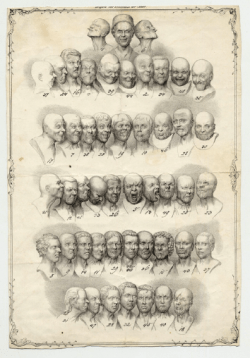
Matthias Rudolph Toma, Messerschmidt’s ‘Character Heads’, 1839. Lithograph. Courtesy of the Museum of Fine Arts, Budapest.
The German-born Messerschmidt led a successful career in Vienna in the mid-18th century, receiving many important commissions from the Habsburg empress Maria Theresa and her consort, Francis Stephen of Lorraine. Messerschmidt’s circumstances changed dramatically around 1770 when he began to show signs of mental instability, leading to the loss of prestigious commissions and conflicts with colleagues and friends. He eventually left Vienna and, in 1777, he settled in Pressburg (now Bratislava), and remained there until his death in 1783, focusing obsessively on the production of the heads as well as more conventional portraits. Messerschmidt called the dozens of heads he created between 1770 and 1783 Kopfstücke (head pieces) and intended them to represent the full range of human expressions, which he believed there are sixty-four. In 1793, ten years after his death, the heads were exhibited at the Citizen’s Hospital in Vienna, when, despite their misrepresentation, they also received the often incongruous titles by which they are still referred to today. They were only referred to as “Character Heads” after Messerschmidt’s death.
Just Rescued from Drowning belongs to a group of alabaster Character Heads probably depicting the same man, but differentiated by the arrangement of the hair. The title suggests that he has just been submerged in water, and his lank hair (or a wig) hangs down over his forehead, but the hairstyle may actually reflect those featured on Gothic sculptures of southern Germany, which would have been familiar to Messerschmidt from his youth.
Another head on view, The Ill-Humored Man, belongs to a group of middle-aged bald men within the series of Character Heads. The man’s tightly squeezed eyes and the flat strip covering his mouth contribute to a strong sense of alienation and interiority and we sense his extreme discomfort. The object covering the mouth may relate to the magnets that the German physician Franz Anton Mesmer (1734–1815) applied to patients during his therapeutic sessions. They formed part of his “animal magnetism” theory that a universal magnetic fluid coursing through the human body could be manipulated by magnets for curative purposes. Mesmer and Messerschmidt were known to be friends and these experimental procedures were of great interest to the artist.
The French artist Joseph Ducreux (1735–1802) was a contemporary of Messerschmidt, and as a painter at the court in Vienna he was probably familiar with his sculpture. Like Messerschmidt, Ducreux was interested in the pseudoscience of physiognomy, and his Self-Portrait, Yawning (by 1783, Getty Museum’s permanent collection) is an example of his experiments with the expressive possibilities of portraiture.
Some forty-nine of the sixty-nine heads Messerschmidt created are accounted for today. A lithograph on view in the exhibition has been a key element in reconstructing the series of Messerschmidt’s heads. Created by Matthias Rudolph Toma after a drawing by Josef Hasslwander, this print (from Budapest) depicts forty-nine of the heads and was made four years after the heads were publicly exhibited in 1835 by their then-owner, Josef Jüttner.
The psychological theme of Messerschmidt’s sculptures and their uncompromising aesthetic colored their public reception in Vienna. After his death and throughout the early 19th century the Character Heads were viewed as oddities and exhibited in Vienna for popular entertainment. Over time, this perception changed and by the end of the 19th century the heads were seen as useful examples of expression and emotion for art students to copy, and for students of anatomy and psychology to study. Some of the heads found their way into art-school storerooms in Vienna, while others were collected both by preeminent medical professionals and by art collectors. By the turn of the century the Character Heads found favor with Vienna’s Jewish cultural elite, which supported avantgarde art movements such as the Viennese Secession and the Wiener Werkstätte, and also had links to Sigmund Freud. Their interests in unconventional contemporary art and the science of psychiatry combined to create a new culture of support for Messerschmidt’s heads in Vienna.
Modernity and Beyond
The works created since 1900 on view in the exhibition represent a wide range of responses to the Character Heads. Modern and contemporary artists have been drawn to Messerschmidt’s heads for their perceived departure from the confines of academic convention. But it is also the combination of a reductive style, refined modeling and carving,
and exaggerated expression that make these sculptures resonate with modern audiences. By the early 20th century, Messerschmidt’s heads were well known in Vienna, and prized by collectors and artists as distinctive and affecting works of art. Anton Josef Trčka’s renowned 1914 portrait photograph of Egon Schiele (1890–1918) reflects the visual and psychological impact of Messerschmidt’s grimacing heads. The camera focuses closely on the artist’s head and hands; his anxious expression and interlocked fingers hint at his angst-ridden mood.
Contemporary artists such as Arnulf Rainer (b. 1929) and Tony Bevan (b. 1951) directly quote Messerschmidt’s sculptures, while others, including Bruce Nauman (b. 1941) and Cindy Sherman (b. 1954), incorporate their body, human expression, and self-portraiture into their work in a way that prompts comparison with Messerschmidt. The sculptures of Tony Cragg (b. 1949) and Emily Young (b. 1951) are more indirectly related, though the sculptors’ grounding in a figurative tradition and their exploration of the material’s expressive potential can be paralleled in Messerschmidt’s works. The juxtaposition of works from different time periods in this section of the exhibition illustrates the psychological power that Messerschmidt’s Character Heads continue to have for the contemporary viewer.
Expression Lab
The final gallery of the exhibition is designed to encourage visitors to consider and respond to Messerschmidt’s sculptures and the contemporary works focused on expression. The gallery is installed with mirrors, art reproductions, and an interactive “photo booth” for those who wish to actively explore and record their own facial expressions. For example, Rainer practiced “pulling faces” in the mirror, performing and documenting a series of contorted expressions as a means of investigating his own image. Using mirrors, visitors will be able to try these exercises themselves. In the photo booth, participants will be invited to replicate the intense facial expression of the Vexed Man or other character heads, or to invent an expression of their own choosing. Visitors may then share their photo on video screens in the gallery. A related video will be shown and reference books will be on hand for those who wish to learn more about Messerschmidt and expression, and about the other artists represented in the exhibition.
An audio tour, narrated by Boström and guest contributor Professor Eric Kandel, a Nobel-prize winning neuroscientist and author of The Age of Insight: The Quest to Understand the Unconscious in Art, Mind, and Brain, from Vienna 1900 to the Present, will accompany the exhibition. Messerschmidt and Modernity will also be accompanied by a richly illustrated book of the same name, written by Antonia Boström and published by Getty Publications.
◊ ◊ ◊ ◊ ◊
From the Getty Store:
Antonia Boström, Messerschmidt and Modernity (Los Angeles: Getty Publications, 2012), 80 pages, ISBN: 9780892369744, $20.
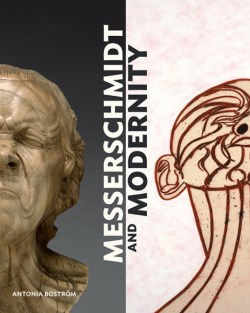 An astonishing group of sixty-nine “Character Heads” by German sculptor Franz Xaver Messerschmidt (1736–1783) has fascinated viewers, artists, and collectors for more than two centuries. The heads, carved in alabaster or cast in lead or tin alloy, were conceived outside the norm of conventional portrait sculpture and explore the furthest limits of human expression. Since their first exposure to the public in 1793, artists, including Egon Schiele (1890–1918), Francis Bacon (1909–1992), Arnulf Rainer (born 1929), and, more recently, Tony Cragg (born 1949) and Tony Bevan (born 1951), have responded to their over- whelming visual power.
Lavishly illustrated, Messerschmidt and Modernity presents remarkable works created by and inspired by Messerschmidt, an artist both of and ahead of his time. The Character Heads situate the artist’s work squarely within the eighteenth-century European Enlightenment, with its focus on expression and emotion. Yet their uncompromising style stands in sharp contrast to the florid Baroque style of Messerschmidt’s earlier sculptures for the court of Empress Maria Theresa of Austria. With their strict frontality and narrow silhouettes, the Character Heads appear to contemporary eyes as having been conceived in a “modern” aesthetic. Their position at the apparent limits of rational art have made them compelling to successive generations of artists working in a variety of media. An exhibition of the same name will be on view at the Getty Center from July 24 through October 14, 2012.
Antonia Boström is senior curator of sculpture and decorative arts at the J. Paul Getty Museum and the editor of The Fran and Ray Stark Collection of 20th-Century Sculpture in the J. Paul Getty Museum (Getty, 2008).
Happy Bastille Day
Commentary from The Onion:
“I Think I’d Make A Pretty Good HBO Show,” The Onion (19 June 2012)
By 18th-Century France
 I don’t think I’m talking out of turn here when I say that, as far as historical eras are concerned, I am probably one of the richest and most exciting periods in Western history. That’s not me bragging; it’s just a generally accepted truth at this point. After all, not every century of a nation’s past can boast successive international wars, a radical intellectual movement, and a bloody revolution, but I’ve got all of that and then some. In fact, one would be pretty hard-pressed to find a period more compelling and ripe for gripping drama than myself.
Which is why, when you think about it, it’s pretty crazy there hasn’t been an HBO original series about me about by now. Something like 40,000 people were beheaded during me, for God’s sake. Put that into a made-for-TV drama that weaves a rich tapestry of historical narrative with gritty tales of intrigue, murder, and sex, and I’m pretty much an untapped gold mine of programming, right?
I know, I know, everyone and their mother thinks they have a great idea for a cable television show, but stick with me on this one. Between sprawling aristocratic estates juxtaposed with sordid underworlds and political upheaval driven by ambitious but flawed political figures, I can deliver the full HBO package. You want elegant costumes? Check. Candelabras? Check. Beautiful women with moles? Check and check. I’m packed full of cool stuff. You could slot me in on, say, Sunday nights at nine and probably get a 2.5 Nielsen rating, easy. . .
The full article is available here»
Exhibition | Canaletto and Guardi
From the Musée Jacquemart-André:
Canaletto – Guardi: The Two Masters of Venice
Musée Jacquemart-André, Paris, 14 September 2012 — 14 January 2013
Curated by Bożena Anna Kowalczyk

Canaletto, San Geremia and the Entrance to Cannaregio, ca. 1726-27
London, The Royal Collection, © HM Queen Elizabeth II 2012
◊ ◊ ◊ ◊ ◊
In the 18th century, Venice and its timeless charm became the subject of choice for painters known as the Vedutisti. Their views of Venice quickly spread across Europe, making the Veduta the most collected and one of the most loved genres among the public to this day. Thanks to some generous loans, the Jacquemart-André Museum is now devoting an exhibition to the Veduta for the first time in France, a genre of painting epitomised by Canaletto and Guardi. It is a very under-represented artistic genre in French public and private collections, which makes this exhibition at the Jacquemart-André Museum, Canaletto – Guardi: The Two Masters of Venice, a must-see event, from 14 September 2012 to 14 January 2013. Curated by Bożena Anna Kowalczyk, the focus is on spreading an artistic movement born at the dawn of the 18th century, which was mainly collected by wealthy Italian, British and German collectors.
The exhibition gives pride of place to Canaletto, the cornerstone of the genre, showcasing more than twenty-five of the master’s essential works from the most prestigious museums and collections, while identifying the artist’s place at the heart of the great Veduta artistic movement. His works resonate with those of Gaspar van Wittel, Luca Carlevarijs, Michele Marieschi, Bernardo Bellotto and Francesco Guardi, who was the last master to succeed in immortalising the charm and elegance of the Venetian 18th century. That is why the Jacquemart-André Museum will display about twenty of his works. The exhibition also lays the stress on capricci: striking scenes of an imaginary Venice, painted by Canaletto, Guardi and Bellotto. Some of these canvases have never been displayed in a temporary exhibition before.
Caneletto
The undisputed master of the Veduta, Giovanni Antonio Canal, known as Canaletto (Venice 1697-1768) made his mark on his century by immortalising the various faces of the Venice of his time in his canvases, including streets and piazzas, canals and views over the lagoon, daily life and festival days. Canaletto was a theatre painter in his youth, and succeeded in bringing together an expert sense of composition, a perfectly mastered technique of perspective, and attractive lighting effects.
Guardi
The exhibition takes place on the three-hundredth birthday of Francesco Guardi (1712-1793), and unites more than twenty of his works, rarely exhibited in France. It highlights his links with his older master Canaletto, both considered the most accomplished Vedutisti. For the first time, the Canaletto drawings that the young Guardi admired in Venice are now displayed opposite the Guardi canvases that they inspired. Their works exude a different awareness of perspective and atmospheric effects. While Canaletto’s approach is more rational, Guardi’s paintings also highlight his imagination and awareness, as well as the unique character that he carefully crafted for each scene. Guardi’s works are typified by warm colours and vibrant light, exalting the beauty of Serenissima and unveiling the charm of a fragile and declining Venice.
The Vedutisti
Whether they preceded or followed Canaletto, each of the great Vedutisti displayed at the exhibition brings an individual richness in vision and technique. Gaspar van Wittel (1652/3 – 1736) set the trend for views of Venice by carefully depicting spectacular settings on each canvas, where the buildings contrast with the transparency, movement and reflections of the water. In his wake, Luca Carlevarijs (1663-1730) portrayed a festive Venice, to the rhythm of foreign ambassadors’ grandiose welcomes as they arrived at the Doge’s Palace. Michele Marieschi (1710-1743), from almost the same generation as Canaletto, was his skilled rival. His preference for unexpected viewing angles sets him apart. Following Canaletto’s considerable success, his nephew, Bernardo Bellotto (1722-1780), trained at the master’s school, casting Venetian landscapes in a colder and silvery light, and often utilising innovative compositions. Belletto led to the spread of the Venitian veduta in Europe and became a major protagonist of this genre during the second half of the 18th century.
The Capricci
Although the Vedutisti sought to depict 18th-century Venice in every detail, it is little-known that they also devoted a considerable portion of their works to inventing an imaginary, fantasy Venice, through the capriccio genre. Concern with reality is abandoned in favour of dreaming up reimagined, rustic or unsettling scenes. These spectacular views, created by Canaletto, Guardi or Bellotto, will be examined in detail in the exhibition.
Exceptional Loans
In order to reunite more than fifty key works, more than twenty of which have never been displayed outside their museums of origin, the Jacquemart-André Museum has received support from the largest European and American museums, who helped to make the exhibition a reality through their exceptional loans. These include the London National Gallery, the British Royal Collection, the Thyssen-Bornemisza Museum in Madrid, the Louvre Museum in Paris, the New York Frick Collection, the Parma National Gallery, the Budapest Museum of Fine Arts, and more.
The Royal Collection
The British Crown possesses the largest collection of Canaletto paintings and drawings. Almost all of them were commissioned to Canaletto by Joseph Smith, the British consul at Venice from 1744, who then sold his collection to George III, King of England. Dr. Bozena Anna Kowalczyk, general curator of the exhibition at the Jacquemart-André Museum, studied this prestigious Canaletto collection in great detail and was granted a loan of eight of Canaletto’s exceptional works, which will be displayed for the first time in Paris. Some of these have never been shown in public outside Windsor Castle or the Queen’s Gallery in Buckingham Palace.
Exhibition Curators
Dr. Bożena Anna Kowalczyk is a renowned authority in paintings of views, and she has been at the centre of studies conducted over the last few years. She decided to focus on Canaletto and Bellotto at the University Ca’ Foscari of Venice, while writing her doctoral thesis on “Il Bellotto italiano” (1993-1996). Her work has fundamentally altered critical analysis of the two artists’ works, and she was the source of many discoveries regarding Canaletto’s works, making her an acclaimed specialist among researchers of the period. She knows also very well Michele Marieschi’s and Francesco Guardi’s work and is the main Bernardo Bellotto specialist (1722-1780), whose general catalogue she is preparing.
Exhibitions previously curated or co-curated by Dr. Bożena Anna Kowalczyk:
– Bernardo Bellotto 1722-1780, Venice, Museo Correr, 2001
– Canaletto prima maniera, Venice, Fondazione Giorgio Cini, 2001
– Canaletto: il trionfo della veduta, Rome, Palazzo Giustiniani, 2005
– Canaletto e Bellotto: l’arte della veduta, Turin, Palazzo Bricherasio, 2008
Associate curator of the exhibition: Mr. Nicolas Sainte Fare Garnot, Jacquemart-André Museum curator
◊ ◊ ◊ ◊ ◊
Note (added 29 August 2012) — See Robert O’Byrne’s piece (24 August 2012) on the exhibition for Apollo Magazine.
YCBA — Postdoctoral Research Associateships
Applications due 6 August 2012
The Yale Center for British Art is offering two Postdoctoral Research Associateships of three-year duration, one in the Department of Paintings and Sculpture and the other in the Department of Exhibitions and Publications. These Postdoctoral Research Associateships are for recent recipients of a PhD (degree granted within the last three years) in a field related to British art. The PhD must be in hand by the time the position begins. The closing date for applications is Monday, August 6, 2012. A preference for either position may be stated in the application but is not required. Applicants should apply online and upload a cover letter, CV, and writing sample. Three letters of reference should be e-mailed directly to ycba.research@yale.edu. For further information, visit http://britishart.yale.edu/about-us/opportunities.
Call for Papers | Diderot: Le Génie des Lumières
As noted at L’ApAhAu (my apologies for the short notice) . . .
Diderot – Le Génie des Lumières: Nature, Normes, Transgressions
Halle, 27-29 June 2013
Proposal due by 15 July 2012
Colloque international à l’occasion du 300e anniversaire de Denis Diderot
Comité d’organisation: Konstanze Baron, Robert Fajen, Heinz Thoma
A l’élaboration de la notion de génie moderne, Diderot a sans doute apporté une contribution décisive: d’un côté, il semble reconnaître la pluralité et la valeur relative des « génies » dont il cherche à déterminer l’origine physiologique et l’application pratique; d’un autre côté – et la plupart du temps – le génie, chez lui, fait figure d’exception: c’est un « ressort de la nature » qui permet aux individus d’exception de créer des oeuvres hors norme. En soulignant soit la sensibilité, soit le sang-froid de l’esprit observateur, Diderot insiste sur le don de la nature qui met le génie en état de transcender les conventions humaines en créant ses propres lois. En liant le génie à l’enthousiasme et aux « grandes passions », il en fait une force tout à fait ambiguë, non exempte de qualités diaboliques: l’homme (ou bien la femme) de génie est capable d’exceller dans le bien aussi bien que dans le mal.
Ainsi, la réflexion de Diderot sur le génie ne se limite pas au seul domaine esthétique. Elle fait, tout au contraire, partie intégrante de l’oeuvre philosophique et littéraire de Diderot dans la mesure où celle-ci se préoccupe du rapport entre l’art et la nature, l’individu et la norme, la règle et sa transgression. En tant que telle, la notion de génie participe aux ambivalences et aux tournures dialectiques qui donnent à la pensée de Diderot son caractère distinct. Ce qui intéresse, par exemple, Diderot moraliste, c’est le rapport du génie aux règles et aux conventions de la société. Dans Le Neveu de Rameau, Diderot entame une réflexion sur le génie où l’art et la morale, la dimension éthique et artistique de la vie des « grands hommes » entrent en opposition fondamentale. L’ambiguïté morale du génie ne cesse d’ailleurs de hanter Diderot qui se dit fasciné par la « méchanceté sublime ». Dans la philosophie de la nature, par contre, il met l’accent sur les conditions subjectives de l’investigation scientifique et expérimentale. Dans les Pensées sur l’Interprétation de la Nature, la nature (soi-disant objective) trouve son complément théorique dans l’expérience subjective du philosophe. En même temps, Diderot admet l’importance des dispositions objectives (talent, intuition, esprit de divination etc.) du philosophe. Dans Jacques le Fataliste et son maître, cette même dialectique entre la nature et son interprétation est portée à son comble lorsque l’ingéniosité du narrateur (voire des narrateurs) se trouve en compétition directe avec celle – non moins romanesque – de la nature-même.
En mettant en relief la notion de « génie », la conférence se propose d’explorer une notion-clé de l’oeuvre de Diderot qui permettra en même temps de cerner des tendances générales, voire typiques de la pensée de Diderot ainsi que des Lumières. Il s’agira donc de caractériser la pensée de Diderot : quel est le rapport entre la disposition naturelle, l’héritage physiologique et même génétique d’un côté et la liberté créatrice de l’autre? Comment Diderot conçoit-il le rapport entre l’art et la nature, les facultés innées et la possibilité du changement, voire de l’innovation? Le génie confirme-t-il ou met-il en question le déterminisme matérialiste ? Quel est le rapport entre l’originalité et la norme dans la pensée de Diderot ? de situer cette pensée dans son contexte tant bien historique que contemporain: Quelle est l’influence de la pensée antique et classique dans la pensée de Diderot ? Quel rôle a joué pour Diderot la conception anglaise (Shaftesbury) ou espagnole (Gracián) du génie / de l’ingenium ? Quelle est la réception de la pensée de Diderot en Allemagne, p.ex. auprès des auteurs du Sturm und Drang ? Dans le contexte français et européen, la pensée de Diderot incarne-t-elle la norme ou plutôt l’exception ? Qu’en est-il, en d’autres termes, de la représentativité de Diderot ? Tout ceci s’effectuera en vue d’un troisième objectif, à savoir de tenter une réflexion nouvelle sur la notion des Lumières : la philosophie des Lumières est-elle dominée par la norme, ou admet-elle l’exception ? Quel est le rôle de l’originalité dans la pensée des Lumières? En quoi les théories (esthétiques) du dix-huitième siècle sont-elles vraiment créatrices, en quoi ne font-elles que prolonger des débats plus anciens?Sujets d’investigation possibles:
• Caractère(s) de Diderot : le grand homme, l’homme sans caractère, etc.
• La théorie esthétique des Lumières: entre « imitation » et « inspiration »
• Enthousiasme, énergie, intuition: au-delà du déterminisme mécaniste
• L’exception et la norme : le statut de l’individu / du bizarre / de l’original
• L’art et la nature de l’invention (technique)
• Figures mythiques, interprétations modernes de l’ingenium / du démon
• Morale et esthétique : l’ingénieux n’est pas l’ingénu…
Veuillez envoyer votre proposition de communication (min. 300 mots) jusqu’au 15 juillet 2012 à l’adresse suivante : konstanze.baron@izea.uni-halle.de
Exhibition | Jean-Jacques Rousseau et les Arts
Thanks to Pierre-Henri Biger for noting this exhibition now on at the Panthéon:
Jean-Jacques Rousseau et les Arts
Panthéon, Paris, 29 June — 30 September 2012
 À l’occasion du tricentenaire de la naissance de Jean-Jacques Rousseau (1712-1778), plus de 150 oeuvres et objets consacrés au philosophe et à son image sont réunis au Panthéon, monument où il repose parmi les Grands Hommes. À découvrir une exposition en deux parties, présentant Rousseau et son oeuvre, (l’Antique, le livre, la musique, la nature) et Rousseau et son image (portraits, allégories, monuments, panthéonisation), et concluant avec une évocation du couple Rousseau-Voltaire.
Cette manifestation bénéficie de prêts prestigieux consentis par la Bibliothèque nationale de France, la Bibliothèque publique universitaire de Neuchâtel, la British Library de Londres, les musées du Louvre et Carnavalet, de nombreuses autres institutions publiques en France et à l’étranger et de collections privées.
Commissaire : Guilhem Scherf, conservateur en chef au département des Sculptures du Musée du Louvre
Scénographe : Jérôme Habersetzer
Catalogue for a New Museum | Simone Handbag Museum
This new book from Yale UP is published in conjunction with the new Simone Handbag Museum in Seoul, opening 16 July 2012 (the catalogue is scheduled to appear in September). Yuri Chong writes about the museum for The New York Times Magazine (12 June 2012).
◊ ◊ ◊ ◊ ◊
Judith Clark, ed., Handbags: The Making of a Museum (New Haven: Yale University Press, 2012), 272 pages, ISBN: 9780300186185, $50.
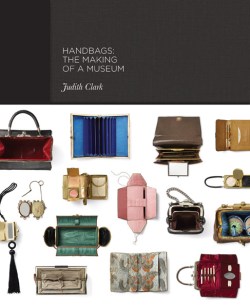 The history of the handbag—its design, how it has been made, used, and worn—reveals something essential about women’s lives over the past 500 years. Perhaps the most universal item of fashionable adornment, it can also be elusive, an object of desire, secrecy, and even fear. Handbags explores these rich histories and multiple meanings.
This book features specially commissioned photographs of an extraordinary, newly formed collection of fashionable handbags that date from the 16th century to the present day. It has been acquired for exhibition in the first museum devoted to the handbag, in Seoul, South Korea. The project is a commission undertaken by experimental exhibition-maker Judith Clark, whose innovative practices are revealed in Handbags.
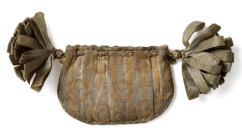
Sweetmeat purse, French, ca. 1670–80. Silk and metal brocade, braid and ribbon.
Essays by leading fashion historians and an acclaimed psychoanalyst investigate the history of gesture, the psychoanalysis of bags, and the museum’s state-of-the-art mannequins and archive cabinets. In order to preserve the words that describe the unique qualities of each bag, a terminology of handbags has been compiled.
Judith Clark is professor of fashion and museology at London College of Fashion. Caroline Evans is professor of fashion history and theory at Central St. Martin’s College of Art & Design. Amy de la Haye is professor of dress history and curatorship, Rootstein Hopkins Chair, at London College of Fashion. Adam Phillips is a psychoanalyst and writer. Claire Wilcox is senior fashion curator at the Victoria and Albert Museum.
Exhibition | Catherine the Great: An Enlightened Empress
Following a £46 million redevelopment, completed last summer, the National Museum of Scotland presents over 600 objects from the Court of Catherine the Great.
◊ ◊ ◊ ◊ ◊
From the museum:
Catherine the Great: An Enlightened Empress
National Museum of Scotland, Edinburgh, 13 July — 21 October 2012

Vigilius Eriksen, Portrait of Catherine II on Her Horse Brilliant, after 1762
Learn the story of the woman behind the legends and discover the greatest collection of treasures from Russia ever seen in the UK
Sharp, funny, generous, iron-willed and passionate, Catherine the Great was one of Russia’s most successful rulers and one of the greatest art collectors of all time. Presented in partnership with the State Hermitage Museum in St Petersburg, this unique exhibition is showing only in Edinburgh. Explore Catherine’s reign through her collections, which vividly reflect her own interests and provide a fascinating glimpse of the wealth and magnificence of the Imperial Russian court. Learn of a woman who won wars and built palaces, wrote plays and books, built a rollercoaster for her own entertainment and who put Russia firmly on the cultural map of Europe.
The exhibition features more than 600 priceless works collected by the Empress. See spectacular paintings, outstanding costumes and uniforms, dazzling cameos, snuffboxes and jewellery, hunting weapons and exquisite works of art seldom seen outside Russia.
◊ ◊ ◊ ◊ ◊
Writing for the The Sunday Times Magazine (1 July 2012), pp. 52-56, Amy Turner reports that the exhibition will place “special emphasis on the Russian-Scottish connection.” Along with many of the empress’s Scottish soldiers and sailor officers, there was the architect, Charles Cameron, and other Scottish characters including art dealers and physicians. As for the equestrian portrait by Eriksen, Turner writes,
The painting was recently discovered in the bowels of the Hermitage, wrapped and filthy, where it was hurriedly stashed for safekeeping at the outbreak of the Russian Revolution in 1917. It has been specially cleaned and restored in preparation for its trip to Scotland. Several copies of the painting exist around the world (one was on display at the Royal Academy’s Citizens and Kings exhibition in London in 2007), but this is the only version attributed solely to Eriksen (55).
◊ ◊ ◊ ◊ ◊
Note (added 12 July 2012) — The catalogue, edited by Godfrey Evans, is available through ACC Distribution.










 Enfilade
leave a comment